


A child who rushes through the page in five minutes and then starts staring out of the window can look confident. A child who freezes over the same task can look shut down. In both cases, the message is often the same, the work is not meeting them where they are.
That is where stretch and challenge begins. It is the practice of helping a learner move one step further than they could manage alone, without tipping them into panic or boredom. For families, that balance matters because children do not only need tasks that are hard enough, they need tasks that feel possible.
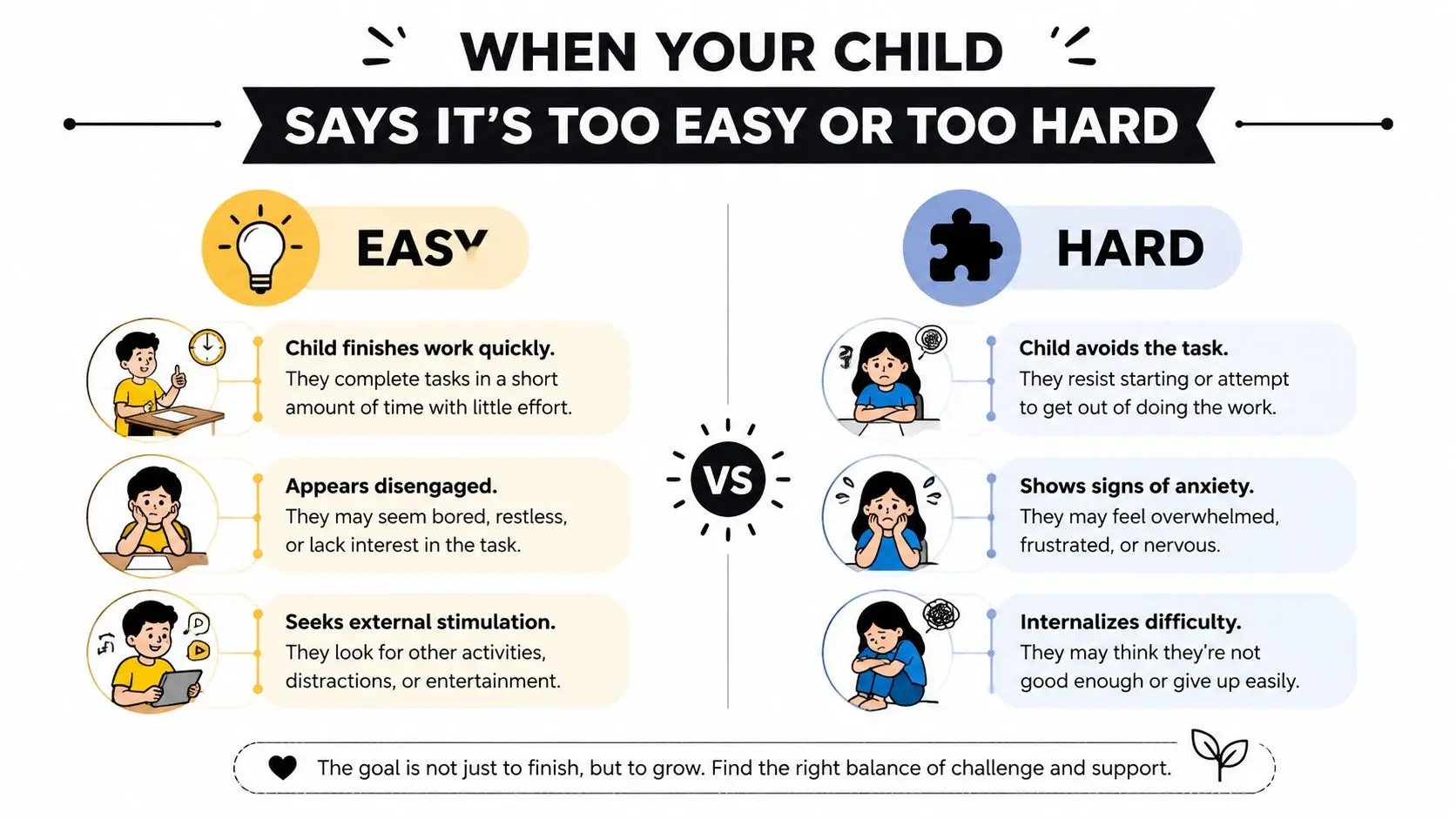
| Two Everyday Moments, One Principle | ||
|---|---|---|
| Signal from your child | What it often means | First family response |
| Finishes quickly and looks bored | The task may be too familiar | Ask them to explain their method, then add a deeper question |
| Avoids the page or gives up fast | The task may feel too far out of reach | Reassure first, then break the work into a smaller step |
| Wants constant help | They may need clearer scaffolding | Prompt them to try one small part independently before stepping in |
| Keeps asking, “Is this right?” | Confidence may be wobbling | Praise the thinking process, not just the answer |
Why this matters for a child's week
Parents often worry that “easy” means clever and “hard” means struggling. In reality, both can mean the work is poorly matched. A child who is under-challenged can become restless, while a child who is over-faced can become anxious. The sweet spot is productive effort, where the child feels stretched but not stranded.
Practical rule: if a child can finish every task without thinking, the lesson may need more depth. If they cannot begin without adult rescue, it may need better support.
The British curriculum has long moved towards this idea of deeper thinking, reasoning and independence, rather than simple repetition, and that shift matters because it makes challenge part of ordinary schooling, not a special add-on for a few children Academy21 on the UK curriculum history of stretch and challenge. That is the heart of it, a child should feel that school is helping them grow, not just keep up.
What Stretch and Challenge Actually Means
Stretch and challenge means setting work that is just beyond what a child can do unaided, then supporting them until they can do more on their own. Training wheels provide a useful analogy. The bike still has to move forward under the child's own effort, but the temporary support stops them wobbling off course.
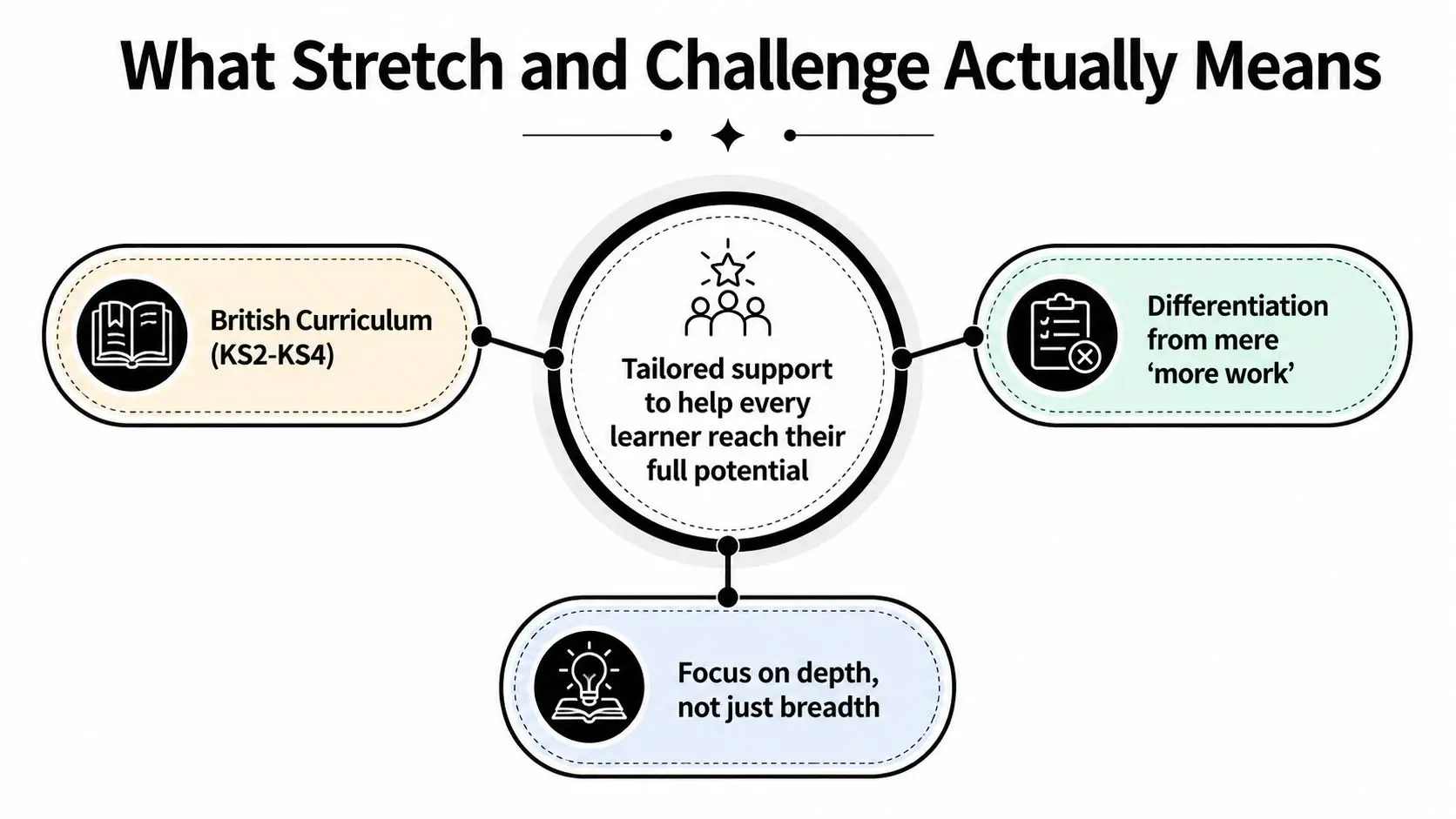
The important distinction is that stretch and challenge is not the same as more work. A child does not need ten extra questions if the first five are already shallow. They need questions, texts, or tasks that ask for more thinking, such as explanation, comparison, transfer, or judgement. That is why British curriculum thinking has increasingly emphasised depth, reasoning and progression across key stages, not just covering content.
A simple way to explain it at home
The Department for Education says every child should be stretched and challenged within and beyond the curriculum, whatever their starting point, and that this includes both pupils furthest behind and those capable of more Every child achieving and thriving. That language matters because it places stretch at the centre of good teaching, not at the edge of it.
A good stretch task often feels like this, “I can almost do this, but I need a clue, a model, or a first attempt.” That is the point. The child is not being asked to leap blind, they are being asked to climb with support that can later be removed. In scaffolded teaching, the support is temporary and adjustable, which lets the challenge rise without overwhelming the learner Structural Learning on scaffolding and stretch.
For parents, the test is simple. If your child is always busy but rarely thoughtful, the work may be too easy. If they are always dependent on help, the work may be too hard. Stretch and challenge sits between those two places, where the thinking grows and confidence grows with it.
The Three Levers Teachers Use Every Lesson
A child notices stretch and challenge most clearly in the rhythm of a week, not in one special activity. One lesson feels ordinary on the surface, yet the teacher keeps asking for sharper thinking, firmer reasoning, and better language. That steady pressure, done kindly, is what makes challenge part of normal school life rather than an occasional extra.
The strongest practice does not depend on a single worksheet or a “top table”. It shows up in three classroom levers that shape the whole lesson: mindsets and beliefs, routine practice, and occasional events. The Chartered College describes these as the operational levers teachers use to build challenge into day-to-day teaching Chartered College guidance on stretch and challenge. Queen's Online School sets out a similar view of flexible learning routes in its explanation of adaptive learning, which helps parents see how one lesson can still feel personal.
Mindsets and beliefs
This is the culture of the room. A teacher who expects children to think hard speaks differently, responds differently, and holds a different line on quality. You hear it in prompts such as, “Tell me why you think that,” or, “Can you improve that answer with evidence?” The message is simple, the teacher believes the child can do more than a first, safe response.
For a child, that belief is often felt before it is named. They start to understand that a rough answer is a starting point, not the end of the conversation. That matters for confidence, because many children, especially those who worry about getting things wrong, need to see that improvement is part of learning, not a sign that they have failed.
Routine practice
This is the daily work, the small habits that stop challenge becoming an occasional treat. A teacher asks a deeper follow-up question, presses for a more precise written sentence, or invites a child to revise an answer after feedback. The child learns that school is not about giving the first answer that comes to mind, it is about refining thought.
These small moves are often the ones parents can recognise most easily. A child comes home and explains a method in fuller detail, or says their teacher asked them to justify an opinion rather than just give it. That is a sign of routine stretch. It is the repeated practice that builds stamina, a bit like adding one more stair each time rather than trying to climb the whole staircase at once.
Occasional events
These are the bigger moments, debates, presentations, problem-solving tasks, or a stretch day. They matter because they give children a chance to use knowledge in a fuller way. A child who has been practising reasoned responses all term suddenly gets to defend an idea, explain a process, or compare two interpretations in public.
A live online lesson can do this well too. A teacher can ask a child to unmute and defend a view, or use chat to gather quick ideas before one pupil is asked to build on another's answer. In mixed-attainment settings, the same event can stretch different children in different ways, because one may be working on clarity while another is being pushed towards deeper evaluation. For children who need extra emotional support, including those in SEN and SEMH provision, the teacher can lower the pressure without lowering the thinking, so the task stays demanding but feels safe enough to attempt. If a child gets caught in anxious loops before speaking, parents may also find how to stop overthinking useful as a companion idea.
A classroom that only ever gives harder sheets has missed the point. Real stretch changes the depth of the question, the precision of the response, and the independence expected from the child.
Used well, these levers help a child feel that challenge is normal. They also help parents recognise the difference between genuine stretch and the old habit of giving “extension work” to keep fast finishers occupied. Occupied is not the same as challenged.
How Adaptive Teaching Turns One Lesson into Many Routes
Adaptive teaching is the practical skill that makes stretch and challenge real. It means one lesson objective can have several routes, so the teacher keeps the same core aim while adjusting the support and the depth. For a child, that feels fair, because everyone is working towards something meaningful, even if they reach it differently.
Queen's Online School has a useful overview of this kind of lesson design in its explanation of adaptive learning, and the same principle appears in strong live classrooms, online or in person.
A Year 6 maths lesson
A class might all be working on the same maths objective. One child uses manipulatives and guided practice to secure the method. Another tackles a reasoning problem that asks them to apply the same skill in a new context. Both are learning, but not in the same way. The first route supports accuracy, the second extends thinking.
A secondary English lesson
A GCSE English class can work from the same text and still have different routes through it. One pupil might evaluate a model answer as an examiner, another might explain a quotation to a peer, and another might complete a wider-reading project linked to the text. The class is not split into “bright” and “weak”, it is differentiated by route, not worth.
In live online lessons, this can be done well when teachers use chat, breakout discussion, and targeted questioning. A pupil who is hesitant to speak aloud may start in chat, then move into a smaller room, then share a fuller response with the class. That can be a powerful way to reduce pressure for anxious learners while still keeping the thinking high.
If your child tends to overthink, a resource such as how to stop overthinking can help parents recognise when worry is blocking performance rather than lack of ability. The goal is not to eliminate challenge. It is to stop fear from disguising itself as inability.
Stretching Every Kind of Learner, Including SEN and SEMH
A classroom that stretches well does not reserve rich thinking for the children who finish first. It makes room for the pupil who needs reassurance, the child who needs a different way in, and the learner whose strengths do not show neatly in one fixed format.
That matters for parents because stretch and challenge should be visible in a child's week, not just in the school brochure. You may see it in the questions your child brings home, the way they talk through a problem, or the confidence they show after being given a task that is just beyond their first attempt. It can look different for each child, but the purpose is the same. The work should ask for thinking, not just busy hands.
The idea fits well with scaffolding. A child can complete a task that sits just beyond independent reach if the support is pitched carefully, then that support is reduced as confidence and mastery grow Structural Learning on scaffolding and stretch. That keeps expectations high. It gives the child a safer route to get there.
Three children, three different versions of stretch
A high-attaining pupil may need depth rather than faster content. They might compare interpretations, justify an answer more carefully, or hold two ideas in mind and explain the tension between them. A child with ADHD may need stretch that includes movement, quick verbal rehearsal, or a practical output, because attention often improves when the task has a clear shape. A child with SEMH needs may need emotional safety first, because a learner who feels under threat is less likely to take the academic risk that stretch asks for.
That is why strong teaching does not just make a task harder. It looks for the next better piece of thinking. Sometimes that means a model answer to study. Sometimes it means a talking partner, a sentence stem, a checklist, or a chance to show understanding in a visual or spoken form. For parents and carers, the useful question is, “What helps my child move from support to independence?” If a school can answer that clearly, it is usually a sign that stretch is being used thoughtfully, not casually.
For families exploring gifted identification alongside support needs, Uptown Psychology gifted testing is a reminder that ability and need do not always sit neatly together. A child can be bright and still need a different route through learning. That is one reason inclusive classrooms matter so much.
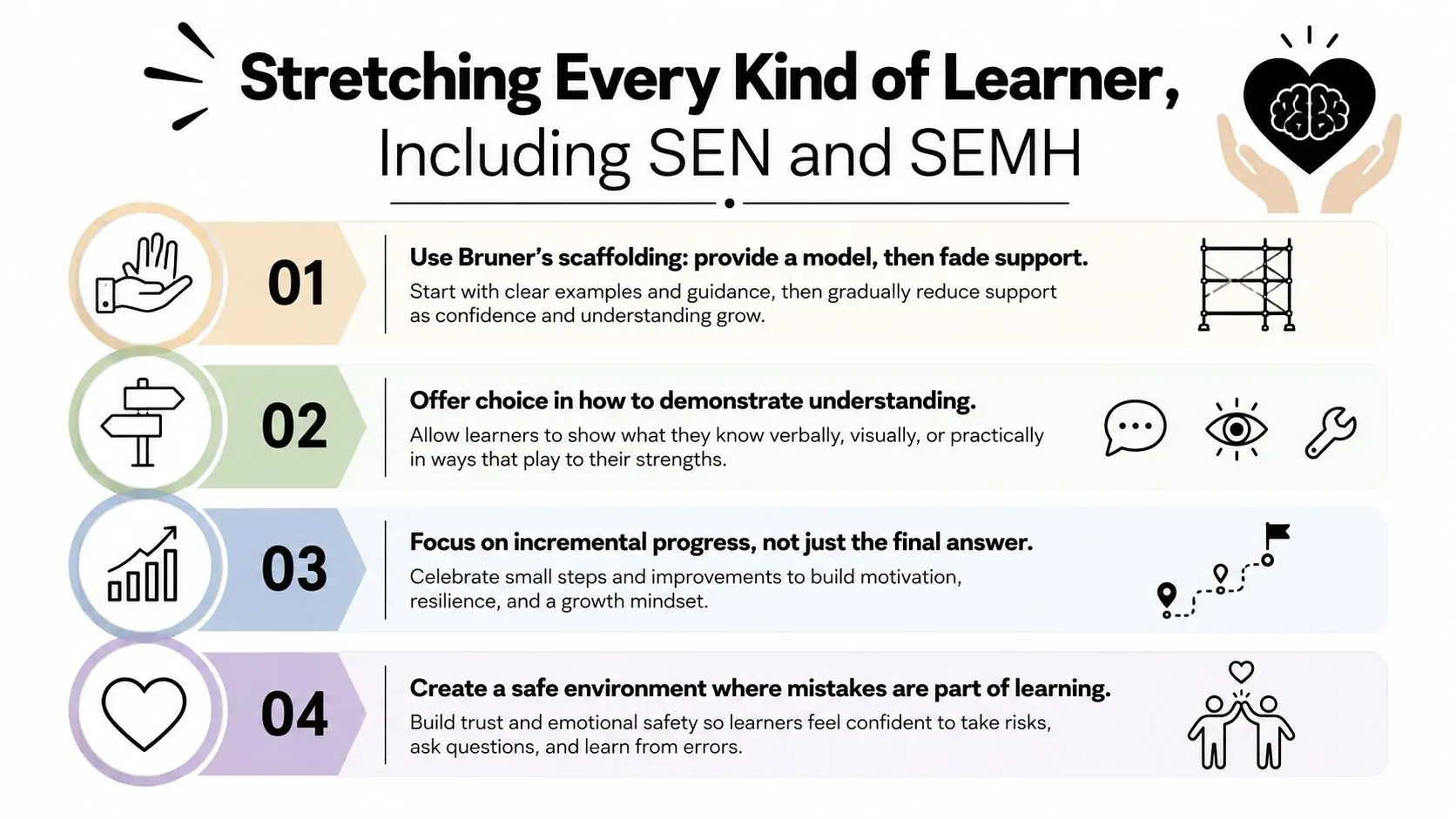
Mistakes should feel usable, not humiliating. When a child trusts the room, they are much more likely to try the hard thing.
For a wider inclusion lens, Queen's Online School's overview of universal design for learning shows how flexible teaching can keep expectations high while removing barriers. The same principle helps in SEN and SEMH support. The aim is not to ask less of the child, it is to remove the barriers that stop them showing what they know.
How Queen's Online School Puts It Into Practice
Stretch and challenge only works when adults know the child well enough to spot the next step. That is one reason live online schooling can work so well for families who want pace, structure and flexibility in the same package. Queen's Online School, part of the Cambridge Online Education Group, uses small live classes, subject-specialist teachers, real-time feedback, and recorded sessions so learners can revisit a difficult moment without shame.
Those design choices matter because they map closely to the principles above. Small groups make it easier for teachers to notice who needs a prompt, who needs a pause, and who is ready for a deeper question. Subject specialists are more likely to recognise when a response is technically correct but intellectually thin. Real-time feedback lets a child adjust their thinking while the topic is still alive, not two days later when the moment has gone.
The recorded session adds something many families value but rarely name, it gives children a safe way to review challenge without the pressure of performing in real time. A pupil who missed the explanation first time can replay it. A pupil who grasped it quickly can revisit the reasoning and stretch further. That is especially helpful in mixed-attainment settings, where one lesson has to meet several starting points at once.
Queen's Online School is also a Pearson Approved Examination Centre, which gives older learners a clearer route into GCSE and A-Level qualifications. For parents of SEN and SEMH learners, the important detail is not the badge itself, but the implication, a school can combine rigour with an inclusive pace and a calmer learning environment.
In a strong stretch culture, the question is never, “Who can cope?” It is, “What does this child need so they can keep thinking?”
Five Things Parents and Carers Can Do at Home
A family home does not need to become a classroom. It just needs a few habits that nudge children towards deeper thinking.
Ask, “How do you know?” This turns a quick answer into reasoning, which mirrors what good teachers do in class.
Praise the strategy, not just the mark. When you notice effort, method, or persistence, your child learns that thinking well matters more than guessing quickly.
Add one stretch question after homework. Try, “Can you find another way?” or, “What would happen if the numbers changed?” so the child practises transfer.
Build a 15-minute reading routine with one discussion question. A short daily read plus a question like, “Why did that character act that way?” strengthens talk, inference, and attention.
Use the explain-it-to-me test. If your child can teach the idea back to you in plain language, they probably understand it well enough to extend it.
These small moves work because they echo the levers teachers use. They don't flood the child with extra tasks, they raise the quality of thought.
How to Tell Whether Stretch and Challenge Is Working
The clearest signs are often easy to miss at first. A child volunteers an answer without being chased. They ask a why question on their own. They choose a harder problem when no one has told them to. These are signs of a mind beginning to meet challenge with curiosity rather than step away from it.
You may also hear a change in the words they use about school. Instead of “It was fine”, your child says, “We compared two ideas,” or, “I changed my answer after the feedback.” That matters because it shows they are noticing learning as a process, not just finishing the task in front of them.
A disappointing mark can still happen. What changes is the recovery. A child who is being stretched well usually comes back faster, because they have learned that difficulty is part of learning, not proof that they cannot do it. Parents can also look at performance analytics as one useful window on progress, alongside the child's confidence and classroom habits, rather than as the whole story.
The most honest sign is usually the pattern over time. Stretch and challenge often shows itself first in confidence, language and behaviour, then later in test results or report comments. That is why parents should watch for curiosity, resilience and independence, as well as marks. A child who starts to ask better questions, explain thinking more clearly, and keep going after feedback is usually showing that stretch and challenge is taking root in daily learning.
Queen's Online School offers live British curriculum teaching, specialist support, and recorded lessons that help children revisit hard ideas at their own pace. If you want an online school where stretch and challenge is built into everyday learning, visit Queens Online School and see how it could support your child's next step.