


On the morning of national offer day, many parents are doing the same thing at the same time, refreshing an inbox, checking a portal, and trying not to read too much into every silence. If your child is waiting for a school place, that wait can feel huge, because this isn't just about a letter or an email, it's about the next chapter of their daily life, their friendships, their confidence, and the routines that will shape their year.

A calm first step is to keep your child's needs at the centre, even if your own nerves are racing. That means looking beyond the headline of “got in” or “didn't get in” and asking what the offer means for travel, support, settling in, and wellbeing. If you're also trying to understand early years transitions, understanding the EYFS framework can help you think about how children adapt to change in practical, child-focused ways.
Introduction to National Offer Day
For many families, national offer day arrives with a strange mix of hope and dread. One parent may be convinced their child will get the first-choice school because it's close by, while another is bracing for disappointment because the local catchment is oversubscribed and the school has a long waiting list.
That emotional swing is real, but the day is also highly practical. It tells you where your child has been allocated, when you need to respond, and whether you need to start thinking about waiting lists or an appeal. The result matters because it affects where your child will learn, who they'll travel with, and how smoothly the move into a new school year will feel.
The most useful way to approach it is to treat the offer as the start of a process, not the end of one. A place can be accepted, challenged, or improved through later movement if the local authority's system allows it, but only if you act on time and understand what the letter or email is saying.
Practical rule: the offer is about your child's future routine as much as it is about the school name. Read it with travel, support, friendships, and confidence in mind.
Understanding National Offer Day
In England, National Offer Day for secondary school places in 2026 fell on 2 March, and 87.8% of applicants received an offer for their first preference while 97.5% received a preferred offer overall, meaning one of the schools they had ranked highly Department for Education statistics. That detail matters because it shows how the system usually resolves a child's preferences, even before any later waiting-list movement.
Why the day is national, not just local
The phrase National Offer Day can sound like a single announcement from one school, but it isn't that simple. It's a coordinated admissions milestone used across England, where local authorities make decisions from the application lists they've already received, rather than schools making isolated offers one by one. That's why families across the country wake up to a similar moment, even though the exact offer each child receives depends on local criteria and available places.
The significance goes beyond administration. A school offer can affect your child's journey to school, their peer group, and the pace at which they settle. For some children, the result confirms a familiar path with friends or siblings. For others, it may mean a new environment that needs careful preparation, especially if they thrive on routine or need extra support.
What the statistics tell parents
The national figures also help set expectations. The system is competitive, but it isn't usually a total lottery. Families often secure a school they ranked near the top of their list, which is reassuring even when the first choice doesn't come through.
Older official reporting shows the same broad pattern. A Department for Education report for 3 March 2008 said that nearly 570,000 families received their secondary-school decision, with 82% getting their first preference, 94% one of their top three choices, and 95.6% an offer at a preferred school historic DfE report. That long view matters because it shows the process has stayed broadly stable over time, even as the number of families and local pressures shift.
So when a family gets an offer that isn't their first choice, it doesn't automatically mean something went wrong. It often means the school was oversubscribed and the published admissions rules were applied. The pertinent question then becomes whether the child's offered school is workable, whether an appeal is sensible, and whether there's a better route still available.
UK Admissions Timeline
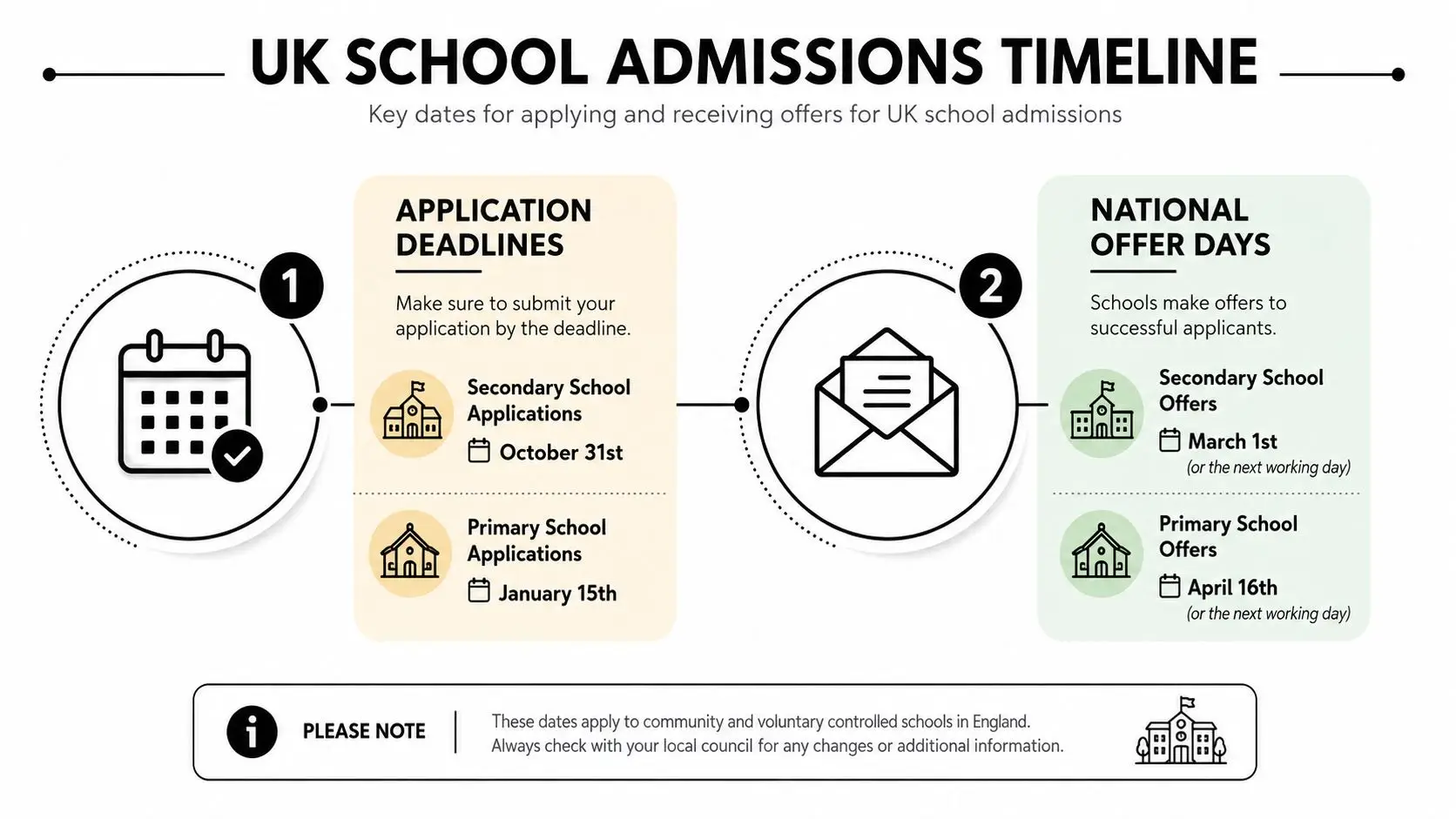
Parents often find the admissions calendar easier to handle once they break it into stages, like marking checkpoints on a road map rather than staring at one big date. For secondary admissions, the deadline is usually 31 October, and for primary admissions it is usually 15 January. If a family misses those dates, the application is usually handled after the on-time round, which can affect the chance of getting a preferred place, as explained in admissions deadline guidance from Little Cedars.
The main dates to keep visible
For secondary school National Offer Day, the standard date is 1 March, or the next working day if that falls on a weekend or bank holiday. For primary school National Offer Day, the standard date is 16 April, or the next working day if needed, according to the primary offer day guidance and secondary offer day guidance.
A simple way to keep the sequence straight is to treat it like three separate moments.
- Apply by the deadline: secondary applications usually close on 31 October, primary applications usually close on 15 January.
- Wait for the national decision: secondary offers arrive on 1 March or the next working day, primary offers on 16 April or the next working day.
- Reply promptly after the offer: councils set a response deadline, and local guidance can vary. Some examples, such as Buckinghamshire, ask families to respond by 11:59pm on 16 March 2026 Little Cedars on admissions deadlines.
Keep the deadline in the calendar before the offer arrives. Once the message lands, the timetable moves quickly, and parents often need time to check travel, childcare, and any support arrangements.
Why the timing matters for children
This timetable is about more than forms and emails. A child who receives an offer needs certainty so the family can plan the journey to school, prepare uniforms, and explain the change in a way that feels calm and safe. A child who does not get the preferred place may need reassurance quickly, especially if they feel anxious about change or find uncertainty hard to manage.
Reading Your School Offer
The offer letter or email is often the moment when parents start decoding school language. Terms like first preference, alternative offer, or waiting list can feel clinical at first, but each one tells you something useful about how the place was decided and what you can do next.
What the offer actually means
For England's secondary transfer, the local authority offers the highest-ranked school on your preference list that meets the admissions criteria, and families normally have at least 20 school days to lodge an appeal secondary offer explanation. That rule sits at the centre of the system. The final offer is not random, it reflects the order of your choices and the school's published rules.
If your child gets the first-choice school, the path ahead is straightforward. If they get the second or third choice, that does not mean the school is wrong for them, but it does mean you should look closely at practical fit. Ask whether the school is easy to reach, whether the transition feels manageable, and whether your child will feel safe, settled, and able to learn well.
How to read common outcomes
A first preference offer means the school you ranked highest that could take your child. A preferred offer means one of the schools you listed, even if it was not your top choice. An alternative offer usually means the council could not place your child at one of your preferred schools and has offered another place so they are not left without one.
That last point matters more than many parents realise. A school that is further away or less familiar may still be a strong fit if it offers better support, a calmer environment, or a more realistic journey for your child. A place that looks acceptable on paper may feel wrong if the travel is too long, the routine is too tiring, or your child is already struggling with anxiety. It helps to read the offer as a sign of fit, not just a label.
Why criteria matter
Admissions decisions often turn on published rules such as distance, sibling priority, catchment, faith criteria, medical need, or grammar selection. These rules explain why a child may receive a place at one school and not another, even when both were on the preference list.
A family can look at an offer and feel frustrated without seeing the full picture. The letter may not say, in plain English, that another child lived closer, had a sibling already there, or met a criterion that your child did not. Reading the offer through that lens makes the next step clearer and helps you decide whether an appeal has real grounds.
Reading the offer with your child in mind
Once the offer is clear, shift from school names to daily life. Will the journey leave your child exhausted before lessons begin. Does the setting suit their learning style, social confidence, or support needs. These questions matter for children who are anxious, who need more structure, or who find change difficult.
For some families, the offer is only the starting point. If the place does not feel right, or if the council's decision raises questions, you can also look at other pathways, including a managed move or in-year transfer through Queen's Online School in-year transfer options. That kind of choice can be especially helpful when a child needs a setting that feels steadier and more suited to their needs.
Actions After Receiving an Offer
The first job after opening the offer is simple, but parents often delay it because they're upset, relieved, or unsure what the result really means. Don't wait for the emotions to settle completely before you act. The deadline still applies, and the child's place, or your chance to challenge it, depends on what you do next.
Start with the place you've been given
Accepting an offer doesn't mean you've given up on a better outcome. It means you're protecting your child's position while you decide what else to do. If you decline without a backup plan, you could make the next stage harder than it needs to be.
A parent might accept a second-choice school while also joining the waiting list for the first-choice school. That's common. If the first-choice place later opens up, the family can reassess whether switching would help the child or fulfill the original preference.
A useful practical checklist is:
- Confirm the deadline: check when the council wants your response.
- Accept or decline formally: use the instructions in the offer notice.
- Compare travel and routine: think about journey length, sibling drop-offs, and after-school care.
- Keep records: save emails, screenshots, and any replies from the council.
Join waiting lists with purpose
Waiting lists are not just a formality. They're part of how local admissions systems continue to move after the main round. The order can depend on the school's published criteria, and some councils publish allocation data that helps families understand how places were awarded Haringey on how offers were made.
That published evidence is useful if your child is near the cut-off or if the school has been heavily oversubscribed. It can show whether distance or another rule is likely to matter more than a general preference.
Practical rule: if the child's needs are stable but the school isn't ideal, keep the place, keep the list, and keep watching. Families don't always get their best option on the first day.
Appeal when the offer doesn't fit the child
An appeal is not about being upset, it's about evidence. If your child has a compelling reason to attend a particular school, you need to show why the place matters and why the published admissions process didn't meet that need.
The strongest appeals usually start with child-centred facts. For example, a child may need a shorter journey because long travel increases fatigue, or they may need a specific school environment because of anxiety, sensory needs, or a complex home-to-school routine. In England, appeals are heard by an independent panel, and the panel's decision can be binding if it goes in your favour secondary offer guidance.
If you're considering an alternative route while waiting, the internal guidance on Queens Online School's in-year transfer page can help you think through continuity if a conventional place isn't the right fit right now.
Considerations for SEN SEMH and International Families
A school offer can mean something different depending on the child in front of you. For a child with SEN, SEMH, or medical needs, the question is not only whether the school sounds suitable on paper, but whether it can support learning, regulation, safety, and confidence in daily life. Parents often need to read the offer in the same way a teacher reads a child's timetable, by asking what will help the child settle, stay calm, and make progress.
What extra evidence can change
Admissions criteria such as sibling priority, catchment distance, and faith or medical need are usually applied before the local authority matches a child to preferences, as explained in the national guidance from Contact on school admissions criteria. For families of children with additional needs, that order matters because a placement may depend on facts that are not obvious from the offer letter alone.
Evidence can make the picture clearer. A doctor's letter, a specialist report, or an EHC plan can show why a certain placement matters for day-to-day learning. A child who becomes distressed by long journeys, noisy corridors, or sudden changes to routine may need that information to be understood properly in an appeal or priority discussion. If you are trying to make sense of the support a school might offer, what SEN support involves explains the terms schools and local authorities often use.
Why international families need a different checklist
International families often face a second layer of uncertainty, because the words used in admissions can be familiar to local parents but new to someone who has recently moved or is working across two systems. Terms like catchment, offer round, and waiting list can sound simple, yet each one may affect what happens next.
Keeping documents organised helps. If a child's place depends on residency, immigration status, or a planned move into the UK, the council may ask for clear proof before it can assess the application properly. If English is not the main home language, translated documents can reduce delays and avoid misunderstandings. It also helps to keep copies of everything in one place, so that if a school or local authority asks for more detail, you can respond quickly.
The emotional side matters as well. A child who is new to the country may need more than a school place, they may need a setting that helps them settle into routines, build friendships, and feel known from the start. Families often make steadier decisions when they treat the offer as part of a wider adjustment plan, not as a final verdict on the child's future.
Exploring Alternative Schooling Options
Sometimes the best next step isn't to keep fighting for a place that doesn't fit. It's to consider a route that protects learning, routine, and confidence while keeping the child's needs at the front.
When an alternative can make sense
An online school can be a strong option if a child needs flexibility, a more controlled environment, or a pace that's closer to their own. It can also help when a family is moving, when a child has struggled with transition before, or when the local admissions outcome doesn't reflect what the child needs to flourish.
The internal page on alternatives in education is useful if you want to compare the idea of a different schooling route before making a final decision.
What parents often look for
A good alternative should still be academically serious. Families usually want live teaching, structured lessons, and a curriculum that leads somewhere credible, not a loose patchwork of activities. They also want support that feels humane, especially for children with SEN or SEMH needs, where confidence and consistency can matter as much as subject content.
For international families, online schooling can also remove a lot of pressure around location. A child can continue with a British curriculum without being limited by local catchment rules or a sudden move between countries. That kind of continuity can be a relief when the admissions process has already been stressful.
How to evaluate the fit
Ask three direct questions. Will this option keep my child learning consistently? Will it reduce stress rather than add to it? Will it give us enough structure to stay settled for the term ahead?
If the answer is yes, request more information, ask for a prospectus, and look for a trial lesson or an introductory conversation. The point is not to replace one worry with another. It's to choose a setting that helps your child feel secure, capable, and ready to learn.
Conclusion and Next Steps
National Offer Day can feel like a verdict, but it's really a turning point. The offer you receive tells you what the system could provide on the day, not everything that may still be possible for your child.
If the place is right, act quickly, accept it, and start planning the practical details. If it isn't, look closely at waiting lists, appeal rights, and any evidence that shows why your child needs a different outcome. If your child needs a more individualized approach, give real weight to alternative schooling, especially when routine, wellbeing, SEN, SEMH, or international circumstances make a conventional placement harder to manage.
A simple next-step checklist helps keep things steady.
- Confirm the offer details and the reply deadline.
- Think through travel, childcare, and daily routine.
- Review support needs if your child has SEN or SEMH needs.
- Decide whether to wait, appeal, or accept.
- Explore alternative schooling if the current option doesn't fit your child well.
The right decision is the one that helps your child feel safe, seen, and ready to learn. That's the standard worth holding onto when the pressure is high.
If your child needs a more flexible or supportive route after offer day, Queens Online School offers a British curriculum with live, interactive teaching and personalised support that can help families find a steadier fit. Visit Queens Online School to explore whether an online pathway could give your child the continuity and confidence they need.