


You may be seeing this in your own home already. Your child freezes when a worksheet asks for one neat written answer, then talks brilliantly about the same topic over lunch. They can explain a science idea with total clarity, but a rigid homework format makes them look less capable than they are.
That gap is painful for parents. You know your child is bright, curious, funny, and full of potential, yet school can sometimes seem built for a narrower type of learner. If you've ever worried that a one-size-fits-all model might miss what makes your child special, you're not overreacting. You're noticing a real problem.
Universal Design for Learning offers a more hopeful way to think about education. It asks a simple question. What if we designed learning from the beginning to fit real children, rather than expecting real children to squeeze themselves into a single method? If you're exploring flexible schooling, resources like this Quantum LEEP Academy guide can also help you compare approaches that aim to support different learning profiles with more care.
A New Lens on Learning for Your Child
A parent once described her son to me like this. “He hates English homework, but if you ask him about the book, he won't stop talking.” Many families know that exact feeling. The issue often isn't that a child can't learn. It's that the route to showing learning has been too narrow.
That is particularly important online, where children can either flourish with flexibility or feel even more exposed by rigid systems. A child with anxiety may need more time before speaking live. A child with dyslexia may understand the text beautifully but struggle to decode it at speed. A child with attention difficulties may stay engaged when lessons include movement, visuals, and clear checkpoints, yet drift when everything arrives in one long block of text.
Practical rule: When a child struggles, ask first whether the barrier is the learning itself or the way the learning has been designed.
Universal Design for Learning, often shortened to UDL, gives parents a useful new lens. It helps you see the difference between a child who needs support with content and a child who needs a better route into that content. Those are not the same thing.
For many parents, that distinction brings relief. Your child may not need lowering of expectations. They may need teaching that is more flexible, more thoughtful, and more humane. That is especially important for children with SEN and for those carrying the invisible weight of SEMH needs, where feeling safe, understood, and able to participate can change the whole school day.
What Is Universal Design for Learning Really
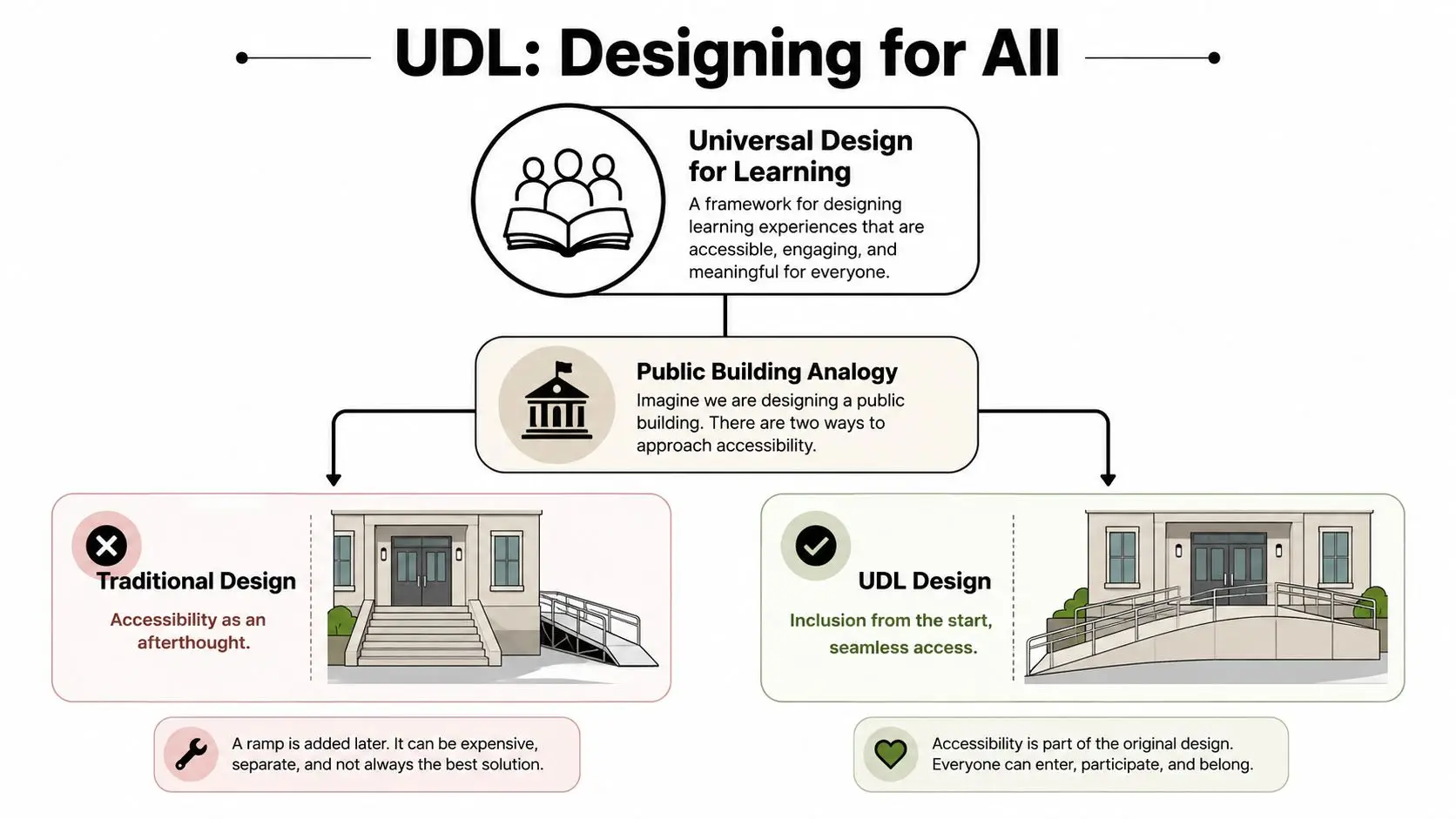
The easiest way to understand Universal Design for Learning is to think about a public building.
Start with the building, not the patch
If a building is designed with only steps at the entrance, someone may later add a ramp to solve the problem. That ramp helps wheelchair users, but it also helps parents with prams, someone on crutches, and a delivery worker carrying heavy boxes. Good design doesn't wait for people to struggle and then bolt something on. Good design plans for human variation from the start.
Learning works the same way. In a traditional model, one lesson format is created first, and then schools try to make adjustments afterwards for the students who can't access it easily. In a UDL model, teachers plan with learner differences already in mind.
Why this matters in the UK context
The framework wasn't invented yesterday. The Universal Design for Learning framework was first formally defined in the 1990s by David H. Rose and the Center for Applied Special Technology (CAST). In the UK, its adoption is seen in frameworks like Cardiff University's Education Development Toolkit, which uses UDL to move from reactive disability support to proactive barrier removal in curriculum design (background on UDL history and UK adoption).
That phrase, proactive barrier removal, is the heart of it. Instead of waiting for your child to fail, panic, avoid, mask, or disengage, UDL asks teachers to build flexibility into the curriculum from day one.
What it looks like in practice
A reactive approach might sound like this:
| Approach | What happens |
|---|---|
| After-the-fact support | A child can't manage the task, so adults scramble to make individual changes later |
| Proactive UDL design | The task already includes options for accessing the material and showing understanding |
In real school life, that could mean:
- Reading support built in: A history lesson includes text, visuals, and teacher explanation rather than only one dense article.
- Response options built in: A pupil can show understanding through writing, speaking, or a visual format during classroom learning.
- Structure built in: Instructions are chunked, deadlines are visible, and examples are provided before independent work begins.
UDL doesn't lower standards. It removes unnecessary obstacles so children can reach those standards more fairly.
Parents often worry that inclusive design means less challenge. In strong teaching, the opposite is true. The goal stays ambitious. The pathway becomes more accessible.
The Three Core Principles of UDL Explained
The UDL framework rests on three ideas. They are often described as the why, what, and how of learning. Once you know them, you'll start spotting them everywhere in a good online lesson.
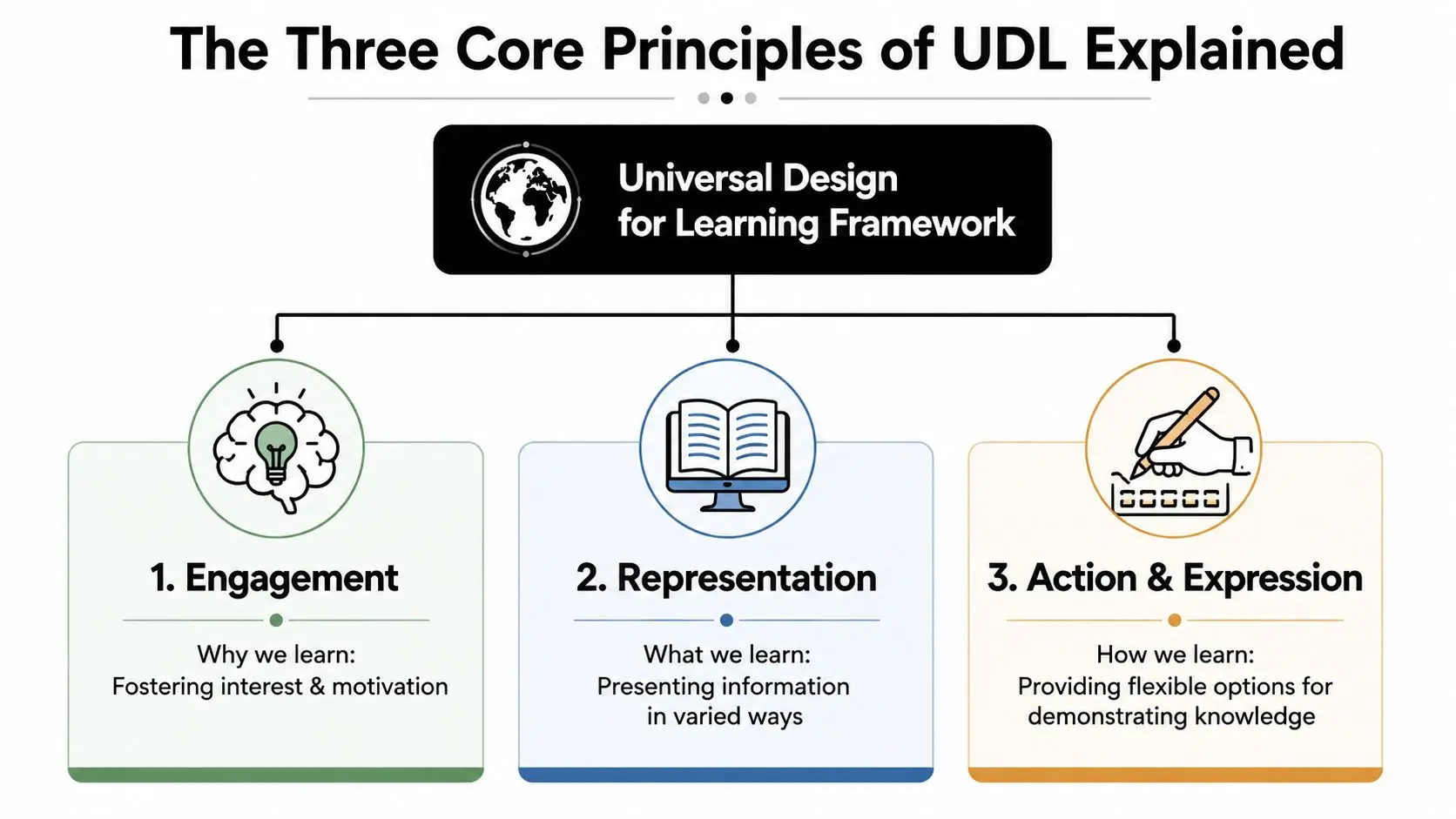
Multiple means of engagement
This is about motivation. Why would your child want to enter the lesson, stay with it, and keep going when it gets difficult?
For one child, engagement comes from choice. For another, it comes from routine and predictability. For a teenager with anxiety, it may come from low-pressure ways to participate before speaking in front of peers. For a younger learner, it may be a visual timetable and short bursts of activity.
A simple example is an essay topic choice. If a Year 8 pupil can choose between two or three prompts, they still practise the same writing skill, but they have more ownership. That sense of agency matters. Children work harder when they feel the task has room for them inside it.
Another strong engagement strategy is low-stakes checking. Instead of one intimidating piece of work at the end of a unit, a teacher uses short quizzes, quick polls, exit tickets, or discussion prompts along the way. That lowers fear and gives the child more chances to succeed.
Multiple means of representation
This principle focuses on how information is presented. Children don't all take in information best in the same format.
One pupil may grasp a concept by reading. Another may need to hear it explained. A third may need a diagram first and the written text second. In online learning, this is especially important because digital tools make varied presentation easier when teachers plan thoughtfully.
If your child is studying a novel, representation might look like this:
- Text version: Reading the chapter independently
- Audio support: Listening to the same chapter with text-to-speech
- Visual support: Seeing a character map or plot timeline
- Teacher guidance: Watching a recorded explanation of the key themes
This is one reason many parents also ask about the difference between UDL and classroom adaptation. A useful companion idea is differentiated learning, which helps explain how teachers respond to varied readiness and learning needs inside a lesson.
A short video can also help make the framework more concrete.
Multiple means of action and expression
This is about how a child shows what they know.
Some children understand a topic well but can't show it fully in one narrow format. A child may have excellent ideas but weak handwriting stamina. Another may struggle to organise a long written response under pressure, yet give a superb verbal explanation.
That doesn't mean written work disappears. It means the learning journey includes different ways to practise and demonstrate understanding before the final required format matters.
Examples parents recognise quickly include:
- Podcast instead of paragraph: A pupil records an audio reflection on a geography topic.
- Slide deck instead of poster: A child presents key facts using visuals and short notes.
- Annotated diagram instead of only prose: A science student labels a process and explains it in stages.
The real question isn't “Can my child do it one specific way?” It's “How can my child best show secure understanding while they are still learning?”
When teachers use all three principles together, children don't just access more. They often feel calmer, clearer, and more competent.
Why UDL Is Essential for Online British Curriculum Students
Online learning can be freeing for the right child. It can also expose every weakness in a poorly designed system. If lessons rely on long stretches of passive listening, confusing instructions, or one narrow way to respond, a child may feel isolated very quickly.
That's why UDL matters so much in online British curriculum settings. It isn't an optional extra added for a few students on the side. It is the design logic that helps digital learning feel human.
Online learning can magnify barriers
In a physical classroom, a pupil may pick up cues from others, glance at a whiteboard reminder, or get quick reassurance from a teacher walking past. Online, those supports need to be designed on purpose. If they aren't, small obstacles become large ones.
Children with SEN often need clarity, scaffolding, and flexibility. Children with SEMH needs often need emotional safety, predictable routines, manageable social demands, and ways to participate without feeling trapped. A child who dreads being called on suddenly may still engage beautifully through the chat box, a guided discussion, or a recorded response.
There is also an important gap parents should know about. UK-specific material doesn't yet clearly quantify how UDL affects SEMH outcomes in fully online settings, even though SEMH needs are a major concern for families. So if you're looking for neat numbers on anxiety reduction in virtual schooling, the evidence base is still developing. What we can say, with confidence, is that the features UDL promotes are closely aligned with what many SEMH learners need most: predictability, choice, reduced pressure, and a stronger sense of control.
Good online design supports every learner
Research in UK higher education shows that applying UDL principles to curricula breaks down barriers for all students, not just those with declared disabilities. A 2023 UKSG study found that UDL supports good quality teaching practice across the whole student cohort by treating learner variability as the rule, not the exception (UKSG study on UDL in higher education practice).
That phrase matters for parents. Learner variability is the rule. Your child isn't an outlier because they need information presented differently, more structure, or flexible ways to engage. Good online teaching expects variation.
A strong digital environment usually includes tools that support this approach. Thoughtful use of a school's virtual classroom technology can make a real difference when it offers recorded lessons, accessible materials, visible instructions, and structured opportunities for interaction.
What parents often notice first
Parents usually tell me they see three changes when online learning is designed well:
- Less panic: The child knows what to expect and how to begin.
- More participation: There are several safe ways to take part, not just one public route.
- Stronger confidence: The child starts to feel that school sees their strengths, not only their struggles.
Children learn better when they don't have to spend all their energy coping with avoidable barriers.
That is why universal design learning has such emotional weight. It doesn't only improve access to tasks. It can change how a child feels about themselves as a learner.
Practical UDL Strategies for Your Child's Online Learning
Parents often ask what UDL looks like on a normal Tuesday. The answer is reassuringly practical. You can spot it in lesson design, teacher habits, feedback, and routines.
What to look for in daily teaching
The most useful question isn't whether a school says it uses UDL. It's whether you can see the approach in concrete actions.
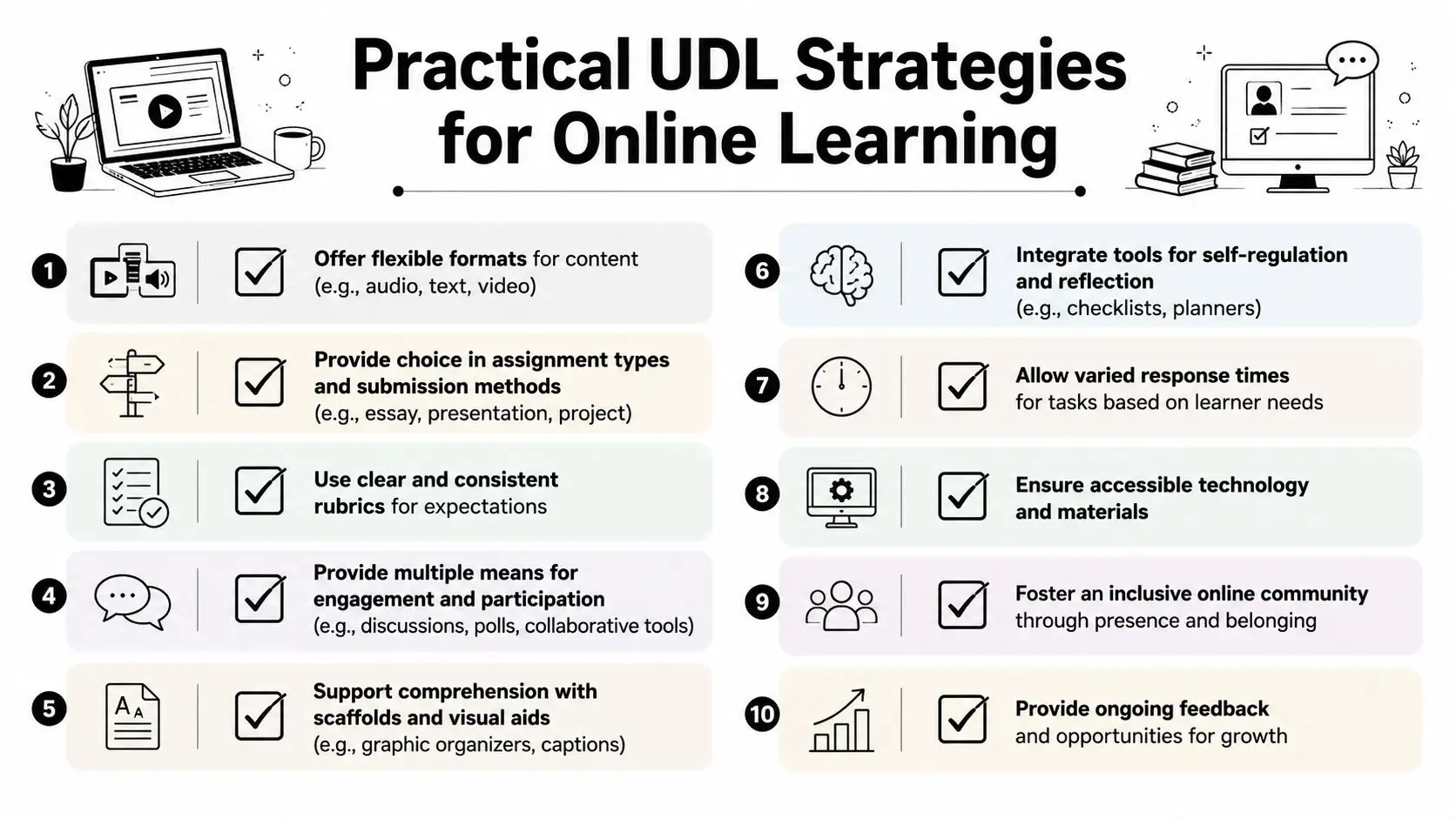
A strong online classroom often includes:
- Flexible content formats: The same idea appears through text, teacher explanation, visuals, or audio support.
- Clear task pathways: Instructions are chunked into small steps rather than hidden inside a long paragraph.
- Visible models: The teacher shows what a good answer looks like before asking the child to work independently.
- Low-stakes checks: Short quizzes, polls, retrieval practice, or draft submissions help children build confidence before higher-pressure tasks.
- Choice where it helps: During learning, pupils may choose between formats for note-making, brainstorming, or presenting ideas.
Evidence-based strategies that matter
One useful benchmark review found that effective UDL implementation includes scaffolds such as concept maps to connect new information to prior knowledge and coaches that model think-aloud processes to support planning. It also emphasised that, for online schools, feedback should be differentiated so it can be customised to individual learners (review of UDL implementation strategies).
That translates into very practical classroom moves:
| Strategy | What it might look like online |
|---|---|
| Concept maps | A pupil planning an A-Level History essay uses a mind map to connect causes, evidence, and counterarguments |
| Think-aloud modelling | A maths teacher narrates each step of solving an algebra problem so the pupil can hear the decision-making process |
| Customised feedback | One student receives a written rubric note, another gets a short recorded explanation, and another receives a step-by-step checklist for revision |
A parent checklist for home and school partnership
When you're evaluating your child's online learning, these questions are worth asking:
- Can my child access the material in more than one way? This could mean transcripts with videos, audio support for reading, or diagrams that simplify complex ideas.
- Does the teacher make thinking visible? Good teachers don't only give answers. They model how to plan, infer, edit, and self-correct.
- Is feedback specific and usable? Children need more than “good work” or “try harder”. They need next steps they can act on.
- Are there supports for self-organisation? Checklists, weekly planners, module maps, and clear deadlines reduce hidden stress.
- Is emotional load considered? A child with SEMH needs may need shorter tasks, more predictable routines, and a quieter route into participation.
Some of the best UDL support looks simple. A transcript beside a video. A checklist before a task. A teacher saying their thinking out loud.
Those small design choices can be the difference between a child shutting down and a child getting started.
UDL in Action at Queens Online School
These ideas become easier to trust when you can picture a child using them.
Anya in Year 10
Anya is working towards her GCSEs and finds dense reading tiring because of dyslexia. She still studies the same literature text as her peers, but she accesses it with text-to-speech support, teacher summaries, and visual theme maps. During class discussion, she contributes confidently because the barrier isn't her understanding. It's the decoding load.
For a homework reflection, she may talk through her interpretation first and then build it into a written paragraph. The standard stays high, but the path into that standard is better designed.
Ben in Sixth Form
Ben is academically strong, but anxiety makes live participation hard on some days. Recorded lessons, predictable lesson structure, and smaller breakout discussions help him prepare before speaking. He isn't forced into instant performance every time he learns.
That matters because emotional safety affects academic access. When Ben knows what's coming and has more than one way to engage, he can focus on the subject rather than on managing panic.
Maya in a collaborative project
Maya is bright and autistic. Group work can become stressful when roles are vague and pace is unpredictable. UK research found that offering choice in assessment formats increased completion rates for students with SEN by 34%, and it gives the example of using a module map for individual tasks within a group project to support a student with autism and reduce anxiety (practical application of UDL in higher education).
In practice, that looks like giving Maya a clearly defined role, a sequence of steps, and options for how she contributes. She still collaborates. She just doesn't have to deal with unnecessary uncertainty to do it.
Answering Your Questions About UDL and UK Exams
Parents are often most confused about one issue. If learning is flexible, does that mean GCSEs and A-Levels are flexible too?
Does UDL mean my child can take GCSEs or A-Levels in any format?
No. UDL supports flexibility during learning, not unlimited flexibility in the final external exam. A common point of confusion is that while UDL encourages varied formative assessment during teaching, final external examinations by UK bodies such as Pearson remain standardised, with limited adaptation available through formal access arrangements (guidance on UDL and standardised assessment).
That means your child might learn a topic through video, discussion, guided notes, quizzes, audio responses, and visual organisers. But if the final qualification requires a written exam, the exam board's format still applies unless approved arrangements are in place.
So what is the value of UDL if the exam is fixed?
A great deal. UDL helps your child reach the exam better prepared, less anxious, and with stronger understanding. It gives them multiple routes to practise, retrieve, organise, and secure knowledge before the final assessment.
For example, a pupil revising GCSE Biology may use teacher recordings, diagrams, flashcards, low-stakes quizzes, and oral recall before sitting a written paper. The exam remains standardised. The preparation is more accessible and more effective.
What if my child needs formal support in exams?
That is where official exam support matters. If your child may qualify for adjustments in external assessments, it's worth learning how exam access arrangements work and what evidence is usually needed.
The key distinction is simple:
- UDL changes the learning experience
- Access arrangements may change specific exam conditions
- Exam boards still control the final assessment format
That clarity helps families make informed choices. Flexibility in teaching is powerful, but it should always be explained transparently.
If you're looking for an online British curriculum school that understands how inclusive design, live teaching, and exam preparation must work together, Queens Online School is worth exploring. It offers a flexible, child-centred environment from primary through A-Level, with specialist teachers, recorded lessons, and support for learners who need school to fit them better, not the other way round.