

You may be sitting with a child who knows the content, can discuss a poem brilliantly at the dinner table, solves maths problems out loud, or gives thoughtful answers in class, yet comes out of exams drained and disappointed. You watch them run out of time, freeze under pressure, lose focus halfway through, or struggle to get ideas onto the page quickly enough. That gap between what they know and what their marks show can be heartbreaking.
For many parents, the hardest part is not knowing whether this is “just how exams are” or a sign that their child needs support. If your child learns online, or enters exams as a private candidate, that uncertainty can feel even heavier. There may be no familiar school office to walk into, no obvious person to ask, and lots of confusing paperwork.
Exam access arrangements exist for exactly this reason. They are not a shortcut. They are not a favour. They are a way of making sure a child's difficulty with speed, reading, writing, concentration, sensory overload, or physical access doesn't block them from showing what they know.
Your Child's Potential Unlocked
A parent once described it to me like this. “My son revises well. He explains everything perfectly at home. Then the exam clock starts, and it all falls apart.” That sentence captures what many families feel. The issue often isn't understanding. It's the barrier between understanding and performance.
Why support matters emotionally
Children notice when their effort isn't reflected in their grades. Over time, they can start to believe they're not clever enough, not organised enough, or “bad at exams”. That belief can sink in fast. It can also be wrong.
Exam access arrangements help remove barriers without changing the knowledge being tested. If a child has slow processing speed, extra time may help. If handwriting is painful or very slow, a word processor may help. If anxiety builds during sustained concentration, supervised rest breaks may help. The arrangement should fit the child, not the other way round.
Access arrangements are about fairness. They help the exam reflect the child's knowledge, not the obstacle in front of them.
This is more common than many parents realise
Parents sometimes worry that asking about support will make them seem demanding. It won't. A substantial number of students receive support in public exams. In the 2024 to 2025 academic year, 25% extra time was granted to between 16.6% and 25.5% of students being assessed, according to Ofqual's updated explanation of access arrangements data.
That matters because it normalises the process. Your child is not the only one who needs a different route to show their ability.
A simple way to think about it
A helpful comparison is glasses. Glasses don't give a child better answers. They help the child see the question clearly enough to answer it. Exam access arrangements work in a similar way. They don't lower standards. They reduce the disadvantage that stands between a child and a fair opportunity.
If your child is bright, capable, and consistently struggling with the exam format itself, it's worth taking that seriously. Support can protect confidence as much as grades.
What Are Exam Access Arrangements
You may be sitting at the kitchen table with your child, looking at exam information, and wondering whether support in an exam somehow counts as an unfair advantage. Parents of online learners and private candidates ask me this often. The short answer is no. Exam access arrangements exist so a child can show what they know without a barrier getting in the way.
In formal terms, exam access arrangements are reasonable adjustments used in public exams for a candidate with a special educational need, disability, medical condition, or temporary injury. The purpose is straightforward. Remove the obstacle, while keeping the exam itself valid.
A useful comparison is a ramp into a building. The ramp does not change where the door leads. It changes how someone gets through it. Exam access arrangements work in the same way. They change access to the test, not the standard of the qualification.
That distinction matters to families, especially if your child learns online or is entering as a private candidate. Without a daily school setting, parents can feel they have to prove everything from scratch. In practice, the question is usually whether there is clear evidence that your child regularly needs a certain kind of support in their learning. If you are still getting familiar with school-based provision, this guide to what SEN Support can look like in practice can help make the language less intimidating.
Common exam access arrangements and what they are for
| Arrangement | What It Is | What barrier it helps remove |
|---|---|---|
| 25% extra time | Additional working time in the exam | Slow reading, slow processing speed, or difficulty organising written answers under time pressure |
| Supervised rest breaks | Planned pauses where the exam clock stops | Fatigue, pain, anxiety, attention difficulties, or medical needs that make sustained concentration hard |
| Separate room | Taking the exam away from the main hall | High distractibility, sensory overload, panic in busy spaces, or a need for a quieter setting |
| Reader or read-aloud support | Help accessing the text of the paper, where the rules allow it | Difficulty decoding written text accurately or efficiently |
| Scribe | A trained adult writes exactly what the student says | A physical difficulty or severe writing barrier that prevents independent recording |
| Word processor | Typing instead of handwriting under exam conditions | Very slow, painful, or illegible handwriting |
| Modified papers | Papers produced in a different format, such as large print or Braille | Visual impairment or another difficulty linked to standard print |
Parents sometimes ask whether these arrangements are decided by diagnosis alone. The approach is more practical than that. Awarding bodies want the support to match the barrier. A child who tires quickly may need rest breaks. A child with strong verbal answers but very weak handwriting stamina may need a word processor. The arrangement should fit the day-to-day difficulty your child experiences.
This matters even more for families outside a traditional school route. Online learners may have fewer chances for teachers to notice patterns in real time, and private candidates may need to gather evidence from tutors, reports, and past work to show what support is normal for them. That can feel lonely, especially if you are also arranging outside help such as specialized autism therapy in Italy or other services alongside exam planning.
What access arrangements do, and what they do not do
Access arrangements do not change the subject content. They do not give hints. They do not replace revision or preparation.
They give a child fairer access to the paper.
That is why schools and exam centres look carefully at the exact barrier involved. A scribe is not interchangeable with extra time. A separate room is not the same as rest breaks. Good support is precise. It removes friction without altering what the exam is meant to measure.
Understanding Your Child's Eligibility
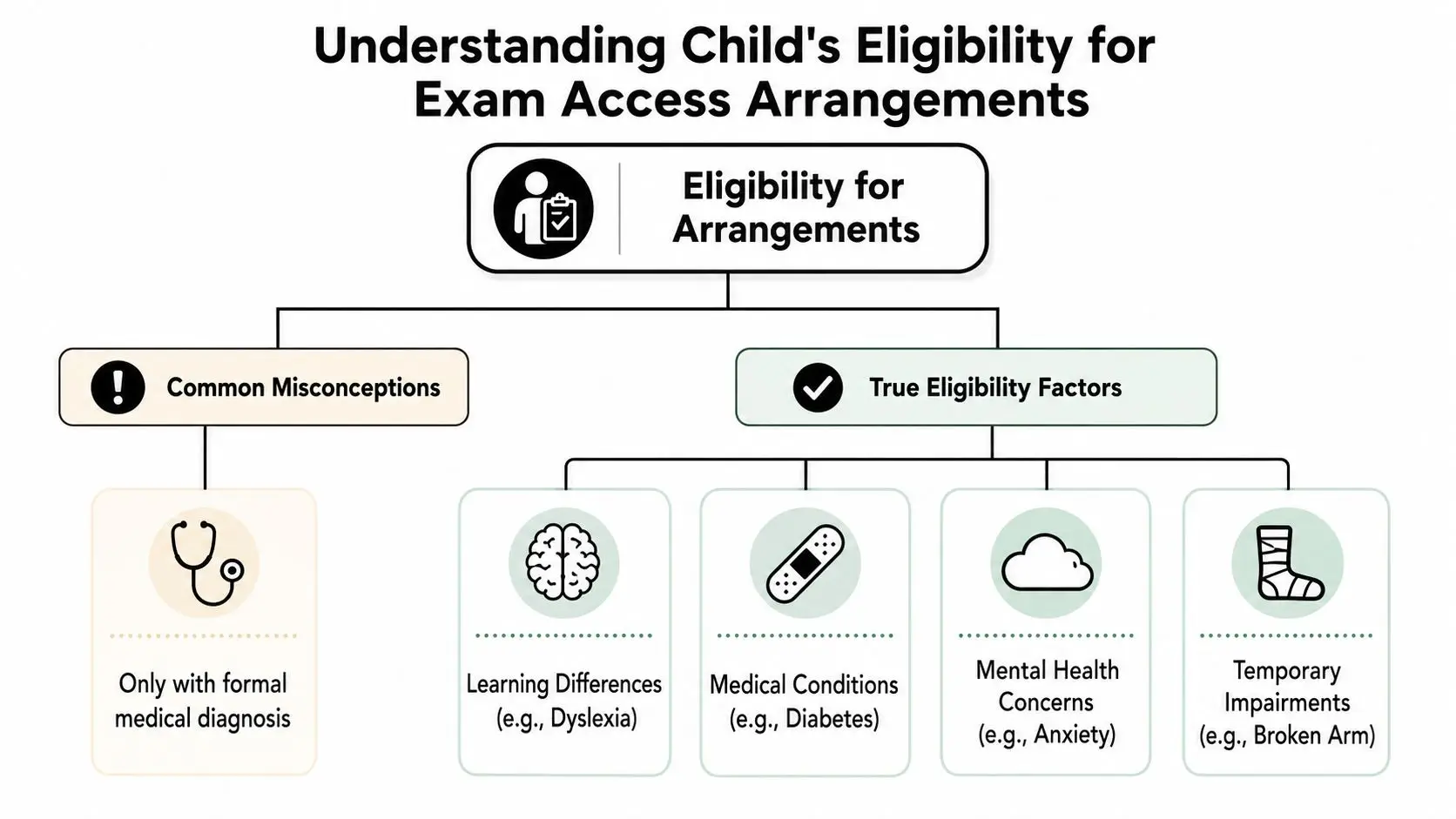
The question I hear most often is this. “My child doesn't have a formal diagnosis yet. Does that mean they can't get support?” In many cases, the answer is no. A diagnosis can help build the picture, but it isn't the only route.
The biggest myth
A formal diagnosis is not a guarantee of exam access arrangements, and it's also not always required. Government background information states that 25% of applications are granted based on the “normal way of working” principle, where evidence of substantial difficulty under the Equality Act 2010, documented by the school and psychometric tests, is sufficient, as explained in this government background note on access arrangements.
That's a relief for families who are still waiting for an assessment or who can clearly see the need without a neat label.
What normal way of working means in real life
This phrase confuses parents because it sounds abstract. In practice, it means the support your child already uses regularly in learning.
For an online learner, that might look like:
- Extra processing time: Your child often needs longer to complete timed assignments and can show stronger understanding when given that time.
- Typing as standard practice: They complete written work on a laptop because handwriting is too slow or exhausting.
- Breaks built into study: They work better when lessons or assessments are broken into shorter chunks.
- Assistive support used consistently: They rely on text-to-speech, enlarged materials, or a quieter environment to complete work.
A school or exam centre is trying to build a clear picture over time. It is not usually about one dramatic incident. It is about a pattern.
What counts as useful evidence
Useful evidence can include teacher observations, marked classwork, mock exam performance, records of support already in place, specialist reports, and parent observations. If your child learns remotely, keep examples. A timed essay they couldn't finish. A set of notes showing strong verbal understanding but slow written output. Emails about recurring difficulties.
For families also navigating wider neurodevelopmental support, resources such as specialized autism therapy in Italy can help when you're building understanding around a child's communication, anxiety, and learning profile alongside school evidence.
If you want a clearer picture of how schools identify and respond to need before formal exam paperwork starts, this overview of SEN support in school is a useful starting point.
The strongest applications tell a story. They show what the child finds hard, when it happens, and what support already helps.
Navigating the Assessment and Application Process
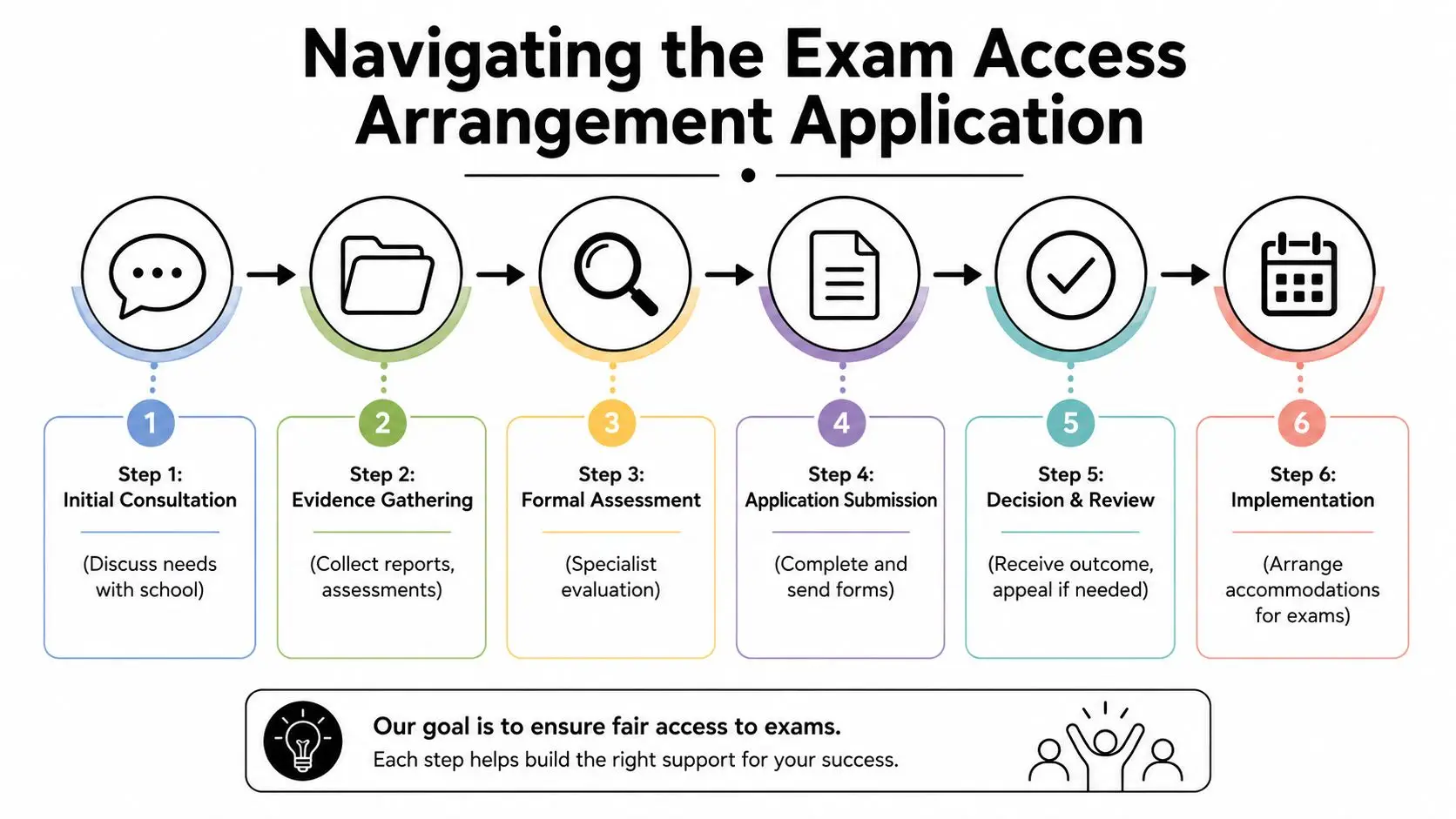
For many parents, this stage feels like standing at the foot of a staircase with too many steps to count. Your child is struggling, exams are getting closer, and the language can sound painfully official. In practice, the process is more like building a case file, one clear piece at a time, so the exam centre can show what your child needs and why that support is part of their usual way of working.
How the process usually works
A good starting point is a conversation with the SENCO or the person responsible for access arrangements at the school or exam centre. Try to bring examples from real work. A parent's instinct that something is wrong matters, but examples such as unfinished mock papers, distressed homework sessions, or repeated difficulty following timed tasks give the centre something concrete to act on.
Next comes evidence gathering. This often includes classwork, timed assessments, mock exams, teacher observations, and records of support already in place. For online learners and private candidates, this can feel more daunting because there may be fewer casual classroom observations. Even so, the principle stays the same. The centre needs to see a pattern over time, not a single bad day.
Sometimes a formal assessment is needed. This is common where arrangements depend on measures of reading, writing, spelling, or processing. Parents often worry that this is the whole case. It usually is not. The assessment is one piece of the picture. The day-to-day evidence of what your child regularly needs is often just as important.
After that, the exam centre prepares the application. Parents do not usually file the official paperwork themselves. The school or registered exam centre submits it through the proper system, using the evidence it has collected and any specialist information it is relying on.
Here is a short explainer many parents find useful before their meeting with the school or centre:
Why timing causes stress
Families often assume access arrangements can be sorted out close to the exams. That is where problems begin. Centres need time to notice patterns, trial support, record the normal way of working, and complete the required checks. If a child only starts using support shortly before exams, it is much harder to show that the arrangement reflects their usual working pattern.
Starting early also gives your child space to get used to the support. Extra time, rest breaks, a reader, or word processing can help, but only if the child has practised working that way before their exam. Support should feel familiar by exam day, not new and unsettling.
If you are considering private assessment
Some families look for outside advice while the school or centre is gathering evidence. That can be sensible, especially if attention, concentration, or overlapping needs are still being explored. If ADHD is one of the concerns, a guide that helps you compare private ADHD services can support informed decision-making.
Private reports can add helpful context, but they do not replace evidence from everyday learning. For a child studying remotely, it helps to keep asking a simple question. What support do they use, regularly, to complete their work? That is often the thread that holds the whole application together.
If your child is taking assessments away from a school site, it also helps to understand how proctored exams online are organised, so the practical exam setup and any approved support can work together calmly and clearly.
Support for Online Learners and Private Candidates
Official guidance often assumes a child is in a traditional school building every day. Many families aren't in that position. Some children learn online because it suits their health, anxiety, neurodivergence, or family circumstances better. Others are entered as private candidates. These children still need support. They instead need a more organised paper trail.

Building evidence when learning happens at home
Parents often ask how a remote learner can prove a normal way of working. The answer is through patterns that can be seen and recorded.
For example, an online teacher may notice that a student gives excellent verbal responses but consistently submits unfinished timed written tasks. Lesson recordings may show the student needing questions repeated or taking longer to process verbal instructions. Timestamped submissions can show how long written work takes. A parent might keep a calm log of homework sessions that stretch because reading load or writing speed is the obstacle.
That kind of evidence matters because it shows real-life impact, not just a label.
What private candidates need to do early
Private candidates have an extra job. They must find an exam centre willing to enter them and handle access arrangements. For private candidates, the process requires finding an approved JCQ exam centre and submitting specialist reports and prior evidence early, as centres enforce strict internal deadlines, such as late January for the Summer 2026 series, as outlined in this Disability Rights UK FAQ on GCSE and A-level access arrangements.
That means families should not wait for the main national deadline and assume it will be fine. Centres often have earlier internal deadlines because they need time to review documents and process applications.
A practical action plan for families
- Contact centres early: Ask whether they accept private candidates needing access arrangements and what evidence they require.
- Collect previous records: Old school reports, mock results, specialist assessments, and examples of support already used can all help.
- Explain the current reality: If your child now learns online, describe how support works in that setting.
- Check fit, not just availability: A centre might accept private candidates but still be unable to deliver the arrangement your child needs well.
If dyslexia is part of your child's profile, this guide to an online school for dyslexia can help you think more broadly about everyday learning support as well as exam access.
How Parents Can Champion Their Child's Needs
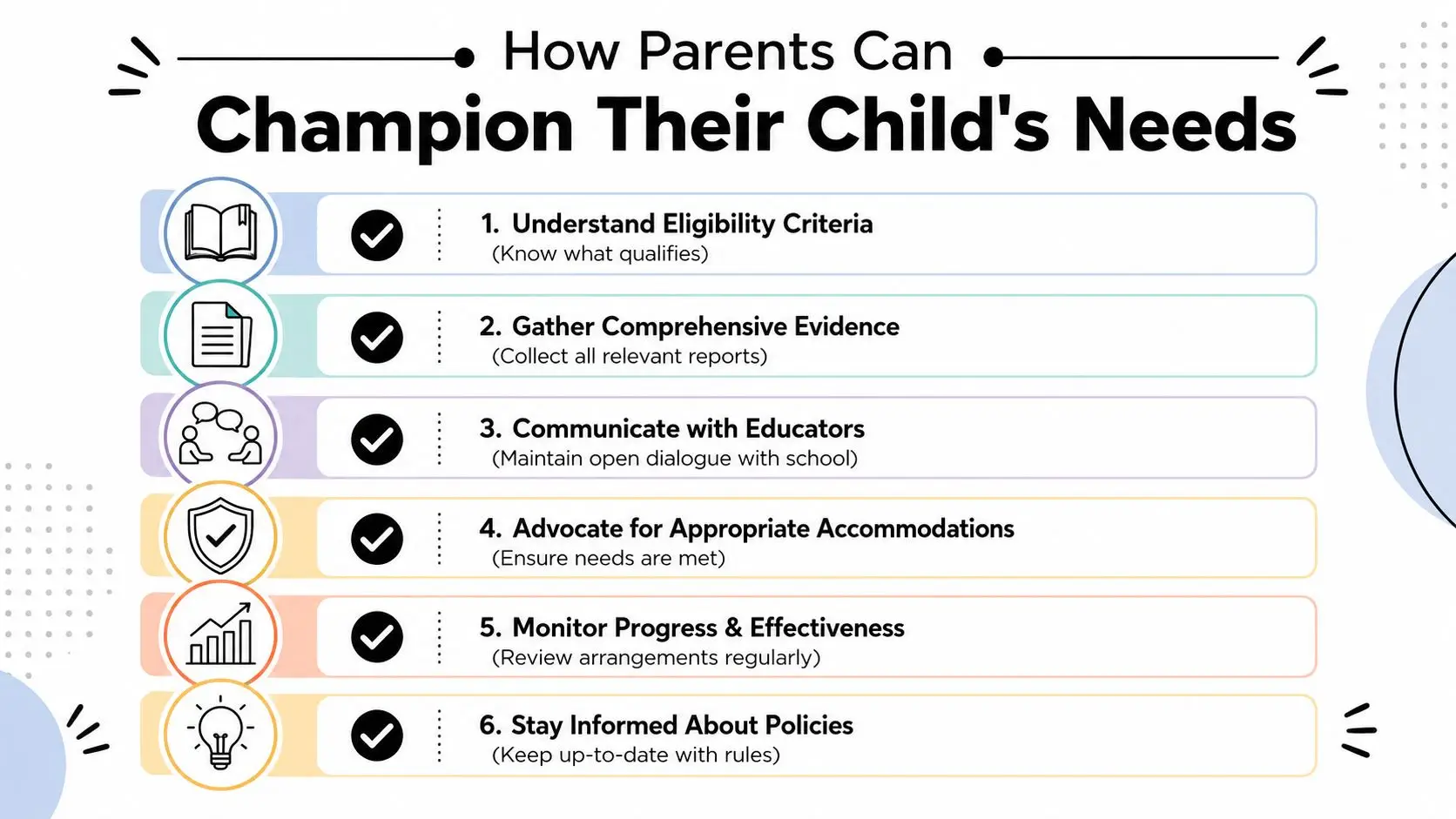
Parents are often the people who hold the fullest picture. You see the after-school exhaustion, the tears over timed homework, the panic before mocks, the difference between what your child can say and what they can write under pressure. That insight is powerful.
You do not need to become an expert in regulations overnight. You do need to become a careful witness.
What helps a school or centre most
Some of the best parental evidence is simple and specific.
- Keep a short home log: Note how long homework takes, where the bottleneck is, and what support makes a difference.
- Save examples: An unfinished timed task tells a stronger story than a general statement about stress.
- Share patterns, not panic: “She can explain the answer but can't get it written down in time” gives staff something concrete to consider.
- Ask what support is already being trialled: If a child may need a word processor in exams, they should be using one regularly in learning.
How to talk to your child about it
Children can feel embarrassed about support, especially teenagers. The tone you use matters. Try to frame arrangements as tools, not labels.
You might say, “This isn't about giving you an advantage. It's about making sure the exam measures your knowledge.” That kind of language protects dignity.
Some children hear “access arrangement” and think “something is wrong with me”. What they need to hear is “this helps the examiner see what you can do”.
Questions worth asking the school or centre
- What evidence do you already have?
- What else would help build the picture?
- Is the support my child uses now enough to count as normal way of working?
- Will my child practise this arrangement before the exam?
Advocacy doesn't have to be confrontational. Calm, consistent, well-documented communication usually gets much further than urgency alone. Your role is to help adults around your child see the full picture clearly.
Your Questions on Exam Access Arrangements Answered
What if the application is turned down
Ask for a clear explanation of why. Sometimes the issue is not that the child has no need, but that the evidence does not yet show a consistent normal way of working or does not meet the threshold required for that specific arrangement.
Request a meeting with the SENCO or exam centre contact. Go through the evidence together. Ask what is missing and whether another arrangement might fit better. A child who is not approved for one form of support may still be eligible for another.
Does being anxious automatically qualify a child for support
Not automatically. The key question is whether the anxiety creates a substantial disadvantage in the exam situation and whether the requested support reflects the child's established way of working.
For some children, the helpful arrangement is rest breaks or a smaller room rather than extra time. The evidence needs to show the impact clearly.
What about children who speak English as an additional language
Speaking English as an additional language does not by itself mean a child qualifies for access arrangements. Schools and centres need to separate language acquisition from an identified difficulty or disability. The support must relate to the specific barrier the child experiences in exams.
Do deaf students follow different rules for speaking and listening components
Sometimes, yes. For deaf students, standard adjustments like sign language interpreters may not be valid for listening or speaking components. They may instead qualify for an exemption if they complete at least 60% of the total exam content, as explained by the National Deaf Children's Society guidance on exam access arrangements. The school or centre must document this carefully.
That point is often missed, and it matters. Families should raise it early if a language or spoken component is part of the qualification.
Will a diagnosis on its own secure extra time
No. A diagnosis may help explain the need, but approval is based on the evidence for the arrangement requested. The child's day-to-day learning pattern still matters.
When should parents start asking questions
As early as you notice a repeated barrier. Waiting rarely makes the process easier. Early conversations give your child time to trial support, build evidence, and feel more secure before exam pressure peaks.
If you're carrying this worry right now, take heart. There is a route through it. It starts with noticing your child carefully, writing down what you see, and asking the right person the next practical question.
If your family wants a flexible British education with live teaching, SEN-aware support, and recognised GCSE and A-level pathways, Queens Online School offers an online learning environment designed to help students feel understood as well as challenged. For parents navigating exam access arrangements, that combination of academic structure and pastoral care can make a real difference.