

Some parents find this page late at night, after another homework battle. Your child is bright, funny, observant, and full of ideas, yet reading a short paragraph can end in tears, silence, or anger. You may already know something isn't right. Or you may still be hearing, “They'll catch up.”
That gap between what your child can think and what school seems to see is painful. It hurts your child, and it hurts you too. An online school for dyslexia can sometimes change that story, not by lowering expectations, but by changing the environment so your child can learn without carrying daily shame.
Your Child's Potential Unlocked
Leo is the sort of child teachers often describe as “so capable, if only he applied himself”. He can explain how things work, build intricate models, and remember details from documentaries after hearing them once. But put a worksheet in front of him, ask him to read aloud, and his shoulders rise. He starts guessing. Then he stops trying.
For many families, that's the hardest part. Not the reading difficulty itself, but the way it slowly changes a child's view of themselves. A child who once chatted freely begins saying very little about school. A child who used to be curious starts avoiding books, writing, and sometimes friends.

When struggle is mistaken for lack of effort
This experience is more common than many people realise. UK research on dyslexia identification in school settings indicates that 9.3% of government schoolchildren are dyslexic, while only 1.5% of private schoolchildren are identified as such, highlighting a significant disparity in how a child's needs are recognized. When a child's needs aren't recognised early, they can spend months or years believing they are the problem.
That emotional toll matters. A child who feels unsupported doesn't just fall behind academically. They can become anxious, defensive, or resigned.
Some children don't say “I'm finding reading hard.” They say “I hate school,” “I'm bad at this,” or “Don't make me go.”
Parents often ask whether moving to online learning means giving up on a normal school experience. In the right setting, it can mean the opposite. It can give your child access to teaching that finally matches how they learn.
A different environment can change everything
A good online school for dyslexia isn't a hiding place. It's a place where a child can work at a pace that allows success to happen often enough for confidence to return. Small live lessons can mean less fear of public mistakes. Recorded sessions can mean your child reviews a tricky concept without the pressure of keeping up with everyone else. Built-in reading support can mean they access the same ideas as their peers, without the same barriers.
A practical example helps. If your child freezes when asked to read from a textbook, an online teacher might share the text on screen, use text-to-speech, pre-teach key vocabulary, and let your child respond verbally first. The lesson still has rigour. The route into it is fairer.
If you're still trying to make sense of what support might look like day to day, this guide on how to help a child with dyslexia is a useful starting point.
Reimagining the Classroom for Dyslexic Learners
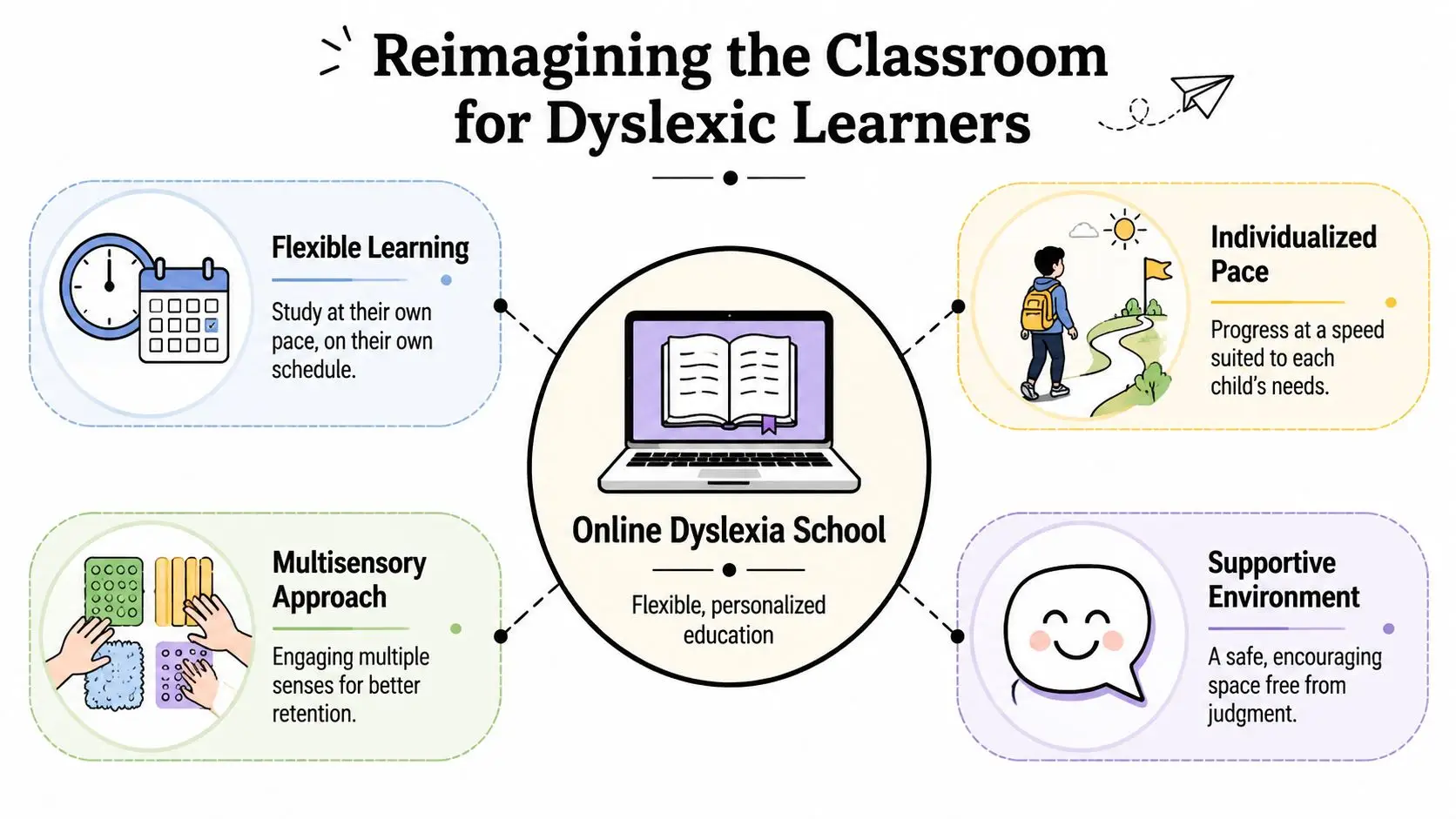
Many parents hear “online school” and picture a child alone with a laptop, clicking through worksheets. That isn't the model you want for dyslexia. A specialist setting should feel more like a classroom redesigned around your child's needs, not a standard school uploaded onto a screen.
Consider the difference between buying shoes off the shelf and having them fitted properly. Both are shoes. Only one was made with the wearer in mind.
What makes specialist online schooling different
A strong online school for dyslexia usually combines several things at once:
- Live teaching: Your child interacts with real teachers in real time, rather than only watching videos.
- Purposeful pacing: Lessons are organised so your child can revisit, practise, and consolidate without feeling rushed.
- Multisensory teaching: Teachers don't rely only on print. They use speech, visuals, movement, annotation, oral rehearsal, and guided practice.
- Built-in support: Tools such as text-to-speech, speech-to-text, audiobooks, and scaffolded writing aren't treated as extras for emergencies. They're part of ordinary teaching.
Dyslexia isn't only about reading speed; it affects how a child processes language, remembers sequences, records ideas, and copes under time pressure. A generic online platform can still leave those barriers in place.
It's a full learning ecosystem
Parents sometimes compare three options. Mainstream school with support. After-school tutoring. Online school. They aren't interchangeable.
Tutoring can help with gaps, but it usually sits around the edges of a school day that may already be overwhelming. A specialist online school can reshape the whole day. That changes far more than timetable logistics. It changes how often your child experiences success.
Here's a simple comparison:
| Learning model | Typical experience for a dyslexic learner |
|---|---|
| Mainstream school plus occasional support | Child may still spend most of the day managing mismatch and fatigue |
| Tutoring after school | Help arrives, but often after confidence has already taken a hit |
| Specialist online school | Teaching, tools, pace, and support are aligned from the start |
Practical rule: If the school can't explain exactly how it teaches reading, writing, spelling, and access to content for dyslexic learners, it probably isn't specialised enough.
A proper virtual learning environment also matters. Parents often benefit from understanding how lessons, resources, feedback, and communication fit together in one place. This overview of a virtual learning environment can help make that clearer.
The Pillars of Effective Online Dyslexia Support
A parent often notices the turning point before a report does. Your child used to chat freely about ideas, then slowly began saying, “I'm just bad at school.” In the right online setting, that pattern can begin to reverse, because the support is built into the school day rather than added on after the struggle.
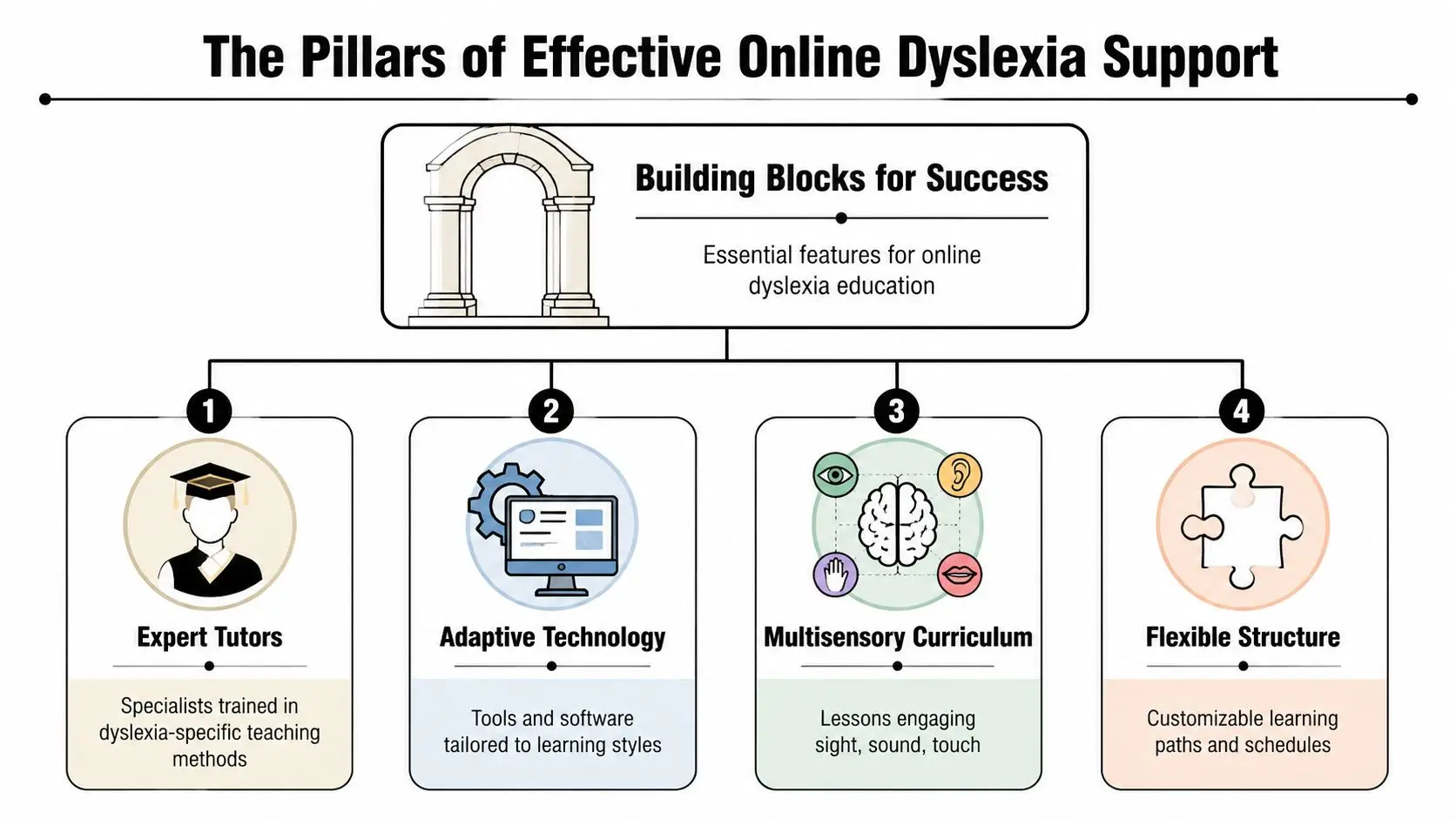
When I speak with families, I suggest four clear questions. How is literacy taught? Who is teaching my child? How much individual attention will they get? What tools are used every day so reading and writing do not become a constant barrier?
Those questions matter because each one connects to how your child feels as well as how they learn.
Structured literacy that is taught on purpose
Children with dyslexia usually need reading and spelling to be taught directly, in a clear order, with practice that builds step by step. Structured literacy works like a carefully laid path. Each new skill rests on one that has already been secured.
In practice, that means a teacher does more than hand over a word list and hope repetition will do the job. They explicitly teach sound patterns, syllables, word structure, and spelling rules. Then they return to those patterns in reading, writing, and revision, so your child can spot the logic instead of feeling they are guessing.
That predictability matters emotionally. A child who understands why a word works is far less likely to freeze when they meet a new one.
Research on online reading interventions has also found better retention when programmes use structured, multisensory teaching rather than static digital practice, including findings reported in studies indexed through the National Library of Medicine. For GCSE outcomes, families should ask any school to show its own results and explain exactly which literacy interventions sit behind them, rather than relying on broad marketing claims.
Teachers who understand dyslexia, not just subjects
A teacher can know their subject well and still miss what a dyslexic learner is experiencing minute by minute.
Your child needs staff who recognise the difference between “won't do it” and “can't yet organise it.” They notice when a pupil understands a science concept but loses marks because they misread the question, forget the second instruction, or cannot get ideas onto the page quickly enough.
Look for signs of responsive teaching such as these:
- Instruction delivery: The teacher gives spoken and written instructions, then checks that your child has understood them.
- Response options: A pupil can explain an answer aloud before writing, or use guided prompts to organise thoughts.
- Feedback style: Corrections are specific and calm, so mistakes feel manageable rather than shaming.
If your child is newly diagnosed, families often need support beyond school choice alone. Some parents find it helpful to read about Haven Medical post-diagnostic care, especially when they're trying to understand what meaningful support can look like after an assessment.
A short video can also help parents recognise what high-quality support should feel like in practice.
Small classes that lower pressure
Small classes change more than the amount of teacher time. They change the emotional temperature of a lesson.
In a large group, a dyslexic child may spend half their energy scanning for danger. Will I be asked to read aloud? Will I finish in time? Will everyone notice if I get it wrong? In a small online class, the teacher can spot hesitation quickly, rephrase a task, or check understanding before worry builds into panic.
That is often where confidence starts to return. Initially, it's subtle.
A child who feels safer is more likely to answer, ask for clarification, and keep trying after a mistake. Those are learning behaviours, but they are also signs of relief.
Assistive technology that is normal, not exceptional
The best technology reduces unnecessary strain. It does not lower expectations. It removes hurdles that have little to do with real understanding.
A pupil might listen to a history extract using text-to-speech, dictate the first version of an essay with speech-to-text, then work with a teacher to improve vocabulary and structure. Another might use audiobooks to access a novel while still receiving direct teaching in decoding, spelling, and sentence construction. This is fair access, much like giving a child with poor eyesight the glasses they need to see the board.
The question to ask any school is simple. Are these tools part of ordinary classroom practice, or are they treated as occasional extras your child has to fight for? When support is normalised, children feel less singled out. That alone can reduce resistance, shame, and exhaustion across the school week.
More Than Grades From Learning to Thriving
Parents often begin the school search because grades are slipping. What keeps them searching is something deeper. Their child no longer looks like themselves.
I've worked with pupils who could barely open a reading task without shutting down. Not because they lacked ability, but because they expected the familiar sting of getting it wrong in front of others. When the environment changed, their behaviour changed too. Not overnight, but steadily.
What confidence looks like in real life
A child who learns at a manageable pace often becomes calmer first, then braver. You may notice small shifts before dramatic ones.
- Morning change: Your child gets dressed for lessons without an argument.
- Lesson change: They turn their camera on, answer a question, or ask for help instead of staying silent.
- Home change: They tell you one good thing about school. For some families, that is enormous.
One pupil I taught used to whisper every answer, even when she was correct. After months in a more responsive setting, she volunteered to explain her thinking to the group. The academic progress mattered, of course. But the ultimate victory was hearing confidence in her voice.
Features that support emotional safety
Not every school feature sounds emotional at first. Yet many of them are.
| School feature | Emotional effect on the child |
|---|---|
| Predictable routines | Less anxiety about what's coming next |
| Option to review recorded lessons | Less panic if information is missed the first time |
| Smaller groups | Less fear of humiliation |
| Verbal responses before written ones | More sense of competence |
| Built-in accommodations | Less feeling of being singled out |
A child who feels safe enough to try is far more teachable than a child who feels watched, rushed, or ashamed.
Thriving includes identity, not just attainment
Children with dyslexia need more than coping strategies. They need a story about themselves that isn't built around failure. They need to know that struggling with print doesn't mean they are lazy, careless, or less intelligent.
This is why I care so much about fit. The right online school for dyslexia can help a child reconnect with strengths that school stress has buried. Curiosity returns. Humour returns. Risk-taking returns. Learning becomes something they do again, not something done to them.
And when that happens, parents often feel a shift in themselves too. Less firefighting. Less dread at email notifications. More room to enjoy their child, not just advocate for them.
Navigating Assessments and Your Child's EHCP
Your child finishes another school day saying, "I'm stupid," and you are left trying to piece together what is really going on. One teacher mentions effort. Another mentions waiting to see how things develop. Meanwhile, your child is carrying the emotional weight of confusion every day.
Assessment often brings relief because it replaces guesswork with clearer answers. Once adults can see the pattern of difficulty, a child is less likely to be blamed for struggling with something their brain processes differently.
Start with clear assessment
A formal assessment looks closely at areas such as reading accuracy, spelling, writing, memory, and language processing. It gives you more than a label. It shows where the strain is happening and what kind of teaching or support is likely to help.
That matters emotionally as well as academically.
A child who has been described as careless may finally learn that difficulty lies in phonological processing or written expression. That shift can change the tone of home and school conversations. Instead of hearing, "Why are you not trying harder?" they start hearing, "What helps you show what you know?" If you want a parent-friendly overview of the process, this guide to understanding special education testing for children is a useful place to start.
Understanding the EHCP in an online setting
In England, the legal basis for Education, Health and Care Plans comes from the Children and Families Act 2014 and the SEN framework built around it. In practice, an EHCP sets out your child's needs, the provision required, and the placement that can meet those needs.
You can picture it as a written map. It should describe the support clearly enough that everyone knows what must be in place, whether your child is learning in a mainstream classroom, a specialist setting, or an online school able to deliver that provision.
For parents, the paperwork can feel cold and technical. Yet the purpose is personal. A well-written EHCP can reduce uncertainty, protect support from being treated as optional, and help your child feel that adults finally understand what learning costs them.
Three practical steps for parents
- Collect evidence that shows patterns: Keep reports, school emails, examples of written work, and brief notes about homework meltdowns, reading avoidance, or fatigue. These details help professionals see the full picture.
- Match provision to your child's actual needs: If an online school is being considered, ask exactly how it would deliver the support named in assessments or in the EHCP. Warmth matters, but clarity matters too.
- Learn the language used in meetings: Terms like accommodations, specialist teaching, interventions, and access arrangements can make discussions easier to follow. This plain-English guide to what SEN support means in practice can help if the terminology feels overwhelming.
Strong advocacy usually starts when a parent can describe both the child's difficulties and the child's strengths. That balance helps professionals see the whole child, not just the paperwork.
A Parent's Checklist for Evaluating Online Schools
You may be sitting at the kitchen table with three school websites open, a notebook full of questions, and a child nearby who has already started to believe school is the place where they feel behind. At this stage, glossy promises are not enough. You need to hear how a school teaches, how it responds when your child is stuck, and whether the daily experience will help your child feel calmer and more capable.
A good online school should be able to describe its support in plain English. If staff speak only in broad terms such as “inclusive,” “personalised,” or “supportive,” keep asking. A parent needs to know what happens in the lesson itself. Your child needs more than access to work. They need teaching that reduces strain, protects self-esteem, and gives them repeated experiences of success.
If you are still waiting for a formal assessment, that matters too. Clear assessment evidence helps parents ask better questions and compare schools more accurately. As noted earlier, formal identification of dyslexia usually relies on specialist testing rather than a school noticing that reading is hard.
Online School Evaluation Checklist
| Area to Evaluate | Key Questions to Ask |
|---|---|
| Teaching approach | How do you teach reading, spelling, and writing to pupils with dyslexia in live lessons? |
| Teacher expertise | What training do your teachers have in dyslexia and SEN support? |
| Lesson format | Are lessons live, interactive, and teacher-led, or mostly independent online tasks? |
| Class size | How many pupils are in a typical lesson or literacy support group? |
| Feedback | How quickly does my child receive corrections and guidance during lessons? |
| Assistive technology | Which tools are built into daily learning, such as text-to-speech, speech-to-text, audiobooks, or recorded lessons? |
| Access arrangements | How do you support pupils who need accommodations for internal assessments and public examinations? |
| Curriculum | Do you offer a full British curriculum, including pathways to GCSEs and A-Levels if needed? |
| Emotional support | How do you respond if a child becomes anxious, shuts down, or avoids reading tasks? |
| Communication with parents | How often do teachers update families, and what does progress reporting include? |
| Trial experience | Can my child try a lesson or meet staff before enrolment? |
| Social life | What clubs, group activities, or safe peer interactions are available online? |
What to listen for when schools answer
Listen for detail.
A strong school will explain what a lesson looks like from the child's point of view. For example, it might describe shorter instructions, reading support built into subject lessons, chances to answer verbally, and feedback given before frustration turns into shutdown. That kind of answer shows the school understands that dyslexia affects energy, confidence, and willingness to keep trying, not just spelling scores.
Small class sizes matter for the same reason. In a smaller group, a child is less likely to freeze when asked to read, less likely to compare themselves harshly with faster writers, and more likely to ask for help early. The academic feature and the emotional outcome are closely linked.
Be cautious if a school talks mostly about platforms, recorded content, or independent study. Many dyslexic learners need live teaching, guided practice, and adults who notice the signs of overload. A polished website cannot tell you whether a teacher will spot that your child has stopped contributing because the reading demand has become too heavy.
These contrasts can help:
- Strong answer: The school gives specific examples of teaching routines, staff training, accommodations, and how pupils are supported in real time.
- Weak answer: The school repeats general claims about being “inclusive” but cannot explain how teaching changes for a dyslexic learner.
- Strong answer: The school discusses progress, confidence, attendance, and emotional safety together.
- Weak answer: The school focuses only on grades, software, or convenience for families.
Bring your child into the decision where appropriate. A short conversation can tell you a lot. Ask which kind of classroom feels safer, what usually happens before they get frustrated, and whether they would prefer to type, speak, or read aloud less often. Children often notice warning signs before adults do.
The right school should help your child learn without feeling under threat all day. That is often the difference between a child who merely copes and a child who begins to believe, again, that they can do this.
Your Questions on Online Dyslexia Schooling Answered
It is often 9pm, your child is finally asleep, and you are still sitting with the same questions. Will online school help, or will it make things harder? If your child has already been worn down by school, those questions carry a lot of emotion as well as practicality.
Will my child become isolated?
A well-run online school builds connection into the week. Pupils should have chances to speak in lessons, work with others on projects, join clubs, and spend time in supervised social spaces.
For many dyslexic children, friendships grow more easily when the fear of getting something wrong in front of everyone is lower. A smaller online class can feel like a quieter room. There is less rushing, less comparison, and less chance of a mistake becoming the main event of the lesson. That often means less anxiety, which makes social confidence easier to rebuild.
Is screen time a problem?
Screen time is only one part of the picture. The key question is how the day is designed.
A thoughtful online school breaks the day up with discussion, short teaching blocks, movement, written and spoken tasks, and time away from the screen. Some work may be done on paper. Some may be answered aloud. That variety matters because dyslexic learners often tire more quickly when every task depends on reading from a screen for long stretches.
If a school cannot explain how it prevents fatigue, concentration dips, and overload, keep asking.
How do GCSEs work in an online school?
GCSEs should work in a joined-up way, not as exam teaching on one side and dyslexia support on the other. Your child may need subject teaching, literacy support, and access arrangements to fit together like parts of the same plan.
If a school mentions intervention, ask who delivers it, how often it happens, and how it links to English, essay subjects, and revision. The British Dyslexia Association explains why identifying needs and putting the right support in place matters so much for school progress and self-esteem: British Dyslexia Association guidance on dyslexia in schools.
You can also ask practical exam questions. Will your child be assessed for access arrangements such as extra time, a reader, or a laptop where appropriate? Who handles the paperwork? How early does that process begin? Clear answers usually show that the school has done this before.
Can my child try it before committing?
A trial lesson or meeting with staff can tell you a great deal.
Afterwards, do not look only for excitement. Relief matters too. Some children come away quieter, but visibly less tense. If your child seems calmer, less defensive, or more willing to talk about school than usual, that is meaningful. It often signals that the setting felt safer.
What if my child has already lost confidence in school completely?
Then the first job is not speed. It is trust.
A child who has spent months feeling confused, exposed, or behind may need a period of recovery before they can show what they know. That can look like shorter tasks completed successfully, more willingness to answer, or less resistance at the start of the day. These are not small wins. They are signs that the nervous system is settling and learning is becoming possible again.
Confidence usually returns in layers. First your child feels safer. Then they start trying. Then progress becomes visible.
Can an online school really suit a complex learner?
It can, if the school is built for flexible teaching rather than simple content delivery. Dyslexic children often need repetition, explicit instruction, adapted materials, and adults who notice when effort is tipping into exhaustion.
Online learning can meet those needs well because lessons can be paced carefully, class sizes can stay small, and support can be adjusted without the social strain some children feel in a busy physical classroom. The academic benefit matters, but the emotional effect matters too. When a child stops spending the whole day bracing for failure, they often have much more energy left for learning.
Queens Online School is one British-curriculum option that offers live online learning, small classes, and SEND-aware support, as noted earlier. The right next step is to find a setting where your child feels understood, taught clearly, and able to believe in themselves again.