


The email from school says one thing. The council page seems to say another. Your child's friend at a different school breaks up on a different day, and suddenly a simple job like booking childcare or planning a grandparent visit turns into a tense evening with three tabs open and a sinking feeling in your stomach.
That stress is real, especially when your child depends on routine to feel settled. For many families, school dates aren't just dates. They shape sleep, transport, therapy appointments, family time, revision plans, and the emotional tone of the whole term.
If you're searching for term dates in Cambridgeshire, you probably want more than a list. You want clarity you can trust, and you want to know how to use that information in a way that supports your child's learning and wellbeing. That's what matters most.
Planning Your Family Year Around School Dates
A parent might start with one practical task. Book a dentist appointment. Then it grows. Work rotas need sorting. Childcare needs confirming. A sibling at another school may have slightly different dates. If your child finds change hard, even one unexpected day off can ripple through the whole week.
That's why school calendars matter so much. They don't just organise the year on paper. They help children feel secure. When a child knows when term starts, when a break is coming, and when normal routine resumes, school feels more predictable. Predictability supports confidence.
When dates affect more than your diary
For a child with SEN or SEMH needs, the school year can feel very physical. A longer stretch of learning may bring tiredness. A sudden break in routine may increase anxiety. A return to school after a holiday may need careful preparation, especially if your child worries about transitions.
A simple example helps. If you know half term is approaching, you can pace things differently:
- Plan recovery time: Keep the first weekend of the break lighter if your child is exhausted by the end of term.
- Schedule appointments carefully: Use holiday periods for non-urgent appointments where possible, so your child doesn't miss lessons and doesn't have to cope with an abrupt midweek disruption.
- Prepare for return: Mark the restart date on a visual calendar, lay uniform out early, and talk through the first day calmly.
Practical rule: The best calendar plan is the one that helps your child feel safe, rested, and ready to learn.
Many parents look for one official answer and assume that's the end of it. In reality, the published Cambridgeshire framework is the starting point. It gives you the shape of the year. Then you match that against your own child's school, your family commitments, and your child's emotional needs.
Cambridgeshire Term Dates 2025-2026 Quick Reference
For Cambridgeshire County Council maintained schools, the published 2025 to 2026 framework gives families a reliable base for planning. According to Cambridgeshire school term dates published by Primary Times, the Autumn term runs from Monday 1 September 2025 to Friday 24 October 2025 and includes exactly 40 school days, the Spring term starts on Monday 5 January 2026 and ends on Friday 13 February 2026 with 30 school days, and the Summer term runs from Monday 13 April 2026 to Monday 20 July 2026 with 36 school days, within a year of approximately 195 total school days.
Here's the visual version many parents find easiest to scan.
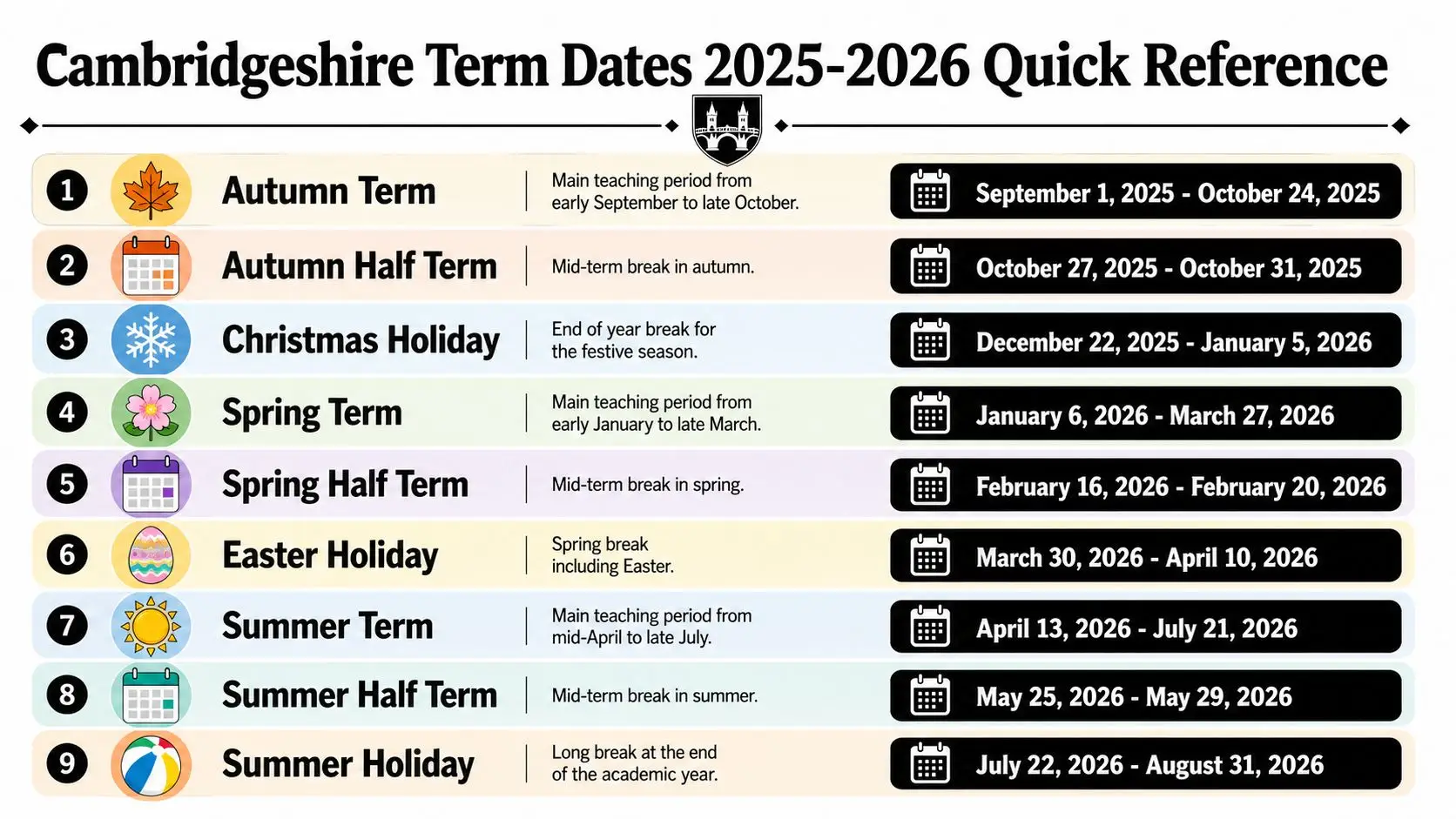
Cambridgeshire school term dates 2025-2026
| Term/Holiday | Starts | Ends |
|---|---|---|
| Autumn Term | Monday 1 September 2025 | Friday 24 October 2025 |
| Spring Term | Monday 5 January 2026 | Friday 13 February 2026 |
| Spring Half Term | Monday 16 February 2026 | Friday 20 February 2026 |
| Summer Term | Monday 13 April 2026 | Monday 20 July 2026 |
| Summer Half Term | Monday 25 May 2026 | Friday 29 May 2026 |
How to use this table in real life
The table gives you the skeleton of the year. Your next step is to turn it into family decisions.
- For childcare planning: The Autumn block is long at 40 school days, so many children feel more tired by the end of October. If after-school care becomes harder late in term, that may be why.
- For appointments: The Spring teaching block before half term is 30 school days. That's a manageable point for some families to review how the term is going and book support around the break if needed.
- For end-of-year planning: The Summer term ends on Monday 20 July 2026. That matters when you're arranging travel, holiday clubs, or transition support for September.
A calendar isn't only about attendance. It helps you spot pressure points before your child reaches them.
What these blocks mean for children
Children usually experience the year as a rhythm. Start, settle, work hard, tire, pause, recover, begin again. When parents know the official term pattern, they can respond earlier.
For example, if your child struggles after Easter, it helps to know the Summer term doesn't just drift loosely towards July. It has a defined start, then a late May half term, then a final run to the end of the year. That lets you break the term into smaller emotional stages and support your child one stage at a time.
Planning Ahead Cambridgeshire Dates for 2026-2027
Some families need next year's dates now, not later. That's common if you're planning work leave, a house move, time abroad, or a school transition. Looking ahead can reduce the constant feeling of reacting at the last minute.
For the 2026 to 2027 academic cycle, Cambridgeshire County Council school term dates and closures information confirms that the summer holiday begins on Tuesday 21 July 2026 and ends on Monday 31 August 2026, giving the usual six-week break. The same published information confirms the Autumn term 2026 starts on Tuesday 1 September 2026 and ends on Friday 23 October 2026, totalling 39 days, followed by half term from Monday 26 October to Friday 30 October 2026.
The pattern families can rely on
The most useful point isn't just the date list. It's the pattern. Cambridgeshire follows a structure that is stable enough for sensible long-range planning.
That helps when you're making decisions such as:
- Booking family travel: A six-week summer break gives more room for longer visits with relatives.
- Changing schools: If your child needs a transition plan, knowing the autumn start date early helps you build a calmer handover.
- Planning work commitments: Parents in healthcare, retail, transport, or shift-based jobs often need leave dates fixed well in advance.
Why the pattern matters emotionally
Children cope better when adults around them sound certain. If you can say, “School starts at the start of September, then there's an autumn half term in late October,” your child hears security in your voice. That matters.
A practical example. If you're considering a move in summer 2026, the break from 21 July to 31 August 2026 gives you a defined window for packing, settling, and helping your child adjust before a new school year begins. A child who is already anxious about change often does better when the family move and the school restart don't clash chaotically.
A sensible way to plan early
Try this three-part approach:
- Mark the confirmed council framework first.
- Add likely family pressure points, such as weddings, overseas trips, or periods of intense work.
- Leave room for school-specific variation, because the council framework may not be the final answer for your child's own school.
That final point is where many parents get caught out.
Why Your School's Calendar Might Differ
A common moment of confusion happens when two parents compare dates and both insist they're right. Often, they are. The difference is that one is looking at the local authority framework and the other is looking at a school-specific calendar.
According to the Cambridgeshire term dates page on GOV.UK, term dates are set by local authorities, but individual schools may deviate. The same verified information notes that this affects families with SEN children in particular, and 32% report scheduling conflicts due to inconsistent school calendars.
The council calendar and the school calendar are not always the same thing
The council dates are the official framework for maintained schools. They're useful and important. But some schools use their own calendar arrangements. That can mean a term ends one day earlier or later than the council list, or that staff training is placed differently.
That might sound minor. In family life, it rarely feels minor.
A one-day difference can mean:
- Childcare has to be rearranged
- A taxi or school transport plan no longer works
- A parent has to change a work shift
- A child who relies on routine faces an unexpected alteration
Why this hits some families harder
If your child manages change easily, a calendar variation may feel irritating but manageable. If your child has SEN, SEMH needs, or high anxiety, a mismatch can have a bigger emotional effect.
Think about a child who has spent weeks preparing to finish on Friday because that's what the family calendar says. If the school ends on Thursday, the child may feel rushed, unsettled, or confused. If the school finishes later than expected, that can be just as hard. The issue isn't only logistics. It's trust in the routine.
When adults have different calendars, children often feel that uncertainty before anyone explains it.
What parents should do with this information
Treat council dates as the baseline, not the final word. Then verify your own school's published dates and any updates sent during the year.
A useful mindset is this: the council calendar tells you the shape of the year, while your child's school tells you the exact lived reality. Once you separate those two, a lot of confusion disappears.
If you have children at different schools, keep one family planner but mark each child separately. Use colour coding if that helps. Parents often try to hold too much in their heads, and that's when mistakes happen.
How to Verify Your Child's Exact Term Dates
Once you know that school calendars can differ, the most caring thing you can do is verify the exact dates early. That isn't over-planning. It's how you protect your child from surprises and protect yourself from stressful last-minute changes.
Cambridgeshire schools are required to include 5 professional training days, and these are often arranged as twilight sessions so children can still have a full school day. The Cambridgeshire proposed term dates document explains that this practice helps preserve children's learning rhythm and supports emotional wellbeing by avoiding unexpected disruption.
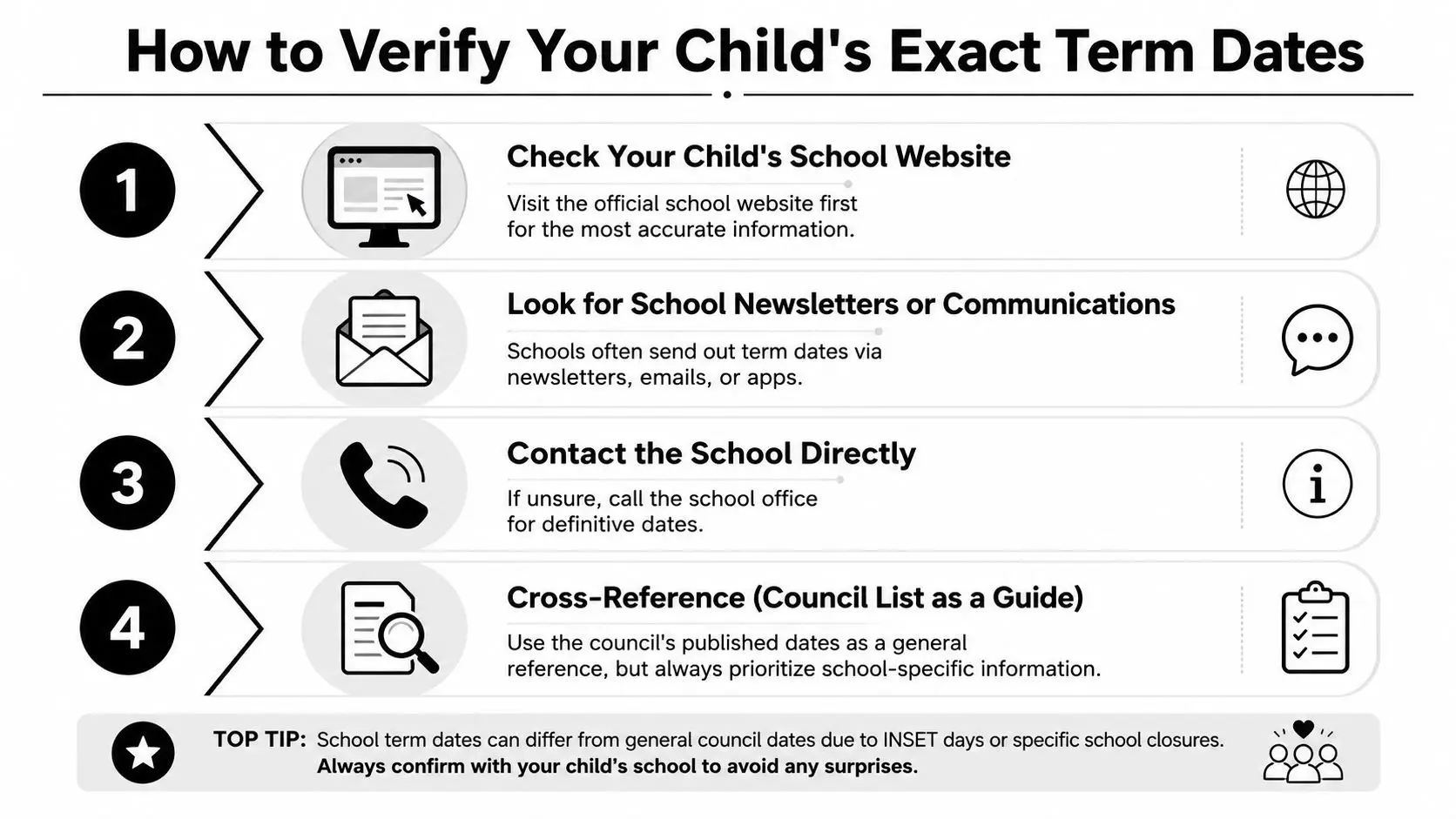
A simple checking routine
Use this order. It saves time and reduces mixed messages.
Start with the school website
Look for a page called term dates, calendar, parents, or key information. Download the latest version if there's a PDF.Check messages sent to parents
Schools often confirm dates in newsletters, email bulletins, text messages, or parent apps.Call the school office if anything is unclear
This matters if your child's school has changed an end date, added a training day, or updated a return date.Use the council list as a reference point
It helps you sense-check the overall pattern, but your child's school should be the final authority for day-to-day planning.
Don't forget training days
Training days are easy to miss because they don't always appear where parents expect them. Some schools spread professional development into twilight sessions, which can reduce disruption for children. That's helpful, especially for pupils who feel unsettled by abrupt changes.
For families, the practical lesson is clear:
- Check whether all 5 training days affect pupil attendance
- Ask if any training is delivered after school instead
- Record confirmed pupil non-attendance dates in one place
A calm school morning usually starts with a calendar checked weeks earlier, not the night before.
If you want a second planning reference for comparing dates and routines across different schooling models, the term dates and timetables page at Queens Online School is a useful example of how some schools present schedule information clearly for families.
A family example
Say your child struggles with transitions and becomes anxious when plans shift suddenly. You check the council framework, then the school website, then a newsletter. The website says Friday is a normal day. The newsletter says staff training affects dismissal arrangements on Thursday. Because you checked both, you can explain the week clearly to your child in advance.
That is calendar checking as pastoral care.
Requesting Term-Time Absence A Guide for Parents
Sometimes a family event falls in term time and there's no neat solution. A funeral, an urgent visit to family overseas, a serious wellbeing need, or a one-off situation can leave parents feeling torn. You want to respect school expectations, but you also know your child is part of a family, not just a timetable.
The best approach is calm, honest, and organised. Schools are far more able to consider a request properly when parents show that they understand attendance matters and that they've thought carefully about the child's needs.
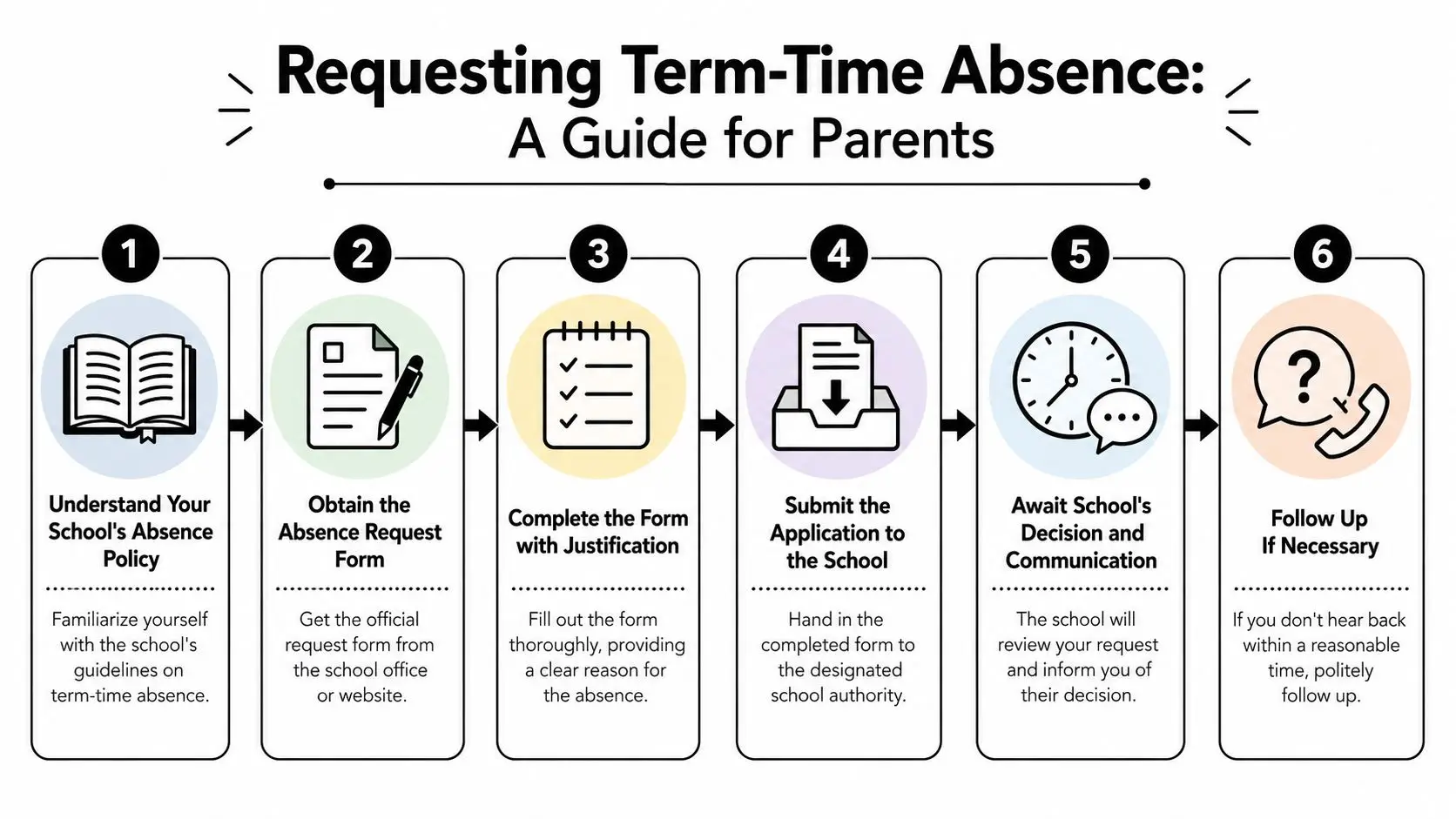
How to make a respectful request
A strong request usually includes the practical facts and the human context.
- Read the school policy first: Every school sets out its absence process. Follow that route rather than relying on an informal message.
- Use the proper form or office procedure: Schools need a clear record. That protects everyone.
- Explain the reason plainly: Keep it factual. If the situation affects your child's emotional wellbeing, say so clearly and briefly.
- Submit it early where possible: Schools can consider requests more fairly when they aren't dealing with a last-minute surprise.
- Prepare your child for either outcome: Don't promise an absence will be approved before the school responds.
What helps schools make decisions
Headteachers are balancing your child's circumstances with attendance expectations and the impact on learning. It helps if your request shows that you've considered both.
A useful tone is: we understand school matters, we wouldn't ask lightly, and this is why the request is important for our child and family.
For example, saying “We've booked a holiday and need permission” lands very differently from “Our child needs to attend a significant family event overseas, and we're asking early so we can support learning and minimise disruption if permission is granted.”
Put your child at the centre of the request. Explain what the absence means for them, not just what the trip means for adults.
If the answer is no
That can feel upsetting, especially if the reason behind the request is heartfelt. Still, it's better to keep communication constructive. Ask what the school advises. Clarify attendance expectations. If your child is disappointed, speak about the decision with steadiness rather than anger. Children often carry the emotional weight of adult conflict.
Some parents also find it helpful to understand the wider legal and parental context before making decisions. The parent's guide to UK home school laws from Queens Online School offers background reading on the broader responsibilities families address when thinking about attendance and education choices.
A practical script
If you're unsure how to phrase a request, keep it simple:
We're writing to request authorised absence for our child. We understand the importance of attendance and are making this request because of a significant family circumstance. We wanted to contact you early, provide full details, and ask for your guidance on the correct process.
That tone is respectful, clear, and child-focused.
Tips for International Families and Exam Years
For international families, school dates can carry a second layer of pressure. You may be coordinating travel across countries, visa timelines, family visits, and a British curriculum that doesn't always line up neatly with local expectations. In exam years, the pressure sharpens further.
According to the Cambridgeshire school holiday overview at Save My Exams, 27% of international students in UK schools face exam timing conflicts due to localised term variations. The same verified data notes that Cambridgeshire's 2026 term ends on 20 July, which can compress preparation time for students needing to meet registration deadlines for autumn 2026 resits, and those deadlines can be up to 6 months prior.
Where the pressure builds
This issue often appears in ordinary family decisions.
A student may assume the end of term means more revision time. In reality, a local term end date, travel plans, and exam administration deadlines can all interact in awkward ways. If the family is moving between countries, that pressure can multiply.
For GCSE and A-Level pupils, the emotional impact is obvious. They don't just need time. They need protected, focused time.
Practical ways to reduce the strain
- Map the academic year early: Put school dates, expected exam windows, and possible travel periods in one document.
- Ask exam questions sooner than feels necessary: Don't wait until the end of term to ask about registrations, entries, or resit timing.
- Keep revision portable: Use a plan your child can continue whether they are at home, travelling, or temporarily out of routine.
- Protect rest as well as study: An overtired teenager doesn't revise well, even with a perfect calendar.
A short family example makes this clearer. A Year 11 student finishes term, flies abroad to see relatives, then realises that autumn exam planning needed attention much earlier. Nobody has done anything irresponsible. The system is more fragmented than families expect.
A different option for some families
For families who need a British curriculum but don't want learning tied tightly to one local timetable, online schooling can be a practical alternative. For example, Queens Online School's online high school for international students shows how some schools support internationally mobile learners through more flexible access to lessons and study routines.
That flexibility won't remove the demands of exams, but it can reduce timetable friction and help students preserve momentum when life spans more than one place.
Your Cambridgeshire Term Date Questions Answered
Parents usually ask the same few questions once the main dates are clear. Here are the answers that tend to help most.
Are bank holidays included in school holidays
Not always in the way parents expect. A school calendar may reflect bank holidays within the broader term structure, but your safest option is to check your child's own published calendar and attendance guidance. If transport, childcare, or wraparound care is involved, verify those arrangements separately too.
Who's right if my school dates differ from the council dates
Your child's school is the one to follow for your child's attendance. The council framework is important, but the school-specific calendar is what governs your day-to-day planning. Keep a copy saved on your phone and in your family planner.
What's the best way to report sickness during term time
Follow your school's absence reporting procedure exactly. Most schools want parents to report absence on the first morning and may ask for updates if the illness continues. It helps to store the reporting number, email address, or app instructions somewhere easy to reach.
How early should I check dates for the next year
Check well in advance. If your family books travel, depends on shared childcare, or supports a child who struggles with change, checking ahead can reduce a lot of anxiety later. Add likely dates to your calendar, then confirm once your school republishes them.
My child gets anxious about transitions. What can I do with term dates
Use the dates actively, not passively.
- Count down visually: Mark the last week of term and the return date on a calendar your child can see.
- Talk through the rhythm: Explain when school is on, when a break is coming, and when normal routine starts again.
- Build in soft landings: Keep the first day back as calm as possible with early bedtime, organised uniform, and a predictable morning.
The calendar works best when it becomes part of your child's emotional preparation, not just your admin.
Should I trust old blog posts or shared parent screenshots
No. School date information goes out of date quickly, and screenshots are often missing context. Use current official school communications and direct confirmation from the school office when something matters.
If you're looking for a schooling model that supports routine, flexibility, and a child-centred approach to learning, Queens Online School offers a fully online British curriculum for primary through sixth form. Families who need clearer timetables, more adaptable scheduling, and strong support for SEN, SEMH, international study, or exam preparation may find it a reassuring alternative to the limits of a rigid local calendar.