


You might be staring at a homework question right now, wondering how anyone can possibly add infinitely many terms and still get a sensible answer. That reaction is completely normal. “Infinity” sounds huge, slippery, and a bit unfair, especially when maths already feels like it asks you to trust strange ideas before they feel real.
The good news is that the sum to infinity of a geometric series isn't magic. It's a pattern. Once you see that pattern clearly, the topic becomes much less intimidating. You don't need to force yourself to memorise rules that feel disconnected. You can understand what's happening, why it works, and when it doesn't.
Can You Really Add Infinite Numbers Together
A lot of students freeze when they first hear the phrase “sum to infinity”. It sounds like a trick question. If something never ends, how can it ever have a final answer?
A simple way to think about it is with food. Suppose you have a pizza and eat half of it. Then you eat half of the bit that's left. Then half of what remains again. You keep going forever, but each new piece is smaller than the last. Your bites don't stay big. They shrink.
That's the key idea. Infinity isn't always about things getting wildly bigger. Sometimes it means following a shrinking pattern without end.
A gentle example
Take this series:
- 12
- 6
- 3
- 1.5
- and so on
Each term is half the one before, so the common ratio is r = 0.5. For a geometric series like this, the sum to infinity exists only when |r| < 1, and with first term a = 12 and r = 0.5, the sum is S∞ = 12/(1 – 0.5) = 24, as shown in Seneca Learning's explanation of sums to infinity.
That answer often gives students a sense of relief. You're not being asked to chase something impossible. You're being asked to notice that the added pieces get so small that the total settles towards a fixed value.
Practical rule: If the terms keep shrinking by the same multiplier, the total can approach a clear limit.
Why this feels strange at first
Your brain is used to finite sums:
- 3 + 4 + 5 = 12
- 10 + 20 + 30 = 60
Those stop. Infinite series don't stop, so they seem as though they shouldn't behave. But some of them do behave beautifully. They creep closer and closer to a number, even though the adding never ends.
If this topic has made you anxious before, that doesn't mean you're bad at maths. It usually means nobody has made the pattern feel concrete yet. Once you picture smaller and smaller pieces being added, the fear starts to fade. You can work with that.
Understanding the Pattern of a Geometric Series
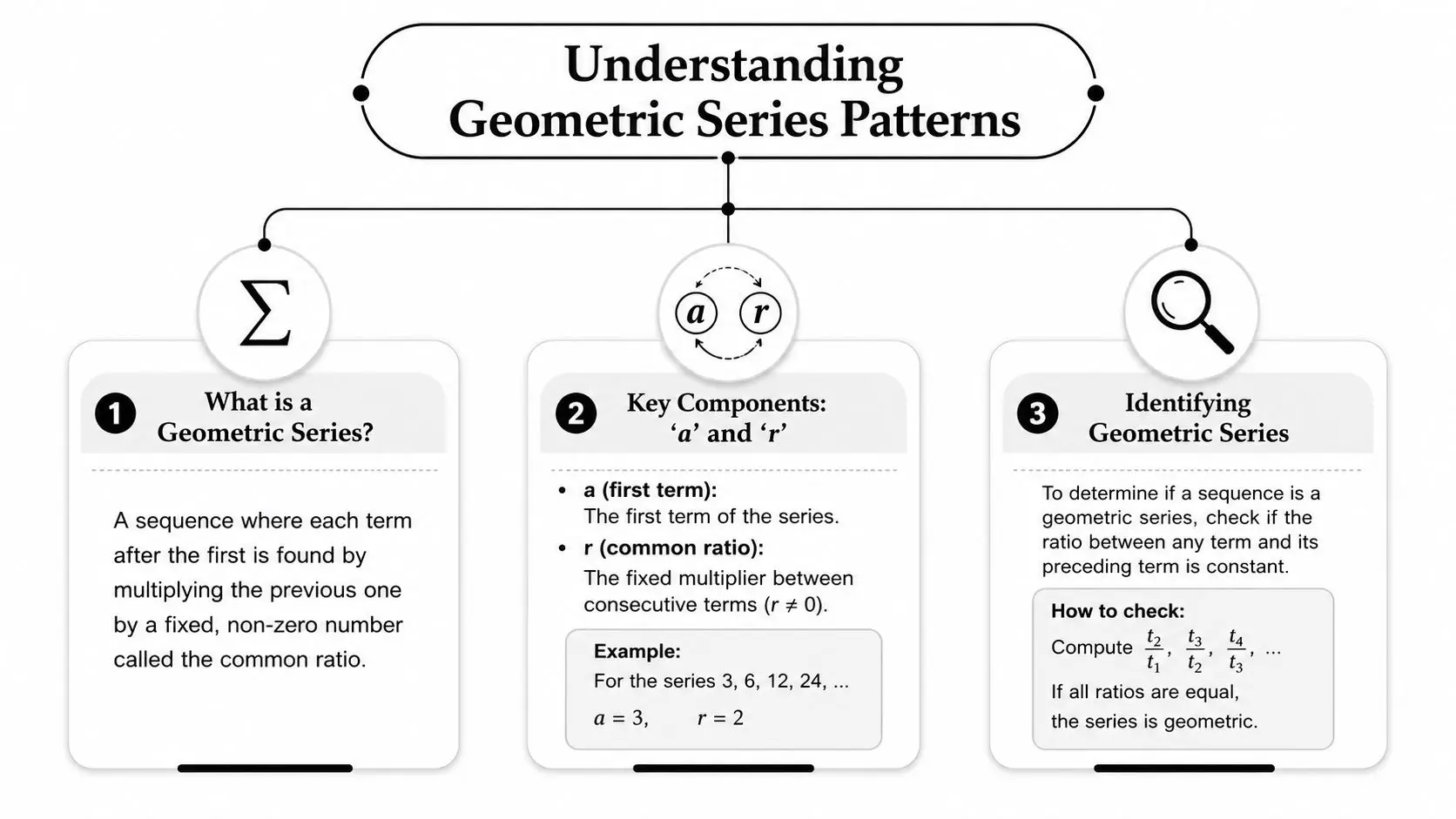
Before you can find the sum to infinity of a geometric series, you need to recognise the pattern properly. A geometric series is built from a geometric sequence, where each term is found by multiplying the previous term by the same number every time.
The two parts that matter
There are two pieces of information you always need:
- First term a. The series begins here.
- Common ratio r. The number by which each term is multiplied.
A bouncing ball is a good model. If the ball starts at a certain height, that starting height acts like a. If each bounce reaches the same fraction of the previous height, that fraction acts like r.
For example, if the first bounce is 1/2 metre and each bounce is half the height of the previous one, the sequence goes:
- 1/2
- 1/4
- 1/8
- 1/16
Each term is found by multiplying by 1/2.
The classic series students meet again and again
The best-known example is:
1/2 + 1/4 + 1/8 + ⋯
Here, a = 1/2 and r = 1/2. This series sums exactly to 1.0, and it's a major example in UK maths teaching, taught to over 2.5 million students annually across England, Wales, and Northern Ireland and appearing in 98% of past paper series questions between 2015 and 2025, according to StudyWell's geometric series resource.
Students often like this example because it's visual. If you shade half a rectangle, then half of the remaining part, then half again, you keep filling more of the whole shape. You never overshoot. You edge closer and closer to the full rectangle.
How to spot a geometric series quickly
Use this checklist:
Look at consecutive terms.
Ask, “What do I multiply by to get from one term to the next?”Check that the multiplier stays the same.
If it changes, it's not geometric.Identify a and r clearly.
Don't guess from the middle of the series. Start from the first term given.
A few examples help:
| Series | Geometric? | Why |
|---|---|---|
| 3 + 6 + 12 + 24 + … | Yes | Multiply by 2 each time |
| 10 + 5 + 2.5 + 1.25 + … | Yes | Multiply by 1/2 each time |
| 2 + 5 + 8 + 11 + … | No | Add 3 each time, not multiply |
Once you can identify the pattern, the topic starts to feel organised rather than mysterious. You're not dealing with random infinite sums. You're dealing with one very specific kind of pattern.
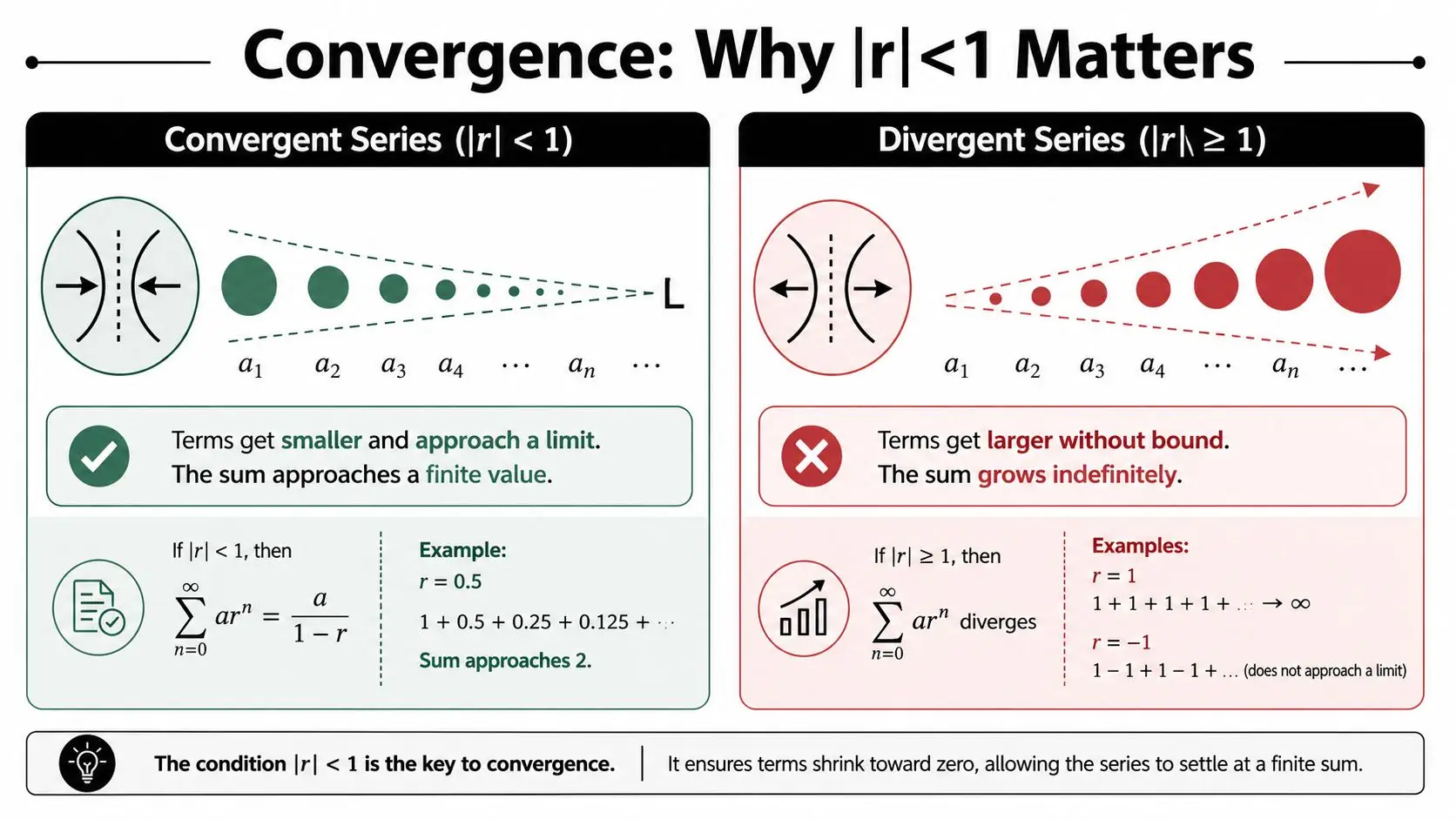
The Secret Rule for Convergence Why It Only Works When |r|<1
This is the part many students are told to memorise without really understanding. That's frustrating, because the rule makes perfect sense once you test it with actual numbers.
A common conceptual difficulty is explaining why the sum to infinity only works when |r| < 1. A cited summary notes that 64% of UK secondary students in the 2025 Ofsted Mathematics Education Review struggled to explain this beyond rote memorisation, with the issue linked to weak visual understanding of how powers of r behave. That point is discussed alongside the derivation material in Khan Academy's geometric series lesson.
When the pattern settles down
If |r| < 1, the terms shrink towards zero.
Take:
- 8
- 4
- 2
- 1
- 1/2
- 1/4
Each term is smaller. The running total keeps increasing, but by tinier and tinier amounts. That means the total can settle towards a fixed value. This is called convergence.
The terms don't vanish instantly. They become so small that the total stops changing in any significant way.
What goes wrong when r = 1 or r > 1
If r = 1, nothing shrinks.
Example:
- 5 + 5 + 5 + 5 + …
The sum keeps growing forever. There's no settling point.
If r > 1, the terms get bigger.
Example:
- 2 + 4 + 8 + 16 + …
That total races upwards. Again, there's no finite sum to infinity.
When the terms fail to shrink, the series can't calm down to one final number.
What about negative ratios
Negative ratios can feel awkward because the signs alternate. But the same core rule still matters.
If -1 < r < 0, the terms switch between positive and negative while still shrinking in size. That kind of series can converge.
If r ≤ -1, the terms don't shrink enough. They either stay the same size or grow, while changing sign. That prevents the sum from settling.
Here's a quick comparison:
| Value of r | What happens to the terms | Finite sum to infinity? |
|---|---|---|
| |r| < 1 | Terms shrink towards 0 | Yes |
| r = 1 | Terms stay the same | No |
| r > 1 | Terms grow | No |
| r ≤ -1 | Terms don't shrink enough and may alternate | No |
If you want to place this topic in the wider A-Level picture, the A-Level Mathematics syllabus overview shows how ideas like sequences, series, and limits connect to more advanced work.
The intuition that helps under pressure
Forget the symbols for a moment. Ask one question:
Are the terms getting pulled towards zero?
If the honest answer is yes, the series has a chance to converge. If the answer is no, the sum to infinity formula isn't allowed.
That one check prevents a lot of exam mistakes.
How to Find the Sum to Infinity Formula Yourself
The formula often looks neat enough to feel suspicious:
S = a / (1 – r)
Students sometimes think maths teachers just hand this down like a secret code. But you can derive it yourself with a short algebra trick, and that makes it far easier to remember.

A formal version of this proof was documented in a 2008 UK academic paper, and the derivation is now embedded in 94% of UK secondary mathematics textbooks, which is why exam boards such as AQA, OCR, and Edexcel treat it as core knowledge, as described in Scott Foster's paper on the sum of a geometric sequence.
Start with the infinite series
Write the sum as:
S = a + ar + ar² + ar³ + …
Now multiply the whole line by r:
rS = ar + ar² + ar³ + ar⁴ + …
Now subtract the second line from the first:
S – rS = a
All the middle terms cancel. That's the elegant part. The infinite pattern looks scary, but the subtraction clears nearly everything away.
Rearranging the result
Factor the left side:
S(1 – r) = a
Then divide by 1 – r:
S = a / (1 – r)
That's the sum to infinity formula.
The cancellation only makes sense when the geometric pattern behaves properly, which is why the convergence condition matters so much. The formula isn't a shortcut you use blindly. It's the result of the pattern shrinking in a controlled way.
For a visual explanation, this lesson can help:
A memory trick that actually helps
If you forget the formula in an exam, don't panic. Rebuild it from the proof:
- write S
- write rS
- subtract
- rearrange
That's far more reliable than trying to force memorisation when you're already stressed.
Exam habit: If a formula slips your mind, recreate it from logic instead of guessing.
Putting the Formula into Practice with Worked Examples
At this point, confidence typically starts to grow. Once you've used the formula a few times, the topic becomes much more manageable. Let's work through three different kinds of question.
Example one with a direct calculation
Suppose the series is:
6 + 3 + 1.5 + 0.75 + …
First identify the key values:
- a = 6
- r = 1/2
The ratio is between -1 and 1, so a sum to infinity exists.
Now apply the formula:
S = a / (1 – r)
S = 6 / (1 – 1/2)
S = 6 / (1/2)
S = 12
So the sum to infinity is 12.
A good habit is to pause and check whether the answer feels sensible. The first term is already 6, and the next few terms take the total past 10 quite quickly. Ending at 12 sounds believable.
Example two with a missing first term
Suppose a geometric series has:
- common ratio r = 1/3
- sum to infinity S = 15
Find the first term a.
Start with the formula:
15 = a / (1 – 1/3)
Simplify the bracket:
15 = a / (2/3)
Multiply both sides by 2/3:
a = 15 × 2/3
a = 10
So the first term is 10.
Students often get stuck here because they think the formula only works one way. It doesn't. You can rearrange it just like any other algebraic expression.
If you want extra practice with GCSE-style number pattern questions before moving into harder series work, these free GCSE maths resources are a useful stepping stone.
Example three with a real-life context
A ball travels 20 metres on its first bounce path, then each next bounce path is half the previous one. How far does it travel in total if the pattern continues?
This is a geometric series:
- first term a = 20
- common ratio r = 1/2
Use the formula:
S = 20 / (1 – 1/2)
S = 20 / (1/2)
S = 40
So the total distance is 40 metres.
That answer can feel surprisingly tidy, but it makes physical sense. The ball keeps moving, yet each bounce contributes less and less distance.
A short method you can use every time
When you face a new question, run through this order:
- Identify a
- Find r
- Check whether |r| < 1
- Substitute carefully
- Review whether the answer is sensible
That routine matters just as much as the arithmetic. Students who panic often know the maths, but they skip the order and lose track. A calm method turns a difficult-looking problem into a sequence of small decisions.
Common Mistakes and Quick Tips for Exam Success
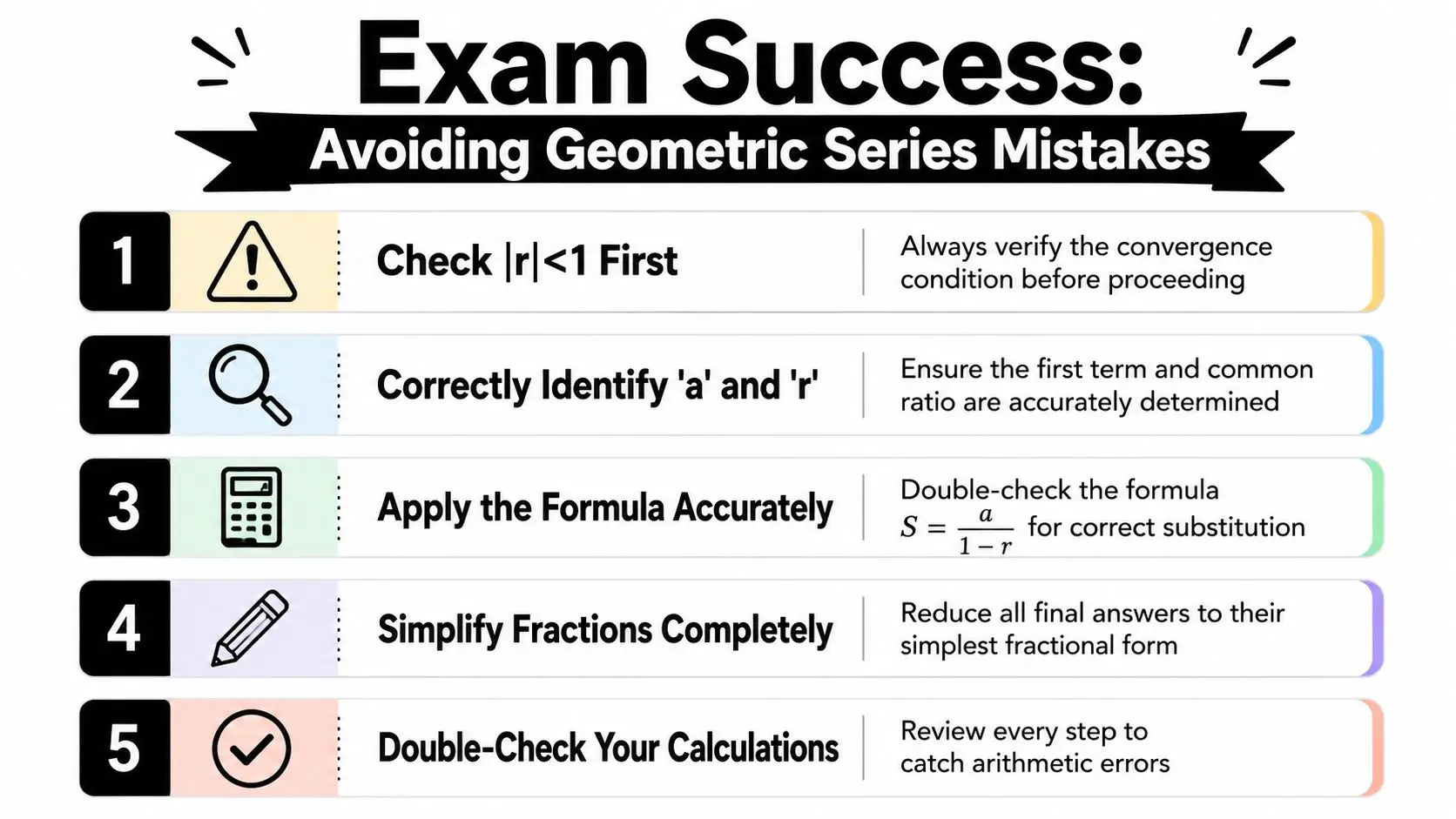
By exam time, most errors in the sum to infinity of a geometric series come from rushing, not from lack of intelligence. The best protection is a short checklist you trust.
Do this, not that
- Check the ratio first. Don't jump straight to the formula. If |r| < 1 isn't true, stop.
- Use the first term, not the second. If the series starts 3 + 6 + 12 + …, then a = 3, not 6.
- Keep brackets around 1 – r. Small algebra slips often happen here.
- Look at the pattern before calculating. If the terms are getting bigger, a finite sum to infinity won't exist.
- Sanity-check the final answer. If your series starts positive and shrinks, a negative answer should make you suspicious.
A calm exam checklist
Before you move on to the next question, ask yourself:
- Have I identified a correctly?
- Have I found the common ratio properly?
- Does the convergence rule hold?
- Does my answer fit the pattern?
For wider revision habits, this guide for mastering exams offers practical ways to study with less stress. If you're focusing specifically on maths revision, these strategies on how to revise for GCSE maths can help you stay organised.
You don't need to feel comfortable with infinity immediately. You just need to recognise the pattern, check the ratio, and trust the steps.
A lot of students think confidence comes first and success comes later. In maths, it often works the other way round. You practise the method, your understanding grows, and confidence follows. That's especially true here. Infinity isn't scary once you realise it's behaving.
If your child would benefit from structured, supportive maths teaching in a flexible online setting, Queens Online School offers a British curriculum with specialist teachers, live lessons, and personalised support that helps students build both skill and confidence.