


Your child is standing at the edge of secondary school, and you're wondering whether the next step will help them flourish or leave them overwhelmed. Perhaps mornings already bring tears, stomach aches, or arguments. Perhaps your child is bright and curious but struggles with noise, crowded corridors, bullying, long journeys, or the pressure to keep up with a large class. You may be searching late at night for a school that protects their wellbeing without lowering academic expectations.
KS3 online learning can provide that alternative, but only when it is much more than a collection of videos and worksheets. A well-designed programme gives a child qualified teachers, clear routines, meaningful relationships, regular feedback, and room to learn without feeling constantly exposed or rushed. The right decision starts with understanding what your child needs to feel safe enough to learn.
Understanding the Transition to Key Stage 3
On the evening before secondary school begins, a child may be worrying about details adults barely notice. Will they find the right classroom? What happens if they forget a book? Who will they sit with at lunch? For a pupil who has managed primary school comfortably, the larger building, unfamiliar routines, different teachers, and increased social expectations can still feel like a huge personal test.
Key Stage 3 covers Years 7, 8, and 9 in the British curriculum. These years introduce children to the wider academic and social world of secondary education, while building the knowledge, confidence, and study habits they'll need for later qualifications. Parents exploring an alternative route often feel guilty, as though choosing online education means taking something away from their child. That worry is understandable, but a different setting isn't automatically a lesser education.
A useful question: Which environment helps your child participate, ask for help, and remember what they've learned?
Consider a pupil who freezes when a teacher asks for an answer in front of a crowded classroom. At home, with a calm desk, a predictable timetable, and a teacher who allows responses through chat before verbal participation, that same pupil may begin contributing. Another child might need to move between lessons without the exhaustion of a long commute or the distress caused by busy corridors. A young performer or athlete may need a timetable that respects serious commitments while still providing consistent teaching.
That doesn't mean online learning removes every difficulty. A child still needs encouragement, boundaries, friendships, and opportunities to develop independence. Parents also need confidence that the programme follows a coherent curriculum rather than offering disconnected activities. A clear explanation of what Key Stage 3 involves can help families compare provision calmly and identify the support their child will need.
The most reassuring choice is usually the one that matches the child, not the one that looks most conventional. Ask whether your child needs more quiet, more flexibility, smaller groups, closer adult attention, or a gentler route back into education. Those needs can sit alongside high academic standards.
Mapping the British Curriculum to a Digital Classroom
Parents often ask a direct question: Will online school cover the same academic ground as a physical secondary school? The answer depends on the provider's curriculum, teachers, assessment system, and progression plan. A digital classroom should deliver a planned sequence of learning, not place resources online and expect a 12-year-old to organise everything alone.
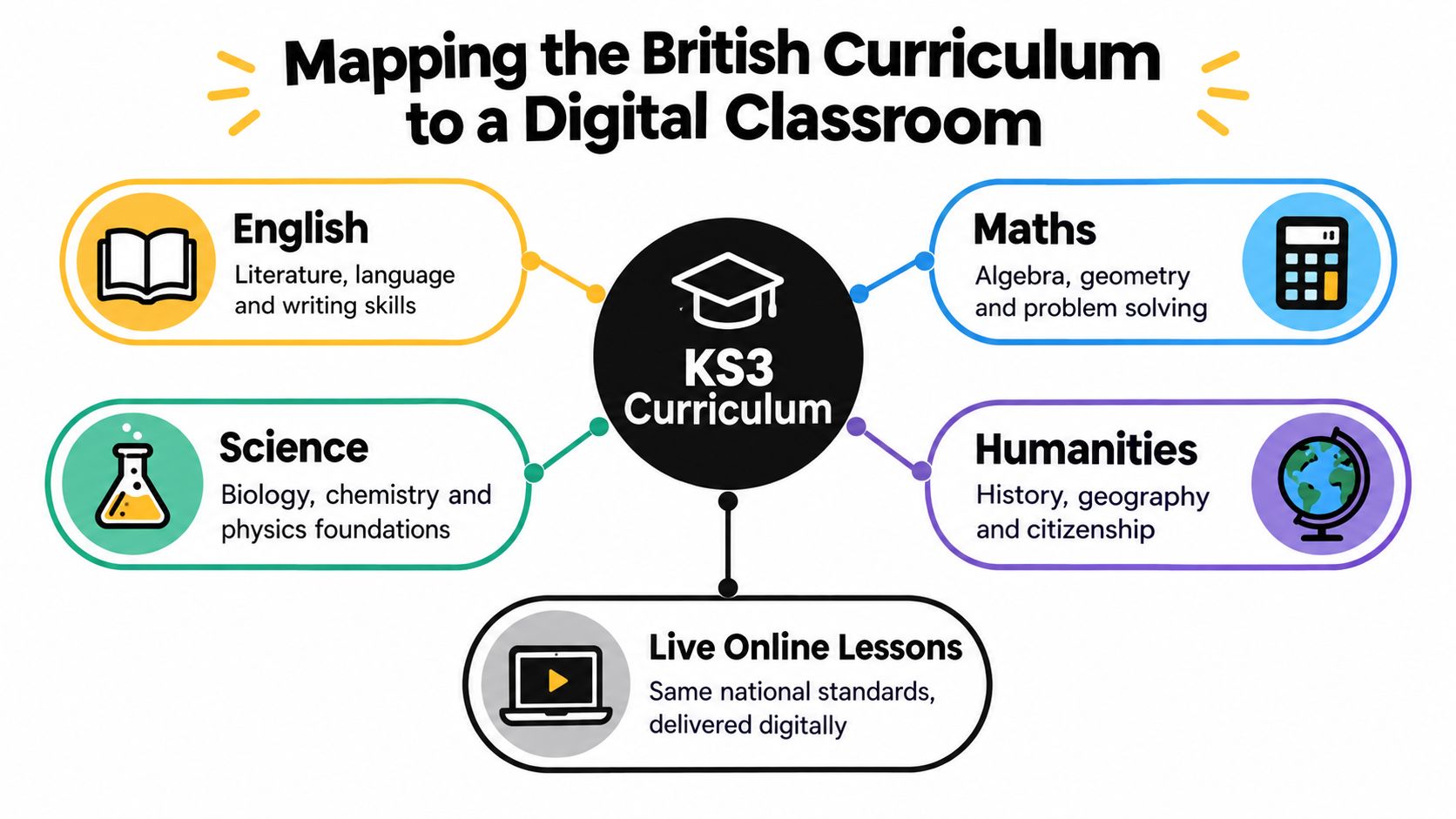
At KS3, English develops reading, writing, language, and literary understanding. Maths builds fluency alongside algebra, geometry, reasoning, and problem-solving. Science introduces the foundations of biology, chemistry, and physics. Humanities commonly include history, geography, and citizenship, while schools may also provide a modern language, computing, art, design, and personal development.
What strong digital teaching looks like
A passive video library is like handing a child a textbook and calling it a lesson. A live online classroom is closer to a workshop. The teacher explains a concept, notices confusion, asks questions, changes direction, and gives pupils a chance to practise while support is available.
For example, in a live maths lesson, a teacher might use a digital whiteboard to model an algebraic method, ask pupils to complete a problem, and use a poll to identify who needs another explanation. In English, pupils might annotate a passage together, discuss a character's motivation in a breakout room, and submit a paragraph for immediate guidance. In science, a teacher can use diagrams, demonstrations, questioning, and follow-up tasks to check whether pupils understand a process rather than merely recognising a definition.
Interaction is part of teaching. A recorded explanation can support revision, but it can't always reveal why a child has made a mistake or whether they've misunderstood a key idea. Quality KS3 online lessons should include teacher questioning, visible modelling, guided practice, independent work, and feedback.
A platform should connect the whole learning experience
Remote education guidance in England expects secondary schools to use a digital platform and provide at least some remote provision through video lessons. The guidance also identifies Oak National Academy as a national content source for learners from reception to Year 11. For KS3, the practical implication is clear: the strongest model combines a platform-based classroom, live or recorded video instruction, and organised curriculum resources rather than worksheets alone. This expectation is set out in the UK guidance on accessing remote education resources.
Parents should be able to see how lessons, homework, assessments, and feedback connect. Ask how teachers record attendance, explain missed work, identify gaps, and communicate concerns. If your child is struggling emotionally, you may also want a trusted, age-appropriate resource to help you find school mental health support and understand the wider support available.
A structured programme should make the curriculum visible to the child. They should know what they're learning, why it matters, what successful work looks like, and who they can ask when they're stuck. A clear outline of online school lessons can help you judge whether a provider offers genuine teaching or access to content.
Weighing the Benefits and Challenges for Your Child
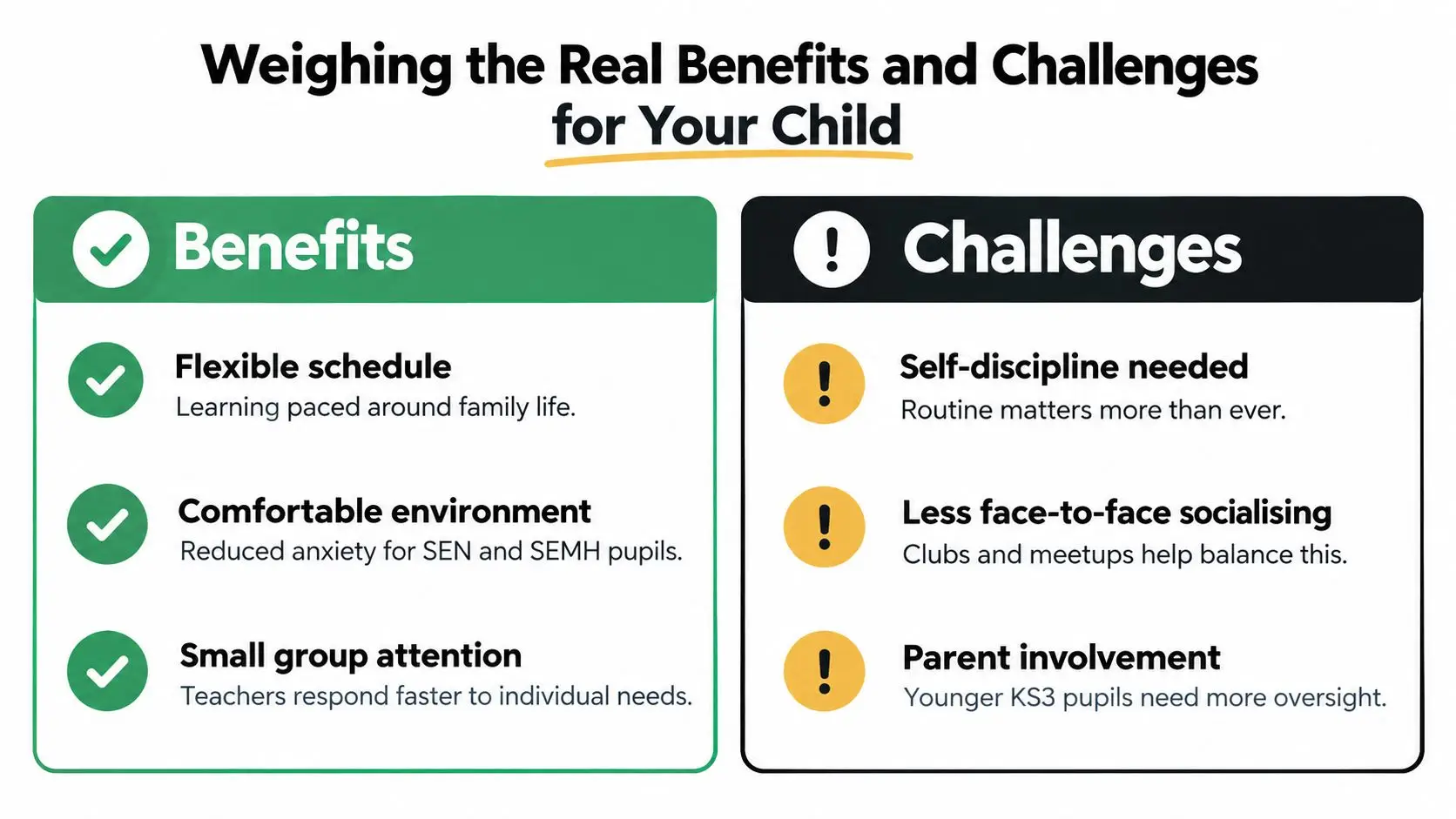
A child may finish a long school journey already tired, then face lessons, homework, and social demands with little energy left. Online learning can change that daily pattern. Learning in a familiar room may reduce the strain after a difficult playground interaction. A smaller online group may give a quiet pupil more chances to speak. Flexible study may also help a child balance education with health needs, sport, music, or family circumstances.
These advantages depend on connection. Without regular contact with teachers and classmates, home learning can bring screen fatigue, distractions, loneliness, and a heavier need for adult support. Some pupils value setting a comfortable pace. Others need an external routine because beginning work alone feels impossible. Ask your child which parts of the day give them energy and which leave them isolated or overwhelmed.
The pandemic provides a warning for families considering online education. During the first UK COVID-19 lockdown, online learning became the main delivery route for many secondary pupils, but access and intensity varied considerably. In May 2020, around 28% of secondary students weren't undertaking online classes, around 20% were spending more than four hours a day in online learning, and only 7% were receiving at least one online teaching lesson every day, according to the UK government review of learning during the pandemic.
What the early remote experience teaches us
Many children were expected to learn through screens without enough live explanation, dependable interaction, or consistent support. The same review found that secondary pupils received an average of 2.14 hours of online learning per day between April and June 2020, compared with 1.48 hours for primary pupils. Secondary pupils therefore had more digital provision than younger children, but still far less teaching contact than a normal school day.
The ONS analysis of remote schooling in England found that secondary pupils covered a closer fraction of the curriculum than primary pupils, while teachers reported the largest losses in arts and design-and-technology. The finding points to a practical risk at KS3: recorded content alone may not provide the explanation, subject guidance, and continuity a pupil needs.
A modern live model can address those gaps through a timetable, a named teacher, regular opportunities to respond, and a clear route for unfinished work. It still requires healthy screen habits. Build in movement, water, fresh air, and time away from devices. Watch your child's concentration and confidence, rather than relying only on attendance records. A pupil who appears present but has stopped asking questions may need help before marks fall.
Families comparing digital tools for language practice may find a current Polychat 2026 review useful for ideas. An app can supplement language learning, but it is not a full KS3 curriculum, teacher feedback, or a complete school community.
Supporting SEN and SEMH Needs in a Digital Environment
For some children, the school building itself becomes a barrier to learning. Noise, fluorescent lighting, crowded spaces, unpredictable changes, rushed transitions, and constant social interpretation can consume the energy that should be available for reading, problem-solving, and conversation. A child may appear oppositional when they're overwhelmed, frightened, or exhausted from masking their needs throughout the day.
A thoughtfully designed online environment can reduce some of that pressure. The child may learn in a familiar space, use headphones, take a short regulated break between lessons, or revisit an explanation without the embarrassment of asking the whole class to repeat it. A pupil with anxiety may contribute through the chat before speaking aloud. A pupil who finds eye contact difficult may engage more confidently when cameras are used flexibly and respectfully.
Support must be designed, not promised
Online schools often mention SEN support, timetable adjustments, and personalised pacing, but neutral UK evidence remains much thinner on whether those features improve participation, wellbeing, or progression at KS3. The KS3 online learning guidance from Nisai reflects this wider gap between the features providers describe and the outcomes parents need to investigate carefully.
Ask specific questions rather than accepting broad assurances:
- Participation: Can your child answer in chat, use a reaction, submit privately, or take part without keeping the camera on at every moment?
- Pacing: Can the teacher provide recorded explanations, chunked tasks, or additional processing time?
- Pastoral care: Who notices a withdrawal in participation, and how quickly does that person contact the family?
- Individual planning: How does the school record adjustments, review them, and communicate them to every relevant teacher?
- Attendance: Can the school distinguish between a technical absence, anxiety-related avoidance, and a child who has joined but cannot engage?
A camera-off period may help an anxious learner settle, but it shouldn't become silent exclusion. The teacher still needs to greet the pupil, check understanding, invite participation in a suitable way, and maintain a relationship. Similarly, flexible pacing should mean supported progress, not indefinite postponement.
A written SEN support plan can help families turn general concerns into practical arrangements. Include the child's triggers, calming strategies, preferred communication methods, signs of overload, and the kind of praise that builds trust. Your child should be involved wherever possible. They're more likely to use a support plan when it feels like something created with them rather than something imposed on them.
The emotional test: After a lesson, does your child feel more capable, or merely relieved that it has ended?
Online learning isn't a universal answer for SEN or SEMH needs. Some children need frequent in-person contact, specialist therapeutic support, or opportunities that a remote setting can't provide. The right environment is the one that understands the whole child and responds early when learning begins to feel unsafe.
Structuring the Week with Timetables and Assessments
Many parents fear that online schooling will turn the household into a sequence of forgotten logins and unfinished tasks. That outcome is avoidable. Children feel calmer when they know what happens next, where work is stored, when breaks occur, and which adult will help if the plan changes.
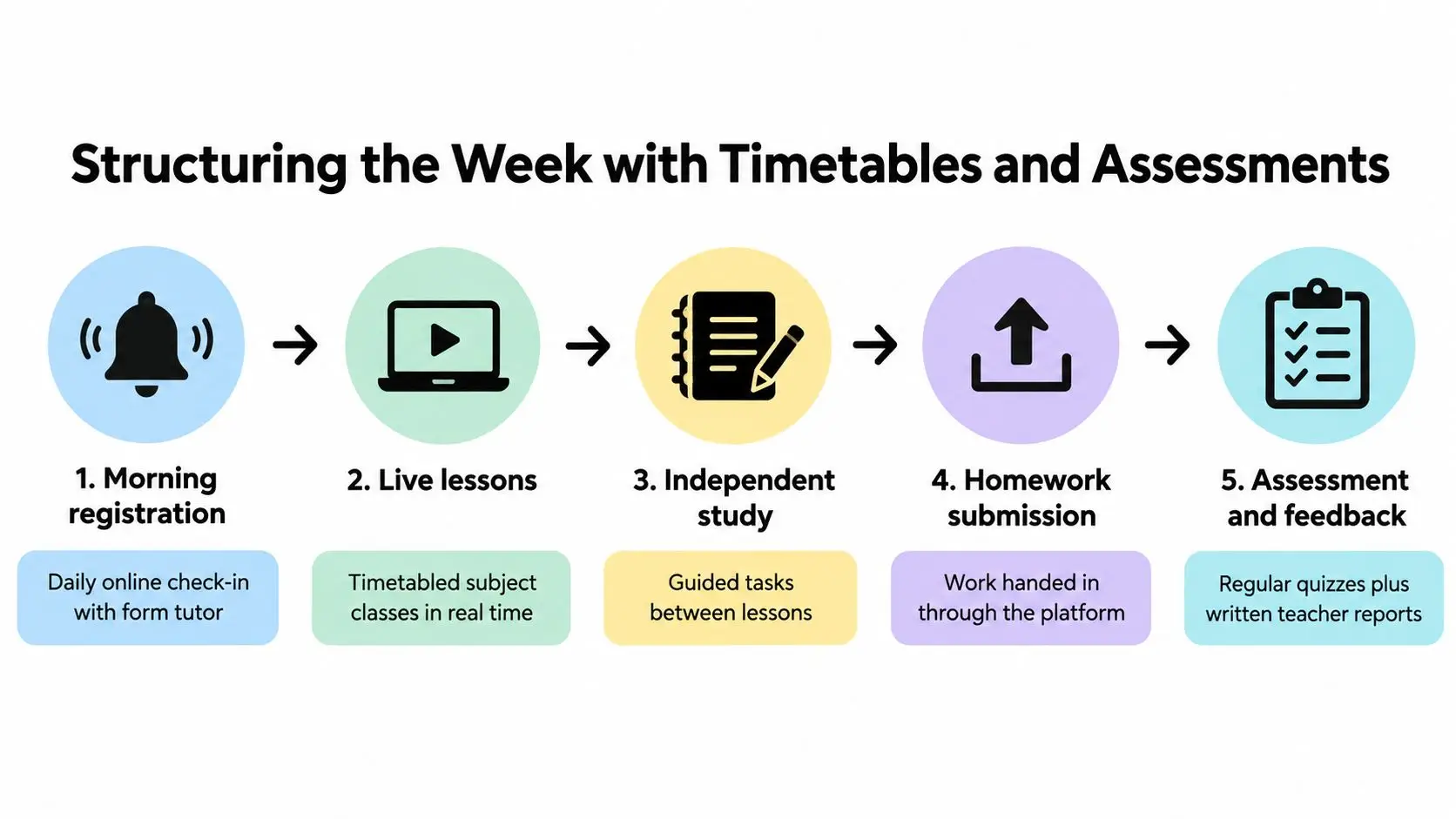
A healthy Tuesday might begin with registration and a brief check-in, followed by a live English lesson. After a movement break and a snack, the child could join maths, complete a short independent task, and submit work through the learning platform. The afternoon might include science, physical activity away from the screen, and a quiet review of anything that needs finishing.
Routine gives learning a safe shape
A useful weekly timetable should show more than lesson titles. It should make space for:
- Live teaching: Real-time explanation, questioning, discussion, and guided practice.
- Independent study: Short, clearly described tasks that match the child's age and current confidence.
- Physical regulation: Movement, outdoor time, and screen-free pauses.
- Feedback: A visible point at which teachers return comments or discuss progress.
- Connection: Tutor contact, group activities, clubs, or planned social opportunities.
Local authority resources for secondary-age home learning include KS3 materials and weekly plans, demonstrating a regional preference for organised, week-by-week learning rather than ad hoc worksheets. Suffolk's resource list also points families towards online platforms and distance-learning options for KS3 and KS4, including maths, science, and English. You can review the Suffolk secondary-age home learning resources for an example of how structured planning can support families.
Assessments should help teachers decide what to teach next, not make children anxious. A short quiz may reveal that a pupil remembers a scientific term but can't explain it. A marked paragraph may show that a child understands a novel but needs help organising evidence. A project can demonstrate research, communication, creativity, and subject understanding in ways a single test may miss.
Parents need visibility, not constant hovering
You shouldn't need to sit beside your child for every lesson. You do need a simple way to see attendance, deadlines, feedback, and concerns. Agree a daily check-in, perhaps after lessons finish, and ask your child three gentle questions: What made sense today? What felt difficult? What do you need tomorrow?
That conversation protects independence while keeping the child emotionally held. If the timetable is too demanding, the answer isn't to blame the pupil for lacking motivation. Review the pace, the length of tasks, the timing of breaks, and the support available.
Choosing the Right Online School Provider
A subscription platform and an online school may both display lessons on a screen, but they place very different responsibilities on the child. A resource platform gives access to content. A school should provide teaching, supervision, assessment, pastoral care, and a progression route.
Use the provider's answers, not its marketing language, to compare the two models.
| Feature | True Online School | Basic Resource Platform |
|---|---|---|
| Teaching | Live or well-supported instruction from qualified teachers | Pre-recorded content or downloadable tasks |
| Interaction | Pupils can ask questions, discuss ideas, and receive responses | Interaction may be limited or absent |
| Timetable | Organised school day with attendance expectations | Family creates its own schedule |
| Assessment | Regular quizzes, written work, teacher feedback, and progress reviews | Self-marked activities or occasional tests |
| Pastoral support | Named tutors, safeguarding processes, and escalation routes | Little or no ongoing pastoral responsibility |
| Curriculum pathway | Clear KS3 sequence and preparation for later qualifications | Families must judge coverage themselves |
| Community | Structured peer interaction, clubs, or group activities | No guaranteed cohort or social programme |
Questions worth asking before enrolment
Start with the teaching. How many lessons are live? Who teaches English, maths, and science? How do teachers respond when a child is quiet, confused, or absent? If recordings are available, are they used for revision and catch-up, or do they replace most live interaction?
Then examine assessment. Ask to see an example of written feedback and a progress report with personal information removed. Find out how the school spots gaps, supports a child who falls behind, and guides future subject choices. A provider that can't explain its assessment process may not be able to explain your child's progress either.
Safeguarding deserves the same scrutiny as academic content. UK government guidance says schools should set age-appropriate supervision for children using the internet and control interactions such as microphones and cameras. The guidance on safeguarding and remote education supports a child-centred approach in which boundaries are part of live lesson design.
Ask how the school handles private chat, recording, unknown contacts, camera use, inappropriate behaviour, and reports of bullying. Your child should know how to seek help without feeling they'll be punished for speaking up. Parents should know who to contact and what happens after a concern is raised.
Finally, look beyond lessons. Check whether pupils can join clubs, collaborate with peers, develop leadership, and maintain friendships outside formal teaching. A child may thrive academically but still need deliberate opportunities to laugh, create, move, and belong.
Taking the Next Step for Your Family's Future
By the time you reach this decision, you may feel tired of comparing timetables, policies, websites, and promises. You may also feel protective of your child in a way that makes every option seem risky. That doesn't mean you're indecisive. It means you understand that education affects sleep, confidence, friendships, family life, and a child's belief in their own ability.
Start with a conversation rather than a sales call. Ask your child what makes school days hard, which lessons they enjoy, how they prefer to communicate, and what would help them feel proud at the end of a week. Their answer might be a quieter environment, a smaller group, more time to process questions, a chance to catch up privately, or an adult who notices when they're struggling.
Next, attend a virtual open day if one is available. Watch how teachers speak to pupils, how students respond, and whether the atmosphere feels calm without becoming distant. Ask admissions staff about your child's specific SEN or SEMH needs, the timetable, assessments, recordings, pastoral support, safeguarding, and the route from KS3 into later qualifications.
A careful choice doesn't promise that every day will be easy. It gives your child the right conditions to recover from difficult days, ask for help, and keep making progress. Choosing a different educational path can be a powerful act of advocacy when the setting matches your child's needs and maintains genuine academic ambition.
Your child doesn't need to fit a school's idea of the average learner. They need teachers who see them clearly, routines they can trust, and a learning environment where success feels possible.
Queens Online School offers live, interactive British curriculum teaching for KS3, with subject-specialist support, structured learning, and recorded lessons that can help pupils revise or catch up. Visit Queens Online School to explore the programme and discuss whether its approach fits your child's academic, emotional, and pastoral needs.