
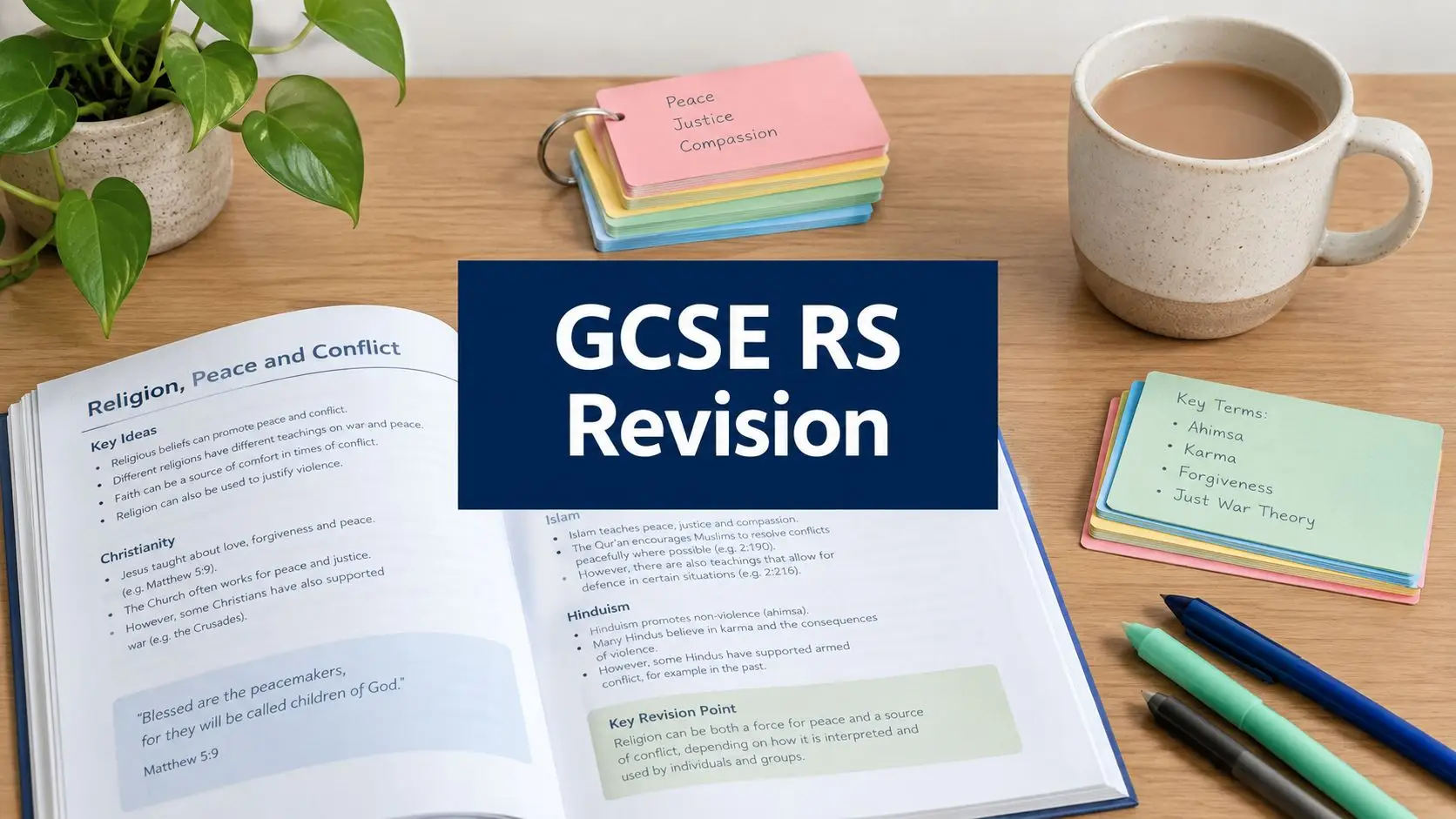
A Year 11 pupil sits at the kitchen table with flashcards spread around a cold cup of tea. One card asks for a religious teaching on peace, another asks about abortion, and a third contains a command word she's never properly understood. She knows she's revised, but she can't tell whether she's learning the right topics or just moving cards from one pile to another.
That uncertainty makes GCSE Religious Studies revision feel much larger than it needs to be. RS brings together religious beliefs, practices, sources of authority, ethical debates and extended written answers, but pupils don't all need the same timetable or the same method. A child who remembers everything when talking may struggle to write under pressure. Another may know the content but lose marks by misreading “evaluate”.
GCSE RS remains a substantial subject rather than a niche option. Provisional UK entries were 242,310 in summer 2025 and 240,945 in summer 2026, a year-on-year decline of only 0.6%, according to official GCSE entry data. Revision deserves the same careful planning as any other high-entry GCSE.
This guide gives you an honest syllabus map, command-word fluency, a realistic four-week timetable and examiner-informed technique. It also keeps the child at the centre, because a revision plan that ignores sleep, anxiety, attention and confidence won't survive contact with real life.
The Night Before the Exam and Why You Need a Plan Now
At 9.30pm, a pupil might decide to revise “everything” before morning. She opens a textbook, copies several pages, watches a video, tests herself once, then panics because she can't remember the first definition. Her parent, trying to help, asks questions from a different revision guide. Within minutes, both of them feel that the exam is already being lost.
That evening isn't a failure of effort. It's what happens when a broad subject has no visible boundaries. GCSE RS can include two religions, thematic issues, philosophy, ethics, scripture and different question types, depending on the specification. A pupil may spend an hour revising a familiar belief while leaving a whole practice topic untouched.
A plan lowers the number of decisions the child has to make. Instead of asking, “What should I revise tonight?”, the pupil sees one manageable task, such as “Islamic beliefs about life after death, then one four-mark explanation”. That structure helps protect sleep in the week before the exam and makes revision a sequence of deliberate practice rather than a reaction to fear.
Start with a map, not a mountain
The first job is to identify the actual board, religions and papers. The second is to divide content into small sessions. The third is to practise retrieving information and applying it to questions.
The historical shift towards full-course RS makes this especially important. A NATRE report on GCSE Religious Studies recorded full-course entries in England rising from 170,767 to 222,412 since 2010, while short-course entries fell from 254,698 to 18,837 over the same period. Modern revision therefore needs to prepare pupils for sustained written responses, not just short bursts of factual recall.
Practical rule: The child should finish each session knowing what was learned, what was forgotten and which question will be attempted next.
Parents don't need to become RS specialists. Their role is to provide calm structure, check that the right specification is being used, protect rest and listen without turning every conversation into a test. “Show me the question you're working on” is usually more helpful than “Tell me everything about Christianity.”
Choosing Your Exam Board Without the Confusion
Before making flashcards, confirm the specification. “GCSE Religious Studies” isn't one identical course across the UK, and using the wrong topic list can waste valuable time while leaving essential material untouched.
AQA generally divides assessment between the study of religions and thematic studies. Its question pattern is particularly useful for planning: each religion or theme uses five-part questions worth 1, 1, 4, 6 and 12 marks, with each theme marked out of 24. The full paper is 1 hour 45 minutes for 96 marks, plus SPaG marks, as set out in AQA's specification overview. Christianity and Islam are common choices, alongside options such as Judaism, Buddhism and Hinduism.
OCR uses papers on beliefs and teachings and practices for two religions, followed by a longer paper on religion, philosophy and ethics. Its full-course 9–1 qualification is entirely written examination: two 1-hour papers worth 25% each, plus one 2-hour paper worth 50%, according to the OCR specification at a glance. OCR options can include Christianity, Islam, Judaism, Buddhism, Hinduism and Sikhism.
Pearson Edexcel offers different routes, so the school's exact course matters. Religious Studies A is organised around study of religions and may include philosophy and ethics or textual studies. Religious Studies B uses Areas of Study, such as religion and ethics, peace and conflict, or social justice. If your child is taking Edexcel, start with the school's chosen route, not a general online summary. The Edexcel exam-board information from Queen's Online School can help families understand why the specification needs checking before revision begins.
Eduqas offers Route A and Route B structures, with choices involving religions, themes and ethical issues. Christianity and Islam are frequent components across UK courses, but the second religion and the precise themes depend on the school's specification.
GCSE RS Exam Boards at a Glance
| Board | Structure | Religions Covered | Papers |
|---|---|---|---|
| AQA | Study of religions and thematic studies | Commonly Christianity and Islam, with other options | Two papers |
| OCR | Beliefs and teachings, practices, philosophy and ethics | Two selected religions, with several options | Three full-course papers |
| Edexcel | Religious Studies A or B, depending on the school route | Two selected religions or themed Areas of Study | Route-dependent |
| Eduqas | Route A or Route B | Religion and theme choices depend on the specification | Route-dependent |
Within the next day, ask the school for the exam certificate, specification code or revision checklist. Check the school intranet and the board's official website. A board switch during revision isn't a harmless change of resource. It can alter the religions, wording, paper order and question expectations, which may cost marks even when the pupil has worked hard.
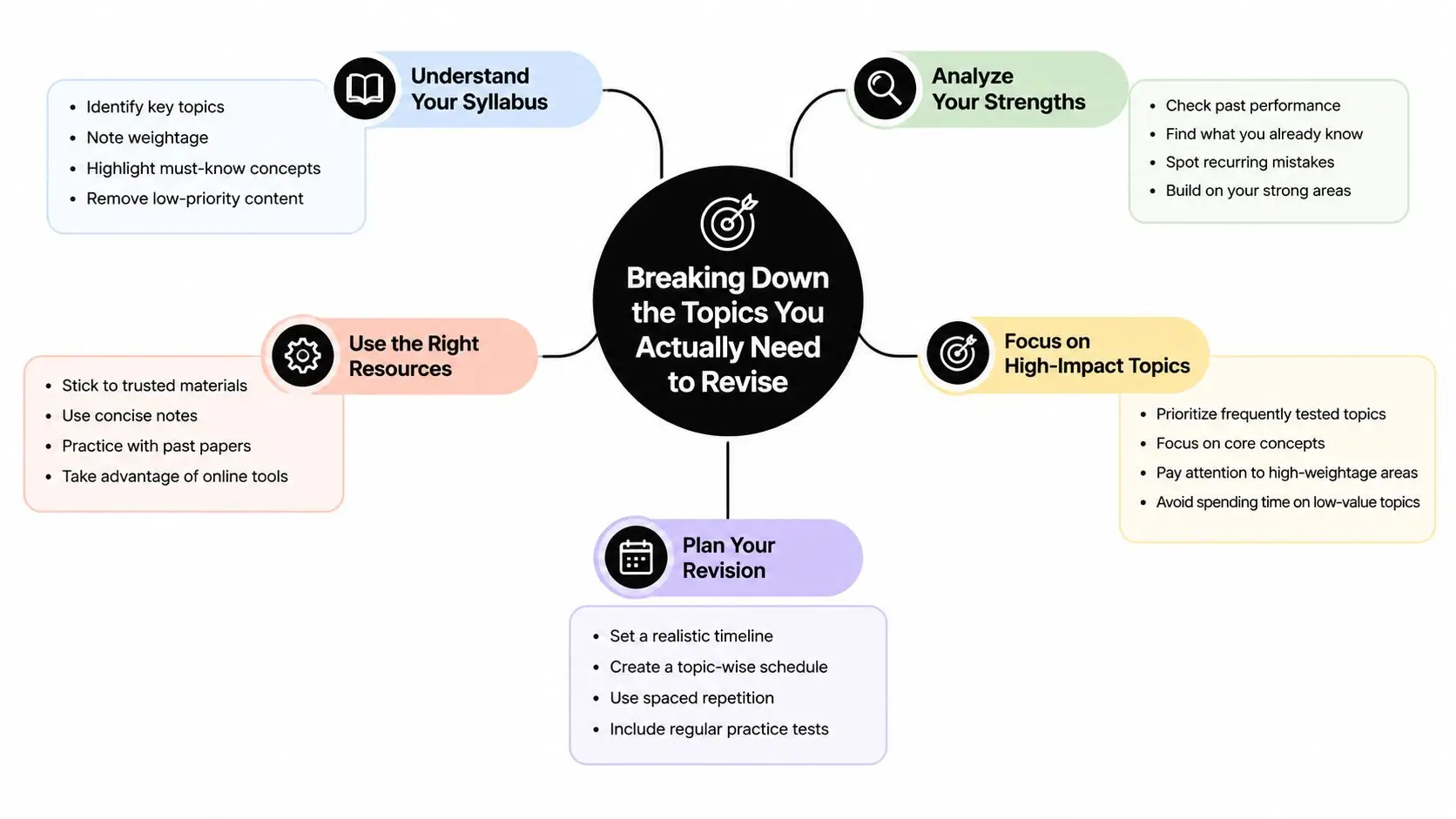
Breaking Down the Topics You Actually Need to Revise
A tired teenager doesn't need a specification document dropped in front of them. They need a topic map that answers one practical question: what do I need to know, and what might I have to do with it in an answer?
Use four colour-coded blocks in a notebook or digital folder. Keep beliefs in blue, practices in green, themes in orange and ethics in purple. The colours aren't decoration. They give a pupil with a crowded memory a quick visual route back into the subject.
Block one covers the two religions
For each religion, build short pages around:
- Beliefs about God, including divine qualities, revelation and the nature of humanity.
- Worship and practice, including prayer, festivals, pilgrimage, charity or community life where relevant.
- Authority, such as scripture, tradition, religious leaders and interpretation.
- Life after death, including judgement, resurrection, reincarnation or other teachings in the chosen traditions.
Don't write a page of disconnected facts. Attach each belief to a consequence. For example, if a pupil revises a belief in judgement, they should also explain how that belief might influence moral behaviour.
Block two is the thematic content
Themes often ask pupils to apply religious and non-religious viewpoints to real situations. Common areas include relationships and families, religion and life, crime and punishment, and human rights.
A useful page has three columns: the issue, a religious response and a contrasting response. Under “crime and punishment”, a pupil might compare retribution, rehabilitation and forgiveness, then add a relevant source of authority from the religion studied.
Block three brings ethics into focus
Ethical discussions may include abortion, euthanasia, poverty, wealth, the environment and animal rights. These topics require more than a definition. Pupils need to understand the argument, the reason behind it and the implications for real decisions.
A simple retrieval card might ask: “Why might a religious believer oppose euthanasia?” The answer should include a belief about the value of life, a source or teaching where appropriate, and an explanation of how that belief leads to the conclusion.
Make the map serve the question
The map links directly to command words. “State” needs precise recall. “Explain” needs a reason and development. “Evaluate” requires a reasoned judgement after considering viewpoints. When pupils revise a topic and a question type together, they stop treating knowledge and technique as separate subjects.
Command Words and Model Answers That Earn the Marks
A pupil can know the content and still lose marks by answering a different question from the one on the page. Command words tell them how to use what they know.
| Command Word | What It Means | Model Sentence Starter |
|---|---|---|
| State | Give a precise fact or teaching | “One belief is…” |
| Explain | Give a reason and develop it | “This means that…” |
| Analyse | Show how ideas connect and what follows | “This leads to…” |
| Evaluate | Weigh arguments and reach a judgement | “The stronger argument is…” |
| Discuss | Consider relevant viewpoints carefully | “Some people would argue…, whereas…” |
For a 12-mark answer, teach a repeatable structure: point, evidence, development, counter-argument and conclusion. A paragraph that says “Christians believe abortion is wrong because life is sacred” has a useful starting point, but it needs development. Why does the belief matter? How does it affect the issue? Is there a Christian argument that may support a different position?
A model answer on abortion
Question: “Abortion is always wrong. Evaluate this statement.”
Some Christians believe abortion is wrong because human life is sacred. The commandment “Do not murder” can be used to support the view that an unborn child should be protected. If life is understood as a gift from God, ending a pregnancy may be seen as rejecting God's authority. [AO1: accurate belief and source, followed by explanation.]
However, other Christians may consider situations where continuing a pregnancy could cause serious harm. They may argue that compassion and love should guide moral decisions, particularly where a person's health or circumstances are difficult. This doesn't mean that life has no value. It means that believers may balance the protection of life with responsibility for suffering and wellbeing. [AO2: a developed alternative viewpoint.]
Some non-religious people may focus on personal autonomy. They could argue that the pregnant person should make the decision because they carry the physical and emotional consequences. Others may oppose abortion on human-rights grounds, believing that the unborn child has a right to life. [AO2: more than one non-religious line of reasoning.]
Overall, I don't agree that abortion is always wrong. Protecting life is a serious argument, but “always” leaves no room for circumstances involving danger, coercion or severe suffering. The strongest judgement is that abortion should be treated as a morally serious decision, with the relevant people considering the value of life, responsibility and compassion. [AO2: clear conclusion that follows from the discussion.]
This answer isn't successful because it uses complicated vocabulary. It earns its strength by explaining why each belief matters, presenting competing views and making a qualified judgement.
For a read-aloud check, the parent and child can underline phrases such as “this means that”, “however”, “on the other hand” and “overall”. Then ask three questions: Is the religious teaching accurate? Has the writer explained its effect? Does the conclusion answer the exact wording, including words such as “always” or “best”?
A similar habit helps with GCSE English revision methods, especially when a pupil needs to organise evidence and develop an interpretation rather than merely remember information.
A Four-Week Revision Timetable That Fits Real Life
Cramming feels productive because the pupil spends a long time at the desk. It often produces recognition rather than reliable recall. GCSE RS rewards both accurate knowledge and flexible thinking, and panic makes it harder to retrieve a source, compare viewpoints or sustain a conclusion.
A realistic timetable uses short sessions, predictable breaks and room for missed days. Each slot below lasts 40 minutes, followed by a 10-minute buffer. That buffer matters for a late bus, a part-time job, caring responsibilities, a difficult homework task or an anxiety dip.
The four-week pattern
Week one, build the map
- Monday: Religion one, beliefs and teachings.
- Tuesday: Religion one, practices and authority.
- Wednesday: Rest.
- Thursday: Religion two, beliefs and teachings.
- Friday: Religion two, practices and authority.
- Saturday: Retrieval cards from the week.
- Sunday: One set of past-paper questions, followed by marking.
Week two, cover themes
- Monday: Relationships and families.
- Tuesday: Religion and life.
- Wednesday: Rest.
- Thursday: Crime and punishment.
- Friday: Human rights.
- Saturday: Compare religious and non-religious viewpoints.
- Sunday: Timed questions from two different themes.
Week three, practise ethics and explanation
- Monday: Abortion and euthanasia.
- Tuesday: Poverty and wealth.
- Wednesday: Rest.
- Thursday: Environment and animal rights.
- Friday: Source-of-authority retrieval.
- Saturday: Plan 12-mark answers without writing the full response.
- Sunday: Complete and mark an extended-response set.
Week four, turn knowledge into exam performance
- Monday: Weakest religion block.
- Tuesday: Weakest theme or ethical issue.
- Wednesday: Rest.
- Thursday: Command-word drills.
- Friday: Timed paper practice.
- Saturday: Correct errors and reread key notes.
- Sunday: Light retrieval only, then prepare calmly for the week.
Use a swap-day rule when a session is missed. Move it to the next available slot, but don't double the workload the following evening. A child who is already exhausted won't gain from being punished with an impossible timetable.
Parents can put phones outside the room for the 40-minute slot, then return them during the buffer. Protect the hour before bed from heavy testing. If a pupil benefits from hearing ideas explained in different ways, resources offering multilingual chatbot insights may support discussion, but any generated explanation must be checked against the school specification and trusted board materials.
Reading Examiner Reports for Easy Grade Gains
Examiner reports are written after marking and explain where candidates handled questions well and where answers fell short. Eduqas' 2025 report noted improved candidate engagement, fewer non-attempts and greater awareness of timing strategies, which makes timed completion and avoiding blank answers sensible revision priorities. OCR reports similarly identify technical aspects of questions and areas where performance can improve, so pupils should treat them as practical training documents, not paperwork for teachers.
Find the report on the relevant board website, then search for the paper and year your child is studying. The important detail is not a general comment about GCSE RS. It's the specific warning connected to the question style, topic and assessment objective.
The desk-side checklist
- Answer every part. Circle the command word and the topic before writing.
- Develop AO2. Explain why a belief or argument matters, not only what it says.
- Use both sides where evaluation is required. A single viewpoint rarely demonstrates a balanced judgement.
- Include specialist vocabulary accurately. A term only helps when the pupil can use it in context.
- Leave time for a conclusion. The final judgement should answer the wording of the question.
- Practise under realistic timing. A strong untimed paragraph doesn't guarantee a complete exam answer.
What examiners reward: accurate knowledge becomes valuable when the pupil applies it, develops it and reaches a justified judgement.
Consider a paragraph that says, “Euthanasia is wrong because life is important. Some people disagree because they want choice.” It contains relevant ideas but the links are thin. A stronger version explains that a believer who sees life as sacred may regard intentionally ending it as beyond human authority, then contrasts this with autonomy and relief from suffering. The writer can finish by judging which principle should carry more weight in the stated circumstances.
The most useful review often takes only a focused reading of the report for the child's paper. After a mock, ask: Which command words caused difficulty? Where did the explanation stop too early? Did the answer include a relevant source? Was the alternative fully developed? Did the conclusion use the wording of the question?
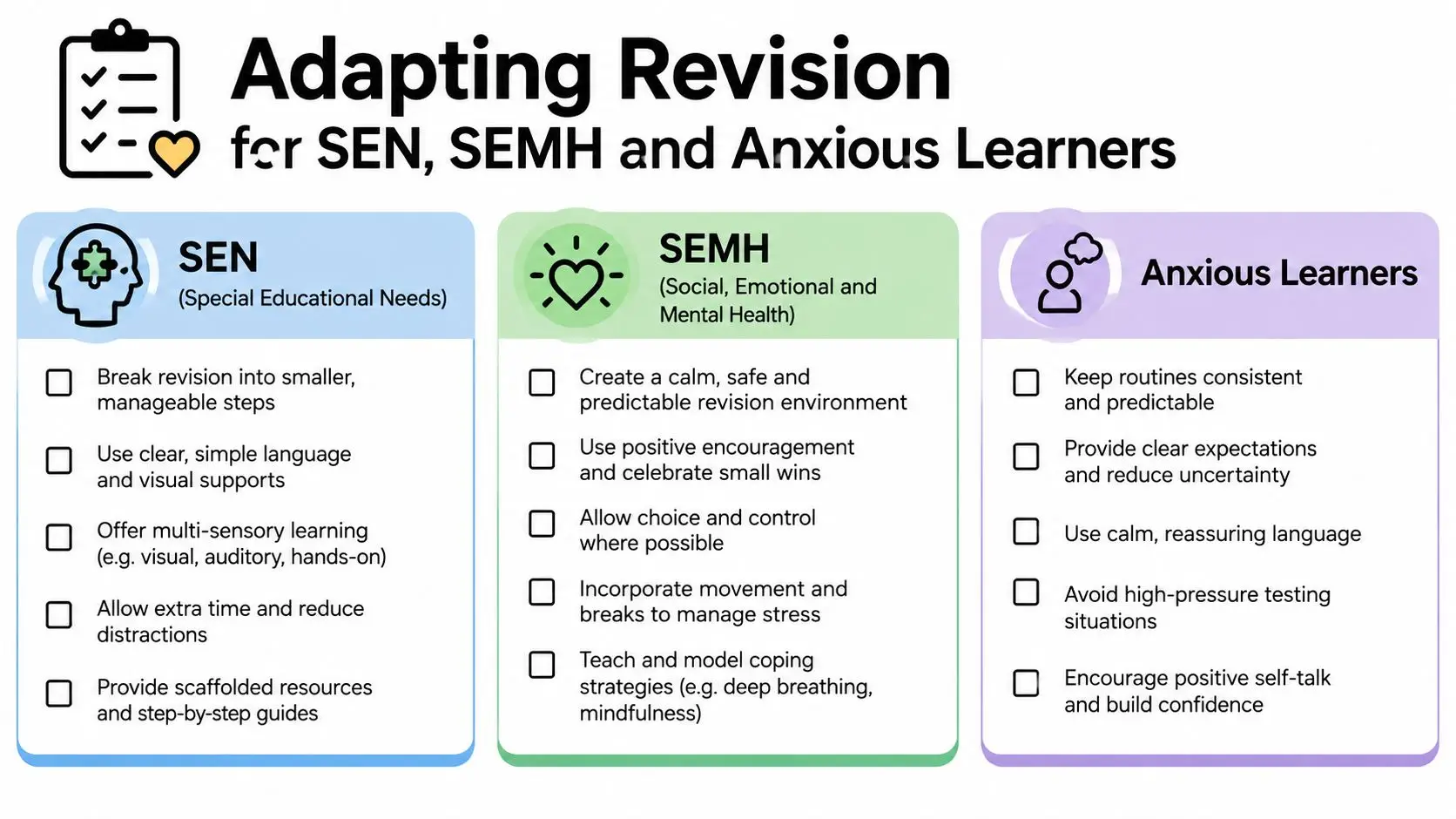
Adapting Revision for SEN, SEMH and Anxious Learners
A revision plan should fit the learner before it fits the calendar. Social and emotional learning supports self-awareness, relationships, emotional self-management and decision-making in both primary and secondary settings, as outlined in the UK Parliament briefing on social and emotional learning. In RS, that can mean using discussion, reflection and calm routines as part of serious preparation, not treating them as distractions from the syllabus.
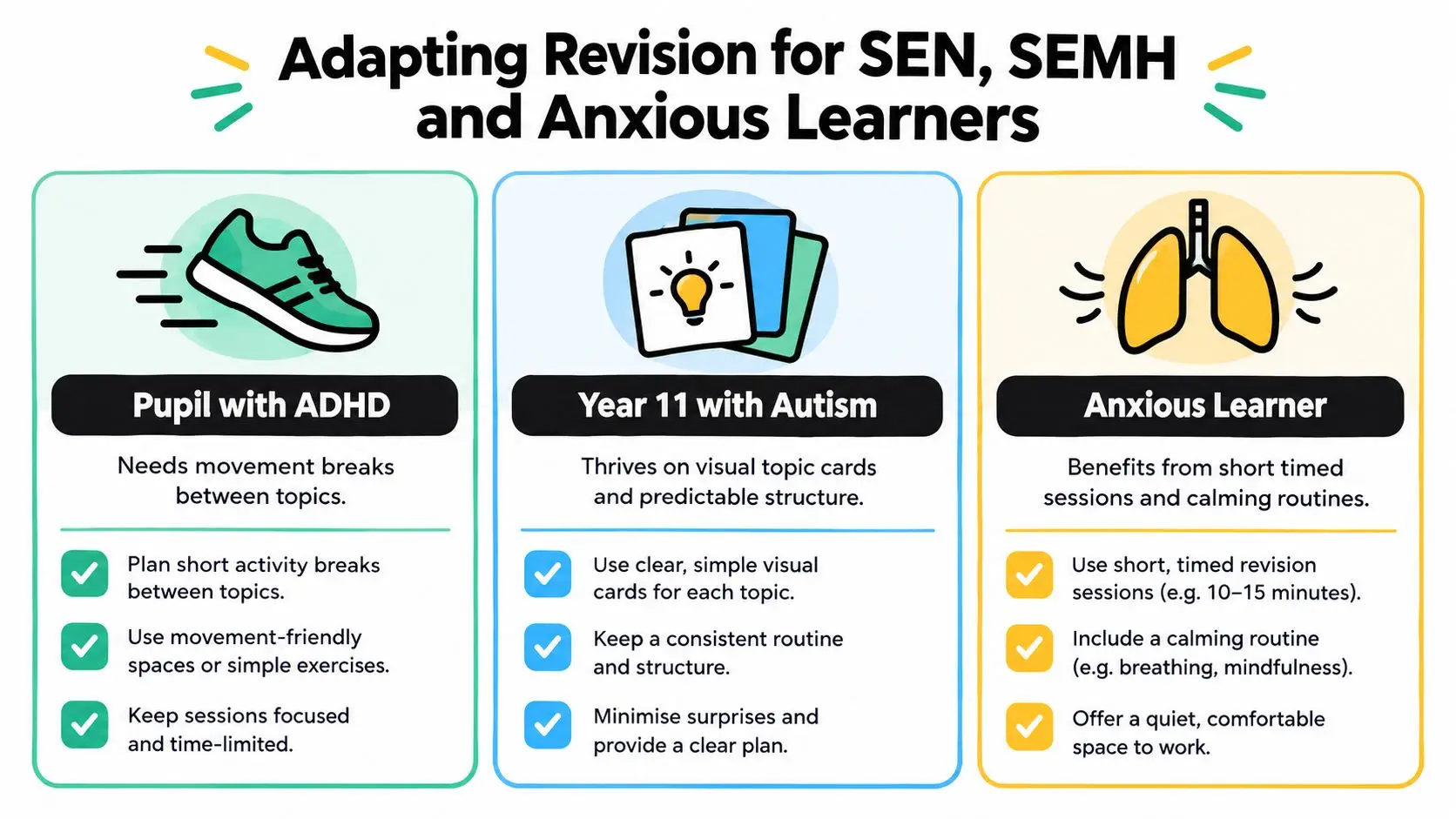
Take a pupil with ADHD who understands a topic but can't sustain a long, silent session. Give them a small target, such as one belief and one question, then add movement between tasks. They might record an answer while walking, sort source cards across the floor or stand to explain a comparison aloud. Guidance on how to break down tasks with ADHD can help parents turn a large revision task into visible, manageable actions.
A Year 11 pupil with autism may feel safer when the order never changes. Use visual topic cards, a written session sequence and a clear finish point. “Beliefs card, two retrieval questions, one planned paragraph, stop” is easier to process than “revise Islam for a while”.
An anxious learner may panic when faced with dense mark schemes or a blank page. Start with a two-minute calm routine: feet on the floor, slow breathing, name the question's topic, then write one fact. Follow with a short timed response and a planned recovery break. The aim isn't to remove every difficult feeling. It's to give the pupil a predictable action when fear appears.
Support without adding pressure
A parent can say:
“Would you like me to listen, help you organise the first step, or give you quiet space?”
That question gives the child control without removing support. Discussion-based preparation can include comparing two viewpoints at dinner, explaining a source aloud or listening to a recorded model answer before attempting a written one.
Schools should be contacted early if a pupil may need access arrangements or other support. Families shouldn't wait for a disappointing mock result before asking what evidence, classroom observations or formal processes may be needed. Ofsted's personal development framework includes resilience, confidence and mental health, and the Education Policy Institute's discussion of social and emotional learning helps place wellbeing within a wider educational context.
For practical guidance on reducing exam stress, keep the focus on routines the child can repeat:
- Before revision: water, clear desk and one stated target.
- During revision: one topic card, one retrieval task and one short question.
- After a difficult answer: mark one success before correcting one gap.
- Before sleep: stop heavy testing and use a calm, familiar routine.
- When panic rises: pause, breathe, name the next small action and ask for help.
Queens Online School offers live online lessons, recorded sessions for catching up, structured GCSE revision support and subject-specialist teaching, with targeted support for learners with SEN and SEMH needs. If your child needs a flexible British curriculum with individual guidance around revision and wellbeing, visit Queens Online School to explore how its online GCSE provision could support the next step.