

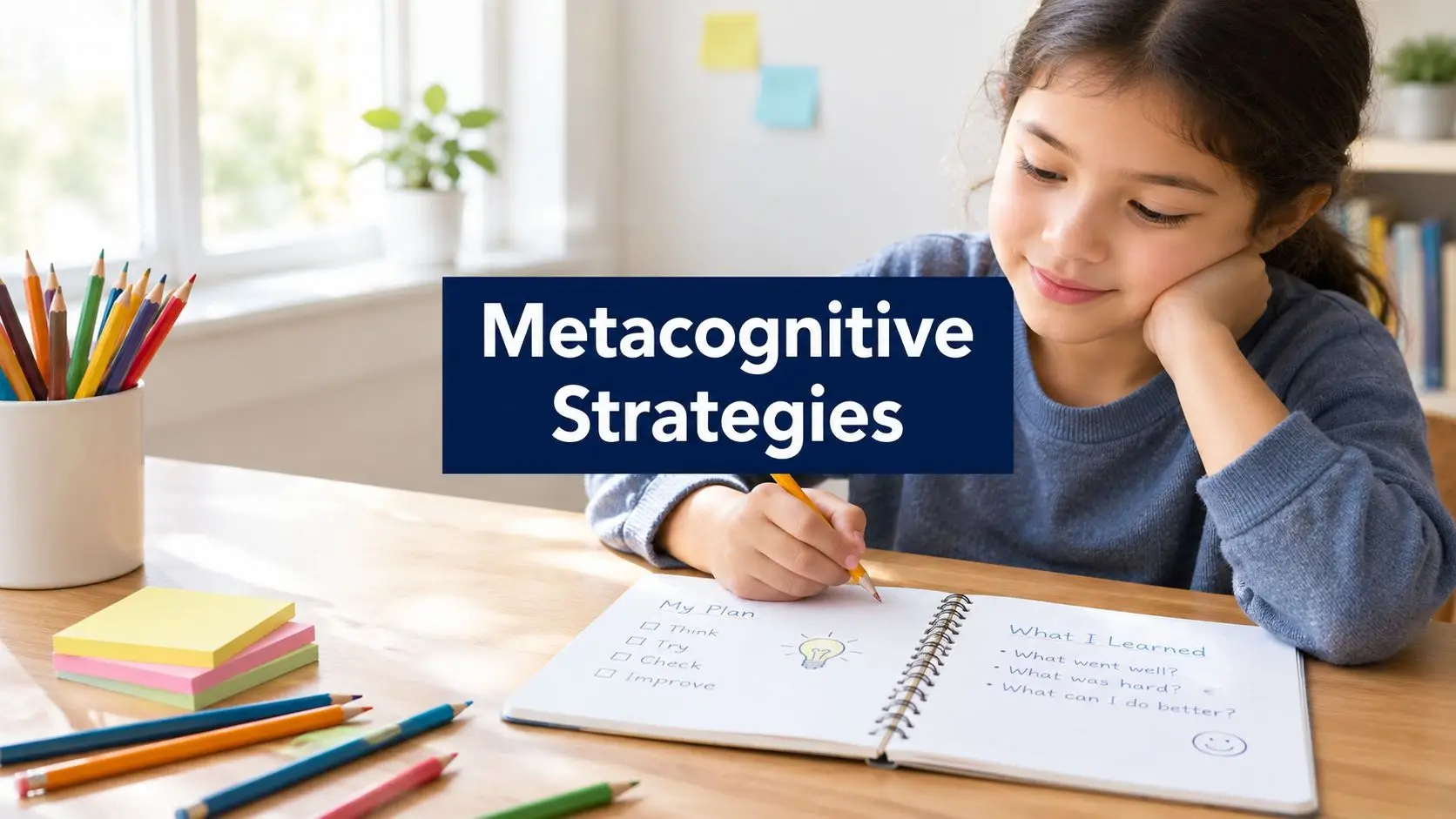
Your child stares at a maths worksheet, pencil hovering above the page. They understood the lesson earlier, yet now their shoulders tense, their eyes fill with tears, and “I can't do it” replaces every possible first step. You want to help, but giving the answer only makes the next problem feel just as frightening.
This moment isn't proof that your child lacks ability. Often, they need support with the hidden work of learning: deciding how to begin, noticing confusion, choosing a different approach, and judging whether an answer makes sense. Metacognitive strategies make that hidden process visible, practical, and less lonely for a child who feels stuck.
Why Smart Children Still Struggle With Learning
A bright child can know plenty and still struggle to use that knowledge at the right moment. Understanding a multiplication method doesn't automatically tell a pupil which method a word problem requires. Knowing vocabulary doesn't guarantee that a child will notice when a paragraph has stopped making sense.
Consider Maya, who joins an online lesson confidently and answers questions aloud. Later, faced with homework, she reads the instructions repeatedly but can't identify what the task is asking. She becomes annoyed, then ashamed, and finally pushes the book away. Her parent sees refusal. Maya experiences a confusing mixture of pressure, uncertainty, and fear of getting it wrong.

The missing inner conversation
Metacognition means noticing and directing your own thinking. A child uses it when they ask themselves:
- What am I trying to achieve?
- Which strategy might help me begin?
- How do I know whether I understand this?
- What could I change if my first attempt doesn't work?
These questions give a child something more useful than reassurance alone. “You're clever” can feel painful when the work seems impossible. “Let's identify the first step together” offers a route forward without judging the child's ability.
For Maya, the shift might sound like this: “First, underline what the question wants. Then, circle the information you need. Which operation could connect those two things?” Her parent hasn't solved the problem. They've helped Maya find the thinking process that was hidden by anxiety.
Confidence grows through control
Children often feel calmer when they can name what's happening. “I'm confused because I don't know which formula to choose” is more manageable than “I'm bad at science.” A teacher or parent can then address the specific barrier, perhaps by revisiting an example, modelling the choice, or breaking the task into smaller parts.
Metacognitive strategies therefore support both academic progress and emotional safety. They teach children that confusion is information, not a verdict. The aim isn't to make every task easy. It's to help your child believe that difficulty can be examined, managed, and approached one step at a time.
The Evidence Behind Thinking About Thinking
Parents understandably want more than a promising idea. They want to know whether teaching children to plan, monitor, and evaluate their learning has a credible foundation.
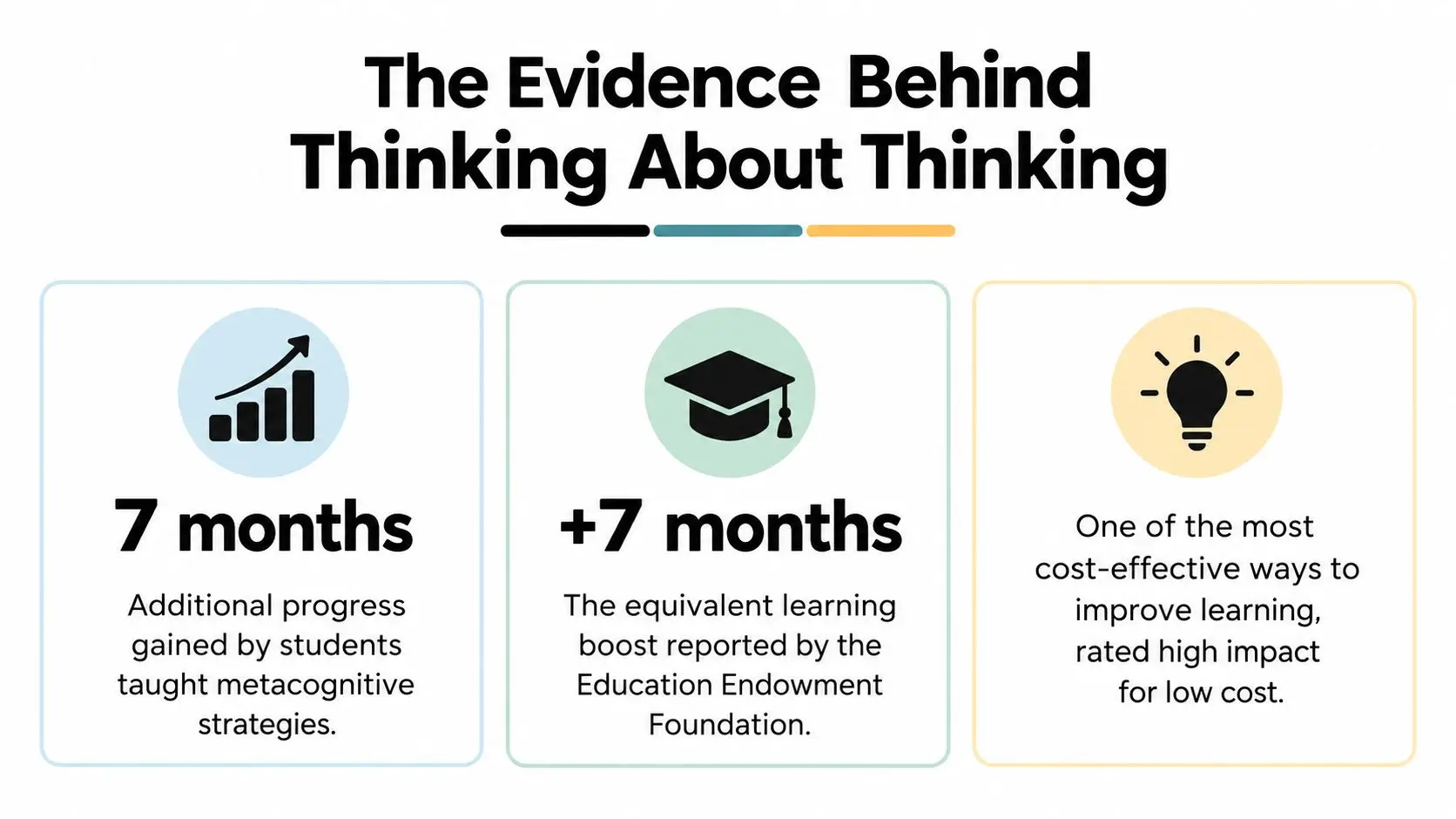
The Education Endowment Foundation's evidence on metacognition and self-regulation identifies these approaches as one of the highest-impact classroom practices, estimating an average gain of an additional eight months' progress over a single school year when strategies are taught well. That figure doesn't mean every child will make exactly the same gain, nor does it promise a particular result for an individual pupil. It describes an average evidence-based advantage across the studies considered.
What the progress means in daily life
The number matters because it represents more than marks. A child who learns to check their understanding may ask for help earlier instead of abandoning a task. A pupil who can choose a revision method may spend less time rereading notes without knowing whether anything has been learned. A reluctant writer may use a plan to turn a blank page into a sequence of manageable decisions.
The EEF guidance report on metacognition and self-regulated learning explains why the method works best when teachers teach strategies inside subject content, rather than presenting them as generic study advice. A child needs to learn not only what planning is, but when planning helps in a history essay, a chemistry investigation, or a fractions problem.
That distinction protects children from empty routines. Asking a pupil to “reflect more” is unlikely to help unless an adult models what useful reflection sounds like. “Which clue told you to use that method?” gives the child a concrete point to examine.
From theory to classroom practice
In England, metacognition became increasingly treated as a teachable classroom routine rather than an abstract psychological idea. The EEF's 2017/2018 guidance helped standardise a practical model involving activating prior knowledge, teaching a strategy, modelling it, providing guided and independent practice, and structuring reflection.
That history matters to families because it explains why the language now appears across primary and secondary education. Teachers aren't asking children to become miniature psychologists. They're giving them repeatable routines for managing attention, motivation, uncertainty, and improvement.
The Core Cycle Of Planning Monitoring And Evaluating
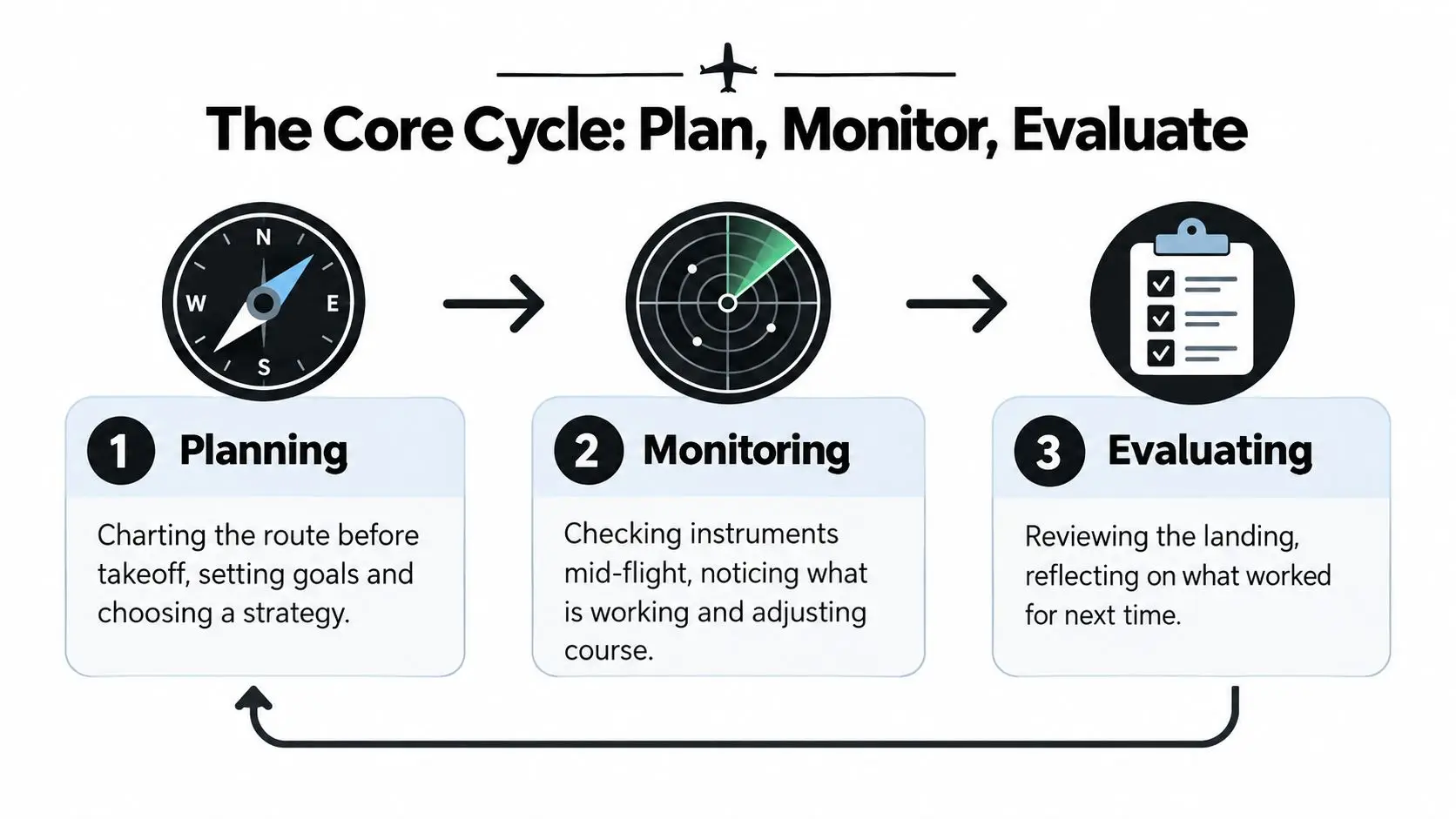
Think of learning as a flight. Before take-off, the pilot charts a route. During the journey, the pilot checks the instruments and responds to changing conditions. After landing, the pilot reviews the journey so the next route can be planned more effectively.
Children can use the same cycle for everyday learning. UK government and EEF resources describe metacognition as pupils' awareness of their own thinking and their ability to plan, monitor, and evaluate learning, presenting it as a teachable routine rather than an abstract skill. You can find the classroom framing in this UK early-career teacher evidence resource.
Planning before the task
Planning isn't writing a beautiful timetable. It's deciding what success looks like and selecting a sensible first move.
Before a child starts an English response, ask, “What does the question want you to explain?” They might then identify the key words, choose two quotations, and sketch a simple opening. Before a maths problem, planning could mean naming the known information, identifying the unknown, and choosing an operation to test.
Useful prompts include:
- Goal: “What will a finished answer need to include?”
- Route: “Which method have you used for a similar problem?”
- Resources: “Would a worked example, diagram, formula sheet, or glossary help?”
- Emotional readiness: “Are you calm enough to begin, or do you need a short pause first?”
Keep the planning proportionate. A child who is already overwhelmed needs one clear decision, not a long interrogation.
Monitoring during the task
Monitoring means checking the instruments while the work is happening. Your child might pause after a paragraph and say, “I've lost the meaning,” then reread the previous sentence, define a word, or ask for clarification. In maths, they might estimate the answer and notice that their calculation produces something unreasonable.
Ask questions that return responsibility to the learner:
Useful prompt: “What tells you that this strategy is working?”
If the strategy isn't working, avoid treating a change of method as failure. Say, “Your first route hasn't taken you where you need to go. What could we try next?” Children learn resilience when adults treat adjustment as part of competent learning.
Parents supporting children with attention or executive-function difficulties may also find these ADHD planning and focus strategies useful, particularly when a large task feels impossible to organise.
Evaluating after the task
Evaluation isn't just deciding whether the answer is right. It involves examining the process and choosing what to carry forward.
Ask, “Which part helped most?” “Where did you become uncertain?” and “What will you do first next time?” For a reading task, a child might realise that previewing the heading helped them predict the topic. For revision, they may discover that explaining a concept aloud exposed a gap that rereading had hidden.
A short reflection after a lesson can also connect with formative assessment, because both approaches use evidence of current understanding to decide what should happen next.
The cycle should feel like a supportive conversation, not an inspection. Your child's answer doesn't need to be polished. The important change is that they begin to notice their own choices and make the next choice with greater confidence.
Tailoring Strategies For Every Age And Need
A strategy that comforts a younger child can frustrate an older pupil, while a routine that supports one learner may overload another. Personalisation begins with the child's emotional and cognitive starting point, not with an adult's preferred technique.
A primary pupil may need a visual route card: “First read, next underline, then solve, finally check.” You might draw a small traffic light beside the task. Green means “I understand and can continue.” Amber means “I'm unsure and need to check.” Red means “I need help with the next step.” The child doesn't have to explain a complex feeling before receiving support.
For a child who becomes anxious before a maths test, the EEF gives a practical example of pausing, naming the feeling, choosing a strategy, and checking progress step by step. You could say, “Your tummy feels tight because the test feels worrying. Let's take one breath, read the first question, and identify what it's asking.” This acknowledges the emotion without allowing it to define the child.
Matching the routine to the learner
| Learner Profile | Key Strategy Focus | Practical Example |
|---|---|---|
| Primary pupil | Visual planning and emotion checking | Use a three-box card: “What do I need to do?”, “Am I on track?”, “What helped?” |
| GCSE student | Exam wrappers and error analysis | After an exam question, identify the command word, the chosen method, the point where marks were lost, and the next revision action. |
| A-Level student | Self-explanation and strategy selection | Ask the learner to explain why a method applies, compare it with an alternative, and justify the final choice. |
| Learner with SEN | Reduce cognitive load and make steps visible | Present one instruction at a time, model the first step, and use a checklist the child can gradually manage alone. |
| Learner with SEMH needs | Emotional regulation and predictable reflection | Begin with a quiet readiness check, offer a choice of starting strategies, and reflect on how feelings affected concentration. |
Older learners need sharper questions
A teenager preparing for GCSE or A-Level work may resist questions that sound childish. Replace “Did you do well?” with “Which part of the question did you decode correctly?” or “What evidence shows that your argument answers the command word?”
An exam wrapper can be brief and private. After completing a question, the student records what they expected to find difficult, what caused difficulty, which strategy they used, and what they'll practise next. Self-explanation adds another layer: “Why does this equation apply here?” The purpose isn't to create paperwork. It's to turn mistakes into usable information.
Support should fade carefully
Children with additional needs often require more explicit scaffolding, not less ambition. A visual timer, speech-to-text tool, chunked instructions, or worked example can free attention for the thinking that matters. Once the child becomes familiar with the routine, remove one prompt at a time and watch whether independence remains secure.
Keep the child's dignity central: a scaffold should feel like a bridge, not a label.
Where Metacognition Shines And Where It Needs Care
“More reflection” isn't automatically better. Metacognitive strategies depend on clear teaching, suitable timing, and careful matching to the subject and learner.
A child can't evaluate a strategy they haven't been taught. Nor can they monitor a process if the task already consumes all their attention. Telling a struggling reader to “think about your thinking” may add pressure when the primary barrier is unfamiliar vocabulary, decoding, or difficulty understanding the text structure.
The EEF project information on ReflectED highlights why parents and teachers should avoid one-size-fits-all conclusions. The approach can be particularly useful for older and lower-attaining pupils, yet the strategy must connect to meaningful subject work and receive enough modelling and guided practice.
What the mixed result teaches us
A UK trial found that one school intervention produced four months' additional progress in maths but two months' less progress in reading. The figures come from the UK practice review and project evidence, and they don't show that reflection is harmful by nature. They show that implementation quality and subject context matter.
Maths may offer a clearly bounded procedure that children can monitor through calculations, estimates, and checks. Reading requires attention to language, meaning, background knowledge, and interpretation. A generic reflection prompt may be too vague for one learner and too demanding for another.

Adjust the support, not the child's worth
Use subject-specific prompts. In literacy, ask, “Which word or sentence interrupted your understanding?” In science, ask, “Which observation supports your explanation?” In maths, ask, “Can you estimate the answer before calculating?”
Watch for signs that the routine has become another burden:
- Too many questions: reduce the reflection to one decision.
- Repeated self-criticism: name the successful action before discussing the difficulty.
- Confusion about strategy choice: provide two options and model when each one fits.
- Dependence on prompts: keep the checklist visible, then remove prompts gradually.
Good implementation feels like responsive teaching. The adult notices what the child can manage, supplies the next useful support, and steps back when the learner is ready.
Building Independent Learners In Live Online Classrooms
A live online lesson can make thinking visible at the exact moment a child needs it. Instead of receiving a finished explanation, pupils can watch a teacher identify the goal, verbalise a choice, notice an error, and revise the approach. The child hears not only the answer, but the reasoning that produced it.
the EEF reports that metacognitive strategies have their strongest effect when taught within specific subject content, rather than as generic study skills. A teacher might model how to plan a history response while teaching the historical topic, or demonstrate how to monitor a scientific explanation while discussing evidence.
What children can experience in real time
In a small online group, a teacher can ask each pupil to predict the first step before demonstrating it. Students can use the chat to submit a confidence check, annotate a shared problem, or explain why they changed their method. These actions give the teacher immediate information and give children language for their own thinking.
A lesson might follow this pattern:
- The teacher names the goal and connects it to prior learning.
- The teacher models the thought process, including a deliberate mistake or uncertainty.
- Pupils practise with guidance, receiving prompts while they make decisions.
- Students attempt a similar task independently.
- The group reflects, focusing on strategy choice rather than personality.
The prompts should gradually reduce. At first, a child may need, “What is the question asking?” Later, a pause from the teacher may be enough for the pupil to ask themselves.
Joining classroom and home routines
Parents can reinforce the same language without recreating the lesson. When your child finishes, ask one question: “What helped you get started?” If they're stuck, ask, “Which part is unclear?” rather than taking over the whole task.
Families considering interactive online classes can look for lessons where children participate, explain, practise, and receive feedback, rather than just watch a recording. At home, keep a small card beside the workspace with three prompts: “Plan it. Check it. Learn from it.” The routine should support connection and calm, not turn every evening into an assessment.
Empowering Your Child To Take Control Of Their Future
A child who learns how to learn gains more than a homework technique. They gain a way to respond when a task feels unfamiliar, an answer goes wrong, or anxiety makes concentration difficult.
You can nurture that independence through small, repeatable moments:
- Ask before telling: invite your child to suggest a first step.
- Name the feeling: acknowledge worry, boredom, or frustration without treating it as failure.
- Model uncertainty: show how you check, revise, and try again.
- Praise the process: notice planning, persistence, checking, and useful questions.
- End with one reflection: ask what the child would repeat next time.
The aim isn't to make your child manage everything alone. Independent learners still need teaching, encouragement, accessible resources, and trusted adults. Independence develops when support is thoughtfully provided, then gently reduced as the child's confidence and competence grow.
A self-directed learner doesn't avoid help. They become better at recognising what kind of help they need and when to seek it. That is a powerful form of agency for a nervous primary pupil, a pressured GCSE student, or a teenager planning their next academic step.
Queens Online School offers live, interactive British-curriculum lessons with subject-specialist teachers who can model thinking, guide practice, and support reflection in real time. If your child needs flexible learning with attention to confidence, SEN or SEMH needs, and independent study habits, visit Queens Online School to explore how its online approach could support your family.