

You may be standing in a familiar place right now. Your child is nearly at the end of primary school, and everyone keeps talking about “secondary transition”, “Year 7”, and “Key Stage 3” as though the meaning should be obvious.
For many parents, it isn't obvious at all.
You know your child as the one who still leaves trainers by the door, still needs reassurance before something new, and yet is suddenly developing opinions, independence, and a sharper sense of self. That's why the question what is Key Stage 3 matters so much. You're not only asking about a school phase. You're asking what kind of experience your child is about to step into, what will be expected of them, and how you can help them feel secure while they grow.
Your Child's Next Chapter Awaiting in Key Stage 3
The last weeks of primary school often hold two feelings at once. There's pride. There's also a quiet lump in the throat.
One child is desperate for science labs, new teachers, and the sense of being more grown up. Another smiles bravely at transition day, then comes home worried about getting lost, making friends, or keeping up with homework. Most children feel both excitement and uncertainty, often in the same afternoon.
That's why it helps to think about Key Stage 3 as more than a timetable change. It's the start of adolescence within school life. Your child is no longer the oldest in a small primary setting. They're becoming part of a broader, more demanding, more independent world.
What this moment often feels like at home
You might notice changes that seem small on the surface but matter a great deal:
- More questions at bedtime about friends, teachers, or fitting in
- A stronger wish for independence, followed by moments of wanting extra comfort
- Greater self-consciousness about appearance, ability, and social standing
- Mixed messages from your child, who may say “I'm fine” while clearly needing support
Starting secondary school isn't only an academic move. For many children, it's the first time they're asked to manage a bigger world while still learning how to manage their feelings.
For families, the modern side of this transition matters too. New devices, online homework platforms, group chats, and digital independence can arrive quickly in these years. If that part feels daunting, this children's online safety guide is a helpful starting point for parents who want practical ways to keep their child safe without causing panic.
Reassurance matters more than perfection
Children don't need a perfect transition. They need adults who notice what they're finding hard and who keep sending the same message: you can grow into this.
That's especially true for children who are sensitive, easily overwhelmed, neurodivergent, or slower to warm up to change. A confident-looking child can still be anxious. A disorganised child may not be lazy. A quiet child may be working very hard just to get through the day.
When parents understand Key Stage 3 properly, they can respond with steadiness rather than worry. That steadiness becomes part of the child's success.
Defining Key Stage 3 The Foundation of Secondary School
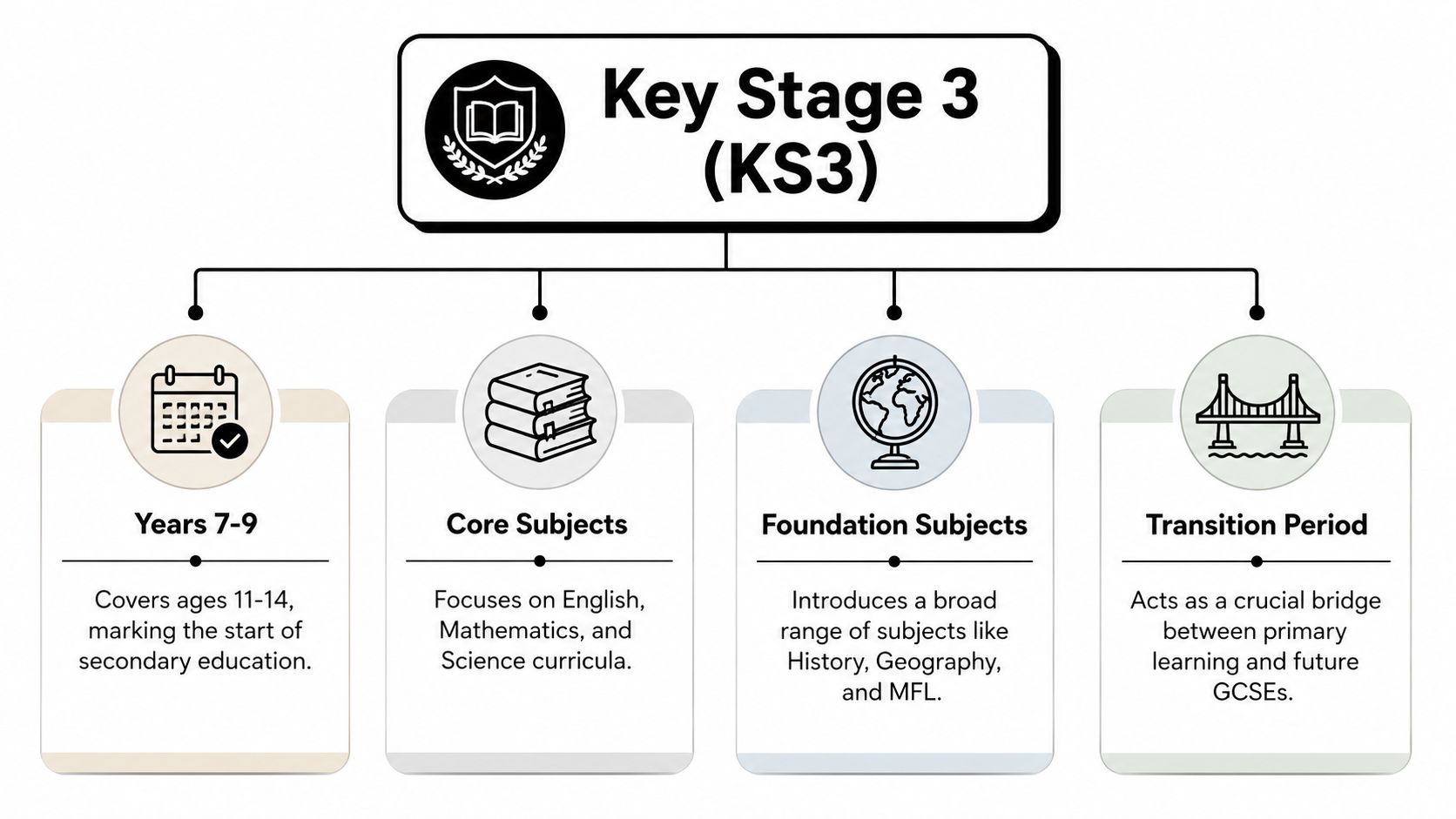
Key Stage 3 is the first stage of secondary education in England. It usually includes Years 7, 8 and 9, covering children aged 11 to 14, as set out in the National Curriculum for secondary education.
For many parents, that definition sounds simple enough. What matters more is what it means in real life. KS3 is the period when school begins to ask a child for more independence, while still giving them time to grow into it. They are no longer in the early routines of primary school, but they are not yet in the exam-focused years either. That middle position matters because children at this age are still changing rapidly, academically, socially, and emotionally.
If primary school built the first habits of learning, KS3 builds the frame that holds later success in place. Subjects become more distinct. Teachers expect pupils to organise themselves more often, switch between classrooms, and cope with different teaching styles. Over time, children start to see that maths, history, science, and English each have their own rules, language, and ways of thinking.
What schools mean by KS3
The statutory KS3 curriculum in England includes a wide range of subjects:
- English
- Mathematics
- Science
- History
- Geography
- Modern foreign languages
- Design and technology
- Art and design
- Music
- Physical education
- Computing
- Citizenship
That breadth is deliberate. At 11, 12, or 13, many children are only just beginning to notice what comes naturally to them, what takes more effort, and what interests them. A broad curriculum keeps doors open while those strengths are still forming.
Parents sometimes worry that if a child is unsettled in Year 7, they are already falling behind for the future. In most cases, KS3 exists to prevent that kind of pressure. It gives children space to practise secondary school life before later choices carry more weight.
Why this stage matters so much
KS3 gives children four things at once.
| What KS3 gives them | Why it matters |
|---|---|
| Breadth across subjects | They can discover interests and gaps before choosing later pathways |
| Specialist teaching | They learn how each subject is studied, not just its basic content |
| Greater responsibility | They begin building the organisation and resilience needed for later study |
| A protected transition period | They have time to mature before GCSE courses become the main focus |
A helpful comparison is this: KS3 works like the scaffolding around a building. It is not the finished structure, but it supports everything that comes next. Remove that support too soon, and children can look older on paper than they feel in practice.
This is also why many families find that a calmer, more flexible setting can make a real difference during these years. For some pupils, especially those who are anxious, distracted by busy school environments, or still finding their confidence, online learning can give them the space to focus on understanding rather than having to keep up. A clear subject pathway, such as this Key Stage 3 maths curriculum guide, can also help parents see how steady progress is built over time.
For parents asking what Key Stage 3 really is, the clearest answer is this. It is the bridge between childhood learning and teenage academic growth. Your child is still being shaped here, and that is exactly why this stage deserves patience, structure, and the right support.
The KS3 Curriculum What Your Child Will Actually Learn
A Year 7 child can come home saying, “We did algebra, analysed a poem, and planned an experiment,” and a parent can wonder whether secondary school has suddenly become too much, too soon. In reality, KS3 is designed to stretch children in manageable steps. The work becomes broader, but it should also become more meaningful.
What changes most is the kind of thinking your child is asked to do. In primary school, success often rests on remembering methods and applying them carefully. In KS3, children still need that secure base, but teachers start asking for something extra. They must explain how they know, weigh up evidence, spot patterns, and communicate their reasoning clearly.
In mathematics, this usually feels like a shift from calculating to understanding structure. Children meet ratio, algebra, geometry, probability, statistics, graphs, and proportional reasoning through problems that ask them to connect ideas rather than complete one familiar method again and again. A graph is no longer just a picture to read. It becomes a way of describing relationships. An algebraic expression is no longer a strange code. It becomes a shortcut for showing a pattern.
That is often the point where parents say, “I can do the maths, but I'm not sure how it is taught now.” A clear Key Stage 3 maths curriculum guide can help you see how those ideas are built gradually, so the jump feels less sudden for both you and your child.
In English, pupils move beyond telling the teacher what happened in a text. They begin asking why a writer chose a particular image, how a character is presented, or what makes an argument convincing. Their own writing grows up too. They learn to adjust tone, build a viewpoint, select evidence, and shape sentences for purpose. That matters far beyond the English classroom. It helps children express themselves clearly at an age when feelings, friendships, and self-confidence can all feel harder to manage.
In science, the curriculum starts to feel more like organised enquiry. Children classify, predict, test, observe, and explain with greater precision. They study big ideas such as forces, particles, cells, energy, and reactions, but the deeper lesson is how knowledge is built. A good science lesson teaches a child to say, “This is my conclusion, and this is the evidence for it.”
Subjects such as design and technology make that change in thinking especially easy to see. The national curriculum expects pupils to research needs, develop ideas, create and test solutions, and improve their work through evaluation, as set out in the Department for Education design and technology programme of study. In plain terms, a child might design something for a real user, make a prototype, gather feedback, and refine it. That process teaches patience. It also teaches that improving work is part of learning, not a sign that they have failed.
One simple rule helps here. If your child says, “I had to redo it,” that often points to healthy KS3 learning.
Underneath the subject content, schools are trying to build habits that make later study possible. Children are learning to keep track of tasks from different teachers, recover after mistakes, listen to feedback without feeling defeated, and stick with work that does not make sense straight away. Those habits do not always show up in a workbook, yet they shape future GCSE success just as much as content knowledge does.
This is also why the emotional side of KS3 should never be brushed aside. Early adolescence can feel uneven. A child may look more grown up one week and need much more reassurance the next. Some families find that pastoral support outside lessons helps them handle that change with more confidence, whether through school systems or services such as Penticton youth support by Interactive Counselling. For many pupils, an online school setting can also reduce noise, social strain, and constant comparison, giving them more room to concentrate on understanding what they are learning and how they are growing.
Navigating the Shift from KS2 to KS4
Many parents understand primary school well. Many also know that GCSEs bring pressure and formal courses. The unfamiliar space is the middle one.
KS3 sits in that middle for a reason. It gives schools a defined period to build knowledge before Key Stage 4, and official data continues to track attainment by the end of Year 9, as explained in the Lancashire guidance discussing KS3 as the bridge to GCSE study. That's one reason this phase should never be treated as filler.
Key stages at a glance
| Aspect | Key Stage 2 (Years 3-6) | Key Stage 3 (Years 7-9) | Key Stage 4 (Years 10-11) |
|---|---|---|---|
| School experience | Usually more settled and familiar | More movement, more teachers, greater adjustment | More structured around qualification courses |
| Independence | Guided closely by adults | Growing independence with support | Expected self-management is much higher |
| Subject learning | Broad foundations | Deeper subject knowledge across a wide range | More specialised and exam-linked |
| Assessment focus | Clear national benchmarks are familiar to many parents | Internal school assessment and progress tracking | Formal external qualifications become central |
| Child development | Late childhood | Early adolescence and identity formation | Greater maturity and future planning |
What often changes for your child
A Year 7 child may go from one main classroom teacher to a string of specialist teachers in one week. They may need to remember where to be, what equipment to bring, and how different adults want work presented. That can feel exciting to some children and exhausting to others.
At the same time, friendship groups often shift. Children compare themselves more. They care more about belonging. Their emotions can look larger because their world feels larger.
For some families, extra support beyond school can help when a child is struggling emotionally during this phase. If you're looking for an example of the kind of targeted help some families explore, Penticton youth support by Interactive Counselling shows the sort of youth-focused emotional support that can complement education.
Why KS3 should not be rushed
Some parents worry that if KS3 isn't intensely exam-driven, it may not be rigorous enough. In reality, children usually do better when schools use these years to strengthen understanding, confidence, and study habits before GCSE courses begin.
You can often see the difference when you compare Year 6 expectations with what comes after. Looking at a Year 6 maths curriculum outline can make the leap clearer. Primary learning secures essential basics. KS3 takes those basics and stretches them into broader, more demanding applications.
A child who seems less immediately “polished” in Year 7 may still be making excellent progress if they're learning to think independently, manage complexity, and recover from setbacks.
That's the heart of the transition. KS2 teaches the child how school works. KS3 teaches the growing young person how to function within a bigger academic world. KS4 then builds on that readiness.
Understanding Assessments Without National Exams
One of the biggest surprises for parents is this. There are no statutory national exams at the end of KS3, and schools use their own internal assessments instead, as set out in the government guidance on Key Stages 3 and 4.
At first, that can feel unsettling. Parents often ask, “If there's no national test, how do I know how my child is doing?”
The answer is that KS3 progress is usually judged through ongoing evidence rather than one final score. That can give you a richer picture of your child.
What meaningful progress looks like
A school may use tests, classwork, homework, projects, speaking tasks, practical work, written feedback, and termly reports. The details vary because assessment is school-specific at this stage.
That doesn't mean standards disappear. It means the school has more room to evaluate how a child is learning across time.
Look for signs such as:
- Teacher feedback that is specific rather than vague praise
- Improvement over time in written work, accuracy, or confidence
- Evidence of effort and response to feedback, not just raw marks
- End-of-term reporting that explains strengths and next steps clearly
- Subject comments that show whether your child is coping with increasing demands
Questions worth asking at parents' evening
Instead of asking only “What level are they?”, try asking:
- Where is my child becoming more independent?
- What do they do well when the work becomes difficult?
- What pattern do you see across this term's work?
- What one habit would make the biggest difference next?
Those questions often lead to more useful conversations than a single headline judgement.
Good assessment at KS3 should help a child improve. It shouldn't simply label them.
Why this can be positive for your child
Without a national exam at the end of Year 9, schools can focus more on secure learning than on short-term performance. A child who needs time to mature, settle socially, or rebuild confidence after a difficult transition has more breathing room.
That matters for bright children who are anxious, for able children who are disorganised, and for pupils who don't show their best in one-off test conditions. It also helps children understand that learning is a process.
As a parent, your role isn't to chase constant proof that your child is “ahead”. It's to look for healthy progress, honest feedback, and signs that they are developing both academically and emotionally.
How Queen's Online School Nurtures KS3 Learners
The needs of KS3 children are quite specific. They need structure, but not rigidity. They need challenge, but not overwhelm. They need adults who take them seriously while remembering that they are still very young.
That balance is one reason some families consider online schooling during Years 7 to 9. For a child who finds large school environments draining, distracting, or emotionally unsafe, a live online model can remove some barriers while still preserving academic expectation.

Why the online model can suit this age group
At KS3, children are beginning to learn how to manage themselves. An online timetable can support that growth because pupils must gradually take ownership of logging in, organising materials, listening carefully, and asking for help when needed.
At the same time, the home environment can reduce some of the noise that makes secondary transition harder. That may include long travel days, corridor stress, sensory overload, bullying concerns, or the social exhaustion that leaves a child with nothing left for learning.
For some families, that combination matters more than people realise. The child doesn't need less ambition. They need a setting where they can access it.
What support can look like in practice
A strong online school model for KS3 usually works best when it offers:
- Live teaching with subject specialists, so children still experience real lessons rather than being left alone with worksheets
- Smaller class interaction, which can make it easier for quieter pupils to contribute
- Personalised feedback, so misunderstandings are spotted early
- Flexibility around pace and routine, especially helpful for children with SEN or SEMH needs
- Pastoral awareness, because emotional wellbeing still shapes academic performance every day
One example is Queen's Online School's Key Stage 3 English provision, which sits within a broader lower secondary curriculum for Years 7 to 9. For families exploring options, the key question isn't whether online learning is modern. It's whether the model gives the child enough human contact, enough academic structure, and enough individual attention.
The emotional advantage parents often notice
Parents of KS3 children often say the same thing in different words. Their child can do the work, but the environment around the work is the problem.
That might look like a capable learner who shuts down in crowded classrooms. Or a thoughtful child whose anxiety spikes during transitions. Or a pupil with SEN or SEMH needs who spends so much energy coping that little is left for concentration.
In those cases, a carefully organised online school can offer a calmer route through the same developmental stage. Children can still build independence, still follow a British curriculum, and still prepare for later qualifications, but with fewer unnecessary pressures.
Some children don't need pushing harder. They need the path cleared so they can show what they already have.
A modern school still needs trust
Parents shouldn't choose any school, online or otherwise, based only on polished wording. They need signs that families feel heard, communication is clear, and pupils are known as individuals. If you're interested in how schools think about family satisfaction and trust, this explanation of how schools measure parent loyalty gives useful context for the wider conversation.
For KS3 in particular, trust matters because this phase can be uneven. A child may thrive in one term and wobble in the next. Good schools recognise that inconsistency is often part of normal development. They respond with clear expectations, strong teaching, and a pastoral approach that keeps the child at the centre.
That's what parents are usually searching for when they ask what is Key Stage 3. They're not only asking for a definition. They're asking where their child will be understood while they grow.
If you're exploring a more flexible, supportive route through Years 7 to 9, Queens Online School offers a British curriculum online with live teaching, subject specialists, and provision across lower secondary. For families who want academic structure alongside a calmer daily experience, it's worth taking a closer look at how the model works in practice.