

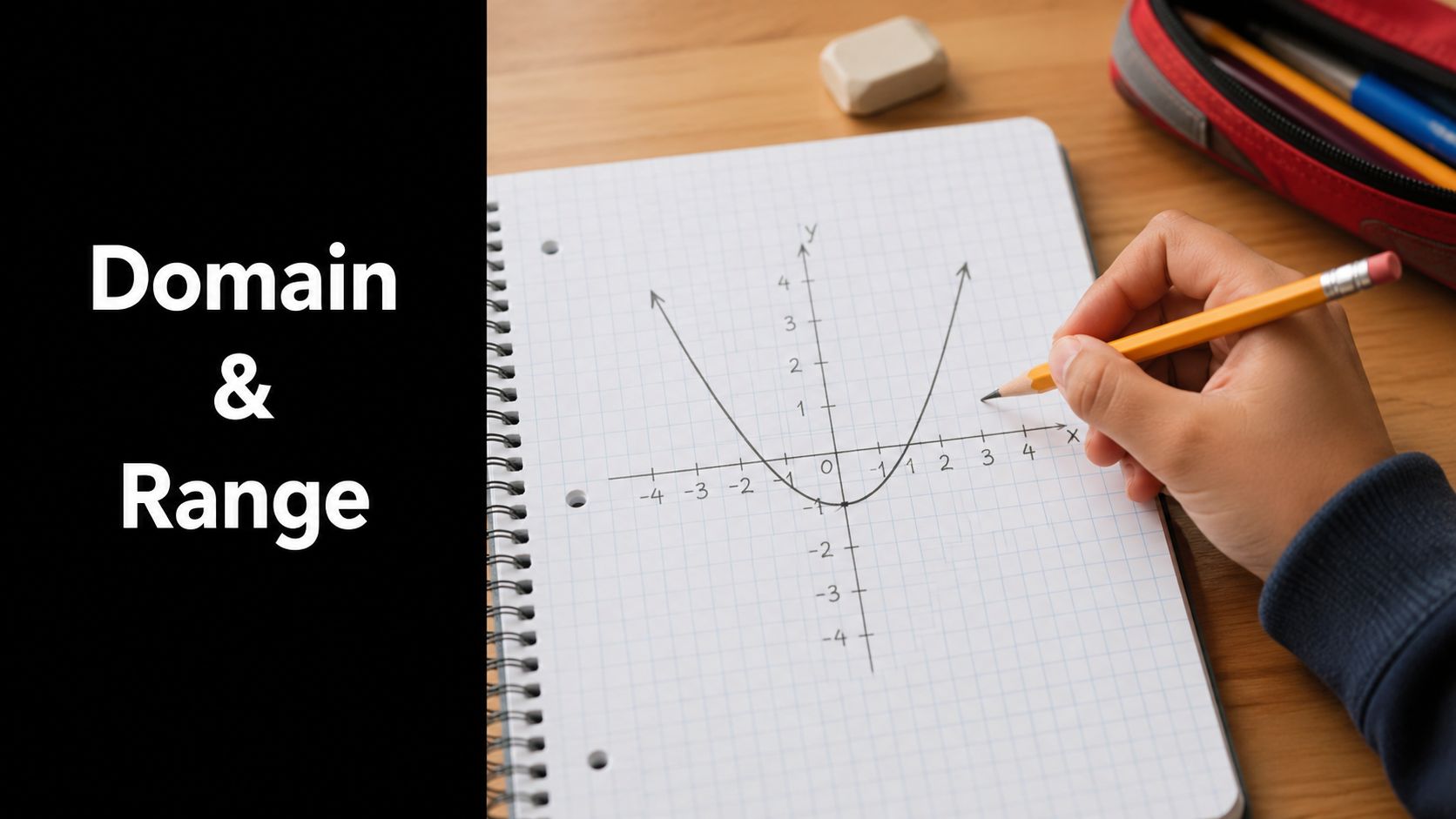
A child sits at the table, pencil in hand, staring at a question about functions. You can almost see the moment confidence slips. “Find the domain and range.” The words look familiar, but they don't feel friendly.
If you're the parent beside them, that can feel just as hard. You want to help, but maths seems to be speaking a language nobody translated. The good news is that domain and range functions aren't really about mysterious jargon. They're about rules, patterns, and making sense of what a function can do.
When children understand the idea underneath the symbols, the whole topic becomes less frightening. That matters a lot for any learner, and especially for children who need calm, structured explanations, extra processing time, or a more visual route into the maths.
That Moment When Maths Homework Feels Impossible
It often starts with a worksheet and a long sigh.
Your child has managed the earlier questions, then suddenly gets stuck on one line: “State the domain and range of the function.” They may read it three times and still not know where to begin. Some children go quiet. Others get cross. A few will say, “I'm just bad at maths,” when really they're overwhelmed by the wording.
That emotional moment matters. A child who feels lost often stops thinking clearly, even if they could understand the idea with the right explanation. If maths homework regularly triggers stress, gentle routines used in caregiver techniques for childhood anxiety can help a child settle before tackling the question itself.
A good first step is to strip away the intimidating vocabulary. “Domain” means the inputs you're allowed to use. “Range” means the outputs the function gives you. That's all. Once a child hears that in plain language, the topic starts to loosen its grip.
What a worried child often hears
Many children hear the question as:
- New words: “Domain” and “range” sound abstract.
- Hidden rules: They suspect there's a trap.
- Pressure to be quick: If classmates seem to get it faster, panic rises.
- Too many symbols at once: Numbers, brackets, letters, and fractions can blur together.
What helps instead
Try this kind of script:
“We're not solving everything at once. We're just asking two questions. What can go in, and what can come out?”
That turns the problem into a rulebook rather than a riddle.
If your child is working towards GCSE content and wants extra practice in a calmer format, free online GCSE maths learning support can give them more chances to revisit topics at their own pace.
The Function Machine What Goes In and What Comes Out
A function is easier to understand when you stop thinking of it as a scary algebra object and start thinking of it as a machine.
Put something in. The machine follows a rule. Something comes out.
That's the big idea behind domain and range functions. The domain is every input the machine is allowed to accept. The range is every output the machine produces.

Start with a real object
Think about a toaster.
You put in bread. The toaster changes it. Out comes toast. In this example, the acceptable inputs are things like slices of bread. That's the domain. The possible outputs are toasted slices. That's the range.
A toaster won't sensibly accept a trainer, a banana, or a maths book. Those don't belong in the machine. Children usually understand this immediately, and that's useful because functions work in the same way. Not every input is allowed.
Then move to a simple maths machine
Take the rule:
y = x + 2
This machine adds 2 to whatever you put in.
If you put in 1, you get 3.
If you put in 5, you get 7.
If you put in 0, you get 2.
You can show it in a quick table:
| Input x | Rule x + 2 | Output y |
|---|---|---|
| 0 | 0 + 2 | 2 |
| 1 | 1 + 2 | 3 |
| 5 | 5 + 2 | 7 |
For this simple function, if we're working with real numbers, the domain is all real numbers because there's nothing stopping us from choosing any real value for x. The range is also all real numbers, because adding 2 can still produce any real output.
A child doesn't need to memorise the words first. They need to feel the pattern first.
A sentence that often clears it up
Many learners confuse domain and range because both sound like lists of numbers.
Try this sentence:
- Domain: “What am I allowed to put in?”
- Range: “What can this rule make?”
That distinction matters because a function is not just a collection of answers. It is a relationship between inputs and outputs. Once a child sees that, the symbols have somewhere to land.
The Two Golden Rules for Finding the Domain
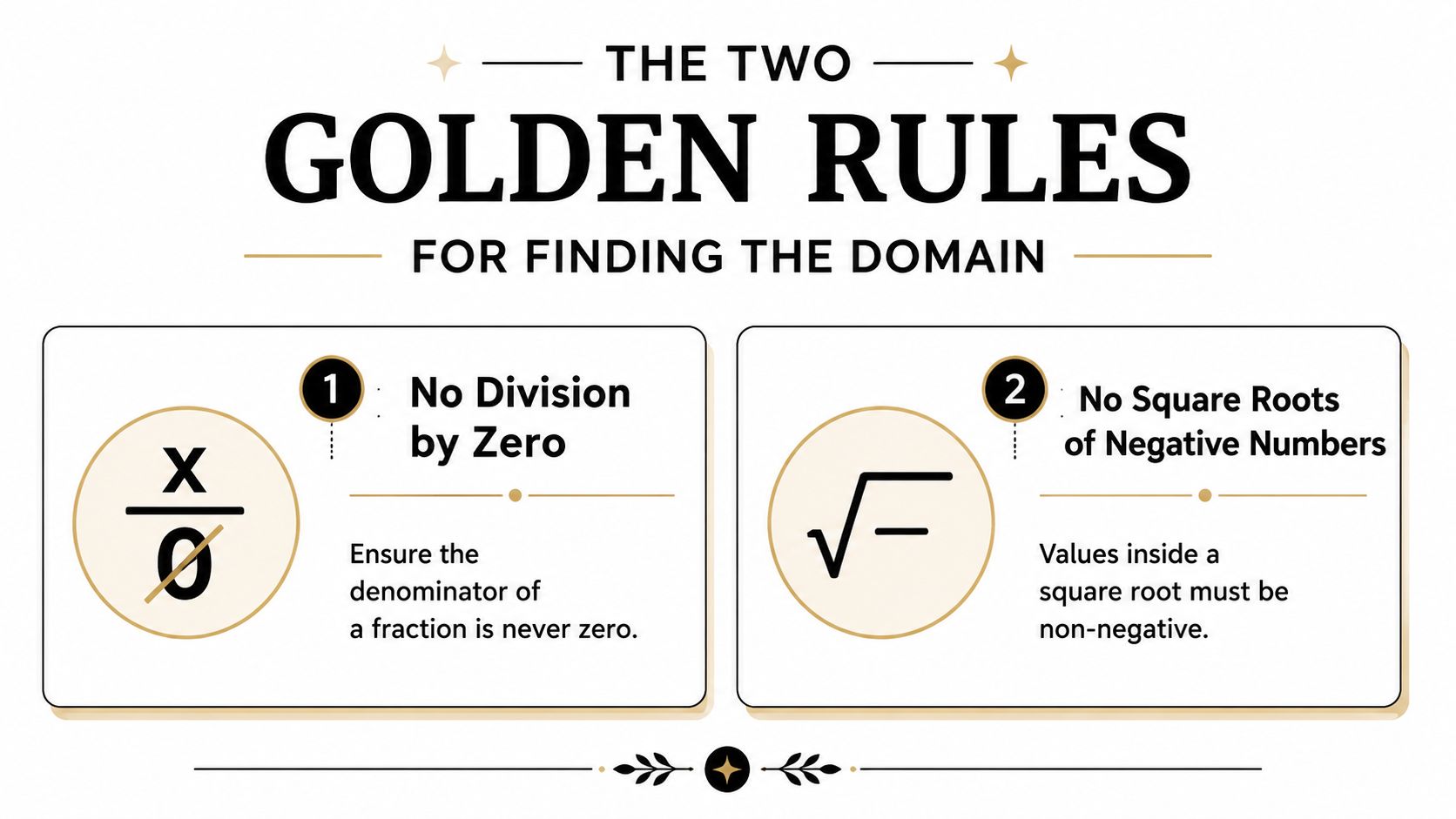
When a function includes fractions or square roots, the machine has safety rules. Some inputs break the rule, so they must be left out of the domain.
In UK maths teaching, domain and range are treated as core function ideas because a function maps each input to a unique output, the domain is the set of allowable inputs, and the range is the set of outputs produced. A standard classroom rule is that a denominator cannot be zero and an even root cannot have a negative radicand, so students must exclude restricted values before stating a domain, as explained in OpenStax-based Algebra LibreTexts on domain and range/03:_Functions/3.03:_Domain_and_Range).
Rule one no dividing by zero
Take the function:
f(x) = 1 / (x – 3)
The denominator is x – 3. If x = 3, the denominator becomes 0, and dividing by zero isn't allowed.
So the domain is all real numbers except 3.
A child can check this with a simple question:
- What value makes the bottom equal zero?
- Exclude that value.
- Write the rest as the domain.
For this example:
- x – 3 = 0
- x = 3
- Domain is all real numbers except 3
Why this rule exists
Children often ask, “But why can't we divide by zero?”
A practical answer is enough at this stage. Division asks, “How many equal groups?” If the group size is zero, the question breaks down. The maths no longer gives a sensible real-number answer. So the function machine rejects that input.
Rule two no even roots of negative numbers
Now take:
f(x) = √(x + 4)
The expression inside the square root is x + 4. For real-number work at this level, the inside of a square root must be zero or positive.
So we solve:
- x + 4 ≥ 0
- x ≥ -4
That means the domain is all real numbers greater than or equal to -4.
A calm method children can repeat
For many learners, especially those who need clear routines, this checklist helps:
- Look for a fraction: If there is one, make sure the denominator is never zero.
- Look for a square root: If there is one, make sure the inside is not negative.
- Write the restriction clearly: Don't leave it in your head.
- Check one test value: Try a value you think is allowed.
Practical rule: When a child feels stuck, don't ask “What's the domain?” Ask “Is there a fraction?” or “Is there a square root?” Smaller questions lower the stress.
Finding the Range Using Your Eyes
Range often feels harder because children can't always get it from one quick algebra rule. A graph helps because it lets them see what outputs the function reaches.

When you look at a graph, think of scanning it in two directions.
- To find the domain, scan from left to right and ask which x-values the graph covers.
- To find the range, scan from bottom to top and ask which y-values the graph reaches.
Use a simple U shape
Take the parabola:
y = x²
Its graph is a U shape. It goes left forever and right forever, so its domain is all real numbers. But the outputs are different. Squaring a number never gives a negative result in this case.
The lowest point is at y = 0. From there, the graph rises upwards. So the range is y ≥ 0.
That visual idea can be stronger than a verbal definition. A child can point to the lowest height on the graph and say, “It never goes below that.”
Think in shadows
A helpful image is the graph's shadow.
If you shine a light across the graph onto the x-axis, the shadow shows the domain. If you shine a light onto the y-axis, the shadow shows the range.
That's often clearer for visual learners than a formal definition. It also helps children who confuse x and y, because each axis gets a different “shadow job”.
This short explainer can help reinforce the visual method:
A quick graph routine
When your child is faced with a graph, ask them to do this in order:
- Trace with a finger left to right for the domain.
- Trace with a finger bottom to top for the range.
- Find turning points or endpoints because these often create limits.
- Notice arrows because arrows mean the graph continues.
If a child can say what the graph is doing in plain English, they're already halfway to the correct range.
Domain and Range for Different Function Families
Children make faster progress when they recognise the type of function in front of them. Different families have different habits.
A straight line behaves differently from a fraction. A square root behaves differently from both. Once a learner spots the family, they know which question to ask next.
Polynomial functions
Polynomials include expressions like:
- y = 2x + 1
- y = x² – 4
- y = x³
These usually have domain equal to all real numbers. There's no denominator to become zero and no square root forcing a restriction.
Take y = x² – 4.
A parent might look at that and worry there must be a hidden catch. There isn't for the domain. You can put in any real x-value.
The range is where the thinking changes. Since x² is never negative, x² – 4 is never smaller than -4. So the range is y ≥ -4.
That's a lovely example because it shows children that domain and range functions don't always have the same kind of answer. The domain can be wide open while the range is restricted.
Rational functions
Rational functions are the fraction ones. Here, the “never divide by zero” rule becomes your main tool.
Take:
f(x) = (x + 1) / (x – 2)
A child may feel more secure if they work almost mechanically:
- Find the denominator: x – 2
- Set it equal to zero: x – 2 = 0
- Solve: x = 2
- Exclude it
So the domain is all real numbers except 2.
The range is trickier and often better handled later with rearranging or graphing, depending on the level. For many students, it's enough at first to master the domain confidently before trying to describe all possible outputs.
If your child is also learning how equations appear as lines and shapes, support with graphing linear equations can make these links feel far less abstract.
Radical functions
Radical functions include square roots such as:
f(x) = √(x – 5)
This family has a clear rule. The expression inside the square root must be zero or more.
So:
- x – 5 ≥ 0
- x ≥ 5
That gives the domain.
The range also has a built-in pattern. A square root output is never negative here, so y ≥ 0.
A family recognition shortcut
Children often benefit from a short decision guide:
| Function type | First question to ask | Common domain pattern |
|---|---|---|
| Polynomial | Is there any restriction visible? | Usually all real numbers |
| Rational | What makes the denominator zero? | Exclude that value |
| Radical | What makes the inside negative? | Keep it zero or more |
One child may prefer to memorise the visual appearance. Another may prefer a spoken script. Both are valid. The goal isn't to sound advanced. The goal is to help the student recognise the right move quickly and calmly.
Writing Your Answer in the Right Language
A child can understand the maths and still lose marks by writing the answer unclearly. Notation plays a critical role here.
Many teachers use interval notation because it describes sets of real numbers neatly. It looks formal, but the idea is simple. You're marking stretches on a number line.
Brackets and what they mean
There are two common symbols:
- Round brackets ( ) mean the endpoint is not included.
- Square brackets [ ] mean the endpoint is included.
So if the domain is all real numbers greater than 3, we write:
(3, ∞)
That round bracket at 3 means 3 itself is not allowed.
Notation Translation Guide
| Meaning | Inequality | Interval Notation |
|---|---|---|
| All real numbers greater than 2 | x > 2 | (2, ∞) |
| All real numbers greater than or equal to 2 | x ≥ 2 | [2, ∞) |
| All real numbers less than 5 | x < 5 | (-∞, 5) |
| All real numbers less than or equal to 5 | x ≤ 5 | (-∞, 5] |
| All real numbers from -4 upwards | x ≥ -4 | [-4, ∞) |
| All real numbers except 3 | x ≠ 3 | (-∞, 3) ∪ (3, ∞) |
One point that trips children up
Infinity never gets a square bracket. It isn't an endpoint you can reach, so it always uses a round bracket.
If your child is moving between graphs and symbolic answers, practice with equations from graphs can help them connect the picture to the notation.
The answer is not finished until it's written in a form the examiner can read quickly and trust.
Common Stumbling Blocks and How to Help
The hardest part of this topic usually isn't the vocabulary. It's the switching between ideas.
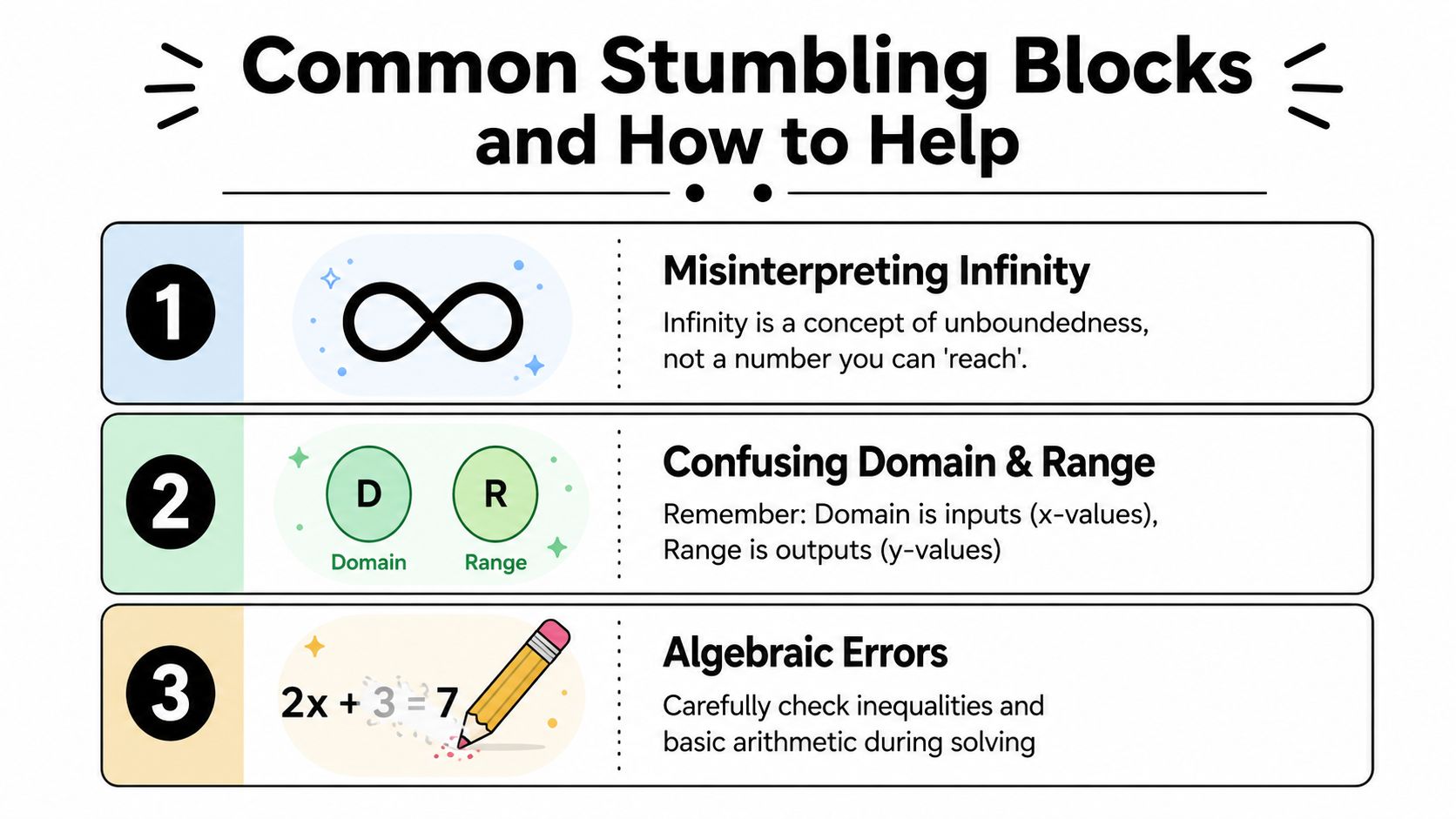
Children must remember whether they are talking about inputs or outputs, whether they are reading an equation or a graph, and whether a restriction belongs to the domain or the range. That's a lot of mental movement, especially for learners who need more scaffolding.
A major gap in beginner teaching is often range in real-world contexts and restricted outputs. Some introductory materials say range is “usually helpful to look at the graph”, which can leave learners under-supported when they need to reason about outputs from context rather than just shape. That matters in the UK because the Department for Education says about 1.67 million pupils were identified with special educational needs in 2024, which makes clear, scaffolded explanation especially important for many families, as discussed in Purplemath's treatment of domain and range.
Mix up one domain and range
This is the classic error.
A child sees a graph and gives y-values for the domain or x-values for the range. The fix is simple but must be repeated often: domain travels along the x-axis, range climbs the y-axis.
Mix up two all real numbers by default
Many students learn one example where both answers are all real numbers, then start applying that everywhere.
That works for some linear functions. It fails for square roots, fractions, and many graphs with lowest or highest points. Ask, “What would stop the machine?” and “What outputs can it never make?” Those two questions pull them back into reasoning.
Why range feels harder
Range often needs more thought because it depends on the behaviour of the whole function, not just one obvious forbidden input.
For example, with y = x² – 4, no input is forbidden, so the domain is straightforward. But the range requires noticing the smallest output. That means looking at structure, shape, or context. Children who find that difficult are not failing. They're tackling the more subtle half of the topic.
A helpful support routine for parents is:
- Use colour: one colour for x-values, another for y-values.
- Draw a quick sketch: even a rough graph can reveal the range.
- Turn words into actions: “slide left to right” for domain, “move up and down” for range.
- Use everyday contexts: if a function models height, age, score, or distance, ask what outputs make sense in real life.
When a child can't find the range, don't repeat the definition louder. Change the representation.
Practice Makes Progress Your Next Steps
Confidence grows through doing, not just reading. Start with short questions, let your child think first, then compare with a worked solution.
Try these practice questions
1. Find the domain of f(x) = 1 / (x + 4)
The denominator cannot be zero.
Set x + 4 = 0, so x = -4.
Domain: all real numbers except -4.
Interval notation: (-∞, -4) ∪ (-4, ∞)
2. Find the domain of f(x) = √(x – 7)
The expression inside the square root must be zero or positive.
x – 7 ≥ 0
x ≥ 7
Domain: [7, ∞)
3. Find the range of y = x²
Squaring any real number gives zero or a positive number.
The smallest output is 0, when x = 0.
Range: [0, ∞)
4. Find the domain of f(x) = √(x + 1) / (x – 2)
There are two restrictions.
First, x + 1 must be zero or more, so x ≥ -1.
Second, x – 2 cannot be zero, so x ≠ 2.
Combine both rules.
Domain: [-1, 2) ∪ (2, ∞)
These ideas don't stay inside one chapter. They support graphing, algebra, advanced functions, and later topics such as calculus. Beyond this, they teach a child to ask sensible mathematical questions. What is allowed? What is possible? What is impossible?
If your family is looking for a flexible British education with live teaching, personalised support, and an inclusive approach for learners at different confidence levels, Queens Online School offers online learning from Primary through A-Level. Its structure, specialist teaching, and support for SEN and SEMH learners can help children build both skill and self-belief in maths.