


Your child comes home exhausted after another day of trying to keep up. Reading takes longer than it seems to take for classmates, written work causes tears, or a noisy classroom leaves them too overwhelmed to learn. You may be hearing, “They're bright, but they aren't showing what they can do,” and wondering whether a SEN support plan will bring practical help or instead create more paperwork.
A good plan should do something more important than record a difficulty. It should help adults understand what gets in the way of learning, what support will be provided, who will provide it, and whether it is helping your child feel safer and make progress.
The need is widespread. In England, the 2026 Department for Education release records 1,319,780 pupils receiving SEN support, alongside 538,500 pupils with EHC plans. It reports that SEN support represented 14.8% of pupils, while EHC plans rose 11.6% year on year. These figures show why schools need organised, measurable support pathways, but the child behind each record must remain the starting point (Department for Education statistics on SEN in England).
Introduction to SEN support plan
A parent might first notice small changes. A child who once enjoyed school begins avoiding reading aloud. They lose equipment, need repeated instructions, or become upset before a lesson has even started. At home, you see the effort behind apparently simple tasks, while school staff may be noticing incomplete work, reduced participation or difficulty joining peers.
Then a teacher or SENCO suggests a SEN support plan. Relief and worry often arrive together. Relief, because someone has recognised the struggle. Worry, because you may not know whether the plan will be personal and useful, or whether it will become a label attached to your child.
The strongest plans make a child easier to understand. They record strengths as well as barriers, include the child's views, and turn broad concerns into actions that adults can follow. A pupil who says, “I can't think when everyone is talking,” is giving valuable information. That voice might lead to quieter working space, shorter instructions or planned preparation before group activities.
A plan should describe the support your child needs to participate, learn and feel secure, not just the difficulty adults have observed.
A SEN support plan isn't a promise that every challenge will disappear. It's a shared route forward, with agreed support and regular opportunities to ask whether the route is helping.
Understanding a SEN support plan
Think of a SEN support plan as a personalised road map. A road map doesn't define the traveller by a problem. It shows the destination, the obstacles, the available routes and the points where people should stop to check progress.
In school, the map starts with the child's individual needs. Staff, parents and the pupil identify barriers, agree outcomes and choose support strategies. The plan should explain how adults will know whether an intervention is making a difference. It belongs to the child, not to a filing cabinet.
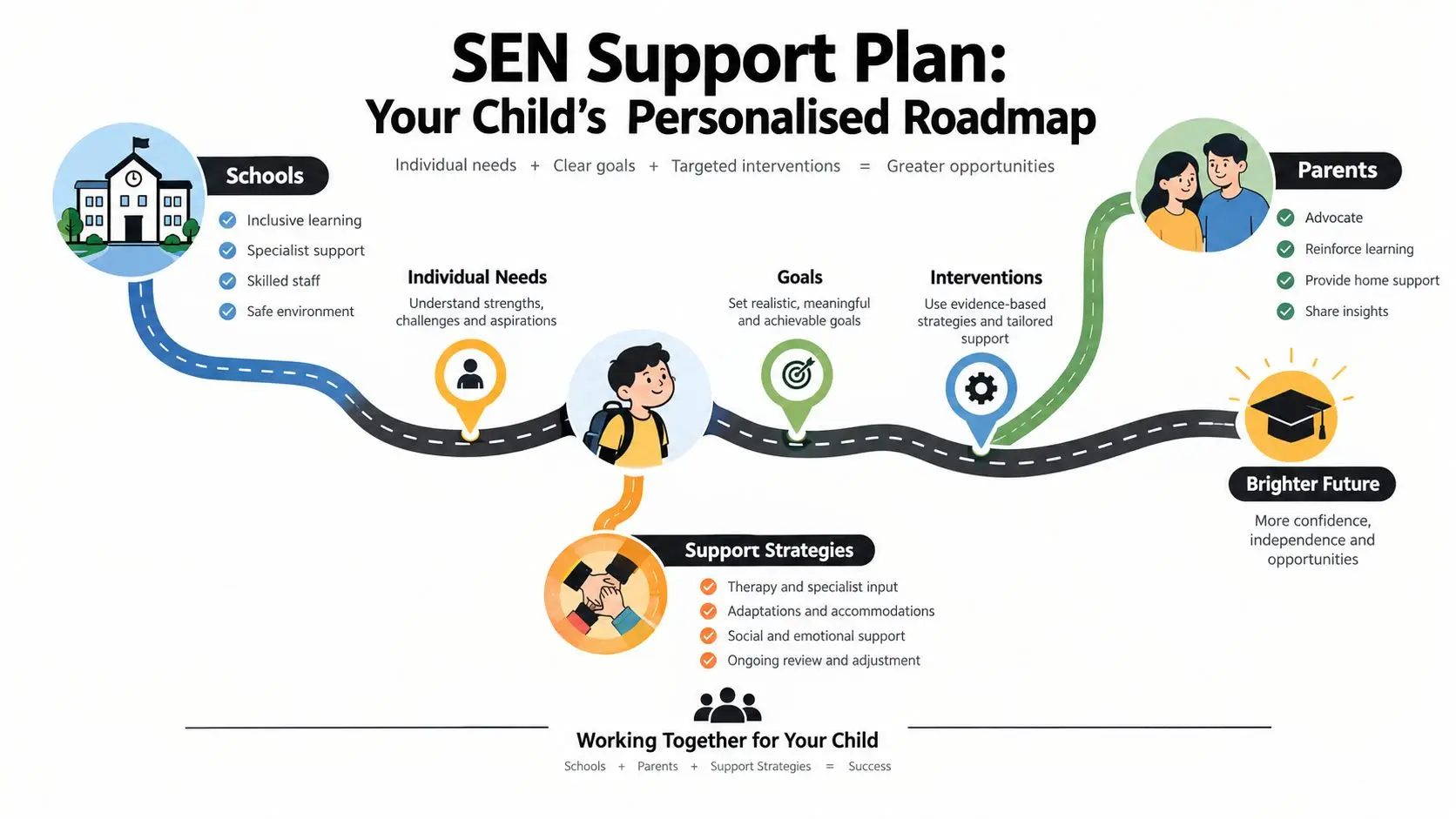
Suppose Maya is in primary school and avoids independent writing. During a planning meeting, her class teacher explains that she has strong ideas when speaking but struggles to organise them on paper. Maya says that she forgets what she wants to write while forming letters, and her parent explains that homework often ends in distress.
The team might agree to explore handwriting and processing barriers, provide a laptop for longer tasks, use a visual writing frame and set an outcome focused on completing a short piece of work with increasing independence. The class teacher, parent and Maya can then review what helped, rather than arguing about whether Maya is “trying hard enough”.
For a straightforward explanation of the wider framework, families can also read what SEN support means in school.
A plan generally answers four questions:
- What does the child need? Describe barriers, strengths, preferences and the child's own experience.
- What will change? Set outcomes linked to learning, communication, independence, wellbeing or participation.
- What will adults do? Name strategies, interventions, staff responsibilities and the context in which support will happen.
- How will we judge impact? Record evidence, review dates and the next decision if progress remains limited.
That structure reassures families because it replaces uncertainty with shared responsibility. It also protects the child from receiving support that sounds positive but has no clear purpose.
Legal and assessment context for SEN support plan
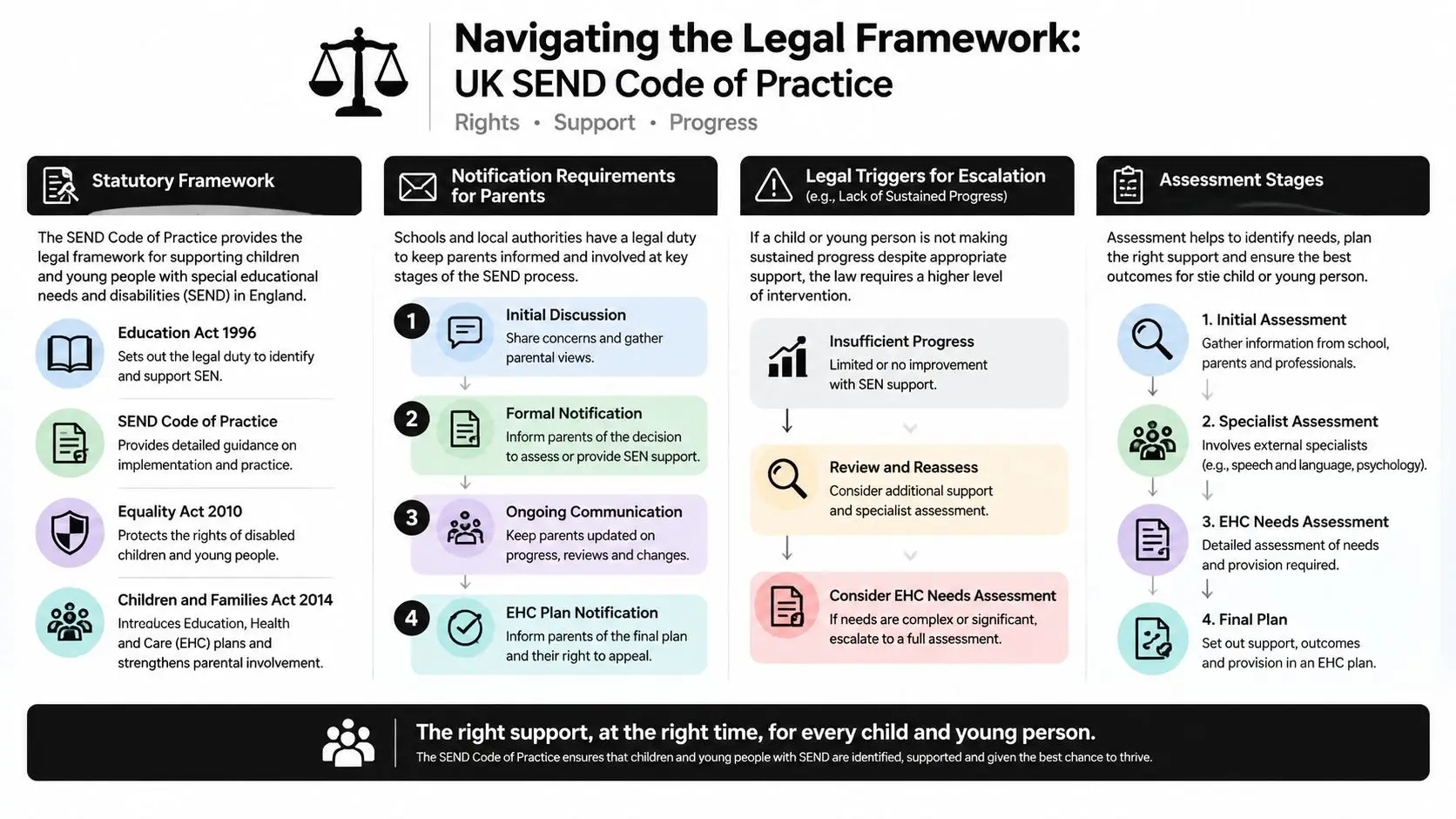
A school may tell a parent that their child is receiving SEN support after noticing persistent barriers in lessons, communication, wellbeing or participation. The SEND Code of Practice graduated approach gives staff a shared process: assess the need, plan support, provide it, then review its effect. Schools should inform parents, involve them in decisions about outcomes and provision, set review dates and ensure support is delivered by staff with suitable skills (Schools' guide to the SEND Code of Practice).
SEN support is separate from an EHC plan. It covers help that is additional to, or different from, the standard curriculum offer, while the child remains supported through school-based arrangements. A useful record should show the starting difficulty, the provision agreed, who delivered it, how consistently it was provided and what changed afterwards. Families can use the official statistics and guidance on SEN support to understand the wider system, but decisions about an individual child must rest on that child's needs and evidence.
When school-based support may not be enough
An EHC needs assessment does not begin automatically because of a diagnosis, test result or particular score. The question is whether the child's needs require provision beyond what SEN support can reasonably deliver. Evidence should show both the child's barriers and the quality of the support already tried, much like checking whether a bridge was properly built before deciding that a longer route is needed.
Useful evidence may include:
- The child's experience: anxiety, exhaustion, sensory distress, communication difficulties or reduced participation.
- Provision records: the strategy, staff member, frequency, duration and setting.
- Impact evidence: work samples, reading records, attendance, behaviour observations or progress towards agreed outcomes.
- Professional advice: relevant reports or observations where available.
- The school's reasoning: why current provision is insufficient and what more specialised help may be required.
Parents can request an EHC needs assessment if they believe SEN support cannot meet their child's needs. An assessment and final plan must normally be completed within 20 weeks from the request date, unless a specific legal exception applies (guidance on EHC plans and assessment). The local authority's timescale begins when it receives the request, not when the school first raises concerns.
Understanding reasonable adjustments in education helps families separate everyday accessibility changes from provision that may need formal assessment.
Core components of a SEN support plan
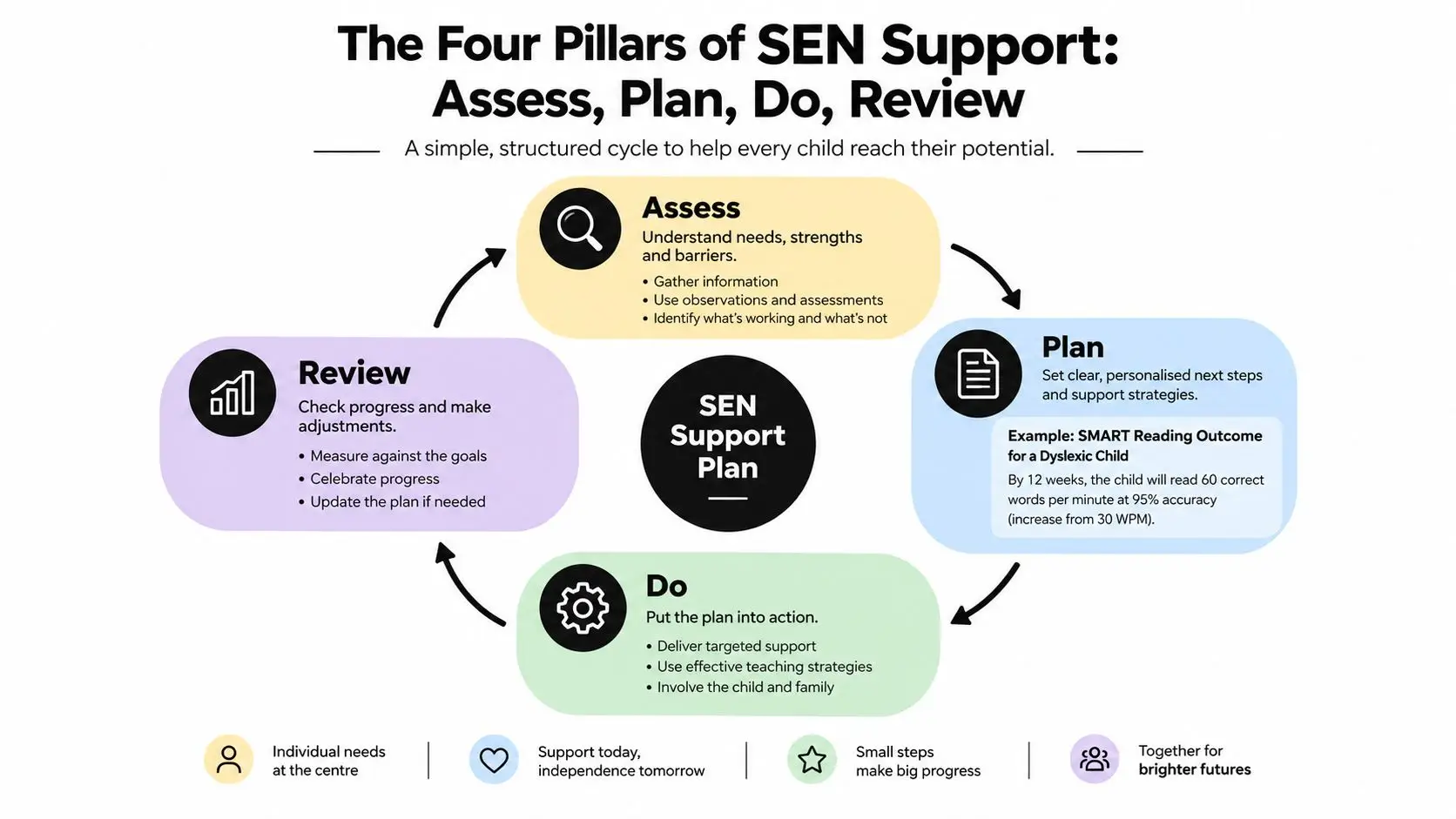
The four-part cycle works like a wheel rather than a staircase. The team doesn't complete it once and store the document. It keeps returning to the child's changing needs and the evidence of what helps.
Assess
Start with the barrier, not the label. Ask what the child finds difficult, when the difficulty appears, what strengths they can use and what the child thinks would help. A dyslexic pupil may understand a story when it's read aloud but struggle to decode the same text independently. That distinction affects the support selected.
Assessment can draw on classroom observations, work samples, conversations with the child and parent, existing reports and progress information. It should also consider wellbeing. A child who refuses reading may be protecting themselves from repeated embarrassment, not avoiding learning.
Plan
Convert the assessment into an outcome that can be recognised. “Improve reading” is too broad. A stronger outcome might describe the child applying a taught decoding strategy during an agreed reading activity, with the level of independence and support made clear.
The plan should identify:
- The intended outcome: What will be different for the child?
- The intervention: What will staff provide, and in which setting?
- The adjustments: What will make ordinary lessons more accessible?
- The responsibility: Which adult will deliver, coordinate and communicate the support?
- The review point: When will the team examine progress and decide what changes?
The SEND Code describes this as agreeing targets and provision with parents and pupils, rather than writing a plan about them without them (SEND Code of Practice).
Do
Delivery must be specific enough for another trained adult to understand. “Extra help” doesn't tell a teaching assistant whether to pre-teach vocabulary, use paired reading, provide processing time or check understanding privately.
For example, a child with dyslexia might receive targeted reading support and extra processing time. The class teacher should connect that support to classroom tasks, while the intervention adult records relevant observations. The child shouldn't have to start again from zero in every lesson.
Review
Review the outcome, not merely whether an adult was present. Ask whether the child is reading with greater confidence, completing more work, communicating needs more successfully or recovering more quickly after overwhelm.
If the support hasn't helped, that isn't evidence that the child has failed. It may show that the strategy, intensity, timing or delivery needs changing. The review should lead back to assessment and a better-informed plan.
Creating and implementing your SEN support plan
A planning meeting becomes more useful when each person brings observations rather than assumptions. Parents may describe what happens at home, the child can identify difficult moments, and school staff can bring work samples and lesson notes. Together, these details create a clearer picture of the child's daily experience.
Prepare before the meeting
Record patterns, including successful moments. Note when your child concentrates well, which instructions they understand, what causes distress and what helps them recover. Ask questions without pressure, such as, “Which part of lessons feels easiest?” or “What helps you get started?”
School staff should collect the child's strengths, barriers, relevant assessments and information from subject teachers. The purpose is to understand the situation accurately, not to build a case against the child. Specific examples also help the team judge whether current support is being delivered consistently and whether it is producing useful change.
Agree outcomes with the child
An outcome should describe a change that matters to the pupil. One child may aim to begin written work without an adult prompt. Another may need to ask for a movement break before sensory overload becomes a crisis.
Use language that adults can observe and review. “Feel happier” may describe an important need, but the team should agree how wellbeing will be recognised. This might include the child reporting greater readiness to enter class or using an agreed regulation strategy.
Clear evidence also matters if the family later asks whether SEN support is enough or whether an EHC needs assessment should be considered. A single difficult incident rarely gives a reliable basis for escalation. A record of needs, provision, outcomes and review decisions shows what has been tried and how the child responded.
Assign responsibilities clearly
Name the adult responsible for each action. The class or subject teacher remains responsible for day-to-day learning, even when a teaching assistant or specialist delivers part of the provision (graduated approach guidance for families and schools).
The plan should identify who will:
- Adapt classroom teaching.
- Deliver targeted intervention.
- Record relevant evidence.
- Communicate with the family.
- Coordinate the review.
Make review a real conversation
Independent SEND guidance states that review should happen at least three times a year, giving families regular opportunities to examine progress and wellbeing (The graduated approach to SEN support). A review should not merely copy the plan forward.
Bring the child's work, their views and the family's observations. Celebrate progress, such as entering a lesson calmly, completing part of a task independently or using a strategy before asking for help. Then agree the next adjustment. If progress remains limited, examine the strategy, intensity and delivery before deciding what further evidence or assessment is needed. A living plan shows that adults are listening and responding.
Adapting SEN support plans for online schooling and SEMH learners
A child may settle better in a quiet home setting yet become anxious when technology fails, cameras are expected or social contact feels limited. Online learning can remove classroom noise while creating different barriers, so the plan should describe both.
| In-person provision | Online adaptation |
|---|---|
| Quiet workspace in class | A low-distraction study area and permission to step away briefly |
| Visual timetable on a wall | A shared digital schedule with lesson links and clear transitions |
| Adult checks understanding at the desk | Private chat, verbal check-in or agreed signal during a live lesson |
| Small-group intervention | Breakout room, individual session or recorded explanation |
| Movement break in class | Planned off-screen pause with a clear return routine |
For a learner with social, emotional and mental health needs, support might include a brief wellbeing check before lessons, predictable greetings, advance notice of changes and a quiet route back into learning after distress. Mindfulness, breathing and movement can offer practical regulation tools. They should sit alongside adult support, not place responsibility for every difficulty on the child.
The pupil and parents should help choose adjustments that feel safe and workable. The plan should also show how staff will review whether each adjustment is helping. If attendance, participation or completed work remains limited, ask whether the difficulty reflects the online setup, the teaching approach, the intensity of support or an unmet need. That evidence helps families decide whether the SEN support plan needs refining or whether further assessment, including possible EHC consideration, should be discussed.
The class teacher remains responsible for learning, even when provision is delivered remotely. A teaching assistant or online tutor should not become the only adult who understands the plan. Guidance on teacher responsibility and consultation can support that conversation.
Flexible access to instructions, ways to show understanding and routes into participation reflect Universal Design for Learning. Families can use these principles when discussing accessible online lessons with Queens Online School.
Medical and therapeutic decisions require appropriate professional advice. Families seeking clinical information about attention-related needs may find that IPA offers online ADHD treatment for children. Education planning and medical treatment should remain separate decisions.
Practical examples and templates for SEN support plan
Templates are useful when they help people think clearly. They become unhelpful when adults fill in generic phrases that don't describe the child.
Primary literacy example
Context: A pupil has strong spoken vocabulary but finds decoding unfamiliar words tiring.
Outcome: The pupil will use the agreed decoding strategy during independent reading and explain which strategy helped.
Provision: The teacher pre-teaches selected vocabulary, offers a suitable reading text and checks understanding without requiring public reading. Targeted reading support reinforces the same method.
Review note: Record which words or strategies were used, the level of prompting and the child's confidence. “Completed intervention” isn't enough. The question is whether the child can transfer learning into ordinary classroom reading.
Secondary maths example
Context: A pupil understands methods when an adult models them but loses track during multi-step problems.
Outcome: The pupil will identify the steps in a problem and use a visual sequence to complete the calculation.
Provision: The maths teacher provides worked examples, highlights key vocabulary and allows processing time before expecting an answer. The pupil can show reasoning using a diagram, spoken explanation or written method.
Review note: Compare independent work with supported work. If the pupil can complete a problem only beside an adult, the plan needs to address independence rather than record the intervention as successful automatically.
SEMH wellbeing example
Context: A pupil becomes overwhelmed during unplanned changes and may leave learning abruptly.
Outcome: The pupil will recognise an early sign of distress, use an agreed signal and move to a planned regulation space with adult support.
Provision: Staff give advance notice of changes, use a visual timetable and complete a brief check-in. The return-to-learning routine is agreed with the pupil and practised when they're calm.
Review note: Ask the pupil whether the routine feels respectful and useful. Record triggers, successful strategies and recovery, not just incidents. The best template leaves room for the child's words, because emotional safety can't be measured solely through completed work.
Conclusion and next steps for SEN support planning
A useful SEN support plan gives everyone the same map of the child's needs. It connects a barrier with an action, the action with evidence, and the evidence with a decision. Predictable, compassionate support can also protect confidence by reducing repeated correction.
Parents do not need legal language for meetings. Ask questions that keep the discussion focused:
- Which barrier are we addressing?
- What does my child say would help?
- Who will provide each part of the support?
- What evidence will show progress or improved wellbeing?
- When will the plan be reviewed?
- If support remains insufficient, what evidence could support an EHC needs assessment?
Evidence should show more than whether an intervention was offered. Record how consistently it was delivered, how well it matched the identified need and what changed for the child. A plan is like a working map: if the route is followed but the child is still stuck, adults need to review the route, and not prematurely consider the support complete.
Request a copy of the agreed plan and note changes, successes and continuing difficulties. If school-based support is not meeting your child's needs, discuss escalation rather than waiting for further distress. The usual timetable for an EHC needs assessment and final plan is 20 weeks from the request date, subject to legal exceptions. Record when a request is received and track each stage.
Start with your child's experience. Agree one clear action with school, then check whether it makes learning and belonging feel more possible.
Queens Online School provides live online British-curriculum teaching, individualised learning plans and regular support check-ins for learners who need flexible SEN or SEMH adjustments. Visit Queens Online School to explore how its assess, plan, do, review approach could support your family's next education decision.