

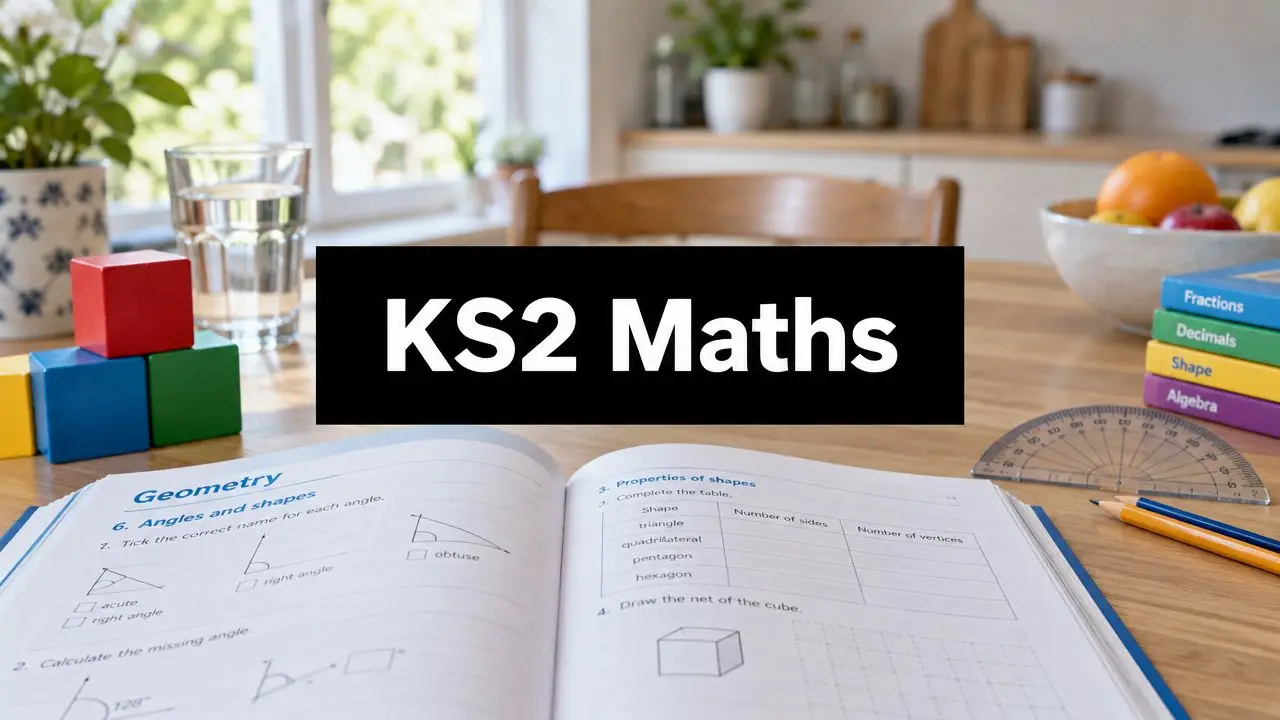
Your child is hunched over a long multiplication question at the kitchen table. You're hovering nearby, unsure whether to explain the method, point to the first step, or quietly let them work it out. They rub out the answer, sigh, and say, “I'm just bad at maths.”
That moment is common, but it doesn't have to define your child's experience. Key Stage 2 maths is a gradual journey through Years 3 to 6. It builds calculation, reasoning and problem-solving skills, while children are also learning how to handle mistakes, uncertainty and the feeling of being stuck.
The most useful support combines clear teaching with emotional safety. Your child needs to know what to practise, why it matters and how to recover when an answer goes wrong.
Why Key Stage 2 Maths Feels So Important
A Year 5 child who struggles with long multiplication may not be struggling with multiplication alone. They may be holding several pieces of information in mind, keeping columns aligned, recalling facts and deciding what to do when an intermediate answer looks unfamiliar. If an adult leans over and says, “You know this,” the child can hear something very different: “You should already be able to do this.”
That pressure can make thinking harder. A child who normally understands place value may suddenly forget where the zero belongs. A child who can explain a fraction with counters may freeze when the same idea appears in a worksheet. The problem isn't always knowledge. Sometimes it's the fear of showing that knowledge imperfectly.
The four years that build foundations
Between Year 3 and Year 6, pupils move from practical and familiar calculations towards more abstract reasoning. They develop confidence with number facts, written methods, fractions, measurement, shapes, data and unfamiliar problems. The national curriculum expects children to build knowledge cumulatively, rather than master every idea in isolation.
That's why a gap in multiplication can affect fractions, division, ratio and later algebra. It also explains why a child who finds one topic difficult can still make strong progress with patient reteaching and well-chosen representations. The national curriculum for mathematics describes the content pupils should learn, but children won't all reach it in the same way or at the same speed.
A useful kitchen-table rule: help your child understand the next step, not prove that they should already know the whole method.
SATs are a milestone, not an identity
Year 6 national assessments can make these years feel high stakes. In England, pupils are judged against a scaled score, with 100 or more representing the expected standard and 110 or more representing the higher standard. The government's KS2 attainment information also shows that 79% of pupils reached the expected maths standard in 2019, compared with 70% in 2016 and 71% in 2022.
Those figures describe national patterns, not your child's potential. A result can help adults identify support, but it can't measure curiosity, perseverance, kindness, creativity or the courage it takes to attempt a difficult question.
Your influence is real, but it doesn't come from turning home into an examination room. Calm conversations, regular attendance, brief practice and communication with school will do more for many children than repeated test papers. The aim is a child who can use mathematics with increasing independence and who still feels willing to have a go when secondary school brings new demands.
What the KS2 Maths Curriculum Actually Covers
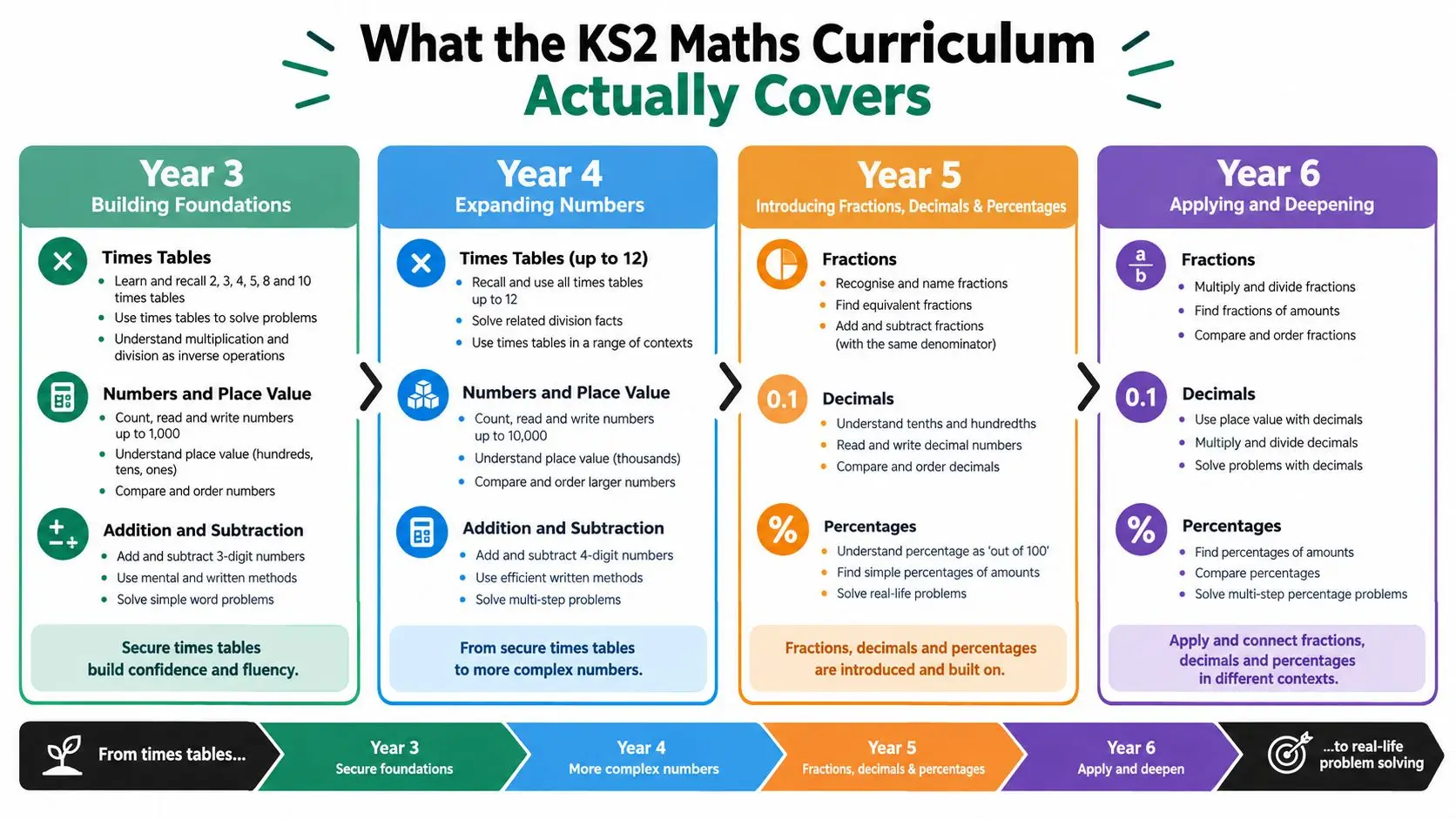
The curriculum is easier to understand if you see it as a developing story rather than a list of disconnected topics. Lower KS2 establishes secure number knowledge and reliable methods. Upper KS2 asks children to use that knowledge flexibly, explain their decisions and solve problems where the method isn't immediately obvious.
The KS2 curriculum guidance for parents and teachers can help you compare your child's learning with the wider programme, but schools may organise topics in different orders. The sequence matters less than whether important ideas are revisited and connected.
Years 3 and 4 build fluency
In Years 3 and 4, children strengthen place value, addition, subtraction, multiplication and division. They work with increasingly large whole numbers, learn multiplication and division facts, and develop formal written methods.
The programme of study specifically includes multiplication and division involving two-digit by one-digit calculations using known tables. For a child, this might mean understanding that 24 groups of 3 can be split into 20 groups of 3 and 4 groups of 3, then recording the calculation efficiently.
Fractions become more secure too. Children compare simple fractions, find equivalent fractions and connect fractions to division. Decimals begin to make sense through place value, not as a completely separate topic.
Years 5 and 6 connect ideas
By Years 5 and 6, pupils meet larger calculations, long multiplication and long division. They work with equivalent fractions, decimals and percentages, then begin to use ratio and early algebraic thinking.
The emphasis shifts from “Can you carry out this method?” to “Which method fits, and how do you know?” A question may ask a child to compare quantities, interpret a timetable, explain a pattern or decide whether an answer is reasonable.
Keep this simple topic map in mind:
- Lower KS2: place value, operations, tables, fractions and measurement.
- Upper KS2: larger calculations, decimals, percentages, ratio, algebra and multi-step reasoning.
- Across all years: geometry, statistics, explanation and problem solving.
The curriculum has three connected aims: fluency, reasoning and problem solving. A fluent child can calculate accurately and efficiently. A reasoning child can explain why a method works. A problem-solving child can select and adapt knowledge in a new situation.
A correct answer matters, but it isn't the whole picture. If your child can say, “I know this fraction is equivalent because both numbers were multiplied by the same amount,” they're demonstrating a deeper understanding than a child who has memorised an answer without knowing why.
The Four Strands of KS2 Maths Explained
Number is usually the strand parents notice first, but children meet mathematics through four broad families. These overlap constantly. A problem about a recipe might involve fractions, measurement, multiplication and reading a table in the same page.
Number is the engine
Number includes place value, the four operations, fractions, decimals, percentages and ratio. Times tables up to 12 provide useful working memory for many of these ideas, but recall should support understanding rather than replace it.
Try this with 36 ÷ 4. Ask your child what they notice, not only for the answer. They might say that 4 groups of 9 make 36, that 36 is divisible by 4, or that the calculation is related to 4 × 9. Those connections help a child choose a method when the numbers change.
Geometry gives shape to thinking
Geometry covers properties of shapes, position, direction, angles and movement. Some children who feel uncertain with number enjoy this strand because they can see and manipulate the ideas.
Ask your child to describe how to move from one corner of a room to another using turns, or to sort household objects by properties rather than appearance. The point is to use precise language such as parallel, perpendicular, right angle and symmetrical.
Measurement connects maths to life
Length, mass, capacity, time, money, perimeter, area and volume all connect number with real decisions. A child may appear confident with multiplication but become unsure when asked to read a scale or decide whether a measurement is sensible.
For example, when making a sandwich, ask whether a teaspoon or a jug is the sensible measure for an ingredient. When planning a walk, compare minutes and hours. These conversations reveal understanding without making your child feel examined.
Statistics asks children to use evidence
Statistics includes charts, tables, averages and interpretation. Children learn that data isn't just something to copy. They need to identify patterns, compare categories and make claims supported by the information.
A simple family survey can become a bar chart. Ask, “What does the chart tell us, and what doesn't it tell us?” That second question matters because strong mathematical readers know the limits of evidence.
| Strand | What it covers | Sign of progress |
|---|---|---|
| Number | Operations, fractions, decimals, percentages and ratio | Chooses an efficient method and checks whether the answer is sensible |
| Geometry | Shapes, angles, position and direction | Uses accurate vocabulary and explains properties |
| Measurement | Time, money, length, mass, capacity, area and volume | Selects appropriate units and reads scales confidently |
| Statistics | Tables, charts, averages and interpretation | Describes patterns and supports conclusions with data |
A Year 6 timetable or bar-chart question may require all four strands. Your child might need to read the display, calculate a duration, compare quantities and explain the result. That's why broad mathematical understanding matters more than isolated worksheet success.
How KS2 Maths Is Assessed in Year 6
Year 6 maths assessments are commonly known as SATs. For the 2025 to 2026 school year, the maths tests are scheduled for Wednesday 13 May 2026 and Thursday 14 May 2026, according to the official information for parents.
The tests contain three papers:
- Paper 1, arithmetic: focuses on calculation accuracy and efficient written methods.
- Paper 2, reasoning: asks children to apply mathematics in problems.
- Paper 3, reasoning: provides further opportunities to interpret and solve problems.
The two reasoning papers are separate from the arithmetic paper, so a child may need different kinds of preparation. Arithmetic practice can support accuracy and recall. Reasoning practice should include reading carefully, identifying relevant information and explaining a choice.
| Paper | Focus | Duration | Marks |
|---|---|---|---|
| Paper 1 | Arithmetic | Confirm the current arrangements with your child's school | Confirm the current arrangements with your child's school |
| Paper 2 | Reasoning | Confirm the current arrangements with your child's school | Confirm the current arrangements with your child's school |
| Paper 3 | Reasoning | Confirm the current arrangements with your child's school | Confirm the current arrangements with your child's school |
The verified parent information confirms the paper structure and dates, but it doesn't provide the duration or mark totals used in this table. Schools should use the current test guidance when explaining those operational details to families.
Understanding scaled scores
A raw mark is the number of questions answered correctly. That raw result is converted into a scaled score so results can be reported consistently across different test versions. A scaled score of 100 or above indicates the expected standard, while 110 or above indicates the higher standard, as set out in the national assessment framework.
You can explain the conversion without pretending to calculate your child's result at home. For example, if a pupil gets a particular raw mark, the official conversion table determines the corresponding scaled score. The same raw mark won't automatically produce the same scaled score in every year because the conversion reflects the difficulty of that year's test.
There's no formal pass or fail. Schools use the results alongside teacher assessment, conversations about progress and planning for support as children move towards Year 7. Your child's maths score is one piece of information, not a verdict on their ability or future.
Common Struggles and Misconceptions in KS2 Maths
A child can appear careless while holding a fragile mathematical idea. Correcting the surface error without finding the underlying misunderstanding often leads to more frustration.
Five patterns to look for
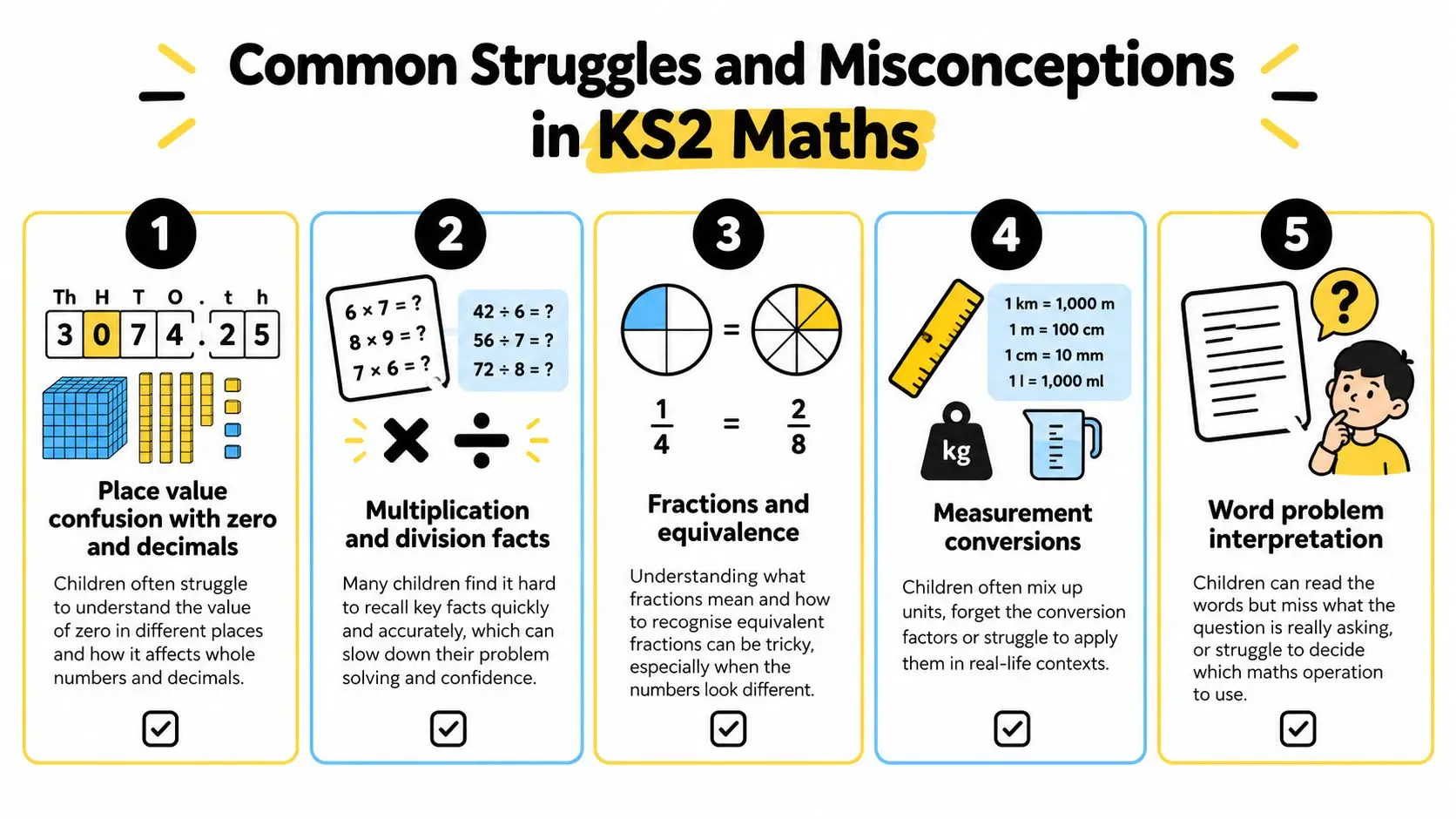
Place value confusion often appears when zero acts as a placeholder, especially with decimals. Use place value counters or a chart and ask, “What does this digit represent?” rather than saying, “You've put the decimal in the wrong place.”
Counting instead of recalling facts can make later multiplication and division slow and tiring. Short, regular practice with Times Tables Rock Stars, Numbots or homemade cards is more useful than a long session that leaves your child upset. Retest a small group of facts later so success becomes visible.
The equals sign becomes a command when children think it means “write the answer now”. Model balanced equations such as 8 + 4 = 6 + 6 and discuss how both sides have the same value. This turns the symbol into a relationship.
Method switching creates errors. A child may begin one written method, notice a different example and change halfway through. Teachers can model one reliable method for a period of learning, then compare methods deliberately once the first method is secure.
Maths anxiety closes the door before the question begins. If your child says, “I can't do maths,” don't respond with a quick “Of course you can.” Try, “This feels difficult right now. Let's find the first part we understand.” A ten-minute calm pre-quiz routine, with no grading and one easy opening question, can lower the emotional barrier.
Listen for the sentence behind the mistake: “I don't understand the place value,” “I'm worried about time,” or “I don't know which operation to choose.”
Some children have persistent difficulties that need a closer look. Dyscalculia can affect number sense and calculation, and a child may need assessment and specialist advice rather than more repetition. Families can begin by discussing patterns with school and reading about possible symptoms of dyscalculia without turning a list into a diagnosis.
A short visual explanation can also help children and adults talk about these barriers together.
Practical Activities and Resources That Build Confidence
The best activity is one your child can start without dread. Choose the skill that needs attention, keep the task brief and stop while your child still feels successful.
For number facts
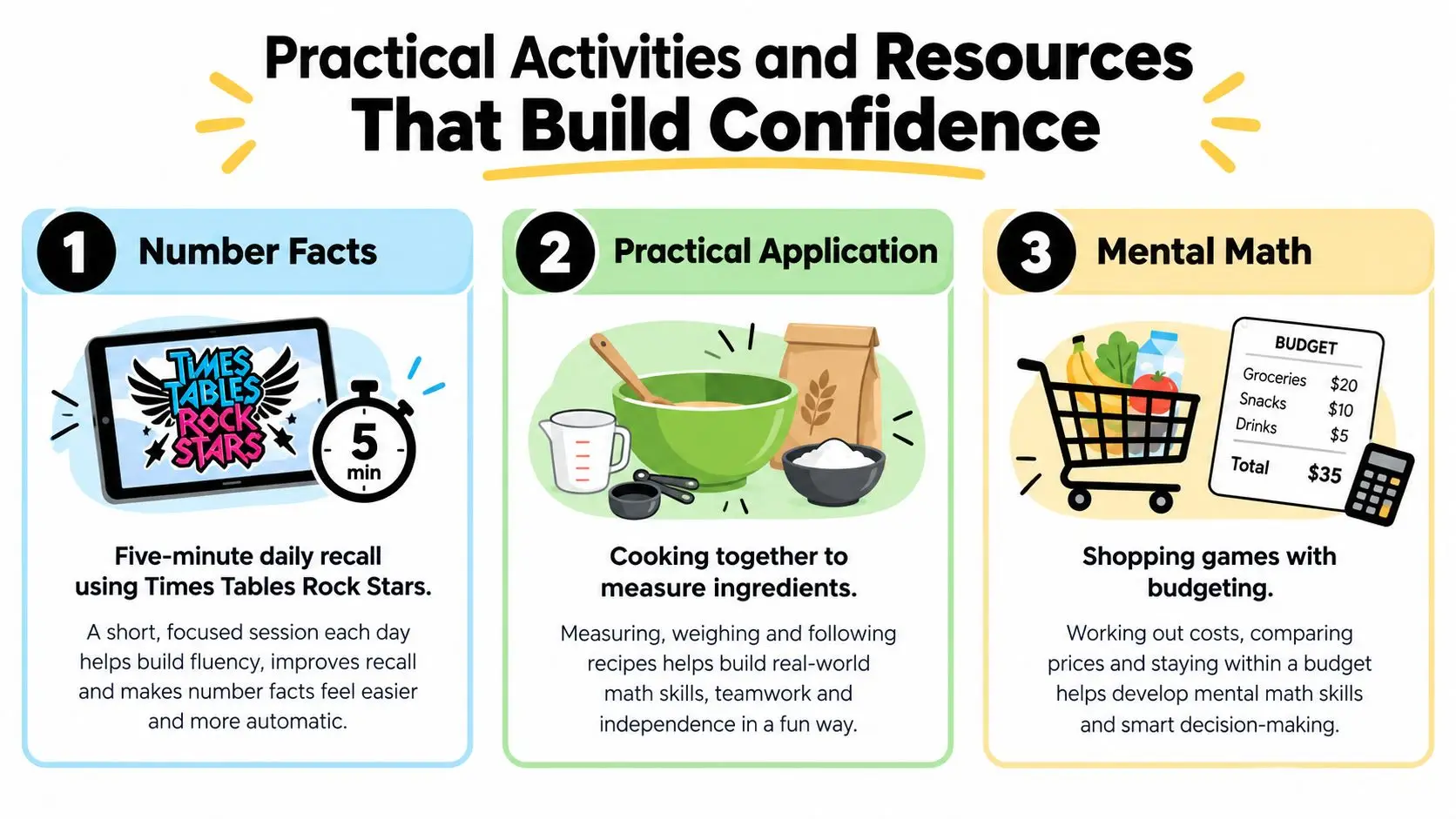
Use a five-minute recall routine with Times Tables Rock Stars, Numbots or homemade flashcards. Show a small set of facts, ask your child to explain a connection, then revisit the same facts later.
For example, if 6 × 4 is secure, ask how it helps with 60 × 4 or 24 ÷ 6. This makes recall meaningful and gives a child several routes to an answer.
For reasoning
Turn everyday decisions into small problems. At the supermarket, ask which of two items costs more, what change might be needed or how a budget could be shared. While cooking, ask how a recipe would change if you made more or fewer portions.
Bar Modelling practice sheets can help children represent known and unknown quantities. Draw the whole amount as one bar and the parts beneath it. A picture can reduce the panic caused by a block of words.
For measurement
Cooking gives children a reason to read scales and measure ingredients. Sewing, gardening and DIY can introduce length, area, estimation and the choice of units. Ask your child to predict first, then measure and compare the result.
Time deserves patience because clocks combine number, language and circular positions. Let your child use a clock face, a number line and digital times together instead of treating a mistake as poor attention.
For statistics and geometry
Ask family members a question, record the answers and create a bar chart by hand. Discuss what the chart shows and whether the sample gives a fair picture.
For geometry, try Lego constructions, tessellations, repeating patterns or simple programming on Scratch. Children can explore symmetry and position while making something they care about.
Free resources such as BBC Bitesize, NRICH and White Rose Maths home learning offer activities that can be selected by topic.
Small and regular beats dramatic: ten calm minutes on most days is more sustainable than a weekend cram that leaves your child convinced maths is punishment.
Celebrate useful behaviours, not only correct answers. “You checked your estimate,” “You changed strategy carefully,” and “You explained your thinking” all tell your child what successful learning looks like.
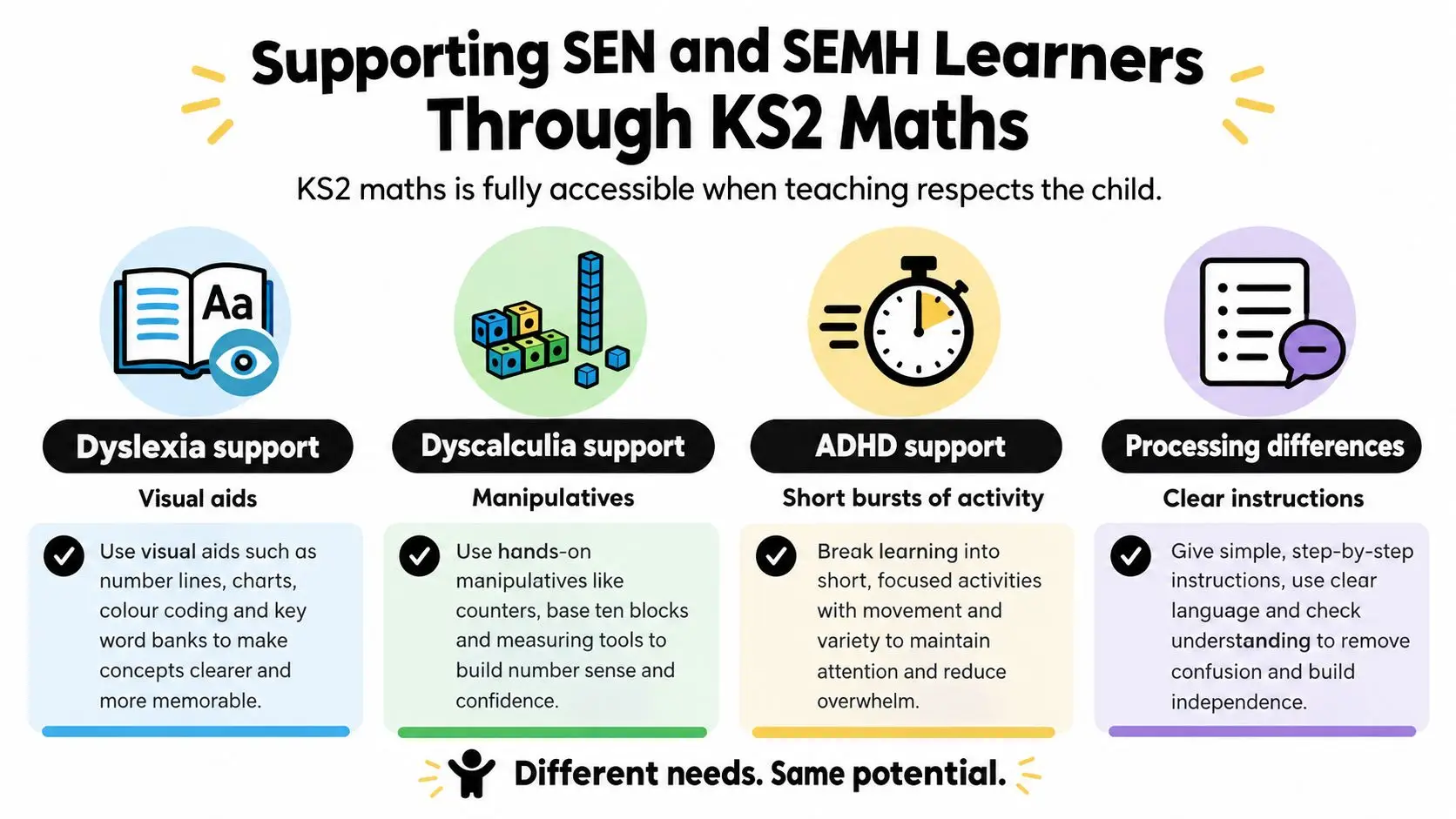
Supporting SEN and SEMH Learners Through KS2 Maths
A child with dyslexia, dyscalculia, ADHD or processing differences may understand a mathematical idea but struggle to show it in a crowded worksheet or timed activity. A child with maths anxiety, school refusal or a trauma response may find the emotional context so threatening that their working memory becomes unavailable.
Support begins by separating the child from the difficulty. A Year 4 pupil who needs smaller steps isn't less capable. They may need the same mathematical goal presented through a different route.
Adjust the route, not the ambition
A teacher might pre-teach vocabulary such as product, difference or equivalent before the lesson. They might use concrete manipulatives before pictures, then symbols, or present a small number of questions with generous space and clear visual structure.
Useful adjustments can include:
- Dyslexia support: a dyslexia-friendly font, uncluttered pages, visual models and spoken instructions.
- Dyscalculia support: counters, bead strings, ten frames, number lines and repeated links between quantities and symbols.
- ADHD support: short bursts of activity, movement breaks, visible goals and quick feedback.
- Processing differences: one instruction at a time, extra thinking time, worked examples and predictable routines.
- SEMH support: a calm arrival routine, a named key adult, permission to pause and a gradual return to challenging tasks.
Parents can ask the school which representation the child is using, how vocabulary is being introduced and what happens when timed work triggers distress. It's also reasonable to discuss access to a visualiser, rest breaks before assessments and a written plan for communication.
The SEN support plan guidance can help families prepare for a focused conversation with school. Ask for specific observations rather than broad labels. “She avoids questions involving fractions” gives adults something to investigate. “She hates maths” describes the pain, but not yet the teaching response.
A child who has fallen behind hasn't reached the end of their learning. Targeted fluency and reasoning work, delivered in a safe relationship, can rebuild both skill and trust. Confidence grows through one calm, successful attempt, followed by another.
How Queens Online School Delivers KS2 Maths
Queens Online School puts the child's starting point at the centre of Key Stage 2 maths. Its live, small-group lessons give teachers opportunities to see pupils' screens and whiteboards, so a misconception can be addressed while the child is still working rather than discovered after a worksheet is submitted.
Lessons move through a clear sequence. The teacher may begin with guided fluency, model a reasoning approach and then give pupils an independent problem to solve. Manipulatives and visual models are used explicitly, helping children connect practical representations with written mathematics.
A pupil working below age-related expectations can meet the same objective through a smaller step. A pupil who is ready for more challenge can explore a richer investigation rather than just completing extra routine questions. That distinction matters because repetition without understanding can discourage a struggling learner, while unplanned extension can leave a confident learner unchallenged.
Structure that reduces worry
Pre-teaching and recap routines help children know what language and ideas they'll meet. Recorded lessons allow pupils to replay an explanation when they need more time, and teachers communicate with parents about what has been taught and how home practice can reinforce it.
This approach can suit a child who needs flexibility, a learner who benefits from a quieter environment or a family looking for live online teaching across Years 3 to 6. The school also includes support for learners with SEN and SEMH needs within its broader online provision.
A calm maths lesson doesn't remove challenge. It makes challenge manageable. When a child learns that mistakes lead to another explanation, another representation or another attempt, maths becomes something they can do rather than something they have to fear.
Queens Online School offers live small-group KS2 maths lessons, personalised support, recorded sessions and a British curriculum for children who need flexible online learning. If your child needs a calmer, more responsive route through Years 3 to 6, visit Queens Online School to explore the provision and discuss whether it fits your family.