


Your child's Biology book is open, but the challenge may not be photosynthesis. It may be the noise from the kitchen, the fear of being asked a question without warning, a missed lesson after a medical appointment, or the worry that practical science can't be learned at home. Choosing online GCSE science means choosing a way of learning that must protect understanding, confidence and wellbeing alongside examination results.
Science remains a major part of the mainstream GCSE curriculum. Provisional summer 2026 data for England recorded 951,510 Combined Science entries, up from 934,500 in summer 2025, while total GCSE entries reached 5,840,185. The figures are reported in the government's provisional GCSE entries data, and they underline why families are asking whether a flexible science route can work for their child.
When a Bedroom Becomes a Classroom
At half past nine, a fourteen-year-old sits at a bedroom desk with a Biology textbook open beside a laptop. Her headphones block out some of the kitchen noise, where her younger brother is colouring, while a live lesson explains how the lungs exchange gases. The bedroom has now become a laboratory, a tutorial room and a social space at the same time.
That setting changes more than the timetable. A child who feels comfortable may pause the teacher, ask about alveoli and try the explanation again. A child who feels watched or overwhelmed may keep the camera off, write nothing and appear to understand when she's actually lost. The learning environment shapes concentration and emotional safety as much as the subject content.
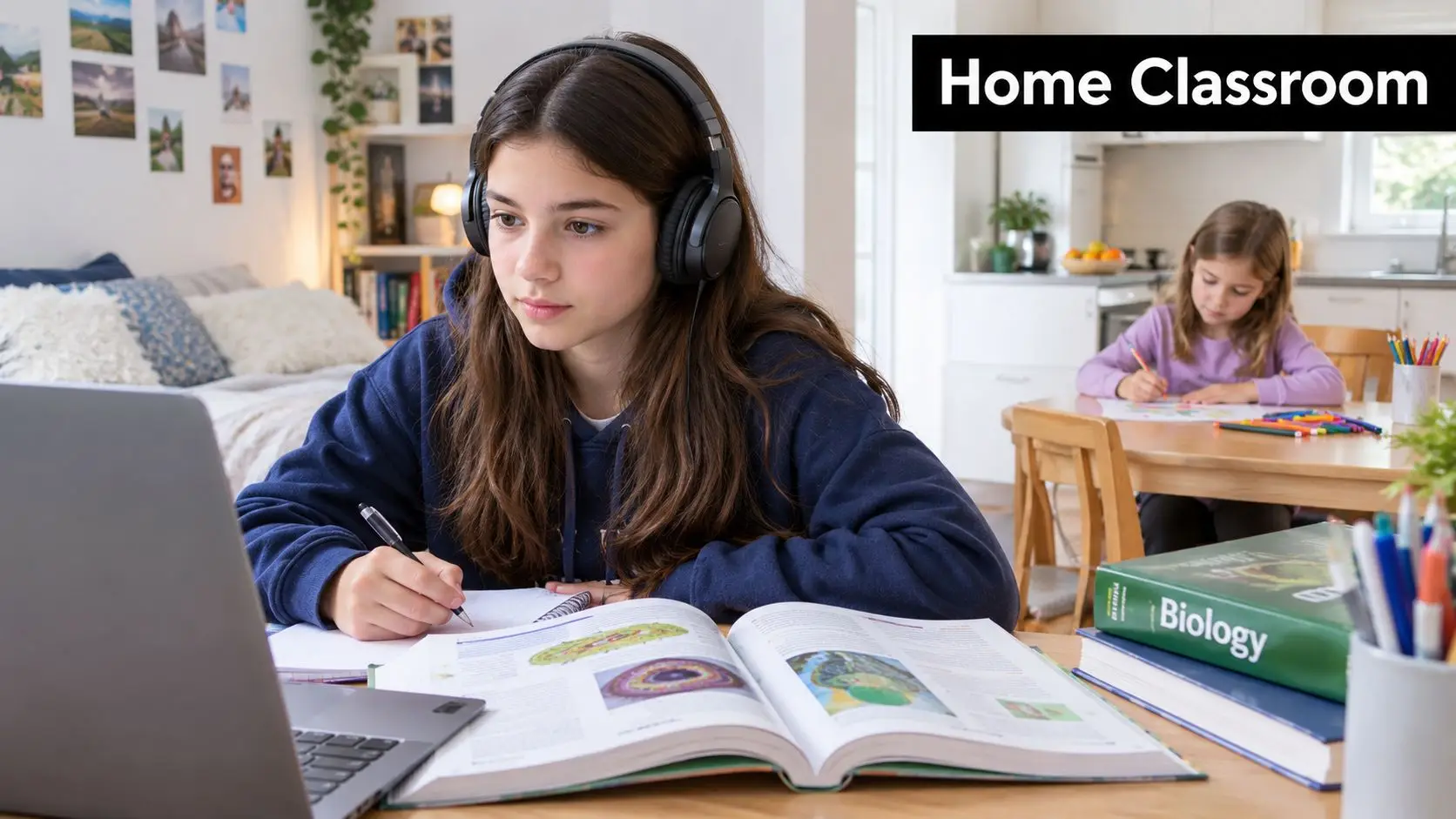
A thoughtful home learning environment gives the child a reliable place to work, but good online provision adds the human structure that a desk alone can't provide. Live teaching gives the week its shape. Recorded lessons allow a learner to pause, rewind and revisit an explanation. Small-group tutorials provide a quieter place to test ideas, while one-to-one support helps a teacher respond to a particular gap, anxiety or special educational need.
The small signs matter
A teacher might notice that a normally chatty student has stopped answering in the chat. Rather than assuming laziness, the teacher can check whether the question was unclear, the screen was overwhelming or the student needs a short pause. That small act of noticing can prevent a child from disappearing from the lesson.
For parents, the important question isn't just whether the platform works. Ask whether the adults behind it know the child well enough to recognise when a blank worksheet means confusion, exhaustion or distress. Online GCSE science works best when the child remains visible as a person, not just as a name in a lesson register.
Understanding Combined and Separate Sciences
The choice between Combined Science and Separate Sciences can sound more complicated than it is. Think of Combined Science as a mixed pizza containing Biology, Chemistry and Physics. Your child studies all three, but the subjects are combined into a double award. Separate Sciences are like ordering three individual pizzas, one for each discipline, with more space for each subject's content.
What each route means
| Feature | Combined Science | Separate Sciences |
|---|---|---|
| Qualification outcome | Two GCSE grades, known as a double award | Three individual GCSEs |
| Subjects covered | Biology, Chemistry and Physics | Biology, Chemistry and Physics |
| Curriculum shape | Integrated study across the three sciences | Dedicated study for each science |
| Typical fit | A learner wanting science within a broad GCSE portfolio | A learner considering advanced science study or science-heavy careers |
| Online timetable | Shared teaching time across linked topics | Separate lesson and revision time for each discipline |
Combined Science still gives a child a substantial grounding in all three sciences. It may suit a learner who wants to keep options open across languages, humanities, creative subjects or vocational interests, especially if a heavier science load would create unnecessary pressure. You can see how a double-award route is described in Combined Science course information.
Separate Sciences allow greater depth and may be the more natural preparation for a learner considering A-level Biology, Chemistry or Physics, or future study in areas such as medicine, engineering or laboratory science. They also demand more organisation. Your child needs to remember which teacher, notebook and revision method belongs to each subject, rather than treating science as one large course.
Choosing around the child
A high mark in a Year 9 science test shouldn't be the only deciding factor. Consider curiosity, stamina, mathematical confidence, existing anxiety and how your child responds when several deadlines arrive together. A learner who loves experiments but struggles with long written tasks may need support, not an automatic move into the lighter option.
Many schools review the pathway in Year 10 after seeing a pupil's baseline knowledge and working habits. That review can be useful, but ask how it works before enrolment. Find out whether the school assesses Biology, Chemistry and Physics separately, explains the workload clearly and includes your child in the decision.
How Live Lessons, Recordings and Small Classes Fit Together
Online learning becomes calmer when each part has a clear job. A live lesson anchors the week, a recording protects continuity, a small class exposes misunderstandings and individual support gives the teacher room to respond to the learner in front of them.
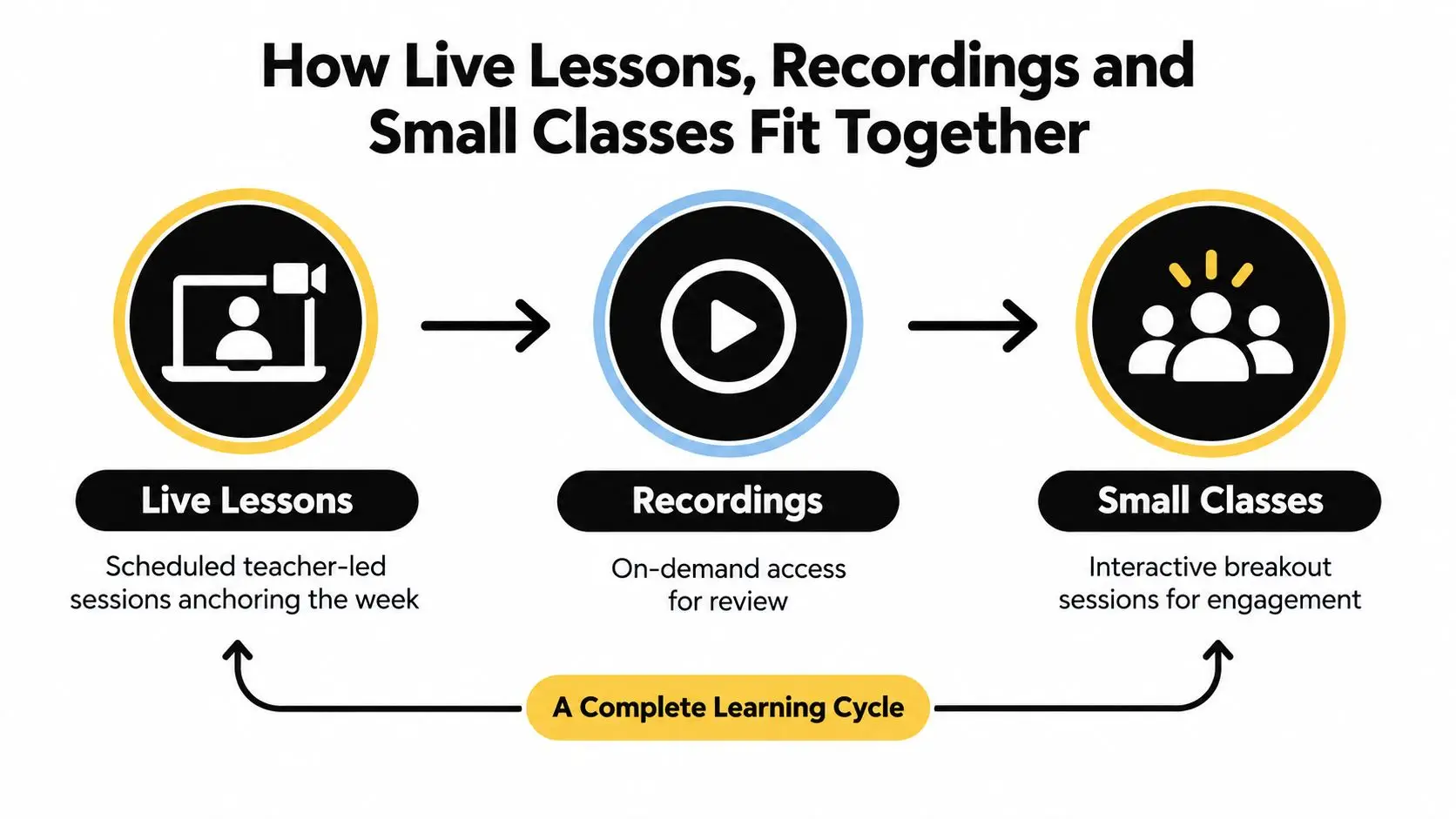
A connected learning rhythm
In a live session, a specialist teacher might model a separation technique, use questions to check recall and ask pupils to predict what will happen before showing the result. Cameras can help the teacher read the room, but participation shouldn't depend entirely on being visibly on screen. A student may contribute through the chat, a microphone or a shared answer.
The recording matters when life interrupts. A hospital appointment, a sporting commitment or a difficult anxiety morning shouldn't turn one missed lesson into a permanent gap. The student can watch the explanation later, pause at a tricky diagram and bring a specific question to the next tutorial. This is different from just sending a worksheet home, because the child can return to the teacher's original reasoning.
Live online school lessons should also lead somewhere interactive. In a small tutorial, perhaps four to eight pupils, the teacher can unpack why a student confused mass with weight, practise an extended-response question or model how to structure a practical conclusion. A one-to-one slot can then target a particular need, whether that means simplifying instructions for a learner with SEN or providing stretch work for someone ready to move further.
Practical rule: A recording should preserve access to teaching, not replace relationships with teachers.
A normal week might therefore begin with a live Biology lesson, include a recorded recap midweek, move into a small-group Chemistry clinic on Thursday and finish with a one-to-one review on Friday. The child experiences repetition without humiliation, support without constant exposure and progress without pretending that every day carries the same emotional capacity.
Exams, Practicals and Accreditation Explained
The qualification at the end of an online course must be treated as seriously as the teaching at the beginning. Online and face-to-face candidates work towards exam-board specifications, and the examination arrangements, grading framework and practical expectations depend on the chosen qualification rather than the fact that lessons took place through a screen.
For England's reformed separate GCSEs in Biology, Chemistry and Physics, the assessment rules include at least 3.5 hours of total assessment time, 15% of marks for practical work, at least 10% of marks for mathematical skills in Biology and Chemistry, and 30% in Physics. Candidates also need opportunities to complete at least eight specified practical activities, with an annual school statement confirming that pupils had reasonable opportunities to complete and record them. These requirements are set out in the government consultation on GCSE science reform regulations.
The practical question families must ask
A screen can show a titration, a circuit or a reaction. It can help a child understand variables, safety and the expected pattern in results. It cannot automatically provide the physical experience or evidence required by a standard UK GCSE specification.
OCR's remote teaching guidance for science identifies practical Chemistry as particularly difficult to carry out remotely, while recommending digital resources, retrieval practice and animations to support understanding. A distance-learning provider also explains that Biology, Chemistry and Physics candidates need required practical work before sitting the papers, and that learners without those practicals may need to consider an International GCSE route. The practical detail is described in Combined Trilogy Science course information.
An online provider should therefore explain its practical model before you enrol. It might organise laboratory days, work with an approved centre, offer a supported practical week or use a specification whose practical skills are assessed through written papers. Ask who supervises the work, how records are kept and which examination route your child will enter.
| Board | Code | Assessment | Practicals |
|---|---|---|---|
| AQA | Confirm with the provider | Written examinations and specification-based assessment | Required practical opportunities must be arranged and recorded where the specification requires them |
| Pearson Edexcel | Confirm with the provider | Written examinations and specification-based assessment | Practical work and evidence depend on the selected GCSE or International GCSE specification |
| OCR | Confirm with the provider | Written examinations and specification-based assessment | Remote teaching can support theory, but required practical arrangements still need careful planning |
Coursework shouldn't be presented as a way around this issue. Families need a clear explanation of the specification, the exam centre and the practical evidence, not reassurance that leaves important details hidden.
Supporting SEN, SEMH and Anxious Learners
A Year 10 student with an autism profile and a history of school refusal may find a camera-optional breakout room far easier than a thirty-pupil classroom. He can see the task in plain English, listen without managing the sensory load of a busy room and answer when he's ready. That doesn't mean he's avoiding learning. It means the school has removed an unnecessary barrier.
Good support begins before the first lesson. An initial conversation with the SENCO should consider the child's EHCP, previous reports, pastoral notes, medical information and known triggers. The teacher then needs practical information, such as whether sudden questioning causes distress, whether instructions must be chunked or whether the child needs extra processing time.
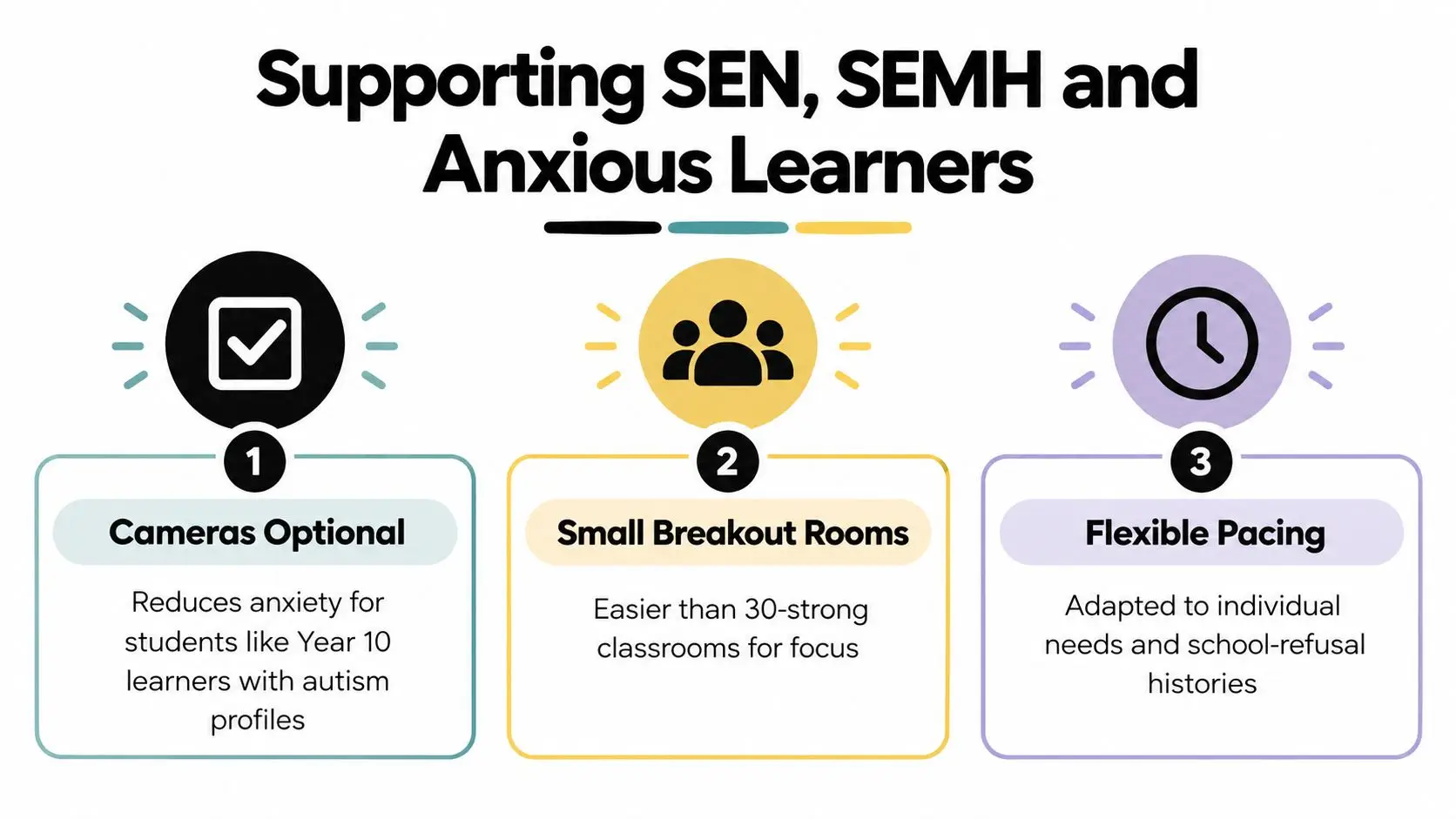
Support should change the lesson
Across a term, effective adjustments might include:
- Predictable transitions: The teacher gives a clear final task and explains what happens next before closing the lesson.
- Flexible participation: Cameras may be optional, with chat, audio or private responses available where appropriate.
- Accessible writing support: A scribe or assistive technology can be considered for extended responses, subject to the relevant access-arrangement rules.
- Planned exam preparation: Access arrangements should be explored well before Year 11 mocks, rather than raised during the final weeks.
- Shared de-escalation planning: Tutors know what to do if the learner becomes overwhelmed, rather than improvising in front of classmates.
- Regular human contact: A weekly one-to-one check-in gives the child a safe place to say, “I don't understand,” or “Today has been difficult.”
Recorded lessons can be especially valuable for anxiety, EBSA and ADHD. A learner can reset after a difficult morning without losing the teacher's explanation, then complete a manageable piece of work and reconnect with the class when ready. Sensory-friendly timetabling, uncluttered slides and short instructions can make the difference between starting and shutting down.
Evidence links wellbeing and attendance closely. Loughborough University reports that overall absence rose from 4.7% before COVID-19 to 7.6% in 2021/22, then remained at 7.4% in 2022/23, while its reporting on school absence and mental ill health records a rise in the probability of mental ill health from 1.82% with no absence to 3.7% with 20% absence and 5.27% with 30% absence. NFER also found average absence of 6.1% among pupils with high life satisfaction compared with 9.0% among pupils with low life satisfaction, as discussed in Loughborough's school mental-health policy briefing.
These figures don't prove that online school solves every difficulty. They do support a child-centred approach in which attendance, belonging and emotional safety are treated as part of learning.
A Sample Weekly Timetable for Online GCSE Science
A workable timetable gives a child enough structure to begin, enough breathing space to recover and enough repetition to remember. The example below shows one possible week for a Year 10 Combined Science student. The exact lesson length and subject order should always be confirmed with the provider.
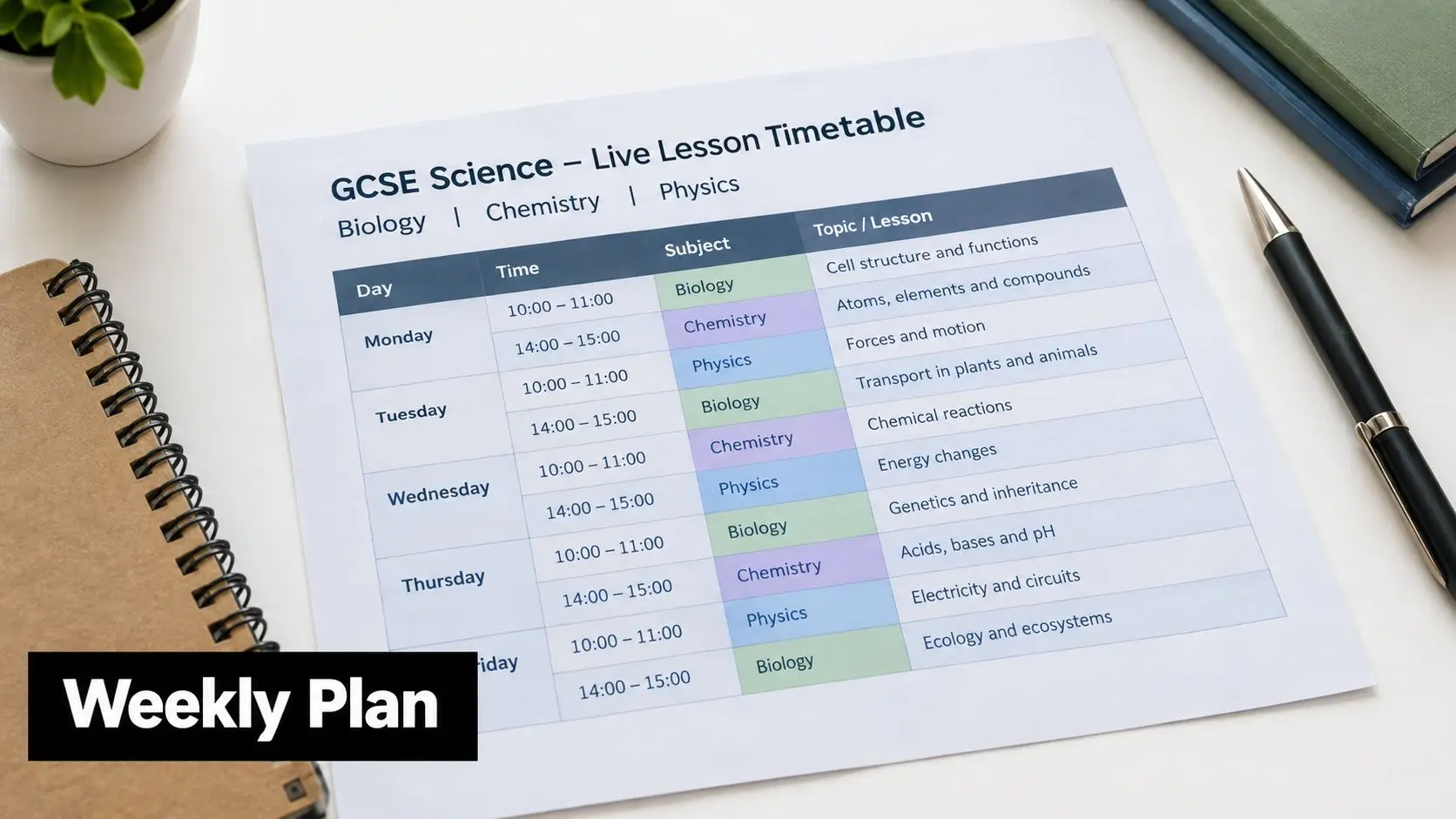
| Day | Morning | Midday | Afternoon |
|---|---|---|---|
| Monday | Live Biology lesson, 45 to 60 minutes | Break and social time | Recorded review, notes and retrieval questions |
| Tuesday | Live Chemistry lesson, 45 to 60 minutes | Break and lunch | Independent Chemistry task |
| Wednesday | Live Physics lesson, 45 to 60 minutes | Social or wellbeing activity | Catch-up recording and teacher questions |
| Thursday | Science retrieval task | Small-group tutorial | Practical write-up with tutor guidance |
| Friday | Live recap or assessment | Break and social time | One-to-one review and planning for the next week |
The recording slot shouldn't become a punishment for missing live teaching. If a child has a healthcare appointment, the family can agree in advance which lesson will be watched later and when the student will ask follow-up questions. A learner who works part-time or trains in sport may need the same principle applied across several subjects, with protected rest rather than a timetable that fills every available hour.
A Year 11 Separate Sciences week would usually need more subject-specific revision. Monday could include Biology exam questions, Tuesday Chemistry calculations, Wednesday Physics retrieval and Thursday practical analysis, with targeted intervention where a teacher has identified a gap. The child still needs food, movement, social contact and sleep. A schedule that looks academically impressive but leaves a young person exhausted is not a successful plan.
A short family routine can help: check the next day's lessons each evening, keep headphones and chargers in one place, and decide what happens if the internet fails. The child should know who to contact and where the recording will appear, rather than feeling that one technical problem has ruined the day.
The important question isn't whether every hour looks like school. It's whether the pattern helps your child return, participate and remember.
How to Enrol and What to Ask Before You Start
Enrolment should feel like a careful matching process, not a sales conversation followed by a surprise timetable. Families need enough information to judge whether the school can support the child academically, practically and emotionally.
A sensible sequence
Begin with a suitability call. Describe your child's current strengths, worries, attendance pattern, medical needs and preferred learning conditions. Ask who will take responsibility for pastoral and SEN information.
Request a taster lesson or sample activity. Watch how the teacher explains a scientific idea, invites participation and responds when a student is unsure. Notice whether your child looks calmer, more curious or more tense afterwards.
Gather the records. Have Year 9 reports, recent science work, attendance history, SEND paperwork, EHCP documents and relevant medical or pastoral notes ready. These records help a provider plan support instead of guessing.
Complete the baseline assessment. Biology, Chemistry and Physics should be considered separately, even if your child is likely to take Combined Science. A gap in one discipline shouldn't be hidden inside an overall score.
Agree the qualification route. Discuss Combined or Separate Sciences, GCSE or International GCSE, the examination board and the practical model. Ask whether a later pathway review is possible.
Sign the learning agreement. Check expectations for attendance, independent work, communication, recording access and pauses in learning.
Confirm examination arrangements. Ask which centre will enter your child, what costs apply, when mock examinations take place and how practical evidence will be managed.
Test the home setup. Confirm that the device, headphones, camera, microphone and broadband can support lessons. Also ask what the school does when the connection fails.
Keep these questions in writing:
- Who teaches Biology, Chemistry and Physics?
- How many pupils attend each live class and tutorial?
- How long are recordings retained?
- When are mock examinations held?
- Which examination board and specification will be used?
- What centre costs should we expect?
- Who coordinates access arrangements?
- What happens if my child needs a pause in learning?
- How are safeguarding, wellbeing and de-escalation concerns shared?
- How will practical work be supervised and recorded?
A school that answers clearly helps a parent make an informed choice. Your child should also be invited into the conversation, in language they understand. They may know something important about the proposed environment that no report can show.
Common Worries Families Bring and Honest Answers
Will my child lose out socially? They might if the school offers lessons and nothing else. Social connection needs to be designed through small-group work, clubs, peer discussion and pastoral contact. A child who feels safer online may participate more readily than they did in a crowded classroom, but families should ask exactly how interaction is created.
Will sixth forms, universities and employers take the qualification seriously? They look at the qualification, examination board, grades and entry requirements. A provider should state clearly whether the child is working towards GCSE or International GCSE, which specification applies and how the examination entry is handled. Don't accept a general promise of recognition when a precise qualification name is available.
What happens if the internet drops? The child needs a simple recovery plan. They should know how to notify the teacher, where the recording will be uploaded and when they can complete the missed task. A technical interruption becomes much less frightening when it has already been anticipated.
What if my child can't face the camera? Camera use should be discussed in the context of safeguarding, participation and the individual learner. A camera-optional approach may help an anxious or autistic child begin engaging, while voice, chat and private responses maintain contact. The longer-term aim should be confidence and connection, not forced visibility.
Can practical science really happen through a screen? Not fully where the UK specification requires physical practical opportunities and records. Online explanations, demonstrations, simulations and practical questions can build understanding, but the provider must arrange suitable laboratory access or select a route with different assessment requirements. OCR's remote-learning guidance makes the difficulty of practical Chemistry clear, so this is an area where families should ask for specifics.
Will online learning make my child fall behind? It can if the student receives materials without teaching, feedback or monitoring. It can also help a learner regain ground when flexible pacing, recordings and small tutorials remove barriers that made a conventional classroom inaccessible. NFER's findings on life satisfaction and absence show why emotional wellbeing belongs in the discussion, not as an afterthought.
The child behind these questions isn't a timetable problem. They may be frightened, exhausted, gifted, lonely, determined or all of those things in one week. The right online GCSE science arrangement won't remove every challenge, but it can give that young person a calmer route into knowledge, practical support and a future they can see themselves reaching.
Queens Online School offers live online GCSE and iGCSE science teaching across Biology, Chemistry and Physics, with small classes, recorded sessions and support for learners with SEN or SEMH needs. If you're comparing online GCSE science routes, visit Queens Online School to discuss the qualification pathway, practical arrangements and learning environment that may suit your child.