

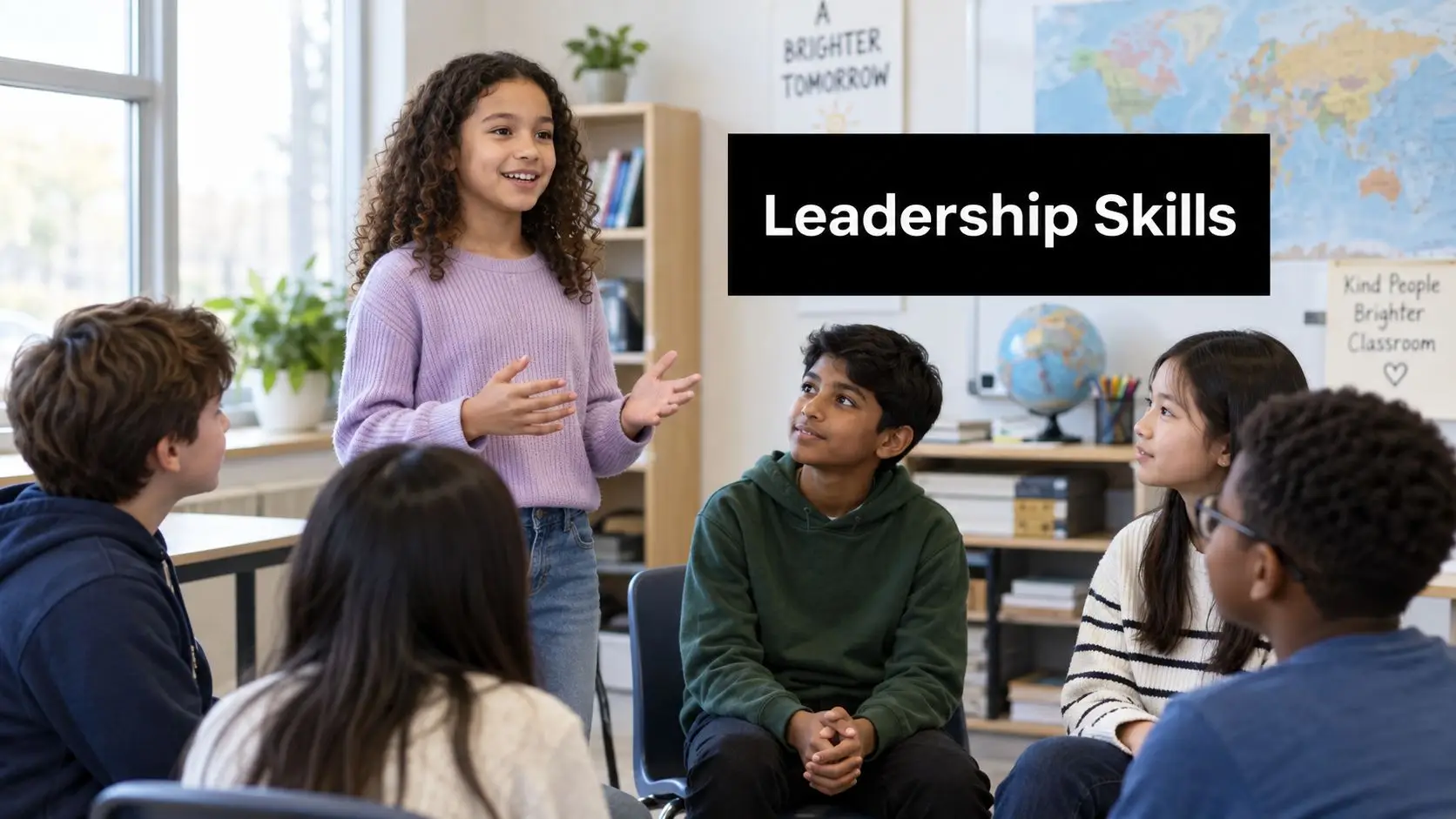
A group task is under way, and one child has a thoughtful idea but keeps it to themselves. A louder classmate takes charge, assigns the roles and speaks for everyone. The quiet pupil isn't lacking intelligence or care. They haven't yet had enough safe, structured opportunities to practise taking initiative.
That moment appears in classrooms, clubs, family conversations and online lessons. Parents often ask how to develop leadership skills without turning childhood into a competition, while teachers want every pupil to contribute without rewarding volume over kindness. The answer begins with a child-centred view of leadership: leadership is a set of behaviours young people can learn, rehearse and improve, not a personality label reserved for the naturally confident.
Why Leadership Must Be Taught, Not Assumed
The Year 5 pupil may be excellent at noticing when others feel uncomfortable. They may listen carefully, organise resources or help a partner understand the task. Yet if adults only recognise the person who speaks first, that pupil receives a damaging message: leadership belongs to somebody else.
The old “born leader” idea makes this worse. It encourages adults to wait for confidence to appear instead of teaching the actions that create confidence. Young people need repeated chances to lead, follow, make decisions, repair mistakes and reflect. A child who chairs a short discussion, checks that everyone has a role and reviews what happened afterwards is learning leadership, even if their voice trembles.
Confidence grows through designed practice
Leaving leadership to chance usually favours children who already understand the social rules of group work. They may have more experience speaking to adults, joining activities or negotiating disagreement. Other pupils, including children who are anxious, new to English, neurodivergent or managing SEMH needs, can be overlooked despite having valuable strengths.
Practical rule: Give every child a real responsibility, then adjust the support rather than lowering the expectation.
Experiential learning makes this process visible because pupils learn through action, feedback and another attempt. A useful introduction to experiential learning can help families and educators distinguish between telling a child to “be confident” and creating a situation in which they can practise confidence safely.
A responsibility shared by adults
Schools can build leadership into group roles, PSHE discussions, subject projects and tutor routines. Families can invite children to chair a household decision, plan part of a journey or explain a choice. The task needn't be grand. A Year 4 pupil choosing how to organise a reading game is already learning to consider options, communicate a plan and accept feedback.
Leadership should also include the right to step back. A child shouldn't be pushed into public speaking when a planning or design role would provide a more secure starting point. Deliberate teaching means noticing the learner in front of us, offering a manageable challenge and helping them try again after disappointment.
Core Leadership Competencies Every Young Person Needs
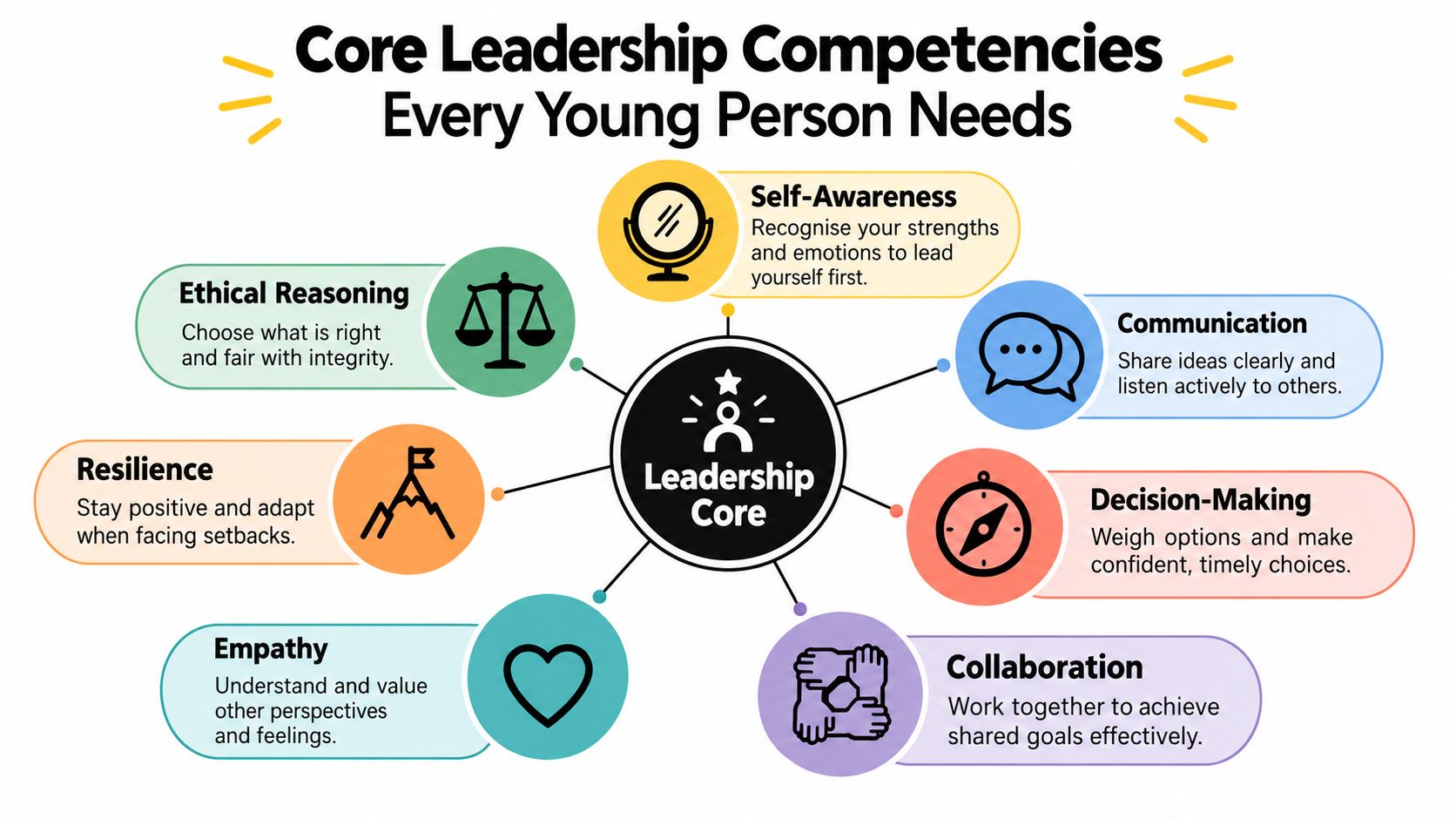
Leadership becomes easier to teach when adults describe observable actions rather than personality traits. The seven competencies below overlap. A pupil can't collaborate well without listening, make a fair decision without self-awareness or show resilience without understanding their own emotions.
The behaviours adults can coach
- Self-awareness: Ask the young person to name what helped or hindered them after a task. “I rushed because I felt nervous” gives a teacher something useful to coach.
- Communication: Require listening before speaking. A pupil can summarise a partner's idea, then add their own view.
- Decision-making: Present a small choice, such as selecting the order of activities, and ask the child to explain the reason rather than defend the outcome.
- Collaboration: Give each group member a defined contribution and let pupils assess whether everyone had genuine influence.
- Empathy: Invite a child to consider how a decision might feel to someone absent, worried or less confident.
- Resilience: After a plan fails, ask for one adjustment and a second attempt. The aim isn't forced positivity. It's learning that setbacks can be examined.
- Ethical reasoning: Use dilemmas involving fairness, honesty, inclusion or responsibility. Ask, “Who could be affected, and what would a fair response look like?”
These skills form a chain. Clear communication without empathy can become dominating. Resilience without reflection can become stubbornness. Decision-making without ethical reasoning may achieve a goal while harming trust.
For a practical way to help learners agree shared responsibilities and review progress, teachers and families may find Pretty Progress collaborative goals useful. The important point is that the goal belongs to the group, while each child can identify the behaviour they'll practise.
This language fits naturally within PSHE, RSE and tutor-time work across the UK key stages. It also gives adults a fairer basis for assessment. Instead of calling a child “a leader” or “not a leader”, record what they did, whom they included and what they'll try next.
What the UK Evidence Tells Us About Leadership Gaps
A newly appointed manager may be expected to support colleagues, make difficult decisions and give useful feedback without having learnt how to do any of these things. UK evidence shows why leadership development should begin before formal promotion.
Research from the Chartered Management Institute found that 82% of people moving into management had received no formal management or leadership training. The same report states that 52% of managers held no management and leadership qualifications, while 33% of current managers and leaders had never received formal training. Around 30% of managers had done nothing to develop their management and leadership skills during the previous three years.
These figures do not mean every child must become a manager. They show that organisations can place people in positions of responsibility before they have practised listening, judgement, encouragement and accountability. Schools can offer that practice earlier, in manageable forms. A Year 4 pupil might lead a short group decision, while a Year 11 student might chair a discussion and respond thoughtfully to disagreement.
Historical evidence points to a wider workforce problem. An Institute of Leadership & Management evidence review published through GOV.UK records that 93% of UK businesses believed a shortage of skilled managers could hold them back, 43% had no talent plan, and only 55% of managerial vacancies were filled internally. Less than one in five employers expected candidates to have received management training before appointment.
| Evidence | What it suggests for young people |
|---|---|
| 82% entered management without formal training, according to CMI research | Leadership practice should begin before formal promotion |
| 93% of UK businesses saw skilled-manager shortages as a risk, according to the UK evidence review | Schools should make responsibility and mentoring visible |
| Less than one in five employers expected prior management training, according to the same evidence review | Young people need structured preparation, not assumptions |
The equity issue matters. If leadership opportunities depend on family networks, extracurricular access or confident self-selection, differences can widen. Schools should give every pupil supported chances to initiate, communicate and influence, including learners with SEN or SEMH needs whose strengths may appear through careful planning, online collaboration, practical tasks or quiet one-to-one support rather than conventional presentations.
Leadership Activities From Primary to A-Level
A sensible programme starts with small, supported responsibilities and gradually increases independence. The adult changes the level of scaffolding, not the child's worth. Online tutors can use the same approach through breakout rooms, shared documents, recorded explanations and short live presentations.
Early Years and Key Stage 1
Young children can lead a familiar routine. A pupil might be the “Huddle Captain”, welcoming the group, checking the visual timetable and asking each child for an idea. Another can lead a reading-pair activity by choosing who reads first and reminding both partners to listen.
At home, a child could demonstrate a game, explain the rules and ask whether everyone understands. The adult should praise specific actions, such as noticing a younger sibling's confusion, rather than saying, “You're a natural leader.”
Key Stage 2
A Year 4 or Year 5 class can rotate roles including discussion host, resource organiser, question collector and digital presenter. During an online science investigation, the host might invite predictions, the organiser could track ideas on a shared board and the presenter could report the group's conclusion.
A teacher can keep the task low risk by providing sentence starters: “Our group agrees because…” and “We changed our plan when…”. Children then practise clear communication without having to invent the entire performance.
Key Stage 3
KS3 pupils are ready for more visible judgement. Ask them to chair a debate on a current-affairs question, ensuring they introduce the issue, invite contrasting views and summarise the discussion without declaring a winner. They can also produce a short podcast in which each member has a defined role, from researcher to interviewer and editor.
An online tutor might ask pupils to submit questions asynchronously before the live session. This gives reflective learners and pupils who find spontaneous speech difficult a meaningful way to influence the discussion.
GCSE and A-Level
GCSE learners can design and present a year-group wellbeing campaign, mentor a Year 7 pupil or lead a genuine fundraising micro-project. Each task should include a brief, a decision log, a feedback point and a final reflection. The child's emotional safety still matters. A learner can contribute as campaign designer, data organiser or accessibility adviser before taking the presenter role.
A-Level students can chair a mock interview panel for younger learners, write an extended-project proposal about a leadership question and shadow a sixth-form leadership team. The work should become increasingly evidence-driven, with students explaining why they chose an approach and how they would revise it.
| Stage / age band | Suggested activity | Core competency developed | Classroom deliverable |
|---|---|---|---|
| Early Years and KS1 | Huddle Captain rotation | Communication and confidence | Welcome and short group check-in |
| KS2 | Lead a reading pair or investigation | Collaboration and decision-making | Shared plan and group summary |
| KS3 | Chair a debate or make a podcast | Listening and ethical reasoning | Debate notes or edited audio |
| GCSE | Run a wellbeing campaign or mentor a younger pupil | Initiative and empathy | Campaign presentation and reflection |
| A-Level | Chair a mock panel or propose an extended project | Strategic judgement and resilience | Proposal, evidence log and review |
Sport can provide another route, especially for pupils who communicate more comfortably through action. Guidance on Vanta Sports leadership development can help educators translate captaincy into listening, encouragement and shared responsibility rather than authority alone. Families can also use after-school activities to offer leadership practice beyond formal lessons.
Daily and Weekly Practice Routines for Home and School
Leadership develops through repetition. A child who leads one impressive project may feel proud, but a child who regularly explains a plan, listens to feedback and takes responsibility starts to build a dependable habit.
A classroom rhythm
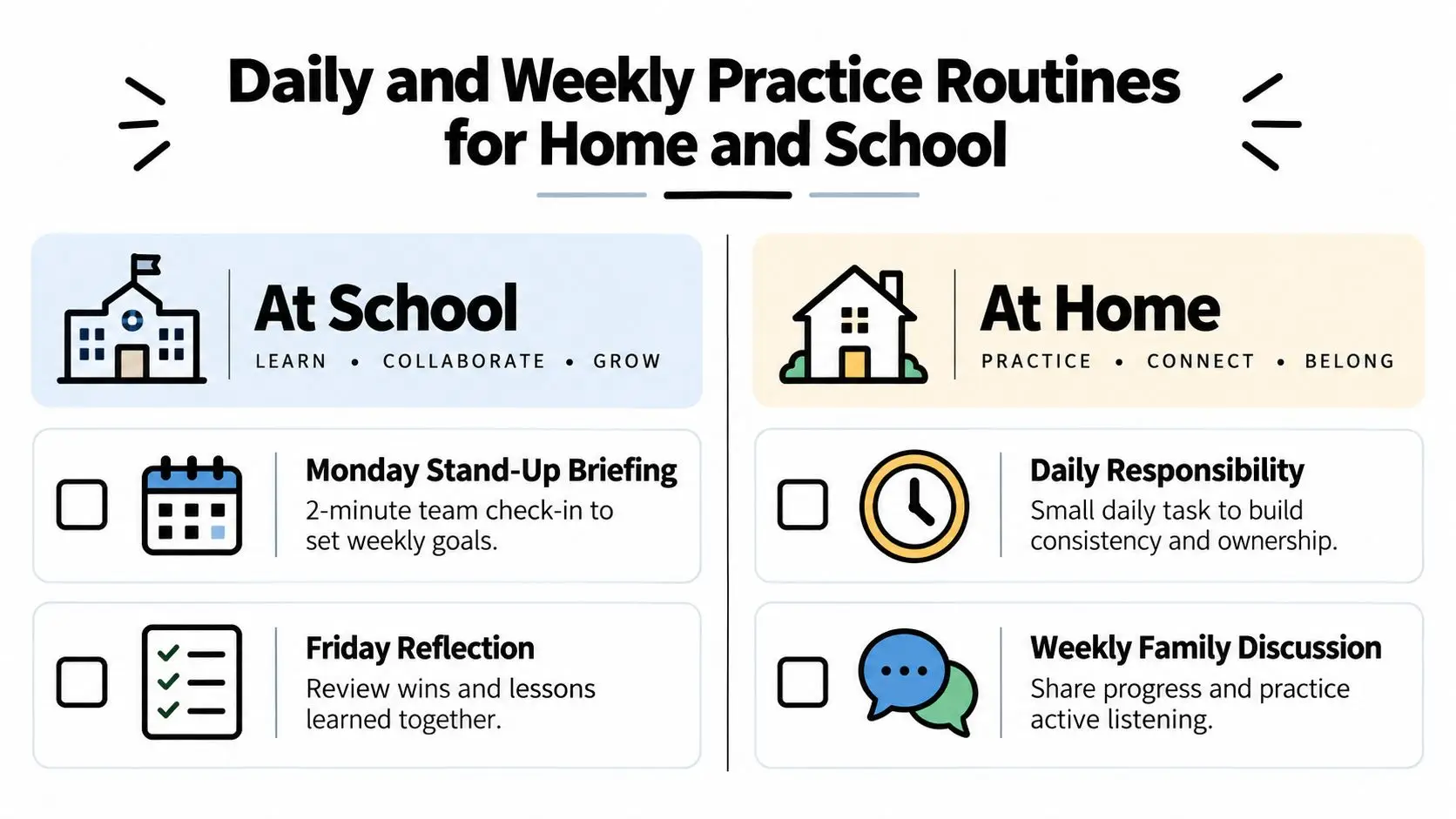
On Monday, use a two-minute stand-up briefing. Each pupil states the group's goal and one action they'll take. In a Year 3 class, this might be as simple as, “We'll finish our model, and I'll collect the card.” In Year 9, pupils can name a risk and agree how they'll handle it.
On Friday, hold a short win-share circle. Pupils identify one useful contribution from themselves or someone else, then record one lesson. Exit tickets can ask, “What did I initiate?” and “How did I include somebody else?” Rotating roles such as resource monitor, timekeeper or digital host make responsibility ordinary rather than performative.
A family rhythm
A Sunday family meeting can have a rotating chair. The chair welcomes everyone, introduces the decisions and checks that each person has been heard. A younger child might choose the order of weekend activities, while an older teenager might compare options and explain the trade-offs.
A daily responsibility should be small enough to complete consistently. A weekly “decision of the week” can involve choosing a meal, planning a walk or organising a shared task. End with a gratitude round, then set a monthly family challenge, such as completing a creative project together.
These routines need adapting by age. A Year 3 pupil may draw their reflection. A Year 9 student can write a concise review. A Year 12 learner might chair the meeting and invite challenge to their proposal. The adult's job is to protect the space from ridicule, interruption and token roles.
Supporting SEN and SEMH Learners to Lead
Leadership should never become another test that a child must pass in the same way as everyone else. For learners with SEN or SEMH needs, begin with regulation, predictability and trust. A familiar adult, a clear visual timetable and a calm briefing space may be more important than the task itself.
The principles of Universal Design for Learning support flexible routes into participation. Offer a visual task card, a pre-rehearsed script, a choice of written, spoken or recorded contribution, and an asynchronous video option for a pupil who can't speak on demand. A learner may show leadership by designing the slide deck, preparing the questions or creating the group plan.
A gradual route into responsibility
- Co-regulate first. Check sensory load, emotional readiness and the presence of a trusted adult.
- Find the strength. Ask whether the pupil prefers organising, drawing, researching, building, explaining or encouraging.
- Start privately. Let the child lead one partner, a short online breakout or a rehearsed routine.
- Add visibility slowly. Move from a recorded contribution to a small group, then to a wider audience if the learner wants that progression.
- Review the experience. Record what helped, what caused distress and which adjustment should remain.
Silent leadership isn't a lesser form of leadership. A planner, scribe, designer or accessibility checker can shape a group's success profoundly. For a child who becomes overwhelmed by rapid discussion, a shared document may provide the safest route to influence.
Adults should capture small, observable steps against EHCP outcomes and SEND passports. “Shared one prepared question in a group meeting” is more useful than “develop confidence”. The record should also include the support provided, the learner's response and the next manageable challenge.
Reflection Tools and How Queen's Online School Helps
Reflection turns activity into learning. At the end of each week, ask three questions: What did I initiate? How did I include others? What would I do differently? A child can answer through speech, drawing, a voice note or a short written entry. The format should reveal thinking, not measure handwriting speed or public confidence.
Teachers can use an observation checklist based on behaviour:
- Initiative: Did the learner notice a need and suggest an action?
- Listening: Did they summarise or respond to another person's idea?
- Inclusion: Did they make space for a quieter or less confident pupil?
- Judgement: Did they explain a choice and consider its effect?
- Reflection: Did they identify a change for next time?
A learner-led portfolio can gather meeting notes, project plans, feedback, podcast clips, campaign materials and reflections across a term. The portfolio makes progress visible without labelling children as fixed types.
Queen's Online School incorporates leadership practice through live online lessons, small-group project work and tutor mentoring, with progression checkpoints across Key Stages. Its British curriculum runs from Primary through Sixth Form, with live teaching, personalised support and opportunities for learners to contribute within an online community. For families considering a flexible route, the key question is whether the setting gives a child authentic responsibility while protecting belonging, wellbeing and access to support.
Leadership isn't a performance reserved for the loudest pupil. It's a practised craft, built through attention, courage, empathy and repair. When adults notice small acts of initiative and give children another chance, hesitant followers can become confident, compassionate contributors.
Queens Online School offers live British-curriculum teaching from Primary through Sixth Form, alongside small-group projects, tutor mentoring and flexible online participation. Visit Queens Online School to explore how your child can build leadership skills in a supportive learning community.