


Your child is at the kitchen table, pencil poised above a workbook, while you wonder whether online primary schooling would bring more calm into the morning or move classroom pressure into your home. Perhaps your seven-year-old becomes overwhelmed by a noisy class, your nine-year-old needs a gentler pace, or your family needs learning that can work around health, travel, or attendance difficulties. It's a serious decision because education affects more than reading, writing and maths. It shapes confidence, friendships, independence and the way a child feels about learning.
The shift towards online education became especially visible during the coronavirus pandemic. Official education statistics recorded remote schooling across England from April 2020 to June 2021, making it a defining modern moment in the way primary-age children experienced education. The ONS account of remote schooling during the pandemic shows why families now ask more detailed questions about live lessons, recorded work, flexibility and support at home.
The right choice depends on the child, not just on the technology. A successful online day should leave a child feeling understood, involved and capable, with enough movement, conversation and encouragement to make learning feel human. The following guide will help you understand what online primary schooling looks like, where it can help, what demands it places on families, and how to assess a provider with care.
Introduction to Online Primary Schooling Today
For a child, school is not just a timetable. It's the moment a teacher notices a worried face, the friend who shares a rubber, the pride of reading a paragraph aloud, and the reassurance that someone knows when concentration has run out. Online primary schooling needs to recreate those feelings through a different setting. A laptop can open the classroom door, but adults must still build the welcome, rhythm and sense of belonging around it.
The official Department for Education statistics service provides historic accountability data from 1992 to 2025, alongside current and historical school information for England. That long-running evidence base places online primary schooling within the wider story of primary education rather than leaving parents to rely only on private-sector promises.
Online learning may suit a child who finds a busy classroom exhausting, a family that moves frequently, or a pupil who needs lessons arranged around attendance or health circumstances. It may also suit a confident learner who enjoys returning to a recording, asking questions through chat, or taking extra time with a tricky multiplication method. Yet the same arrangement can feel lonely or demanding for a child who needs frequent physical prompts, spontaneous play and close adult help.
Start with the child's morning, not the provider's brochure. Ask whether your child will feel settled, noticed and able to ask for help.
A useful test is to imagine an ordinary Tuesday. Your child logs in, greets the teacher, joins a short phonics or maths activity, moves away from the screen to complete a practical task, and later tells you about something they enjoyed. If the proposed day sounds like long periods of passive screen watching, the model may need closer examination. The most reassuring programme is one that explains how teachers support attention, friendships, emotional regulation and progress, not only which platform hosts the lessons.
What Online Primary Schooling Really Means
Online primary schooling is a classroom without fixed walls. The teacher introduces ideas, children practise and discuss them, and adults check understanding. The device carries part of the lesson, while other learning takes place away from the screen.
For a seven-year-old, the key question is how the day feels. Will they be greeted, know what to do next and have a clear way to ask for help? A good programme makes those moments visible rather than leaving a child alone with a login.
Live interactive lessons
Live lessons take place in real time. A teacher might demonstrate how to partition a number, ask children to hold up an answer, invite them to explain their reasoning and send them into a small discussion group. The child's experience matters most here. They hear their name, respond to a familiar adult and notice that their ideas count.
A Year 3 morning might start with live maths, followed by a movement break and an offline task using counters or a workbook. The teacher could review the work later and address a common misunderstanding in the next lesson. This pattern gives children contact with their teacher while letting their eyes and bodies leave the screen.
Blended learning
A blended programme joins live teaching with independent activities, practical work and, sometimes, face-to-face experiences or wider enrichment. A child might attend a science lesson about habitats, collect leaves in the garden, replay a short explanation and create a labelled diagram.
Learning changes shape across the day. The child listens, talks, writes, moves, makes and reflects, much as they would during different parts of a school day. Parents can also see which tasks need supervision because learning is not confined to the device.
Recorded and self-paced sessions
Recorded lessons allow a child to pause, replay or revisit an explanation. This can ease the worry of asking for repetition in front of classmates, and it can help a pupil who is unwell or temporarily unable to join live teaching.
The trade-off is the independence required afterwards. A primary child may watch a recording willingly, then forget the activity that follows. Younger pupils usually need an adult to help them begin, stay with the instructions and recognise when they are stuck.
The Education Endowment Foundation guidance on digital technology notes that primary pupils covered less material remotely than their in-class peers, with the difference especially marked in Key Stage 1 because younger children depended more on parent-led instruction.
Ask what your child will do before, during and after each session. A strong programme sets out those steps in a way a child can understand and an adult can support.
Benefits and Challenges Through Your Childs Eyes
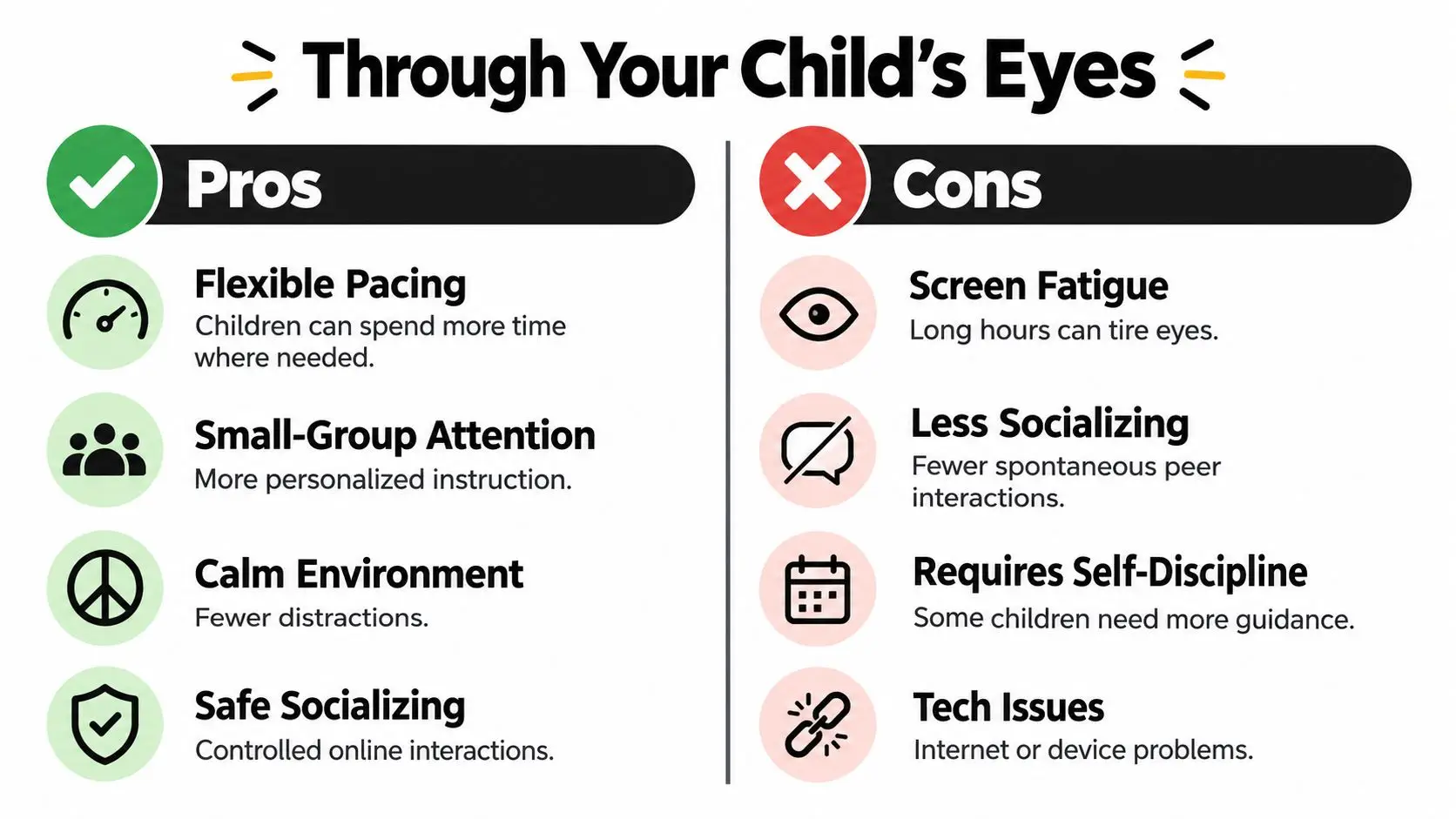
At 8:45, your seven-year-old opens the laptop, sees the morning plan and says, “I know what happens first.” For some children, that clear start feels reassuring. A pupil who needs extra thinking time can replay an explanation or finish without watching classmates move ahead. A child who finds a busy classroom overwhelming may answer more confidently from a familiar desk, especially when the teacher uses small groups and gentle questions.
A recorded catch-up lesson can protect confidence too. If your nine-year-old misses school through illness, revisiting the explanation privately may feel safer than returning convinced everyone else is ahead. Live feedback still matters, because a teacher can spot and correct a misunderstanding before it becomes a habit.
What flexibility feels like
| Child's experience | Possible benefit | What adults should check |
|---|---|---|
| “I need more time.” | The child can replay an explanation and work at a manageable pace. | Does a teacher review the completed work? |
| “The classroom feels too loud.” | A calmer setting may reduce overload. | Are there planned opportunities for social contact? |
| “I like knowing what happens next.” | A visible routine can create security. | Is the timetable predictable and age-appropriate? |
| “I'm nervous about answering.” | Smaller interactions may build confidence. | Can the teacher notice quiet disengagement? |
The difficult moments deserve equal attention. After several screen-based activities, a child may feel tired or irritable. A failed connection can interrupt concentration, while toys, pets or household noise can pull attention away. Parents may also find themselves switching between teacher, organiser and technical helper.
Evidence from remote learning, including the findings previously discussed, points to a particular concern for younger pupils. They usually need more adult guidance than older children. A programme that expects a seven-year-old to organise, begin and monitor most tasks alone may leave them feeling lost rather than independent. Before choosing, ask what help is available at the point a child gets stuck.
Social life needs planning
A playground offers spontaneous practice. Children invent games, repair small disagreements and notice a friend's mood without an adult scheduling each exchange. Online schooling can include clubs, friendships and group activities, but families should check whether these happen regularly and whether the format suits their child.
A quieter child may thrive online, but quiet must never be mistaken for coping.
Look beyond the lesson screen. Does your child finish animated and ready to show you something, or tense and withdrawn? Can they name the adult who will help? Can they explain the next task without prompting? These small daily signs often reveal more about fit than a polished demonstration lesson.
Keeping Children Safe and Supported Online
A seven-year-old may freeze when a chat message feels unkind, close the laptop after a frightening pop-up, or stay silent because they are unsure whether an adult will listen. Online safety therefore begins before a child enters a virtual classroom. A responsible provider should explain who can join lessons, how teachers moderate interaction, what happens after a child reports something uncomfortable, and how staff keep parents informed. Ask what adults do when a concern is raised, rather than accepting a general promise about bullying.
Safety teaching should connect with moments children recognise. Ofcom reports that 93% of online children aged 8 to 17 recalled at least one online-safety lesson at school, and 76% found it useful in its research on children's online worlds. The Ofcom findings support lessons about receiving an uncomfortable message, choosing what information to share, and stopping to ask for help.
The ONS found that 89% of children aged 10 to 15 had read or received information about staying safe online during the previous 12 months. For a primary pupil, useful practice might include reporting a message, checking privacy settings with an adult, and learning that seeking help is a sensible action, not a punishment.
SEN and SEMH support
Children with special educational needs, anxiety, or social, emotional and mental health needs require individual planning. The SEND Code of Practice recognises that online learning can offer live teaching support, wider curriculum access and peer interaction when physical attendance is difficult. It also highlights social, emotional and physical development, including face-to-face contact with peers where feasible.
A child with anxiety might start in a small live group, with camera use agreed sensitively and a familiar adult nearby. The teacher could then invite a chat response, followed by a brief spoken answer and a shared activity. Each stage should feel like a manageable bridge, not a test. The aim is growing confidence while keeping friendships and support within reach.
Parents should ask how staff identify distress, adapt instructions, support communication differences and coordinate with outside professionals. Families can also use this guidance on preventing cyberbullying to discuss kindness, reporting and what to do when an online interaction feels wrong.
How to Evaluate and Choose the Right Provider
Begin with a live conversation, not a sales page. Ask the provider to describe what happens when a child doesn't answer, misses a lesson or becomes upset. A teacher who talks about noticing patterns, checking in privately and adapting the task is showing a more child-centred understanding than one who only describes features.
A parent-friendly checklist
| Evaluation Area | What Good Looks Like | Questions to Ask |
|---|---|---|
| Curriculum | Clear British curriculum alignment and meaningful progress checks. | How are reading, writing and maths assessed and reported? |
| Teachers | Qualified teachers with primary experience and strong online practice. | Who teaches my child, and how do they give feedback? |
| Class experience | Children participate, talk and receive attention rather than simply watching. | How does the teacher involve quieter pupils? |
| Live and recorded balance | Live connection is supported by purposeful offline and recorded work. | What does a typical day feel like for a pupil? |
| Accreditation | The provider explains its recognised qualifications and examination arrangements. | Which organisation accredits or examines the programme? |
| Wellbeing | Safeguarding, pastoral care, mindfulness or emotional support are clearly described. | Who does my child contact if they feel worried? |
| Community | Clubs, group activities and social opportunities help children develop belonging. | When do pupils meet informally or collaborate? |
| Home support | Parents receive clear routines, technical help and communication. | How much supervision is expected from us? |
Look for evidence rather than impressive language. A provider may mention a Pearson Approved Centre, small classes, British curriculum alignment, specialist teaching or clubs, but you still need to ask how those features affect your child's Tuesday morning. A small class only helps if the teacher uses the opportunity to notice understanding and encourage participation.
The guide to decoding UK online school reviews can help you read testimonials carefully. Look for recurring details about communication, teacher responsiveness, onboarding and children's emotional experience, rather than relying on one dramatic success story.
Include your child in the decision. Show them a sample lesson, ask what makes a classroom feel safe, and notice whether they prefer speaking, typing, drawing or demonstrating. Their response won't settle every academic question, but it can reveal whether the proposed environment feels inviting or threatening.
Daily Timetables Technology and Home Routines That Work
A calm online day has a rhythm children can predict. It might start with a live lesson, move into handwriting or practical maths away from the screen, return for a short group check-in, and finish with reading, creative work or a recorded explanation. The exact timetable will vary, but the principle is stable: screen time should serve learning, not become the whole experience.
The DfE guidance on providing remote education treats remote education as a last resort when attendance isn't possible. It also makes clear that schools should consider younger children and some pupils with SEND who need high levels of adult support. A Year 3 child recovering from illness may manage a short live lesson, then need an adult beside them to organise materials, repeat instructions and encourage completion.
Build the day around the child
Use a visible timetable with words, colours or simple icons. “Maths, snack, movement, writing” is easier for a young pupil to follow than a complicated digital calendar. Keep pencils, paper, headphones and chargers in one place so the child doesn't begin each lesson with a search.
Technical preparation should be quiet and routine. Check that the device works, the internet connection is dependable, the child knows how to mute and unmute, and an adult knows how to contact the provider if something fails. The school's platform should be simple enough that a child can identify the next activity without repeated frustration.
Supervision is often underestimated. In the March 2026 Parent, Pupil and Learner Voice survey, 51% of primary parents said they supervise their children when online, while 56% manually check the websites they visit. Those figures underline a daily reality. Even when a teacher leads the lesson, a primary child may still need an adult to protect focus, support safety and help interpret instructions.
Read the practical advice on building a home learning environment before the first day. A dedicated corner, comfortable seating, regular movement and a clear end-of-school ritual can help a child separate learning time from family time.
Next Steps to Enrol With Confidence
Choosing online primary schooling doesn't require you to pretend every concern has disappeared. It requires you to match the model to your child's personality, learning needs, emotional wellbeing and the support your family can realistically provide.
Start with a conversation. Ask the provider for a taster lesson or demonstration, find out how teachers support children who need help, and request a clear picture of the first week. Let your child see the learning space and practise joining a session before the formal start, so the first morning feels familiar rather than frightening.
Then check four essentials:
- Model fit: Does the balance of live teaching, recorded work and offline activity suit your child's attention and confidence?
- Child protection: Can staff explain moderation, reporting, anti-bullying procedures and online safety teaching?
- Individual support: Will the provider adapt learning for SEN, SEMH, anxiety or attendance-related needs?
- Home readiness: Can your family provide the supervision, equipment and predictable routine the programme expects?
Belonging should continue beyond lessons. Clubs, mindfulness, group projects and informal conversations can give a child reasons to look forward to school, not tasks to complete. With the right preparation, online learning can become a warm, structured space where your child feels seen and gradually grows in independence.
Queens Online School offers live, interactive British curriculum teaching for primary pupils, with subject-specialist teachers, small classes, recorded sessions, SEN and SEMH support, mindfulness, clubs and a wider online community. Visit Queens Online School to explore the primary programme and arrange your next step with a clearer understanding of what your child needs.