

There is no single national GCSE grade rule for A levels. Most UK providers ask for 5 or 6 GCSEs at grade 4 to 6, with higher grades in chosen subjects, and online schools follow the same academic standards as mainstream sixth forms.
You may be looking at your child's predicted grades while trying to work out whether the next step is a traditional sixth form, an online school, or a part-time route. Perhaps your child is strong in one subject but anxious about another. Perhaps SEN, illness, sport, family circumstances, or a move between education systems means that a standard checklist doesn't tell the whole story.
The reassuring answer is that A level requirements are provider-specific, and a child's readiness involves more than a row of GCSE grades. The right question isn't only, “Does my child reach the cut-off?” It's also, “Will this course, pace, subject combination, and support structure allow my child to learn confidently?”
What A Levels Really Are in 2026
At a Year 9 options evening, many parents first hear A levels described as the qualification needed for university. That description is accurate, but incomplete. Your child will choose a small group of subjects, study them in depth, and usually sit examinations at the end of the programme. The experience is much narrower and more specialised than GCSE study.
A levels were introduced in the UK in 1951 as a standardised school-leaving qualification, replacing the Higher School Certificate. The reform established the subject-by-subject specialisation that still shapes advanced study in England, usually across three to four subjects. You can read a concise history of this development in the background to UK A levels) and explore the practical student experience in how A levels work.
The modern linear model
The biggest structural change came in 2015, when England moved back to terminal assessment. Students generally sit their examinations at the end of the second year, rather than building the final A level from modular AS units. This means that regular revision, careful note-making, and early support matter because a child can't rely on small modules continually counting towards the final result.
A levels are graded from A to E*, with U used when the qualification isn't awarded. AS levels can be taken as standalone qualifications, but they no longer automatically form part of the final A level in the way older modular arrangements did. A school may therefore recommend an AS route for a particular learner, but families should ask exactly how it fits the provider's programme.
University applications add another layer. Universities may make conditional offers using subject grades, while UCAS Tariff points provide a separate way of expressing qualification results. The important practical point is that predicted grades, teacher references, and the eventual examination results all influence progression planning. A child who needs more time to build confidence should be supported early, rather than judged only by a single predicted outcome.
Practical rule: Treat the first year as preparation for the final assessment, not as time that can be safely left until later.
GCSE Grades and the Entry Threshold Question
The most common misunderstanding about requirements for A levels is the belief that one national GCSE threshold applies everywhere. It doesn't. Providers set their own general entry standards, then add subject-specific conditions for courses such as Mathematics, Chemistry, or a modern language.
A useful starting point is to expect a provider to ask for 5 or 6 GCSEs, often at grades 4 to 6, with a stronger result in the subject your child wants to study. The exact policy may also require English and Mathematics. The Prospects guide to studying A levels at college highlights this variation between providers.
Read the policy in two layers
First, check the general entry rule. One sixth-form specification gives an example of a student needing either 6 GCSEs at grade 5 or above including Mathematics and English, or 5 GCSEs at grade 6 or above including Mathematics and English. It then adds subject requirements, including grade 7 in Mathematics and Science for Chemistry, and grade 7 in Mathematics with grade 5 in English for Mathematics. These are provider examples, not national rules, so ask the school for its current written policy. (Example sixth-form entry requirements)
Second, identify the requirements for each chosen subject. A child might meet the general standard but miss the Chemistry requirement, or achieve the Mathematics grade but not the English condition. That doesn't mean the child has failed. It means the family needs to discuss an alternative subject, a resit, additional preparation, or a different provider.
| Sixth Form Type | Number of GCSEs | Minimum Grades | Subject-Specific Ask |
|---|---|---|---|
| General sixth form route | 5 or 6 | Often grades 4 to 6 | Higher grade in chosen subjects |
| Selective academic pathway | Varies | Stronger overall profile | Higher grades for particular courses |
| Four A level pathway | Varies | May be substantially higher | Top GCSE profile across studied subjects |
| Online or flexible provider | Provider-specific | Must meet its published criteria | Confirm each subject separately |
A student who is just below a threshold may still have options. Ask whether the school considers English or Mathematics resits, accepted vocational equivalents, prior reports, attendance, study habits, and teacher references. A positive attitude matters, but it won't replace a compulsory subject grade when a department has set one.
The most helpful step is simple: request the entry policy in writing. Then ask for an admissions conversation focused on your child's actual profile, including strengths, gaps, SEN or SEMH needs, and the amount of independent study the course requires.
Choosing the Right A Level Subjects
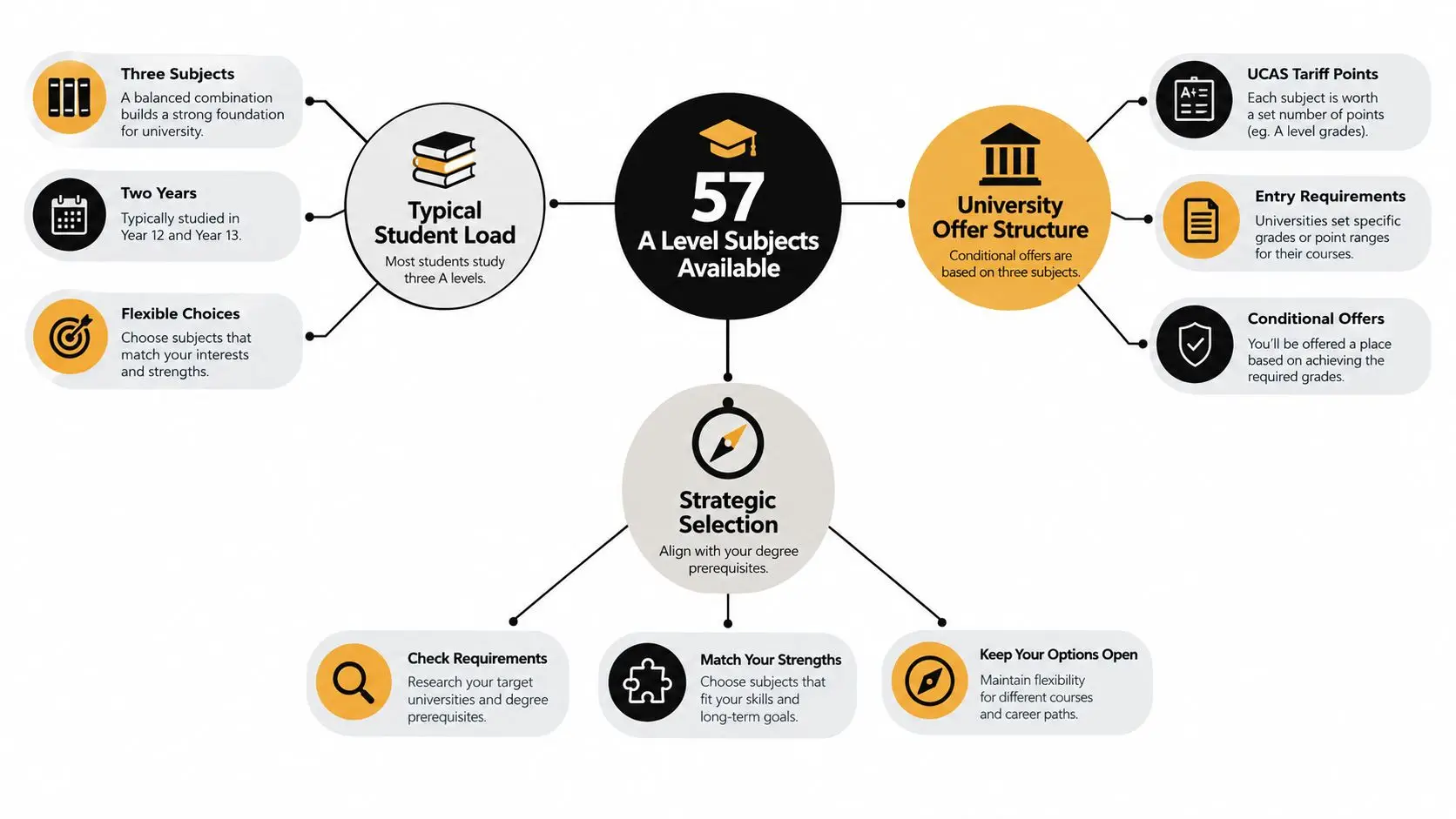
Subject choice can feel overwhelming because UK students can choose from 57 A level subjects, according to Ofqual's qualification statistics. Yet most students don't study a wide range. In 2026, about two-thirds of students took exactly three A levels, which reflects the depth and workload of the qualification rather than a lack of ambition.
Start with the child, then work backwards
Begin by asking what your child enjoys, where they work steadily, and which subjects future courses require. A student considering engineering may need Mathematics and may benefit from Physics. A medicine applicant should investigate the precise requirements for the universities they're considering, often including Chemistry. A student interested in English or history may need strong essay-writing subjects.
Facilitating subjects can preserve options, but they shouldn't be imposed without considering the learner. A child who enjoys Biology but struggles with extended independent revision may need a realistic conversation about workload and support. The best combination is academically suitable and emotionally sustainable.
| Decision | Practical question |
|---|---|
| Interest | Will the child engage with this subject when the work becomes difficult? |
| Preparation | Do GCSE results and teacher feedback show a sound foundation? |
| Progression | Do target university courses require or prefer this subject? |
| Workload | Can the child manage the reading, practical work, and revision? |
Some families consider four A levels for highly competitive pathways, including applications to Oxford or Cambridge, or for students with a particularly strong and consistent academic profile. However, the extra subject increases workload, and some providers raise their entry standard for four A levels. One 2026 sixth-form guide requires 8 grades at 9 to 8 for a four-A-level pathway. (Paddington Academy entry guide)
Before finalising choices, compare university course pages and ask subject teachers for an honest view. For broader exploration, families can find your subject on Knobee, then confirm the final combination with the sixth form and the university departments your child may apply to.
Registration, Exam Boards and Key Dates
A school or online centre normally registers the student for examinations, but private candidates need to confirm who is responsible for entries. Common exam boards include AQA, OCR, Pearson Edexcel, and WJEC/Eduqas. The board can affect specifications, required practical arrangements, and non-exam assessment, so families should ask before enrolling.
For private candidates, available exam series and entry deadlines need careful checking. The practical timetable often develops like this:
- After Year 11 results: Confirm the sixth-form place, subjects, and any conditions attached to the offer.
- October half-term: Review early progress, discuss support needs, and check whether the chosen pace remains appropriate.
- January: Use mock preparation to identify gaps, not to label the child. Ask for a revision plan that matches their attention, health, and confidence.
- February: Finalise examination entries where the centre uses this point for entries. Ask about late-entry charges before the deadline passes.
- May to June: Written examinations take place, alongside any required non-exam assessment or practical arrangements.
- August: Results are released, and the school or centre helps clarify university confirmation.
- September: University places and next-step arrangements are confirmed where applicable.
The Department for Education published revised 2026 A level and other 16-to-18 results statistics on 15 September 2026, creating a current results context for families comparing routes and providers. (Revised 2026 results statistics)
Ask the centre to confirm photo identification for exam halls, evidence needed for access arrangements, and how predicted grades are submitted, particularly for overseas university applications. A child who needs extra time or a quieter room should not have to raise the issue during the examination season. Gather evidence early and keep communication with the exams officer in writing.
International Equivalencies and Overseas Families
International families often arrive with a strong academic record but uncertainty about where it fits in the British system. There isn't one universal conversion table that settles every subject and every university decision. Admissions teams examine the qualification, grades, subjects, language evidence, and the level of content covered.
| Qualification | Country/Region | Equivalent Route into UK A Level Year |
|---|---|---|
| US high school diploma with SAT or AP study | United States | Provider and university assessment of subjects and level |
| International Baccalaureate | International | Usually assessed through completed IB results and subject level |
| CBSE or ICSE | India | Subject-by-subject comparison with GCSE or A level expectations |
| State certificate with ATAR | Australia | Assessment against the student's state curriculum and intended course |
| European Baccalaureate | European schools | Review of subjects, grades, and language preparation |
| Cambridge International A levels | International | Broadly comparable for many UCAS purposes, subject to confirmation |
Cambridge International A levels are broadly equivalent for UCAS Tariff purposes in many contexts, but a university may still confirm requirements course by course. Families should contact the admissions team before committing to a subject combination, especially for medicine, engineering, Mathematics, and laboratory sciences.
English-language evidence can also matter. A non-native English speaker may need IELTS or another accepted demonstration of proficiency, depending on the school and university. Mathematics and Science courses may require bridging work if the previous curriculum covered different topics or approached examination questions in another way.
Get a written equivalency decision
Ask the prospective sixth form to review school reports, transcripts, syllabuses, and examination certificates. An ENIC statement may help establish the level of an overseas qualification, but it won't automatically confirm that a child has the precise subject preparation needed for an A level course.
Families moving into the British system can also review international A levels before comparing providers. The safest route is early contact with both the sixth form and the target university, with questions asked subject by subject rather than relying on a general statement that a qualification is “equivalent”.
Studying A Levels Online or Part-Time
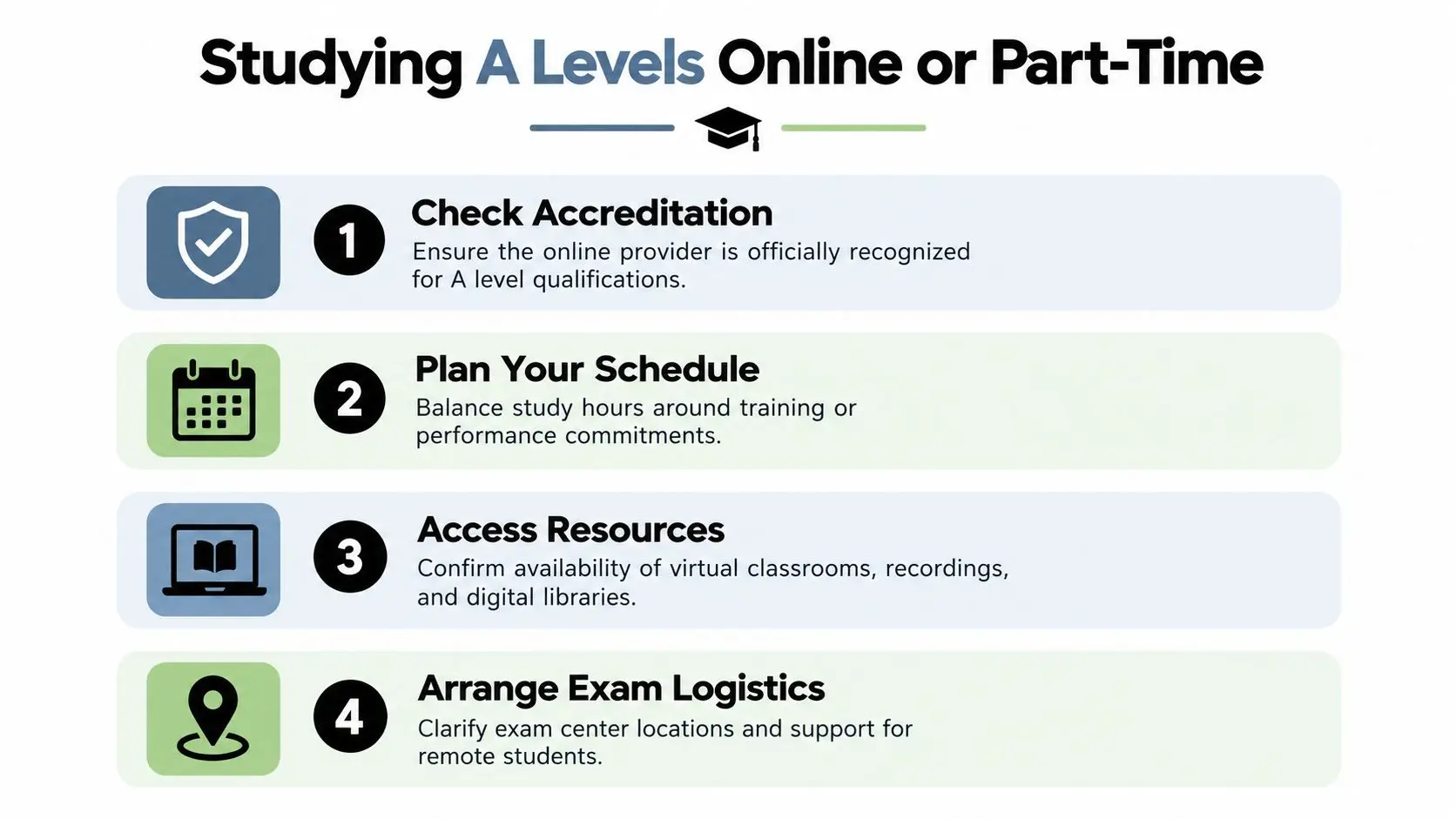
Online and part-time study can suit a child who is managing illness, elite sport, performing arts, anxiety, geographical distance, or a difficult school environment. The flexibility may reduce pressure, but it doesn't remove academic requirements. A credible online provider normally applies standards comparable to a mainstream sixth form, such as 5 GCSEs at grade 4 or above including English and Mathematics, alongside subject-specific conditions. A child taking A level Mathematics may, for example, need grade 6 in GCSE Mathematics.
The format varies significantly. A full-time online school may timetable live lessons with subject specialists and provide recordings for review. A flexible school may rely more heavily on asynchronous study plans. A part-time college can combine scheduled attendance with another commitment. Your child's independence matters as much as the timetable.
Check the learning environment, not just the prospectus
Ask to see a sample timetable and find out how quickly teachers respond when a student is stuck. A child with SEN may need shorter study blocks, clear written instructions, predictable routines, and frequent check-ins. Another learner may need help creating structure because home study removes the natural rhythm of moving between classrooms.
Practical Science needs particular attention. Ask whether laboratory work takes place through residential sessions, partner centres, or another supervised arrangement. The provider should also explain how exam centres are booked for students who don't attend a physical sixth form every day.
Universities generally assess the legitimate qualification and examination results rather than whether lessons took place online or face to face. Families should still verify the provider's exam-board arrangements, accreditation, safeguarding, pastoral support, and access arrangements. You can review the structure of online A level study while comparing it with local colleges and sixth forms.
Beyond Grades, Supporting the Individual Child
A GCSE transcript can describe attainment, but it can't fully describe readiness. In England, 1.7 million pupils had special educational needs in 2024, representing 18.4% of all pupils, according to Department for Education analysis of SEN and disability data. That scale matters because families shouldn't feel their child is an unusual exception when they ask for individualized teaching.
Around 430,000 pupils in England had an Education, Health and Care plan in January 2024, equal to about 26% of pupils with identified SEN. Other learners receive SEN Support without a formal plan. (DfE-linked SEN analysis) A child with an EHCP may need assistive technology, extra time, or structured wellbeing support, while another may make progress with regular feedback and predictable routines.
The attainment context also needs honesty. In 2024/25, average Attainment 8 was 14.8 for pupils with an EHCP, 33.8 for pupils on SEN Support, and 50.2 for pupils with no identified SEN. (UK education data analysis) These figures don't predict an individual child's future. They do show why a school should ask what support will help the learner progress, rather than treating GCSE outcomes as a complete judgement of potential.
| Factor | What to look for | Why it matters for A levels |
|---|---|---|
| Study skills | Can the child plan, organise notes, and ask for help? | A level learning requires sustained independent work |
| Stamina | Can they build up reading and extended writing gradually? | Essays, problem sets, and revision take concentration |
| Emotional safety | Is there a trusted adult and a clear pastoral route? | Anxiety can block learning even when ability is present |
| Access support | Are extra time, rest breaks, or digital readers documented? | Adjustments work best when arranged before examinations |
| Feedback habits | Does the child act on specific advice? | A level progress depends on refining knowledge and technique |
Parents should ask about induction or taster sessions, mentoring, learning support, and the pastoral structure. A student who struggled at GCSE may still thrive if teachers break content into manageable steps, target gaps early, and protect motivation when progress feels slow.
A strong route combines prior attainment with preparation and a support scaffold designed around the learner.
A Practical Checklist for Parents and Students
Use the next school term to replace uncertainty with specific questions. You don't need to solve every decision at once, and your child shouldn't feel that one predicted grade has already decided their future.
Academic and course planning
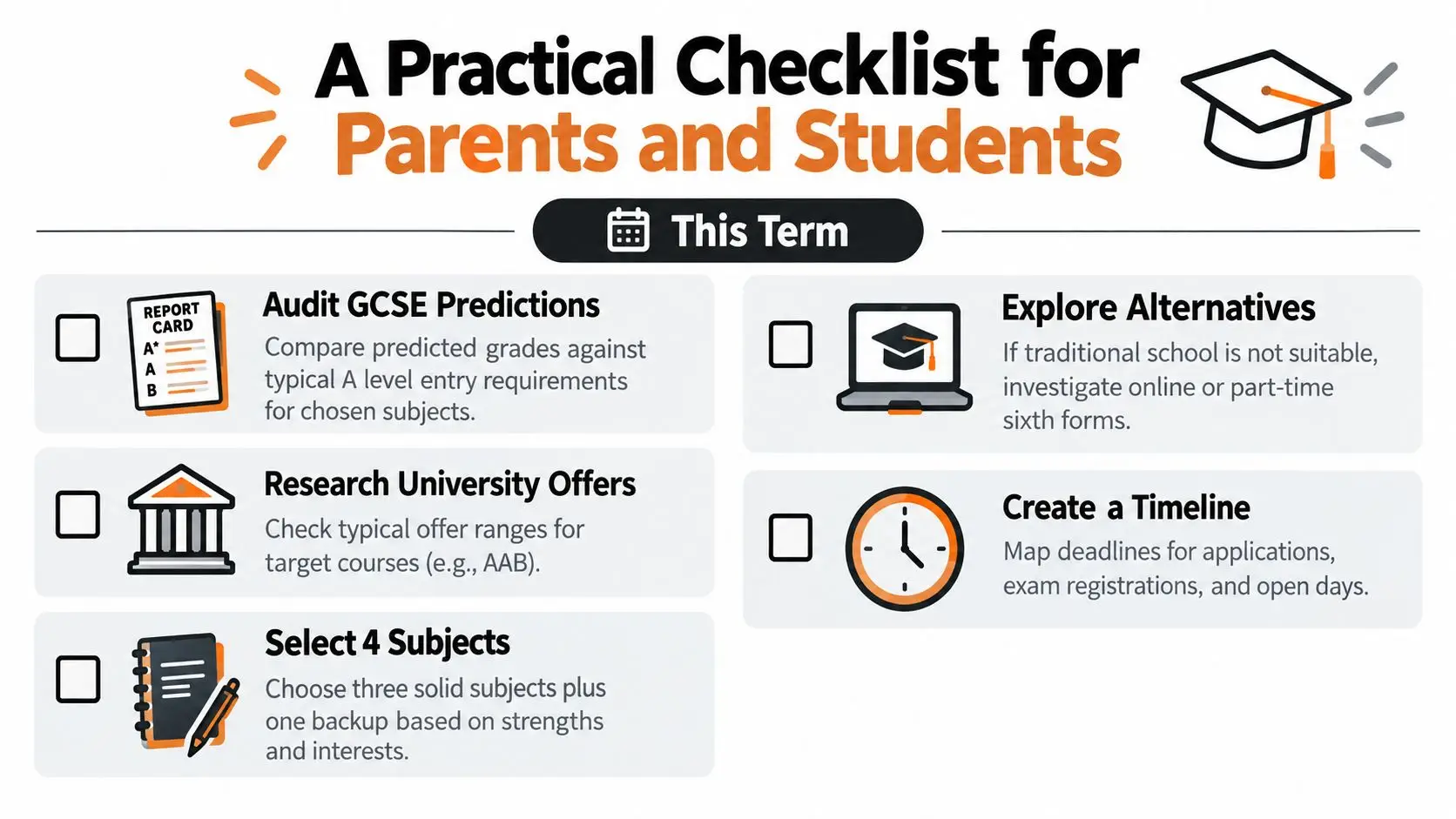
- Audit GCSE predictions. Compare current predictions with the published general and subject-specific requirements for each possible sixth form. Mark the subjects where your child is secure, borderline, or needs a conversation.
- Book a meeting with the head of sixth form. Take reports, support plans, and questions about workload. Ask for a written explanation if the policy isn't clear.
- Request a subject taster day. Your child should experience the pace, reading, practical work, and teaching style before choosing a course.
- Confirm the exam board. Ask whether the provider enters students for AQA, OCR, Pearson Edexcel, or WJEC/Eduqas, and check how practical or non-exam assessment is managed.
- Check university requirements. Look at target course pages, including subject prerequisites, typical offers, English-language evidence, and predicted-grade expectations.
Support and routine
- Arrange access support before Year 11 ends. Keep evidence current and ask who submits arrangements to the exams officer.
- Create a weekly revision rhythm. Start with manageable blocks, scheduled breaks, and a visible plan your child can adjust.
- Contact pastoral staff early. Don't wait for a crisis before identifying the adult your child can approach.
- Protect downtime. Rest, friendships, movement, and interests help make an intensive course sustainable.
- Map deadlines. Record applications, open days, examination entries, and UCAS or international university deadlines from the autumn of Year 12.
If your child's route includes online learning, add questions about live lessons, recordings, response times, practical Science, exam-centre access, and safeguarding. If your child has SEN or SEMH needs, ask how teachers adapt explanations and how progress is reviewed.
Every A level route looks slightly different. Preparation, not perfection, is the goal, and a calm plan can help your child approach the next stage with confidence.
Queens Online School offers live online A level teaching, recorded sessions, subject-specialist support, and access to recognised examinations through a flexible Sixth Form route. Visit Queens Online School to discuss your child's subjects, entry profile, pacing, and individual support needs.