

Some evenings, Year 5 arrives at the kitchen table before your child does. It shows up in the longer reading book, the maths sheet that suddenly looks less familiar, or the sigh that says, “I don't get this,” when they probably got plenty of school done already and feel full.
For many parents, this is the point where quiet worries begin. Is the work meant to look harder now? Are SATs already creeping in? Why do friendships suddenly feel more important and homework more draining? Those questions are normal, and they don't mean your child is falling behind.
A Familiar Kitchen Table Moment
Your child is staring at a fraction wall. You're trying to sound calm while wondering why halves and fifths now look like a puzzle designed to test the whole family. They were fine with maths last year, you think. So why does Year 5 suddenly feel heavier?
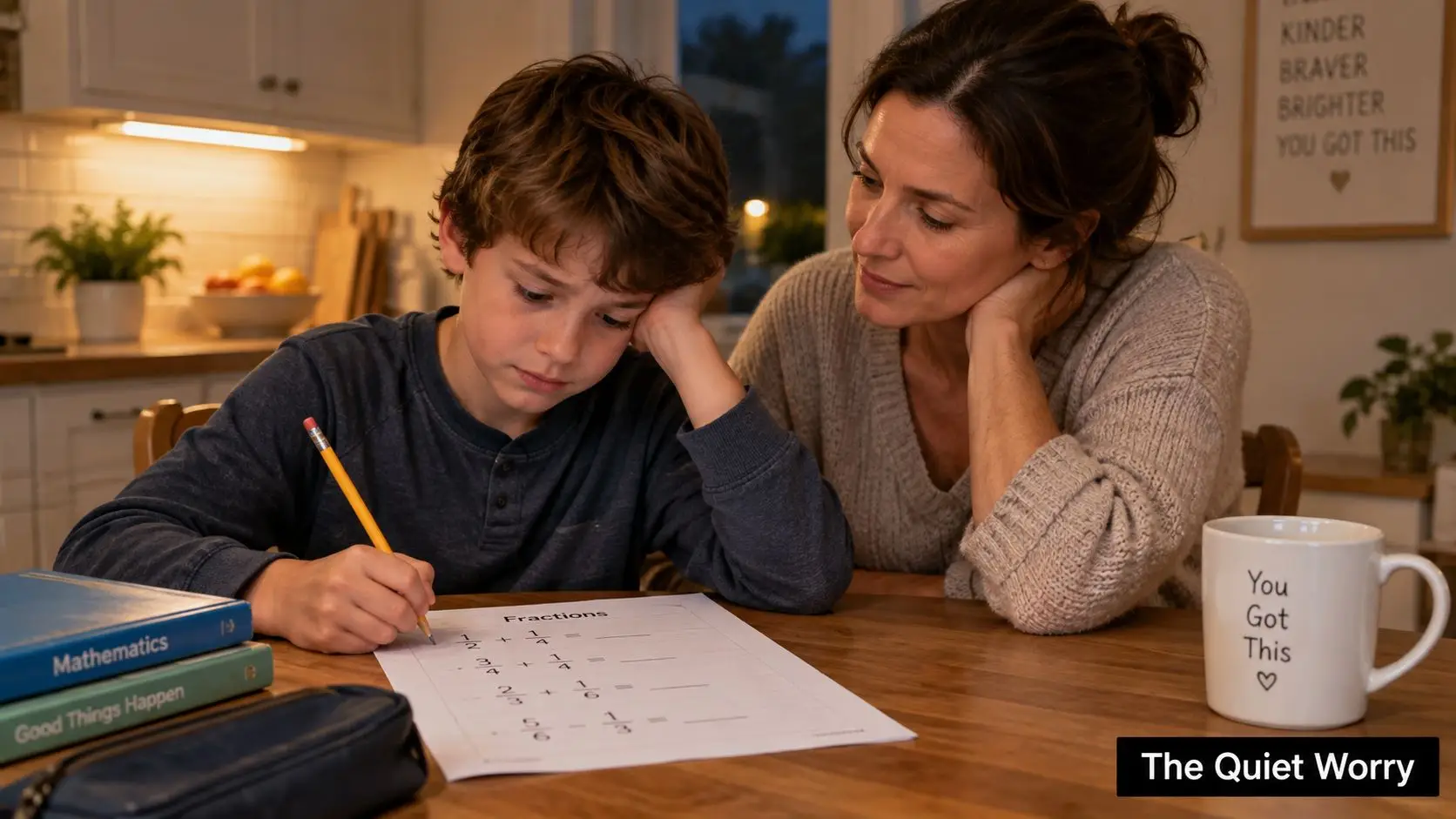
That moment is familiar in many homes. A nine or ten-year-old can look more grown up on the outside, but still wobble when school asks for more independence, longer concentration, and more confidence with trickier ideas. One night it's fractions. Another night it's a reading book with denser language, or a spelling list that seems to expect a leap rather than a step.
Parents often carry several worries at once. You may hear whispers about Year 6 and SATs and start looking ahead before your child is ready. You may notice that friendships are shifting, that your child is comparing themselves more, or that they're suddenly more sensitive to getting things wrong.
Year 5 often feels like a bridge year. Children aren't at the end of primary school yet, but the school day starts asking them to think and work more like older pupils.
Understanding the curriculum Year 5 follows can really help. Once you know what school is trying to build, the harder worksheet stops feeling random. You can see the pattern. English asks for deeper reading and longer writing. Maths moves into bigger numbers and more steps. Science expects more careful thinking, not just excitement about experiments.
What Year 5 is really about
Year 5 is less about racing ahead and more about strengthening the foundations for the final stretch of primary school. Children usually do rise to that challenge, even if they grumble on a Thursday evening or seem uneven from one week to the next.
You don't need to become the teacher at home. You do need a clearer picture of what your child is learning, why it feels different from Year 4, and how to support them in ways that fit real family life.
Where Year 5 Fits in the Primary Curriculum
Year 5 often feels like the point where primary school changes shape.
Your child is still very much a child. They still lose jumpers, forget to put the reading book back in the bag, and sometimes insist homework was "easy" right up until the moment they sit down to do it. Yet in school, teachers are starting to expect something more settled. Longer concentration. Better organisation. More willingness to explain an answer, not just give one.
In England, Year 5 sits in Upper Key Stage 2, alongside Year 6, and the statutory framework places it in the 9 to 10 age range, as set out in the primary national curriculum framework. There is no national test at the end of Year 5. For many families, that is a relief. For teachers, it means the year can be used to strengthen habits and understanding before the final year of primary school.
A helpful way to picture Year 5 is as the middle span of a bridge. Year 4 has laid down the planks. Year 6 is the far side, where children are expected to cross with more confidence. Year 5 is where schools check that the bridge can hold weight.
That shows up in ordinary classroom life. A maths task may have several stages instead of one. A reading lesson may ask children to prove an idea from the text. A writing task may stretch over several days, with planning, drafting, editing, and improving. None of that means the work has suddenly become severe. It means children are being asked to stay with their thinking for longer.
Most schools, including academies, still build from the same broad Year 5 expectations, even if topics are arranged differently. So while one class might study space and another studies rivers, parents usually notice similar shifts in how learning feels:
- Lessons ask for more staying power. Children are expected to keep working through a problem, even after the first easy answer has gone.
- Writing grows in length and control. Teachers look for clear paragraphs, purposeful vocabulary, and ideas that link together.
- Maths involves more held in the head at once. Pupils often need to remember earlier steps while tackling the next one.
- Independence matters more. Bringing the right book, following instructions, organising notes, and correcting mistakes all become part of the learning.
If school reports or homework comments mention grammar, comprehension, or composition in ways that feel a bit opaque, this overview of Key Stage 2 English expectations can help translate the language.
Parents sometimes worry that a child who finds Year 5 harder must be falling behind. In many cases, the opposite is true. The curriculum is supposed to feel more demanding because children are being stretched into greater independence. A nine or ten-year-old may know the content, yet still need help managing the effort, the pace, or the frustration of getting stuck.
This is especially important for children with SEN, attention differences, working memory difficulties, or slower processing speed. Year 5 can expose those pressure points more clearly because the tasks become longer and less heavily scaffolded. A child may understand the topic but lose track of multi-step instructions, tire during extended writing, or need more time to organise ideas. That does not mean the child cannot do the work. It usually means the route into the work needs to be clearer, chunked, or supported.
Assessment in Year 5 is usually quieter than parents expect. Teachers build the picture from classwork, reading conversations, short checks, marked books, and what a child can do independently after guided practice. They are often asking practical questions. Can this pupil apply yesterday's method today? Can they explain their reasoning? Can they recover after a mistake without giving up?
So if Year 5 feels like a step up in your house, that is very normal. It is the year where primary school starts asking children to carry their learning with a steadier grip, while adults at school and at home help them practise how.
Core Subjects and What Children Are Expected to Learn
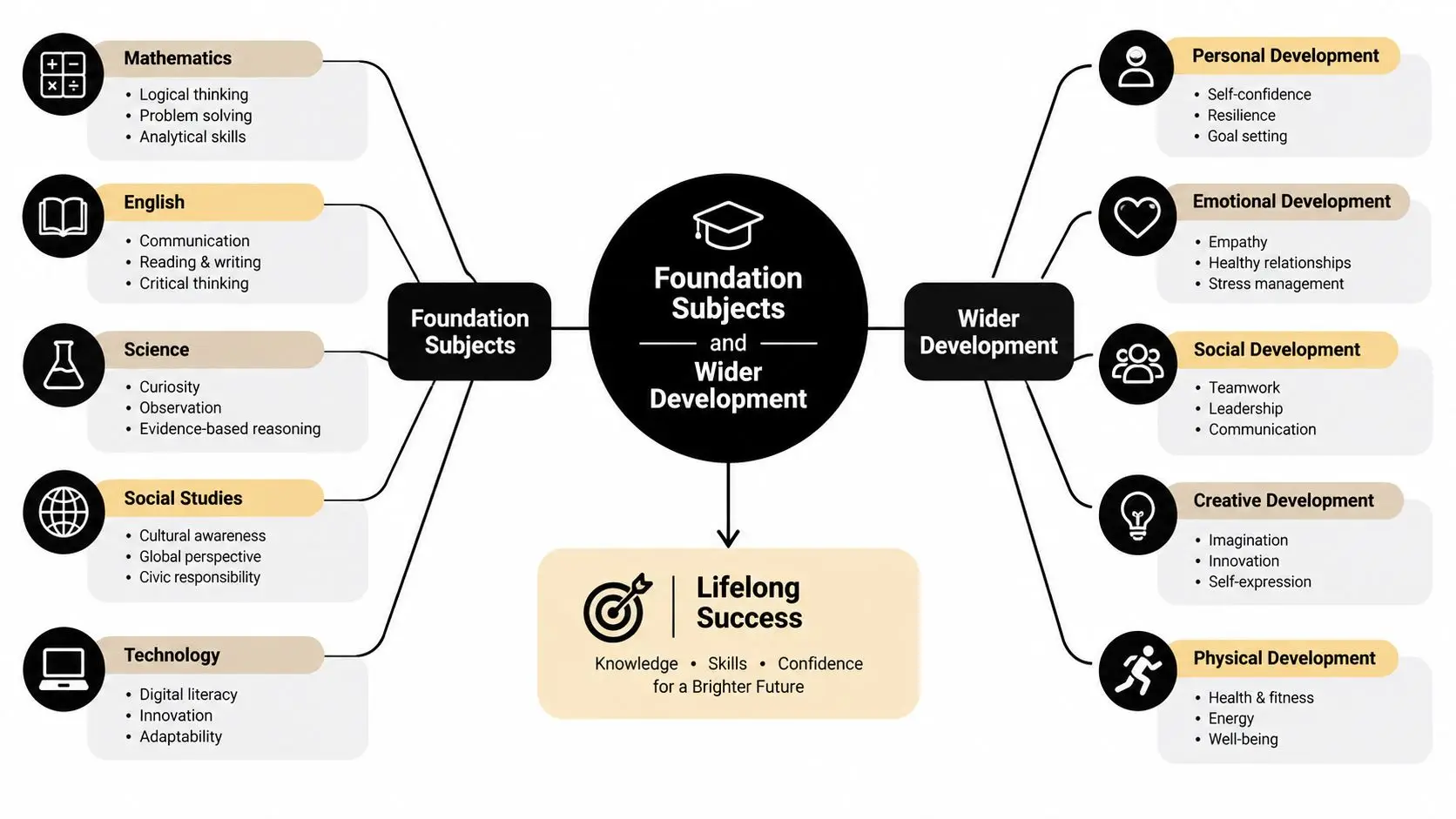
By Year 5, the core subjects start working together more like parts of one school day than three separate boxes. Your child might read a text about climate change in the morning, write an explanation after lunch, and use numbers or graphs to support their points later in the week. That joined-up feel is one reason Year 5 can seem more grown-up to both children and parents.
English in everyday terms
English in Year 5 is less about getting through the words on the page and more about making sense of them, talking about them, and using them well in writing. Children are usually reading longer books, richer class texts, poetry, and non-fiction that asks more of their attention.
In the classroom, that often looks like a child pausing to explain why a character acted in a certain way, spotting a clue the author has tucked into a paragraph, or noticing that a report sounds different from a story. Reading becomes a bit like detective work. The words matter, but the meaning under the words matters too.
Writing grows in the same way. Teachers still care about punctuation, spelling, and handwriting, but those skills are there to support clearer thinking. A child might write a persuasive letter, a newspaper report, a myth, or an explanation text, and each piece needs a different voice and structure. Paragraphing starts to matter more because children are learning to group ideas, not just fill a page.
If your child says, “I don't know what to write,” the difficulty is often not a lack of ideas. It is holding the plan, the vocabulary, the sentence structure, and the spelling all in mind at once. For some children, especially those with SEN or working memory difficulties, that load is heavy. A quick oral rehearsal at home can help. Ask, “Tell me your first sentence,” before asking them to write the whole thing.
Maths in everyday terms
Maths in Year 5 takes a noticeable step forward because children are expected to handle bigger numbers and more steps without losing track of what they are doing. Place value stretches into the hundreds of thousands and beyond. Fractions, decimals, formal written methods, line graphs, and problem-solving all become more common.
A useful way to picture this is that Year 4 often teaches the tools, while Year 5 asks children to choose the right tool and explain why. A child may know how to multiply, but Year 5 also asks whether multiplication is the right method in the first place. That extra layer can be the part that feels hard.
You may see homework that looks unfamiliar even if the answer seems simple. For example, your child might solve a calculation correctly and still be asked, “How do you know?” Teachers are checking whether the method makes sense, whether the child can spot an error, and whether they understand the size of the numbers they are working with.
For parents who want a clearer picture of the topics and methods, this guide to British curriculum Year 5 maths gives a helpful breakdown.
If maths causes tears, slow it right down. One question done calmly is often more useful than a whole page done in panic.
Science in everyday terms
Science in Year 5 becomes more thoughtful and more precise. Children often study forces, materials, living things, and Earth and space, but the bigger shift is in how they are asked to think.
Teachers want children to ask sensible questions, make predictions, notice patterns, compare results, and explain what they found using evidence. In other words, science lessons start to feel more like real investigations. “It floated” is only the starting point. The next step is explaining why it floated, what changed, and whether the test was fair.
This can suit many children well because science gives them something concrete to talk about. They can see the magnet pull, watch the material dissolve, or record how a shadow changes. For children who struggle with long writing, practical science can be a chance to shine first and explain second. A short spoken explanation before writing often helps them organise their thoughts.
Year 5 Core Subject Expectations at a Glance
| Subject | Key Year 5 Expectations |
|---|---|
| English | Read a wider range of texts, explain ideas using evidence from the text, write for different purposes, organise writing into clear paragraphs, and build fluency in spelling, punctuation, and handwriting |
| Maths | Work with larger numbers, use formal written methods accurately, understand fractions and decimals more securely, solve multi-step problems, and explain mathematical reasoning |
| Science | Learn key scientific ideas, ask questions, carry out fair tests, record observations clearly, and explain results using evidence |
Children often feel these rising expectations before they can put them into words. One day they come home proud because everything clicked. Another day the same child feels defeated by a page of fractions or a writing task that seemed too big to start. That wobble is common in Year 5. It usually shows that your child is stretching, practising, and learning how to cope when the work asks for more.
Foundation Subjects and Wider Development
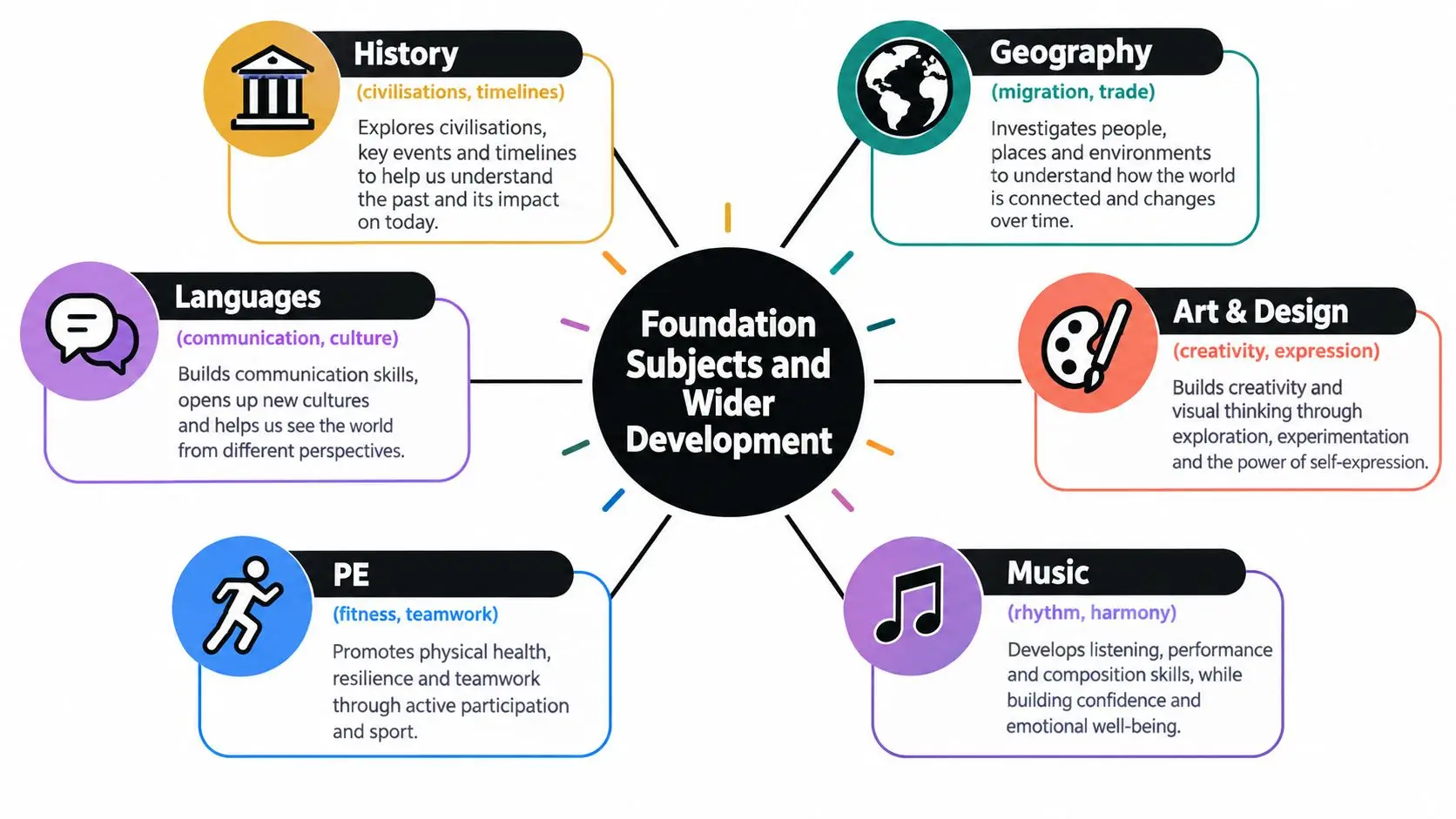
A strong Year 5 isn't built on English and maths alone. Children also start becoming more rounded learners. They handle bigger historical ideas, broader geographical patterns, more teamwork in PE, and more responsible use of technology.
What the wider curriculum is doing
In history, children often move beyond simple timelines into ideas such as civilisation, change, continuity, and comparison. A class might study the Maya, ancient Greece, or a local history unit and ask not just what happened, but why it mattered.
Geography also becomes more abstract. Children may learn about rivers, trade, climate, migration, settlement, and land use, but teachers usually anchor these in something concrete. A local map, a nearby river, or a familiar weather pattern helps the topic make sense.
In computing, pupils often work with sequencing, debugging, and simple programming environments such as Scratch. Online safety becomes more nuanced too. It's less about “don't talk to strangers online” and more about judgement, privacy, and digital behaviour.
The personal side of Year 5
PE and PSHE often tell parents as much about their child's Year 5 experience as any exercise book does. In PE, children may meet more competitive situations. They have to cooperate, recover from mistakes in front of others, and keep trying when they're not instantly good at something.
PSHE and relationships education matter a great deal in this year. Friendship worries, managing emotions, healthy relationships, and early conversations around body changes can all appear. A child who seems unsettled may not be reacting to academic content at all. They may be carrying social strain, tiredness, or worries they can't yet explain neatly.
One more point matters here. UK SEN data shows that SEN support peaks at age 9, where 17.0% of pupils receive SEN support, according to the special educational needs in England statistics. For Year 5 parents, that's an important reminder that needing support at this age is common, not unusual.
A child who finds multi-step maths overwhelming may cope better with shorter chunks, repeated instructions, and a calm check-in than with more pressure.
Modern foreign languages are often introduced or developed further in Year 5 too, usually through short listening, speaking, reading, and vocabulary tasks. It's another area where confidence can wobble before it grows.
A Sample Week of Year 5 Learning
The easiest way to understand the curriculum Year 5 pupils follow is to watch it unfold across a week. So let's follow Ava, a fictional Year 5 pupil, through ordinary school days that feel busy, mixed, and very real.
Monday to Wednesday
On Monday morning, Ava starts with English. Her class is writing persuasive letters linked to a class novel. The teacher models how to use evidence, rhetorical questions, and formal tone. Ava likes the story but finds it hard to turn her thoughts into neat paragraphs, so the teacher gives her sentence starters for the opening.
Maths comes before lunch. The lesson focuses on long multiplication. Ava can do the basic method when the numbers are small, but she loses her place if the page gets cluttered. Her teacher encourages her to draw place value columns more clearly and check each step before moving on.
Tuesday brings science. The class investigates dissolving and separating mixtures. Ava loves practical work, but this lesson still asks for careful writing because she must record what happened and explain why. In the afternoon, history shifts the class to the Maya civilisation, where they compare artefacts and ask what those objects reveal about daily life.
By Wednesday, the timetable changes pace. French includes greetings, classroom phrases, and short listening practice. PE is netball, where Ava is still learning where to stand and when to pass. Guided reading later in the day slows things down with poetry, where the class talks about rhythm, mood, and the meaning behind a line.
Thursday and Friday
Thursday is often the day parents notice most at home. The week's thinking starts to accumulate. Ava has a geography enquiry on rivers and the water cycle in the morning, then a computing lesson using a spreadsheet to organise data.
By the time she gets home, she isn't lazy or unfocused. She's tired.
Friday rounds things off with a PSHE circle about managing emotions, then a short spelling and times-tables check. There may be music, art, or assembly before home time. The mood often lifts because children can feel the end of the week, but they still need to hold themselves together through routine and expectation.
Sample Week of Year 5 Learning
| Day | Morning Focus | Afternoon Focus |
|---|---|---|
| Monday | Persuasive writing in English, long multiplication in maths | Reading follow-up or class novel work |
| Tuesday | Science investigation on materials | History study such as the Maya civilisation |
| Wednesday | French and guided reading | PE with teamwork and tactics |
| Thursday | Geography enquiry such as rivers | Computing using data or simple spreadsheets |
| Friday | PSHE, spelling, times tables | Assembly, creative subjects, reflection |
Thursday-evening wobbliness is often a sign of effort, not failure.
When you see the week as a whole, it makes more sense why some children come home full of stories and others come home needing quiet. Year 5 asks them to switch between subjects, social demands, written stamina, and practical problem-solving all day long.
Supporting Your Child at Home Without the Stress
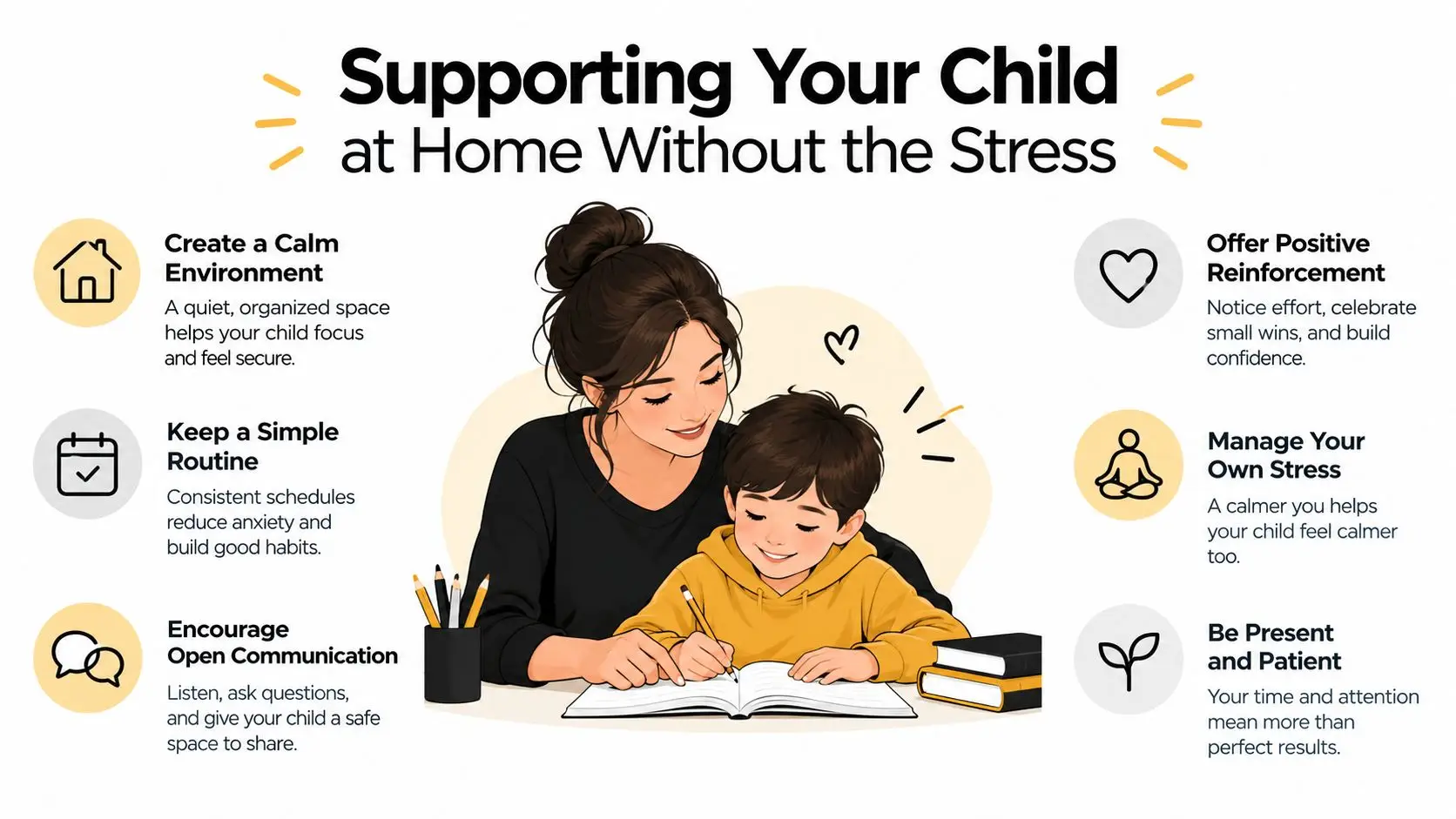
Home support works best when it feels calm and doable. Most children don't need an extra classroom in the house. They need an adult who notices what's hard, keeps routines steady, and helps them make small gains without shame.
Small routines that help most
For English, a short paired reading time can do far more than a battle over a long worksheet. Read together for a few minutes, then ask simple thinking questions. Why did that character react that way? Which word gives the scene its mood? What do you think might happen next?
For maths, daily life is full of useful practice:
- At the shop: Ask your child to estimate the total or work out the change.
- In the kitchen: Let them measure ingredients, double a recipe, or compare amounts.
- On a journey: Use train or bus times to talk about duration and timetables.
Science support doesn't need expensive equipment. Watching what dissolves in water, noticing how shadows change, or talking about a nature documentary can all support school learning. The key is the conversation after the activity.
A calmer home routine often starts with structure. If evenings are becoming tense, this guide to a home learning environment may help you simplify what happens before homework even begins.
SEN-aware support from the start
Some children need the task adjusted before they can show what they know. That isn't lowering expectations. It's making the work accessible.
Try practical supports such as:
- Short chunks: Give one or two instructions at a time rather than a full list.
- Visual reminders: A simple checklist on paper can reduce overwhelm.
- Extra processing time: Pause before repeating the question. Some children need space to think.
- Effort-focused praise: “You kept going when it got tricky” helps more than “You're so clever.”
If your child's schoolwork is regularly causing tears, ask the teacher what support is already helping in class. Sometimes the answer is surprisingly small, such as using squared paper for maths, reducing copying, or allowing oral rehearsal before writing.
When outside support might fit
Some families also look at extra structure beyond school, such as tutoring, recorded explanations, or online lessons. One option is Queens Online School, which offers Key Stage 2 teaching within the British curriculum, including Year 5, through live online classes and recorded learning for families who need flexibility or a different pace.
One useful test: if a support idea raises tension every night, it probably needs changing. A child learns better from ten connected minutes than from a long hour of stress.
What matters most is that your child feels safe to have a go. Presence, warmth, and curiosity carry more weight than perfect presentation.
Walking Beside Your Child Through Year 5
Back at that kitchen table, the fraction wall hasn't changed. Your child may still frown at it. But you know more now, and that changes the feeling in the room. The worksheet is no longer a mystery. It's one small part of a year that asks for deeper thinking, broader learning, and steadier independence.
Three shifts usually define Year 5. First, subjects deepen. Reading asks for more thought, writing asks for more control, maths asks for more reasoning, and science asks for better explanation. Second, the wider curriculum grows in importance. History, geography, computing, PE, languages, and PSHE all help shape the learner your child is becoming. Third, independence matters more. Children start carrying more of the school day in their own heads, and that can feel tiring before it feels natural.
What progress really looks like
Progress in Year 5 rarely looks dramatic from one week to the next. It often looks like this instead:
- A longer attention span during reading or writing
- A better explanation in maths, even before the answer is fully secure
- More confidence in asking for help
- A calmer recovery after making a mistake
Those are meaningful gains. They matter because they show your child is growing into the demands of Upper Key Stage 2 rather than ticking off tasks.
Mindsets worth carrying this year
Keep these close when the year feels busy:
- Mistakes are part of learning: Children need room to get things wrong without feeling they've failed.
- Routine beats intensity: Sleep, attendance, and predictable evenings often help more than last-minute cramming.
- Curiosity is powerful: A child who asks questions is learning, even if the page isn't perfect.
- You don't have to know everything: Your role is to stay alongside your child, not to become their classroom teacher.
A simple commitment for this week is enough. Sit with your child for ten minutes during one piece of homework, ask them to explain what they think the task is really about, and listen before you help.
If you're looking for a flexible way to support Year 5 learning, Queens Online School offers a British curriculum pathway that includes Key Stage 2, with live teaching, recorded lessons, and support that can suit different learning needs. It's a practical option for families who want structure, continuity, and a clearer fit for their child's pace.