

A child can come home from school saying, “I knew the answer, but I didn't put my hand up.” Parents often hear that sentence as a confidence problem. Sometimes it's something more practical: the class moves quickly, the child can't find a moment to speak, or asking for help feels too exposing.
In a smaller group, that same child may begin to answer, test an idea, and discover that mistakes don't cause embarrassment. The teacher has more opportunity to notice a puzzled expression, pause before frustration grows, and explain the point in a different way. The child hasn't suddenly become more capable. The learning environment has made that capability easier to show.

Introduction When Your Child Feels Lost in the Crowd
A busy classroom can make a bright learner look disengaged. A child may copy the work without understanding it, avoid eye contact when the teacher asks a question, or wait until the lesson has moved on before admitting they're stuck. For a pupil with SEN or SEMH needs, the pressure can feel even heavier. Noise, uncertainty, rapid changes and fear of being wrong can all reduce their willingness to participate.
This is why parents ask why small groups. They're rarely asking only about the number of pupils in a room. They're asking whether their child will be noticed, whether support will arrive before confusion turns into discouragement, and whether lessons will feel safe enough for genuine effort.
Small-group learning can change those daily moments. A teacher can hear more of each child's thinking, correct a misunderstanding while it's still manageable, and invite participation without putting a reluctant pupil on display. Children also hear classmates explain ideas, which can make a difficult concept feel less isolated and more achievable.
At Queen's Online School, small groups are treated as a teaching choice rather than a decorative feature. The important question isn't, “How many learners are present?” It's what the teacher does with the extra opportunity to listen and respond.
This matters online too. A live lesson can preserve closeness when pupils are visible, the teacher uses questions carefully, and children receive immediate feedback. Recorded sessions can then give learners space to revisit explanations at a calmer pace, while clubs and peer activities help them feel part of a community rather than alone behind a screen.
The evidence is helpful, but a parent also needs a practical lens. Smaller groups work best when teaching is matched to a child's diagnosed needs, interaction is frequent, and emotional safety supports academic risk-taking. They're not automatically better in every situation, and a small number on a website tells you very little unless you understand how the group is taught.
How Small Group Learning Really Works
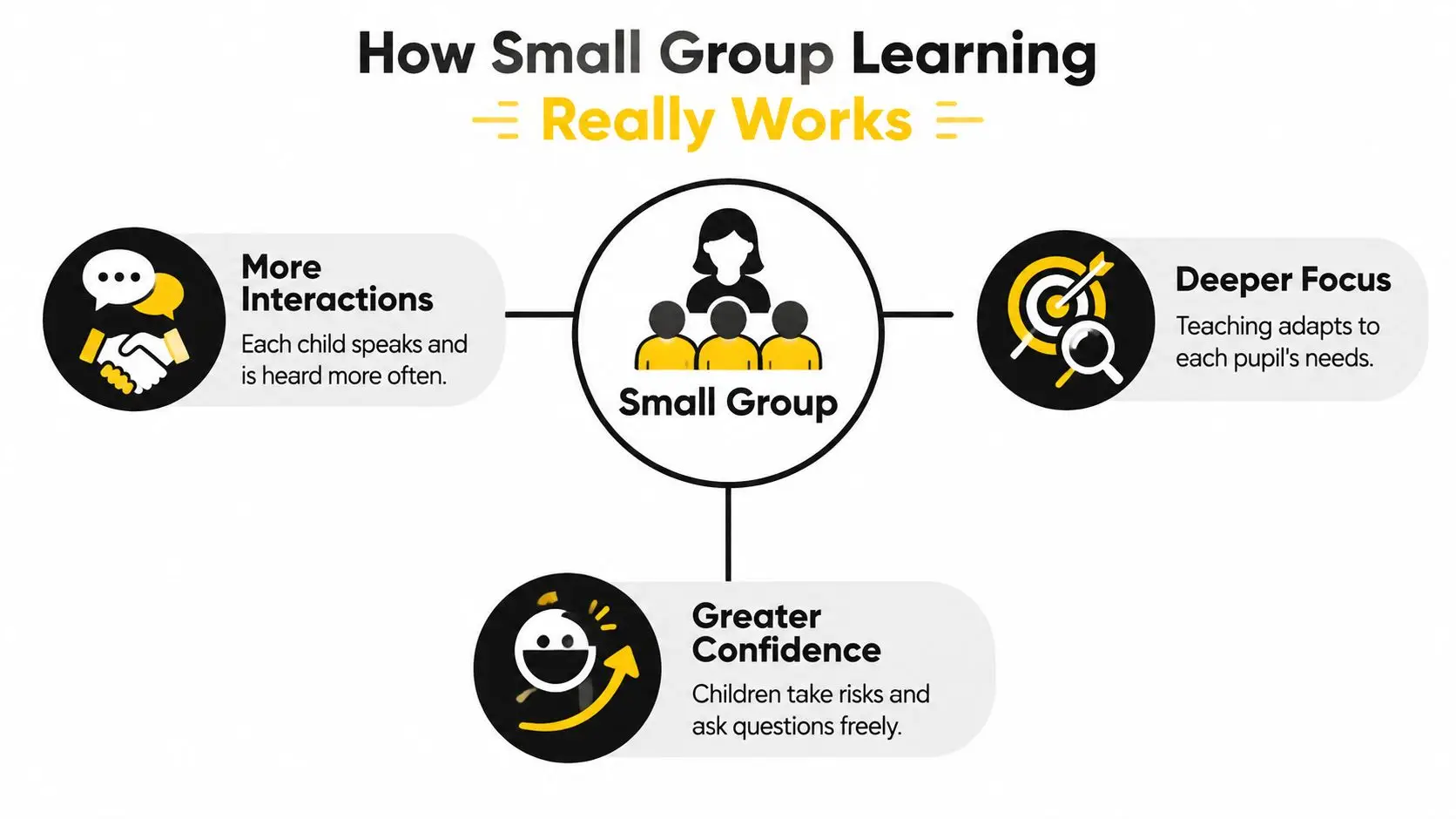
The simplest explanation is that fewer pupils create more opportunities for meaningful interaction. But headcount is only the starting point. The benefit appears when the teacher uses that space well.
Think about the difference between a private music lesson and a concert hall. In a concert, one performer can't respond to every listener's hesitation. In a small lesson, the teacher hears each attempt, notices where the rhythm breaks, and adjusts the next exercise. Small-group teaching works in a similar way. The child doesn't just receive information. They try, explain, receive feedback and try again.
The interaction loop
A productive small group often follows a clear loop:
- The teacher introduces an idea in manageable language.
- Each pupil has a chance to respond, verbally, in writing or through a shared activity.
- The teacher identifies the exact misunderstanding rather than guessing.
- The explanation or task changes to meet that need.
- The child practises again while the correction is still fresh.
In a large class, a teacher may ask a question and hear from only a few confident pupils. In a smaller group, a quieter child has more natural openings to speak. That participation gives the teacher evidence. “They're struggling” becomes something more precise, such as “They understand equivalent fractions but confuse the denominator when comparing them.”
The value of a small group isn't fewer faces on a screen. It's better information about what each child understands.
Online teaching can strengthen this loop when the lesson is live and interactive. Visible faces help the teacher read concentration and uncertainty. Chat can give a hesitant pupil another way to respond. Shared whiteboards, questioning and immediate correction allow the teacher to address an error before the child practises it repeatedly.
A smaller group also supports emotional safety. Children are more likely to ask a question when they don't feel they're interrupting a crowd. A teacher can acknowledge effort, normalise uncertainty and give a pupil time to gather their thoughts. For families looking beyond group size, practical guidance on strategies to prevent behaviour problems can also help explain how clear routines and positive relationships support attention.
Evidence Behind Smaller Classes and Happier Learners
England's education evidence review describes a sustained movement towards smaller groups. The share of pupils in classes of fewer than 26 rose from 18% in 1996 to 25% in 2010, according to the official education evidence review. The report also says the clearest benefits appear in the early years, where smaller classes have a stronger positive link with attainment and behaviour, particularly for lower-attaining pupils.
That early-years focus makes sense to anyone who has taught younger children. A reception or primary pupil may need a prompt repeated in a new way, help organising equipment, or reassurance before attempting an unfamiliar task. When a teacher can respond quickly, the child spends less time feeling lost and more time engaged with the learning.
Current figures show how this principle remains embedded in England's school system. The average infant class size fell to 25.9 in 2025/26, from 26.2 in 2024/25, the lowest infant class size since 2008/09. The legal cap remains 30 pupils in an infant class. The same government statistics release reports 20.7 pupils per teacher in nursery and primary schools and 16.7 pupils per teacher in secondary schools in 2025/26.
What the figures mean for a child
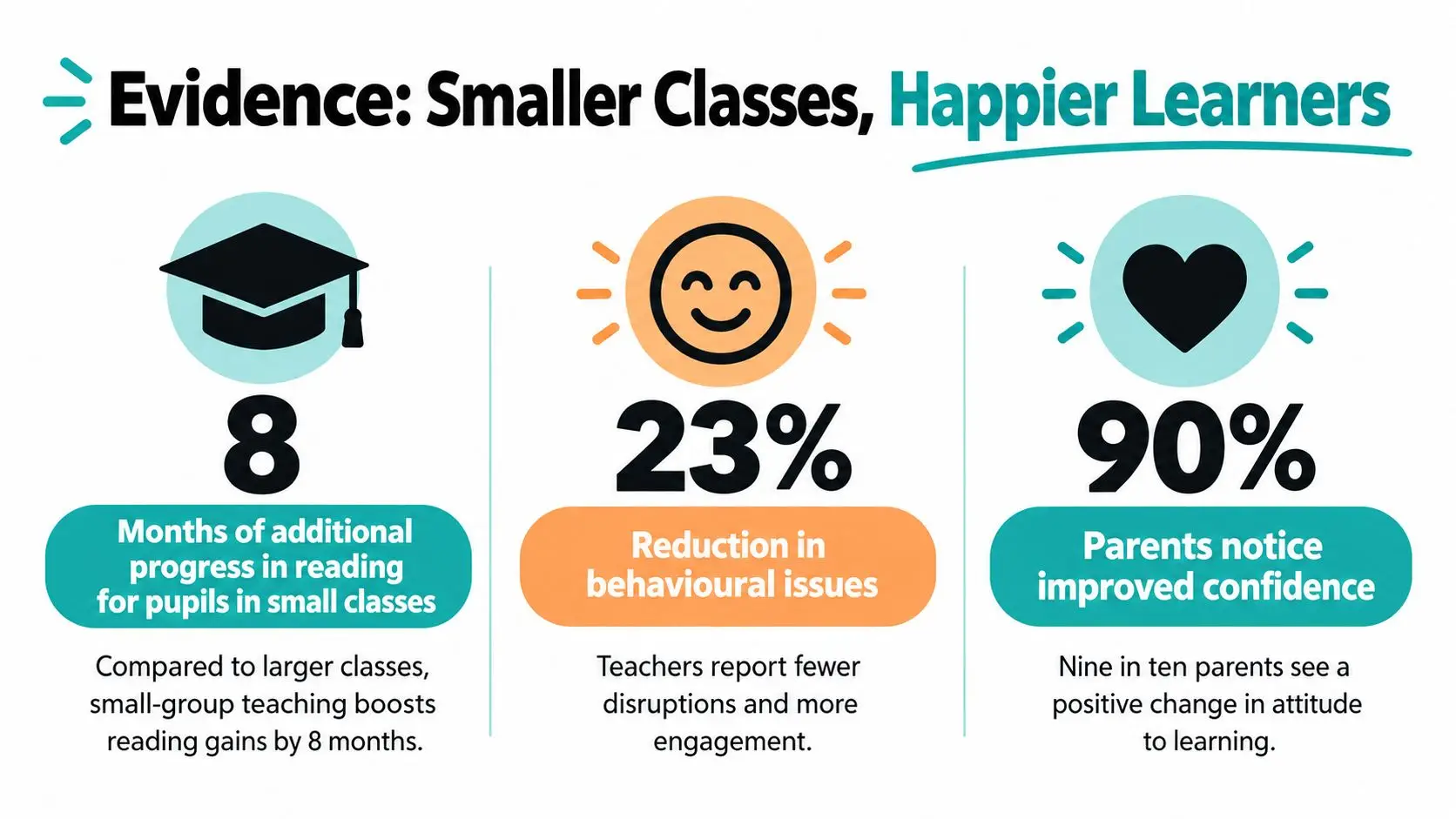
The Education Endowment Foundation rates reducing class size as a small positive intervention, with about two months of additional progress over an academic year on average. Its evidence summary reports stronger effects in reading, at two months, than mathematics, at one month, and stresses that gains depend on increased teacher-pupil interaction rather than reducing the number of children in a room. See the EEF evidence on reducing class size.
That distinction matters emotionally. A child who receives quicker feedback is less likely to spend a whole lesson repeating an error. A pupil who knows the teacher will notice confusion may feel safer asking for help. Over time, that can support participation, persistence and calmer behaviour.
The evidence doesn't promise that every child will make the same progress. It suggests that younger learners and pupils who are struggling may benefit most, especially when the teacher uses the group to create more responsive teaching. For parents, the useful question is therefore not “Is this class small?” but “Will my child be known well enough for the teaching to change when they need it?”
For a more focused explanation of the wider educational rationale, parents can also explore the benefits of small class sizes, while keeping the central principle in mind: interaction quality turns a smaller setting into a learning advantage.
Why Targeted Small Group Tuition Often Matters More Than Class Size
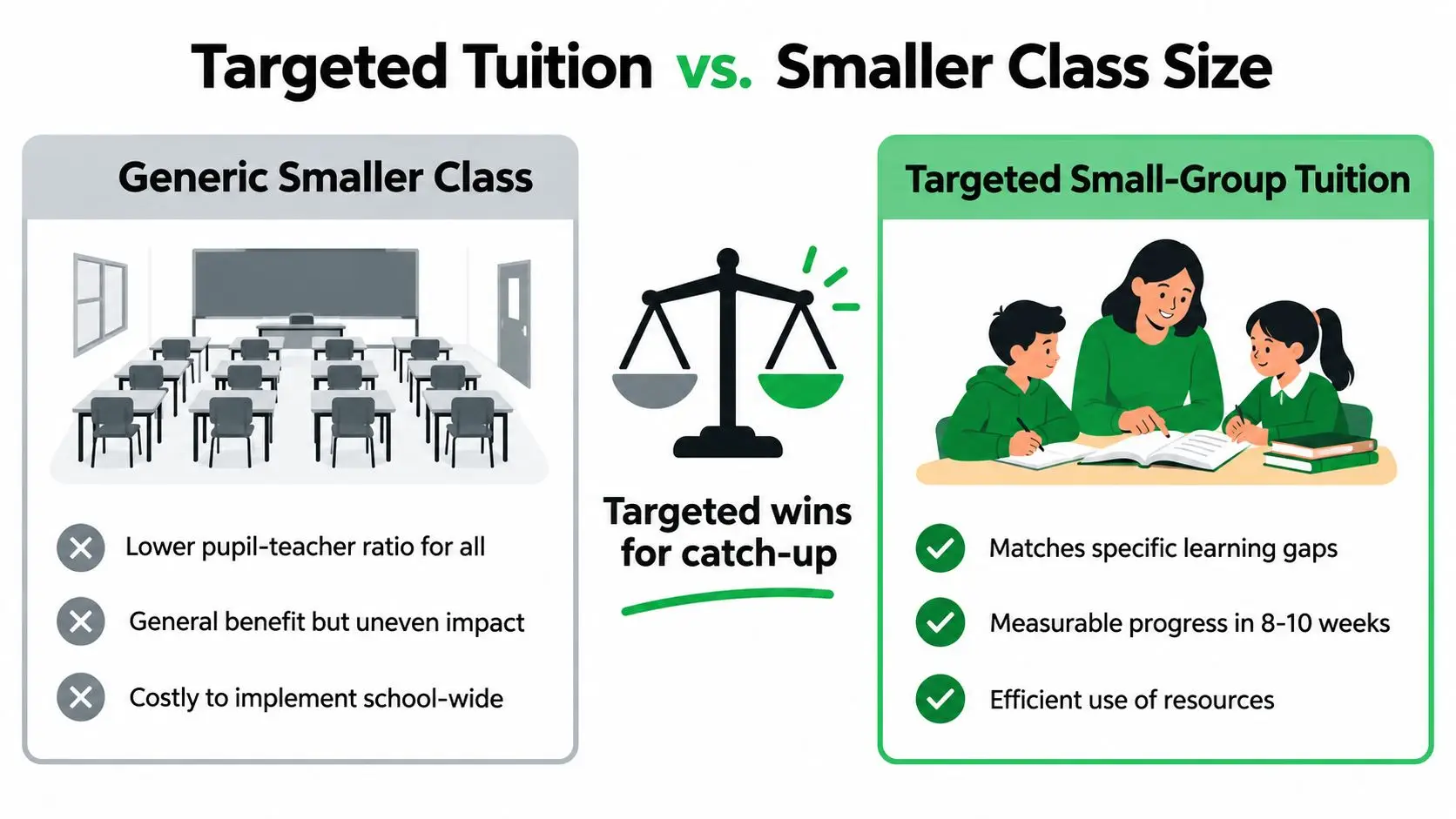
A smaller class can create better conditions, but it doesn't automatically solve a learning gap. A child struggling with fractions may sit in a reduced-size class and still receive an explanation designed for the whole group. Targeted tuition begins elsewhere. It starts by finding out exactly what the child can do, where the understanding breaks down, and what needs to happen next.
The Education Endowment Foundation says targeted small-group tuition adds about four months' progress on average, works best when matched to need, and can be more cost-effective than reducing class size across a whole school. Its small-group tuition evidence summary places the emphasis on diagnosis and focused instruction, not headcount alone.
A closer comparison
| Generic smaller class | Targeted small-group tuition |
|---|---|
| Gives more pupils access to a lower pupil-teacher ratio | Begins with a specific diagnosed gap |
| May improve interaction across the lesson | Concentrates practice on the skill the child needs |
| Benefits can vary between learners | Progress can be checked against a clear starting point |
| Requires a broad change to provision | Uses trained teaching for selected pupils |
Take a Year 5 pupil who can add fractions but loses confidence when denominators differ. In a group of four to six children, the teacher can model a common denominator, ask the pupil to explain each step, and correct the precise point of confusion. The child isn't being given more worksheets. They're receiving a sequence of explanations and responses built around their thinking.
The size of the group still matters. UK guidance notes that effectiveness drops once groups rise above about six or seven pupils, and the Department for Education's independent tutoring review reports about five months' progress for one-to-one tuition and four months for small-group tuition, with effectiveness falling beyond that range. The review also stresses that tutoring should connect to the normal curriculum and use strong diagnostic assessment. Parents can read the independent review of tutoring in schools.
Ask what the group is for
A group can be small and still be poorly matched. Children may have different gaps, different levels of confidence or different reasons for needing support. That doesn't mean mixed groups can't work, but the teacher needs a clear purpose and a way to monitor whether each child is benefiting.
For families comparing provision, personalised learning paths offer a useful way to think about the distinction. The strongest question isn't “How few pupils are there?” It's “How will the teacher use assessment, feedback and practice to help my child move forward?”
What Small Groups Look Like at Queen's Online School
A small online class should feel active, not empty. The child needs to see the teacher, hear classmates think aloud and have purposeful chances to contribute. At Queen's Online School, live lessons use subject-specialist teaching and real-time interaction so pupils can receive support while they're working, rather than waiting until a later report.
Consider a shy primary pupil who knows the answer but rarely volunteers. In a live small group, the teacher can use a gentle question, allow thinking time, and invite the child to respond in chat before speaking aloud. If the answer is partly right, the teacher can build on it instead of replacing it. That small moment can change the child's sense of themselves from “I never get picked” to “My thinking matters.”
A different learner may have SEN or SEMH needs. They might understand a topic but become overwhelmed by a crowded, fast-moving lesson. A teacher who knows the pupil can adjust the explanation, break the task into steps and notice when concentration or anxiety is beginning to fade. The aim isn't to lower expectations. It's to make the route towards those expectations clearer and more manageable.
Flexibility without losing belonging
Recorded sessions give children the option to revisit a difficult explanation, pause at a comfortable point and return to the lesson with greater readiness. That flexibility can help a learner who needs more processing time without making them feel they're holding everyone else back.
The school's wider approach also recognises that children need relationships, not only lessons. Mindfulness activities, leadership opportunities, community clubs and social events can give pupils ways to connect beyond academic performance. For a young person who has felt isolated in a previous setting, belonging may be the condition that makes participation possible.
Families considering this model can explore interactive online classes and ask how pupils contribute during a typical lesson. Queen's Online School also provides Pearson-accredited GCSE and A-Level pathways through its approved examination centre, giving older learners an academic route while retaining live teaching and pastoral attention.
The online format doesn't remove the need for safeguarding or inclusion. A zero-tolerance anti-bullying policy, support for SEN and SEMH needs, and organised opportunities for peer connection all form part of the child's experience. Closeness online comes from deliberate teaching and dependable relationships, not from placing a camera in front of a lesson.
How Parents Can Evaluate Small Group Providers With Confidence
A provider's claim about small classes is only the beginning of your research. Ask to see how the number affects your child's experience, especially if your child is anxious, neurodivergent, behind in a subject or moving from a traditional school.
Questions to ask before enrolling
- Group size: What is the maximum number, not just the usual number? Does it change for different subjects or year groups?
- Teacher expertise: Which teachers lead the sessions, and do they have subject knowledge and experience supporting children with SEN or SEMH needs?
- Assessment: How does the provider identify gaps before teaching begins? Can the teacher explain what your child is ready to learn next?
- Feedback: How often will your child receive specific feedback? Will it show what they understood, what needs practice and how to improve?
- Participation: How does every pupil contribute? Look for questioning, discussion, collaborative tasks and alternatives for children who find speaking aloud difficult.
- Wellbeing: What happens if your child becomes distressed, withdrawn or overwhelmed during a lesson?
- Safeguarding: Ask about staff checks, reporting routes, online safety and the adult responsible for pastoral concerns.
- Community: Find out whether pupils can build friendships through supervised clubs, peer activities or group projects.
Observe the child, not just the presentation
During a taster call or lesson, notice your child's reactions. Do they look towards the screen, attempt the task or ask a question? Do they seem calmer after the session, even if the work was challenging? A positive sign isn't constant happiness. It's the feeling that difficulty is manageable and help is available.
Watch the teacher too. Do they use names? Do they wait for answers? Do they correct errors kindly and precisely? Does one confident pupil dominate while others remain invisible? A small group that operates like a lecture may deliver less value than a larger class with thoughtful participation routines.
A useful test: Ask your child, “What did your teacher notice about your thinking today?” A meaningful answer suggests the lesson involved more than passive listening.
Be cautious when a provider focuses only on a headline group size. A child-centred setting can explain how pupils are grouped, how needs are reviewed and what happens when the arrangement isn't working. It should also welcome questions about accessibility, emotional support and communication with families.
Conclusion Choosing Connection Over Crowds for Your Child
Small groups work best when they give a child something a large class often struggles to provide consistently: a teacher who has time to notice and respond. That response may be a corrected fraction, a calmer explanation, a pause before answering, or a quiet invitation to try again.
The evidence points towards particular value in early-primary settings, for lower-attaining pupils and for targeted tuition matched to diagnosed needs. It also gives parents an important safeguard against oversimplified promises. Smaller isn't always better by itself. The group needs a clear purpose, skilled teaching, regular feedback and enough emotional safety for children to take risks.
For a shy learner, connection may look like answering one question. For a pupil with SEN, it may mean having instructions adapted before frustration takes over. For a teenager working towards GCSE or A-Level qualifications, it may mean receiving precise feedback while still feeling known as a person rather than treated as a grade.
That's the deeper answer to why small groups. They create room for eye contact, conversation, correction and courage. When those things work together, children can make progress without feeling that they have to manage learning alone.
Queen's Online School offers live, interactive small-group lessons, subject-specialist teaching, flexible recorded sessions, inclusive support for SEN and SEMH needs, and Pearson-accredited GCSE and A-Level pathways. Visit Queens Online School to explore how a more connected learning environment could support your child.