

Your child logs off from lessons and shrugs when you ask how school went. “Fine,” they say. But you can tell they weren't really part of it. They watched, listened, maybe answered once, and then disappeared into the background.
That's the moment many parents start looking more closely at class size.
Not because a smaller number sounds impressive on a prospectus, but because they want something more human for their child. They want a teacher who notices the hesitation before a wrong answer, the confidence dip after a hard week, and the spark when a subject finally starts to make sense.
In online education especially, that difference matters. A small class can feel warm, focused, and responsive. Or it can still feel distant if the teaching model is weak. The key question isn't only how many pupils are enrolled. It's whether your child is known, heard, and supported in real time.
More Than a Number It's About Your Child Being Seen
A child in a large class often learns to wait.
They wait for a turn. They wait for feedback. They wait and hope the teacher notices that they've stopped following the lesson. Some children cope by becoming quieter. Others become restless. A few push harder to be noticed, which can look like disruption when it's really frustration.
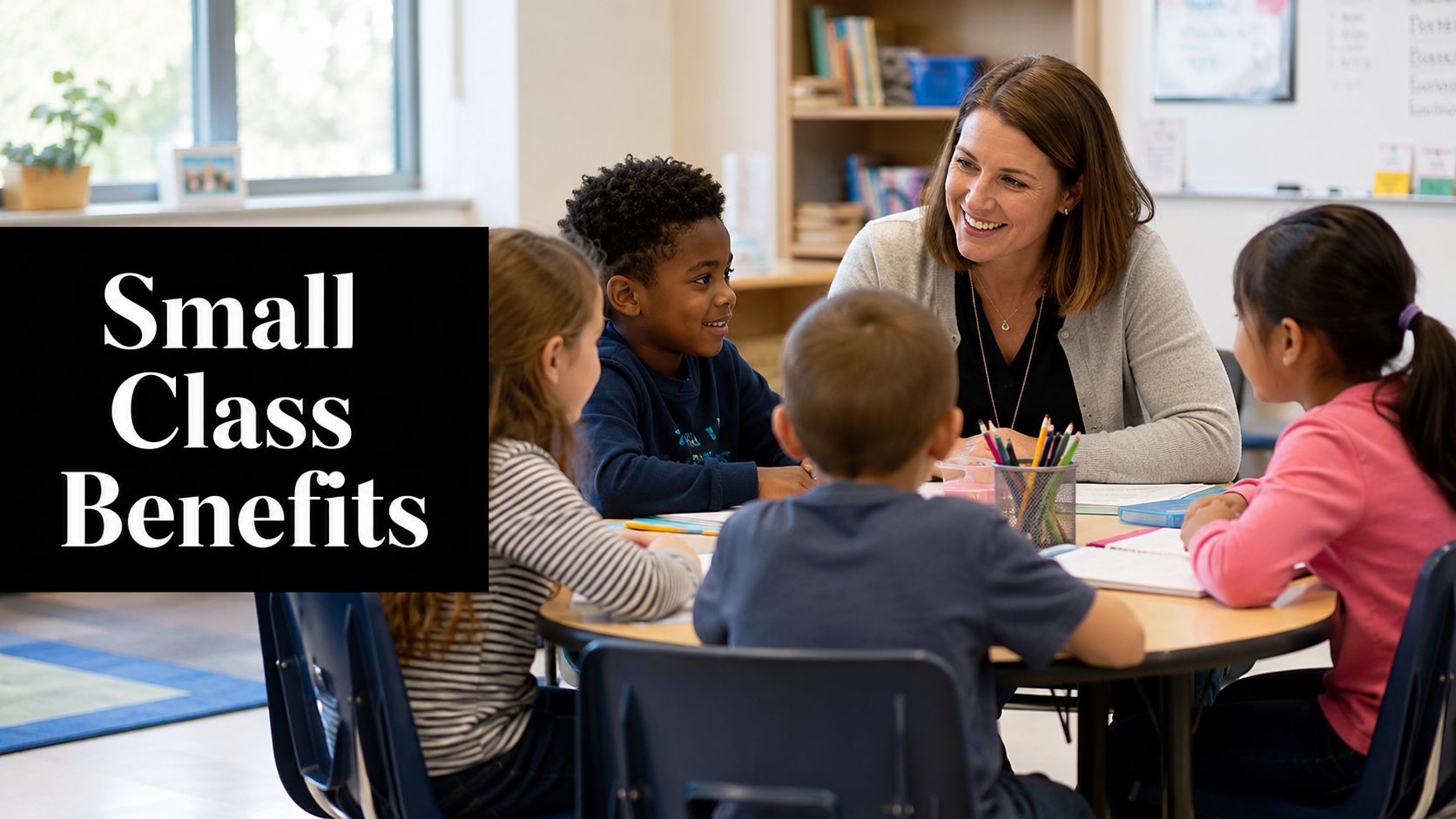
Now place that same child in a much smaller group. The teacher greets them by name. They can ask a question before confusion turns into panic. Their contribution isn't one voice among many. It's part of the lesson.

For many families, that's the heart of the small class sizes benefits conversation. Being seen changes how a child feels before it changes how they perform. A pupil who feels safe is more likely to take risks, admit they're stuck, and stay engaged when work becomes challenging.
Why online teaching method matters
Parents often get confused about this. They assume a small online class automatically brings the same advantages as a small physical classroom. It doesn't always.
A 2025 NFER study found that for SEN pupils in the UK, the academic benefit of small classes fell from 18% in physical settings to 7% in fully online environments unless live, real-time teacher feedback was guaranteed. That matters because it shows that numbers alone aren't enough. The teaching method has to make the small group feel active and responsive.
Small classes help most when the teacher can respond in the moment, not after the lesson has already moved on.
If your child needs reassurance, structure, or a sense of connection, pastoral support becomes part of the learning experience, not something separate from it. That's why many parents also ask how a school handles relationships and wellbeing alongside academics. A useful starting point is understanding what pastoral care in schools means for daily student support.
Defining a Genuinely Small Class Size
When schools say they offer “small classes”, the phrase can mean almost anything.
For one school, it might mean a group that is only slightly smaller than average. For another, it means a class small enough for each pupil to be drawn into discussion, checked for understanding, and guided individually during the lesson itself. Those are very different experiences.
The clearest UK benchmark comes from the Education Endowment Foundation review, which found that benefits are most consistently seen when classes are reduced to around 15 pupils or fewer, largely because teachers can give more individualised feedback and more responsive instruction in that environment, as discussed in this EEF class-size evidence review.
What changes below that threshold
This isn't a magic number. It's a practical threshold.
Once a group becomes small enough, the teacher's job changes. They stop spending most of their energy on managing a crowd and start spending more of it on teaching the child in front of them. They can spot the blank look after a new explanation. They can ask a follow-up question that checks real understanding. They can adapt the next task because they've noticed who is ready to move on and who needs another example.
A simple way to think about it is gardening. If you're caring for too many plants at once, you water the whole bed and hope for the best. With fewer plants, you notice which one needs more light, which one is wilting, and which one is ready to grow faster.
Small vs. Typical UK Class Sizes at a Glance
| Experience | Typical UK Classroom (30+ pupils) | Small Classroom (Under 15 pupils) |
|---|---|---|
| Teacher attention | Brief and shared across many pupils | More frequent and tailored to the individual |
| Asking questions | Easy to avoid, especially for shy pupils | More natural and expected |
| Feedback timing | Often delayed | More likely to happen during the lesson |
| Lesson pace | Set for the middle of the group | Easier to adapt for different learners |
| Participation | A few voices can dominate | More pupils contribute regularly |
| Emotional visibility | Struggles can stay hidden | Teachers notice patterns sooner |
Practical rule: If a school says it has small classes, ask what happens inside those lessons. How often does each child speak, receive feedback, and get checked for understanding?
That matters even more for families considering flexible learning schools that combine structure with personal attention. Flexibility only helps if the teaching remains close, organised, and responsive.
The Research-Backed Benefits for Your Child
Parents usually notice the emotional side of small classes first. Their child seems calmer, more willing to join in, and less drained after school. Research suggests those feelings aren't incidental. They're part of why smaller groups can help children learn better.
A widely cited benchmark comes from the Tennessee STAR experiment. Students who were randomly assigned to classes that were 7 pupils smaller, a 32% reduction, made gains equal to about 3 additional months of schooling four years later, with the strongest effects in the earliest grades, according to this Brookings review of class-size research.

Academic gains start with faster correction
Children rarely fall behind all at once. More often, they miss one explanation, then another, and then start hiding the fact that they're lost.
In a smaller class, the teacher has a better chance of catching that early. A child solving fractions incorrectly can be stopped before they practise the error ten more times. A pupil misreading a history source can be redirected before their confidence drops. That quick correction matters because it prevents small misunderstandings from turning into wider learning gaps.
Participation becomes less intimidating
For many children, especially quieter ones, speaking up in a large class feels risky. They worry about getting it wrong in front of too many people. In a smaller group, the social pressure often eases.
AASA's evidence summary reports that classes at about 1:15 in the primary years are linked to higher test scores, more school participation, and improved behaviour, and that many benefits continue into later schooling. The same summary, echoed in the verified data provided, also notes that smaller classes can strengthen the day-to-day experience of school, not just exam results.
That matters for a child who has started to withdraw. Participation isn't only about putting a hand up. It's about feeling that your ideas belong in the room.
Relationships become part of the learning
Children learn best from adults they trust. That trust grows more easily when a teacher has time to know them properly.
In a smaller class, a teacher can recognise patterns. They notice when your child is usually eager but suddenly quiet. They remember that reading aloud causes anxiety, or that success in science often comes when instructions are broken into smaller steps. Those details shape teaching in ways families can feel.
- Academic confidence grows when pupils get timely clarification rather than storing up confusion.
- Emotional safety improves when children know they won't be overlooked.
- Classroom behaviour often settles because pupils are engaged, visible, and less likely to drift.
A child who feels known is more likely to stay in the lesson, not just attend it.
The small class sizes benefits aren't only about attainment. They touch confidence, belonging, and the simple relief of not having to struggle unnoticed.
Unlocking Personalised Learning and SEN Support
For children with SEN or SEMH needs, personalised learning isn't a bonus. It's the difference between coping and flourishing.
In a larger group, even a caring teacher has limits. They may know a child needs extra processing time, quieter prompting, movement breaks, or a different route into the task. But if too many pupils need attention at once, the lesson naturally drifts toward the middle. The children at either end often pay the price.
What personalised teaching looks like in practice
In a smaller class, support can happen inside the lesson rather than later as damage control.
A pupil with dyslexia might receive instructions in shorter chunks and be invited to answer verbally before writing. A child with anxiety might use the chat to show understanding privately. A pupil with attention difficulties might be brought back gently by name before they disengage completely. These aren't dramatic interventions. They're small, timely adjustments that protect confidence.
Research supports that picture. As highlighted in AASA's evidence summary, teachers in smaller classes have more time for individualised instruction, and nearly three-quarters of primary teachers reported improved relationships with students. Those stronger relationships are foundational for children who need trust, predictability, and calm adult attention.
Before and after the class size changes
Before:
A child enters a lesson already bracing for the moment they'll fall behind. They copy what others are doing. They avoid eye contact. They hold the stress in all day and release it at home.
After:
The child is in a group where the teacher notices quickly, adjusts the task, and gives a short piece of reassurance. The lesson still stretches them, but it doesn't overwhelm them. They start to believe that learning is something they can do, not something that happens to other children.
That shift is especially important for families looking into inclusive education practices that support different learning profiles. Inclusion works best when the classroom is small enough for adaptation to happen naturally and consistently.
Why organisation around the child matters too
Support doesn't stop with teaching. Parents of children with additional needs often need joined-up communication, clear records, and consistent follow-through between lessons and home.
That's why systems matter as much as goodwill. If you're comparing schools, it can help to look at how they organise student communication, lesson notes, and parent contact. Even resources built for tutoring teams, such as guidance on how to manage tutoring students and parents, can give you a useful lens for judging whether a school's support model is likely to feel calm or chaotic.
- Look for responsiveness: Does the teacher adapt in real time, or only after problems build up?
- Ask about communication: Will you hear about concerns early, while they're still manageable?
- Check emotional fit: Does the setting reduce shame and pressure for your child?
Some children don't need a different curriculum. They need a classroom small enough for the right curriculum to reach them.
How Queen's Online School Delivers This Advantage
Parents often hear the phrase “small online classes” and assume they know what it means. In practice, the experience can vary widely. Some lessons are little more than online lectures with a smaller audience. Others are structured so each pupil is expected to participate, respond, and receive feedback while the lesson is still unfolding.

One useful UK benchmark comes from a 2025 Ofsted remote education benchmark, which found that online schools with student-teacher ratios below 1:8 saw a 34% increase in passing rates for GCSE English. For parents of older pupils, that's important because it suggests the online threshold for high-stakes exam success may be tighter than the broad “small class” label implies.
What this can look like in a live lesson
A well-designed online class with around eight pupils feels different from a webinar. The teacher can greet each student, notice who hasn't contributed yet, and shift between whole-class explanation and direct questioning without losing momentum.
For example, in an English lesson, one pupil might analyse a quotation aloud while another adds ideas in chat. In maths, the teacher can pause on a mistaken step and ask the group to compare methods before confusion spreads. In humanities, debate becomes possible because there are enough voices for discussion but not so many that students disappear.
That's the kind of environment some schools build deliberately. Queen's Online School describes a model of live, interactive classes, subject-specialist teaching, and small-group learning across the British curriculum. For families, the key issue isn't the marketing language. It's whether the lesson design turns a small number into a real educational advantage.
What to listen for when you attend a school call
When you speak to any online school, ask practical questions.
- How does the teacher check understanding live? You're looking for immediate interaction, not only marked work after class.
- What happens if a child goes quiet? Good schools have a clear answer because this happens often online.
- How are exam classes taught? GCSE and A-Level learners need active discussion, precise correction, and regular accountability.
A short introduction to the learning environment can often make this easier to picture:
The strongest small class sizes benefits online usually come from a combination of factors. Live teaching. Immediate feedback. Teachers who know the pupils. A timetable that leaves space for relationships, not just content delivery.
Your Questions Answered by Education Experts
Parents usually ask the best questions after they've been disappointed once. They've seen glossy claims. They've heard “personalised learning” before. Now they want specifics.
That instinct is healthy. A good school won't be unsettled by careful questions. It will answer them clearly.
Will my child have enough social opportunities in a small online class
Yes, if the school is intentional about building community.
A smaller class often improves the quality of interaction because students speak to one another regularly, work together in breakout tasks, and learn each other's personalities over time. Friendships tend to form more naturally when children aren't competing with a very large group for space and attention.
Ask what exists beyond lessons. Clubs, form time, group projects, mentoring, and student events all matter because social connection online doesn't happen by accident.
Do the benefits apply to older students as much as younger ones
They can, but the reason changes.
For younger children, small classes often help with confidence, routine, and early understanding. For GCSE and A-Level learners, the value lies more in sharper feedback, deeper discussion, and the chance to test ideas aloud. Older students need room to wrestle with complex material, not just receive information.
Is a small class a guarantee of a better education
No. It creates the conditions for stronger teaching, but it doesn't replace strong teaching.
Use this checklist when comparing schools:
- Ask about live feedback: Can teachers respond during the lesson, especially if your child is confused?
- Check teacher quality: Are lessons taught by subject specialists who understand the curriculum well?
- Probe for participation: How often is each pupil expected to contribute?
- Look at support systems: Who notices if your child is struggling academically or emotionally?
- Request a real example: Ask the school to describe what happens when a child falls behind in a typical week.
The best question a parent can ask is simple. “How will you know if my child is starting to slip, and what will you do that same week?”
That question cuts through vague promises very quickly.
If you're weighing whether a smaller online class would help your child feel more confident, more supported, and more engaged, Queens Online School is one option to explore. Look closely at how lessons are taught, how feedback is given, and how relationships are built. Those details are where small class size stops being a claim and starts becoming a daily experience for your child.