

A compound sentence is 2 or more independent clauses joined together, so it works like two train carriages connected for a smoother journey. Each part can stand on its own, but together they help a child write with more flow and confidence.
When a child's writing sounds clunky, parents often feel stuck too. You can see the idea is there, yet the sentence feels a bit chopped up, and that's usually the moment when compound sentence meaning starts to matter in a very practical way. A child doesn't need to memorise a dry rule first, they need to feel how linking two complete thoughts can make writing sound more natural, more expressive, and more grown-up.
Why Compound Sentences Matter for Your Child
A child might write, “I wanted to play outside. It was raining.” That's clear, but it sounds a little flat, like two separate steps instead of one smooth idea. A compound sentence helps the writer connect those thoughts, so the sentence feels more complete and less choppy and abrupt.
When writing starts to sound more natural
That matters for homework, but it also matters for confidence. Children often know what they want to say, yet they freeze when the page doesn't sound right. Once they learn how to join ideas cleanly, they stop relying on tiny, broken sentences and start sounding like a writer who can control pace and tone.
Practical rule: if two ideas belong together, a compound sentence can help them travel as one thought.
This is also where reading and writing support each other. A child who notices how sentences connect in books starts to hear the same pattern in their own work, and that strengthens sentence choices across subjects. If you want a broader view of how this connects to reading development, reading as a skill is a helpful place to explore the link between understanding and expression.
Why parents feel more confident once the rule clicks
Parents do not need to be grammar specialists to help. They just need a simple way to spot two complete thoughts and ask whether those thoughts should stay separate or be joined. That one shift turns homework time from guesswork into a calm, guided conversation.
Children also enjoy the sense of control. They realise writing is not only about getting the answer right, it is about choosing how the sentence feels. That is a powerful moment, because it helps them see grammar as a tool for voice, not a punishment for mistakes.
What Exactly Is a Compound Sentence
Think of simple sentences like strong LEGO bricks. A compound sentence is what you build when you click two of those complete bricks together so they hold one another without falling apart.
The stand-alone test
In UK classroom guidance, a compound sentence is a sentence with 2 or more independent clauses joined by coordinating conjunctions, semicolons, or conjunctive adverbs; BBC learning materials explain the same idea more clearly as two simple sentences joined with connectives such as and, or, and but (UK classroom guidance, BBC Bitesize compound sentence guide). The key test is simple, each clause must be able to stand alone as a complete sentence.
An independent clause is a complete thought with a subject and a verb. If you can split the sentence into two separate full sentences without losing meaning, you're looking at a compound sentence. That is the clearest way to check compound sentence meaning in real writing.
A sentence can only count as compound if each part could survive on its own.
The Cambridge Dictionary gives the same core definition in a concise form, describing a compound sentence as two independent clauses joined by a coordinating conjunction such as and, or, or but (Cambridge Dictionary). That's useful for parents, because it keeps the idea tidy, two complete thoughts linked together, not one long sentence with a fragment attached.
If your child needs help spotting clause boundaries, a resource that focuses on identify independent and dependent clauses can reinforce the difference between a clause that stands alone and one that doesn't. Once that distinction is clear, compound sentences become much easier to build and check.
How to Build a Compound Sentence
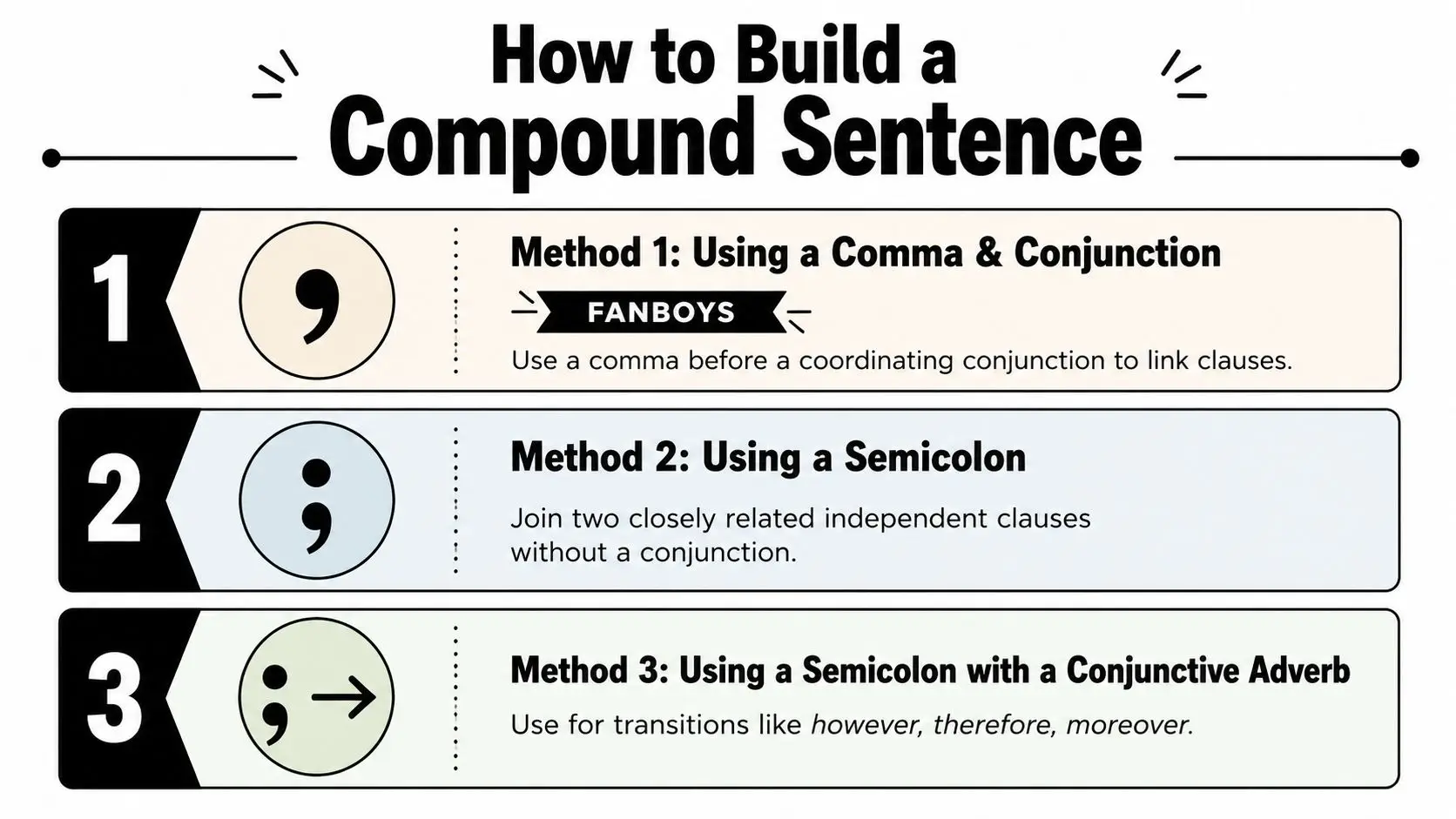
The easiest way to build a compound sentence is to start with two complete ideas and choose the right bridge between them. That bridge can be a conjunction, a semicolon, or, for older writers, a conjunctive adverb.
Using coordinating conjunctions
The most familiar method is comma + conjunction. The seven coordinating conjunctions are remembered by FANBOYS, which stands for For, And, Nor, But, Or, Yet, So. If your child joins two full clauses with one of these, the comma usually comes before the conjunction.
For example, “I finished my reading, and I wrote a summary.” Both parts stand alone, and the comma helps the reader pause at the right place. The BBC's learner-friendly explanation matches this pattern too, since it describes compound sentences as two simple sentences joined by words like and, or, and but (BBC Bitesize compound sentence guide).
Using a semicolon
A semicolon works when the two ideas are very closely related and the writer wants a tight, neat connection. “I wanted to go outside; it was pouring with rain.” The ideas belong together, so the semicolon feels natural and tidy.
Using a semicolon with a conjunctive adverb
A more advanced option is semicolon + conjunctive adverb + comma. Words like however and therefore show the relationship between the ideas. “I wanted to go outside; however, it was pouring with rain.”
Helpful check: if the two clauses could each become their own sentence, you've got the right raw material for a compound sentence.
For parents helping with homework, this rule keeps things manageable. Ask first, “Are there two complete ideas here?” Then ask, “Which bridge makes the relationship between those ideas clearest?” For more support with sentence work in a school context, primary school English online is a useful reference point for structured learning.
Compound vs Simple and Complex Sentences
A child often gets confused here because all three sentence types can look similar at first glance. The easiest fix is to compare them side by side and focus on how many complete thoughts each one carries.
Three sentence types, one simple way to sort them
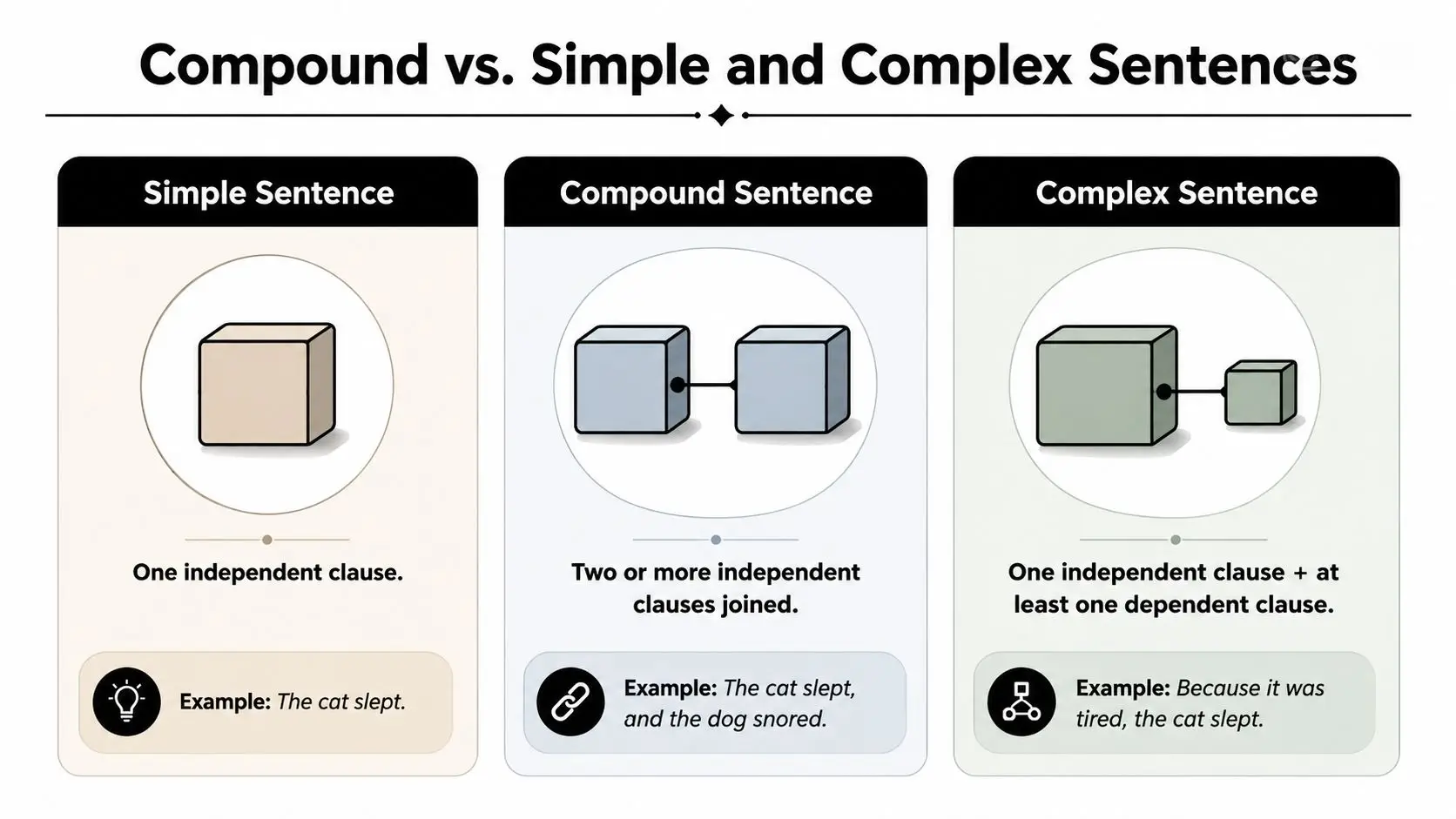
A simple sentence has one independent clause. “The cat slept.” It says one complete thing and stops.
A compound sentence has two or more independent clauses. “The cat slept, and the dog snored.” There are two complete thoughts, and they are linked on purpose.
A complex sentence has one independent clause and at least one dependent clause. “Because it was tired, the cat slept.” The opening idea can't stand alone, so it leans on the main clause.
| Sentence type | Structure | Example |
|---|---|---|
| Simple sentence | One independent clause | The cat slept. |
| Compound sentence | Two or more independent clauses joined | The cat slept, and the dog snored. |
| Complex sentence | One independent clause plus at least one dependent clause | Because it was tired, the cat slept. |
That comparison matters because writers need to know what job each structure does. Simple sentences are clean and direct. Compound sentences link equal ideas. Complex sentences show dependence, cause, time, or condition.
A recipe way to remember it
If you like food analogies, think of sentence types like recipes. A simple sentence is one complete ingredient group. A compound sentence is two complete groups mixed together with a connector. A complex sentence uses one main group with a smaller piece that depends on it.
Two full thoughts joined together give you balance. One full thought with a dependent piece gives you a different kind of control.
The BBC explanation of compound sentences as two simple sentences joined together makes this distinction especially useful for classroom writing tasks (BBC Bitesize compound sentence guide). Once a child can tell these structures apart, editing becomes much less frustrating because they know what they're trying to build.
Compound Sentences in Action with Examples
Children usually understand this best when they see ordinary sentences from real life, not textbook language. The moment the examples sound like something they might write, the idea starts to stick.
Before and after examples
“I wanted to play football outside. It started to rain.” These are two clear simple sentences, but they sound separated. Joined as a compound sentence, they become, “I wanted to play football outside, but it started to rain.”
“The homework was difficult. I asked my mum for help.” That works as two short statements, but “The homework was difficult, so I asked my mum for help” feels smoother and more connected.
“Sam finished his science project; he felt proud.” The semicolon shows the ideas are closely related. There is no need to push them apart when they clearly belong in the same thought unit.
Examples children can recognise
- School: “I revised for my test, and I felt calmer in class.”
- Friends: “Lena wanted to join the game, but the other children had already started.”
- Home: “Dad made dinner, and we set the table together.”
- Hobbies: “I practised the piano, so my hands felt tired.”
These examples do more than show grammar. They show tone. A compound sentence can make a child sound thoughtful, organised, excited, or reflective, depending on the connector they choose.
The useful habit is to compare the sentence before and after joining. Two separate statements can feel plain. A well-built compound sentence can sound warmer, more controlled, and more interesting without becoming difficult.
If your child finds longer reading or sentence work tiring, focused practice with prose comprehension worksheets can help them notice how writers connect ideas in context. That awareness often carries over into their own writing much faster than memorising rules alone.
Practice Exercises and Learning Tips
A little practice helps the idea move from “I've heard of this” to “I can do this.” Keep it short, calm, and encouraging, because children learn faster when they feel safe making small mistakes.
Mini quiz
Which sentence is compound?
- The bird sang, and the cat watched.
- The bird sang loudly.
Join these two simple sentences with but.
- I wanted to go outside.
- It was raining.
Is this a compound sentence?
- My brother read a book; I drew a picture.
Which connector fits best?
- I was hungry, ___ I ate my sandwich.
Answer key
- The first sentence.
- I wanted to go outside, but it was raining.
- Yes.
- so
The BBC's learner example, “I wanted to play outside, but it was raining,” is a good model to imitate because it shows two complete ideas joined clearly (BBC Bitesize compound sentence guide). That kind of pattern is easy for children to copy once they hear it.
Tips for children
- Read aloud: If the sentence sounds jerky, check whether the ideas need a connector.
- Test the clauses: Split the sentence in half. If both halves make sense alone, you're on the right track.
- Choose the mood: Use and for addition, but for contrast, and so for result.
Tips for parents
- Ask, don't rescue: “Do you see two full ideas there?”
- Point to the connector: “Which word joins the thoughts most naturally?”
- Praise the thinking: Children build confidence faster when they know the reasoning mattered, not just the final answer.
Support grows when parents treat grammar like problem-solving, not a guessing game.
For families who want more structured language support, Queens Online School offers live, interactive teaching with a British curriculum and specialist guidance that fits different learning needs. Visit Queens Online School to see how confident grammar learning can become part of a wider, supportive education journey.