

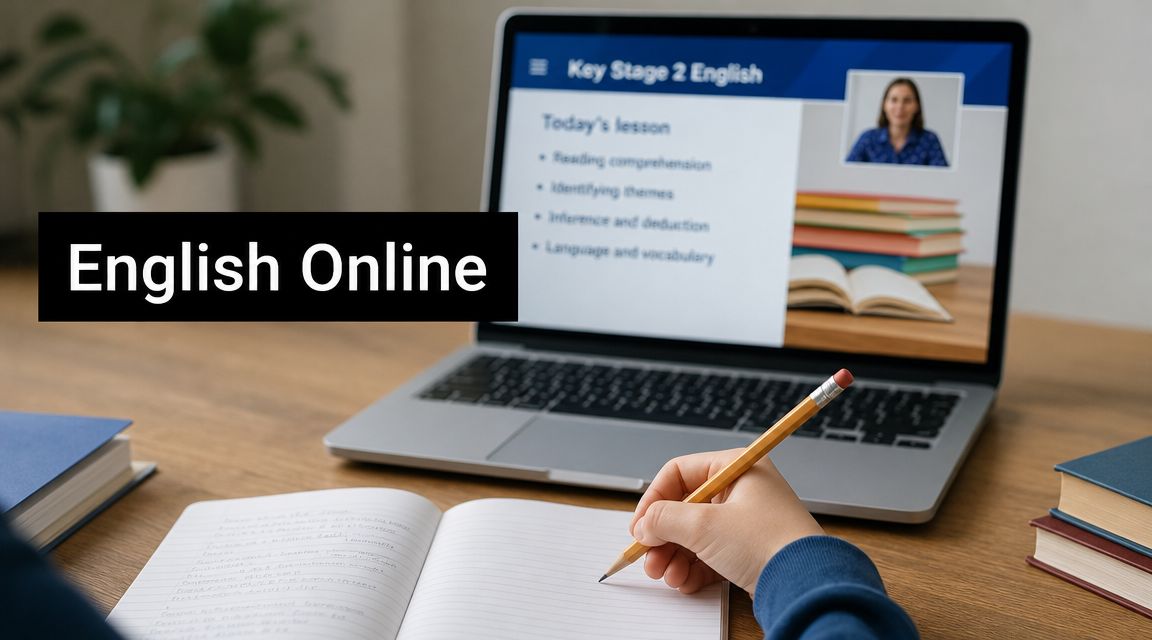
You might be reading this after another difficult homework session. Your child can talk brilliantly about a story at the dinner table, but freezes when asked to write. Or they're bright and curious, yet school English feels rushed, noisy, or discouraging. Many parents arrive at online learning from that place of worry. They're not looking for a gimmick. They're looking for a calmer, better fit.
That's why primary school English online deserves a more careful look. Done well, it isn't just a child watching videos on a laptop. It's a teaching model that can give younger learners more speaking time, more feedback, and a pace that suits how children learn.
Why Parents Are Exploring Online English Options
A lot of families don't start by wanting something radically different. They start by noticing a small change. A child who once loved books begins saying they're “bad at English”. A weekly spelling test becomes a source of tears. Reading aloud feels tense. Writing takes so much effort that the child gives up before the first sentence is finished.
For some children, the issue is confidence. For others, it's pace. They may understand more than they can show in a busy classroom. They may need more repetition, more modelling, or more time to answer without feeling watched by everyone else.

When school support feels too broad
Parents often tell me the same thing in different words. “My child isn't failing, but they're drifting.” That matters. English at primary level builds layer by layer. If a child misses confidence in phonics, vocabulary, reading fluency, or sentence structure, the gap tends to show up later in comprehension and writing.
The wider school context helps explain why more families are exploring alternatives. The 2024 DfE key stage 2 results showed only a partial recovery to pre-pandemic levels, and many families are looking for extra support in core skills such as reading and writing.
Online English often becomes attractive at the moment a parent realises their child doesn't need “more work”. They need different teaching.
Why online now feels like a proactive choice
Parents used to think of online learning as a backup plan. That's changed. Many now see it as a way to match teaching more closely to the child in front of them.
A shy child may speak more in a small online group than in a full classroom. A child who struggles with transitions may feel calmer learning in a predictable home environment. A strong reader who finds school writing repetitive may enjoy more stretch and more discussion.
Here's what parents are usually hoping for:
- More individual attention so a child isn't waiting while others catch up.
- More visible teaching where the adult explains, models, and checks understanding step by step.
- More emotional safety for children who feel overwhelmed, embarrassed, or overlooked.
- More consistency through routines that reduce friction and help a child settle into learning.
That doesn't mean online is automatically right for every family. It means the question has shifted. It's no longer “Should learning happen on a screen?” It's “What kind of teaching helps my child feel capable again?”
The Digital English Classroom and What Your Child Will Learn
A strong online English lesson should feel like a real classroom lesson, not a video call with worksheets attached. In Key Stage 2, children need to build several connected skills at once. Reading supports writing. Speaking supports vocabulary. Grammar supports clearer expression. When one part is missing, the rest becomes harder.
I often describe English as a set of building blocks. If your child is going to become a confident communicator, they need secure foundations before they can build upwards.

Reading comes first, but not on its own
Reading in an online English programme isn't just silent reading followed by comprehension questions. A teacher might share a short passage on screen, read part of it aloud, ask pupils to predict what happens next, then guide them to spot clues in the language.
That matters because many children seem to “read” but don't yet explain, infer, or summarise well. In a live lesson, the teacher can pause and ask, “What tells us the character is worried?” or “Which word changes the mood here?” Those little exchanges deepen understanding.
If you want a practical picture of how structured online reading can look for children, this overview of what children do in ReadLab is useful because it shows how targeted practice can sit alongside teacher support.
Writing grows through modelling and practice
Children rarely become stronger writers because they're told to “write more”. They improve when a teacher breaks the task down. First, gather ideas. Then build sentences. Then improve vocabulary. Then organise the piece so it makes sense to a reader.
A live online lesson on persuasive writing might start with a playful debate. Should school uniforms include trainers every day? The class discusses reasons, listens to counterarguments, and collects powerful phrases. Then the teacher models a paragraph and explains why it works. Only after that does the child write independently.
This is the difference between task-setting and teaching.
For parents comparing curriculum-based options, Key Stage 2 English teaching focused on mastering language skills gives a clear sense of how reading, writing, speaking, and language knowledge fit together.
Grammar and speaking support everything else
Grammar can feel dry when it's taught as isolated rules. It becomes much easier when children see its purpose. A teacher might show how fronted adverbials change sentence rhythm, or how precise verbs make character description stronger.
Speaking and listening also matter more than many parents realise. When children explain an idea out loud, rehearse a sentence before writing, or respond to a story in discussion, they're doing the thinking that strong English depends on.
Practical rule: If an online programme teaches reading, writing, grammar, and speaking as separate boxes, be cautious. In good primary teaching, they constantly feed one another.
Live Lessons Versus Recorded Content Which Format Works Best
Not all online English feels the same to a child. Some formats feel lively and supportive. Others place too much weight on independence too soon.
Many parents often get confused. Recorded lessons sound convenient, and sometimes they are. But convenience for adults isn't always the same as effectiveness for younger learners.
Why live teaching matters more in primary
A peer-reviewed study on elementary online learning found that teachers rated online instruction as most effective when it was organised, engaging, and interactive, and it stressed that younger pupils are less independent and need direct teacher facilitation in developmentally appropriate online environments, with synchronous formats better able to respond to pupils' needs than asynchronous-only sessions (elementary online learning research).
That lines up with what most experienced primary teachers already know. Young children usually need someone to notice confusion early, redirect attention gently, and keep language learning active.
A child trying to learn how to improve a sentence often needs immediate correction. A child reading aloud benefits when a teacher can stop, praise, prompt, and model. Recorded content can't do that in the moment.
The child's experience in each format
A sociable child may enjoy the energy of a small live class. A cautious child may prefer one-to-one tuition because there's less performance pressure. A highly independent child may cope well with some recorded follow-up. But very few primary pupils thrive on recorded content alone for English.
Here's a straightforward comparison.
| Feature | Live, Small-Group Lessons | One-to-One Tuition | Recorded (Asynchronous) Lessons |
|---|---|---|---|
| Interaction | Real-time with teacher and peers | Real-time with teacher only | No live interaction |
| Feedback | Immediate and shared through discussion | Immediate and fully personalised | Delayed or absent unless paired with marking |
| Pacing | Guided pace with group momentum | Fully tailored to the child | Child must self-manage pace |
| Confidence-building | Good for speaking and turn-taking | Good for anxious or highly specific needs | Harder for children who need encouragement |
| Best fit | Children who benefit from structure and peer presence | Children who need precision, reassurance, or tailored support | Revision, recap, or extra practice after teaching |
Where recorded lessons do help
Recorded lessons aren't useless. They're often helpful as reinforcement. If a child misses part of an explanation, wants to rewatch a modelled example, or needs to revisit a grammar point before homework, recorded material can be excellent.
That's very different from making recordings the main method of teaching.
Some providers use a blended model well. The British Council's Primary Plus Online for ages 5 to 11 runs as a 10-week course built around live online classes with a specialist teacher, interactive guided learning, and a personal progress dashboard, with small classes designed to allow more personalised attention (Primary Plus Online). That combination matters because primary English works best when speaking practice, correction, and independent practice all support each other.
If you're weighing formats more broadly, it helps to understand how asynchronous learning works in practice before deciding how much independent study your child can realistically manage.
A good question to ask is simple. “Will my child mostly be taught, or mostly be left to get through content?”
Tracking Progress and Providing Personalised Feedback
One of the biggest worries parents carry is this. If my child learns online, how will I know whether they're really improving?
The answer shouldn't be “wait for a report at the end of term”. Good online English teaching makes progress visible much sooner than that.
What useful feedback looks like
In primary English, the most valuable feedback often happens during the lesson itself. A teacher hears a child read and corrects a misread word. The child writes a sentence in the chat, and the teacher highlights one phrase that works well and one part to improve. During a discussion, the teacher prompts a fuller answer and helps the child use a stronger word.
That kind of feedback is immediate, specific, and easier for children to act on.
A strong online programme usually includes:
- Live verbal feedback during reading, speaking, and writing tasks.
- Marked written work with short, clear next steps.
- Progress tracking that helps parents see patterns over time.
- Teacher observations about confidence, focus, and participation, not just correct answers.
Why technology can help rather than hinder
The technology itself isn't the goal. It's the vehicle. The important question is whether the platform helps the teacher see the child's thinking.
Independent guidance on online English teaching highlights tools such as Zoom and Microsoft Teams because they support whiteboards, breakout rooms, chat, screen sharing, and audio sharing, and recorded lessons can help pupils replay input they missed. The same guidance also points to the value of tools that support immediate feedback and collaboration in online learning (online English teaching tools and feedback features).
In practice, that might mean a teacher watching a child build a paragraph sentence by sentence on a shared screen, rather than only seeing the final result. For parents, that's reassuring because it turns learning from a mystery into something trackable.
Questions worth asking a provider
When you speak to an online school, ask direct questions:
- How often does the teacher give feedback? You want more than occasional grading.
- What can parents see? A dashboard, marked work, or teacher notes can all help.
- How are errors handled? The best teachers correct without discouraging.
- How is progress judged? Look for a mix of lesson observation, written work, and periodic checks.
Children improve fastest when they know exactly what they're trying to do next. Parents feel calmer when they can see that happening.
Supporting Diverse Learning Needs Online
For some children, online English is more than just convenient. It can be a better match for how they cope, focus, and learn.
This is especially true for children with SEND, SEMH needs, low literacy confidence, school-based anxiety, or a pattern of disengagement. In a busy physical classroom, English can become tangled up with other challenges. Noise, transitions, social pressure, fear of getting things wrong, sensory overload, or the pace of whole-class teaching can all get in the way before the actual learning has even begun.
Why the environment matters
In England, 19% of pupils were persistently absent in 2023/24, and pupils with SEND often face the largest attainment gaps, which is one reason many families look for more structured and supportive alternatives (online tutoring context for absent pupils and SEND).
That statistic matters because attendance and learning are closely linked. A child can't build reading fluency or writing stamina if each week feels fractured.
Online learning can reduce some of the barriers that traditional settings create. The home environment is often quieter. The routine can be more predictable. The teacher can adjust the pace more quickly. For some children, that means they finally have enough calm to think.
What support can look like in practice
A child with dyslexic traits may need text read aloud, shorter writing chunks, and repeated modelling. A child with SEMH needs may need a very clear lesson routine, advance warning before speaking, and a teacher who notices rising anxiety early. A child with attention difficulties may need short tasks, visual prompts, and regular check-ins.
These are not small adjustments. They are often the difference between avoidance and engagement.
Practical signs of supportive provision include:
- Small teaching groups so the adult can respond quickly.
- Clear routines that make lessons predictable.
- Multi-sensory teaching through spoken explanation, on-screen annotation, reading aloud, and discussion.
- Flexible participation so a child can answer aloud, type in chat, or respond through short written tasks.
- Close communication with home so patterns in effort, fatigue, and confidence don't go unnoticed.
If inclusive practice is a priority in your search, this guide to inclusive education practices is a useful starting point because it helps parents think beyond labels and focus on the actual support a child receives.
Children with additional needs don't just need kindness. They need teaching that is structured enough to reduce stress and flexible enough to meet them where they are.
The key match to look for
Parents sometimes ask whether online learning is “good for SEN”. That's too broad. The better question is whether the specific online model suits your specific child.
Some children need one-to-one support. Others benefit from a small group where they can hear peers and practise social communication in a lower-pressure setting. Some need a highly structured curriculum. Others need a more therapeutic pace. The strongest decision usually comes from matching the environment, teacher style, and lesson format to the child's profile, not from choosing the most polished website.
Your Checklist for Evaluating Online English Schools
Once you start looking, many providers sound similar. They all mention flexibility, engagement, and personalised learning. The difference usually appears when you ask sharper questions.
This checklist helps you move past marketing language and focus on what affects your child's day-to-day experience.

Start with class size and teacher contact
Parental expectations around teacher interaction don't come from nowhere. In 2022, the EU averaged 13.3 primary pupils per teacher, across 23.0 million primary pupils and 1.89 million primary teachers, which gives a useful benchmark for why families expect regular adult contact rather than mass delivery (Eurostat primary education statistics).
That doesn't mean every online class should mirror that exact ratio. It does mean small-group teaching isn't a luxury. For primary English, it's closely tied to participation, correction, and confidence.
Ask these first:
- How many children are in each class? Smaller groups usually allow more reading aloud, more questioning, and more individual feedback.
- How often does my child speak in a lesson? If the answer is vague, keep digging.
- Who teaches the class? Look for subject-specialist teachers or experienced primary educators, not fluent English speakers.
A practical example helps here. Some families compare tutoring platforms, language apps, and full online schools without realising they offer very different things. As one curriculum-based option, Queens Online School provides British curriculum teaching online with live classes and subject teachers for primary-aged learners. That kind of detail matters more than broad promises.
Check the curriculum and teaching method
The next issue is whether the provider is teaching English properly, or just assigning English-related activities.
Look for answers to these questions:
- Is the programme aligned with Key Stage 2 expectations?
- How are reading, writing, grammar, and speaking taught together?
- Are lessons live, recorded, or blended?
- What independent work is expected between lessons?
Key question: Ask the school to describe one actual English lesson from start to finish. Strong providers can do this clearly.
A provider should be able to explain how they teach comprehension, model writing, correct grammar, and track progress. If they only talk about “fun content” or “interactive resources”, you still don't know how your child will learn.
A short video can help parents think through what to look for in an online learning environment:
Don't skip safeguarding and communication
Primary children need secure, well-managed online spaces. You should feel comfortable asking detailed safeguarding questions.
Use this checklist when you speak to a provider:
| Area | What to ask |
|---|---|
| Safeguarding | How are live lessons supervised and recorded? What are the rules for communication with pupils? |
| Technology | Which platform is used, and is it easy for a primary child to navigate? |
| Parent communication | How often do I hear from teachers, and in what format? |
| Feedback | Will I see marked work, comments, or progress notes? |
| Trial lesson | Can my child try a lesson before we commit? |
Look at your child, not just the provider
The final test is very simple. Can you imagine your child in this environment?
A confident talker may flourish in a lively small group. A child with anxiety may need a gentler start. A child who tires easily may need shorter sessions and clearer breaks. The “right” online English school is the one whose structure, staffing, and teaching style make your child more likely to participate, persist, and feel successful.
A Sample Week in an Online English Programme
Parents often need something more concrete than features and promises. They want to know what the week would feel like for their child.
A well-run online English week has rhythm. It balances live teaching, practice, creativity, and rest. The child shouldn't be staring at a screen all day. They should be moving between direct instruction and manageable independent work.

One possible routine
On Monday, your child joins a live grammar lesson. The teacher introduces a sentence pattern, models examples, and checks understanding with quick responses in chat and discussion. Afterwards, the child completes a short task independently, applying the same idea in their own writing.
Tuesday focuses on reading comprehension. Your child reads a short text, answers guided questions, and records a brief spoken response or joins a discussion. Wednesday brings a live writing workshop, where the teacher helps the class plan and draft a story opening. Thursday uses games and retrieval tasks to revisit vocabulary from earlier in the week. Friday centres on a short project and personalised feedback.
That kind of weekly flow doesn't happen by accident. It reflects careful sequencing. Parents who want to understand how teachers build that sequence may find this article on lesson planning for teachers helpful, because it shows how weekly language learning can be mapped in a clear and manageable way.
What children often enjoy most
Children usually respond well when the week includes variety:
- Live moments where they can speak, ask, and be noticed.
- Independent tasks that feel achievable rather than overwhelming.
- Creative work such as story writing, role play, or response to a text.
- Review time so they can revisit something they nearly understood the first time.
A good week in primary school English online feels structured, but not rigid. It gives children enough routine to feel secure and enough variety to stay interested.
Frequently Asked Questions About Online Primary English
Does my child need to be confident with technology?
Not usually. Most primary children can learn the routines of joining a lesson, using mute and chat functions, and opening simple tasks quite quickly when the platform is clear and the teacher guides them. The bigger issue isn't technical skill. It's whether the online environment is simple enough for a child to focus on English rather than on buttons and tabs.
How much parental supervision is needed?
That depends on the child's age, confidence, and profile. Younger primary pupils often need help getting set up, staying on timetable, and organising materials. Older or more independent children may need very little support once routines are established.
Many parents find the first few weeks require more involvement. After that, the goal should be steady independence, not constant hovering.
Will my child miss the social side of learning?
Not if the programme is designed well. In live online English, children can still discuss texts, take turns, collaborate in breakout groups, and respond to each other's ideas. Social learning in English isn't only about sitting next to someone. It's about sharing thought, language, humour, and perspective.
That said, the social fit matters. Some children need a lively group. Others need a smaller, quieter circle before they feel safe enough to join in.
Can online English really help a child who is behind?
Yes, if the teaching is properly structured and matched to the child's needs. Children who are behind usually need explicit teaching, lots of guided practice, and feedback that is immediate and encouraging. They don't need to be left alone with generic worksheets.
If your child has low confidence, ask whether the provider can explain exactly how they teach struggling readers or reluctant writers. The detail in that answer will tell you a lot.
Is one-to-one always better than a group?
Not always. One-to-one tuition can be excellent for precision, reassurance, and individual pacing. Small groups can be powerful too, especially for speaking, listening, discussion, and confidence-building. Some children benefit from a mix.
The best format is the one that helps your child stay engaged, receive useful feedback, and feel able to contribute.
What should I do before enrolling?
Keep it simple:
- Watch your child learn during a trial, if one is offered.
- Notice their energy after the lesson. Were they tense, flat, or proud?
- Ask specific questions about teaching, feedback, and support.
- Trust the fit as much as the feature list.
If a child feels calmer, clearer, and more willing to try, that's often the strongest early sign that you're on the right path.
If you're looking for a structured British curriculum option with live teaching for younger learners, Queens Online School is one route to explore. Families often begin by comparing the format, class size, teacher support, and curriculum approach against their child's specific needs. That's the right way to choose.