

Your child used to talk about school over breakfast. Now they're quiet, reluctant to get dressed, or anxious about opening their laptop for lessons. When you ask what's wrong, they say nothing's happened, but you're left wondering whether someone is making school feel unsafe.
You don't need to prove that it's bullying before asking for help. You need to know who will listen, what the school will do, and how your child will be protected while adults work out what's happening.
Why Every Parent Should Read Their School's Anti-Bullying Policy
An anti-bullying policy should be more than a document stored on a school website. Think of it as the school's written commitment to how children will be heard, protected and supported. It isn't a guarantee that bullying will never happen, but it should explain what adults will do when concerns arise.
For example, suppose your child keeps asking to miss a particular lesson. They eventually explain that classmates laugh whenever they answer a question. You shouldn't have to search through several documents to discover whether to contact the teacher, pastoral lead or safeguarding team.
The scale of the issue makes that preparation worthwhile. In the year ending March 2023, 34.9% of children aged 10 to 15 in England and Wales, roughly 1,544,000 children, experienced in-person bullying during the previous year, while 19.1% experienced online bullying, according to the Office for National Statistics bullying bulletin. These categories can overlap, so don't add the percentages together.
Read it through your child's eyes
A parent searching for an anti bullying policy in schools UK guide usually wants reassurance. The most useful reassurance is concrete: your child can recognise the reporting route, use it without unnecessary barriers, and understand what happens afterwards.
Look beyond firm-sounding statements about unacceptable behaviour.
- Find the child-facing explanation. Would your child understand it, or does it rely on legal and disciplinary language?
- Check the tone. Does the school invite concerns, including uncertain ones, or expect families to arrive with proof?
- Look for ongoing support. Does the policy explain how adults check whether the child feels safe after intervention?
A reassuring policy tells a child what adults will do, rather than simply telling children what they mustn't do.
Reading it before a problem arises gives you space to ask questions calmly. You might discover that your child doesn't know where the reporting form is, or assumes they can only speak to their class teacher.
Ask them which adult they'd approach if something felt wrong. Their answer matters more than whether they can repeat the school's slogan.
The Legal Framework Behind Every UK Anti-Bullying Policy
There isn't one identical legal framework across the UK. The statutes discussed below concern England. Families in Scotland, Wales or Northern Ireland should check the framework applicable to their school rather than assume an English requirement applies unchanged.
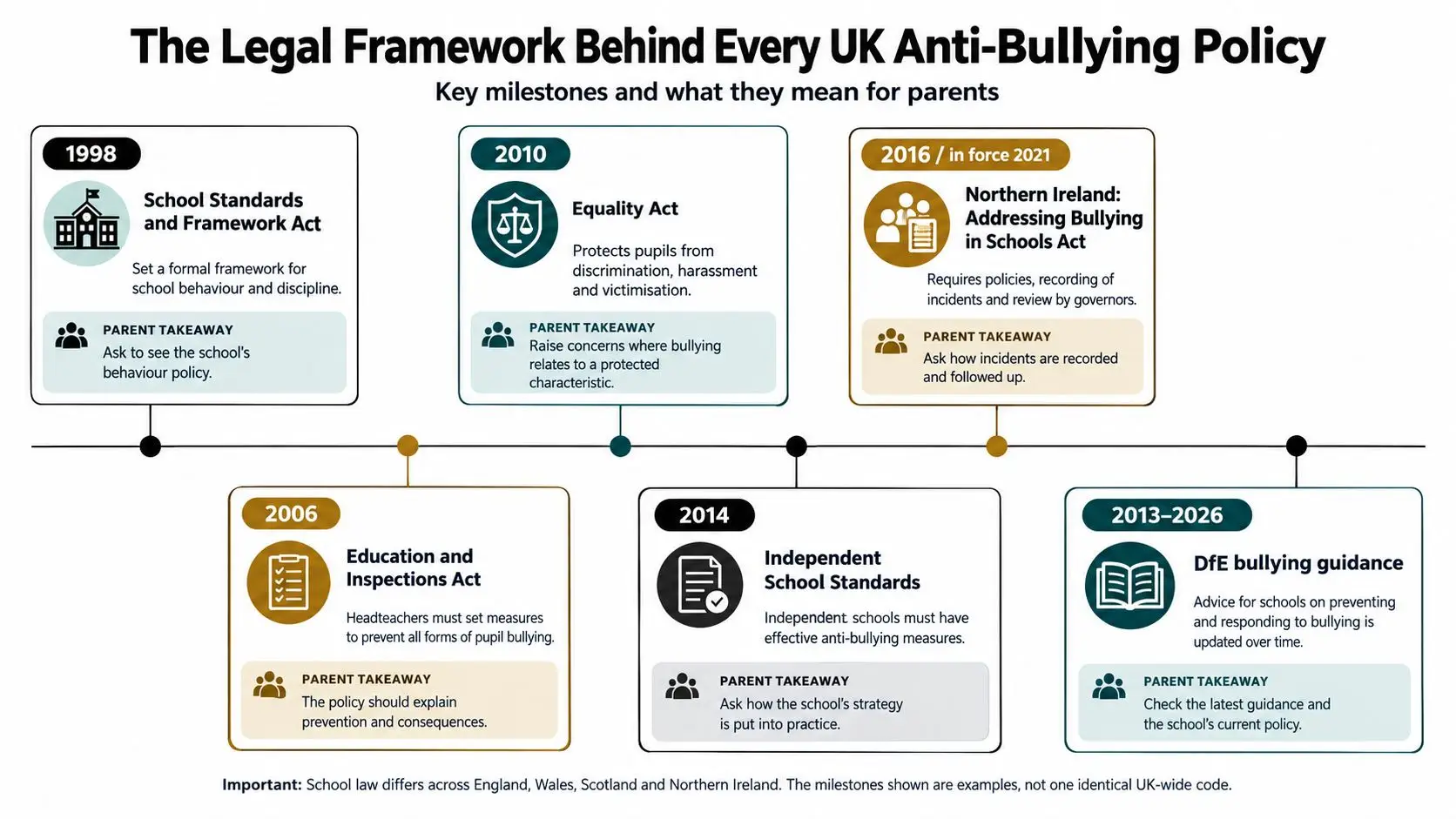
In England, the School Standards and Framework Act 1998, section 61(4) required headteachers to determine measures aimed at preventing all forms of pupil bullying. Schools also had to publicise those measures in writing and make them known to pupils and parents at least once each school year.
The Education and Inspections Act 2006, section 89, subsequently placed anti-bullying measures within the wider behaviour-policy framework. Maintained schools in England must include measures to prevent all forms of pupil bullying and communicate them to pupils, staff and parents, as explained in the Department for Education's prevention and response guidance. A school may also maintain a separate anti-bullying document.
The timeline provides a visual overview of that legal development.
What the law means for your child
Department for Education guidance published in 2017 reinforced the expectation that policies should be clear to pupils, parents and staff, and incidents addressed quickly. In practical terms, a document that adults understand but children can't use falls short of the purpose of communication.
There's also a distinction between managing behaviour and protecting a child from serious harm.
- Behaviour response. The school investigates harmful conduct and applies its behaviour procedures.
- Safeguarding escalation. Where there's reasonable cause to suspect significant harm, the concern should go to the designated safeguarding lead, with potential referral to children's social care under the Children Act 1989.
- Immediate protection. A child shouldn't have to wait for a disciplinary decision before adults consider their safety.
For further explanation of the English framework, consult this guide to anti-bullying law in the UK.
International families comparing terminology may also find Premiere Education's dignity for all students act summary useful as a separate comparison resource. It concerns New York, not the legal duties governing an English school.
For parents, the central question remains practical: can the school explain how its legal responsibilities translate into protection for your child?
Anatomy of an Effective Anti-Bullying Policy
A policy can sound thorough while leaving important gaps. A 2024 content analysis of English school anti-bullying policies found that documents covered, on average, around 61% of assessed best-practice items, with the strongest improvements since 2008 in cyberbullying and bias-based bullying, as reported in the analysis of English school policy content. That research also traces the statutory history described above.
The useful test isn't the document's length. It's whether each part answers a question a frightened child or worried parent might ask.
Start with recognition, then response
A workable definition should address repeated or intentional harmful behaviour involving a power imbalance. That imbalance might involve physical strength, popularity, group numbers or access to embarrassing information.
Consider classmates repeatedly removing a pupil from a shared project chat. The harm isn't necessarily a spoken insult. The pattern of exclusion, who controls access, and its effect on the child all need examination.
| Policy element | What it should achieve | Warning sign |
|---|---|---|
| Definition and examples | Help children recognise harmful patterns, including cyberbullying and bias-based bullying | Only physical aggression is described |
| Named responsibilities | Identify who receives concerns and who leads the response | References to “staff” without clear ownership |
| Accessible reporting | Offer private routes children can actually use | Only a written form or public conversation |
| Investigation commitments | Explain acknowledgement, updates and review arrangements | “We deal with matters promptly” without further detail |
| Recording standards | Preserve allegations, evidence, actions and outcomes | Informal conversations with no documented follow-through |
| Consequences and support | Address behaviour while protecting and supporting those involved | Punishment is treated as the entire solution |
Don't let labels become barriers
A disagreement between children isn't automatically bullying. Equally, an adult shouldn't dismiss harmful behaviour because they haven't yet established repetition or intent.
For example, a pupil reports a threatening message but can't explain whether similar messages have been sent before. The school should still assess the concern and protect the child where necessary. Establishing the correct label is part of the investigation, not a condition for receiving help.
- Ask about ambiguity. How does the school respond when accounts differ or the pattern isn't yet clear?
- Check the support pathway. What help is available to the targeted child and to the pupil whose behaviour caused harm?
- Look for usable language. Could a child identify an example resembling their own experience?
An effective document should leave you understanding both the boundaries and the response, without needing to become a safeguarding specialist.
How Reporting and Investigation Should Actually Work
Consider a hypothetical Year 8 pupil who tells their tutor that classmates are targeting them in a group chat. They're frightened that reporting will make the messages worse. The response should begin with listening and safety, not with a demand for a complete evidence file.
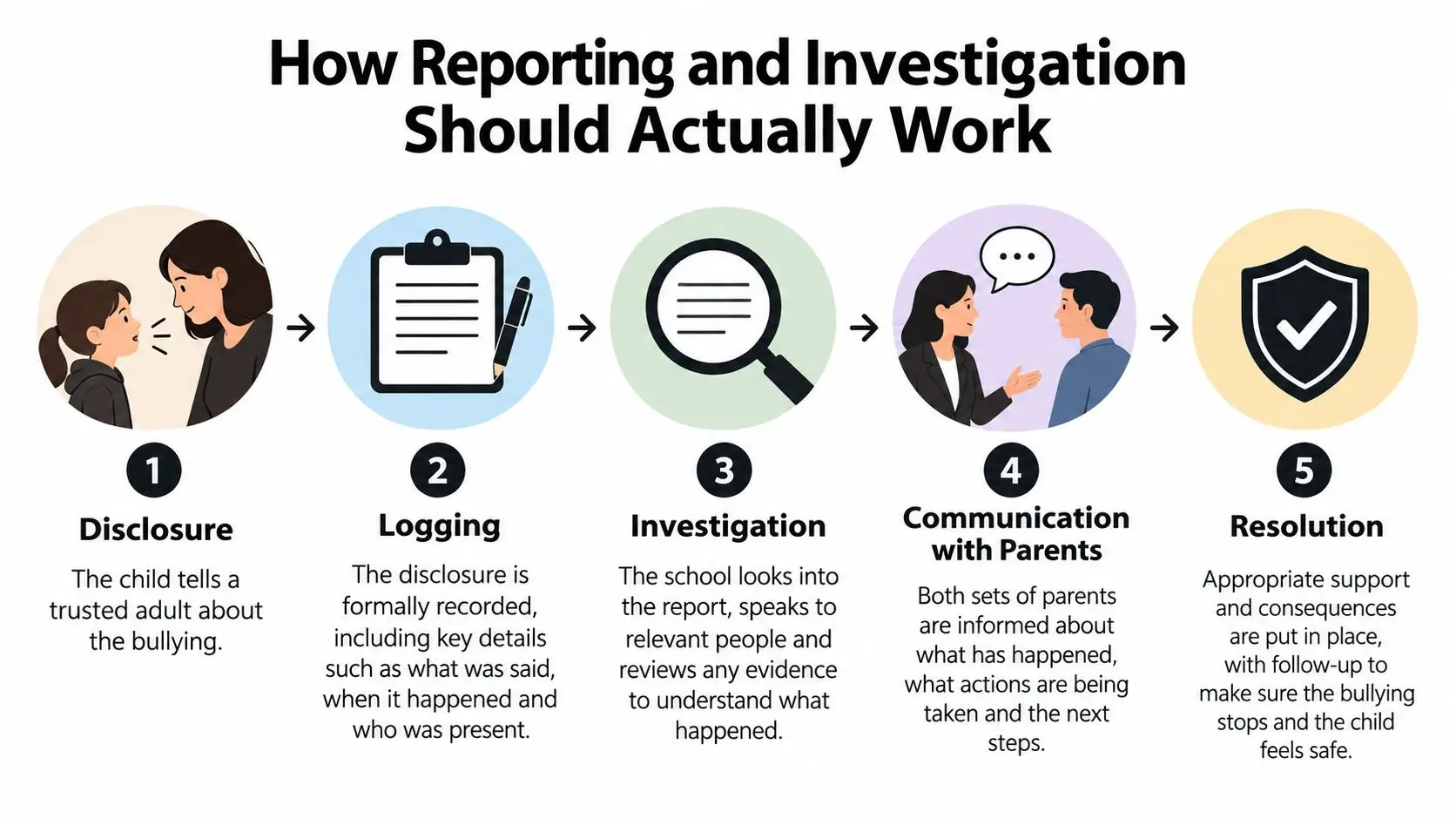
The flowchart shows the broad sequence, but protection should run through every stage.
At disclosure and before the next lesson
The tutor should hear the pupil's account privately, record it accurately and explain who needs to know. They shouldn't promise absolute secrecy, but should explain how information will be shared for protection.
In this example, I'd expect the responsible adult to establish whether there are threats, whether contact is continuing, and what the pupil fears will happen next. The immediate plan might include a named check-in adult and changes to school-controlled messaging access.
Practical rule: Don't make a child repeatedly retell a distressing account simply because several adults need information.
During investigation and at the agreed update
The school should state its own acknowledgement, investigation and review timescales. There's no universal deadline offered here: parents need the school's published commitments and a clear explanation if an investigation takes longer.
- Record the concern. Include the pupil's account, relevant dates, available evidence, immediate actions and the adult responsible.
- Gather evidence carefully. Review relevant messages and speak to pupils separately. Don't ask the child to remain in a hostile chat to collect more material.
- Keep the family informed. Agree when the next update will happen, even if the investigation remains open.
- Explain the outcome. Describe findings and protective actions, while recognising that another pupil's personal information may remain confidential.
Consequences should follow the school's policy and the circumstances. Restorative work may be considered where safe, but a child shouldn't be pressured into a joint meeting or apology exchange that leaves them frightened.
The accompanying video can be used alongside a conversation about reporting concerns.
After the apparent resolution
The final check isn't whether the school has closed its record. It's whether the pupil can attend lessons, participate and use relevant platforms without renewed targeting.
In the group-chat example, the review should ask about retaliation, indirect exclusion and whether the child trusts the agreed support. If harm continues, adults should revisit the plan rather than tell the pupil that the matter has already been resolved.
Who Does What, Staff, Parents and Pupils
A parent shouldn't have to coordinate the school's internal response. The policy should distinguish the adult who receives a concern from the person who investigates it, oversees protection and communicates with the family.
If your child tells a subject teacher, that teacher shouldn't send them away to start again with someone else. A sensible arrangement is for the receiving adult to pass the concern through the agreed route and explain that handover to the child.
Staff carry the responsibility for action
All staff should know how to recognise concerns, respond calmly, record disclosures and pass information to the appropriate colleague. Leaders should ensure training covers the school's actual environment, rather than relying only on general awareness.
The designated safeguarding lead coordinates child-protection concerns, but shouldn't become a substitute for every other adult's responsibility. Teachers still need to supervise their classrooms, challenge harmful conduct and follow the agreed safety arrangements.
| Person | The question they should be able to answer |
|---|---|
| Receiving teacher | “Have I passed this concern on, and does the child know what happens next?” |
| Investigation lead | “What remains unclear, and what evidence do we need?” |
| Safeguarding lead | “Does this concern require a child-protection response?” |
| Family contact | “Has the parent received the promised update?” |
| School leadership | “Are staff following the procedure consistently?” |
Parents support, pupils report, adults protect
At home, try to listen without turning the conversation into an interrogation. Write down what your child tells you, distinguish their account from your own interpretation, and explain what you intend to share with the school.
- Parents can raise concerns early. You don't need to wait until your child uses the word bullying.
- Parents can challenge an unsafe outcome. Ask for the school's escalation or complaints route if the protective plan isn't working.
- Pupils can help as bystanders. They can report what they've seen, avoid forwarding harmful material and offer companionship.
- Pupils shouldn't investigate. They shouldn't be expected to confront classmates, mediate threats or obtain proof.
For a primary child, reporting might mean telling their teacher that someone keeps stopping them joining a game. For a teenager, it might mean privately alerting a tutor about humiliating messages.
Both need the same underlying reassurance: telling an adult starts an adult response. Keeping themselves safe isn't a task they must complete alone.
Online and Remote Schooling, Policy in a Digital Classroom
A child can be physically at home and still feel unsafe in school. In an online classroom, the relevant spaces include live lessons, chat, email, learning platforms, group work and access to recorded sessions.
The setting may look calm from the doorway while something upsetting is happening on screen.
Government guidance states that independent schools and academies must prevent bullying so far as reasonably practicable through an implemented policy. It also addresses conduct beyond the physical school site where it affects pupil safety, as explained in the government's guidance on preventing and tackling bullying.
For parents, that means an after-school messaging incident shouldn't be dismissed solely because it happened outside a timetabled lesson. The school should consider the connection to school relationships and the child's safety.
Match safeguards to the digital space
Ask how supervision works in practice. There's a difference between a teacher presenting a lesson and an adult actively noticing hostile chat or exclusion in breakout work.
- Live lessons and chat. Who monitors messages, and who can restrict harmful contact?
- Group tasks. How does the teacher notice when a pupil is repeatedly denied access or ignored?
- Recordings. Who can view or download them, how long are they retained, and how is misuse handled?
- Identity and messaging. What happens if someone impersonates a pupil or sends hostile school-linked emails?
- Outside school hours. When are reports monitored, and what should families do if a concern can't safely wait?
A pupil's recorded presentation, for example, might be copied and used to mock their speech. A suitable response should examine access and sharing, not merely remind everyone to be kind.
For additional parent-facing questions and preventative ideas, use this cyberbullying prevention guide.
Protect participation, not just access
Removing the targeted child from a class chat may stop immediate contact, but it can also exclude them from learning and friendships. Ask how adults will preserve their access while addressing the behaviour causing harm.
The aim is for the child to take part safely, not to disappear from the space where others have targeted them.
When comparing online schools, ask about supervision ratios in live rooms without assuming any particular ratio guarantees safety. Also ask who covers moderation if the teacher is occupied, how concerns are handed over, and whether children can report privately during lessons.
The strongest answers describe adult actions and platform controls, not just acceptable-use rules.
Closing the SEND and SEMH Gap in Bullying Policy
An Anti-Bullying Alliance study of almost 45,000 pupils in England found that frequent face-to-face bullying affected 29% of pupils with SEND, compared with 22% of pupils without SEND, according to evidence submitted to Parliament on bullying and SEND. Those findings concern SEND and shouldn't be treated as a separate prevalence estimate for every child with SEMH needs.
SEND means special educational needs and disabilities. SEMH refers to social, emotional and mental health needs. For these children, an inclusive policy needs to explain adjustments, not promise equal treatment.
The checklist highlights the areas parents should examine.
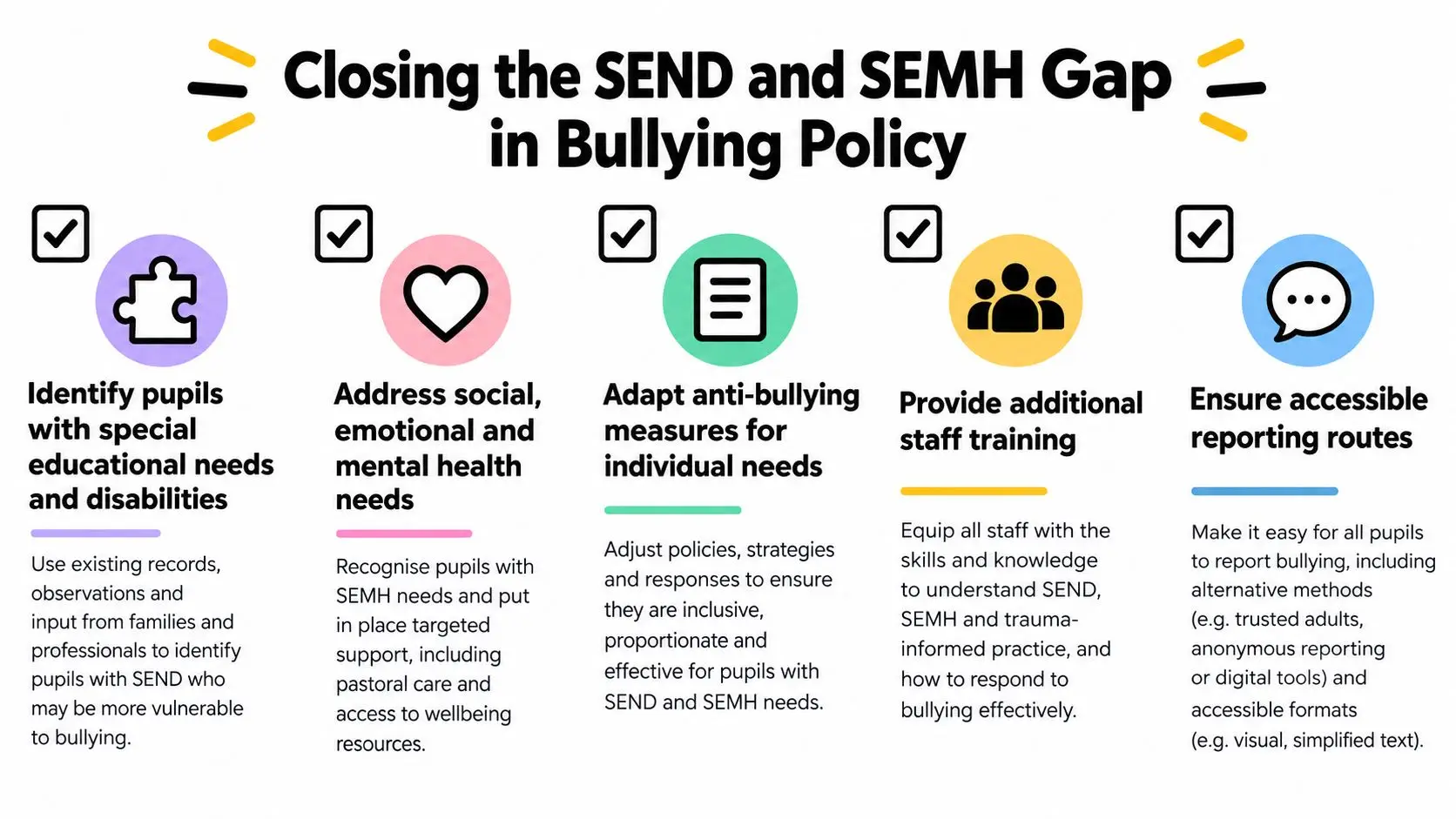
Adjust the route to the child
Consider a pupil who finds spoken explanations difficult. They may be able to identify upsetting messages but struggle to describe the sequence in an unfamiliar meeting. A reasonable practical adjustment could be a familiar adult, visual prompts or supported written communication.
- Communication needs. Can the child report without completing a complex form or giving an immediate spoken account?
- Sensory needs. Is there a calm place to talk, with breaks where needed?
- Emotional needs. Can adults establish safety and help the child regulate before asking detailed questions?
- Staff understanding. Does training address neurodivergence, hidden impairments and the risk of misreading distress?
These arrangements should connect with the child's existing support. This explanation of a SEN support plan can help parents frame questions about that connection.
Understand distress without excusing harm
Suppose a pupil shouts after classmates repeatedly imitate their speech. Investigating only the shouting would miss the preceding conduct. Adults should examine the whole sequence and distinguish bullying, conflict and behaviour associated with unmet needs.
Families considering separate discussions about assessment can also explore the cognitive assessment screening resource from Orange Neurosciences. Screening isn't a substitute for investigating bullying, and a child shouldn't need an assessment result before receiving protection.
Ask how leaders monitor incidents involving SEND or vulnerability-related needs while protecting confidentiality. Most importantly, ask your child whether the support feels usable: an adjustment written into a plan matters only if adults apply it when the child needs help.
Turning the Policy Into Action, A Sample Passage and Parent Checklist
A school or family could adapt this illustrative policy passage, rather than treat it as a quotation from an existing policy:
We will listen to every bullying concern, record it and assess immediate safety. A named adult will explain the investigation and update arrangements. We will adapt reporting to the child's needs, address harmful behaviour and review whether protection is working.
Find the current policy on the school website or request it directly. Confirm these essentials:
- Definition. Are harmful patterns and digital conduct covered?
- Reporting. Can your child use the route?
- Ownership. Is a responsible adult identified?
- Response. Are updates and protective actions explained?
- Review. Does someone check that harm has stopped?
At parents' evening, ask who your child should approach and how individual needs will be accommodated. Notice changes such as withdrawal or lesson avoidance without assuming bullying is the cause.
This week, read the policy with your child and agree which adult they'd tell.
Queens Online School offers live online British-curriculum lessons, with personalised learning and support for learners with SEN and SEMH needs. Visit Queens Online School to explore its provision and ask how its anti-bullying arrangements, reporting routes and digital-classroom safeguards would work for your child.