

The GCSE results are open on the kitchen table. Your child is relieved about some subjects, disappointed by others, and suddenly everyone is asking, “So, what are you doing next?” You may be wondering whether they should stay at school, move to a college, choose an apprenticeship, or study online. Your child may be thinking, “What if I choose wrong?”
That mixture of excitement and fear is normal. Sixth form is important, but it isn't a test of whether your child has already worked out their whole life. The right choice starts with their learning needs, confidence, health, interests and ambitions. It doesn't start with what their friends are doing or which provider sounds most prestigious.

The Moment Your Child Starts Asking About Sixth Form
Perhaps your child is like Daniel. After opening his GCSE results, he pushed the paper towards his mum and said he didn't know whether his grades were “good enough”. He wanted to study subjects connected with design, but he was also worried about leaving familiar teachers and travelling across town every day. His mum wanted to help, yet every answer seemed to create another question.
That conversation matters because sixth-form decisions are emotional decisions as well as academic ones. A young person can be capable of advanced study and still feel frightened by the change. They may be grieving the end of a friendship group, embarrassed by one result, exhausted after exams, or wondering in private whether anxiety will make a normal school day impossible.
Start with the child, not the prospectus. Ask what helps them learn, what drains them, and what kind of day they could realistically manage.
In England, young people must remain in education or training until at least their 18th birthday. That can mean full-time sixth-form study, an apprenticeship, a supported internship, or employment or volunteering combined with part-time education. It doesn't mean every teenager must attend a traditional school sixth form, which is important for learners managing SEND, anxiety, health conditions, caring responsibilities or a need for a flexible timetable. The government's 16 to 19 study programme guidance describes provision as an individual programme shaped around prior attainment and career goals.
A useful conversation might sound like this:
- Learning: “Do you understand better when a teacher explains something live, when you practise independently, or when you can replay a lesson?”
- Routine: “Would a busy campus give you energy, or would the journey leave you too tired to work?”
- Belonging: “Where do you think you'd feel safe enough to ask for help?”
- Direction: “Which subjects interest you now, and which doors might they keep open?”
This guide looks at what UK sixth form means, the routes available after GCSEs, entry requirements, the application process, in-person and online learning, and progression beyond A levels. The aim isn't to push one model. It's to help you replace panic with better questions, so your child can choose a setting in which they can learn, cope and grow.
What UK Sixth Form Actually Is and How It Fits Into the System
Sixth form is the stage of education after GCSEs, usually covering ages 16 to 18. In England, it follows Key Stage 4 and is commonly called Key Stage 5. The phrase describes a period of study, not a single kind of building. A student might attend a school sixth form, a sixth-form college, a further-education college, or an online provider.
Think of GCSEs as a wide map. Your child studies several subjects and discovers areas of strength. Sixth form is the bridge from that broad map to a more specific destination, such as a university course, an apprenticeship, employment or another form of advanced study. The bridge needs to be challenging, but it also needs to be stable enough for the learner to cross it.
The main qualifications
A levels are advanced level qualifications usually studied over two years. Students commonly choose a small group of subjects and build deeper knowledge than they did at GCSE. A levels can support university applications and other higher-education routes because they carry UCAS points.
They aren't the only option. BTECs and other applied qualifications can suit learners who prefer coursework, practical assignments or a vocational focus. T Levels combine classroom learning with substantial workplace experience. Some providers offer the International Baccalaureate, which gives students a broader programme with several areas of study. Apprenticeships combine paid employment with training and study.
The important question isn't “Which qualification sounds most academic?” It is “Which form of learning will allow my child to show what they know and build the skills their next step requires?”
A simple timeline
- Ages 14 to 16: Key Stage 4, with GCSEs and other Level 2 qualifications.
- Age 16: A choice between sixth-form study, college, an apprenticeship or another approved route.
- Ages 16 to 18: Key Stage 5, with A levels, applied qualifications, technical study or a programme built around individual needs.
- Age 18 and beyond: University, a higher or degree apprenticeship, employment, further training or another planned destination.
England's participation figures show why this stage matters without suggesting that every young person follows the same route. At the end of 2021, 81.2% of 16-to-18-year-olds were participating in education or apprenticeships, while 90.5% of 16- and 17-year-olds were participating in education or apprenticeships and 5.0% were classified as not in education, employment or training. These figures come from the Department for Education's 16 to 18 destination measures methodology.
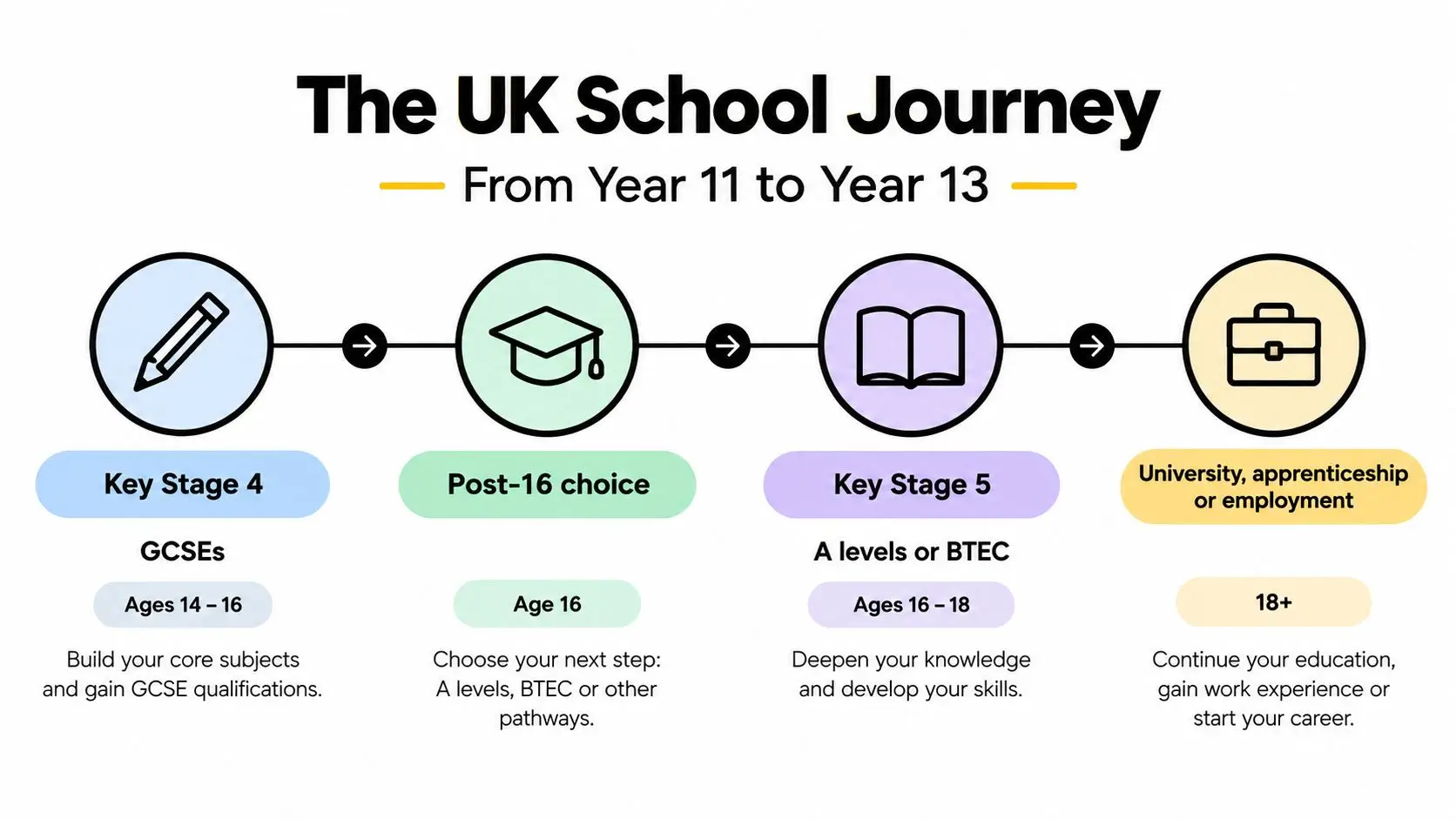
The timeline is a planning tool, not a verdict on your child. A learner who needs more time, a different environment or a practical route hasn't fallen behind. They may need only a bridge designed around them.
Pathways Available After GCSEs
At 16, a young person has more than one legitimate route. The most familiar is a school sixth form, but a separate sixth-form college, further-education college, apprenticeship or online sixth form may be a better match depending on the learner's daily reality.
A school sixth form often feels reassuring because the buildings, teachers and routines are familiar. That can help a child who values continuity. The trade-off is that the subject range may be narrower, and the environment may still feel like school when the learner is ready for more independence.
A sixth-form college usually offers a more adult setting and may provide a broader mix of A levels and applied qualifications. A further-education college can be particularly useful for vocational subjects, technical courses and practical learning. The wider choice can be liberating, although larger settings may feel overwhelming to a student who needs close pastoral contact.
An apprenticeship suits a young person who wants to learn through employment. It brings practical training and study together, but the learner must be ready for workplace expectations and a specific occupational direction. Parents comparing vocational qualifications with A levels may find this BTEC vs A level 2026 guide useful, especially when a child is unsure whether assessment through assignments or examinations suits them.
Online sixth form can provide live teaching, recorded lessons and a structured programme without a daily journey to a campus. It may suit a student whose anxiety, health, caring responsibilities, location or subject interests make a physical setting difficult. It also requires independence, reliable communication and a clear plan for social connection, safeguarding and examinations. Families considering the employment and study differences can also review apprenticeship versus A levels before deciding.
Sixth Form Pathways Compared
| Pathway | Typical Structure | Best Suited To | Key Trade-off |
|---|---|---|---|
| School sixth form | Lessons within a secondary school, often with familiar staff | Learners who value continuity and a known routine | May offer fewer subjects or less independence |
| Sixth-form college | A post-16 campus with academic and applied courses | Students ready for a more adult environment and broader choice | A larger community may feel less personal |
| Further-education college | Vocational, technical and academic programmes | Learners who prefer practical or career-linked study | Course quality and support can vary by subject and provider |
| Apprenticeship | Paid employment combined with training and study | Young people who want workplace learning | The role can narrow choices if the occupation isn't right |
| Online sixth form | Live online lessons, independent work and remote support | Learners needing flexibility, specialist subjects or reduced travel | Social contact and self-management need deliberate planning |
For a learner with SEND or SEMH needs, the label of the provider matters less than the support behind it. Ask who will coordinate reasonable adjustments, how the provider responds to distress, whether lessons can be recorded, and how the student's voice shapes reviews.
Admissions, Entry Requirements and the Application Timeline
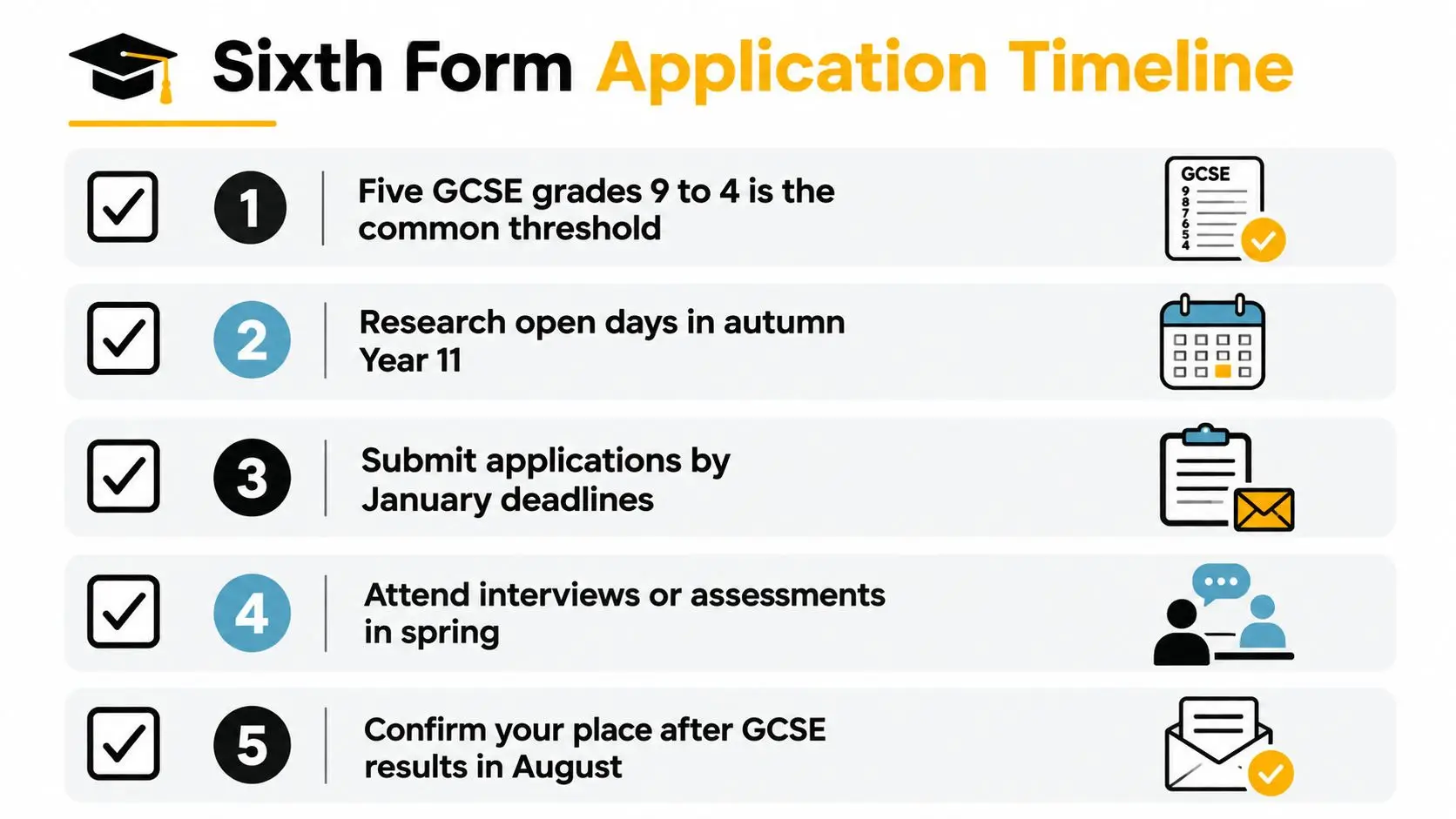
Admissions can feel mysterious because providers use similar language but not identical criteria. A common benchmark for A levels in England is at least five GCSEs at grades 9 to 4, normally including grade 6 in the subjects a student wants to study. These are typical guidance thresholds, not a universal legal admissions rule, so families should read each provider's published requirements.
Subject grades matter. A student may meet the overall five-GCSE benchmark but miss the required grade for a particular A level. That doesn't make the student incapable. It means the provider is considering whether the learner has the foundation for that specification.
Aisha's application
Aisha wants Biology, Chemistry and Psychology. Her predicted grades look suitable for one sixth form, but another asks for a higher GCSE grade in Biology and Chemistry. A third provider accepts the overall threshold but recommends a different combination because it doesn't run Psychology.
Aisha should apply to providers with different criteria rather than assuming one result will decide everything. She and her parents should ask whether predicted grades are used, whether interviews or assessments form part of the process, and what happens if the final results differ from the predictions.
The usual rhythm is straightforward:
- Autumn of Year 11: Visit open evenings, read subject requirements and speak with teachers.
- Application period: Submit forms by each provider's deadline, often during Year 11.
- Spring: Attend an interview, information session or assessment if required.
- After an offer: Check the conditions, subject combination and support arrangements.
- Results day: Confirm the place, discuss changes and ask about alternatives if needed.
If Aisha misses a required grade by one mark, the conversation shouldn't end with “No”. She can ask whether the provider has discretion, whether a different subject combination is realistic, whether a foundation route exists, or whether a resit could run alongside her next programme. GCSE resits, alternative qualifications and another provider may all be worth discussing.
For interview preparation, a practical resource such as the Qcard interview confidence aid can help a nervous student rehearse answers without turning the conversation into a performance. Families can also check requirements for A levels before comparing offers.
At an open evening, ask:
- Which grades are required for each chosen subject?
- How are predicted grades and contextual circumstances considered?
- Who supports a student who is struggling emotionally or academically?
- Which exam boards and specifications are used?
- What happens if results miss the offer?
In-Person Sixth Form Versus Online Sixth Form
At seven on a winter morning, one student may be chatting happily with friends on the way to sixth form. Another may already feel exhausted before the first lesson begins. The same daily commute can be a social opportunity for one learner and a serious barrier for another, especially when disability, fatigue, anxiety or limited local provision is involved.
Official local-authority returns estimated 55,000 learners using post-16 school transport in England in 2025–26, including around 31,000 learners aged 16 to 18 entitled to SEN transport, compared with 13,000 using mainstream transport. These figures appear in the participation in education, training and employment statistics. Travel belongs in the decision alongside subjects, grades and pastoral care.
The daily experience
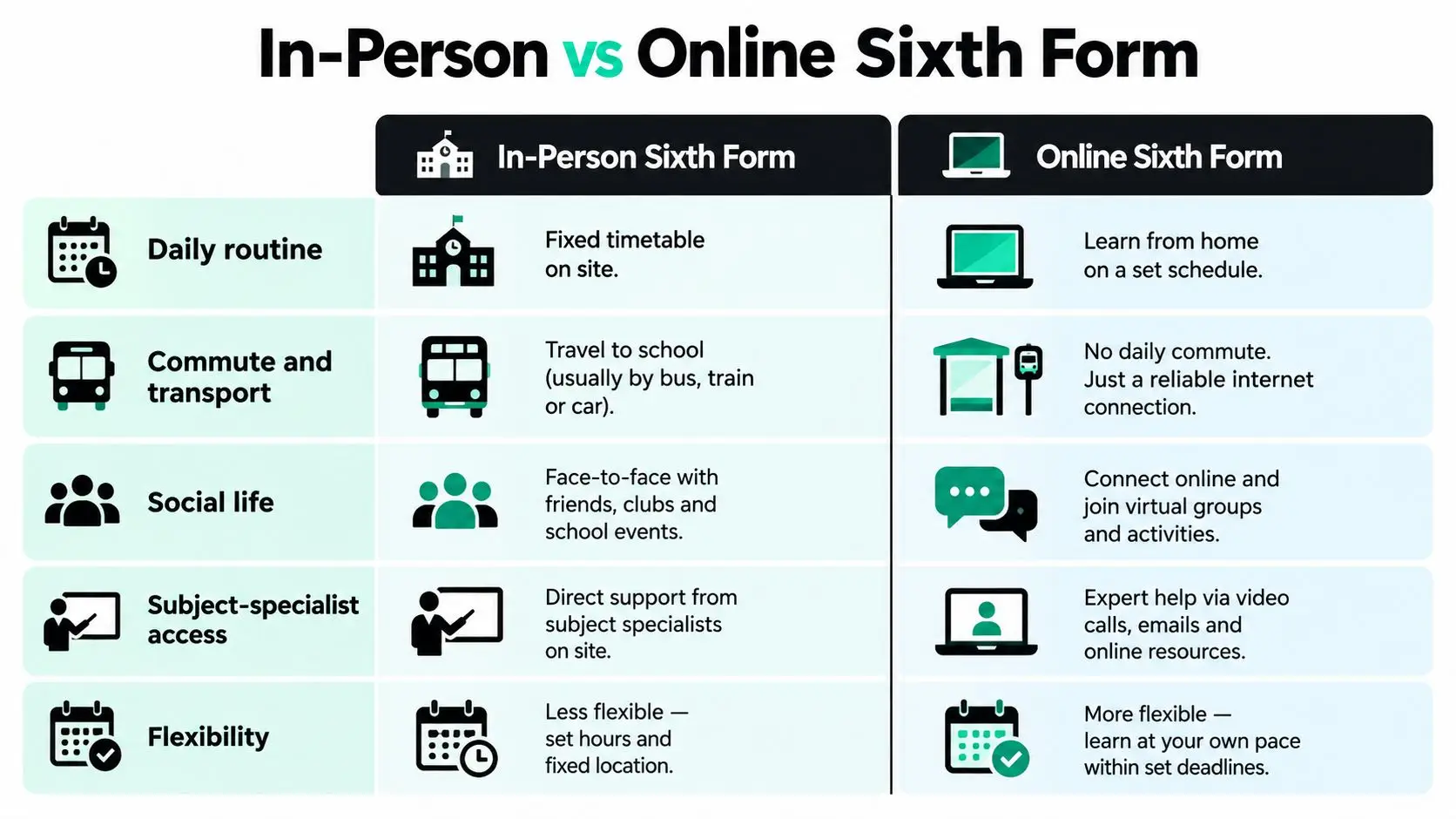
An in-person sixth form provides a fixed timetable, face-to-face teaching and regular contact with peers. Teachers may notice a puzzled expression and clarify a difficult idea before it becomes a larger problem. A student who gains energy from routine, movement and company may find the campus motivating.
Online sixth form follows a different pattern. A learner can attend live lessons from home, revisit recorded teaching during revision and avoid a stressful journey. The arrangement still requires reliable attendance, organisation, safeguarding procedures, a suitable workspace and regular communication with teachers. Flexibility changes where learning happens, not the learner's responsibility to take part.
Families weighing a fully remote route can read more about A levels online study before comparing providers and asking how each one supports their child's particular needs.
Ask what happens on an ordinary Tuesday, not only what the provider promises on its open day.
Friendship deserves specific questions. A campus offers proximity to other young people, whereas an online provider needs to create connection through clubs, group work, mentoring and planned events. A child who already feels isolated should receive a clear explanation of how they will build relationships and know whom to contact when they are struggling.
Empty places aren't the same as suitable choice
In 2024–25, 78% of schools with sixth forms had unfilled places, with 540,000 reported places and 410,000 pupils on roll, according to the same official statistics. Spare capacity does not show that a suitable course is available nearby. Subject combinations, transport, support quality and geography can still remove an apparent option.
A useful comparison starts with the learner's ordinary week:
| Question | In-person model | Online model |
|---|---|---|
| Routine | Fixed timetable on site | Live lessons from home, with planned independent study |
| Travel | Daily journey and transport arrangements | No daily campus commute |
| Social connection | Immediate peer community | Planned online community and activities |
| Specialist subjects | Dependent on local staffing | May widen access beyond local provision |
| SEND and SEMH | On-site pastoral and learning support | Remote adjustments, mentoring and recorded teaching must be explicit |
| Examinations | Usually organised through the provider | Confirm the examination centre and access arrangements |
For an online option, ask how examinations are administered, how access arrangements are agreed and who contacts the family if attendance falls. A parent should be able to tell whether flexibility means planned support or merely being left to manage alone.
From A Levels to University, Apprenticeships and Beyond
A levels are not the destination. They are evidence of what a learner has studied, how they can think and how consistently they can work. Universities may consider predicted grades during applications and final grades later, while references, personal statements and relevant activities help explain the student behind the results.
UCAS tariff points give some qualifications a common way to express achievement for higher education applications. A university may publish specific grade requirements rather than relying only on a points total, so students need to check individual course pages. Subject choice can also matter. A future engineering applicant may need particular mathematics or science preparation, while another course may welcome a broader combination.
The same principle applies to higher and degree apprenticeships. They can be competitive and often ask for strong A level or equivalent results, but they also value motivation, communication and evidence that the applicant understands the occupation. A young person who enjoys practical problem-solving may find an apprenticeship more engaging than a purely academic route.
England's 2024 A-level results provide context rather than a promise about an individual child. The Department for Education reported that results were broadly stable compared with the previous year, with the proportion of entries awarded grade A or above rising from 26.5% in 2023 to 27.6% in 2024 and the proportion achieving grade C or above increasing from 75.4% to 76.0%. The official 16 to 19 attainment statistics also recorded 23.8% of sixth-form college A-level results at grade A or above in 2024, compared with 22.9% in 2023 and 22.3% in 2019. These figures describe England, not every UK nation, and comparisons need to account for changes in grading arrangements and examination conditions.
Course planning matters too. In England's summer 2025 examination series, 313,190 students received A-level results, and students took an average of 2.60 A levels, rising to 2.66 among 18-year-olds. The official examination results update supports a practical point: a sixth-form timetable must coordinate several subjects, not treat each course as an isolated purchase.
Queen's Online School is one online example that operates as a Pearson Approved Examination Centre and offers GCSE and A-level qualifications recognised by universities worldwide. Families comparing progression support can also explore practical tools such as this AIApply tool comparison for job seekers, particularly when a student begins preparing for employment or apprenticeships.
The best progression plan matches the learner. A realistic target, strong support and steady confidence can serve a child better than a prestigious option that leaves them constantly overwhelmed.
Choosing the Right Sixth Form for Your Child
Consider three learners.
Maya is energised by people, enjoys debate and wants a busy campus. A school sixth form or sixth-form college may give her the daily interaction she needs. She should still check subject availability and whether the timetable leaves enough time for independent work.
Owen is neurodivergent and finds unpredictable corridors and long journeys exhausting. A smaller setting, predictable online timetable, recorded teaching and a named pastoral contact may be more appropriate. His parents should ask how support is reviewed and how he will maintain social connection.
Leila is a young carer and plays elite sport. Her week doesn't fit neatly around a conventional school day. A provider offering planned flexibility may help, but only if Leila receives live teaching, regular feedback and a genuine progression plan rather than being expected to study alone.
At open evenings, ask:
- How are lessons taught, and how much independent study is expected?
- What are typical class sizes and teacher contact arrangements?
- Is the provider an examination centre, or will the student travel elsewhere?
- Who provides pastoral care during a difficult week?
- How are SEND and SEMH needs assessed, supported and reviewed?
- What progression information can the provider explain clearly?
- Which costs remain after tuition, including transport, equipment and trips?
For students aged 16 to 18 in DfE-funded education in England, tuition fees generally can't be charged, and compulsory enrolment, registration or examination fees generally can't be charged either, subject to specified exceptions. Families should still ask about transport, equipment, meals, trips and bursary support through the 16 to 19 funding rules.
The best sixth form is the one that lets this child keep learning, feel safe and move forward. You don't need to make the choice without fear. You need to listen carefully, ask direct questions and choose a setting your child can realistically inhabit every day.
Queen's Online School offers live and recorded online GCSE and A-level teaching, subject-specialist support, personalised mentoring and a Pearson Approved Examination Centre for families seeking a flexible sixth-form route. Visit Queens Online School to explore whether its online model fits your child's subjects, support needs and next step.