

The conversation often starts the same way. GCSEs are nearly done, everyone is tired, and suddenly every meal turns into a debate about sixth form, college, apprenticeships, grades, university, money, and what “success” is supposed to look like.
One parent wants to keep options open. The child says they're sick of classrooms. Someone else worries that leaving the academic route means shutting doors forever. At its core, the question is: what kind of environment will help this young person stay motivated, feel capable, and build a future they can live with?
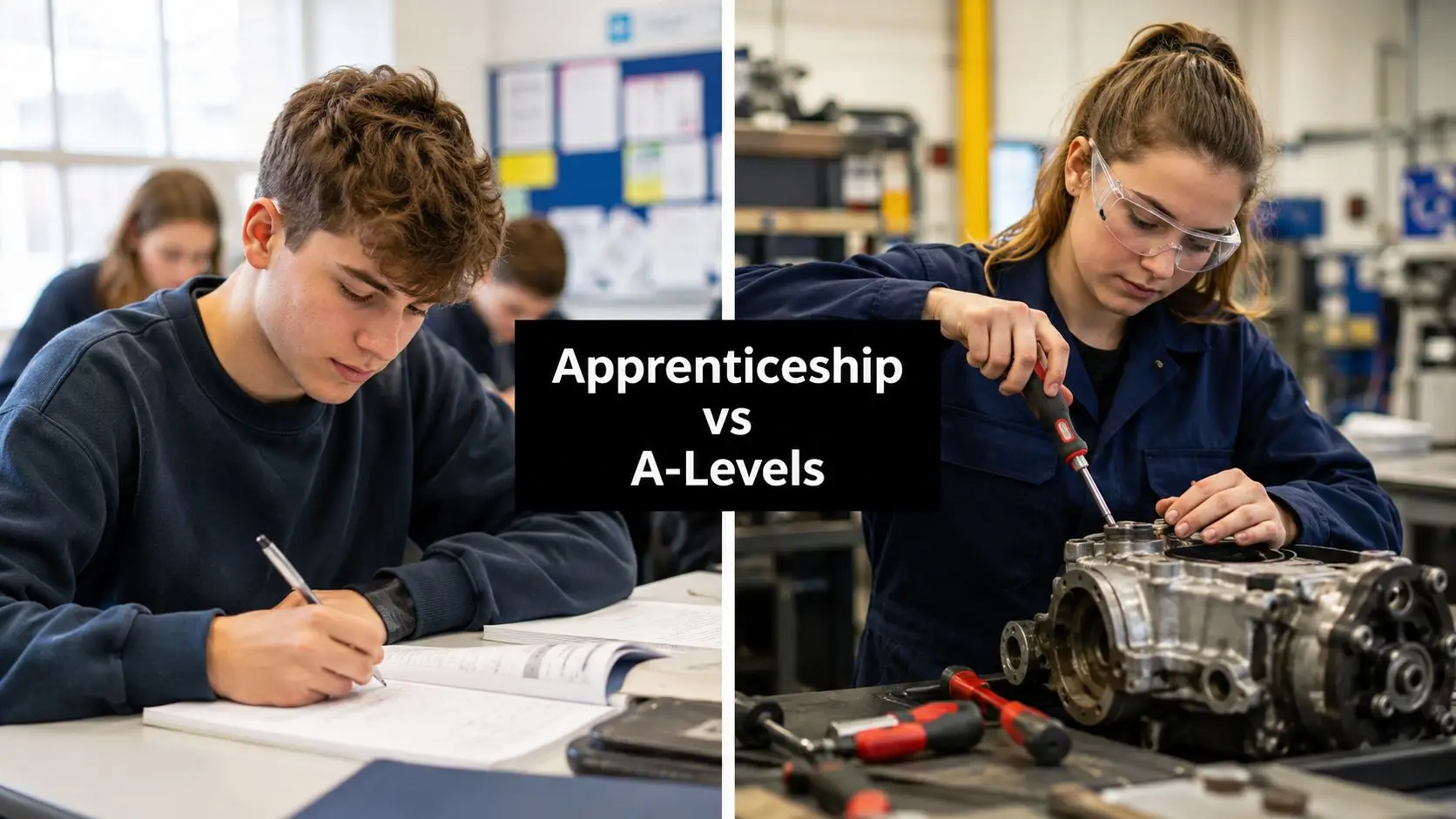
That's why the apprenticeship vs A Levels decision shouldn't be treated like a status contest. It's not about which route sounds more impressive in the abstract. It's about where your child is most likely to grow, cope, and succeed.
That Big Conversation About What Comes Next
A family I'd recognise in almost any school starts with a simple problem. Their child has done reasonably well at GCSE, likes some subjects, hates others, and has no interest in pretending to be someone they're not. The parents are trying to be supportive, but their questions come out as pressure. “Shouldn't you do A-Levels just in case?” “What if an apprenticeship is too narrow?” “What if you regret it?”
The child hears something else. “You'd better not get this wrong.”
That's the emotional reality of post-GCSE choices. It's not just paperwork and prospectuses. It's fear of closing doors, fear of disappointment, and fear that one decision at 16 will define everything. Parents feel responsible. Teenagers feel judged. Both often feel lost.
The best decisions happen when the family stops asking, “Which route is better?” and starts asking, “Which route fits this child's mind, energy, and goals?”
Take two common examples. One student loves reading around a subject, arguing a point, and working towards exams. She may grumble about revision, but she likes the structure of academic study. Another student can't bear sitting still for long, comes alive when solving practical problems, and wants work to feel real rather than delayed. Putting both children on the same path because it feels safer is a mistake.
Your child doesn't need the “best” route on paper. They need the right conditions to do well.
That matters even more for children with SEN or SEMH needs. A noisy sixth form, constant comparison, or high-stakes exam pressure can flatten one child and suit another perfectly. In the same way, a workplace-based route can give one teenager confidence and routine, while leaving another overwhelmed by early adult expectations.
If you keep your child at the centre, this decision gets clearer. Not easy. But clearer.
Understanding the Two Main Paths After GCSEs
Before anyone compares them, strip away the stereotypes. A-Levels are not automatically “better”, and apprenticeships are not automatically “less academic”. They are different systems built for different kinds of progression.
| Feature | A-Levels | Apprenticeships |
|---|---|---|
| Core model | Full-time study | Paid work plus study |
| Typical structure | 100% academic | 80% work and 20% study |
| Duration | Fixed two years | Usually 1 to 5 years |
| Main environment | Classroom and independent study | Workplace plus training provider or college |
| Qualification shape | Subject-based | Level depends on apprenticeship |
| Money | No salary for studying | Salary while training |
What A-Levels actually involve
A-Levels are a fixed two-year, 100% academic route. Students usually study three subjects in depth and spend those two years focused on lessons, assignments, reading, revision, and exams. If your child enjoys thinking thoroughly, writing analytically, and keeping broad university options open, A-Levels make sense.
If you want a plain-English breakdown of how the system works, this guide on how A-Levels work is useful for families who need the basics laid out clearly.
What an apprenticeship actually involves
An apprenticeship is a job with structured training attached. In the 2023/24 academic year, England recorded 339,600 apprenticeship starts, and the route combines work and study using an 80/20 split over 1 to 5 years, according to the House of Commons Library briefing on apprenticeships.
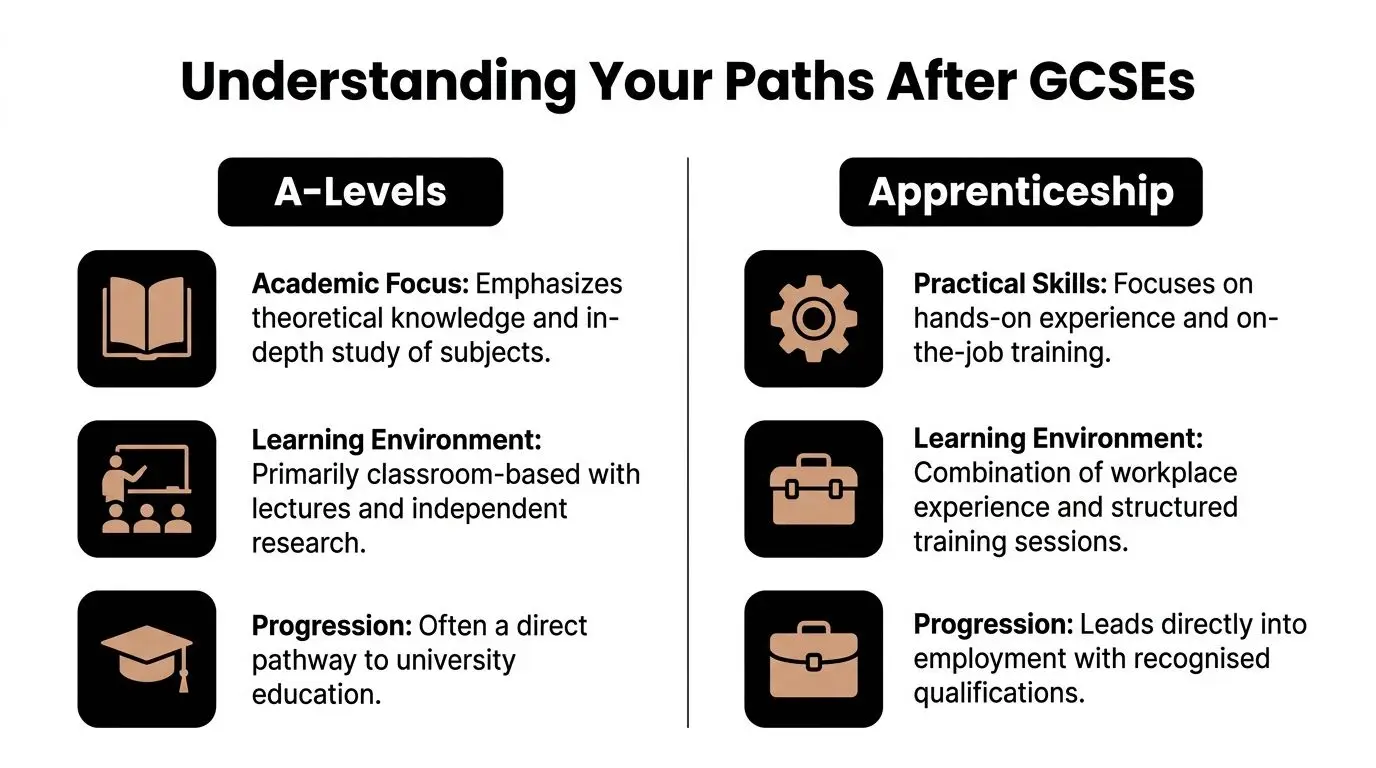
That means your child isn't sitting in education full-time in the same way. They're entering a professional setting, earning a salary, and learning in a context where the work itself teaches them.
For some teenagers, that makes a significant difference. They stop asking, “When will I ever use this?” because they're already using it.
The deeper difference
A-Levels specialise in academic depth. Apprenticeships specialise in integrated training. One says, “Learn the theory now, apply it later.” The other says, “Start applying it while you learn.”
That's why apprenticeships can be one of the strongest pathways to high-demand careers for students who want a direct line between effort and outcome.
Practical rule: If your child needs visible purpose to stay engaged, the apprenticeship model often suits them better. If they're happy to invest in delayed payoff and abstract study, A-Levels often suit them better.
Neither route is automatically easier. They ask for different strengths. A-Level students need self-discipline around revision and academic pressure. Apprentices need maturity, punctuality, and the ability to function in a real workplace much earlier.
A-Levels and Apprenticeships A Detailed Comparison
Parents usually want the same thing at this point. A clear side-by-side comparison without the fluff. Fair enough.
A-Levels vs Apprenticeships at a Glance
| Feature | A-Levels | Apprenticeships |
|---|---|---|
| Study style | Academic, subject-based | Practical, job-based |
| Day-to-day life | Lessons, homework, revision | Work tasks, training, study time |
| Assessment | Usually exams and coursework | Practical assessment, portfolio, employer-led standards |
| Entry focus | Overall GCSE profile and subject suitability | Employer criteria and functional thresholds |
| Income | No salary while studying | Earn a salary while training |
| Pace | School or sixth form rhythm | Workplace rhythm |
| Best for | Students who enjoy theory and academic progression | Students who want practical experience and early employment |
Entry requirements are not a small detail
It is a recurring issue that many families get caught out by. They assume enthusiasm, potential, or practical ability will outweigh weak English or Maths grades. Often, they won't.
A critical requirement for many major employers is a grade 4 or 5 in GCSE Maths and English for apprenticeship applicants. By contrast, A-Level entry is usually based on overall results, while a student aiming at a top university route may need grades 6 or 7 in specific subjects, as explained in this guide comparing apprenticeships, T Levels and A-Levels.
If your child has a 5 in Maths and a 3 in English, don't dismiss that as “close enough”. For many apprenticeships, it's an instant rejection.
That can feel brutal. It is brutal. But it also gives you a clear action point. If English or Maths is below the threshold, that gap needs attention now. Not after results day panic.
Daily life looks very different
A-Level students are still in an education-first environment. Their timetable revolves around teachers, deadlines, mock exams, and subject mastery. A teenager who still needs time to mature, organise themselves, and work out what they enjoy may benefit from that protected space.
Apprentices live by adult expectations much earlier. They have to turn up, behave professionally, take feedback from managers, and handle workplace norms. A teenager who hates school but rises to responsibility may flourish there.
Here's a practical example.
- Student suited to A-Levels: Loves Biology, writes strong essays in Psychology, and wants time to decide between medicine-related fields, social science, or a university course.
- Student suited to an apprenticeship: Wants to get into a business environment, learns quickly through doing, and becomes more motivated when their work has a visible purpose.
Neither child is “better”. They just need a different setting.
Cost and income change the pressure
A-Level study keeps a child in full-time education. Apprenticeships let them earn while they train. That matters in households where financial independence is emotionally important to the child, or where earning early would boost confidence and stability.
But don't let salary seduce you into the wrong decision. Some teenagers like the idea of getting paid, yet aren't ready for the discipline of employment. Others are desperate to leave school, but only because they're burnt out and need a better learning environment, not necessarily a workplace.
The question isn't whether your child wants to leave the classroom. It's whether they're ready for the demands that replace it.
Assessment style matters more than parents realise
Some students can explain brilliant ideas in discussion, but freeze in exams. Others like the clean fairness of written papers and hate being judged continuously in practical settings.
A-Levels usually reward students who can revise, retain, interpret, and perform under exam conditions. Apprenticeships tend to reward students who can apply knowledge consistently, build evidence over time, and function competently in real tasks.
If your child has SEN or SEMH needs, this difference matters. A young person with anxiety may find workplace learning grounding or overwhelming, depending on the environment. A student with attention difficulties may struggle with long written revision blocks yet thrive with practical repetition and visible outcomes.
That's why “apprenticeship vs A Levels” is never just about qualification type. It's about the daily experience of learning.
Which Learner Profile Fits Your Child Best
This is the section parents usually need most. Not because it gives a neat answer, but because it shifts attention away from reputation and back to the child in front of you.
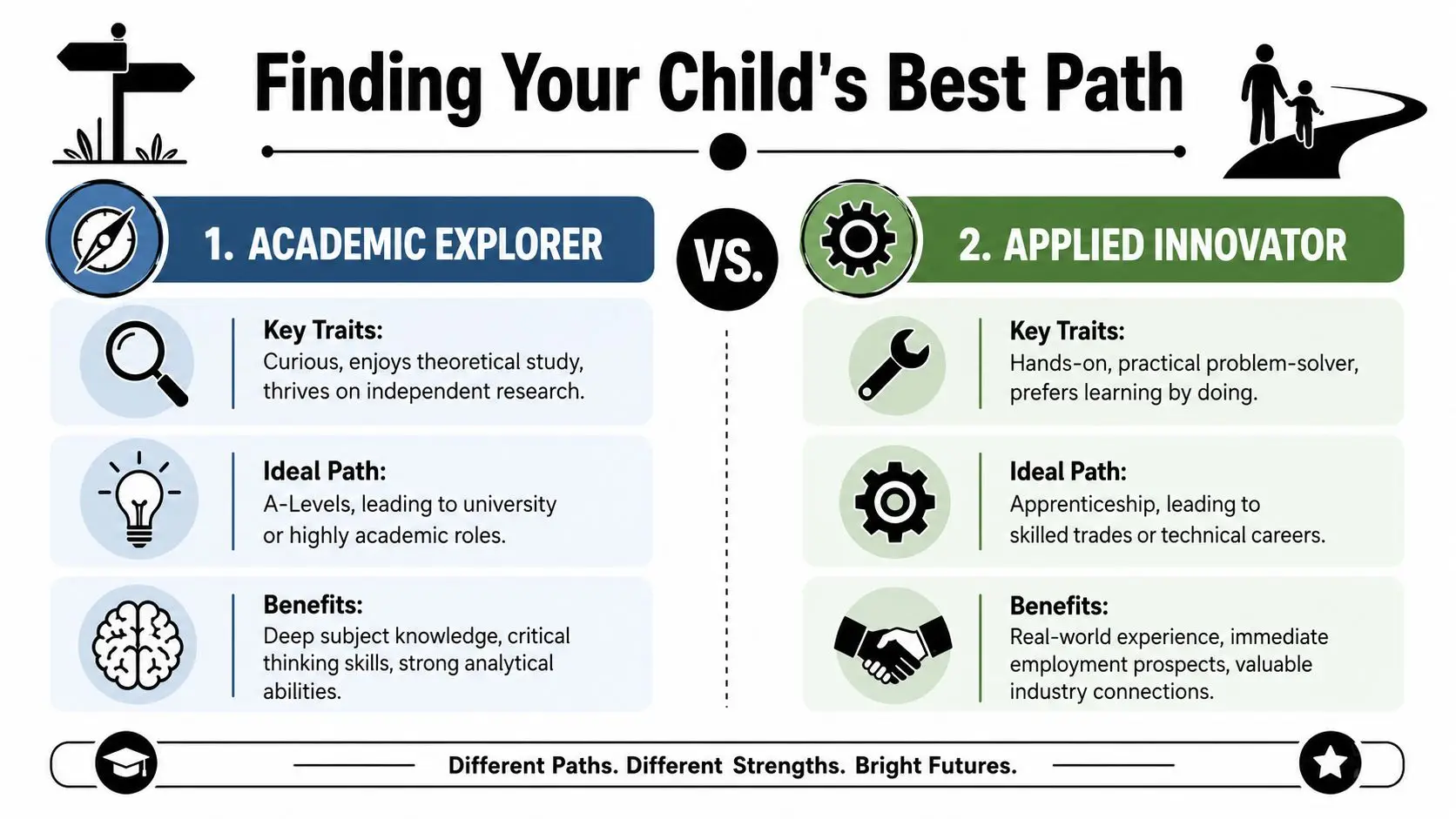
The Academic Explorer
This child is curious in an academic way. They don't just want to know the answer. They want to know why the answer works, how the theory developed, and what competing views exist.
You'll often notice things like:
- Subject loyalty: They have favourite subjects and are happy to spend time on them outside lessons.
- Tolerance for delayed payoff: They can work now for a result that comes later.
- Comfort with theory: They don't need everything to feel practical immediately.
For this child, A-Levels often fit well because the route rewards deep study and keeps more academic doors open.
The Hands-On Achiever
This child learns by doing. They may have looked restless at school, not because they lack ability, but because they need activity, relevance, and feedback grounded in real life.
You may recognise this pattern:
- Applied confidence: They understand quickly once they can see the point of a task.
- Energy through action: A desk all day drains them. Responsibility often sharpens them.
- Stronger practical memory: They retain what they've used, tested, built, or delivered.
This learner often does better in an apprenticeship because the environment gives structure with purpose. They're not waiting years to see where learning leads.
The Student Who Needs a Different Pace
Some children don't fit either stereotype neatly. They may be bright but exhausted. Capable but anxious. Interested but inconsistent. This is common with students who have SEN or SEMH needs.
For them, the wrong environment can do more damage than the wrong subject.
A key detail matters here. A-Levels are universally Level 3 qualifications, but the vast majority of apprenticeships are at Level 2, which is GCSE-equivalent rather than A-Level equivalent, as set out in the Ethnicity Facts and Figures summary drawing on Sutton Trust analysis.
That means parents must check the exact level of any apprenticeship on offer. Don't assume all apprenticeships are comparable to A-Levels. Many aren't.
If your child needs a slower, more supported route, there's no shame in choosing stability over speed. A teenager with SEMH needs may need smaller teaching groups, reduced social pressure, and a more predictable rhythm before they can thrive academically. Another may need the confidence boost of practical work and adult trust.
A structured tool like a career aptitude test for kids can help start the conversation, not as a verdict, but as a way to surface patterns your child may struggle to articulate.
A child who says “I don't know” often means “I don't know how to explain what school feels like for me.”
If that's your child, slow the process down. Ask where they've felt most capable. Ask what drains them. Ask whether they want more independence, or just less pressure. Those answers matter more than whatever route sounded best at parents' evening.
Mapping the Journey Beyond Real-World Outcomes
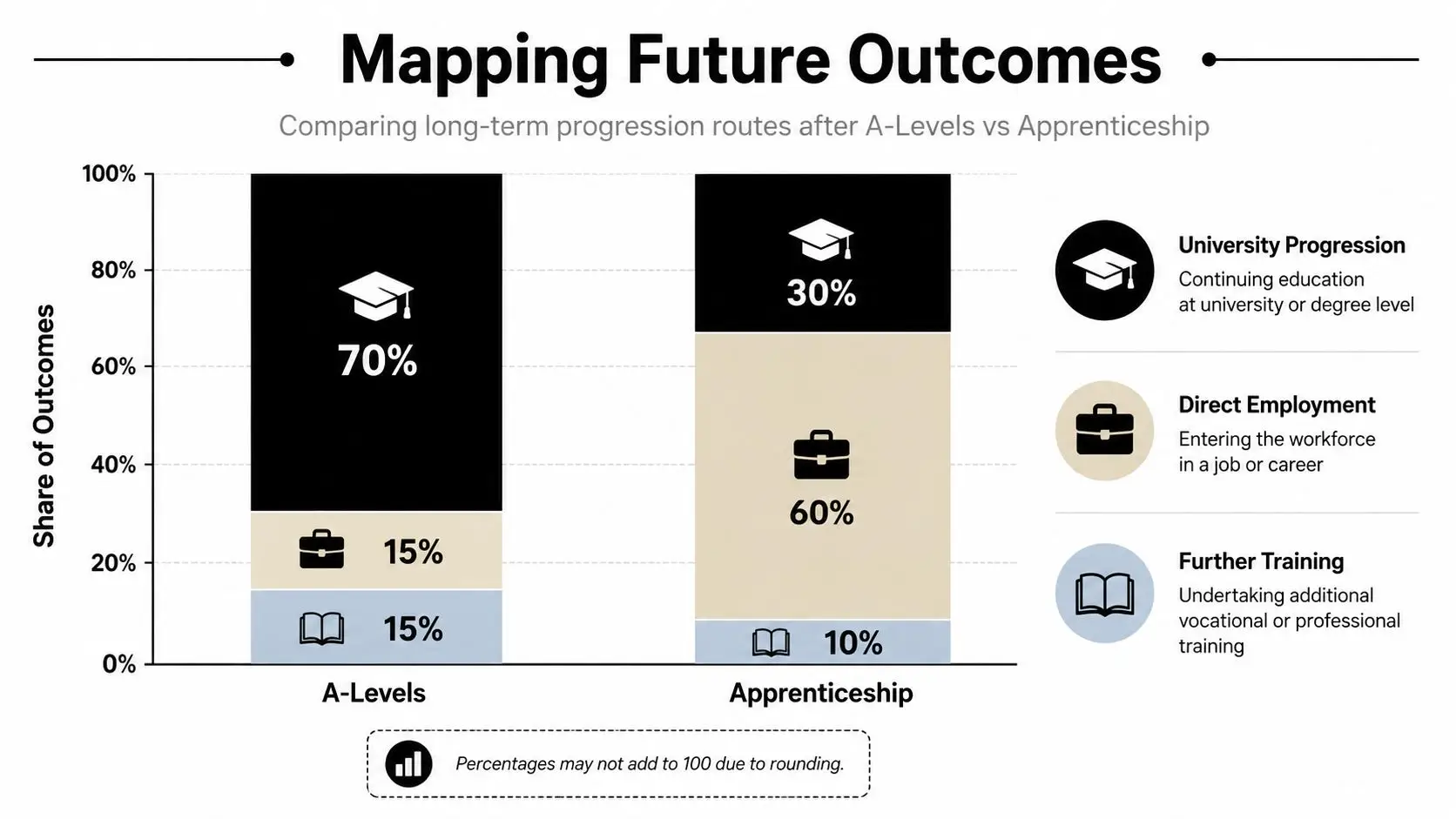
Families often focus so hard on the next two years that they forget to look beyond them. That's where myths creep in. The biggest myth is that the academic route automatically leads to better long-term outcomes.
It doesn't always.
Degree Apprenticeships deserve far more attention
Many parents still hear “apprenticeship” and picture only entry-level vocational work. That's outdated. Degree Apprenticeships sit much higher up the ladder and can offer a route into professional careers without the standard university debt pattern.
This matters if your child is capable of higher study but doesn't want a fully classroom-based route. It also matters if they want a degree outcome linked closely to employment.
If your family is also comparing routes that lead into higher education, it helps to understand the wider picture around university entry requirements in the UK, because not every university route starts from the same place.
Earnings challenge the old assumptions
The most striking fact in this whole debate is simple. Individuals with a Level 5 higher apprenticeship can average lifetime earnings of £1.5 million, which is higher than the average £1.4 million earned by graduates from non-Russell Group universities after student debt is factored in, according to Higherin's summary of the evidence.
That should make every parent pause.
Not because money is the only thing that matters. It isn't. But because too many families still assume the route with the most academic branding is automatically the safest financial bet. Sometimes it isn't.
The long game
Real-world outcomes depend on level, sector, motivation, and fit. A poor-fit A-Level route followed by a half-hearted degree is not a smart plan. A well-chosen higher apprenticeship can be.
Don't compare the label. Compare the destination, the cost, and the kind of learner your child is.
If your child wants university-style learning but hates the idea of a purely academic bridge to get there, Degree Apprenticeships deserve serious attention. If they want broad subject exploration before specialising, A-Levels may still be the stronger route.
The right question is not “Which path sounds more prestigious?” It's “Which path gives this child the strongest chance of finishing well and moving forward confidently?”
A Checklist for Making Your Family's Decision
By now, the decision should feel less abstract. Good. It needs to become practical.
Five questions to ask around the table
- Where does your child succeed? Not where you wish they'd succeed. Think about the environments where they stay calm, motivated, and engaged.
- How do they learn best? Through reading, discussion, and independent study, or through action, repetition, and hands-on feedback?
- Are they ready for workplace expectations? Wanting to leave school isn't the same as being ready for a job.
- Do they need flexibility or containment? Some teenagers need independence. Others need more structure than they're willing to admit.
- What happens if the first choice doesn't fit? A route is important, but so is the ability to review and adjust.
Public opinion has moved sharply on this issue. YouGov and The Times polling found that 45% of Britons believe apprenticeships prepare young people better for the future than university, while only 4% favour degrees, according to the Sutton Trust report Levels of Success. That doesn't mean every child should choose an apprenticeship. It means families are right to question old assumptions.
Support matters as much as the route

If your child is leaning towards A-Levels but struggled in a traditional school setting, don't assume the only version of A-Level study is a noisy sixth form with large classes and constant social pressure. Some students need a calmer, more personalised route.
For practical decision-making, families often benefit from independent frameworks like this guide to Professional Careers Training, especially when they need to match long-term aims with a training style that won't burn the student out.
The route matters. The fit matters more.
Frequently Asked Questions
Can my child still go to university after an apprenticeship?
Yes, in some cases. The key issue is the level and type of apprenticeship. Higher and Degree Apprenticeships can lead directly into advanced study or include degree-level learning as part of the route. Families must read the specific progression details, not assume all apprenticeships work the same way.
Are apprenticeships only for manual trades?
No. That view is badly out of date. Apprenticeships now exist across professional and technical fields. The key question isn't whether apprenticeships are “for trades”. It's whether the specific apprenticeship is at the right level and in the right sector for your child.
What if my child starts A-Levels and hates them?
Then act early. Don't waste a year trying to save face. Some students need a change of course, provider, or pathway. It's far better to switch than to grind through the wrong route and come out exhausted, underachieving, and convinced they've failed.
How competitive are Degree Apprenticeships?
They can be highly competitive because they combine strong career progression with paid training. That means your child needs solid applications, the right grades, and a realistic backup plan. Treat them as a serious target, not an easy option.
My child has SEN or SEMH needs. Which route is safer?
“Safer” depends on the child. Some young people need the predictability and academic pacing of A-Levels in a supportive environment. Others need a practical route that restores confidence through real work. Focus on stress triggers, independence level, social tolerance, and how your child responds to pressure.
Should we choose the route with the best reputation?
No. Reputation doesn't sit the exams, manage anxiety, or turn up to work each day. Your child does. Pick the environment where they're most likely to function well and keep going when things get hard.
If your child is leaning towards A-Levels but needs more flexibility, stronger pastoral support, or an environment that works better for SEN or SEMH needs, Queens Online School is worth a serious look. It offers live online teaching, small class sizes, specialist support, and a British curriculum designed to help students thrive academically without forcing them into a one-size-fits-all school experience.