

Year 10 is the first year of Key Stage 4, and Key Stage 4 covers Years 10 and 11 for students aged 14 to 16. For many families, that simple answer brings a second feeling with it straight away: this is the point where school starts to feel more serious, more focused, and often more emotional for a child.
If you're a parent looking at letters from school, subject lists, option choices, or talk of GCSEs and wondering what all this means in real life, you're not alone. School language can feel needlessly complicated when what you really want to know is much simpler. What key stage is Year 10, what changes now, and how can you help your child feel steady as they move into it?
As a Head of Year, I'd say this is one of the most important transitions in secondary school. Not because your child suddenly needs to become a different person, but because Year 10 asks them to grow into new habits. They're expected to carry more responsibility, work more independently, and start thinking seriously about qualifications that will shape what comes next.
That can sound heavy. It can also be manageable, with the right support.
Your Child Is Entering Year 10 What Does It Mean
The clearest answer is this. Year 10 is the start of Key Stage 4, often shortened to KS4. In the British system, this is the phase where students move into GCSE study and begin the formal preparation for national public exams.
Parents often get confused because schools use several labels at once. You may hear Year 10, KS4, GCSE course, options, core subjects, mock exams, and coursework, sometimes all in the same conversation. Underneath that jargon, the change is straightforward. Your child is moving from the broader learning of lower secondary school into a more qualification-focused stage.
According to GEMS Education's explanation of the British curriculum, Key Stage 4 covers ages 14 to 16, specifically Years 10 and 11, and is dedicated to the GCSE framework. That matters because Year 10 isn't just another school year. It's the point where the work your child does starts linking directly to the qualifications they'll complete by the end of Year 11.
What this usually feels like for a child
For many children, the first signs are practical. Their timetable becomes more fixed around chosen subjects. Teachers start talking more often about exam technique, not just understanding a topic. Homework may feel less like “finish this sheet” and more like “revise this content” or “complete this piece carefully because it connects to assessed work”.
Emotionally, it can be a mixed moment.
- Pride: your child may feel more grown up because they've chosen subjects that reflect their interests.
- Pressure: they may suddenly realise these choices feel connected to their future.
- Uncertainty: they may still be only 14, trying to juggle school, friendships, confidence, and big expectations all at once.
Starting Year 10 doesn't mean a child should already have everything figured out. It means they're beginning a stage where guidance matters more, not less.
If your child seems excited one day and overwhelmed the next, that's normal. They're stepping into a part of school that carries more weight, but they don't need to carry it alone.
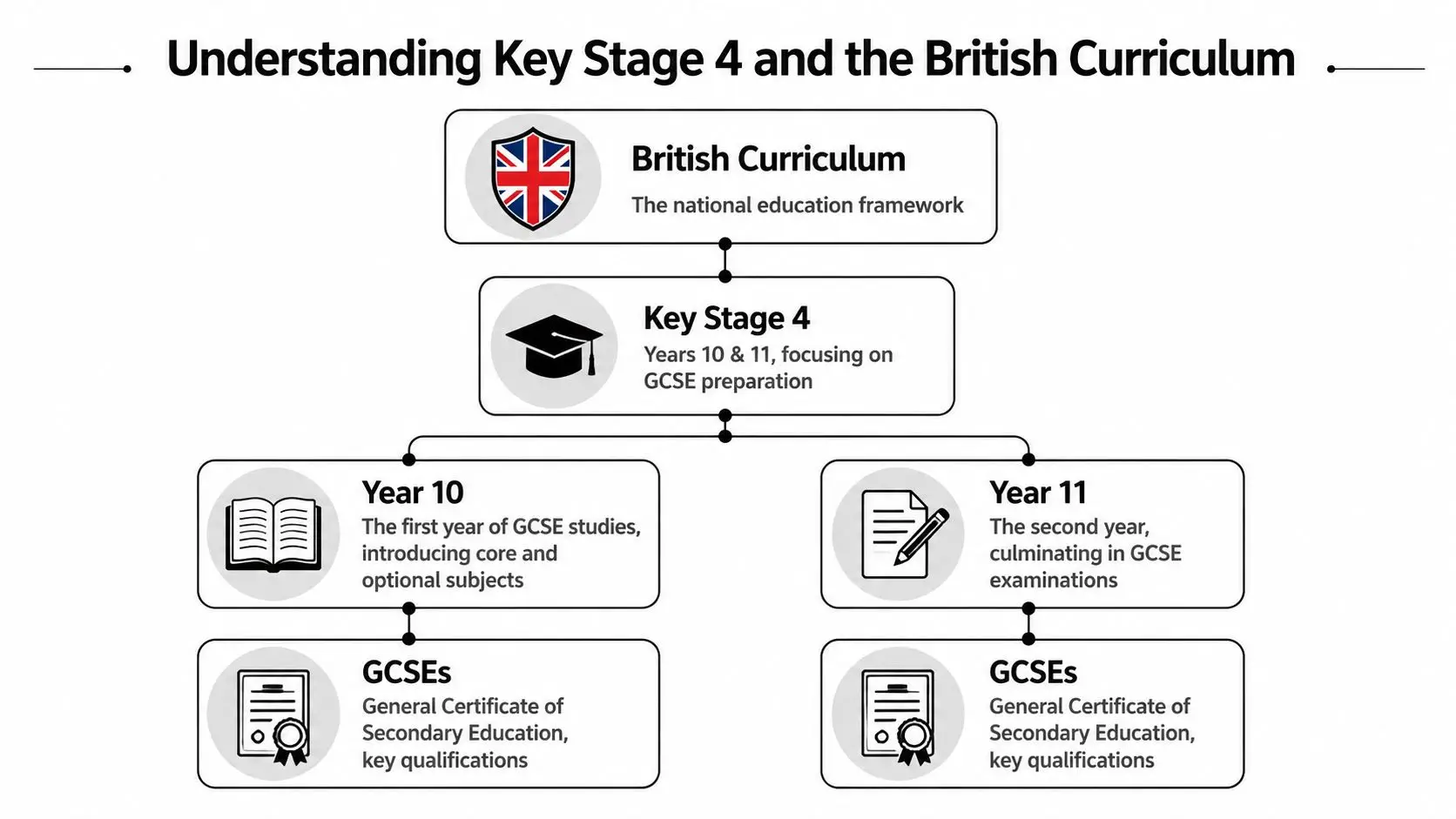
Understanding Key Stage 4 and the British Curriculum
A parent often notices the shift before they know the label for it. Your child comes home talking about option subjects, teachers mention GCSE courses, and school suddenly feels more serious. The name for that shift is Key Stage 4.
Where Key Stage 4 fits
The British curriculum works in stages, a bit like building a house room by room. Earlier stages lay the foundations. Key Stage 4 uses those foundations for work that leads to recognised qualifications.
Your child has spent Key Stage 3 building breadth. They study a wide range of subjects, practise different skills, and begin to spot strengths and interests. If you want to compare those earlier years with what comes next, this guide to Key Stage 3 gives helpful context.
At Key Stage 4, the purpose changes. School still supports your child's general development, but the curriculum is now organised around GCSE study and the knowledge, coursework, and exam preparation that come with it. After Year 11, many pupils move on to sixth form, college, apprenticeships, or other post-16 routes.
What the British curriculum means at this stage
For parents, the phrase "British curriculum" can sound more formal than it needs to. In practical terms, it means there is a national structure for what children study and when these stages usually happen.
At Key Stage 4, pupils study a combination of core subjects and chosen options. English, Maths, and Science remain central. Alongside them, children usually continue with a selection of other subjects that match their interests, school offer, and future plans.
That matters because Year 10 is no longer a broad sampling year. It is the start of a more focused route.
Why this stage can feel so significant
Children often feel two things at once in Key Stage 4. They may enjoy studying subjects they have chosen, and they may also feel the weight of those choices. That mix is very common.
GCSEs matter because they shape the routes available after Year 11. They can influence sixth form courses, college options, and later career plans. For a 14-year-old, that can feel like being asked to look a long way ahead while still managing ordinary teenage life.
This is also why some families begin to consider whether the setting suits the child as well as the curriculum does. A busy classroom works well for some pupils. Others need quieter routines, more flexible pacing, or extra support with confidence and organisation. In those cases, an alternative learning environment such as online schooling can make Key Stage 4 feel more manageable without lowering expectations.
A simple way to remember it
| Stage | School years | Main focus |
|---|---|---|
| Key Stage 3 | Years 7 to 9 | Broad subject learning |
| Key Stage 4 | Years 10 to 11 | GCSE courses and qualifications |
| Post-16 study | After Year 11 | A-Levels, vocational courses, apprenticeships, or other next steps |
So, what key stage is Year 10? It is Key Stage 4, the point where school begins to connect more directly to qualifications, confidence, and the choices your child will have later on.
What to Expect in Year 10 The First GCSE Year
Your child comes home in September and says, “It still feels like school, but harder.” Parents often hear some version of that in Year 10. The building is the same, the timetable still has lessons and homework, yet the experience shifts. Year 10 is the point where school starts to feel less like a general routine and more like preparation for real qualifications.
As noted earlier, Key Stage 4 includes core subjects such as English, Maths and Science, alongside other planned parts of the curriculum and the option subjects your child has chosen. In practical terms, that means the week becomes more focused. Your child is no longer moving lightly across a wide range of topics. They are building knowledge in courses that lead to GCSE grades.
That shift can feel a little like moving from practice matches to league fixtures. There is still time to improve, make mistakes, and grow in confidence, but the work now carries more weight and clearer direction.
What changes in the classroom
A typical Year 10 day may still include English in the morning, Science before lunch, and subjects such as History, Art, Spanish, or Design Technology later on. What changes most is the level of independence expected.
Teachers often begin to ask students to do more than complete the task in front of them. They may need to keep organised notes, remember deadlines across several subjects, and understand how marks are awarded. A child can know a topic reasonably well and still be disappointed by a result because GCSE questions reward specific kinds of answers.
You might hear comments like, “I revised, but I didn't write it the right way.” That is a very Year 10 problem. Students are learning the subject itself, but they are also learning the rules of the exam.
Some common changes include:
- Earlier revision habits: teachers may suggest flashcards, knowledge organisers, or short weekly review sessions long before Year 11
- More purposeful homework: tasks often focus on exam-style responses, extended writing, or applying knowledge rather than simple recall
- More formal assessment: class tests may start to resemble mock papers, with mark schemes and timed questions
- Greater responsibility: students are expected to keep track of equipment, deadlines, and missed work more independently
If your child finds this harder than Year 9, that does not automatically mean they are slipping. Very often, it means the style of learning has changed and they are still adjusting to it.
Coursework, option subjects and the pressure of keeping up
Year 10 also brings a practical challenge that families sometimes underestimate. Progress is no longer measured only by end-of-topic tests. In some subjects, students may need to complete coursework, controlled tasks, performances, practical work, or portfolio pieces during the course.
That matters because pressure in Year 10 is rarely caused by one big event. It usually comes from several small demands arriving at once. A science test, a draft in English, an art piece to finish, a PE assessment, a maths homework deadline. For a child who is still developing organisation skills, that can feel like trying to carry too many books at the same time.
The subjects chosen earlier now become part of everyday life too. A student who was excited to pick Geography or French in Year 9 may have days when the choice feels heavy. That is normal. Teenagers often enjoy a subject one week and doubt themselves in it the next.
A steady weekly routine helps because it reduces decision-making when your child is already tired. A simple pattern might look like this:
| Part of the week | What it may involve |
|---|---|
| School days | Lessons, homework, class assessments |
| One quiet evening | Reviewing notes from the week |
| Weekend slot | Light revision or catching up on coursework |
| Regular downtime | Sport, hobbies, family time, rest |
Children do not need every evening to become a revision session. They usually do better with a rhythm they can keep going for months.
If mock exams are already being mentioned and you're unsure what they involve, this parent's guide to mock GCSE exams can help you understand the purpose behind them.
Some children settle into Year 10 quickly. Others need more careful support because the pressure shows up as procrastination, irritability, headaches, or worries about getting things wrong. If anxiety is starting to shape your child's school experience, this parent's guide for anxious teens offers useful ways to respond calmly and constructively.
For some families, this is also the stage when they begin to ask a wider question. Is the curriculum the problem, or is the learning environment making it harder than it needs to be? A busy school day suits many pupils. Others cope better with more flexibility, quieter study conditions, or teaching that can be paced around how they learn. Online schooling can be a good fit in Year 10 for children who need that kind of personalized support while still working towards the same GCSE goals.
A short video can also help make the shift to GCSE study feel more concrete:
What helps most in Year 10 is not constant pressure. It is a clear routine, steady encouragement, and a learning setup that gives your child room to grow in confidence as the GCSE journey begins.
Supporting Your Child Through the Pressures of Year 10
Year 10 can stir up feelings that children don't always know how to name. A child who used to seem relaxed may become snappy over homework. Another may insist they're fine while inwardly worrying that everyone else is coping better.
That emotional shift makes sense. Schools in England's explanation of key stages notes that for a 14-year-old child, this transition is emotionally significant because the curriculum narrows and the child has to take on a higher level of personal responsibility for their academic future. It also highlights that reassurance matters because KS4 is dedicated to preparing for external examinations.
What reassurance looks like at home
Reassurance doesn't mean telling your child that exams don't matter. They do matter. But children cope better when they feel that their worth at home isn't tied to every mark.
Try the difference between these two conversations:
- “You need to do better in Science or you'll limit your future.”
- “Science feels tougher right now. Let's work out what's making it hard and what support would help.”
The second approach still takes school seriously. It primarily keeps the child at the centre.
Children rarely need constant reminders that Year 10 is important. They usually know. What they need is the sense that an adult is steady beside them.
Practical support that lowers tension
Parents often ask what helps. The basics matter more than complicated strategies.
- A regular study space: it doesn't need to be perfect. A clear desk, charger, notebook, and quiet time can make revision feel less chaotic.
- Predictable routines: one planned homework slot after school often works better than repeated arguments all evening.
- Permission to pause: breaks, exercise, hobbies, and sleep are part of successful study, not distractions from it.
- Gentle check-ins: ask, “What's on this week?” or “Which subject feels heaviest?” rather than “Have you done everything?”
If your child shows signs of anxiety, a practical outside resource can help you find the right words. This parent's guide for anxious teens offers useful ways to support a teenager without increasing pressure.
When a child needs more than encouragement
Some children need more structured support. That may be because they're losing confidence, feeling stuck socially, struggling with organisation, or becoming overwhelmed by the pressure of subject choices and exam preparation.
Watch for patterns rather than one bad evening. If a child regularly avoids homework, becomes distressed before school, or speaks about themselves harshly, it's worth talking with school staff early. Early support is often calmer and more effective than waiting for things to build.
A good question to keep returning to is this. “What does my child need to feel safe, capable, and supported enough to learn?” That question usually leads parents in the right direction.
How Online Schooling Can Transform the Year 10 Experience
For some children, the challenge of Year 10 isn't the curriculum itself. It's the environment in which they're trying to manage it. A busy classroom, social pressure, sensory overload, missed explanations, or fear of asking for help can turn a demanding year into an exhausting one.
That's why some families look at online schooling during Key Stage 4. Not as an easy route, but as a different structure that may suit the child better.

The national curriculum guidance makes an important point about children with SEN or SEMH needs. It notes that the narrowing of subjects can be overwhelming and highlights the value of continuous, real-time feedback and small class sizes in preventing a child from feeling isolated or anxious about their future. That idea applies far beyond formal labels. Many children cope better when teaching is more personal and less crowded.
What online learning can solve in real life
Consider a child who understands the work but hates speaking in a large classroom. In a live online lesson, that child may be able to use chat, message a teacher, or ask a question without the social intensity of putting a hand up in front of everyone. That doesn't remove challenge. It removes one barrier.
Another child may need to replay part of a lesson because they lost focus or felt flustered. In an online model with recorded sessions, they can revisit the explanation later and fill the gap before it becomes a larger problem.
Useful technology can support that independence too. If your child is moving towards digital note-taking, this guide to compare iPads for note-taking can help families think through practical setup choices.
When flexibility becomes a form of support
A strong online programme gives a child structure, but with more room to breathe. That might mean a quieter learning space, easier access to lesson materials, or a timetable that reduces the friction of travel and school-based stress.
One example is Queen's Online School's virtual learning environment, where families can access a British curriculum online with live teaching and lesson materials in one place. For a Year 10 student, that sort of setup can support organisation as much as academics.
Some children don't need less ambition in Year 10. They need a setting where they can meet that ambition without feeling constantly overwhelmed.
Online schooling won't be right for every child. Some thrive in the buzz of a physical school. But for a child who is anxious, distracted by a difficult school environment, or in need of a more individualized pace, it can turn Year 10 from something they dread into something they can manage with growing confidence.
Your Partner in Your Child's GCSE Journey
Year 10 is Key Stage 4, and that means your child is beginning the first year of their GCSE journey. It's a serious step, but it doesn't have to be a frightening one. With calm guidance, practical routines, and the right learning environment, most children grow into this stage far more steadily than parents first fear.
The key is to keep looking beyond labels. GCSEs matter, but your child's confidence, wellbeing, and sense of belonging matter too. A child who feels supported is better placed to learn, recover from setbacks, and keep moving forward.
If your family is considering a more personalised route through KS4, it helps to explore options early and ask one simple question. Where will my child be most ready to learn, ask for help, and build momentum for the future?
Queen's Online School offers families a way to study the British curriculum online through Key Stage 4, with live lessons, subject specialist teaching, and a structure designed to support different learning needs. If you're exploring a calmer, more flexible path for Year 10 and beyond, you can learn more at Queens Online School.