

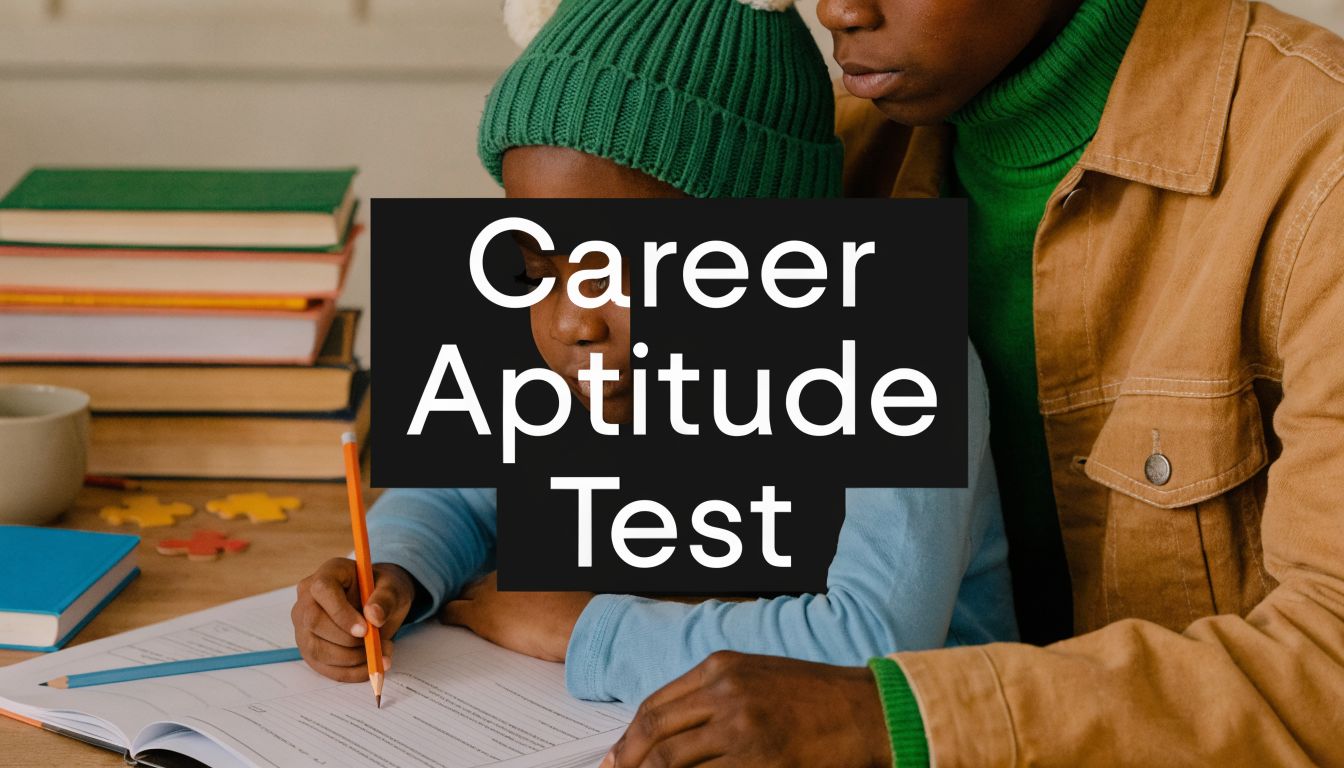
You may be there right now. Your child is building elaborate worlds in Minecraft, noticing tiny details in stories, taking apart gadgets, calming upset friends, or asking questions that seem far older than their years. You watch them and wonder what all this might mean for their future.
That question carries a lot of emotion. Pride, hope, curiosity, and sometimes worry. You want to support what makes your child unique, but you don't want to push them into a box or make them feel that one test has to decide the rest of their life.
A career aptitude test for kids can help, if you use it in the right spirit. Not as a verdict. Not as a label. As a starting point for understanding your child more completely.
Guiding Your Child's Future A Primer for Parents
A parent once told me, “My son can spend an hour designing a cardboard bridge, but he melts down if I ask him what he wants to be when he grows up.” That’s more common than many families realise. Children often show us their strengths long before they can explain them.

Aptitude discovery works best when it begins with observation. The child who organises every group game may be showing planning and leadership. The child who remembers how things fit together may be showing spatial reasoning. The child who writes pages of dialogue may be showing verbal strength and imagination.
That doesn't mean you need to name a career at age nine or twelve. It means you can begin noticing patterns.
What parents often worry about
Many caring parents carry one of these fears:
- Choosing too early: “If we do a test now, will my child feel trapped?”
- Missing a hidden strength: “What if they're capable of something we haven't noticed?”
- Getting it wrong: “What if the result doesn't sound like my child at all?”
- Adding pressure: “I want to help, not make them anxious.”
All of those concerns are reasonable. A good process reduces pressure rather than increasing it.
A child doesn't need a perfect plan. They need language for their strengths, room to grow, and adults who listen carefully.
Why this matters in real life
In the UK, statutory guidance introduced in 2013 requires impartial careers guidance for pupils aged 11 to 18, and primary programmes such as Primary Futures, launched in 2016, have reached 1.2 million pupils using simplified aptitude quizzes to spark early awareness, according to this overview of aptitude testing in UK education. That tells us something important. Schools increasingly recognise that children benefit when adults help them connect learning, strengths, and future pathways early.
For parents, the primary value isn't just future planning. It's emotional. When a child feels seen, they become more open. They begin to say things like, “I think I'm good at this,” or “I like solving problems this way,” instead of “I'm just bad at school.”
That's where useful guidance begins.
Understanding What Aptitude Tests Really Measure
Parents often hear the word aptitude and assume it means intelligence, exam success, or a fixed destiny. It doesn't. Aptitude is better understood as a child's natural potential to learn or perform well in certain kinds of tasks.
Consider the analogy of ingredients in a kitchen. Aptitudes are the raw ingredients you start with. Skills are what you learn to cook. Interests are the dishes your child wants to try this week. Personality shapes how they like to work in the kitchen at all.

Aptitude, interest, skill, and personality
These four ideas get mixed up constantly, so it helps to separate them clearly.
| Term | What it means | Everyday example |
|---|---|---|
| Aptitude | Natural potential | Your child quickly spots visual patterns |
| Skill | Learned ability | Your child improves at coding after practice |
| Interest | What currently draws attention | Your child is obsessed with animals this month |
| Personality | Preferred way of working and responding | Your child loves teamwork or prefers quiet independence |
A child might have strong numerical aptitude and still dislike maths homework because the teaching style doesn't suit them. Another child may love drama but also have a quiet aptitude for analysis that appears in puzzles or strategy games.
That's why no single result should be taken at face value without context.
What a test can and can't tell you
A useful career aptitude test for kids can show patterns such as:
- Reasoning strengths: verbal, numerical, logical
- Processing preferences: speed, accuracy, problem-solving style
- Spatial or practical strengths: working with shape, design, structure
- Emerging themes: where effort feels more natural
It can't tell you your child's one true career. It can't account for motivation, mental health, family circumstances, teaching quality, or how much a child may change over time.
Practical rule: Treat test results as clues to explore, not conclusions to defend.
In UK schools, the Career Ready programme uses performance-based tasks with pupils aged 11 to 14. A 2022 DfE evaluation found these assessments led to a 28% increase in pupils' self-awareness of their STEM aptitudes and a 15% higher progression rate to GCSE STEM subjects, as described in this summary of the programme's use of aptitude-based assessment. That matters because self-understanding often changes choices before grades do.
A simple way to read results
If a report says your child has high spatial reasoning, don't jump straight to one profession. Ask broader questions.
- Where do we already see this? Lego builds, map reading, art, design apps, construction toys
- What subjects might fit? Design and Technology, physics, computing, art
- What environments suit them? Hands-on, visual, practical, structured
That shift, from “What job is this?” to “What strengths does this reveal?”, helps parents stay grounded.
Choosing the Right Test for Your Child's Age and Stage
The right approach depends far more on your child's developmental stage than on any brand name. A seven-year-old doesn't need the same kind of assessment as a fifteen-year-old choosing GCSE subjects.
Primary years and early curiosity
For primary-age children, think exploration rather than evaluation. Keep it playful, short, and connected to daily life.
Good starting points include:
- Observation at home: Notice what your child returns to without prompting
- Conversation prompts: “What part did you enjoy most?” works better than “What job do you want?”
- Simple quizzes or activities: these can introduce broad themes like helping, building, creating, or organising
- Role exposure: books, visitors, hobby clubs, and real-world examples
A useful question at this age isn't “What career fits?” It's “What kinds of thinking and doing seem to energise my child?”
If you're also trying to understand how your child engages with learning, this guide to learning styles and how children take in information can help parents think more carefully about preferences without reducing a child to a single label.
Key Stage 3 and subject choices
By Key Stage 3, career guidance becomes more practical. This is often the age when children start hearing about GCSE options, and many feel they should already know what they're good at. Most don't.
Structured aptitude testing can help. It can identify broad tendencies before choices narrow.
Look for assessments that help with:
- Recognising strengths your child hasn't noticed yet
- Linking strengths to subjects rather than to a single job
- Opening options instead of closing them down
A child who scores strongly in pattern recognition and analytical tasks may want to keep maths, science, computing, or design pathways open, even if they haven't settled on a future role.
GCSE and sixth form years
For older pupils, more formal tools can be useful because decisions start to carry longer-term consequences. This is the stage where pupils may be considering A-Levels, vocational routes, university courses, or apprenticeships.
The best assessments here are those that combine several strands:
- Aptitude findings
- Interest patterns
- Academic context
- Personal reflection
Older teens also need help interpreting results realistically. A strong verbal profile may point towards law, teaching, writing, psychology, or many other paths. The point isn't to choose one instantly. It's to build a sensible shortlist and test it through subject choices, reading, work experience, and conversation.
When a child is older, the value of testing often lies less in “discovering” a future and more in reducing guesswork.
How to know if a test is right
Ask three simple questions before using any tool:
| Question | Why it matters |
|---|---|
| Is it age-appropriate? | Young children need shorter, lower-pressure formats |
| Is it clear what it measures? | Parents should know whether it covers aptitude, interest, or personality |
| Will an adult help interpret it? | Results make more sense in conversation than in isolation |
A good test meets your child where they are. It doesn't rush them into decisions they're not ready to make.
Exploring the Different Types of Career Assessments
Many parents search for a career aptitude test for kids and discover a confusing mix of quizzes, psychometric reports, school tools, and personality questionnaires. The first step is to recognise that these are not all doing the same job.
Interest inventories
Interest inventories ask, in effect, what does your child enjoy? They may include questions about favourite school tasks, hobbies, preferred projects, or topics they like reading about.
These tools can be helpful when a child feels stuck or says, “I have no idea what I like.” They widen the conversation. A pupil who enjoys debate, storytelling, and current affairs may discover a thread that points towards communication-heavy fields.
They are less helpful when used alone. Children often like what feels familiar, what they've already had access to, or what seems socially acceptable.
Aptitude assessments
Aptitude assessments ask something different. What kinds of tasks come more naturally to your child? These may include pattern-based exercises, verbal reasoning, numerical thinking, or spatial tasks.
The Morrisby Profile, a UK-specific assessment validated by the British Psychological Society, uses 12 aptitude modules for pupils aged 11 to 18. Data cited in this overview of the Morrisby Profile states that high spatial aptitude scores above the 80th percentile predict a 3.2 times greater likelihood of success in Design & Technology GCSEs. For some children, that kind of insight can explain why a practical or visual subject feels easier than a heavily written one.
If you're comparing broader forms of cognitive assessment, parents sometimes also read about the Wechsler Intelligence Scale for Children to understand how ability testing differs from career-focused aptitude profiling. That's useful context because not every cognitive test is meant for careers guidance.
Personality tools
Personality tools look at how your child tends to work. Do they prefer structure or flexibility? People or solo work? Fast-paced variety or careful routine?
These tools can help when a child says, “I could do that job, but I don't think I'd like the day-to-day life.” That's an important distinction. A career can match aptitude and still feel draining if the environment doesn't suit the person.
Choosing the right assessment tool
| Test Type | What It Measures | Best For | Example |
|---|---|---|---|
| Interest inventory | Preferences and enjoyment | Broadening ideas and starting discussion | A quiz about favourite activities and subjects |
| Aptitude test | Natural potential in specific task areas | Subject choices and identifying hidden strengths | Morrisby Profile |
| Personality test | Work style and personal preferences | Thinking about environments and fit | A questionnaire on teamwork, structure, and pace |
Parents often get the best results by combining all three perspectives. A child may enjoy art, show high spatial aptitude, and prefer quiet, focused work. That combination tells you more than any one score alone.
Turning Test Results into Meaningful Conversations
A report can help or harm, depending on what happens next. I've seen children light up because a result finally gave words to a strength they couldn't explain. I've also seen children shut down because an adult treated the report like a fixed judgement.
The conversation matters more than the score.

A better way to begin
Let's say a child expected a creative result but the test suggests strong analytical reasoning. A parent who says, “Well, maybe you're not artistic after all,” will close the door immediately.
A better response sounds like this:
“That's interesting. I hadn't noticed how strong you are at logic tasks. Do you think that shows up anywhere in real life?”
That question gives the child room to reflect instead of defend themselves.
Phrases that open conversation
These are the kinds of prompts I encourage parents to use:
- “What part of the result feels most like you?”
- “What surprised you?”
- “Where do you notice this strength outside school?”
- “Does this make any subject feel easier to understand?”
- “What would you like to explore more after seeing this?”
Notice what's missing. No pressure to choose a profession. No “See, I told you so.” No ranking one strength above another.
A short example from practice
A Year 9 pupil once came to a review meeting looking defeated. His test had highlighted practical and spatial strengths, but he thought success only counted if he was “academic” in the narrowest sense. His mum handled it beautifully.
She said, “You've always been the person who can see how things fit together before anyone else. That's a real strength. Let's think about where it could take you.”
His whole posture changed. He wasn't being corrected. He was being recognised.
That kind of response matters because early aptitude profiling isn't only about immediate choices. According to the Longitudinal Study of Young People in England, early aptitude profiling at age 14 is correlated with 28% better alignment between career choices and skills by age 19, with a reduction in the proportion of young people who become NEET, as summarised in this discussion of career quizzes for UK high schoolers. Better alignment often begins with better conversations.
What to avoid
Some common mistakes can make children feel boxed in:
- Over-interpreting one result: one profile doesn't define a whole person
- Using adult language too quickly: children connect more with examples than technical terms
- Comparing siblings: each child needs their own pathway
- Treating lower scores as weakness: they may reflect fatigue, anxiety, inexperience, or a mismatch in format
You are more than a score. Your child is too.
A useful result should leave your child feeling more understood, not more judged.
Adapting Career Guidance for Learners with SEN and SEMH
Many standard guides often fall short in this regard. They assume every child can sit through the same timed tasks, process the same language, and interpret results in the same way. Many children can't. That doesn't make their strengths any less real. It means the process must adapt.

In the UK, 1.57 million pupils have SEN, representing 16.5% of students, and many find standard aptitude tests inaccessible. Data from the Education Endowment Foundation (2024) indicates these tests can yield lower benefits for SEN pupils, highlighting the need for adapted, multi-sensory tools and teacher-led moderation, as outlined in this discussion of accessibility and career aptitude testing. For families of children with autism, ADHD, dyslexia, SEMH needs, or communication differences, this isn't a small detail. It's central.
What adaptation looks like in practice
A more inclusive approach may include:
- Shorter sessions: fatigue and overload can distort results
- Low-literacy formats: a child may reason brilliantly but struggle with dense written instructions
- Multi-sensory tasks: visual, practical, and interactive formats often reveal strengths standard tests miss
- Adult mediation: a teacher, counsellor, or parent can help clarify language and reduce anxiety
- Observation-based evidence: what the child consistently does well matters as much as formal test output
For many learners with SEN or SEMH, I trust patterns over one-off performance. If a child repeatedly shows excellent system thinking in gaming, model-building, or routine planning, that matters.
Keep the child safe first
Children with SEMH needs may interpret testing as threat rather than support. If a child is already anxious, perfectionistic, or feeling like they've “failed” in school, a poorly framed assessment can reinforce shame.
That’s why I recommend strength-based language from the beginning. Say:
- “We're trying to understand how you work best.”
- “There's no pass or fail.”
- “This helps us notice what suits you.”
Parents looking for a fuller picture of the support available in education may also find this guide to SEN support and what it can include helpful.
The fairest assessment is not always the most standardised one. It's the one that gives the child the best chance to show what they can do.
Careers guidance should fit the whole child
An inclusive process doesn't only identify strengths. It also considers sensory needs, communication style, social energy, transitions, and emotional regulation. A child may have clear aptitude for a field but need a particular kind of environment to thrive in it.
That's why adapted guidance is not “extra.” For many children, it's the only route to valuable insight.
From Aptitude to Achievement Your Child's Personalised Path Forward
Aptitude discovery is only the beginning. The deeper work is helping a child turn insight into confidence, subject choices, habits, and opportunities that fit who they are.
The most helpful approach is usually simple. Start with curiosity. Choose a tool that fits your child's age and needs. Discuss the results gently. Then watch what happens when your child gets more chances to use their strengths in real life.
What helps children move forward
Children grow when adults connect insight with action:
- Strengths need practice: a child with verbal aptitude still needs reading, speaking, and writing opportunities
- Interest needs exposure: many children don't know what they enjoy until someone broadens their world
- Confidence needs repetition: being good at something once isn't enough. Children need to feel competence again and again
For older students, families often combine aptitude insights with practical preparation, subject support, and structured study routines. If you're also looking at academic pathways and exam readiness, some parents compare options such as test prep centers that support structured study and exam preparation alongside school-based guidance.
Independent reflection matters too. As children get older, they benefit from learning how to take ownership of goals, pace, and motivation. This introduction to self-directed learning and how students build independence is a useful starting point for parents who want to nurture that habit.
The aim isn't to produce a child with a polished career plan at a young age. It's to help them know themselves well enough to make thoughtful decisions, recover from detours, and build a future that feels both realistic and hopeful.
If you're looking for a school that takes this personalised, child-centred approach seriously, Queens Online School offers a flexible British curriculum with live teaching, small classes, and individualized support from Primary through A-Level. Families often choose it because children aren't treated as numbers. They're known as individuals, with different strengths, different challenges, and different paths to success.