

You may be comparing online A-level Physics courses late at night, while your child sits nearby wondering whether they can keep up. Perhaps school has become overwhelming, or perhaps your child learns best with more flexibility and less daily pressure. You want a route that protects their wellbeing without reducing academic expectations.
The important question is not only whether lessons are recorded or whether the platform looks polished. For A-level Physics online, success depends on what happens beyond the screen: practical work, examination arrangements, regular feedback, and support that reflects the individual learner. The right choice can give your child room to grow. The wrong choice can leave a family discovering essential requirements too late.
Navigating the Choice of Online Physics
A parent might begin with a straightforward hope: fewer stressful mornings, more control over the learning environment, and a teacher who understands the child rather than treating every difficulty as a lack of effort. Then the practical questions arrive. Will my child feel isolated? Will the course be rigorous enough for university? Who will notice if motivation falls?
Those concerns are reasonable. Choosing online education isn't choosing an easier version of sixth form. It's choosing a different structure, one that must make academic expectations visible and provide human support deliberately. A child who becomes anxious in a busy classroom may concentrate better at home, while a child who struggles with organisation may need more frequent check-ins than a conventional timetable provides.

Look past the comforting surface
A recorded lesson can be paused. A difficult explanation can be revisited. Those features may reduce pressure for a learner with processing, anxiety, health, or attendance difficulties. But flexibility only helps when someone checks understanding and helps the student return to work after a difficult week.
Before enrolling, ask your child what they need to feel safe and capable. Do they want live contact with a teacher? Would they ask a question in a group, or prefer a private message? Can they manage a weekly plan independently, or do they need an adult to help break tasks into smaller steps?
A reassuring course is one where your child knows who will notice, who will respond, and what happens next.
A useful starting point is to compare the academic model, pastoral provision, and assessment arrangements of online A-level courses in the UK. The decision should leave your child feeling supported, not labelled as a problem to be managed.
Understanding A-Level Physics Online Requirements
Watching a lesson about mechanics isn't the same as completing a physics qualification. A successful programme must connect conceptual understanding, mathematical problem-solving, practical investigation, examination preparation, and reliable assessment administration.
UK A-level Physics includes a compulsory practical-skills endorsement. The entering centre must ensure that candidates have opportunities to complete the prescribed practical activities. A distance learner must register with an awarding-body-approved centre before undertaking relevant assessment work. This means a family needs clear answers to operational questions, not just a promise of engaging video content.
The laboratory question
Ask where the required practicals will happen, how many on-site days are needed, who supervises the work, and who authenticates the student's evidence. A provider should also explain how arrangements work for international or geographically remote learners. If the course page only discusses flexibility, revision resources, and exam preparation, the qualification pathway may be incomplete.
JCQ advises private candidates to confirm each centre's procedures, fees, deadlines, and access arrangements directly. Its July 2025 listing reported 190 centres accepting private candidates (JCQ guidance). The existence of online lessons, therefore, doesn't automatically mean that a learner has a complete route to assessment.
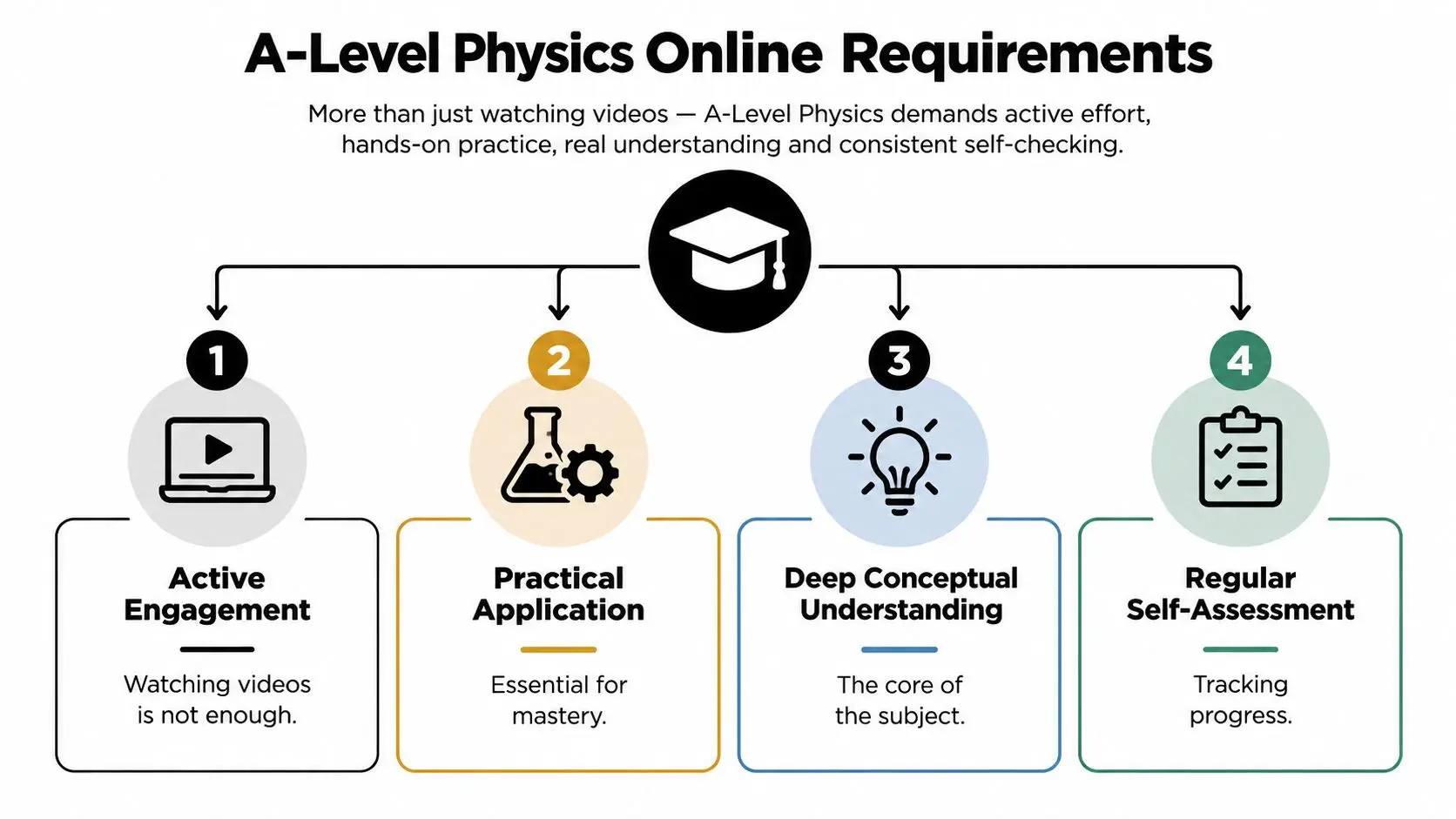
A strong online programme should make four elements work together:
- Active engagement: Your child needs to solve problems, explain reasoning, ask questions, and respond to feedback. Passive viewing won't reveal whether they can apply an idea independently.
- Practical application: Experiments connect equations to observations. If physical laboratory access is limited, the provider should explain the role of simulations and how required assessed practical work will still be arranged.
- Deep conceptual understanding: Physics becomes difficult when familiar formulas appear in unfamiliar situations. Teachers should address misconceptions, not merely mark answers right or wrong.
- Regular self-assessment: Short checks, marked assignments, and review conversations help identify gaps before they become exam-time surprises.
Inclusion needs a concrete plan
Demand for the subject remains strong. UK Physics entries increased by 4.3% in 2025, equivalent to 1,843 additional entries, according to the Association for Science Education's post-16 exam results summary. Yet a growing subject still needs an inclusive delivery model.
JCQ's 2025–26 guidance says access arrangements can apply to written examinations and non-examination assessments when they reflect the candidate's normal way of working. Applications must be completed in advance, and centres remain responsible for teaching, authenticating, and marking the candidate's work. For a learner with SEN or SEMH needs, ask how evidence of normal working will be gathered across the course, how anxiety or slower processing will be supported, and how practical participation will be supervised.
A recorded lesson may help a student replay difficult content, but it can't replace live feedback, practical planning, or a documented examination process. Read the Pearson Edexcel A-level Physics syllabus alongside the provider's support and assessment information.
Selecting the Right Online Physics Provider
Two providers may use similar words, such as flexible, interactive, and personalised, while offering very different experiences. Compare what your child will do each week and what adults will do when progress slows.
Use the matrix below during calls and open-day conversations. Ask for specific examples rather than accepting general assurances.
| Criteria | Ideal Standard | Red Flag |
|---|---|---|
| Practical endorsement | A written plan identifies facilities, supervision, authentication, and the examination centre. | The provider says practicals are “covered” without explaining where or how. |
| Teaching model | Live lessons allow questions, worked examples, and teacher feedback, with recordings used as a support. | The course relies mainly on a library of videos and automated quizzes. |
| Exam centre logistics | Registration, deadlines, fees, access arrangements, and candidate responsibilities are explained clearly. | Families are told to find an examination centre after enrolling. |
| SEN and SEMH support | Staff discuss normal-way-of-working evidence, catch-up routines, communication, and reasonable adjustments. | “Flexible learning” is presented as the entire inclusion strategy. |
| Progress monitoring | Teachers review assignments, identify misconceptions, and contact families when appropriate. | Your child receives content but little individual feedback. |
| Student belonging | Learners have structured opportunities to interact with teachers and peers. | Isolation is treated as the student's responsibility. |
Match the model to the learner
A highly independent student may value recorded material and flexible scheduling. Another child may need a predictable live timetable, small-group discussion, and a private route to ask for help. A student who has experienced school refusal may need gradual re-engagement, while a confident learner preparing for engineering may need demanding extension questions.
Parents comparing wider education options may also find a practical Aventura school guide by Style Site Optical useful as a reminder to examine the whole school experience, not just the advertised subject. The same principle applies online: safeguarding, communication, teaching quality, and assessment arrangements belong in the decision.
Ask one decisive question: “If my child misses a week because of anxiety or illness, what exactly happens when they return?”
A good answer names people, actions, and timescales. It might include a catch-up conversation, prioritised tasks, recorded lessons, and a review of whether further support is needed. A vague answer leaves the parent carrying the entire recovery plan.
Essential Equipment and Resources for Success
Online Physics needs a dependable working environment. That doesn't mean turning your home into a laboratory, but it does mean removing avoidable obstacles before the course begins.
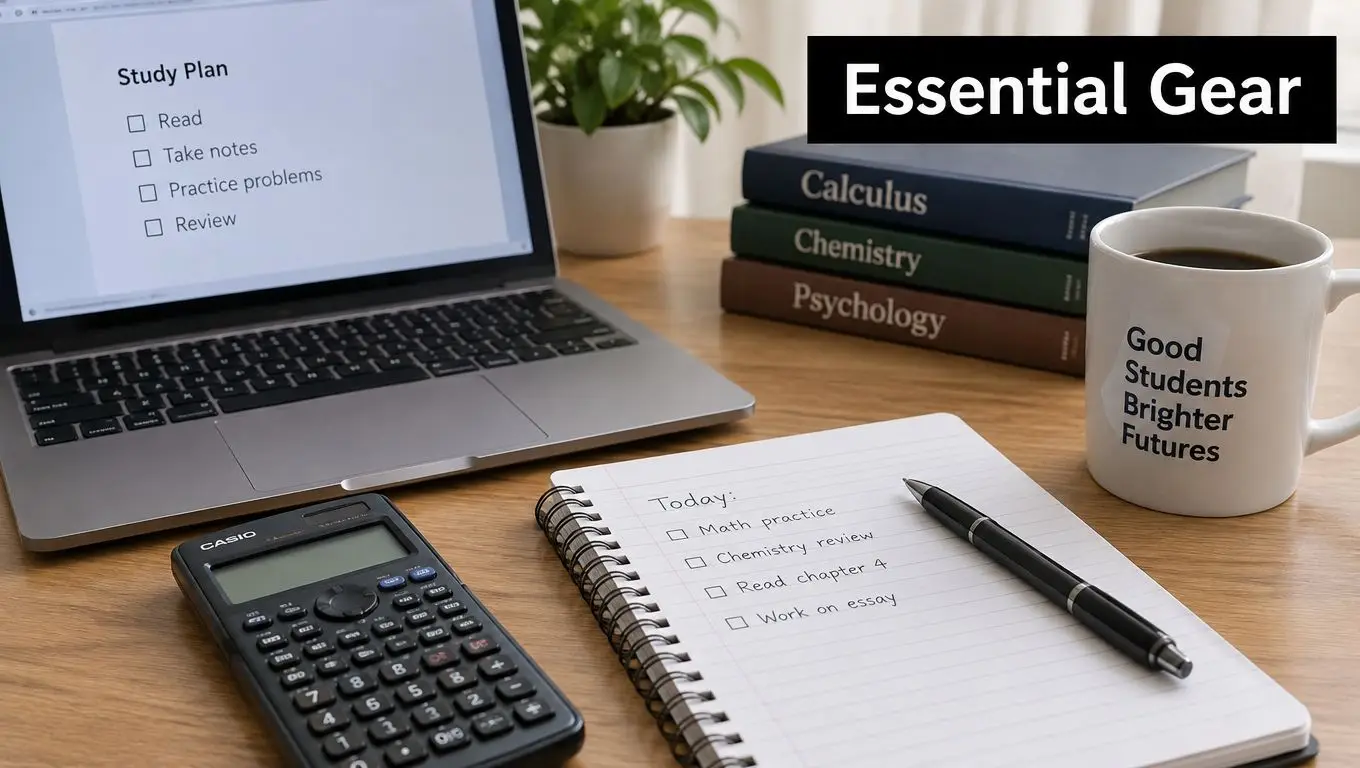
Start with the essentials:
- A reliable computer and connection: Your child needs to join live lessons, view demonstrations, upload work, and communicate with teachers without constant technical interruptions.
- A consistent study area: A quiet desk, suitable lighting, headphones if needed, and a charger can make starting work easier. For a student with sensory sensitivities, control over sound and visual distractions may matter as much as the furniture.
- A calculator and stationery: Your child should have the approved calculator required by the course and examination board, together with graph paper, a ruler, a notebook for worked solutions, and a folder for feedback.
- Course texts and revision materials: Use the specification to select resources that match the examined content. A revision guide should support teaching, not replace it.
- Simulation and data tools: Digital simulations can help students explore variables, repeat an investigation, and see relationships that are difficult to arrange at home. They shouldn't be presented as an automatic substitute for assessed laboratory work.
Make the setup emotionally manageable
A child who has struggled with school may associate equipment with failure. Build the workspace with them, keep the first routine simple, and agree where questions will be recorded. A short checklist beside the laptop can reduce the executive-function burden of remembering every step.
Tools that help tutors organise learners and communication, such as Tutorbase software, can be useful in a wider support system, although the provider's teaching and feedback process remains the central consideration. Technology should reduce friction around learning, not add another dashboard for your child to manage.
Creating a Sustainable Study Plan
Online learning works best when the week has a visible shape. Without a school corridor, bell, or teacher physically nearby, your child needs routines that make the next action obvious without making every day feel like an examination.
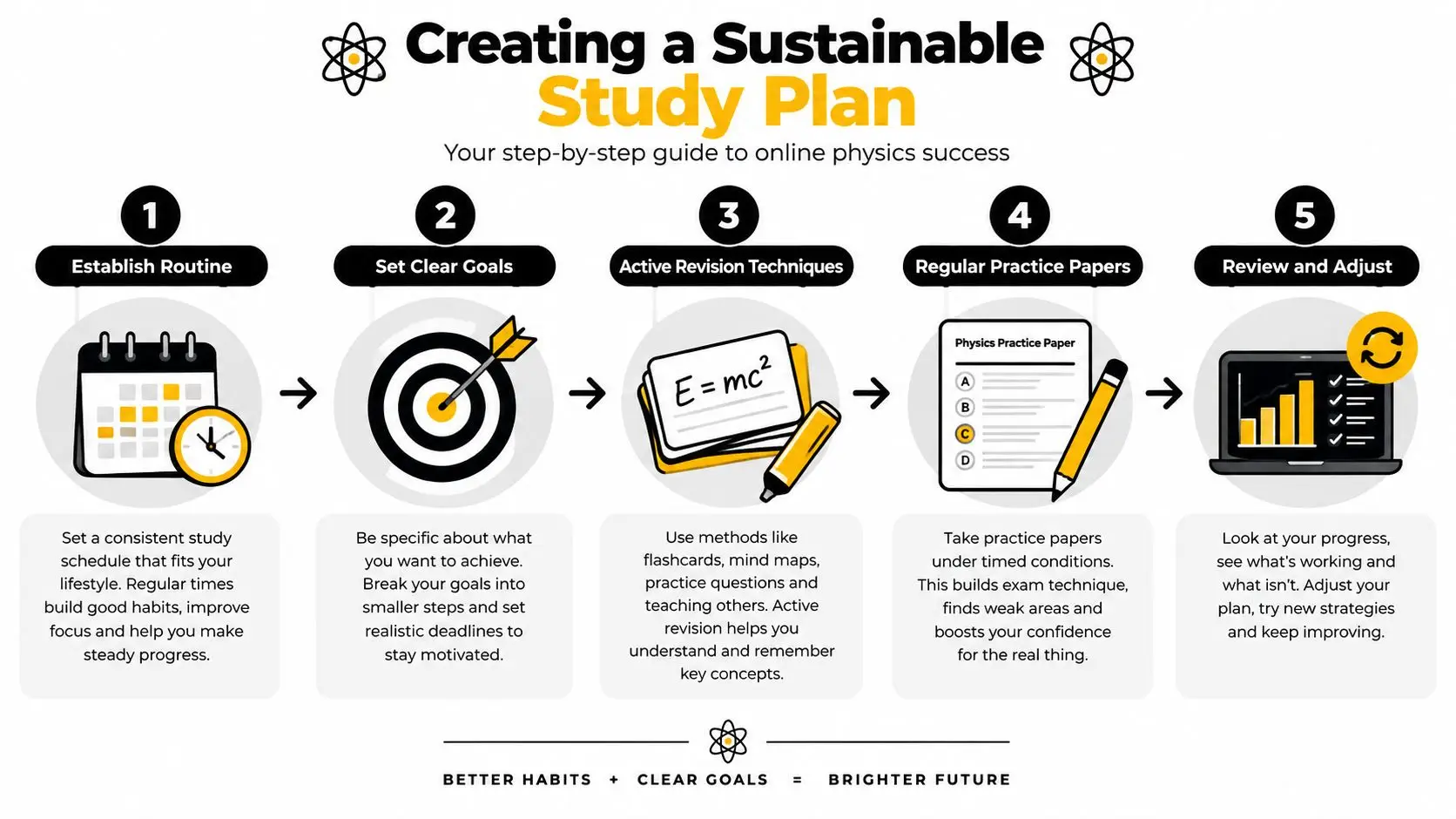
Begin with the fixed points. Put live lessons, practical sessions, appointments, and family commitments into one calendar. Then add independent work in manageable blocks, leaving space for rest and recovery. A child with SEMH needs may need a gentler start to the day, while another learner may do their strongest mathematical thinking early.
Give each study block a job
A useful weekly rhythm might contain:
- Lesson preparation: Read the learning objective and list one question before class.
- Active lesson participation: Complete examples rather than watching passively.
- Consolidation: Rework a difficult question without looking at the solution, then compare methods.
- Practical reflection: Record what was measured, what could affect the result, and how the evidence supports the conclusion.
- Exam practice: Attempt a small set of specification-aligned questions under clear conditions.
- Review: Note one secure skill, one gap, and one action for the next session.
The exact amount of study will vary by learner, timetable, health, and ambition. A sustainable plan is one your child can follow repeatedly, including after an unsettled day. Cramming may create a temporary feeling of activity, but regular retrieval and correction build more dependable understanding.
Use feedback as the adjustment point
After a marked assignment, don't move straight to the next topic. Ask your child to classify errors: Did they misunderstand the concept, choose the wrong equation, mishandle units, misread the command word, or lose marks while explaining? Each category needs a different response.
Past papers become more useful when your child studies the corrections, not just the score. If anxiety rises, reduce the immediate task while keeping the routine intact. For example, the next session might involve correcting two questions and explaining one method aloud rather than attempting a full paper.
The plan should bend around your child without disappearing when the week becomes difficult.
How Queen's Online School Supports Your Child
The structural questions matter more than polished course language. Queen's Online School, part of the Cambridge Online Education Group, presents its A-level Physics provision as a Pearson Edexcel International A-level route with externally assessed written papers, live online teaching, advanced simulations, subject-specialist support, practice feedback, and access to a dedicated learning portal.
That combination addresses several needs, but parents should still ask for the operational detail that applies to their child. Find out how practical and laboratory-skill development is supported, how examination-centre arrangements are handled, and which responsibilities sit with the family, the school, and the approved centre.
Support should be personal and visible
The school describes live, interactive classes, small class sizes, personalised learning paths, and real-time feedback. For a learner who loses confidence after an incorrect answer, timely feedback can turn a mistake into a next step. For a student who works ahead, subject-specialist guidance can help maintain challenge rather than allowing independent study to become disconnected worksheet completion.
The support model also includes one-to-one video calls and targeted provision for learners with SEN and SEMH needs. Parents should discuss how that provision would look in practice. Useful questions include how teachers identify a normal way of working, how missed learning is recovered, how staff communicate with families, and how access arrangements are documented before assessment deadlines.
A zero-tolerance anti-bullying policy and opportunities for peer interaction may also matter to a child whose previous school experience has damaged their confidence. Flexibility is valuable, but belonging still needs deliberate cultivation.
Families can review the subject information for Queen's Online School A-level Physics and then arrange a conversation focused on their child's profile. Bring specific examples, such as difficulty with timed writing, sensory overload during practical work, or anxiety about asking questions. Clear information allows both sides to judge whether the provision is suitable.
Empowering Your Child's Physics Journey
The best online Physics decision starts with your child, not the platform. A polished interface may help, but it won't answer whether the practical endorsement is planned, whether an approved examination centre is involved, or whether a student with SEN or SEMH needs will receive structured support.
Look for a complete pathway. Your child should know how lessons, independent study, practical work, feedback, revision, and examinations fit together. You should know who supervises the required activities, who manages deadlines, how access arrangements are considered, and what happens when illness, anxiety, or missed work interrupts the plan.
Your role isn't to become the Physics teacher. It's to help create the conditions in which your child can work and to ask the questions that protect them from avoidable uncertainty. A weekly check-in might be enough: What felt clear? What felt difficult? What help do you need before the next lesson?
The emotional goal matters as much as the academic one. Your child should finish the course with stronger scientific reasoning, but also with evidence that difficulty can be handled through explanation, practice, feedback, and support. Online education can offer that experience when flexibility is matched by accountability and care.
Choose slowly enough to examine the details, then give your child a stable plan and a trusted adult to turn to. With the right arrangements, studying A-level Physics online can become a route towards renewed confidence rather than another source of pressure.
Queens Online School offers live A-level Physics teaching, subject-specialist feedback, online simulations, and support for learners who need a more flexible British curriculum pathway. Visit Queens Online School to discuss your child's practical, examination, and learning-support needs with the school.