


Choosing online A Level French is often a family decision made with some anxiety attached. You may have a child who loves languages but feels worn down by a crowded school timetable, or a teenager who can manage written work yet freezes when asked to speak in class. The right online setting can protect that confidence while still preparing them properly for a demanding qualification.
French still carries real academic weight, but it's also a subject that can disappear from a school offer when numbers fall. That is why online provision matters, especially for families who want a serious route through the exam without asking a child to fit into a class that no longer really exists. The challenge is finding a programme that treats both the subject and the child with equal respect.
The Strategic Value of Studying French Online
French remains a subject worth choosing even when the national picture looks less stable. Official England data shows 7,035 provisional A-level entries for French in summer 2025, down 8.3% from 7,675 in 2024, which was the largest percentage fall among A-level subjects, making flexible online provision especially relevant for schools that cannot run viable classes (official England entries data). A shrinking cohort does not reduce the intellectual value of the subject; it makes access harder in some schools.
Why the subject still matters
For families weighing options, the important question is not whether French is fashionable, but whether it still gives a teenager a serious academic edge. The answer is yes, because it develops precision, memory, listening discipline, and the ability to express complex ideas under pressure. Those are useful far beyond language lessons, and they matter for students who may later combine French with STEM, business, law, international studies, or cultural fields.
Online study also helps when a school only has a tiny French cohort. A teenager should not have to drop a subject they enjoy just because a timetable cannot support it. If your child needs a structured, British-curriculum route with live lessons and specialist teaching, Queens Online School's online A Level pathways show how that model can work in practice.
Practical point: scarcity in a local school does not mean the subject lacks value, it often means the student needs a different delivery model.
A more realistic way to think about value
French can feel abstract until you connect it to a child's actual future. A student who wants university study abroad, international work, or stronger cultural fluency benefits from the discipline the course demands. For some families, the value is also emotional, because keeping a subject alive can stop a teenager feeling that a personal interest has been sacrificed for convenience.
When a child needs extra speaking confidence, short, regular conversation practice helps more than occasional bursts of revision. A resource such as practice speaking French with ChatPal can sit alongside formal tuition as a low-pressure way to build routine and reduce the shock of live speaking.
The key is to choose French for the right reasons. Do it because the subject still opens doors, because it stretches a child's thinking, and because online provision can keep opportunity open when a school cannot.
Building a Sustainable Weekly Study Rhythm
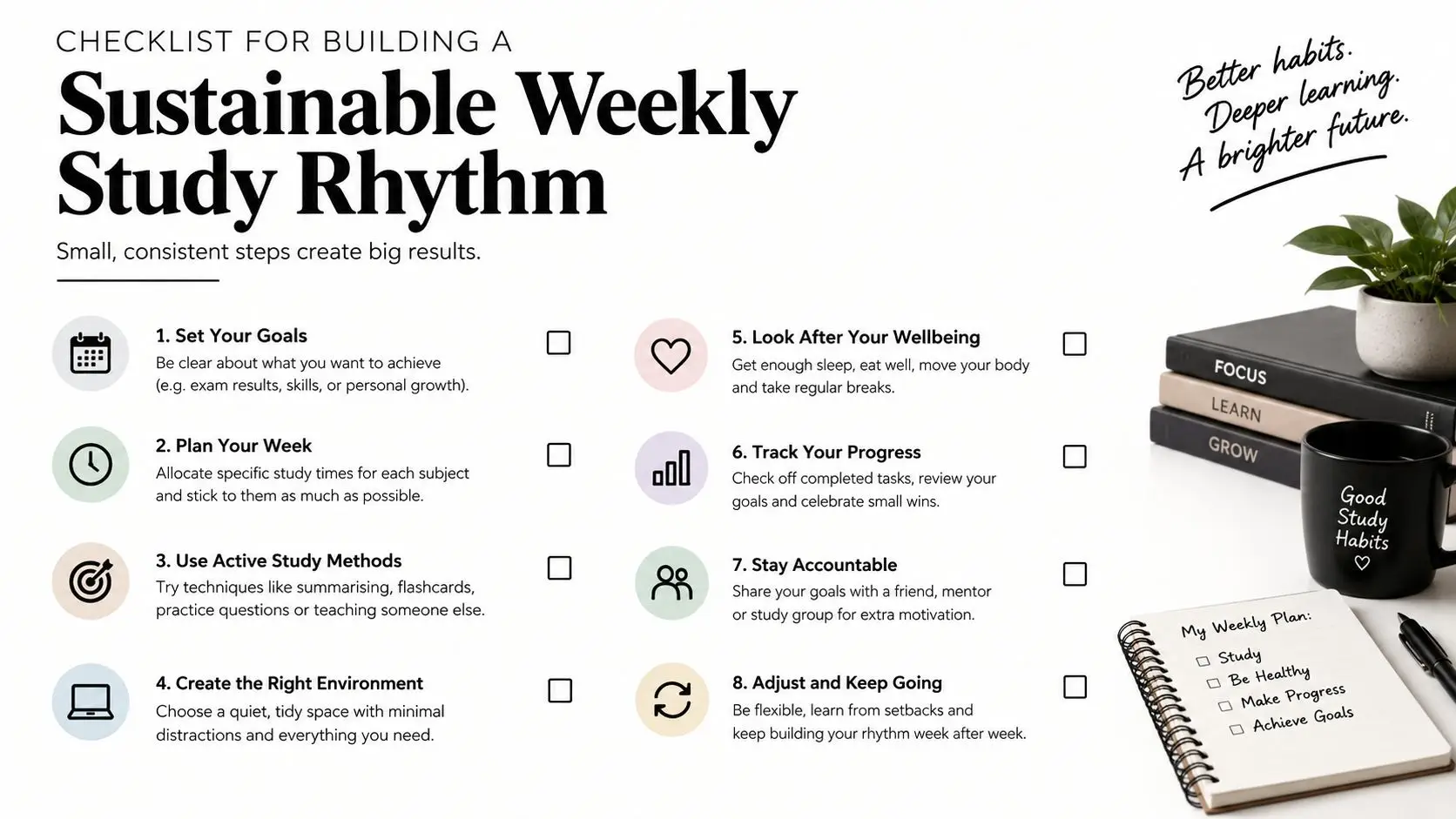
A good online course only works if the week has a rhythm. Without one, students drift into passive revision, and French becomes something they open only when panic sets in. The most effective routine is steady, modest, and repeated, because language learning rewards contact more than cramming.
Build the week around active tasks
A simple pattern works well for many students. Start with listening and reading, then move into translation in both directions, then write something timed, then speak aloud. That order mirrors the assessment demands and helps the child meet the subject in the right sequence, instead of hiding in the part that feels safest.
Eduqas examiner feedback identifies translation into French as highly variable, and recommends a correction log grouped by grammar, vocabulary, spelling and task completion, with each error rewritten and retested after spaced intervals (Eduqas A-level French report). That advice is practical because it turns mistakes into retrievable learning rather than repeated frustration. A student who keeps misspelling a verb ending can see the pattern, rewrite it correctly, and test it again a few days later.
Useful habit: one mistake logged properly is more valuable than ten pieces of work skimmed and forgotten.
Keep the workload small enough to survive
The aim is not to fill every evening with language work. It is to build a routine the child can live with. A weekly cycle might include one unseen translation, one short essay, and one speaking recording, but the exact shape should match the child's stamina and school commitments. Parents often relax once they realise consistency matters more than volume.
A planning tool such as build a weekly planning routine can help families map study time around sport, commuting, health appointments, and downtime. If the timetable is visible, the child is less likely to feel ambushed by French and more likely to see progress as manageable. That sense of control matters just as much as marks.
For a revision structure template, the Queens Online School A-level revision timetable template can be a useful reference point for families wanting a simple, repeatable framework.
The goal is a week that feels predictable. When a teenager knows exactly when listening, writing, translation, and speaking will happen, French stops feeling like a looming block and starts feeling like a sequence of achievable jobs.
Preparing for the High-Stakes Speaking Exam
The speaking exam is where many students feel exposed. They may understand the grammar well enough on paper, then freeze the moment a teacher asks them to react out loud. That is why recorded lessons alone are not enough, no matter how polished they look on a screen.
For AQA A-level French, speaking lasts 21 to 23 minutes, includes five minutes of supervised preparation, and requires both a stimulus-card discussion and a presentation plus discussion of an individual research project, all recorded and submitted as a complete, unedited audio file (AQA speaking details). Those demands are very specific, and they reward learners who have practised under conditions that feel close to the actual exam.
Why live rehearsal changes the outcome
A teenager does not become exam-ready by watching other people speak French. They become exam-ready by being interrupted, questioned, corrected, and asked to think on their feet. That is why live rehearsal with a subject specialist matters so much. The student needs to hear unpredictable follow-up questions, not just rehearse model answers that sound fine in theory.
“Confidence in speaking comes from being stretched safely, not from being left alone with a video.”
A strong programme will include small-group or one-to-one oral practice, targeted feedback, and repeated mock answers to unfamiliar prompts. For example, a student might prepare a 90-second response on a Francophone issue, then answer a follow-up question that changes the angle completely. That is uncomfortable at first, but it is exactly the kind of discomfort that builds real fluency.
What parents should listen for
The difference between ordinary conversation and exam speaking is easy to miss. A teenager may chat happily at home and still struggle when the task becomes timed, recorded, and assessed. The right online course should make that difference visible early, then help the learner work through it calmly.
For families comparing provision, Queens Online School's French at A Level is one example of a programme built around live teaching rather than passive viewing. What matters most is that the course creates repeated oral practice, clear standards, and a pathway to the recording stage without panic.
The speaking exam is not just a test of accent or confidence. It is a test of preparation, and preparation improves when the child has room to rehearse, reflect, and try again.
Protecting Wellbeing Through Flexible SEN Support
Maya was bright, careful, and exhausted. She loved French vocabulary, but every school day left her drained, and by late afternoon she had little energy left for revision. Her parents were not questioning her ability. They were worried that the pace and pressure of school were making it harder for her to show what she knew.
That concern sits alongside wider evidence. An Office for National Statistics analysis found that the estimated probability of children presenting to hospital with mental-health issues rose from 1.82% when no school sessions were missed to 5.27% at 30% absence, with the effect significantly stronger for children with SEND (ONS analysis of child mental ill health and absence). For some children, missed learning reflects health needs rather than poor motivation.

A safer way to keep progress moving
Maya's French teacher changed the shape of the work. Instead of expecting her to keep pace through fatigue, the school recorded key explanations, provided transcripts, and let her return to speaking practice when she felt steadier. On days when live discussion felt too much, she could preview questions in advance and send back an audio response later.
That flexibility matters because England identified more than 1.7 million pupils with special educational needs in January 2025 (SEND equality impact assessment). A single method will not suit all of them. Some learners need captions, some need more time to process a question, and some need a calmer route into speaking so they can take part without feeling exposed.
Support that protects confidence
An online setting can lower pressure when it is built properly. A child with anxiety may benefit from a consistent teacher, advance notice of tasks, and a private way to ask for help. A learner who struggles with spontaneous speech can begin with a short recorded answer, receive focused feedback, and only then move to live discussion.
Parent lens: the question is not whether the child can cope with harder work, it is whether the structure helps them stay engaged long enough to do it.
Queen's Online School is one of the providers families may compare when they want a British online route with live teaching, small classes, and specialist support. That matters because a teenager with SEND or SEMH needs should not have to choose between wellbeing and ambition.
The right online French support does not lower the standard. It removes the barriers that get in the way of reaching it.
Evaluating Accredited Online French Programmes
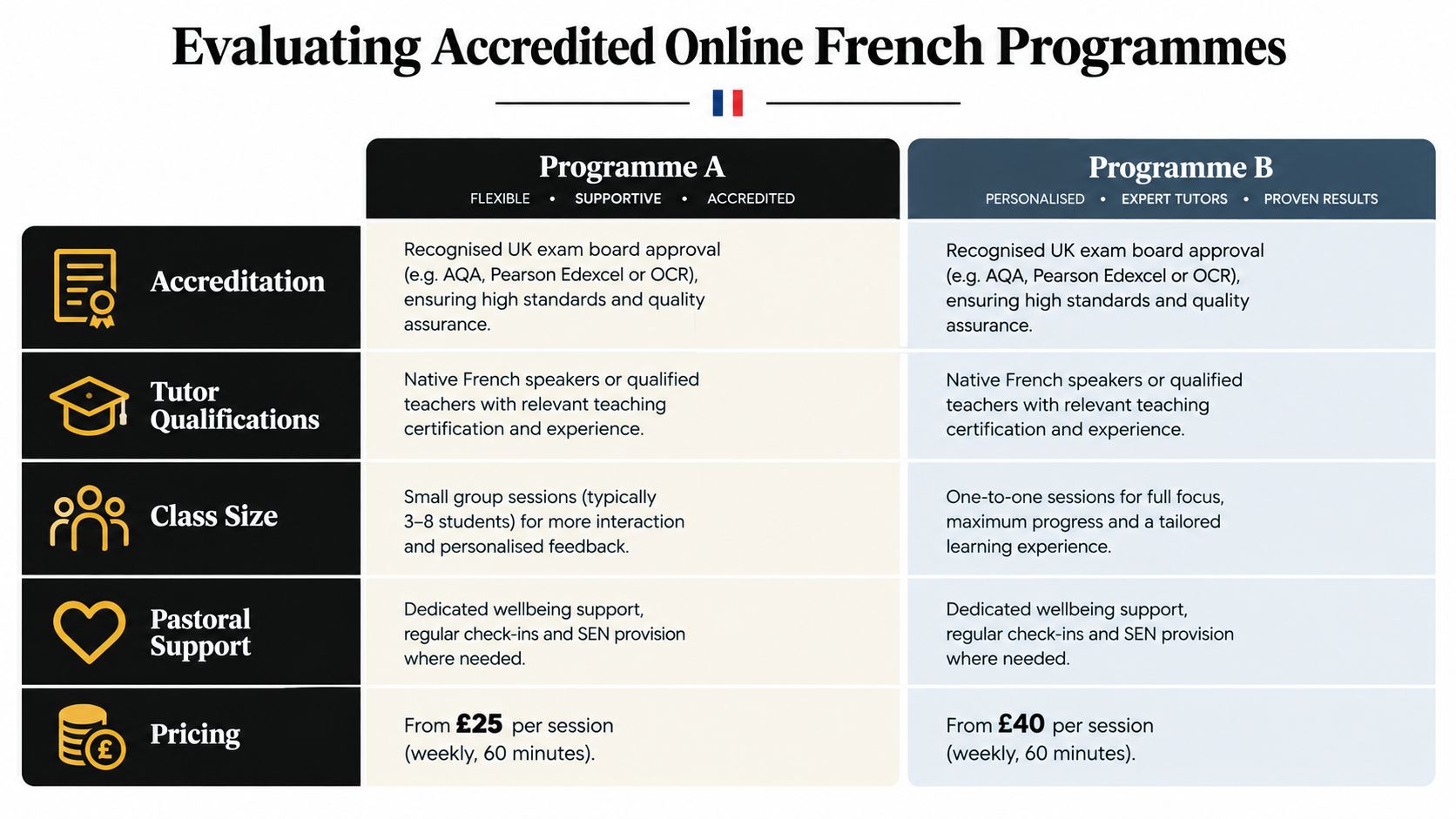
A parent checking online French courses is often comparing two very different experiences. One may be little more than recorded lessons and worksheets. Another may include live teaching, exam practice, and the steady pastoral support a teenager needs to keep going when French becomes hard.
What strong provision should include
A serious programme should feel like a school, not a file library. Look for subject-specialist teachers, live interaction, and a clear route into exam preparation. Ask how speaking is practised, how written work is marked, and who explains the exam centre process. If those answers are vague, the programme is leaving out part of the journey.
The YouTube walkthrough below helps parents look at course design and delivery with a sharper eye.
A simple comparison lens
It helps to separate convenience from support. A platform can look polished and still leave a learner isolated. Another may feel less flashy but offer the regular teacher contact, feedback, and reassurance that an anxious student needs. For a child with SEN or exam stress, that difference matters as much as the content itself.
| What to check | Stronger programme | Questions families should ask |
|---|---|---|
| Teaching | Live specialist lessons | Who teaches the course, and are they experienced in A-Level French? |
| Speaking support | Repeated oral practice and feedback | How often does my child practise speaking, and who listens back? |
| Pastoral care | Check-ins and SEN-aware adjustments | How do you support anxiety, processing time, or quieter learners? |
| Assessment pathway | Clear examination support | Which exam centre is used, and how are mock assessments handled? |
Parents should also ask whether captions, extra processing time, and alternative ways to rehearse speaking are available when needed. Those adjustments are not extras for many learners, they are the bridge that lets them access the same standard of work.
One careful comparison question usually reveals a lot. Does this programme give my child a genuine chance to learn, speak, and belong, or only a place to watch lessons?
Empowering Your Child's Language Learning Journey
French works best when the child feels safe enough to keep going. That means the home environment matters too, not because parents need to act like teachers, but because calm routines, clear expectations, and small celebrations can steady a teenager through the hard parts. A child who feels seen is much more likely to persist through the awkwardness that language learning always brings.
UK government surveillance reported that children and young people with SEND experienced greater anxiety during disrupted education, and highlighted the value of practical routines such as consistent teachers, advance notice of tasks, and planned social contact to make participation emotionally safer (government surveillance report on children and young people). That is a strong reminder that wellbeing is not separate from achievement. It is part of the conditions that make achievement possible.
What helps at home
Keep encouragement concrete. Praise a corrected verb form, a brave speaking attempt, or a completed translation rather than waiting for a perfect mark. If the child has had a difficult week, make it normal to return to the lesson by replaying a recording, doing a shorter task, or speaking privately before they speak publicly.
A few practical habits make a real difference:
- Keep the teacher relationship stable: A familiar adult lowers the stress of asking for help.
- Give notice before speaking tasks: Surprise is the enemy of confidence for many anxious learners.
- Celebrate small wins: A finished audio answer deserves recognition, not just a top grade.
- Protect recovery time: A tired child cannot absorb French well, even if they are capable.
A healthier definition of success
Success in online A Level French should mean more than surviving the course. It should mean a teenager who can handle the exam demands, but also feels more capable, more independent, and less frightened of making mistakes. That is especially true for learners with SEND or anxiety, where emotional safety and academic stretch need to live together.
If you're looking for a British online route that combines specialist teaching, live lessons, and support for learners who need more flexibility, visit Queens Online School. It's a sensible next step for families who want French to remain rigorous without becoming overwhelming, and who want a setting that respects both progress and wellbeing.