

At 7:15 on a May morning, a Year 6 child may be eating cereal in a T-shirt while a faded maths revision timetable curls away from the fridge. A parent is checking the time, wondering whether to mention the test, offer another practice question, or let breakfast be breakfast. The child may look calm, worried, excited, tired, or completely uninterested. All of those reactions are normal.
Key Stage 2 SATs are statutory assessments for pupils in England at the end of Year 6, when most children are aged 11. They provide a national picture of attainment, help schools understand what pupils have learned, and contribute to public school-performance reporting. They're important, but they're only one part of a child's story.
The most useful support usually looks ordinary: a predictable morning, enough sleep, a familiar adult who listens, and permission to talk about worries without turning every conversation into revision. Families who are building a calmer start to the day may also find this Lumas ADHD morning guide helpful, particularly when transitions and time pressure make mornings harder.
The Morning of SATs Week
The first thing to remember is that your child arrives at school as a whole person, not as a collection of marks. A child who has slept badly, feels frightened about getting an answer wrong, or is struggling with attendance may need reassurance before they need another worksheet.
SATs exist because schools, families and the education system need a consistent way to understand attainment at the end of primary school. They're statutory, which means eligible pupils take them as part of the national curriculum assessment process. The results support school accountability and national and regional comparisons, but they also help teachers identify strengths and areas where a child may need further support.
That wider purpose can feel distant at the kitchen table. Your child is more likely to be thinking about whether the reading paper will be difficult, whether they'll be allowed a toilet break, or whether they'll remember how to set out a calculation. Those concerns deserve a patient answer, not dismissal.
Practical rule: If your child asks, “What happens if I don't know an answer?”, teach them to pause, try what they can, and move on when necessary. One difficult question doesn't define the paper or the child.
The official system covers several types of assessment. Children sit tests in reading, mathematics, and English grammar, punctuation and spelling. Writing and science are assessed by teachers, so a child isn't judged by a single morning or a single paper.
The rest of this guide focuses on the questions parents usually ask once SATs become real. What happens in each subject? What does a scaled score mean? How can access arrangements remove unfair barriers? What do attendance, recovery and emotional readiness have to do with results? How can preparation protect your child's confidence rather than consume it?
What Key Stage 2 SATs Actually Are
Think of SATs like a school sports day where every child runs a measured race. The race gives adults a consistent result, but it doesn't describe everything about the runner. It doesn't show who encouraged a friend, who kept practising after stumbling, or who discovered a new love of sport. Similarly, a test measures selected parts of reading, mathematics, and grammar, punctuation and spelling at a particular point in time.
Children in England take the assessments in Year 6, during the national testing window in May. The tests measure attainment at the end of the primary phase and use common papers and administration arrangements. Schools then report the outcomes to parents alongside teacher assessments for writing and science.
They're not pass-or-fail examinations. A result below the expected standard doesn't mean a child has failed at school, and a result at or above the standard doesn't capture every quality that matters. A pupil might be a thoughtful collaborator, a gifted storyteller, a careful scientist or a resilient learner, even if a test doesn't show those qualities directly.
The purpose behind the papers
Schools use outcomes to understand how pupils are performing against the national standard. The Department for Education also uses the results in national and regional statistics, while test results contribute to public school-performance reporting. That makes SATs an accountability measure as well as an assessment of individual attainment.
Parents often worry that the test result will follow their child forever. In practice, secondary schools use a range of information when planning teaching and support. A child who finds reading difficult may need targeted help, while another may need extension work. The result is a starting point for conversation, not a complete forecast.
| Question | Answer |
|---|---|
| Who takes KS2 SATs? | Eligible pupils in Year 6 in England. |
| When do they take place? | During the designated national testing window in May. |
| Which formal tests are included? | Reading, mathematics, and English grammar, punctuation and spelling. |
| Is writing tested by a paper? | No. Writing is assessed by the teacher. |
| Is science tested by every child? | Science is teacher-assessed nationally, with sampling used within the wider system. |
| Are SATs pass or fail? | No. They show whether attainment meets the national expected standard. |
Families wanting to see how these assessments sit within the wider primary curriculum can explore the Key Stage 2 curriculum. The clearest message to carry into May is simple: your child is taking a set of assessments, not being reduced to them.
Subjects, Papers and Timing
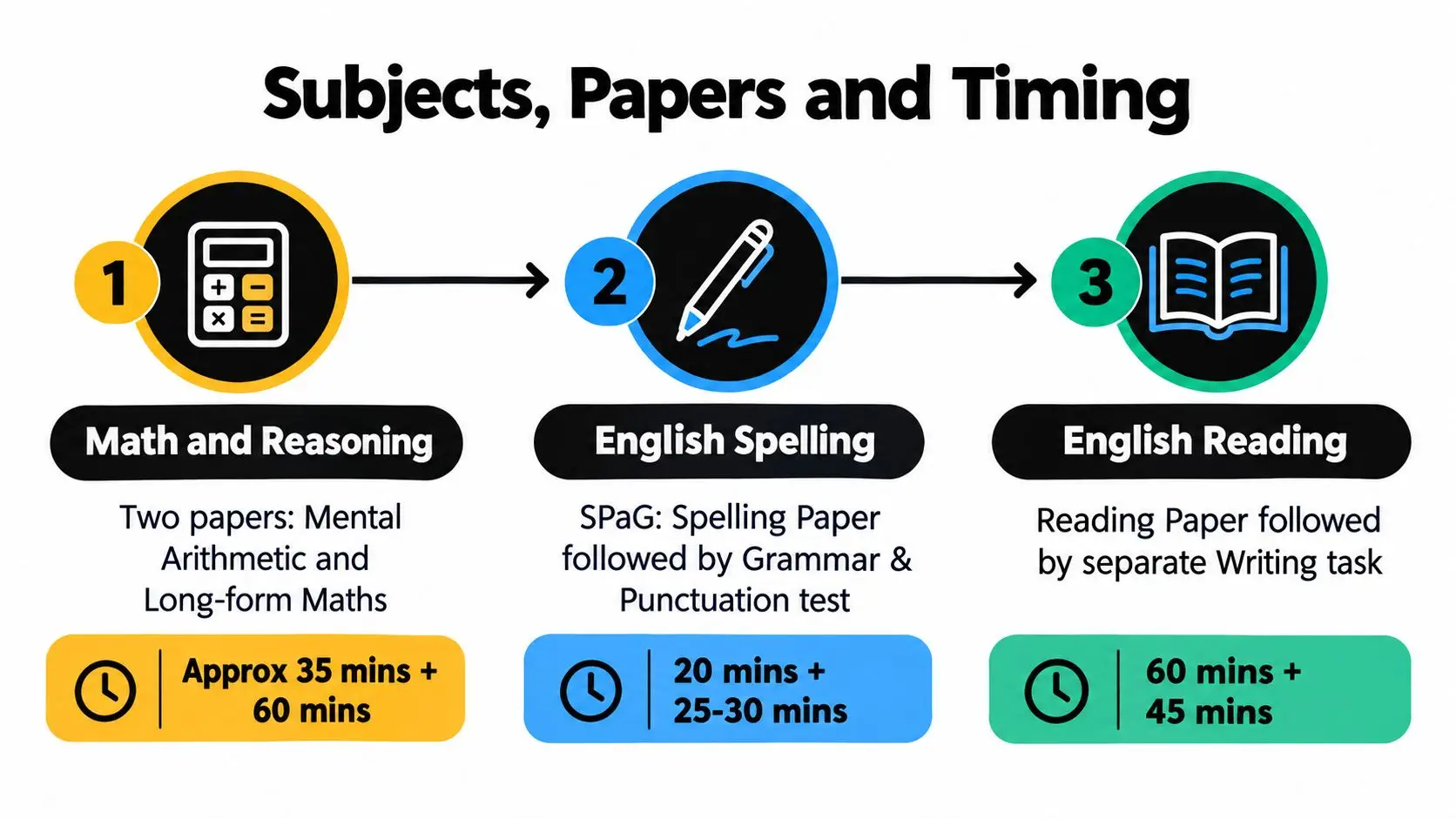
The papers follow a familiar pattern, although schools administer them according to the official timetable and guidance for the relevant year. English grammar, punctuation and spelling, often called SPaG, includes a spelling paper followed by a grammar and punctuation test. Reading is assessed through one paper containing fiction, non-fiction and poetry material. Mathematics includes arithmetic and reasoning papers.
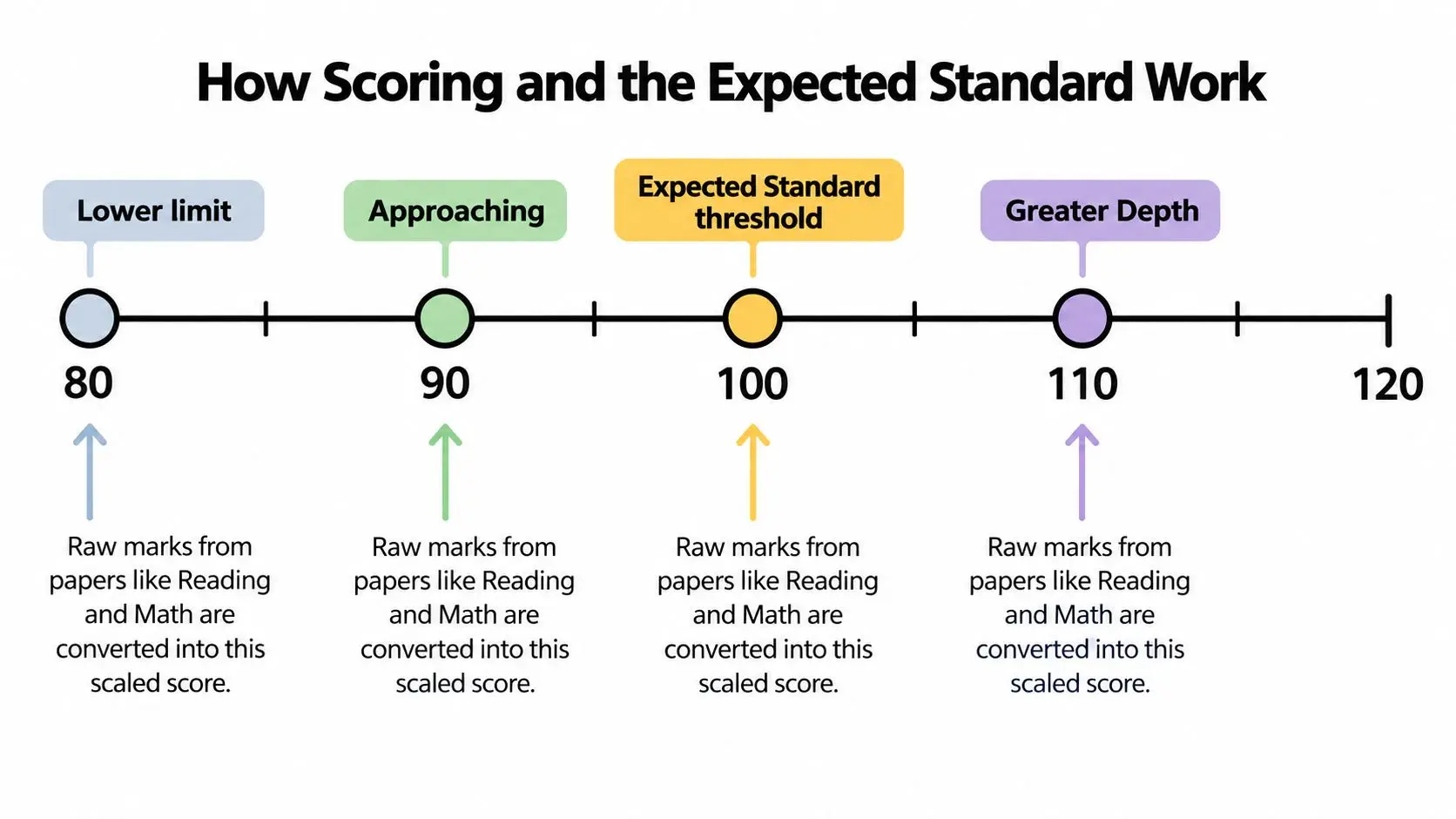
The official test information confirms that results are reported as scaled scores from 80 to 120, with 100 representing the expected standard. The scale allows raw marks to be converted consistently across different test forms, so parents shouldn't try to compare raw marks from separate papers as though they were identical measures.
What each subject asks children to do
The SPaG assessment checks spelling knowledge and the accurate use of grammar and punctuation. The reading paper asks pupils to retrieve information, interpret language, make inferences and respond to different types of text. The mathematics papers combine calculation with reasoning, so children need to show how they approach a problem rather than rely only on memorised facts.
Parents sometimes assume that every part of the curriculum appears in a formal test. That isn't the case. Teachers assess writing through classroom evidence and professional judgement, while science teacher assessment forms part of the national reporting picture. A child's summer report therefore contains more than the three formal test outcomes.
For a child who becomes overwhelmed by long tasks, the experience matters as much as the subject list. A teacher may break the morning into manageable explanations, follow agreed access arrangements, and watch for signs of fatigue. At home, a calm breakfast, familiar clothes and an unhurried departure can protect attention more effectively than a final burst of revision.
The Key Stage 2 maths programme can help families understand the mathematical knowledge and reasoning skills that sit behind the papers. Whatever resources you use, avoid turning breakfast into an exam rehearsal. Sleep, food and emotional steadiness give children a better foundation for showing what they know.
How Scoring and the Expected Standard Work
A child's paper begins with a raw mark, meaning the number of marks awarded for answers. That raw mark is converted into a scaled score between 80 and 120. The published national curriculum assessment guidance explains that 100 means the pupil has met the expected standard, while a score below 100 means they haven't met it on that assessment.
The conversion is necessary because papers can vary in difficulty. A raw mark from one year shouldn't be treated as directly equivalent to the same raw mark from another year. The scaled score gives schools a common reference point, although parents should still compare cohorts and outcomes with care.
What “met” means for a family
A child who meets the expected standard has demonstrated attainment at the national age-related benchmark in that test. A child who is recorded as not meeting the expected standard may have particular gaps, may have found the testing conditions difficult, or may just have had an unhelpful day. The label should lead to useful teaching, not embarrassment.
The formal tests contribute the reading, mathematics, and grammar, punctuation and spelling outcomes. Writing sits alongside them as a teacher assessment judgement, based on the child's classroom work and the relevant assessment framework. The national headlines also report teacher assessment for science.
The result sheet from school normally brings these outcomes together in a focused report. Look for each test outcome, the writing and science teacher assessment information, and any explanation the school provides. If a result worries you, ask the teacher what the child can do confidently, which skills need support, and how transition to secondary school will address those needs.
A scaled score is not a pass mark in the way a driving test has a pass decision. It's a national expectation used to describe attainment. Your child remains more complicated, more capable and more interesting than the number on the page.
Access Arrangements for SEN and SEMH Pupils
Access arrangements should help a child demonstrate knowledge without changing what the test measures. Schools begin with the child's normal way of working in class. If a pupil routinely uses a particular support during everyday learning, the school can consider whether that support is appropriate in the test, following the current guidance.
The arrangements can include extra time, rest breaks, scribes, readers, transcripts, word processors, technical aids, prompts, highlighters and accessibility objects. Modified papers are available in formats such as large print, braille and altered layouts. Some arrangements require advance approval or notification, so families should raise concerns early rather than waiting for SATs week.
Matching support to the barrier
A child with an EHC plan may automatically qualify for up to 25% additional time in all KS2 tests, while a pupil using modified large print or braille versions may automatically qualify for up to 100% additional time, subject to the conditions in the official access arrangements guidance.
The fairest arrangement depends on the barrier. For example:
- Handwriting fatigue: A word processor may allow a child to give answers without pain or exhaustion when this is their usual classroom practice.
- Visual impairment: Braille or modified large print can make the test accessible, with the relevant additional time.
- Attention difficulties: Supervised rest breaks may be more helpful than extra time because they allow the child to reset without losing concentration.
- Reading access: A reader may support an eligible pupil in permitted papers, but the arrangement must follow the rules for that subject.
- Anxiety or SEMH needs: A familiar adult, smaller group or separate room may reduce distress where the school has evidence that this reflects the pupil's established support.
Fairness means removing an unnecessary barrier, not making the assessment easier.
Parents sometimes hear “special arrangements” and fear that their child will be singled out. A quiet room, movement break or familiar adult can feel far less threatening when it has already been used successfully in class. Ask the school what evidence it has, which arrangement matches the difficulty, and how the plan will be explained to your child.
Families exploring the practical process can read about exam access arrangements. The scaled-score expectation stays the same. The route to showing what a child knows becomes more equitable.
Recovery, Attendance and the Hidden Picture
A child may miss part of Year 6 because of illness, anxiety, family circumstances or another barrier, then return to lessons carrying more than unfinished work. National results help schools see broad patterns, but they cannot explain one child's absence or predict one child's outcome. The modern attainment series records the proportion meeting the expected standard in reading, writing and mathematics combined at 53% in 2016, 61% in 2017, 64% in 2018, and 65% in 2019. It records 59% in 2022, 60% in 2023, 61% in 2024, 62% in 2025, and 63.3% in 2026, with the usual reporting pattern disrupted during the pandemic years (official attainment series).
| Year | RWM combined |
|---|---|
| 2019 | 65% |
| 2022 | 59% |
| 2023 | 60% |
| 2024 | 61% |
| 2025 | 62% |
| 2026 | 63.3% |
The combined measure suggests recovery in national attainment, while pupils' experiences remain unequal. The 2026 reporting records 49% of disadvantaged pupils meeting the expected standard, compared with 63.3% of all pupils meeting the expected standard. It also reports that the disadvantage gap index reached its highest level in four years (2026 national headlines). That comparison describes a population, not an individual child. A school should use it to ask whether pupils are receiving the teaching, pastoral care and practical support they need.
Attendance data can add another part of the picture. Government analysis links pupil-level attendance and attainment through the National Pupil Database, allowing absence to be examined alongside KS2 outcomes (attendance and attainment data). The useful response to a child who is struggling to attend is early, curious contact with school. Anxiety, illness, family pressures and unmet learning needs call for different support, so a single attendance figure cannot explain the cause.
A missed lesson is not a moral failure. It is information about what may help the child return, learn and feel secure.
Preparation That Puts the Child First
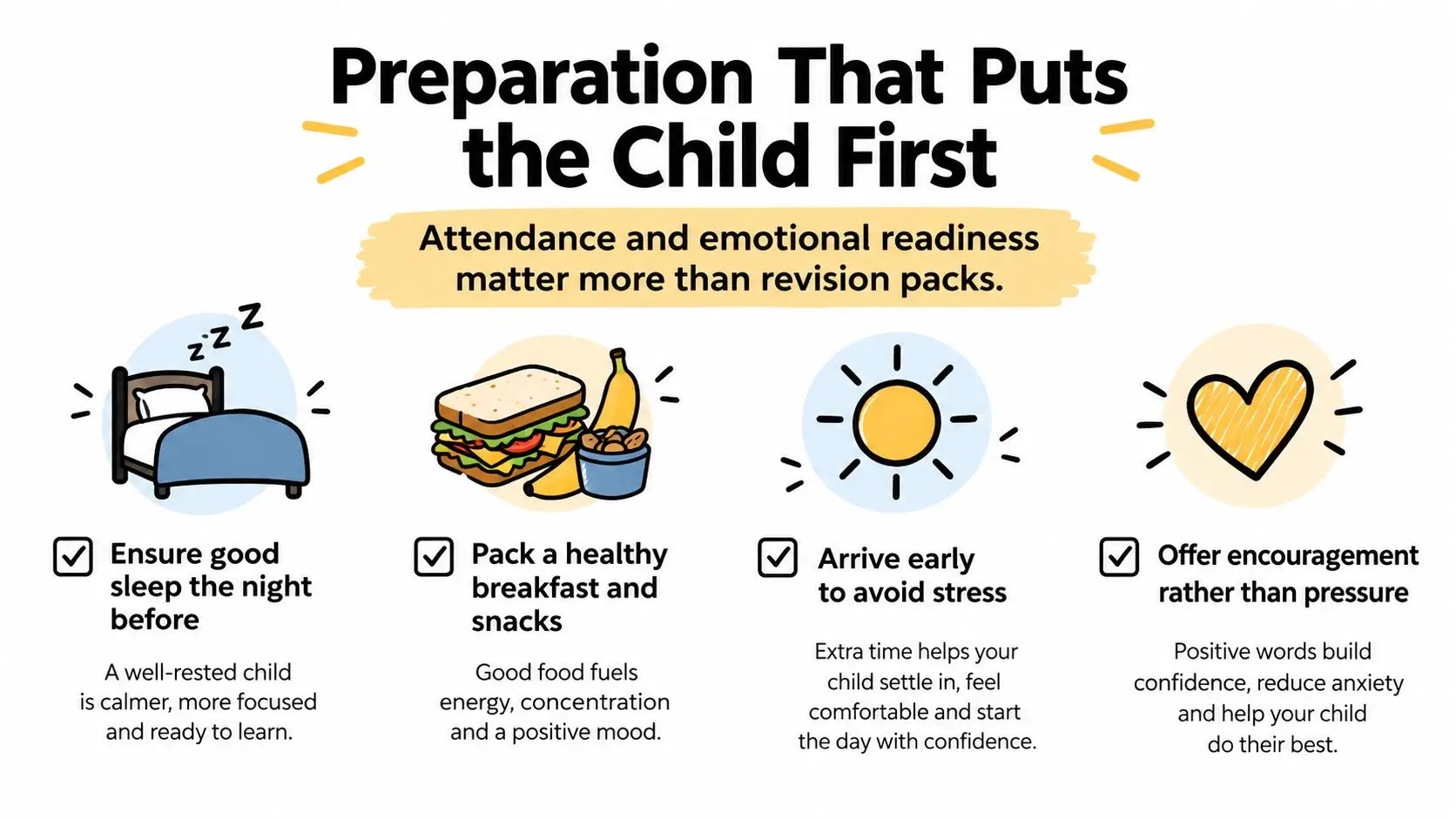
Revision packs can make adults feel busy, but they don't automatically make children ready. A rested child who feels safe and can ask for help is usually better placed to reason, read carefully and recover from a difficult question than a child who has been drilled until learning feels like punishment.
Protect the basics in the run-up to the tests:
- Protect sleep: Keep bedtime predictable, especially before the testing week.
- Offer a proper breakfast: Include familiar food with enough substance to avoid starting hungry.
- Keep weekends recognisable: Children need play, movement and time away from schoolwork.
- Talk while walking: A side-by-side conversation can make worries easier to express than a formal questioning session.
- Stop cramming: The final forty-eight hours should reduce pressure, not add another stack of papers.
At home, read together and ask questions such as, “What makes you think that?” or “Which words create that impression?” Practise times tables through a quick game such as Hit the Button, and use an arithmetic paper occasionally as a short, planned check rather than a daily judgement. Free materials, including past papers on the SATs-Papers site and BBC Bitesize KS2 pages, can provide examples, but stop if your child's confidence is falling.
What practice might look like
A maths reasoning question may ask a child to use several pieces of information, decide which operation is needed, and explain or show the working. A SPaG question may ask them to identify the correct punctuation, choose a suitable grammatical term, or spell a dictated word. Don't rush to correct every error. Ask the child to explain their thinking, then show one manageable next step.
A fridge checklist might say:
- Bag and uniform ready.
- Sleep protected.
- Breakfast planned.
- Water bottle prepared if school permits it.
- One calm conversation about worries.
- No last-minute paper before leaving.
- Encouragement focused on effort and self-knowledge.
If your child says, “I'm scared I'll let everyone down,” answer the fear underneath the words. “You don't have to make anyone proud with one paper. Your job is to try, ask for the support you're allowed, and come home.”
How Queens Online School Supports Pupils Through KS2
A child-centred approach to SATs starts long before the testing window. In an online setting, the daily routine needs to make learning visible, manageable and relational, so pupils know who will notice when they are confused, tired or unusually quiet.
Queens Online School uses small live classes and interactive teaching within its British curriculum. For a Year 6 pupil, that can mean more opportunities to explain a reading inference, share a calculation method, or receive feedback while the work is still fresh. The school's KS2 provision includes English reading and grammar, punctuation and spelling, with attention to the expected standard represented by a scaled score of 100.
Linking support to real barriers
The most useful question isn't, “Does the school prepare for SATs?” It's, “How does the school help this child access learning?”
- A pupil who needs formal support can work with the school's SENCO on an access-arrangements process that considers normal classroom practice and the relevant evidence.
- A child with attention needs may benefit from planned movement breaks and shorter periods of concentrated work.
- A pupil experiencing SEMH difficulties may need regular check-ins, a named key adult and a timetable that makes emotional support part of the school day rather than an emergency response.
- A learner who needs greater fluency can receive targeted reading or arithmetic intervention, with teaching focused on specific gaps rather than repeated general revision.
These supports don't alter the national standard. They help a child reach the point where the standard can be assessed fairly. Families should still ask practical questions: Who will contact us if attendance changes? How are worries recorded? How does the school prepare a child for the move into Key Stage 3? What will happen if the results show a gap?
When results arrive, give your child time before analysing them. Read the report, ask the school how it interprets the outcomes, and find out how secondary teachers will receive relevant information. A child who finishes SATs week still feeling curious, capable and secure has achieved something that no score can fully measure.
Queens Online School offers live small-group teaching, personalised SEN and SEMH support, and a British curriculum that carries pupils from Key Stage 2 towards later qualifications. Visit Queens Online School to discuss how its flexible online setting could support your child through KS2 SATs and the transition beyond.