


Your child comes home exhausted again. They say their tummy hurts before school. Homework that should take twenty minutes turns into tears, shutdown, or anger. You've spoken to staff, filled in forms, and tried every reward chart you can think of, but deep down you know this isn't about effort or behaviour. Your child is struggling, and ordinary support isn't enough.
That feeling matters. Parents usually notice the pattern long before the paperwork catches up. You see the panic before assembly, the meltdown after masking all day, the fear of reading aloud, the refusal that looks like defiance but feels more like distress.
A Statement of Special Needs, or today in England an EHCP, exists to turn that instinct into something concrete. It's the point where a child's difficulties stop being dismissed as “they'll grow out of it” and start being formally recognised in law. For families in Northern Ireland and Wales, the Statement still matters directly. For families in England, its logic still matters because the modern system grew from the same core idea: if a child needs provision beyond what's normally available, that help must be set out clearly and delivered.
Your Child Deserves to Thrive at School
A child doesn't need to be failing every subject to need specialist support. Sometimes the clearest sign is dread. A bright child may freeze when asked to write. A sociable child may become unreachable after a noisy day. A teenager may seem “fine” in class and then collapse emotionally at home.
Parents often tell me the hardest part isn't only the child's struggle. It's the feeling of not being believed. You know your child isn't lazy. You know they aren't choosing anxiety, overload, or school refusal. You want someone to see the whole child, not just a behaviour incident or a test score.
That's where a legal plan can become a turning point. It gives structure to what you already know. It says, in effect, “these needs are real, they affect learning, and support must match them.”
When the legal words feel intimidating
The language can sound cold at first. “Statutory assessment.” “Provision.” “Placement.” But behind those terms is a simple purpose. Your child needs the right help, in the right setting, in a form that can be delivered.
For some families, that setting may be a mainstream school with stronger support. For others, it may be a specialist placement. For others still, especially when a child is overwhelmed by the physical school environment, online schooling becomes part of the conversation.
A good plan doesn't start with the institution. It starts with the child's lived day. What makes learning possible, and what makes it fall apart?
In England, the old Statement system was replaced by the EHC plan under the Children and Families Act 2014, but the history still matters. Mencap notes that in the 2019/20 academic year, 80,135 children in England held a statement of SEN or an EHC plan with a primary SEN associated with learning disability or difficulty, representing 29% of children with that formal documentation in that group, as outlined in Mencap's children and learning disability statistics. That tells us something important. Formal plans are not rare edge cases. They exist because many children need support that must be clearly set out and protected.
What Is a Statement of Special Needs Exactly
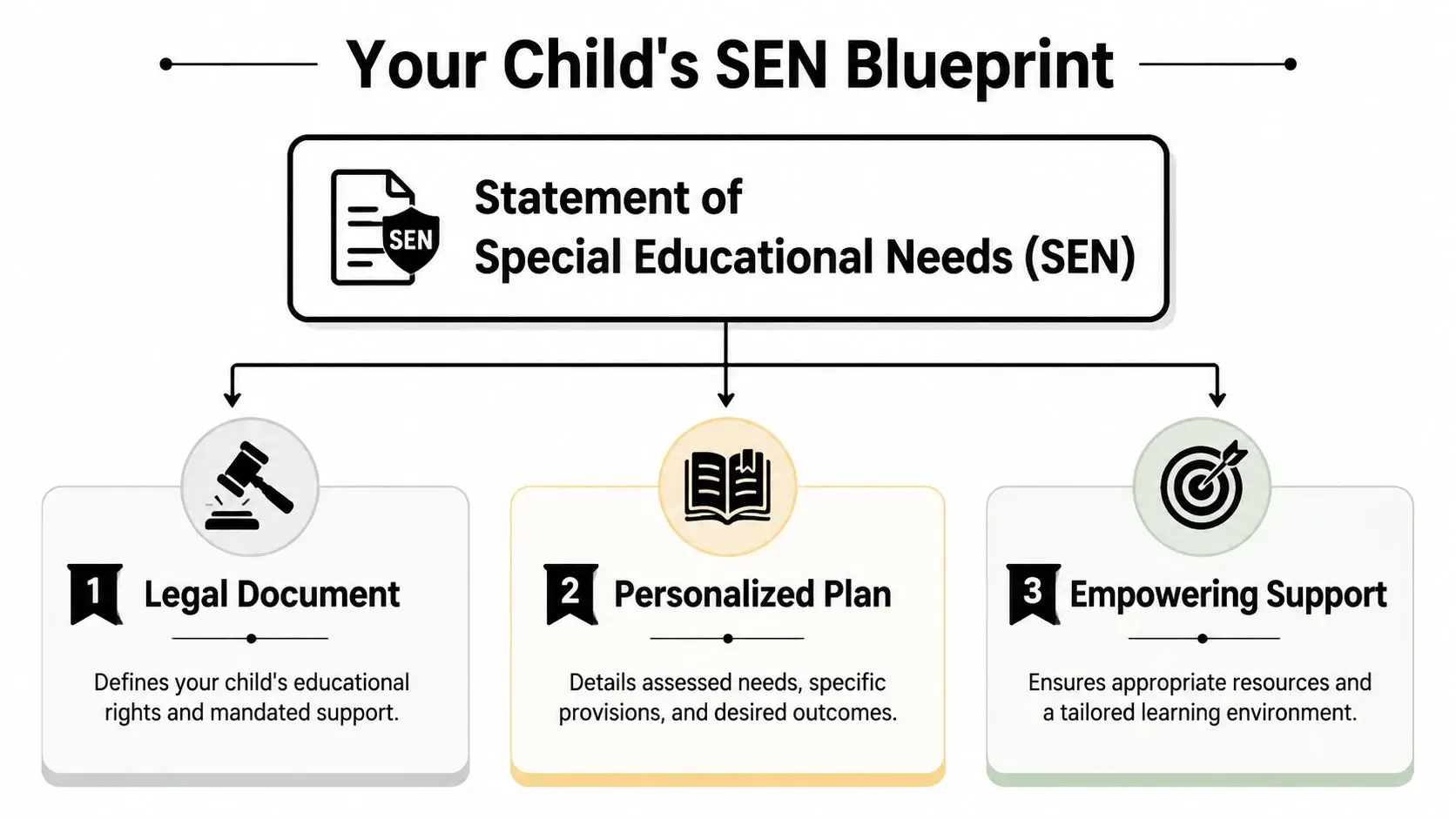
Think of a Statement of Special Educational Needs as your child's educational blueprint. It isn't just a description of problems. It's a legal document that records what your child needs, what support must be provided, and where that support should happen.
In Northern Ireland, a Statement is issued at Stage 5 after a Stage 4 statutory assessment, and it has exactly six parts, explained in SENAC's guide to what a Statement is. Each part does a different job. Together, they create a picture of the child and a framework for action.
The six parts in plain language
Here is the structure families need to understand:
| Part | What it covers | Why it matters for your child |
|---|---|---|
| Part 1 | General details | Identifies the child and basic administrative information |
| Part 2 | Description of special educational needs | Sets out what the child is struggling with and how it affects learning |
| Part 3 | Special educational provision | Lists the support that must be arranged |
| Part 4 | School placement | Names the school or type of school |
| Part 5 | Non-educational needs | Records relevant needs outside education |
| Part 6 | Non-educational provision | Records support that is not educational provision |
The most important parts for most parents are Part 2 and Part 3.
Part 2 is where your child's reality must be written clearly. In Northern Ireland, the Children's Law Centre explains that Part 2 must describe the child's needs, and gives the example: “Leo experiences debilitating anxiety leading to school refusal”, in its guidance on what details should be included in a Statement. That matters because once a need is properly described, it is legally recognised. It can't be brushed aside as a phase or misbehaviour.
Why wording changes outcomes
If your child has autism, anxiety, sensory overload, speech and language needs, or attention difficulties, the wording has to reflect the actual impact on learning. “Gets worried at times” is weak. “Experiences severe anxiety that prevents entry to lessons” is much clearer. The child feels seen, and the adults around them are forced to respond to the actual issue.
That same principle helps when families are also trying to understand overlapping profiles. If your child has autistic traits or already has a diagnosis, practical reading like this parent's guide to Asperger's can help you put everyday challenges into words before meetings.
A Statement also helps parents separate ordinary SEN support from support that needs legal force. If you're still trying to understand that distinction, this explanation of what SEN support means in practice is a helpful starting point.
Practical rule: If a need affects learning, access, attendance, communication, or emotional safety in school, it needs to be described precisely enough that another adult could understand it without guessing.
One more point often gets missed. SENAC warns that if needs affecting learning are left only in Part 6, the Education Authority has no legal duty to arrange that provision. Parents should push for educationally relevant needs to appear in Parts 2 and 3, where they carry enforceable weight.
Statement vs EHCP Key Differences for Families
The confusion is understandable. Parents hear “Statement,” “EHCP,” “special needs plan,” and sometimes even old terminology used by schools or other parents. The right term depends largely on where you live.
Statements of Special Needs are no longer issued in England but remain legally active in Wales and Northern Ireland, while parents in England must use the Education Health and Care Plan, according to this SEN legal overview for families. If your family moves within the UK, that difference matters straight away.
The comparison families usually need
| Feature | Statement of SEN | EHCP |
|---|---|---|
| Where families encounter it | Still active in Wales and Northern Ireland | Used in England |
| Legal status | Statutory legal document | Statutory legal document |
| Main scope | Focuses on special educational needs and provision | Brings together education, health, and care |
| Language families use | “Statement”, “statutory assessment”, named placement | “EHCP”, “EHC needs assessment”, named placement |
| Practical effect | Sets out needs, support, and placement in legal terms | Does the same, but within a broader joined-up framework |
For parents, the practical question is not “Which label sounds more modern?” It's “Which system applies to my child, and how do I use it well?”
What hasn't changed
Even though the documents differ, the heart of both systems is similar. A child has identified needs. Those needs must be assessed. Provision must be described clearly. A placement must be considered in light of whether the child can learn there.
That last point matters when parents start exploring alternatives to a local physical school. If a child cannot cope in a busy building, the issue isn't whether the setting is traditional. The issue is whether the setting can meet need safely and effectively.
Parents often lose confidence because the terminology changes. The central question never changes. What does this child need in order to access education?
Families in England also benefit from knowing how much the formal plan system has grown. The Department for Education's published figures show that 538,500 pupils had an EHC plan in January 2026, representing 29.0% of all SEN pupils, and this was an 11.6% increase from 2025 to 2026, as set out in the official special educational needs in England statistics for 2025 to 2026. The same release notes that 19.6% of all pupils in England receive some form of SEN support. Parents are not asking for something unusual when they seek formal recognition. They are asking for a system designed to meet real need.
The Journey to Securing a Statement
The process can feel heavy because it asks you to prove what you already live with every day. Try to think of it as building a detailed record. The stronger that record, the harder it is for anyone to minimise your child's needs.
Start by writing down what school looks like for your child in real life. Not broad labels. Specific patterns.
What to gather before and during assessment
Useful evidence often includes:
- School records such as reports, behaviour logs, attendance concerns, exclusion history, or notes about unfinished work.
- Professional input including paediatric, psychology, speech and language, occupational therapy, or CAMHS documents if you have them.
- Your own observations like morning panic, sleep disruption, sensory triggers, homework distress, toileting accidents, shutdown after school, or refusal patterns.
- Examples of what has and hasn't worked such as reduced timetable attempts, quiet space access, visual timetables, movement breaks, or adult support.
A parent's written evidence is often more powerful than they expect. You aren't adding emotion to weaken your case. You're showing the human cost of unmet need.
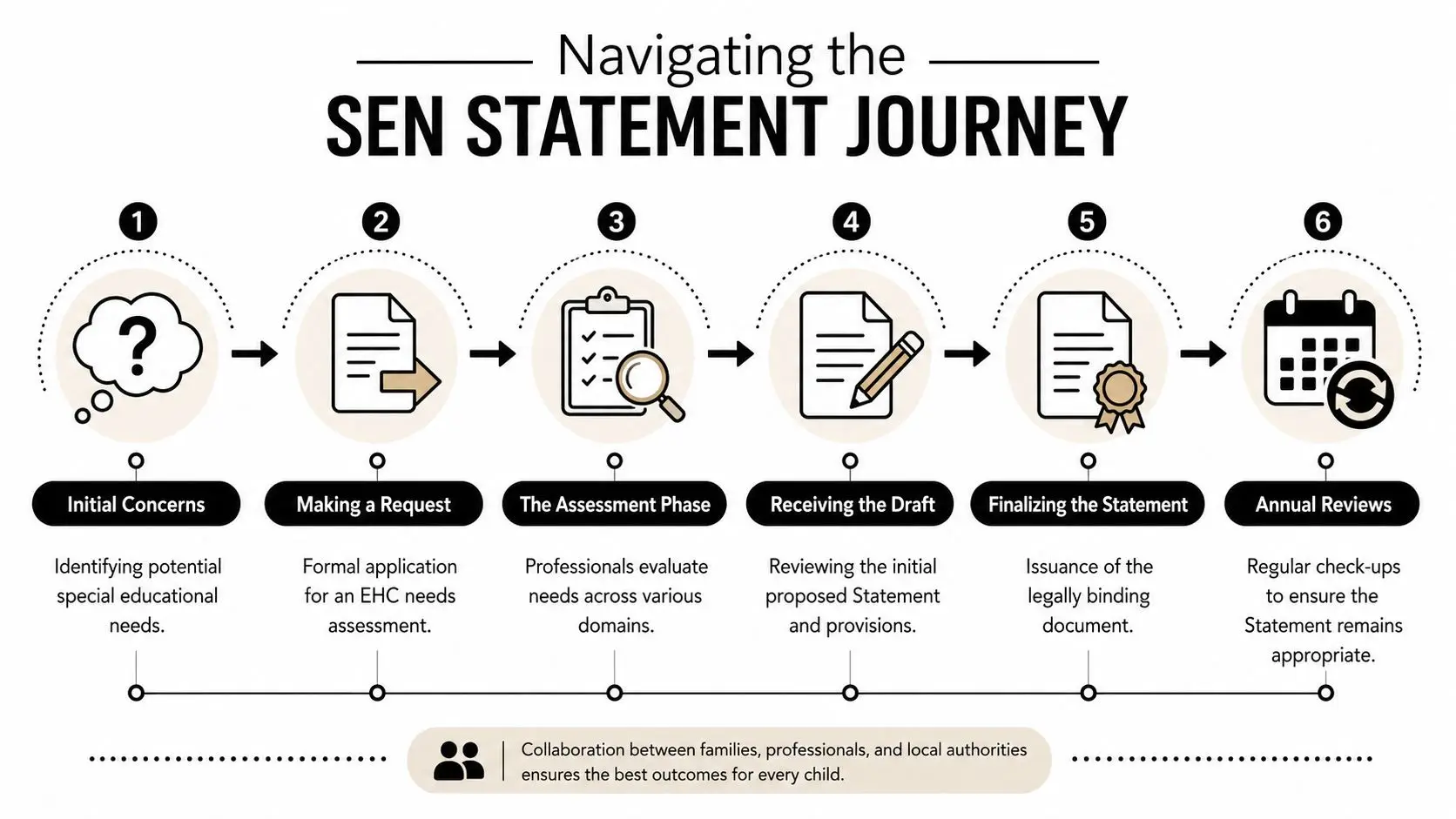
The stages usually feel like this
Concern becomes pattern
You realise the problem isn't occasional. It keeps happening, and ordinary classroom adjustments aren't enough.A request is made
A parent or school asks for a statutory assessment. Put concerns in writing and keep copies.Professionals assess need
Reports should move beyond labels and explain impact. How does the child's difficulty affect access to learning?A draft appears
Read every line carefully. Vague wording often slips in here.The final Statement is issued
Once finalised, it becomes a legal document.
Keep a simple timeline with dates, names, and what was promised. When you're tired, records protect you.
The annual review matters
A child doesn't stay still. Needs change, progress happens, new difficulties appear, adolescence shifts everything. In Northern Ireland, a Statement is reviewed annually to make sure the support still matches the child's needs, as explained in nidirect's guidance on SEN Statements.
That review is not just a paperwork check. It's your chance to say, “This support helped, this part no longer fits, and this new barrier now needs to be addressed.” A child who once needed help entering school may later need support with exams, friendships, or independent study instead.
Your Rights and Your Child's Entitlements
A Statement only protects your child if the wording is strong enough to enforce. This is why parents need to pay close attention to Part 3, the section that sets out provision.
The key phrase is specified and quantified. If support is written precisely, the Education Authority has a legal duty to arrange it. If it is written vaguely, families are often left arguing over what was “meant”.
Vague wording versus enforceable wording
Here's the difference:
Too vague
“Access to support for speech and language needs.”Far stronger
“3 hours per week of specialist speech therapy.”
The SEND Code of Practice 2015 makes this distinction important, and the government guidance explains that when provision is clearly quantified, it carries legal force in a way that general wording does not, as detailed in the SEND Code of Practice.
What parents should look for in the wording
Read each provision line and ask:
- Who delivers it
Is it a specialist teacher, teaching assistant, therapist, or another named professional? - How much is provided
Is there a frequency, duration, or number of sessions? - What the support is for
Does the provision directly match the need described elsewhere? - Where it happens
In class, one-to-one, small group, online, in therapy time, or during transitions?
If your child has ADHD, autism, anxiety, or language needs, this level of detail also helps you translate general advice into legal wording. Practical material like this ADHD classroom accommodations guide can help parents spot what accommodations should be discussed and, where appropriate, formalised.
“Access to” is not the same as “will receive”. If the plan leaves room for interpretation, delivery often becomes inconsistent.
When school support and exam support overlap
Older children often need the same clarity around tests and qualifications. A child may cope day to day but still need formal access arrangements in assessments. Parents who are thinking ahead to GCSEs or A Levels often find it useful to understand exam access arrangements and how they work, especially when a child's needs affect processing speed, attention, reading, writing, or anxiety.
If support written in the plan isn't being delivered, raise it in writing. Ask what has been provided, when, by whom, and how gaps will be remedied. The law works best when the wording is precise and the parent keeps a clear record.
Translating Support to an Online School Setting
Many parents reach a point where the issue is no longer only support. It's the environment itself. Their child may be capable of learning but unable to tolerate corridors, noise, transitions, crowds, bullying, sensory overload, or the emotional strain of getting through the day.
This is where guidance becomes frustratingly thin. There is very little direct advice for families trying to work out how a legacy Statement or modern equivalent operates in an online school setting. That uncertainty is real. A Frontiers article discussing online schooling and SEN notes that guidance on moving from a legacy Statement to online education is scarce, and also highlights that 33% of pupils with EHC plans had Autistic Spectrum Disorder as their primary need, raising important questions about whether virtual settings can meet required staffing arrangements, as discussed in this research on online schooling and special educational needs.

What the legal question really is
The right question isn't “Can online school count?” in the abstract. The question is more practical:
- Can the setting deliver the provision named in the plan?
- Can it provide the staffing arrangements the child needs?
- Can it reduce barriers that are making attendance or participation break down?
- Can it create a learning environment where the child is emotionally safe enough to engage?
For some children, online learning removes major barriers at once. The child can learn in a controlled sensory environment. Transitions are simpler. Social pressure is lower. Recorded lessons can help a learner revisit instructions at their own pace. Live teaching can still provide structure and contact, without the strain of a full physical campus day.
Matching support to the child, not to tradition
The strongest approach is to translate each provision into a practical online equivalent. If a child needs predictable routines, the timetable and lesson platform must support that. If they need repetition, recorded sessions help. If they need closer monitoring, regular check-ins and communication with families matter. If they are overwhelmed by mainstream classroom dynamics, a calmer virtual environment may be part of what makes education accessible again.
Parents exploring this route often benefit from looking closely at how learning works in virtual environments. The most useful test is whether the school can explain exactly how support will be delivered, monitored, and adjusted.
Online schooling should never mean “less support, but remote”. It should mean “support redesigned around how this child can actually learn”.
Your Next Steps with Queen's Online School
If you've read this far, you're probably not looking for vague reassurance. You're looking for a way forward that treats your child's needs seriously and doesn't force them into a setting that keeps hurting them.
Start with the document you already have, or the one you're trying to secure. Read it through the eyes of your child. Where are they thriving? Where are they distressed? Which parts clearly describe their needs, and which parts still sound too broad to protect them properly?
A steady way to move forward
Take these next steps one at a time:
Gather your paperwork
Put reports, school emails, assessments, and your own notes in one folder so you can see the full picture.Highlight the key needs
Mark the lines that describe what blocks learning. Anxiety, sensory overload, language difficulties, attention, fatigue, school refusal, or social stress.Check the provision wording
Look for specifics. Hours, type of support, who provides it, and when.Ask whether the current setting can deliver it
Not in theory. In your child's real day.Explore alternatives carefully
If physical school is breaking down, it's reasonable to investigate whether online schooling could offer a safer and more workable route.
A parent's job isn't to accept the setting that causes the least paperwork. It's to pursue the setting where their child has the best chance to learn, recover confidence, and feel understood.
Your child doesn't need a perfect educational story. They need an honest one, built around their actual needs and strengths. A well-written Statement or EHCP can help make that possible. And if you're considering online education, the right questions are no longer “Is this too different?” but “Does this fit my child better?”
If you're exploring whether a flexible online setting could meet your child's SEN or SEMH needs, Queen's Online School is worth a closer look. You can review the school's approach to personalised support, request a prospectus, or arrange a friendly conversation to discuss whether its live lessons, small classes, and structured online environment could suit your child's plan and daily needs.