


Maya's Year 5 maths lesson starts, the teacher asks a question, and Maya goes quiet. Her school report shows a grade and a predicted level, yet it says nothing about what helps her, what frightens her, or what she is working towards. A personal learning plan can hold those missing pieces.
What a Personal Learning Plan Is
A personal learning plan is a short, written, shared record of where a learner is now, what they are working towards, what support helps, and how progress will be checked. It belongs to the child as much as to the adults. Maya can see her own words on the page, not only a teacher's judgement.
Think of a sat-nav. It shows the next few turns, not a map of the whole country. When the road changes, it recalculates. Maya's plan does the same. It names the next goal, the support for that goal, and the date when everyone looks again.
Families often mix up four documents that look similar on paper.
| Document | Looks at | Records support and review | Changes learning |
|---|---|---|---|
| School report | Past grades and effort | No | No |
| Predicted grade | Forecast outcome | No | No |
| Personal learning plan | Current position and next goals | Yes, with a review date | Yes, through agreed adjustments |
| EHC plan (England) | Needs, outcomes and statutory provision for ages 0 to 25 | Yes, legally recognised | Yes, through statutory provision |
A school report looks backwards. A predicted grade forecasts an outcome without changing the teaching. A personal learning plan looks forward, with a named support and a review date.
In England, an Education, Health and Care (EHC) plan is the statutory framework for children and young people aged 0 to 25 whose special educational needs or disabilities need support beyond ordinary classroom provision. Explore Education Statistics recorded 638,700 active EHC plans in January 2025, an increase of 10.8% from January 2024, and 97,700 new plans issued during 2024, up 15.8% year on year. Those plans can record education, health and social-care needs, intended outcomes, and the provision required. You do not need that statutory process to write a plain-language plan at home. A good plan names the child's strengths, communication preferences and emotional needs, not only subjects and predicted grades. The parts below are what make that plan checkable.
Core Components Every Plan Should Include
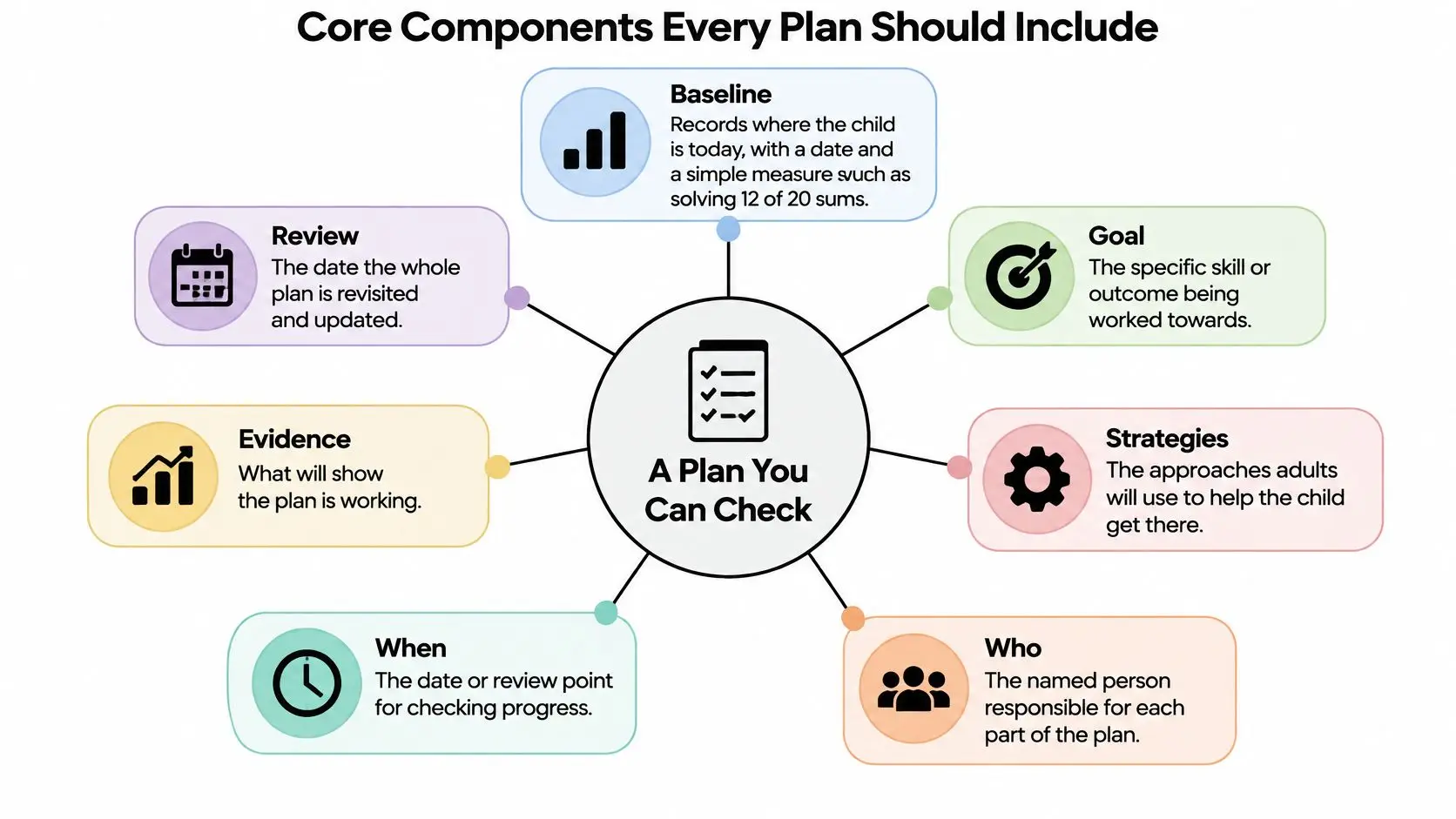
A plan works when each part can be checked. Seven components do that job. If one is missing, the others lose their meaning.
| Component | What to record | Example for a child |
|---|---|---|
| Baseline | Current performance and confidence, with a date | Solves two-step equations with help; confidence 4/10 |
| Strengths | What the child does well and enjoys | Explains ideas clearly in writing; enjoys science videos |
| Barriers | What gets in the way of learning | Long verbal instructions cause panic in live lessons |
| Outcomes | Two or three measurable goals with a time frame | Completes four fraction problems independently in three of four sessions |
| Provision and adjustments | Support, who provides it and how often | Recorded explanations; visual schedule; 15-minute weekly mentor check-in |
| Learner voice | The child's own account of what helps and what does not | "I want to answer in chat first before I speak" |
| Review date | When progress will be checked and by whom | Fortnightly, with parent, teacher and child |
What makes each part checkable
Baseline records where the child is today, with a date and a simple measure. For Maya, that is two-step equations completed with help, plus a confidence rating of 4 out of 10 in live lessons. Without that starting point, later success has nothing to stand next to.
Strengths names what the child does well and enjoys. Maya explains ideas clearly in writing and loves science videos. Those strengths are the route into harder work, not a nice extra at the bottom of the page.
Barriers names what gets in the way. Long verbal instructions cause panic once a live lesson starts. A barrier with no evidence attached is only a worry. You need something you can see: silence on camera, a dropped chat, a task left blank.
Outcomes sets two or three measurable goals with a time frame. Maya's is four fraction problems, done independently, in three of four weekly sessions.
Provision and adjustments records the support, who provides it, and how often. Recorded explanations, a visual schedule, and a 15-minute weekly mentor check-in are specific enough to keep or drop.
Learner voice captures the child's own account. Maya's line is, "I want to answer in chat first before I speak." Adults do not rewrite that into smoother language.
Review date sets when progress will be checked and who will sit in the conversation. Fortnightly, with parent, teacher and child, is short enough that a failing adjustment does not drag on for a term.
An outcome with no baseline cannot show progress. A barrier with no evidence is just a worry dressed up as a plan.
How to Write a Plan Your Child Can Own
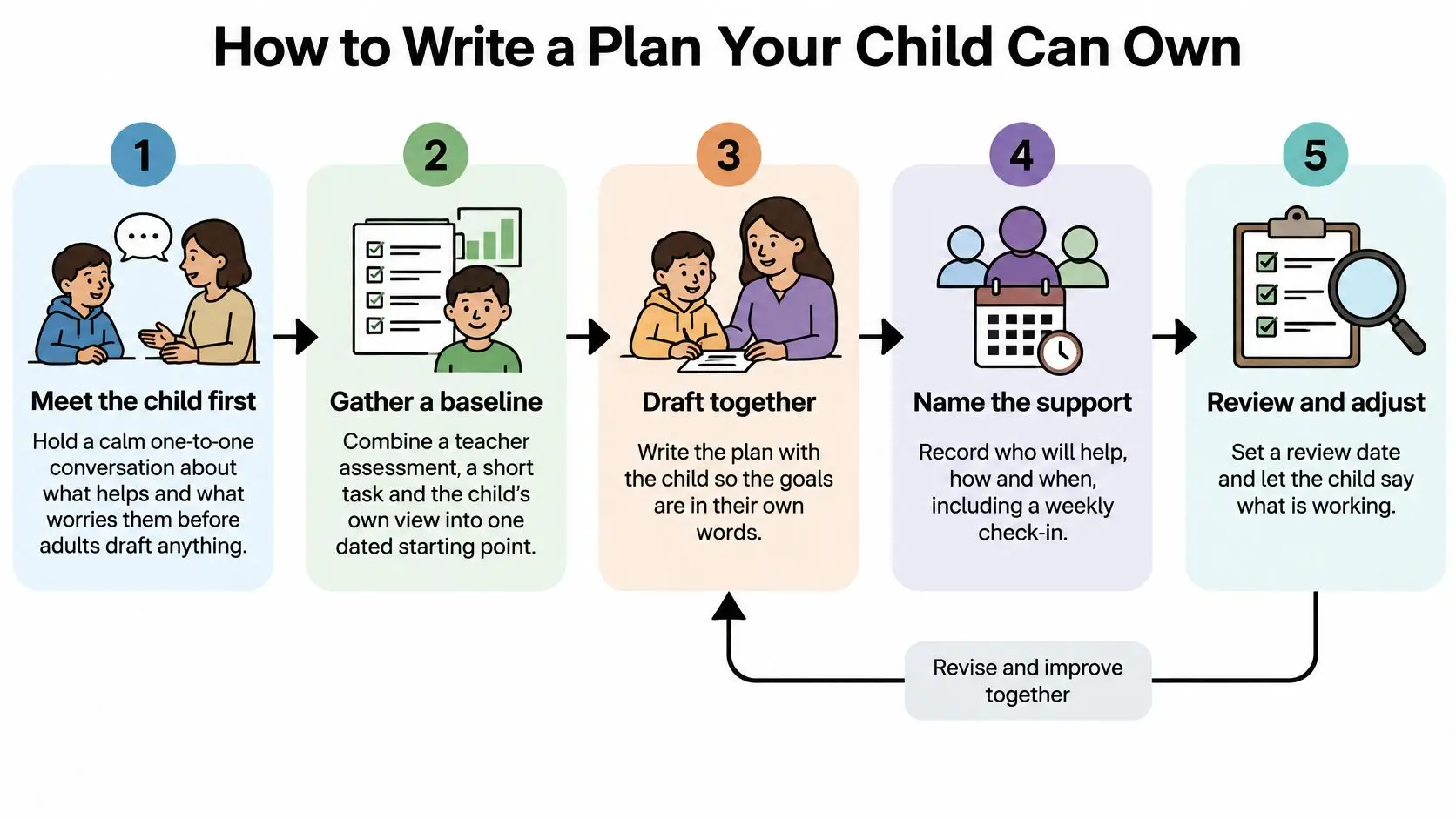
Write the plan with the child in the room, not after the adults have already decided. Seven steps keep the voice, the evidence and the habit in the right order.
Meet the child first. Hold a calm one-to-one conversation about what helps and what worries them before anyone drafts a sentence. This protects the child's voice. Maya is more likely to say "I freeze when the teacher talks for a long time" in a quiet chat than in a meeting of three adults.
Gather a baseline. Combine a teacher assessment, a short task, attendance and engagement records, and what you notice at home. One dated starting point stops later reviews turning into memory contests. If Maya completed two sums with help on Monday and said her confidence was 4 out of 10, that is the baseline, not a general sense that maths is hard.
Agree two or three outcomes. Each one should be measurable and time-bound, and the child should choose at least one. Ownership starts here. A goal Maya picked is harder for her to shrug off than a goal handed down.
Name the barrier and the adjustment for each outcome. A missed target then points to a specific cause, not to the child. If four fraction problems are not done, you ask whether the instructions were too long, not whether Maya "didn't try."
Assign roles. State who provides each support, and how the child can signal they need a break, such as a card in the chat or an agreed hand signal. Clear roles stop support falling between parent, teacher and mentor. Mentor sessions can cover academic goals, personal growth, and strategies for independent learning, self-advocacy and resilience, which helps older learners practise speaking up before they lead a review themselves.
Set the review date and a success question. Ask something the child can answer, such as "Did this help me stay in the lesson?" A date turns the plan into a habit rather than a file that lives in a drawer.
Share a one-page version and keep it visible. Give the child a copy they can read, colour in or decorate. For younger children, a drawn or spoken plan works as well as a written one. The point is that they can find their own goal without asking an adult to open a document.
Practical rule: If the child cannot point to their goal on the page, the plan still belongs to the adults.
A Complete Example Plan for Maya
Here is Maya's plan as a one-page record, filled in at the first meeting and ready to review.
Baseline, first meeting. Solves two-step equations with help. Confidence in live lessons: 4/10.
Strengths. Explains ideas clearly in writing. Enjoys science videos.
Barriers. Long verbal instructions cause panic in live lessons.
Outcome, six weeks. Complete four fraction problems independently in three of four weekly sessions, using a visual model when needed.
Provision. Recorded explanations from the teacher in every lesson. A visual schedule set up by a parent each Sunday. A 15-minute mentor check-in every Thursday.
Learner voice. "I want to answer in chat first before I speak."
Review. Fortnightly with Maya, her parent and her teacher. The question each time is, "Did this help me stay in the lesson?"
How to read a miss
Say the six weeks end and Maya has managed the four problems in only one session. She also says the panic is still there when the teacher talks for a long stretch. The fraction goal is not the problem. The barrier is emotional, not a gap in number sense. Keep the target. Investigate the barrier first: shorter recordings, a pause before the live explanation, or chat answers before any spoken turn. Lowering the goal would hide the underlying cause and teach Maya that fear shrinks the ambition.
Writing Goals That Measure Progress Without Pressure
Vague goals feel kind and achieve very little. Specific goals tell the child what "done" looks like, and they leave room for how the work felt.
"Improve maths" becomes "complete four fraction problems independently in three of four weekly sessions, using a visual model when needed."
"Be more confident in class" becomes "answer one question per lesson in chat, rating confidence from 1 to 5 before and after."
"Stop being anxious about tests" becomes "complete a 10-minute practice quiz with a pause allowed, noting distress before and after."
The feeling sits next to the result. Maya can hit four correct fractions and still leave the lesson frightened or exhausted. If you only record the marks, you will call that a success. She will not.
Three traps that undo a good goal
Too many goals. More than three overwhelms a child and splits attention. Two strong goals beat a list of eight that nobody remembers by Friday.
Goals set only by adults. Children often reject or ignore them. If Maya cannot say the goal back, it is not hers yet. A short guide on helping kids follow through on goals is useful when a child agrees in the meeting and then stalls at home.
Lowering the target the moment it is missed. Investigate the barrier first. Unclear instructions, fatigue, a specific difficulty such as dyscalculia, sensory overload, or fear of getting things wrong can all look like "the goal was too hard." Once the barrier has a name, the goal can stay ambitious and the adjustment can change. Clear learning objectives for students help you keep that line between the aim and the support.
The test is simple. The child should explain their goal in one sentence, in their own words, and say why it matters to them. If Maya says, "I want to do four fraction questions on my own most weeks, because then I won't need someone sitting with me," the goal is ready.
Supporting SEND, Anxiety and Wellbeing Needs
Start with strengths, then barriers, then adjustments. A plan that opens with a list of problems teaches the child that they are the problem.
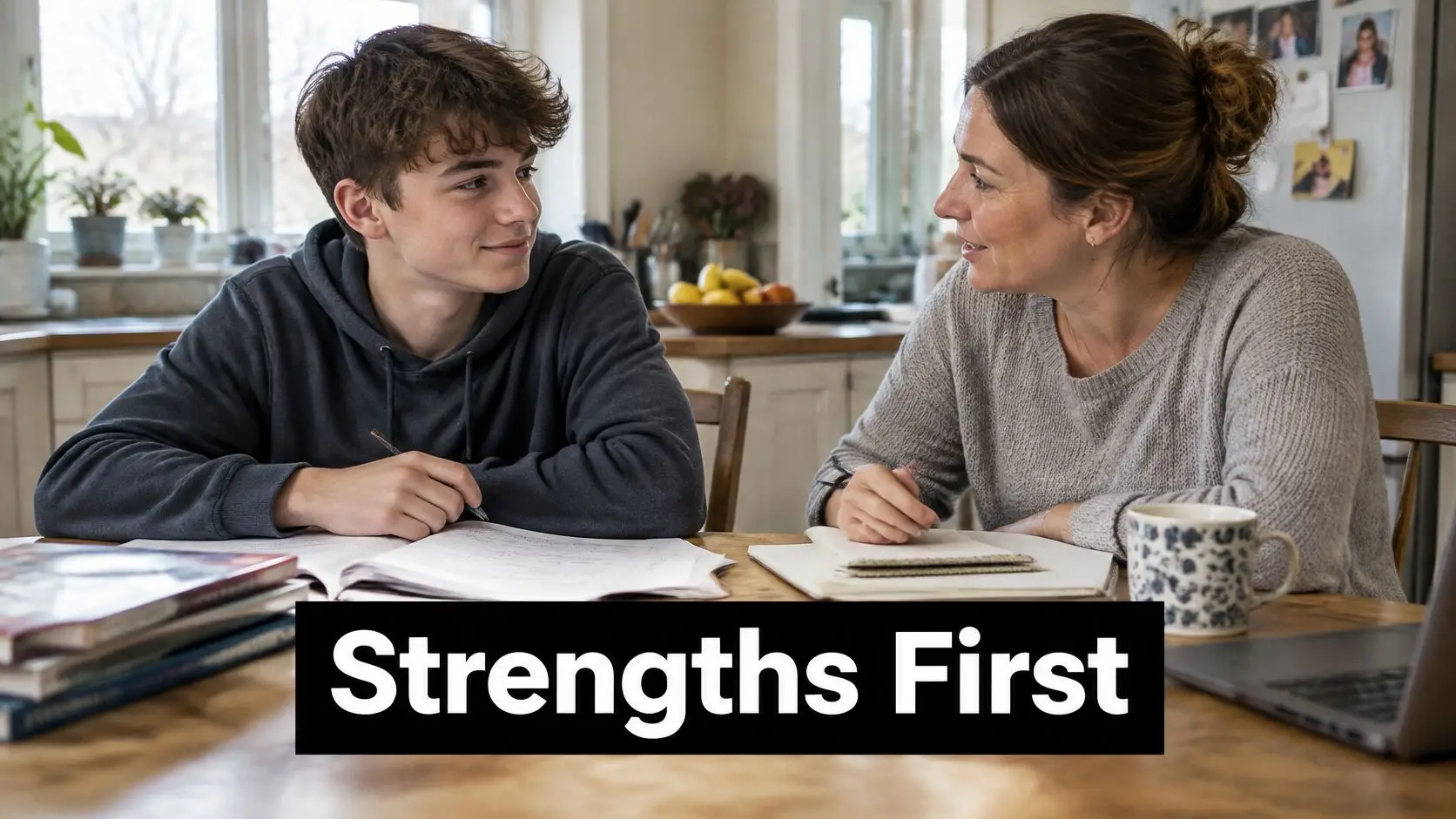
Take Sam, 15, who revises well on paper and falls apart in timed tests. His strength is clear written explanations. His barrier is exam anxiety: racing thoughts, stomach pain, and a fear of being called on. He wrote those warning signs himself, so his teacher can notice them early rather than waiting for a blank script.
What goes on Sam's page
The plan is a set of actions, not a diagnosis.
- Weekly check-in: a named adult, same day, fifteen minutes.
- Reduced first task: one short question before any longer paper.
- Advance notice: any timetable change sent the day before.
- Permission to pause: a brief stop when panic rises, then a return to the same question.
Each student with special educational needs is paired with a dedicated mentor who meets regularly, and every student has access to a wellbeing mentor as part of pastoral care. Sam uses that check-in to say whether the pause helped.
In the UK government's May 2025 parent, pupil and learner survey, 26% of pupils and learners and 34% of parents who knew about mental-health support at their school or college said they or their child had used it, and 83% of parents agreed they felt confident caring for their child's mental health, according to the parent, pupil and learner voice findings. Confidence at home still needs a concrete plan at school. Reviews track both the work and the feeling: whether the assignment was finished, and whether distress fell from 8/10 to 5/10 over four weeks.
For learners with SEND, name the adjustment and the functional change you expect. Chunked instructions, a visual timer, or a sensory-friendly break should show up as something you can count, such as staying for the first 15 minutes of a task in four of five sessions. If that stalls, you can tell whether the teaching, the adjustment or the level of support needs to change. A SEN support plan is one place those adjustments can sit beside the academic goals. Where attention and emotional regulation are tangled, families sometimes also look at Kelowna counselling for ADHD alongside school support, so the plan is not asked to do a counsellor's job.
A short film on naming feelings before a task can help a teenager put warning signs into their own words.
Emotional safety is not an optional extra. A child who feels safe can take part. A child who is frightened will not learn well, however tidy the plan looks on paper.
Reviewing the Plan and Deciding What Changes
A review is five parts in a fixed order: a baseline task, the agreed adjustment, evidence from classwork or from attendance and engagement, the learner's voice, and a decision to continue, change or stop. Do them in that order so feelings do not get bolted on at the end.
A fortnightly rhythm fits an online week. One short dashboard holds subject evidence, one learning behaviour indicator, a learner reflection, teacher feedback, and a revised target. Department for Education evidence on effective feedback asks for three things: personalise feedback to the learner, specify the exact steps needed for improvement, and help learners set realistic goals and track progress. Feedback changes learning only when it closes the gap between where the child is and where the goal sits. "Well done" does not tell Maya what to do differently on Thursday.
Signals and the decision they call for
| Review signal | What it may mean | Action |
|---|---|---|
| Goal met in three sessions running | Adjustment is working and skill is embedding | Keep the support and raise the challenge slightly |
| Goal met only with adult prompts | Learning still depends on support | Keep the support and plan to fade prompts gradually |
| Goal missed and child reports distress | Barrier is emotional rather than academic | Investigate the barrier with the child before changing the target |
| Goal missed with no distress reported | Task is unclear or too hard | Simplify the task or rewrite the instructions |
| Child says the adjustment does not help | Support does not match the child's needs | Replace the adjustment and review again in two weeks |
| No change after four weeks | Target, teaching or support needs changing | Review all three with the teacher and parent |
The question at every review is, "How will we know this plan is working beyond better marks?" Progress can be read from assessment data, mentor check-ins, the child's self-reflection and engagement, with wellbeing, confidence, independence and connection considered alongside grades. Regular progress reports and teacher consultations give families a view of achievements and of what still needs work, which is the point of reporting student progress in a way a child can understand.
Regular review should slowly cut the child's reliance on prompts. Fewer prompts, with the goal still met, is the plan doing its job.
Start Your Child's Plan This Week
You do not need a perfect template. You need three actions, in this order.
- Write three strengths, one dread, and one six-week goal. Three things your child does well, one thing that makes them dread learning, and one goal for the next six weeks.
- Book a short conversation with the teacher. Compare notes and agree a review date before the meeting ends.
- Ask what would make the next lesson feel safer. Write your child's answer word for word.
Seek more support if a child with identified SEND has no plan, if distress is affecting attendance, or if the school has not responded to your concerns. Ask for the SENCO. In England, a referral for an EHC needs assessment is the statutory route when needs go beyond ordinary provision. Families who want a structured alternative can ask us, after a discovery call, to design a customised learning pathway covering subjects, pace and schedule, from KS2 through Sixth Form, including lesson recordings and self-paced work where the week is uneven. Pick one of the three actions and do it this week.
Queens Online School builds a personal learning plan into live British-curriculum lessons, with mentor check-ins, recorded catch-up and support that follows the child's pace from Key Stage 2 to Sixth Form. Feelings, barriers and goals sit in the same plan, so progress is more than a mark. Visit Queens Online School to see how a pathway can be shaped around your child.