

The results are on the kitchen table and the grade sits one below the offer, or the offer has gone entirely, and nobody in the house has said anything for twenty minutes. Then someone asks the question that starts everything: can you resit A levels? Almost always, yes. But the version most families picture, a second attempt at the same paper in a few weeks, isn't how it works.
A resit is a formal exam entry. It has a specification code, a component list, an approved centre willing to take your child, a fee, a deadline and, in most cases, a full year attached to it. Getting the entry right matters as much as the revision does. Search "how to resit A levels" and you'll mostly find timetables and past papers, which is the smaller half of the job.
The families who come through a resit year well are the ones who treat it as a project with dates rather than a mood with textbooks. They also keep the child at the centre of it, because a plan that ignores anxiety, illness or a need for extra time falls apart in the exam hall, not on the revision schedule.
Check Which Resit Rules Apply to Your Qualification
Priya is 17. She took A level Chemistry, came out with a B, and missed her offer by four marks. Her first question was which paper she could sit again. On a linear A level there is no single paper to pick. The qualification works like a return train ticket: you travel the whole route again, not one station.
Four qualifications sit on different calendars, so the rules come before any revision plan. The table shows what a resit means for each type.
| Qualification | Resit window | What you retake | Fees to check |
|---|---|---|---|
| Linear A level (Ofqual-regulated) | Next summer series (May to June) | All written components; non-exam marks may be reused | What the centre charges for a full entry, including any examination fee of its own |
| Unitised AS or A level (Qualifications Wales or CCEA Regulation) | Next summer series | An individual unit, once only | The centre's fee for a single unit entry, and whether that unit is still offered |
| A level with coursework or practical components | Next summer series | Written components; coursework or practical marks can be retaken or carried forward | Whether the centre can supervise practical work and what it charges |
| GCSE English Language or Maths | November series may be available for eligible candidates | Full qualification | Whether the centre runs the November series and what it charges |
What a four-mark miss actually costs in papers
The summer window follows the exam calendar. GCSE, AS and A level papers are set in May and June, so an A level taken to improve a grade normally waits for the following summer series. GCSE English Language and Mathematics are the exception: eligible candidates may have a November series. A student who sits in summer 2026 would therefore plan a resit for summer 2027, using the awarding body's 2027 timetable once it is published.
That is a full year of work. The grade gain has to be worth another set of papers, another centre entry and twelve more months before a degree starts.
Priya's course is linear, so she sits every written paper again. Her practical endorsement may be carried forward if her centre and board allow it. Families often assume the weakest paper can be isolated. On this structure it cannot.
Some UK qualifications split the work differently. Ofqual-regulated A levels designed under current requirements require students to retake all examinations. Some unitised AS and A levels regulated by Qualifications Wales or CCEA Regulation allow individual units to be retaken, each unit only once, as the joint statement from the qualification regulators sets out. One unit instead of the whole qualification can cut the workload sharply, so check the structure before anyone buys a revision guide.
Check before you commit. Pull three details from the certificate and statement of results: the specification code, the regulator (Ofqual, Qualifications Wales or CCEA Regulation) and the awarding organisation. Then confirm all three with the school, sixth-form provider or approved centre that will make the entry.
Fees vary by grade, subject and institution, and a centre can add its own examination fee, so confirm the total before committing. Results day is a poor day for arithmetic and a worse day for decisions. Give the family a week, gather the marks and the specification, then choose.
Resit, Clearing or a Different Route
A resit feels like the responsible option, which is exactly why it deserves a challenge. It costs another year of study, another set of fees and twelve more months before a degree begins, all to move one grade. Sometimes that trade is obviously right. Sometimes it isn't, and the alternative isn't failure.
The scale explains why one-size advice fails. In England, 313,190 students received A-level results in summer 2025, part of 864,810 AS and A level results issued overall (Department for Education statistics on 2025 16 to 18 results). Each of those students sits a different distance from their plan, and because resits normally run in the following summer series, the decision carries a full additional academic year with it, affecting university start dates, student finance, predicted grades and any application written while waiting.
Before weighing any of that, rule out a marking error. If the mark looks wrong rather than the preparation looking weak, a review of marking is faster and cheaper than a year of study, and the steps are set out in this guide to appealing exam results.
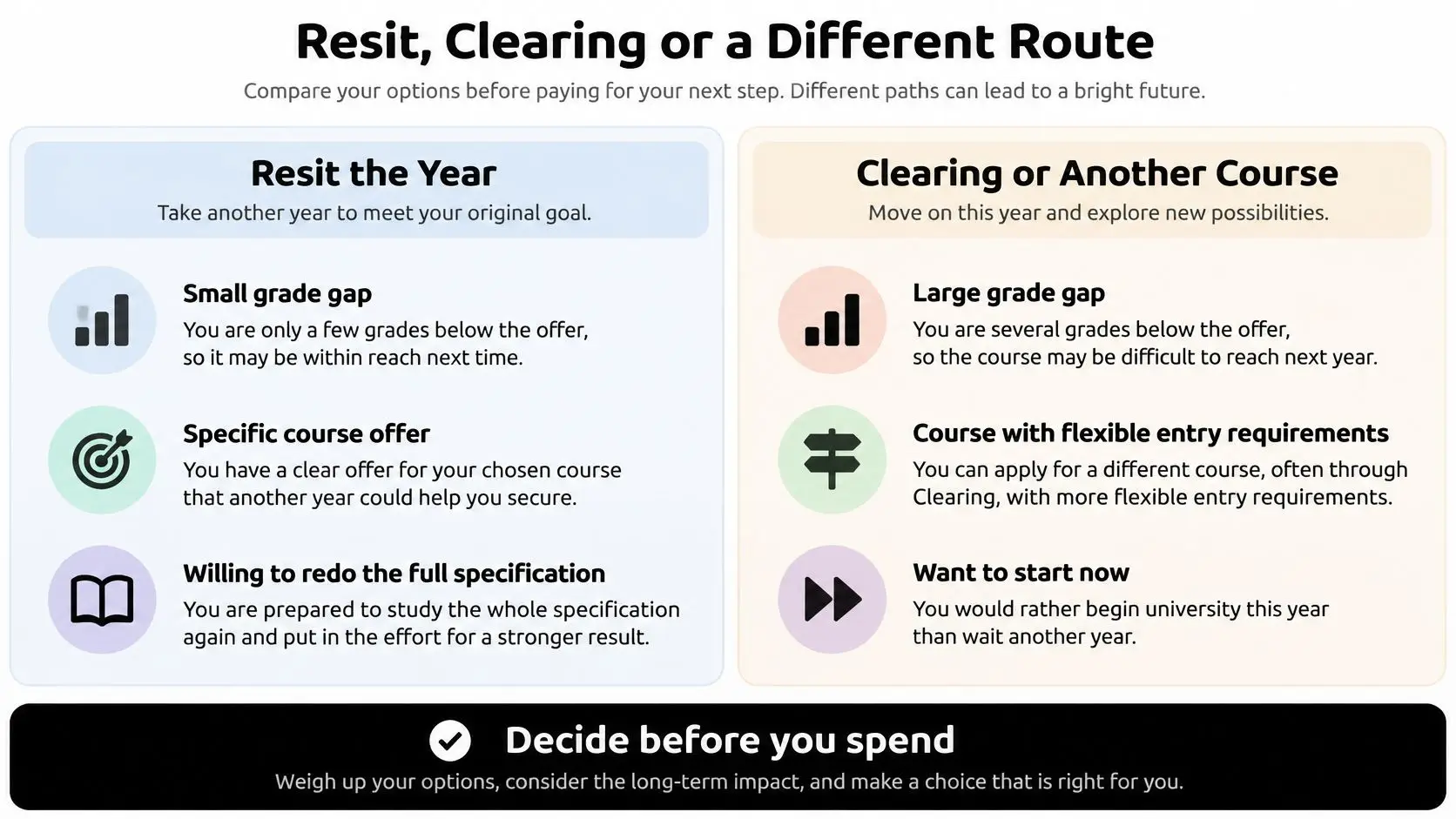
The comparison below is the one to work through before money is spent, because each option is best under different conditions.
| Option | Best when | Main cost | Check first |
|---|---|---|---|
| Resit the A level in the next summer | Grade gap is small and the course requires that grade | A full extra academic year | Whether the university accepts resit grades |
| Apply through Clearing | Results narrowly missed the offer and places remain on the course | Possibly losing the chosen course | Which courses still have vacancies on results day |
| Take a foundation year | Entry grades are far short or there is no direct route | An extra year of fees and study | Whether the foundation course leads to the target degree |
| Change qualification route | Current subjects don't fit the target course or career | Learning new subjects from a standing start | The entry requirements of the target course |
Three questions to put to every university
- Do you accept resit grades for this specific course? Ask the admissions team for the course in writing, because policies differ between departments in the same university.
- Can the place be deferred? Some departments will hold an offer for a year, which changes the arithmetic completely.
- Will you use the predicted grade or wait for the resit result? The answer decides whether the student applies this cycle or next.
Sam, 17, missed his offer by one grade and rang three universities in an afternoon. Two said resit grades were accepted without penalty. That answer settled the choice before his parents had priced a retake course. Recognition is rarely the sticking point anyway: the A Level and International GCSE qualifications we offer are accepted by universities, colleges and employers in the UK and internationally, and our students apply through UCAS with support from the Guidance Team at Queen's Online School. The variable is the course's own policy, which is why you ask.
Where schooling was disrupted by illness, SEN or SEMH needs, gather evidence now: a letter from the school, a medical report, a record of adjustments. Admissions teams read context, but only the context you send them. And name the feeling out loud. Many teenagers hear "don't resit" as "you weren't good enough", so say clearly that moving on is a decision, not a verdict. Resitting isn't automatically the safe option. A year of fees, lost earnings and delayed progression can outweigh one grade unless the course or profession requires it.
Finding an Exam Centre That Will Take You
Amira is 18 and studies A level Biology and Psychology online from home. She has anxiety, and her exams need a separate room and supervised rest breaks. When her Psychology grade landed a grade below her offer, her mother began ringing centres in the first week of July. The first two wouldn't take private candidates at all. The third would, but asked for medical evidence for the separate room eight weeks before the exam date. That call took eleven minutes and ended a month of dread.
The rule behind those refusals is simple. Ofqual's student guide to exams and assessments explains that private candidates, including home-educated students, learners who have left school or college, and students studying with a distance-learning provider, a tutor, a parent or independently, must register with a school, college or other approved examination centre. Not every centre accepts them, so families should make contact as early as possible and confirm the exam board, subjects, entry deadlines and fees.
The trap for online learners is assuming that enrolment creates an entry. It doesn't. Teaching and examination entry are separate arrangements, and an online course does not automatically produce an exam entry. GCSE, International GCSE and A Level exams are sat at approved exam centres rather than at home, in line with UK examination board requirements, and Queen's is a Pearson Edexcel Approved Centre, which is one of the first things worth checking when you compare options. Families weighing online study against a school place can read more about A level homeschooling and where exam entry fits into it.
Questions to put to every centre
- Do you accept private candidates for this specification? Name the board and the specification code, not just the subject.
- What are your internal deadlines and fees? Centres set their own cut-off dates, usually well ahead of the board's.
- How is invigilation arranged? Ask who supervises, and whether the centre runs the series in full or only for certain subjects.
- Are papers sat on paper or on screen? The answer affects practice, and it isn't the same everywhere.
- What do you need for access arrangements? Extra time, supervised rest breaks, a separate room, medical evidence, and who pays for each element.
- How is coursework or practical work handled? Whether the centre can supervise it, and what that costs.
One checklist, every centre. Ask the same six questions by email and keep the replies. Comparing written answers is far calmer than comparing how persuasive someone sounded on the phone.
Support isn't uniform between centres, and national reporting on it is still settling. Ofqual's access-arrangement statistics for GCSE, AS and A level were still classed as "official statistics in development" in November 2025, according to Ofqual's 2025 results overview. Assume nothing carries over from a previous school unless a centre confirms it in writing. Start the access conversation when you make the entry, not when the exam is close.
Planning Revision Around the Marks You Lost
A resit year lifts a grade when the plan is built from the marks that went missing. Here is the working order.
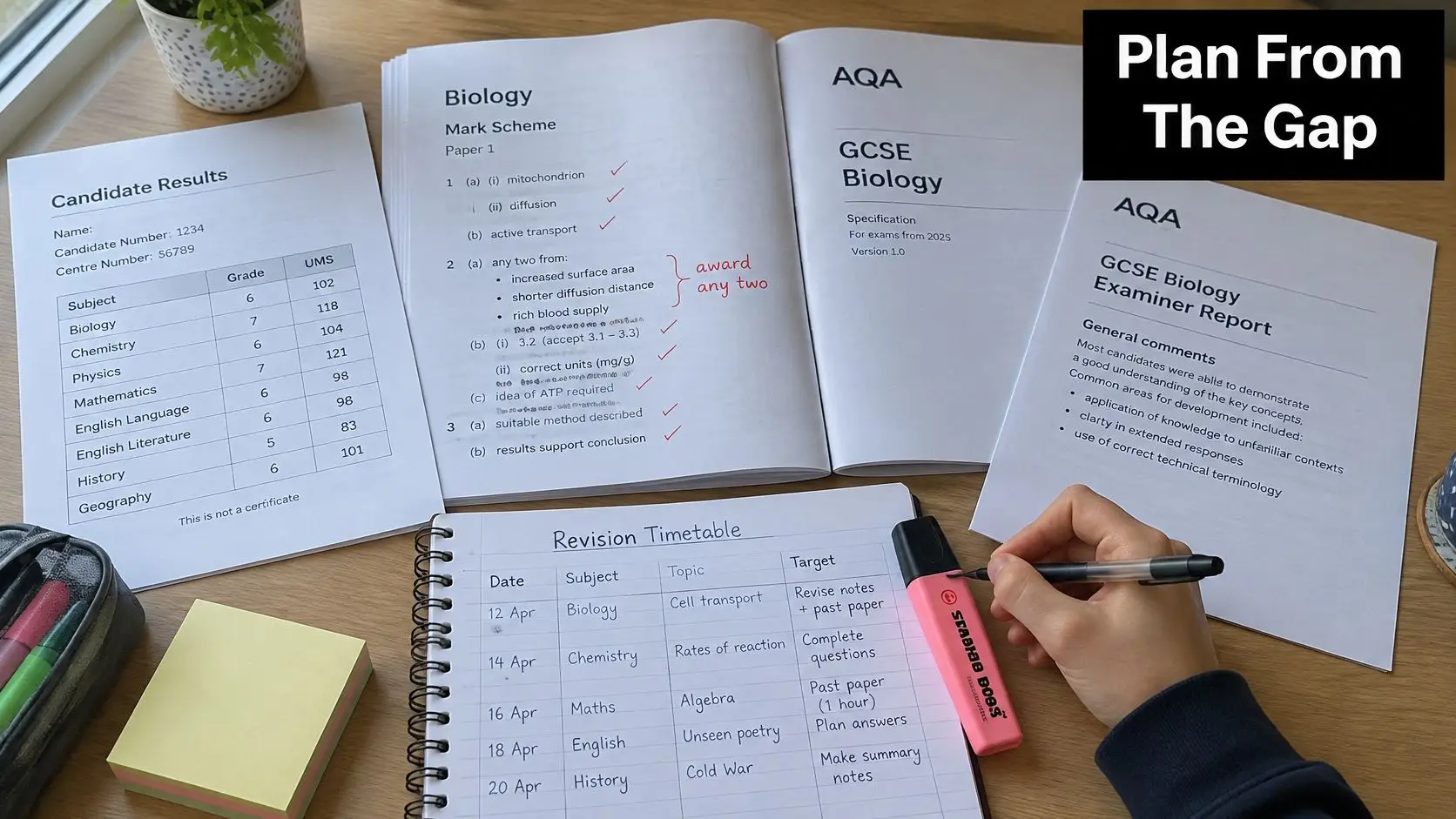
- Record the baseline. Grade, component marks and raw marks where the board releases them.
- Collect what explains the marks. Specification, mark schemes, examiner reports and a few years of grade boundaries.
- Set a target with a number in it. The university offer, plus the marks realistically recoverable in the time available.
- Split the week three ways. Content repair, retrieval practice and timed papers, with a fixed share for each.
- Sit full papers at checkpoints. Marked independently or moderated by a teacher, never self-marked in a good mood.
- Review the entry, the access arrangements and the fallback. Confirm them again in the spring, not just in September.
Official data helps you compare sensibly, but it can't promise a grade. England's performance datasets, such as the Explore Education Statistics A level data set, report entries and grades by subject, region, institution type and student characteristics, and the methodology distinguishes component-level entries from qualification-level results, including passes, ungraded outcomes and absence codes. The pitfall is reading a national figure as a personal probability. Government statistics describe populations, not causes.
What the tracker should record
A spreadsheet with four columns does more than a shelf of revision guides: topic, question type or command word, marks lost, and error category. After each paper, sort every lost mark into it. Twelve weeks of that gives you a map of where the grade is hiding, and it stops a resit year turning into a repeat of the first one, since more attempts don't cure a recurring misconception or a habit of running out of time.
| Error category | What it looks like | Fix |
|---|---|---|
| Knowledge | Blank or wrong answers on topics never fully learned | Content repair from the specification with a one-page topic summary |
| Application | Correct facts applied to the wrong context in the question | Practise with unseen case studies and compare against model answers |
| Analysis | Describes a point but doesn't explain the link | Write explicit because chains and check examiner report phrasing |
| Evaluation | Lists points without reaching a judgement | Write one-paragraph verdicts and mark them against the mark scheme |
| Timing | Runs out of time on the last question | Full timed papers with a time budget set per mark |
Say Jamal retook Physics and pulled his mock apart. Roughly three in five of his lost marks came from the final extended question, which he never reached. Rereading notes would have fixed none of it. He rebuilt his week around timed papers with a minute-per-mark budget, and his teacher marked two a week.
Timed essays and long answers need a reader who isn't the student. Teachers and tutors are the gold standard, and AI help with essays and revision can give a first pass on structure and explanation between lessons, provided the final judgement comes from the mark scheme. The wider method, including spacing and retrieval, is covered in this guide to how to revise for A levels.
Protect energy as deliberately as you protect study time. A student who is already anxious about exams doesn't need a plan with no edges. Schedule one full day off each week, keep sleep steady from the start of the year rather than the week before the first paper, and treat a missed session as information rather than a moral failure.
Enter Your Resit and Lock In the Summer Plan
The entry itself is a short list of tasks with long consequences. Work through it in order and keep every confirmation in writing.
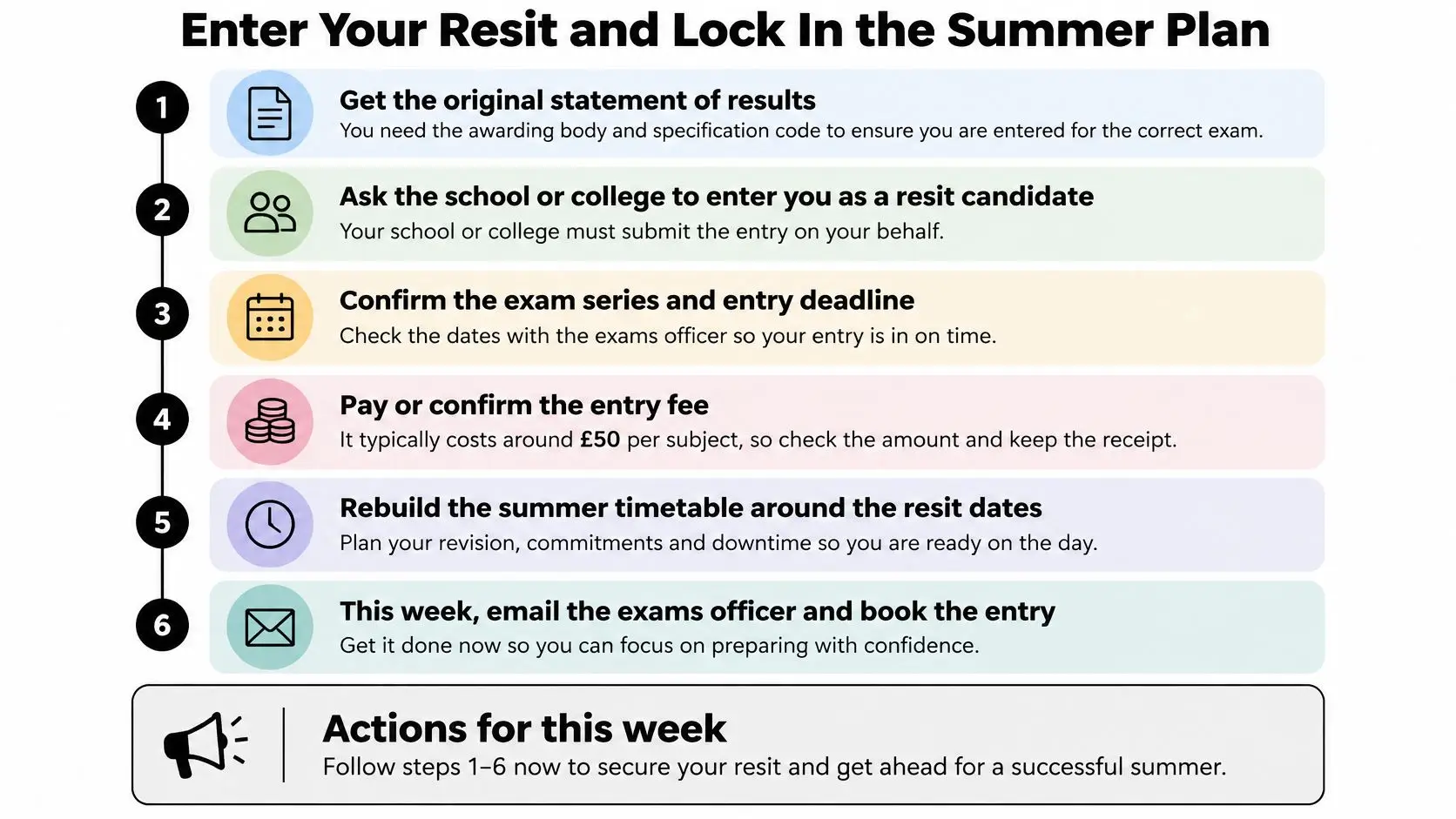
- Find the original statement of results. The awarding organisation and specification code are on it, and the centre will ask for both.
- Ask who will enter you. The old school or sixth-form college may, or you may need an approved centre that accepts private candidates.
- Confirm every required component is being entered. Entries often go wrong at this stage, so read the next paragraph.
- Settle the fee and the payer. Selecting examination centres, registering the student, paying exam fees and meeting entry deadlines sit with the parent, so diarise each one.
- Check the university's policy on first-sit and resit grades before the entry is made, not after.
- Book access arrangements and send the evidence before the centre's deadline, not when the timetable arrives.
- Get written confirmation listing each subject, paper and fee. That email is how you know the job is done.
Step 3 matters more than it looks. Ofqual counts entries at component level while results are issued for the whole qualification, so a centre that enters only the paper where the student did worst hasn't entered a resit at all. The guidance for schools and colleges on the period after exams sets out the practical sequence: obtain the statement of results, identify the awarding organisation and specification code, then have an approved centre confirm the correct entry route and deadlines.
For a student who wants to hear the process rather than read it, watch this together before the first call to a centre.
Build the calendar backwards from the first paper
Ofqual schedules GCSE, AS and A level examinations between 7 May and 23 June 2026 for the 2026 series, and candidates must be available throughout the examination period, as the Ofqual student guide for 2026 states. Your child may sit only a handful of papers inside those weeks, but the family calendar has to hold all of them.
Tom's parents booked a holiday in the second week of June before anyone checked the centre's entry date, then discovered the deadline had passed while they were away. They now start every summer with a deadline calendar on the fridge. Build yours backwards from the first paper: content review, timed papers, rest days, and a buffer for the unexpected.
A practice run of the journey helps a nervous candidate more than another hour of revision, especially for an international family travelling to a UK centre or a student who has never sat in that building. Agree in advance how your child will know the year is going well, using mock marks and marked papers rather than how they feel on a Tuesday. A year is long enough for good intentions to rot, so the seven ways to stop procrastinating from Badger are a useful starting point for a bright but avoidant student.
Three things this week. Email the exams officer or centre and ask for the entry route and internal deadline in writing. Put both dates, plus the first paper, into a shared calendar. And if your child needs extra time, rest breaks or a separate room, start that conversation now. Our teachers at Queen's Online School are subject specialists, and a resit year with steady teaching behind it is a very different experience from one carried alone. A resit is a clear, recoverable route for many students, and the paperwork is the part you can control first.
Queen's Online School teaches the British curriculum online from Primary through Sixth Form, with live lessons, recorded sessions and subject-specialist teachers, and our Guidance Team supports students applying to universities in the UK and internationally through UCAS. If your child is weighing a resit year, we can help you plan the study around the exam dates and the entry that has to happen first. Visit Queens Online School to see how that year could be structured.