


Your fourteen-year-old is calmer at the kitchen table than they ever were in a crowded corridor. Home is working. Then GCSEs come up, and the calm cracks. You can picture the child you know, bright in conversation and shaky on a timed paper, and you are not sure which route protects both the learning and the person.
That worry is the right one to start with. Online GCSE courses for homeschooling can teach the syllabus well and still leave a teenager stranded if no approved centre will enter them, if a speaking task cannot be arranged, or if the nearest sitting is a long drive on a morning when their nerves are already high. The qualification is the same national exam other pupils take. The way in is not.
The decisions below follow the order that keeps your child steady: which style of study fits them, whether the exam route is real, what sitting it costs, how support for anxiety or SEN is secured, and what a live week should feel like in the body as well as on the timetable.
Online GCSE Options Compared at a Glance
A fourteen-year-old can be thriving at home and still need a clear path into public exams. You are not making this choice in a tiny corner of education. Department for Education statistics recorded 111,700 children in elective home education on the autumn 2024 census date, 1.4% of children aged 5 to 16, up from an estimated 92,000 in autumn 2023. Those figures cover children whose local authority knew they were educated at home, so they are not a full count of every home-educated learner. Even so, more than one in every 70 children in that age range was recorded as electively home educated. The House of Commons Library later estimated 126,000 children in elective home education in England in autumn 2025, about 1.5% of school-age children. The 2024 count is a floor, and the trend is still rising.
How to read the four routes
| Route | How lessons run | Exam entry | Suits | Main risk |
|---|---|---|---|---|
| Live online school with subject teachers | Scheduled live classes in small groups, plus recorded sessions | Provider is an approved centre and sits exams at approved centres | Children who need structure, feedback and a teacher | Fixed timetable and fees to plan for |
| Self-study with private-candidate exam route | Parent-chosen resources, self-paced study | Parent registers the child with an approved centre, which is not obliged to accept private candidates | Confident self-starters with a parent who can teach | No teacher feedback and centre availability |
| Private tutor for single subjects | One-to-one or small group sessions | Tutor does not enter exams, so a centre must still be found | Filling a single gap in one subject | Patchy coverage and costs that add up across subjects |
| Hybrid part-time school timetable | On-site lessons for some subjects, home study for others | Usually entered through the school | Families wanting a mix of school and home learning | Less flexibility and travel time to the site |
Read the Suits column before the price in your head. A teen who goes quiet when maths is left to a textbook needs a teacher who sees the working and corrects it that week. A confident reader who already annotates novels can often self-study English, with you checking the specification rather than teaching every lesson. Queen's Online School is the live, teacher-led route in the first row, with small classes and recorded sessions so a hard topic can be replayed without a second full lesson. None of the four rows ends at the laptop. Every route still needs an approved exam centre.
The table answers one question: does your child need a teacher-led timetable, or a flexible plan you can run with confidence?
Pearson Accreditation and Exam Entry Rules
A course can teach the right topics and still not produce a qualification. The grade only counts when the exam is sat through an approved centre for the correct specification. Marketing language about being "GCSE ready" is not the same as a centre number, and that gap matters most to the child who has worked for two years and then discovers nobody will enter them.
Queen's Online School is a Pearson Edexcel Approved Centre and a registered UCAS centre, so the Pearson Edexcel centre status behind the qualification route can be checked alongside the subjects on offer. GCSE, International GCSE and A Level exams are sat at approved exam centres rather than at home, in line with UK examination board requirements. Ask for the exam board, the specification code and the centre approval reference in writing before you pay a term's fees. A warm admissions call is not a substitute for that paper trail, and requesting it costs you one email.
The rule that catches families out
Ofqual's student guide states that home-educated learners entered as private candidates must register with a school, college or other approved examination centre, and centres are not obliged to accept private candidates. That second half is the sentence to read twice. A centre can decline your child, so treat the search the way you would treat booking a venue for a wedding: early, in writing, with a backup name already on the list. Leaving it until the spring of Year 11 is how a capable teenager ends up anxious rather than entered.
Say these questions out loud to the centre, and write down the answers:
- Which exam board and specification will my child be entered for?
- Does the centre accept private candidates for every subject on our list?
- Which non-exam assessments, such as speaking or practical work, does it run, and how are they recorded?
- What is the entry deadline, and who submits access arrangement applications?
A teenager taking GCSE English needs the third answer before you enrol. Some centres run examination-only entries, so spoken work can be refused even when the written papers are fine. Confirm how the speaking component is handled, and by whom, while you can still change subject or provider. Ask the same about Art & Design, where set tasks and portfolio work follow a different rhythm from timed written papers.
Support in a live lesson does not travel into the exam hall on its own. Reasonable adjustments such as extra time, supervised rest breaks or modified papers are arranged by the exam centre, and the request usually needs evidence of need already on file. For a learner with SEN, ADHD, dyslexia, autism or SEMH-related barriers, that means raising it at entry rather than in the final term. Otherwise the quiet room that helps on a Tuesday morning is not there on the morning the grade is decided, and a child who coped all year meets the one day nobody prepared for.
What Exam Entry Really Costs and Where to Sit
A parent can choose a flexible online course, feel the relief of a timetable that fits, and then learn that the only centre still taking private candidates for her son's art and science papers is two hours away. The teaching was right. The sitting was not. The centre is the platform the exam leaves from, and that gap is where a calm plan starts to wobble.
Schools Week reported that at least 10 private-candidate centres had stopped accepting candidates within a year, and that 69 of 207 identified centres offered only a limited subject or access-arrangement service. A course can be academically suitable and still fail your child if you cannot secure a nearby centre for every subject they are taking. GCSE, International GCSE and A Level exams are sat at approved exam centres rather than at home, in line with UK examination board requirements, so the centre question belongs beside the subject list.
What families are paying and how far they travel
| Route | Average cost | Typical travel | Notes |
|---|---|---|---|
| Home-educated private candidate | £160 average; 85% paid £100 to £200 | Two-thirds travelled 20 to 50 miles; 10% travelled over 100 miles | Family pays entry, centre administration and any special arrangements |
| Pupil entered through a school | £57 average GCSE fee | Usually none, as the school hosts the exam | School arranges entry and most administration |
Those survey figures are exam costs, not course tuition. There is no typical online course fee in that reporting, so tuition, entry, centre administration and special-arrangement charges belong on one written schedule before the first subject is chosen. Queen's Online School's GCSE online exam arrangements explain how sittings are organised, but they do not replace the centre's fee list.
A subject-by-subject check
Before you lock a subject list, ask each centre these points in writing:
- Science practical work: Can the centre host or accept the practical or internally assessed element, or is the specification one a private candidate can complete?
- Art and Design portfolio: Who supervises and authenticates the portfolio, and is there a deadline weeks before the written or timed piece?
- Access arrangements: What evidence do they need, and what is the last date they will submit it?
- Full fee schedule: Entry, invigilation, administration and any charge for a smaller room or a reader, listed per subject.
Say a family enters four subjects and each sitting lands near that £160 average. The exam line alone is in the region of £640, and that is before petrol, a parent taking time off work, and a centre administration fee on top. For a child who already finds crowds hard, a 100-mile dawn start is not a small extra. It can undo months of steady work. Get each centre's full fee schedule in writing before you choose the first subject, and pick the combination you can reach on a school-run morning.
Support for SEN, SEMH and Access Arrangements
A child who left school because of anxiety can settle at the kitchen table within weeks. The room is quiet. Nobody watches them walk into a hall. The exam is still ahead: a fixed morning, a centre they may never have seen, and a paper sat under someone else's rules. That is when the old fear often returns, and a parent can feel the move home only relocated the problem.
This pattern is common. SEN support and education, health and care plans are more common among children educated at home than across the wider school population. Those needs belong in the first conversation about a course, not in a footnote after the timetable is already fixed.
What support has to cover
Home can lower the noise, the corridor crush, and the fear of being called on in front of thirty people. The same home can raise isolation, the load of planning the day, and dependence on you to remember every deadline. A useful course works like a handrail on a staircase: the child still climbs, but nobody asks them to invent each step while anxious. Look for structured routines, regular pastoral contact, a written support plan, and someone who will talk to the exam centre with you.
If anxiety stops your child joining a live lesson, you need a plan for that week. A recording left in a folder, with a hope they catch up alone, is not that plan.
Help during lessons and formal exam help follow different rules. A teacher can offer a movement break, a laptop, or a quieter check-in because that is how your child works in class. A JCQ access arrangement is agreed before the assessment, case by case, and only with evidence of need. Queen's Online School's page on exam access arrangements sets out how that coordination works alongside lessons.
25% extra time is the example parents hear most. It is not automatic because a child has dyslexia, ADHD, or another diagnosis. JCQ's access arrangements guidance requires the centre to show that the adjustment reflects the learner's normal way of working, and to explain how the difficulty affects teaching, learning, and the exam. Specialist reports and records from classroom tests or mocks are the usual evidence. A diagnosis letter on its own will not carry the application.
What to do, in order
- List the child's needs and normal support. Write what already happens in lessons: extra time on mocks, a word processor, a rest break, a quiet room.
- Gather specialist evidence. Reports, EHCP extracts, and teacher notes of how the difficulty shows up in real work.
- Ask the centre what it needs and when. Schools and colleges apply on the student's behalf. Some arrangements, including extra time or a scribe, normally go through Access Arrangements Online and must meet the deadline.
- Apply before that deadline. Do not wait for the entry week.
Supervised rest breaks, or non-electronic ear defenders, may not need that online application, though the centre still follows awarding-body rules and keeps evidence, as JCQ's overview of adjustments explains. For a child with SEMH needs or sensory sensitivity, a planned rest break can matter more than extra minutes on a paper they cannot face. Ask whether the usual support can be recorded as normal practice, which evidence is required, and when forms must go in. A predictable plan is itself a form of care.
How a Live Online GCSE Week Is Structured
It is Tuesday, and mathematics is the only live lesson on the screen. Your child is at the kitchen table, in their own room, with a start time and a stop time. A fully qualified UK teacher is teaching in real time. That boundary is what keeps a homeschooled GCSE week kind: the brain gets a beginning, a middle and an end, instead of an open tab that never quite closes.
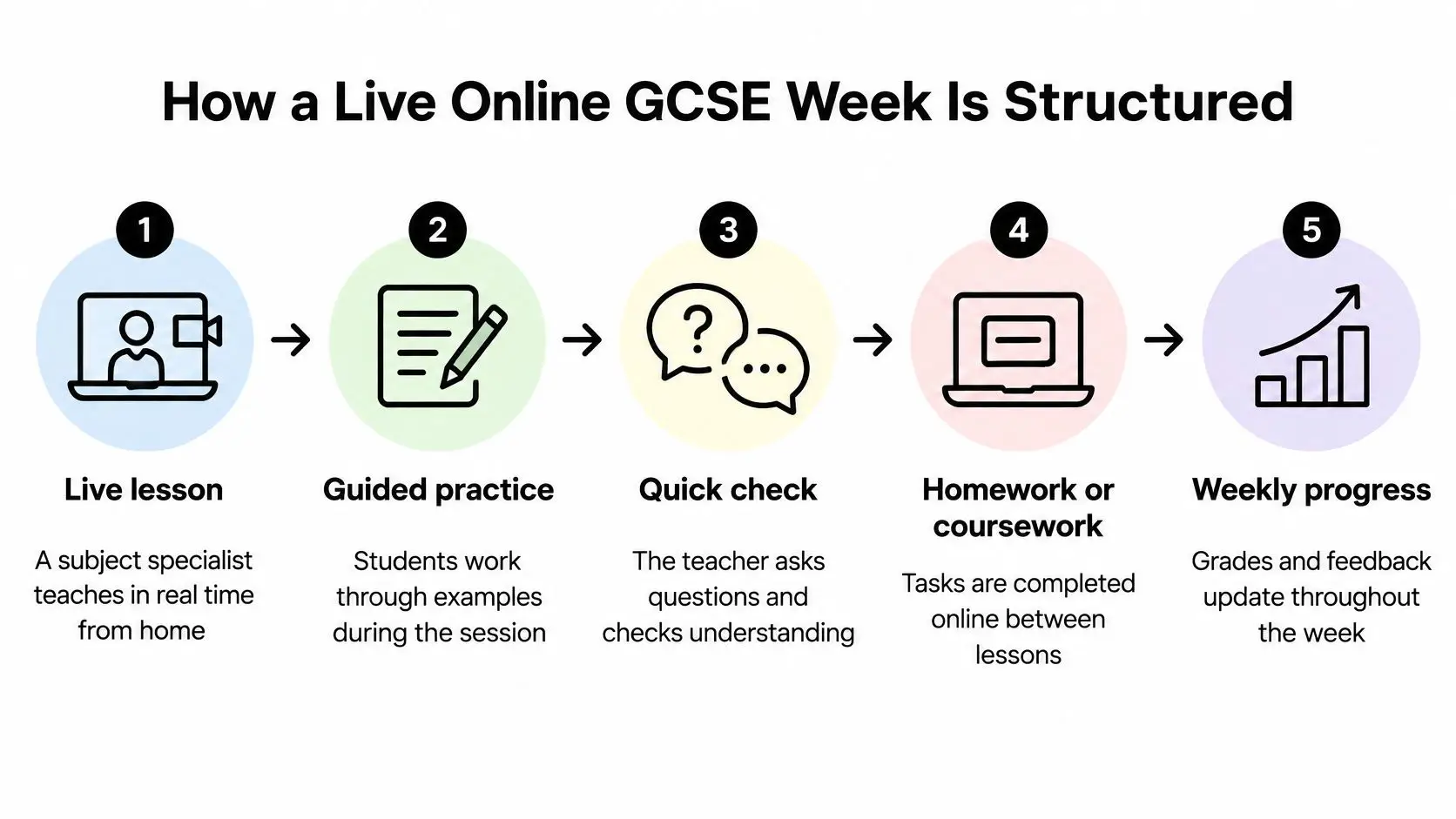
Live lessons run from home on a fixed weekly timetable. The week works like a bell you can see. One subject begins, practice happens while help is still in the room, then the screen closes. Without that shape, a worried child keeps the laptop open "just in case", and the evening slides into more video.
One subject's rhythm
English Language, Mathematics, Science, and Art and Design Fine Art can share the same four beats:
- Live lesson. A subject specialist teaches in real time. Your child can ask when the explanation slips.
- Guided practice in that same session. They try a question while the teacher is still there, so a wrong method does not sit unnoticed until Sunday night.
- Recorded review, used sparingly. The recording is for the topic that snagged, not a second compulsory watching of the whole hour.
- An offline task. A written response, a worked example on paper, or a sketch for the portfolio, away from the screen.
A good week then leaves the laptop. Outdoor walks, reading and family meals sit on the timetable the way a lesson does. Those hours are recovery for a child who has already spent the morning concentrating, not a prize if the homework finishes early.
Ofcom's Online Nation report puts children aged 8 to 14 at about 2 hours 59 minutes online a day across phones, tablets and computers, with 13 to 14-year-olds reaching about four hours, and notes that 76% of 8 to 14-year-olds visited an education-related online service in a month while 78% of 13 to 17-year-olds said the internet helps with schoolwork. Live teaching can sit inside a habit that already exists. A stack of live lessons, recordings, group chats and evening scrolling pushes past that time.
Safeguarding and a Tuesday that stays human
Children do come across material online that feels worrying or nasty. Before you enrol, confirm authenticated classrooms, moderated messaging, a clear way to report a concern, and privacy controls. A video link with no adult oversight is not a school.
On that Tuesday, the live maths lesson includes worked examples. Afterwards they finish one paper task at the table. Dinner is device-free, and the laptop stays in another room. After two weeks, check three things only: do they finish work without tears, do they sleep at a regular time, and can they tell you one thing they learned? If the answer is no, change the load before you change the child.
Tracking Progress, Coursework and Grades
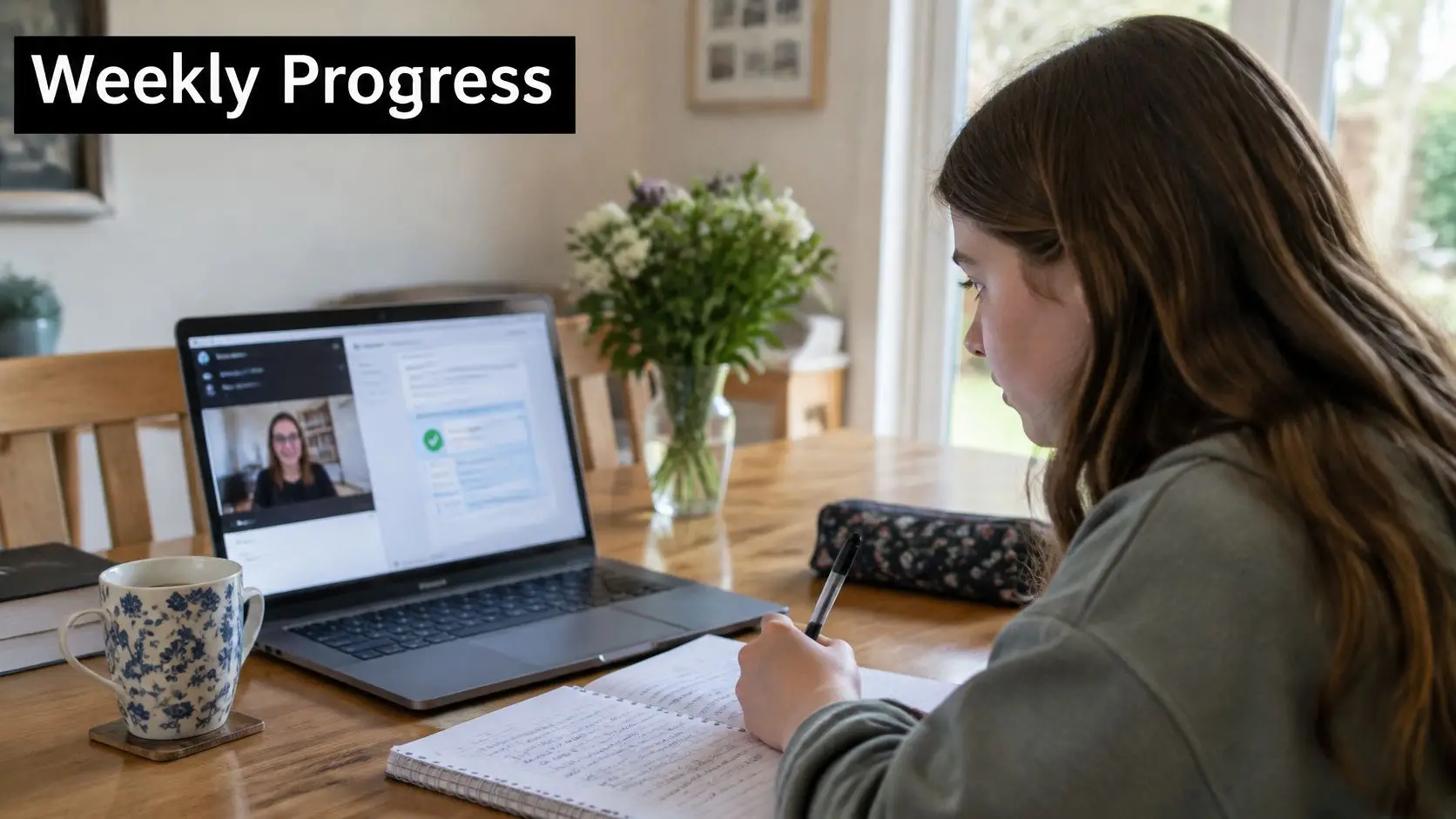
Much of the ongoing assessment, including coursework, quizzes and regular tests, is completed online as part of normal lessons. Progress shows up through the week, not only in a summer envelope. That rhythm matters for a child who has learned to dread the word "test", because a short quiz in lesson time feels different from a hall full of strangers.
Three children, one grade scale
Reformed GCSEs in England use a numbered scale from 9 down to 1, with 9 the highest grade and U meaning unclassified. Ofqual's 9 to 1 grade data sets the outcomes as 9, 8, 7, 6, 5, 4, 3, 2 and 1, then U. It is not a renamed A* to G scale. Grade 4 is the commonly used threshold for a standard pass, and it is a fair first target to say out loud.
- A standard-pass goal in maths. A learner agrees an initial aim of grade 4, then uses mock papers and teacher feedback to see whether the barrier is algebra, geometry or exam technique. The next fortnight's work follows that answer, not a vague wish to "try harder".
- A high aim, held lightly. A highly able learner may aim for grades 7 to 9. The danger is turning every quiz into a verdict. Keep the target on the report, and keep the weekly talk on one skill.
- Recovery before comparison. A child coming back from school-related stress needs smaller milestones that protect confidence. "Finish the paper" can be the win long before the grade is.
Predicted grades, progress reports and sixth-form entry requirements all use this same scale. Read them against the specification your child is entered for, not against a cousin's school or a social-media thread. Once a term, sit with your child and ask three short questions: what is working, what feels hard, and what the next goal is. The point of the number is a sense of achievement they can feel, not a ranking they have to survive.
This short film shows how a live lesson feels from the student's side, which is often the missing piece when a report looks fine on paper and the child still seems flat.
Confirm the Exam Route Before You Enrol
Come back to the child, not the brochure. Do they need a teacher-led timetable and feedback, or a flexible plan you can run with confidence? If tears follow every unmarked worksheet, the flexible plan is costing them more than a timetable would. If they light up when they can go deep on a novel and only stall in one subject, a full live week may be more school than they need.
Three steps close the decision. They point back to the centre checks you have already drafted, rather than starting again:
- Shortlist only the routes that pass the centre and subject checks. If a provider cannot enter your child for every subject you care about, it is not on the list, however warm the trial felt.
- Get the full fee schedule, travel times and access-arrangement deadlines in writing. A verbal "we can probably fit you in" is not an entry.
- Book a trial lesson or a call so your child can show you how they respond to live teaching. Watch their shoulders, not only their answers.
Say you are comparing two providers for a fourteen-year-old who needs maths structure. One has a glossier platform. The other has a centre about 30 minutes away, and after the trial your child is calmer, not more wound up. Choose the calmer one. Queen's Online School's GCSE course covers Key Stage 4, Years 10 and 11, for ages 14 to 16, in English Language, Mathematics, Science and Art and Design Fine Art, taught live in small classes with recorded sessions. The recognised GCSE, International GCSE and A Level qualifications are accepted by universities, colleges and employers in the UK and internationally, and students completing A Levels or International GCSEs can apply to universities with support from the Guidance Team through UCAS. The team can answer the centre questions before you commit.
A clear plan now is what protects your child's confidence on the morning of the exam. They should walk in knowing where they are sitting, what support is agreed, and that the work of the year was aimed at this paper, not at a last-minute scramble.
Queen's Online School teaches live GCSE lessons from home for ages 14 to 16, with qualified UK teachers, small classes and a documented route into approved exam centres. If you are weighing online GCSE courses for homeschooling and want the centre, subject and access-arrangement questions answered before you commit, visit Queens Online School and speak to the team about a timetable that fits your child.