


An online-schooled child can study GCSEs entirely online, but most final exams are still taken at an approved examination centre, usually on paper. Most GCSE scripts in England are now marked digitally. That describes how the work is marked, not where the student sits the exam: any move to on-screen assessment is controlled by awarding-body rules.
Your teenager may feel calmer learning at the kitchen table, and you may have found a course that seems manageable. Then the exam information raises a practical question: does booking a GCSE online exam mean a supervised computer test, a paper exam at a local centre, or a test taken in their bedroom?
These are separate parts of the process. Online teaching determines where your child learns; digital marking describes how answers are processed; exam arrangements determine where and under what supervision they sit the final assessment. For a teenager who finds unfamiliar rooms, travel or timed tests overwhelming, separating these stages makes it easier to identify what needs preparing and where support may help.
Can a GCSE Really Be Sat Online?
Studying online doesn't automatically make the final exam an online exam. For most GCSE subjects, families should plan for attendance at an approved examination centre unless the awarding organisation confirms another authorised arrangement for the exact qualification.
In England, Ofqual's December 2025 consultation on regulating on-screen assessment explains that current regulations don't prescribe paper or screen, but proposes separately accredited specifications with substantially different questions for each format. It also proposes restricting on-screen assessment in subjects with more than 100,000 national entries in an English summer examination series during the previous five years.
The named subjects include GCSE English language, English literature, mathematics, combined science, biology, chemistry, physics, history, geography, religious studies, French, Spanish and business. These are proposals, not a blanket announcement that GCSEs are moving online.
Which parts of a GCSE can be done online
| Part of the GCSE | Possible online? | What it means for your child |
|---|---|---|
| Live online lessons | Yes, widely offered | Teaching can be fully remote |
| Digital marking of scripts | Yes, largely | Digital marking doesn't show where the child sat the exam |
| Digital submission of coursework | Often, where the board and subject permit it | Check the specification for each subject |
| On-screen final exam from home | No, not the standard regulated GCSE route | Don't assume a home-based final exam is available |
| On-screen final exam at an approved centre | Limited provision, with controlled expansion proposed | Under the proposals, the centre supplies standardised devices |
| Paper final exam at an approved centre | Yes, the norm for most GCSEs | Prepare for a supervised paper examination |
Say your child studies GCSE mathematics through live digital lessons. Their teacher can explain algebra on screen, but the final assessment must follow the arrangements authorised for that specification.
Before paying: Ask for the qualification's full name, specification code and exam board, not simply confirmation that the course is online.
Also distinguish GCSEs from International GCSEs. Don't transfer a statement about remote assessment for an international qualification to a regulated GCSE without checking the awarding organisation's rules.
The Three Layers of an Online GCSE
Learning to drive involves lessons, a test and a licence. Similarly, a GCSE route combines preparation, assessment and certification, but families also need to distinguish the digital processes operating within it.
The visual separates the learning journey from the supervised assessment and the resulting qualification.
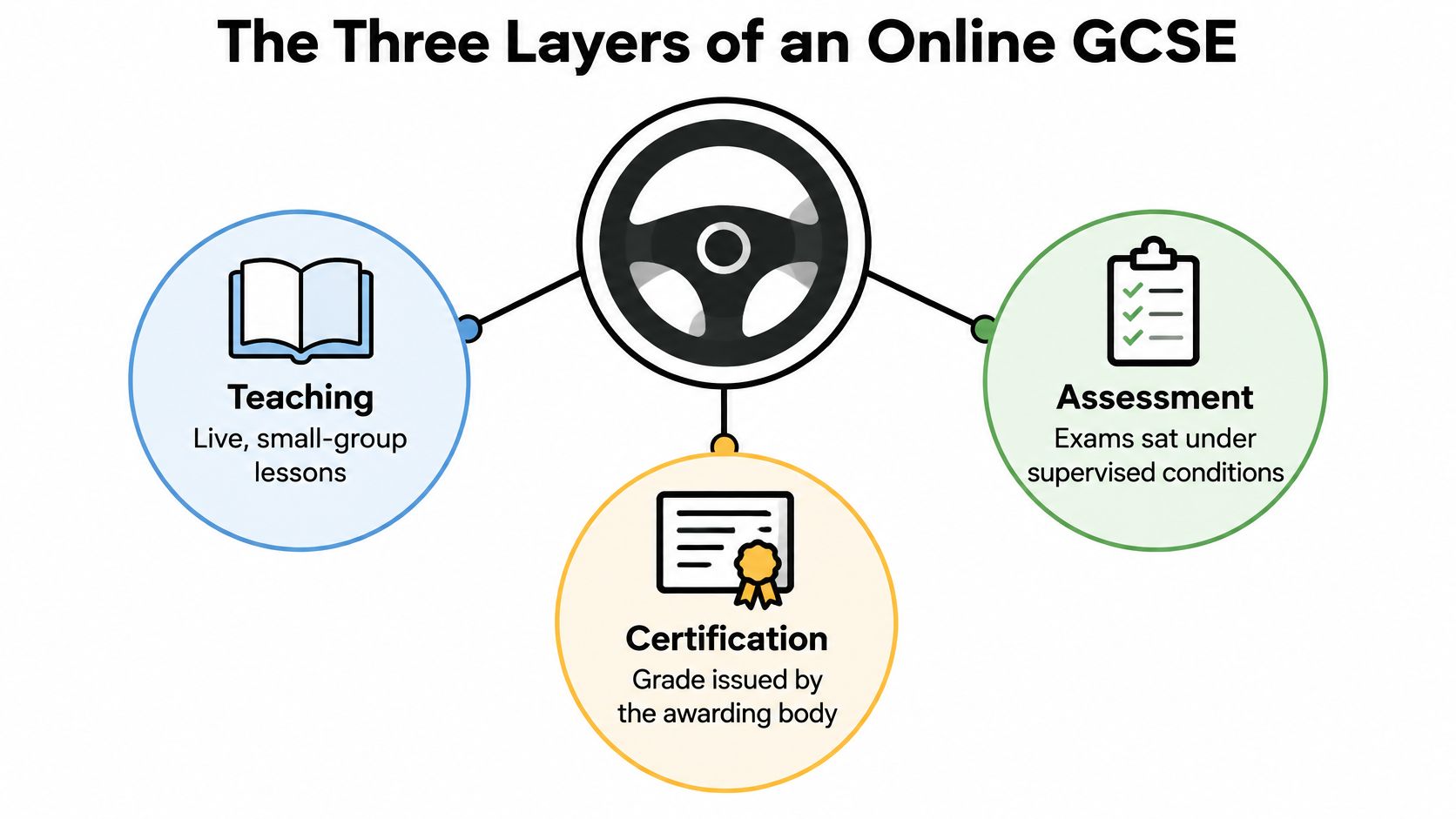
Teaching, marking and final assessment
- Teaching: Who teaches your child, how do they receive feedback, and how is work submitted? Look for subject-specialist teaching, clear lesson routines and accessible recordings where offered.
- Marking: How are completed scripts processed? Ofqual's delivery report records 14,010,515 GCSE scripts marked online in England's 2024 examination series. This describes the marking process, not a computer-based sitting.
- Final assessment: Where will your child sit, and under whose supervision? Obtain the venue and authorised assessment format in writing.
Consider Priya, a hypothetical history learner. She attends lessons from home, uploads essays and receives digital feedback, then travels to a centre for her final papers. Her confidence with online learning doesn't automatically tell you whether she's ready for a supervised examination room.
Information about proctored examinations can help you understand supervision terminology, but the qualification-specific rules remain decisive.
Judge each layer separately. Strong teaching, secure assessment and a correctly issued awarding-body certificate are connected, but none substitutes for checking the others.
How to Register and Schedule an Online GCSE, Step by Step
Registration is a sequence of checks, not a test of your parenting. Working through them in order makes it easier to spot an unresolved entry before it becomes a last-minute worry.
This overview provides a starting checklist; the detailed checks below help you confirm what applies to your child.
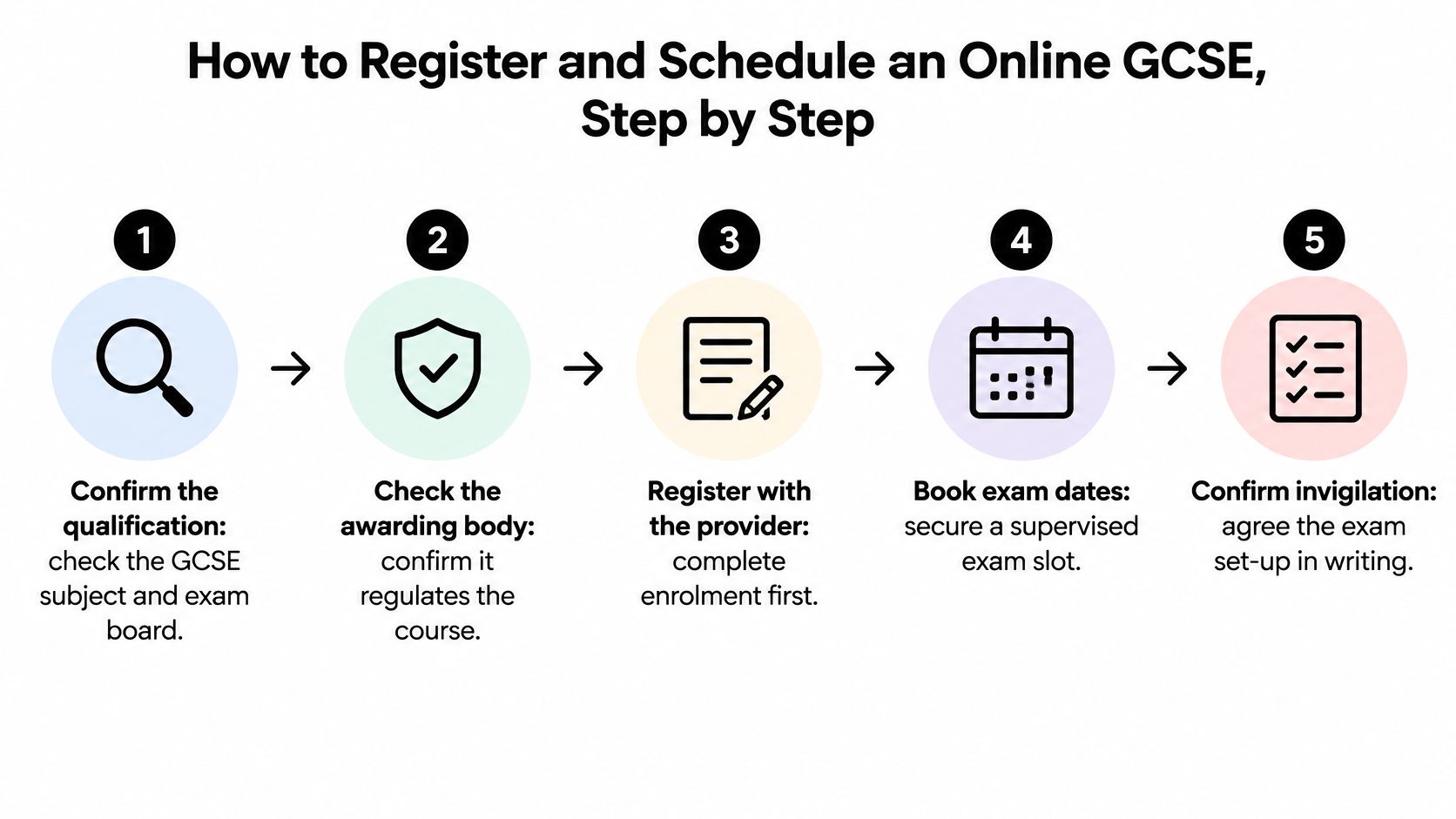
Confirm the entry before planning the sitting
Identify the qualification. Request the full subject title, awarding organisation and specification code. Check that lessons prepare your child for that specification, including any coursework or other required components.
Verify the examination centre. Ask the relevant board to confirm the centre's approval and whether it can accept your child's entry. For a Pearson qualification, request confirmation of the relevant Pearson centre arrangements rather than relying on a badge on a website.
Agree the mathematics tier. Ofqual's November entries publication explains that foundation offers grades 5 to 1, higher offers grades 9 to 4, and a higher-tier candidate narrowly missing grade 4 can receive grade 3. Use teacher assessment, mock performance and your child's intended next step, not convenience, to guide the discussion.
Start access-arrangement checks. Tell the centre about existing support and ask what evidence it needs. Get its processing deadline before assuming an adjustment will be available.
Confirm each subject entry. The Department for Education's summer 2025 provisional entries publication recorded 5,777,020 GCSE entries in England. These count subject entries, not individual children, so ask for an itemised entry confirmation.
Check the timetable and venue. Record every paper, arrival instruction and location. If unfamiliar places trigger anxiety, ask whether your child can visit beforehand.
Request identity and equipment instructions. Check permitted calculators, stationery and any approved technology against the centre's written guidance. Don't assume equipment used in lessons is automatically permitted.
Name the administrative contact. Record who holds your child's candidate information and handles results enquiries. Keep that person's details with the entry confirmation.
The accompanying video offers another way to approach the registration process.
Technical Requirements and Exam-Day Setup
| Requirement | Online lessons at home | Final GCSE exam at centre |
|---|---|---|
| Device | Own laptop or tablet, kept charged | For proposed on-screen provision, a standardised centre device; a personal device only where authorised as a reasonable adjustment |
| Internet | Stable broadband, tested at lesson times | Centre-managed connectivity and a contingency plan for on-screen assessment |
| Room | Quiet, private study space | Supervised room with centre rules for phones and communication devices |
| Identity | Login matched to the enrolment name | Formal identity checks under the centre's procedures |
| Software | Teaching platform and web browser | For on-screen papers, secure platform or browser controls specified for the assessment |
Your home setup supports learning; the centre controls the examination setup. A paper examination doesn't require your child to bring a laptop merely because their lessons took place online.
Ofqual's on-screen assessment consultation proposes controlled digital provision with centre-supplied devices and safeguards for security, accessibility and reliability. Ask the centre to explain its actual arrangements, including what staff do if hardware fails, rather than treating proposed protections as proof that a particular venue has implemented them.
Ask what happens when something goes wrong
Suppose your child's broadband drops during a live lesson. You might reconnect, use a recording or contact the teacher. During an authorised on-screen examination, however, your child should alert the invigilator and follow the centre's incident procedure, not restart software or switch devices independently.
Ask for clarity about:
- Room and device rules: Where phones, watches and other communication devices must be stored.
- Invigilator responsibilities: How a child requests help without discussing examination content.
- Incident handling: How a technical interruption is recorded and escalated.
- Complaints and appeals: Who explains the applicable process if the family disputes how an incident was handled.
These aren't reasons to treat an online learner with suspicion. Ofqual's summer 2025 malpractice statistics recorded 5,025 student malpractice cases across GCSE, AS and A level in England, approximately 0.4% of the 1,376,480 students with results issued or pending when rounded to one decimal place.
A clear procedure helps a worried teenager know what to do. Ask staff to explain it before examination day, when your child has enough breathing space to take it in.
Support for SEN and SEMH Learners
Say a Year 11 learner has dyslexia and severe examination anxiety, and their parents have just chosen online schooling. Lessons feel safer already, but the child still worries that the final assessment will undo that progress.
The child's needs should drive the support plan. Special educational needs and social, emotional and mental-health needs deserve careful consideration, while approved arrangements remove unfair barriers without lowering what the examination assesses.
This preparation should feel like practical support, not another hurdle for your child to clear.
Common access arrangements and what they need
Ofqual's access-arrangements statistics estimate that 18.0% to 27.7% of students taking at least one GCSE, AS or A level in England in 2024–25 had an approved arrangement valid for use.
| Arrangement | Typically suits | What it needs before exam day |
|---|---|---|
| Additional time | Slower processing or reading needs | Evidence of eligibility and the learner's normal way of working |
| Modified question paper | Visual or other print-access barriers | Advance requests and centre processing |
| Supervised rest breaks | Anxiety, fatigue or medical needs | Evidence meeting the applicable rules; ask whether professional evidence is required |
| Reader or scribe | Some reading, writing, motor or processing barriers | Assessment and approval under subject and board rules |
| Use of a computer | Handwriting or access needs | Confirmation of permitted use and practice under timed conditions |
Arrangements granting 25% extra time accounted for 67.2% of approvals for GCSE, AS and A level in England in 2023–24, according to Ofqual's academic-year access-arrangements report. That doesn't mean extra time is automatically appropriate for every anxious or dyslexic learner.
Build the support into the assessment
- Identify needs early: Ask your child which tasks cause difficulty, including reading instructions, handwriting or sustaining concentration.
- Gather evidence: Give the centre relevant assessments and examples of established classroom support.
- Obtain approval: Confirm what has been authorised and for which assessments.
- Practise the arrangement: Test assistive technology, breaks or permitted computer use in realistic timed conditions.
- Confirm delivery: Check the venue can provide the approved format and that your child knows how to request help.
For longer-term planning, Guiding Growth's guide to IEPs offers useful context about documenting individual support, though its IEP and 504 terminology doesn't replace UK examination procedures.
Use the school's exam access-arrangements information to begin a detailed conversation. Personalised teaching and approved examination adjustments are separate commitments, so ask for confirmation of both.
Pros, Cons and Whether Universities Accept Online GCSEs
An online course doesn't, by itself, produce a lesser certificate. The awarding organisation issues the qualification, not the video platform used for lessons.
For admissions, focus on whether the qualification is accepted and whether your child meets the course's subject and grade requirements. Don't interpret a general statement about recognition as a promise of admission to every sixth form, college or university.
This comparison helps families weigh the learning environment alongside recognition.
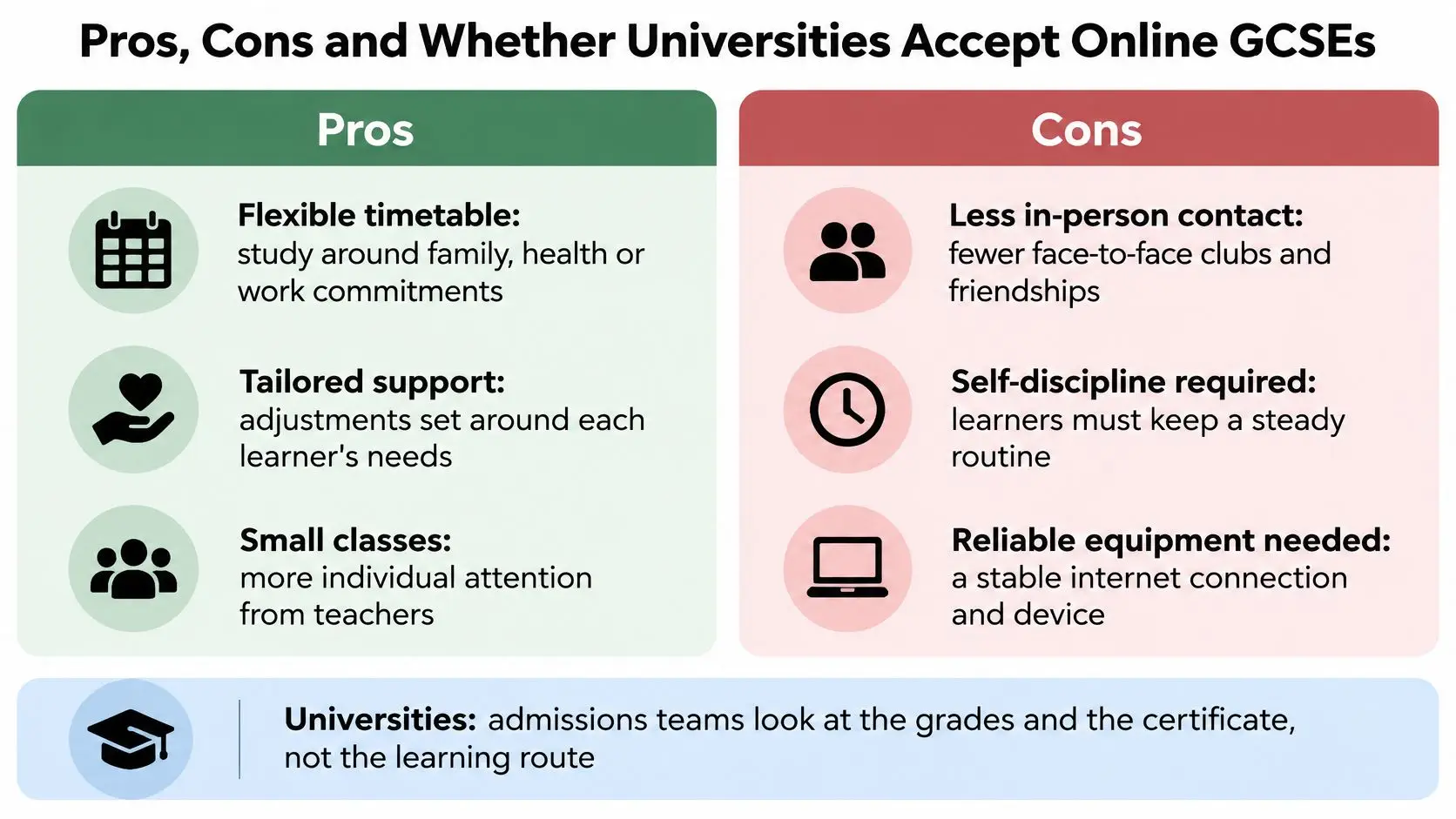
Benefits to look for
- Flexible pacing: Recordings and revision resources can help a child revisit difficult explanations where the provider offers them.
- Direct teaching: Live small-group lessons with subject specialists can provide opportunities to ask questions.
- Responsive feedback: Regular marking can identify misconceptions before they become entrenched.
- Targeted support: SEN and SEMH provision can be built around individual learning needs.
- Less lesson travel: Learning from home may reduce a tiring daily journey.
Trade-offs to plan for
- Independent routines: Your teenager still needs a reliable start time, work schedule and someone to notice missed tasks.
- Different peer contact: Friendships and activities may need deliberate planning outside lessons.
- Examination travel: A suitable teaching arrangement doesn't guarantee a nearby assessment venue.
- Technical disruption: Unreliable equipment can interrupt participation.
- Subject availability: Check the actual options rather than assuming a full school catalogue.
When comparing providers, use this explanation of online-school accreditation as a starting point for questions, then verify examination approval with the awarding organisation.
A self-motivated child who needs flexibility may thrive online. A child who struggles to begin tasks independently may need a closely supervised timetable, whether that's provided online or in a school building. Ask prospective admissions teams about the exact qualification, particularly where GCSE and International GCSE routes differ.
Preparing Your Child for Exam Day and Results
A Year 11 student opens their results and discovers they've missed a sixth-form requirement by a grade. They're upset, embarrassed and convinced the next step has disappeared.
In that moment, a parent needs both a practical route and a calm response. Start with the child, not an argument about marks: acknowledge the disappointment, pause if needed, and agree when you'll contact the centre together.
Prepare for the experience, not just the questions
Before examinations, practise timed papers in the expected format. For an authorised on-screen assessment, ask whether your child can practise with the relevant interface and device type; for paper assessments, include sustained handwriting practice where appropriate.
Use mock results to identify a manageable revision priority rather than handing over an overwhelming list of weaknesses. A centre visit, a rehearsed journey and clear arrival instructions can make the setting less unfamiliar.
- Agree a help plan: Explain how your child should alert an invigilator about illness, distress or technical problems.
- Discuss approved breaks: Make sure they understand the arrangements officially authorised for them.
- Make room for nerves: Ask what they're worried about without promising that they'll feel completely calm.
Respond to results without rushing
Ofqual's summer 2025 reviews publication reports that 4.3% of GCSE grades awarded in England were challenged and 1.0% changed following reviews. A review is possible, but it isn't a guaranteed improvement, and marks can go down.
Ask the centre to explain the result, the relevant review option, the deadline and any fee. Weigh the potential benefit against the risk, while also contacting the intended sixth form or college about available options.
A disappointing result doesn't erase your child's effort. Keep the conversation about possible next steps, not whether they've let anyone down.
The examination centre holds the candidate record and must submit a review request through the board's procedures. Keep that contact involved rather than trying to manage the process alone.
Questions to Put in Writing Before You Enrol
A reassuring telephone conversation helps, but written answers let you check details when you're not under pressure. They also give your teenager something concrete to return to when uncertainty starts to build.
Send these questions to any provider you're considering:
- What will we pay, and by when? Ask for subject-entry charges, any review fees and the entry deadline for the relevant examination series.
- How will my child be entered? Confirm whether the centre accepts online-schooled learners and whether your child will be a school candidate or private candidate.
- What is the technical contingency plan? Request the written procedure for a device or connection failure during an on-screen paper.
- What happens if support needs change? Ask who reassesses the situation, what evidence is needed and how the centre communicates any limits.
- Can you confirm subject-specific approval? Request written confirmation covering the qualifications your child intends to take.
Turn unanswered questions into a decision list
Suppose a parent receives a reply naming the approved centre, itemising charges and confirming the entry deadline. They can then compare that offer with their child's travel tolerance, support needs and chosen subjects.
An unanswered question should remain an open item, not become an assumption. If the provider can't yet confirm a venue or adjustment, ask who will resolve it and when you'll receive a written answer.
This week, send the questions in a single email and request the evidence needed to verify centre approval before enrolment.
Queens Online School offers live online teaching with subject-specialist teachers and support for learners with SEN and SEMH needs. Visit Queens Online School to discuss your child's subjects, learning needs and examination pathway, and ask for written confirmation of the exact qualification, Pearson approval and assessment arrangements before enrolling.