


The right university is the one where your child will feel supported, engaged, and able to thrive, not the one with the flashiest name. In practice, that often means looking past prestige and comparing course fit, support, and total cost before you choose.
A family can do everything “right” on paper and still end up with a decision that feels heavy. The shortlist looks impressive, relatives have opinions, and every league table seems to reward a different story. That's why how to choose university has to start with the student, not the brand.
Why University Choice Feels So Overwhelming
A parent often tells the same story in different words. One university has the higher ranking, another has the course your child wants, and a third looks more realistic financially, yet none of them feels obviously right. That tension is normal, because university selection is a fit exercise, not a trophy hunt.

The pressure gets louder when everyone around the student has an opinion. League tables push prestige, admissions language pushes ambition, and family conversations can make it feel as if there's one correct answer. There isn't. The practical question is whether the university will help the student settle, learn well, and finish strong.
Practical rule: if a choice looks impressive but makes your child anxious, unsupported, or financially stretched, it's not a good fit.
The strongest decisions usually come from a calmer process. A family looks at the child's actual needs, then checks which universities can meet them in the world, not just on a glossy prospectus. That matters even more for SEN and SEMH learners, because the wrong environment can make daily study feel like a grind rather than a path forward.
There's also an emotional layer people skip too quickly. Choosing university can feel like choosing a future identity, not just a place to study. For that reason, families who slow the process down usually make better decisions than families who rush to protect against missing out.
For a fuller decision framework, families can also consult the practical comparison approach in track visual learner progress with Guiding Growth, especially when the student learns best through structure, visual planning, or step-by-step organisation.
Understanding Your Child's Needs and Learning Style
Start with the student, not the university brochure. Before you compare open days or rankings, write down what helps your child learn well, what makes them withdraw, and what kind of setting keeps them steady across an ordinary week. A university can have a strong academic reputation and still be a poor match if the pace, size, or culture leaves the student drained.
A practical way to begin is to separate academic needs, emotional needs, and day-to-day needs. Academic needs cover things like how a student learns best, how much structure they need, and whether they cope better with discussion, independent reading, or more direct teaching. Emotional needs include confidence, predictability, and how they respond to pressure. Day-to-day needs cover travel, accommodation, food, routines, and how easy it is to ask for help without feeling exposed.
Learning style should be treated as something concrete, not vague. Some students learn best through seminars and active discussion, while others need quiet time, clear written guidance, and space to process feedback. Some cope well with open-ended deadlines and weekly reading loads, while others do better when expectations are broken into smaller steps and the workload is easier to predict.
That matters even more for SEN and SEMH learners. Look closely at whether the university offers predictable timetables, accessible support, calm places to study, and staff who will respond properly when a student is struggling. The core question is whether the environment helps the student stay regulated and confident enough to keep going, not whether the prospectus sounds impressive.
There is a similar issue for international and online-school families, who are often left out of standard advice on choosing a university. A student who has studied across different systems may need clearer entry guidance, stronger induction support, and a course structure that does not assume every applicant has followed the same path. For families checking admissions routes and subject requirements, the guidance on Queens Online School university entry requirements can help translate school history into a realistic shortlist.
Good fit usually looks ordinary on paper, because it is stable, familiar, and workable week after week.
Use the subject and the support structure as the main filters, not the brand name. The university that looks strongest in general terms may still be the wrong choice if the teaching format, feedback rhythm, or support team does not suit the student. A psychology applicant, for example, should compare how each programme is taught, how assessment works, and what help is available when workload or wellbeing becomes an issue.
If your child learns well through visual organisation, keep the planning process visual too. A simple chart, colour-coding system, or structured checklist can make patterns much easier to see, and families can track visual learner progress with Guiding Growth while building that shortlist. Use those notes to compare the universities in front of you, then keep the choices that match how your child works.
Researching Courses and Institutions Strategically
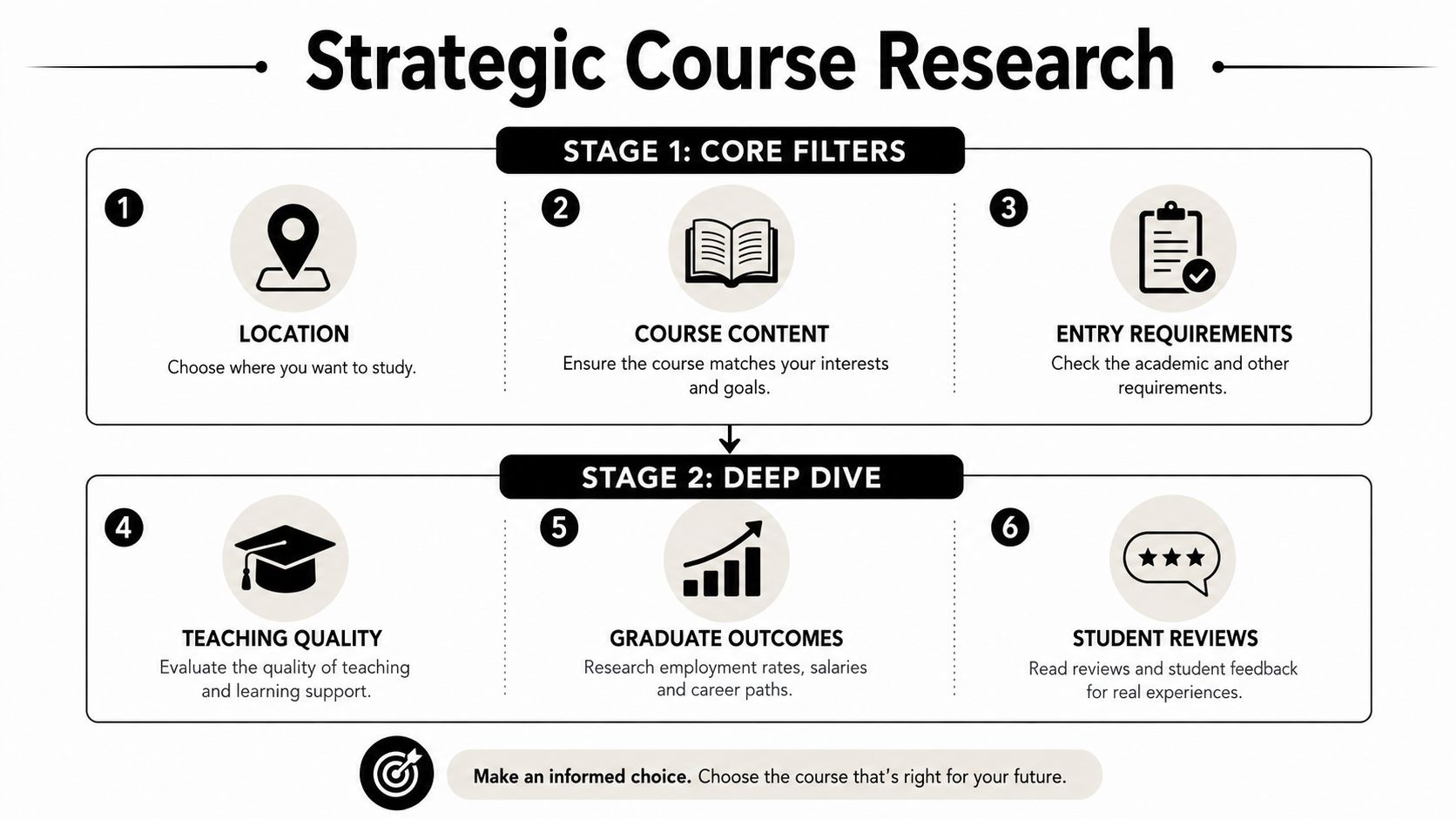
A course can look right on paper and still be a poor fit once you look at the day-to-day reality. Start by ruling out anything that misses the child's essential requirements, then compare the remaining options on support, workload, location, and the practical shape of student life.
Use a shortlist matrix, not a gut feeling
A multivariate shortlist matrix is straightforward and useful. Score each university against weighted criteria such as course fit, location, cost, support services, and campus environment, then compare the totals side by side. That keeps the process honest, because a university that looks appealing on a website can still fail the student on practical grounds.
This approach works well for families because it separates academic mismatch from wider life fit. Stage one removes programmes that are wrong in subject, level, or structure. Stage two checks whether the remaining choices are realistic financially and emotionally. That second check is where many students avoid an expensive mistake.
A spreadsheet helps because it makes trade-offs visible. Put the criteria that matter in rows, the universities in columns, then add notes under each score, such as module titles, placement opportunities, or whether the department has a disability support team. For families weighing mobility and location, the article on top spring destinations for students is a reminder that city choice and daily routine can shape student satisfaction in ways rankings do not show.
A shortlist should get smaller because the fit is getting clearer, not because the deadline is forcing a panic decision.
For applicants working through entry criteria, the guide on university entry requirements in the UK is a useful companion at this stage. It helps families check whether the route is realistic before they commit emotionally.
The research should finish with a short list, not an endless trail of open tabs. Read the module descriptions, compare assessment styles, and look at what the course demands week by week. If a programme does not suit the student's strengths and energy, it is not worth pursuing just because the university name sounds strong.
Families often get clearer results by treating the search like choosing a place to live, not collecting a prestigious label. The central question is whether the setting supports daily learning, and that means the small details matter more than the logo.
| Stage | Timeline | Key Actions |
|---|---|---|
| Early shortlist | Before applications | Compare course content, entry requirements, and student support |
| Deep research | Before visits | Read module pages, check teaching style, and note assessment methods |
| Real-world checking | Open day period | Ask questions, speak to staff, and compare the atmosphere |
| Final decision | After offers | Re-score the shortlist and confirm the best fit |
For students exploring overseas options, compare study abroad options in Germany can add context when the family is weighing different countries, costs, and student experiences. International fit still comes down to the same issue, a programme and environment the student can live well in.
Evaluating Academic Quality and Student Support
League tables are useful, but they're not enough. The more reliable question is whether the university can support the student through the full journey, from first lecture to final assessment. That's why student experience and outcomes deserve more attention than institutional reputation alone.
The data backs up the priorities families already feel in practice. In wider higher-education research, 74% of surveyed students rated academic quality and reputation as very important, 74% wanted a desired programme of study, and 73% prioritised job placement, showing that outcome-related factors dominate university choice, as summarised by Times Higher Education. For families, that means subject fit and progression matter at least as much as the overall ranking.
What support actually looks like
Look beyond the headline score and ask what happens inside the department. What's the staff-to-student ratio like? How quickly do students get feedback? Is there a named wellbeing or disability service? Those questions matter because support is what keeps a student moving when the work becomes difficult.
For SEN and SEMH learners, this part of the search is essential, not optional. Check whether the university offers adjustments, quiet exam arrangements, assistive technology, or a support team that responds quickly and clearly. A large campus can still be a good fit, but only if the support system is visible and easy to use.
You can also learn a lot by how the university answers a direct question. If you email admissions or student support with a specific concern and get a vague reply, treat that as data. If they respond clearly and practically, that's a positive sign about how the institution handles real student needs.
For families comparing UK options, the internal guide on university acceptance rates can help frame admissions competition without losing sight of fit. Admissions selectivity matters, but it should never replace the question of whether the student will be supported once they arrive.
Comparing Costs, Funding, and Scholarships
Affordability should be judged by net cost, not headline tuition. That means looking at tuition, living costs, transport, textbooks, and the likely debt path, then deciding whether the overall package makes sense for your family. A university can look affordable until rent and travel are added.
The financing context in England has changed sharply over time. The undergraduate tuition-fee cap was introduced at £3,000 in 2006, rose to £9,000 in 2012, and reached £9,250 in 2017, which is why value-for-money sits at the centre of the modern university decision. Families can't compare fees in isolation anymore.
Research shows how strongly cost shapes choice. 67% of students rated cost of attendance as a very important influence, 95% said cost was at least somewhat important, and affordability ranked first among cost-related factors at 53%, ahead of student outcomes at 39% and flexibility at 36%, according to the National Center for Education Statistics. That pattern matches what many parents already feel, especially when a student is comparing cities with very different day-to-day expenses.
Build the real budget
Accommodation often changes the picture more than families expect. A student in London faces a very different budget from one studying elsewhere, and local travel can become a major monthly drain. Scholarships, bursaries, and hardship funds can help, but they should be treated as support, not as a reason to ignore the underlying cost.
If your child is international, check scholarship rules, visa-related financial requirements, and whether the institution offers specific funding routes for overseas applicants. A realistic budget is the one that can survive a full academic year, not just the first instalment.
A practical rule works well here.
If you can't explain how the course will be funded from start to finish, it isn't financially ready.
Making the Most of Open Days and Visits
Open days are where glossy marketing starts to give way to everyday reality. A campus visit can show whether the setting feels calm, crowded, supportive, or wrong for your child. The aim is not to collect freebies, it is to gather evidence about how life there would feel.
Ask about the parts that affect daily life
Arrive with questions, not just curiosity. Ask about class sizes in first year, how feedback is given, what support exists for mental health and disability needs, and how the university handles exam adjustments. If your child has SEN or SEMH needs, ask directly about pastoral care, quiet study spaces, and who they would speak to if they started struggling during term.
Do not depend only on the official tour. Sit in on a lecture if you can, eat in the student union, and talk to current students who are not part of the presentation team. Their answers are often more useful than any brochure because they describe the university as it works in practice.
Families who cannot travel in person still have useful options. Virtual open days and recorded tours can show how the university presents itself online and how quickly staff respond to questions. For online-school families, especially those used to flexible learning, that response time matters because it gives a clue about how the university treats remote or independent-minded applicants.
Queen's Online School students often arrive with a sharper sense of fit because they have already studied in a fully online environment. That can make it easier to judge whether a university's teaching format, communication style, and support system will suit them.
For international and online applicants, a simple timeline helps keep the process steady.
| Stage | Timeline | Key Actions |
|---|---|---|
| Research | Early | Check course fit, entry requirements, and support services |
| Open days | Before final shortlist | Ask direct questions and compare student experience |
| Application prep | Before deadlines | Draft personal statement and gather references |
| Offer review | After offers | Re-score choices against your child's priorities |
If your child is considering multiple countries as well as universities, the planning advice in compare study abroad options in Germany is a useful reminder that location, cost, and support should be compared together, not separately.
Build an accurate budget
A visit should also test the numbers against reality. Ask what accommodation costs, whether travel between halls and campus is manageable, and how often students spend beyond the headline fee on food, printing, equipment, or daily transport. The cheapest option on paper can become expensive once those ordinary costs are added.
If your child is international, check whether the university gives clear guidance on scholarship rules, visa-related financial requirements, and overseas funding routes. A budget only works if it can survive a full academic year, not just the first payment.
Use the visit to confirm whether the support is practical, not just advertised. A university that answers questions clearly, shows you the spaces your child will use, and explains what happens if problems arise is giving you something useful to judge.
Your Complete University-Choice Checklist and Final Steps
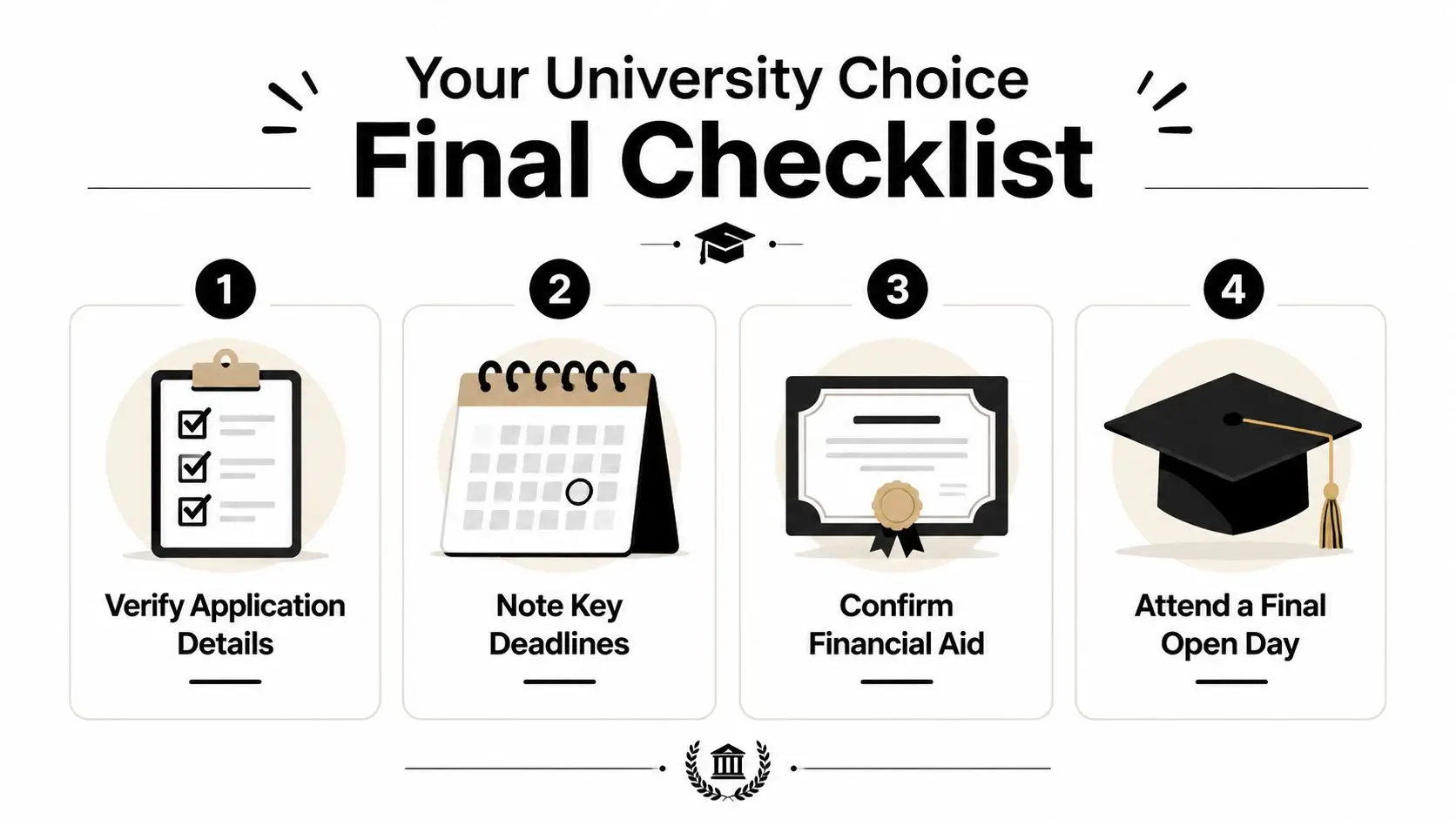
The final decision stage is where small oversights cause the most regret. Return to the shortlist and check each option against your child's real needs, not the version that sounds best on paper. If one university falls short on support, affordability, or course fit, do not let prestige override the evidence you have already gathered.
Final checks before you apply or accept
Make sure the paperwork is complete. Personal statement, references, supporting evidence for adjustments, and any financial documents should all be ready before deadlines creep up. International applicants should also recheck visa requirements, English-language tests, and any extra entry conditions. Families using online schooling should confirm that their references, predicted grades, and application timeline are aligned with the UCAS application process, so nothing is missed at the point of submission.
Use the last review to test how the university works day to day. Ask who responds if your child needs help with study skills, mental health support, or exam adjustments, and check whether those routes are clear or hidden behind layers of form-filling. That matters particularly for SEN and SEMH learners, where a promise of support is less useful than knowing who will pick up the phone, what the response time looks like, and whether staff understand the child's profile.
The choice may still come down to saying no to the option that looks nicest from the outside. That is judgement, not failure. A student who turns down a poor fit leaves room for a place that suits their pace, confidence, and independence better.
For families who have worked through the process patiently, this moment deserves recognition. You have compared real needs, not just labels, and that is what leads to a choice the child can live with and grow into.
If you want a school that already understands how support, structure, and student confidence affect progression, Queens Online School offers live British curriculum teaching, small classes, and specialist support for learners who need flexibility. Visit Queens Online School to see how its online pathway can help families prepare for university with more clarity and less pressure.