


If you're reading this with a browser full of university tabs, a worried child beside you, and a growing sense that everyone else understands UCAS better than you do, you're not alone. The UCAS application process can feel strangely high-stakes even before a single form is submitted. One missed date, one unclear reference, one personal statement that doesn't sound quite right, and families start to fear that a young person's future could wobble.
That pressure can feel even heavier for students who don't fit the standard picture. A child studying online. A teenager with SEN or SEMH needs who needs time, clarity, and reassurance. A home-educated student without an obvious referee. An international family trying to understand British systems while also thinking about visas, accommodation, and cultural change. For these students, the UCAS application process isn't just paperwork. It's emotional labour.
The good news is that UCAS becomes much more manageable when you break it into small decisions. Families don't need to solve everything at once. They need a calm roadmap, honest conversations, careful checking, and support that keeps the child's well-being at the centre.
Mapping Your Journey with Key UCAS Timelines
A clear timeline lowers panic. When families can see what happens in spring, summer, autumn, and beyond, the UCAS application process stops feeling like one giant deadline and starts feeling like a sequence of manageable tasks.
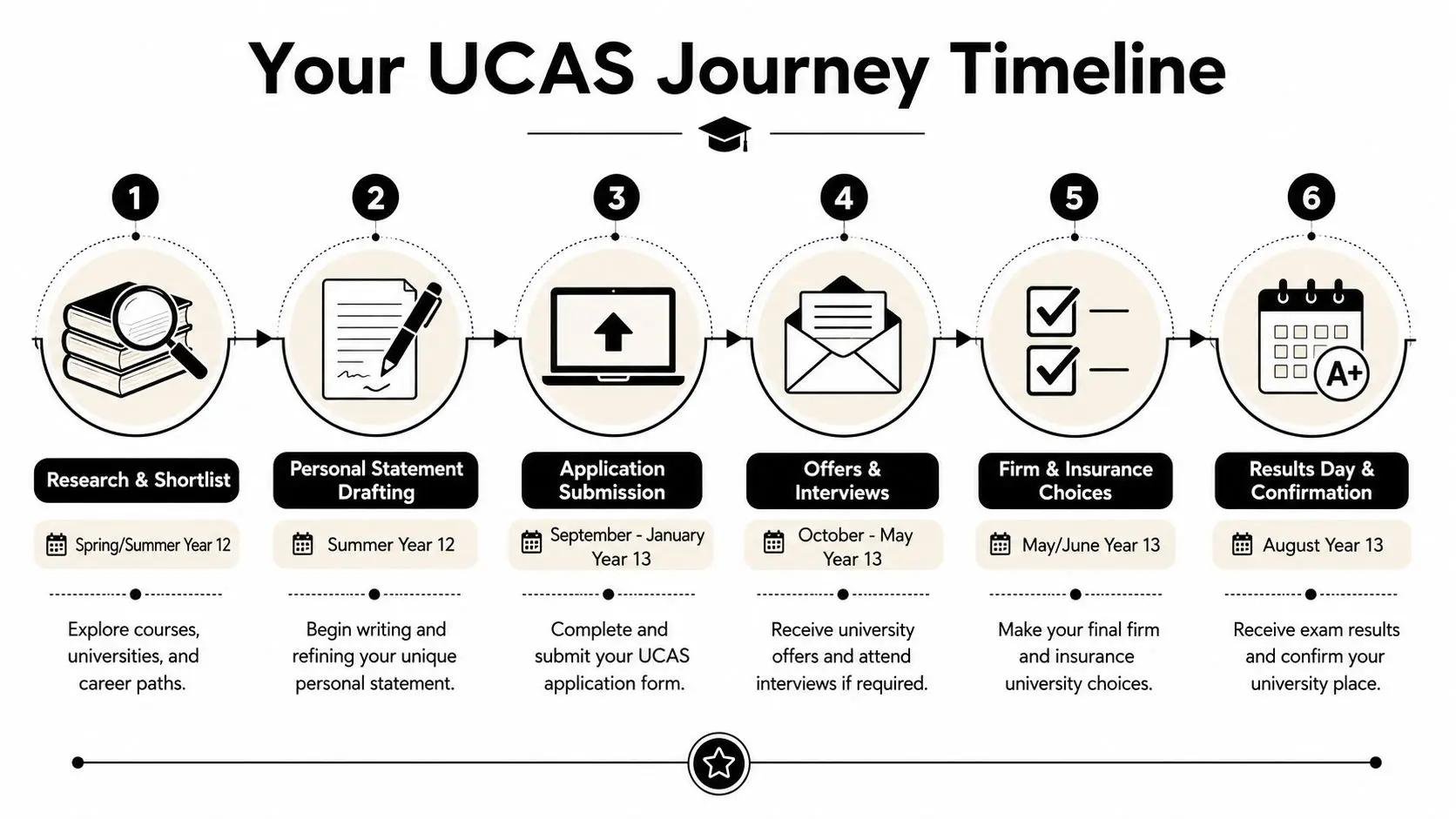
A calmer way to view the year
By late spring or early summer of Year 12, many students are ready to begin researching courses, attending open days, and thinking seriously about where they might thrive. This is also a good point to start gathering the raw material for a personal statement: books read, projects completed, interests developed outside lessons, and reflections on why a subject matters to them.
Summer is often when a child's confidence either grows or dips. Some students become energised by possibility. Others freeze because every choice suddenly feels permanent. That's why families need to treat this stage as exploration, not a final verdict.
Start early enough that your child can change their mind without feeling they've failed.
By September of Year 13, the practical side becomes more urgent. Application details need checking, course choices need narrowing, and references need organising. If your child wants help understanding the bigger university picture before they choose, this guide on how to get into university can help frame the process.
The deadlines that matter most
Some applications have an earlier cut-off than families expect. For courses starting in autumn 2027, the UCAS deadline for Oxford, Cambridge, and most Medicine, Dentistry, and Veterinary Science courses is a strict 15 October 2026 at 18:00 UK time according to UCAS deadline guidance for early-entry courses. Forgetting that date can mean a child misses out before their application is even read.
For everyone else, the standard cycle continues later into the academic year. That doesn't mean families should leave things late. A rushed application often creates avoidable stress, especially for students who need processing time, predictable routines, or extra emotional support.
| Date | Milestone | Action for Your Family |
|---|---|---|
| Spring to Summer Year 12 | Research and shortlisting | Explore subjects, campus styles, support services, and daily living needs |
| Summer Year 12 | Personal statement drafting | Start notes early so your child isn't writing from panic in autumn |
| September Year 13 onwards | Application building | Check qualifications, course codes, email address, and referee arrangements |
| 15 October 2026 at 18:00 UK time | Early deadline for Oxford, Cambridge, and most Medicine, Dentistry, and Veterinary Science courses | Submit early-entry applications well before the deadline |
| Autumn to Spring | Offers and interviews | Prepare emotionally as well as practically. Waiting can feel intense |
| May to June Year 13 | Firm and insurance choices | Compare offers carefully, including support needs and living arrangements |
| August Year 13 | Results and confirmation | Review next steps calmly, including confirmation or alternative routes |
A simple family rhythm
Try a monthly check-in rather than a constant stream of UCAS talk.
- Choose one focus each month. Research in one month, drafting in the next, references after that.
- Protect your child's energy. A student with SEMH needs may cope better with short planning sessions than long application marathons.
- Write down deadlines visibly. A wall planner, shared calendar, or family note app can stop dates living only in one adult's head.
The timetable matters, but the true aim is steadiness. A child who feels contained and supported usually makes better decisions than one who feels chased.
Choosing Courses That Inspire Your Child
Families often think course choice is about prestige first. In practice, the right choice is usually the one that brings together interest, ability, support, and the kind of life your child can imagine themselves living.
A student might be torn between a subject they love and one that sounds safer at family gatherings. That's a very human conflict. But if a teenager spends years studying something that never fully engages them, the emotional cost can be high. Motivation matters. Curiosity matters. Feeling at home in the subject matters.
Ask where your child will flourish
A useful conversation isn't "Which university is best?" It's "Where will you be well enough, supported enough, and interested enough to succeed?"
For one student, that may mean a large city university with specialist facilities and plenty of clubs. For another, it may mean a quieter campus, a shorter journey from home, and stronger pastoral support. A young person with SEN might need to look carefully at disability services, accommodation options, and teaching style. An international student may care particularly about community, airport access, and whether the university feels welcoming to overseas families.
Consider these questions together:
- What subject keeps coming back when your child reads, watches videos, or talks about their future?
- What learning style fits them best, such as seminar discussion, practical work, studio teaching, or independent reading?
- What environment helps them regulate well if they're prone to anxiety, overwhelm, or exhaustion?
- What support will they need day to day rather than only on paper?
Balance head and heart
A practical approach helps. Make a shortlist that includes a few different kinds of option, not five versions of the same university.
For example, a student called Aisha loves Psychology but keeps hearing that a more obviously vocational course would be "safer". Instead of dismissing either path, her family could compare both by reading module lists, checking assessment styles, attending virtual events, and asking which course content she wants to spend years studying. That often reveals more than rankings do.
A course isn't just a title. It's three or more years of reading, writing, discussion, pressure, growth, and daily life.
If your child is still building subject confidence, it can help to look at subjects for specific exam boards so they can connect school study with future degree interests. That kind of clarity can be especially reassuring for online learners and international students navigating unfamiliar qualification pathways.
A shortlist that feels realistic and hopeful
Try building a shortlist around three filters:
Emotional fit
Does your child sound relieved or energised when talking about this option?Academic fit
Do the entry requirements and course content match their current path and strengths?Practical fit
Can your family picture the finances, support, travel, accommodation, and independence involved?
When those three line up, the choice tends to feel steadier. The aim isn't to pick the course that impresses strangers. It's to help your child choose a future they can step into with confidence.
Crafting a Personal Statement That Shines
The personal statement is where many students become self-conscious. They know they're meant to sound thoughtful, capable, and distinctive, but they often end up sounding generic because they're trying so hard to sound "impressive".

The strongest statements usually begin when a student stops performing and starts reflecting. UCAS applications require a single personal statement of 4,000 characters that must explain why they want to study the subject, what makes them suitable, and what extra preparation they've done according to this guide to UCAS personal statement expectations. That limit pushes students to choose meaningful evidence, not a long list of everything they've ever done.
A simple structure that works
A good draft often has three parts:
Opening
Start with a real reason for caring about the subject. Not a dramatic quote. Not a cliché. Just a truthful beginning.Middle
Show what you've done to explore the subject and what you've learned from it.Ending
Leave the reader with a sense of direction, maturity, and readiness.
Students often need help turning experiences into evidence. That's where examples of achievements that land interviews can be useful, because they show how to describe contribution and growth rather than listing activities.
From vague to vivid
A weak version might sound like this:
"I have always wanted to help people and I am passionate about Psychology. I enjoy reading and working with others."
That isn't wrong. It's just thin. It doesn't tell an admissions tutor anything memorable.
Now consider a student with SEMH needs who has found stability through art therapy and wants to apply for Psychology. A stronger version might explain how structured creative work helped them understand emotional regulation, why that sparked an interest in behaviour and mental health, and how they pursued that interest through reading, discussion, or related study. That turns a private challenge into academic motivation. It feels honest, specific, and mature.
If your child needs more detailed guidance on planning and editing, this article on how to write a personal statement can help break the process into manageable stages.
What students often get wrong
Many teenagers think they need to sound formal. They don't. They need to sound thoughtful.
They also assume every sentence must be dramatic. It shouldn't. The personal statement works best when it shows clear thinking, subject engagement, and a sense that the student knows why this course suits them.
A short explainer can help students hear what a stronger statement sounds like in practice:
A practical drafting routine
Try this if your child feels stuck:
- Talk before writing. Ask them to explain out loud why the subject matters to them.
- Collect proof. List books, projects, work experience, competitions, wider reading, or independent study.
- Find the thread. Look for the idea that connects their experiences.
- Draft badly first. A rough draft is progress. Silence on a blank page isn't.
- Edit for honesty. Remove anything that sounds like someone else.
The personal statement isn't a test of who can sound the most polished. It's a test of whether the student can present a genuine, relevant academic self. For many young people, that's the first time they've had to do that. They deserve patience while they learn.
Securing Strong References and Predicted Grades
References can be one of the most stressful parts of the UCAS application process, especially for students outside traditional schools. Families often assume there's a simple official path for independent applicants. In reality, this part is often much less clear than it should be.
The problem isn't that non-traditional students lack ability. The problem is that they may lack an obvious person in the system who can formally speak for them. Guidance for students applying independently is often unclear on how to secure a valid referee, and this can create submission blocks for non-traditional learners according to this discussion of reference challenges in the UCAS process.
What a reference needs to do
A strong reference usually helps universities understand three things:
Academic readiness
Can this student cope with the course?Learning habits
Do they work consistently, respond to feedback, and engage seriously?Context
Has the student faced barriers, changes in schooling, or circumstances that matter?
Predicted grades sit alongside that picture. They help universities judge likely performance before final results are available. Families should make sure the predicted profile is realistic, evidence-based, and discussed early enough that there are no last-minute surprises.
Why online learners can be well placed
It's easy to assume references only work well in a physical school building. That isn't true. Online schools, tutors, and structured education providers can often know a student very well if teaching is live, interactive, and sustained over time.
For example, Queen's Online School provides live lessons with subject-specialist teachers, which gives staff a basis for writing academic references and setting predicted grades for students studying online. That can be especially helpful for home-educated learners, international students, or young people who need a more flexible environment.
Practical rule: Ask about references long before the application deadline. Families shouldn't wait until the form is nearly complete.
A parent may also find it useful to understand how grades translate into application planning. A UCAS Tariff points calculator can support those conversations, especially when comparing pathways or checking where a child's current qualifications place them.
Questions to ask early
Not every family knows what to ask. Start here:
- Who is willing and eligible to act as referee?
- What evidence will they use for predicted grades?
- Have they taught or supervised the student closely enough to write specifically?
- When do they need the final course list and draft statement?
Students with SEN or SEMH needs may also want a referee who understands not just their grades, but their resilience, consistency, and growth over time. A thoughtful reference can help a university see the whole student, not just the transcript.
Submitting and Tracking Your Application
By the time a child reaches the submit stage, emotions are mixed. There may be relief, but also fear of making a silly mistake. That's why this stage needs calm checking more than speed.
The UCAS application follows a straightforward sequence in the Hub: register, complete personal details and education history, choose up to five courses, add the personal statement, include a referee, pay the fee, submit, and then monitor progress through UCAS Track according to the official UCAS application guidance. The 2026 application fee is £28.95 for up to five choices, paid once rather than per course, as explained in UCAS advice for parents, guardians, and carers.
The checks that matter most
Families often focus on the big things and overlook the small fields that cause delays. Yet small errors can create real problems.
Use an email address your child checks regularly and will keep access to. An outdated address can mean missed messages at the worst possible time.
A careful final review should include:
Personal details
Names, dates, nationality category, and contact information must be accurate.Education history
Every qualification should match the institution name and dates as closely as possible.Course choices
Check the exact course and university combinations, especially where names are similar.Personal statement
Confirm the final version is pasted correctly and reads cleanly.
Mistakes that can derail a strong application
Some pitfalls are more serious than they look. Submitting a personal statement under 1,500 characters is linked with a 22% lower chance of an offer, and inconsistent education history entries can delay processing by 3 to 5 days according to this guide to common UCAS application pitfalls.
That matters because a child can do the hard thinking well and still be let down by avoidable technical errors.
Read every field as if you're the university seeing it for the first time. Misspellings, missing grades, and inconsistent dates are easier to spot with fresh eyes.
After you press submit
Once the application is sent, the emotional tone changes. The job becomes monitoring rather than building.
UCAS Track is where students receive updates and later respond to offers. Encourage your child to check it routinely, but not obsessively. A healthy rhythm helps. One check a day is enough for many students. Constant refreshing rarely brings peace.
For parents, this stage can be hard because the work feels less visible. But this is still support work. Keep routines steady. Help your child keep perspective. Remind them that waiting isn't failure. It's part of the process.
Navigating Offers and What Comes Next
When offers start arriving, families often expect to feel only joy. In reality, this stage can bring new uncertainty. A student may receive an offer from a university they aren't sure about, or wait longer than friends, or have to compare options that each solve one problem but create another.
That doesn't mean anything has gone wrong. It means the next decision deserves care.
Understanding the choices in front of you
Most students will deal with either conditional offers or unconditional offers. A conditional offer means the place depends on meeting the stated results or requirements. An unconditional offer means the place isn't tied to future exam results in the same way.
After offers arrive, students usually need to choose a firm choice and an insurance choice. The firm choice is the place they'd most like to attend. The insurance choice should be one they would still be happy to join if their results don't go exactly to plan.
A sensible family conversation might sound like this:
- Which place feels right academically?
- Which place feels realistic?
- Which place still supports my child's well-being if things become stressful?
Support needs don't disappear after an offer

For students with SEN or SEMH needs, an offer is only part of the decision. Families should contact disability or student support services early and ask practical questions about adjustments, mentoring, accommodation, and wellbeing support. A university may look ideal on paper but feel very different once those conversations begin.
International students have another layer to consider. There were 138,460 international applicants by the June 2025 deadline, with increases from Nigeria, Ireland, and the USA showing strong global demand for UK study places, according to UCAS data on international undergraduate applicants. That makes it even more important to stay organised with documents, accommodation, and immigration steps once an offer is in hand.
If results day doesn't go to plan
Results day can bring relief, tears, or both. Some students confirm their place straight away. Others need to consider alternatives. Clearing can be a lifeline, not a sign that a child has failed. It gives students another route into higher education if their original plan changes.
A teenager who misses a grade by a small margin may still find a course that suits them well. In some cases, the eventual destination turns out to fit better than the first plan. Families need to hold that possibility open, especially in the first emotional hours after results.
The outcome matters, but so does the story your child tells themselves about it. Protect that story. A changed route isn't a ruined future.
The UCAS application process asks a lot of young people. It asks them to choose, explain themselves, wait, and cope with uncertainty. Done well, it can also help them grow into a clearer sense of who they are and where they want to go next.
If your family wants structured support with subject choices, predicted grades, references, and the wider university journey, Queens Online School offers an online British curriculum with live teaching and guidance that can help students move through the UCAS process with greater clarity and confidence.