


It's Monday morning, and your child is dressed but still sitting on the edge of the bed. They can do the work. It's the corridors, the journey or the feeling of being watched in class that makes leaving home feel impossible. You've started comparing online schools, but every website promises flexibility, support and a fresh start.
Knowing how to choose an online school means looking beyond those promises. The question is whether this particular child will be known, safe and able to gain the qualifications they need, on ordinary days and on the days when things become difficult.
A Checklist Built Around Your Child
Before speaking to admissions teams, put your child's morning beside the options. A school that suits an independent teenager may leave a younger learner waiting for help. A lively discussion group might reassure one child and overwhelm another.
Use the same questions for every school. That makes it easier to compare clear answers rather than the warmth of a sales conversation.
What to compare before you shortlist an online school
| Check | Ask this | Strong answer | Walk away if |
|---|---|---|---|
| Curriculum fit | Does the pathway match this child's age and goal? | Named primary, lower secondary, GCSE or A Level route | Only a vague claim of a British curriculum |
| Live teaching | Who teaches, how often, and how small is the group? | Subject specialists, live interaction and timely feedback | Recorded videos with no teacher contact |
| Exam route | Who enters GCSEs or A Levels and where are they sat? | An approved centre, written entry steps and a plan for practicals | The family must find a centre with no school support |
| Accreditation | What is the school's legal and awarding status? | Named company, awarding organisation and centre relationship | Cannot name the board or who is accountable |
| Flexibility | What happens if a live lesson is missed? | Recordings, a catch-up rule and a way to join mid-year | One fixed intake and no way to revisit teaching |
| Wellbeing | Who notices if the child withdraws? | Pastoral check-ins, screen breaks and an anti-bullying route | A policy document and no named person |
| SEND or SEMH | Who coordinates adjustments and how often are they reviewed? | A named lead, adapted materials and access arrangements | Inclusive used as a slogan with no map of support |
| Technology | Will lessons work on the devices we actually own? | Device guidance, tablet access and a plan when broadband drops | Assumes a private laptop and perfect wifi |
| Safeguarding | How are chat, cameras and peer contact moderated? | A designated lead, out-of-hours reporting and private help | Unmoderated chat or no route if a child is distressed |
Give the important rows a face
Say your children share a laptop. Recordings sound helpful, but only if each child has a realistic time to watch, complete work and ask questions. Flexibility isn't useful when the household timetable makes learning impossible.
For a quiet teenager, camera expectations and a trusted adult may matter more than an impressive platform. For an aspiring GCSE scientist, the immediate concern may be the awarding organisation and how practical requirements will be met.
If your child has special educational needs and disabilities, or SEND, or social, emotional and mental health needs, or SEMH, use a written SEN support plan to organise the conversation around actual barriers.
Star two rows that protect your child's confidence this term and two that protect their qualification pathway. Keep the remaining checks, but let those starred rows determine what you investigate most closely.
Curriculum and a Real Exam Route
The worry beneath many parents' questions is simple: what if my child works hard and the certificate doesn't open the door they hoped for? A library of lessons and a school-supported qualification route aren't the same thing.
Ofqual's summer 2021 analysis estimated 7,424 A Level entries and 12,660 GCSE entries from private candidates in England, while cautioning that centres didn't consistently identify private candidates. The practical lesson is to establish the examination arrangements before choosing the teaching.
Follow the entry from subject to certificate
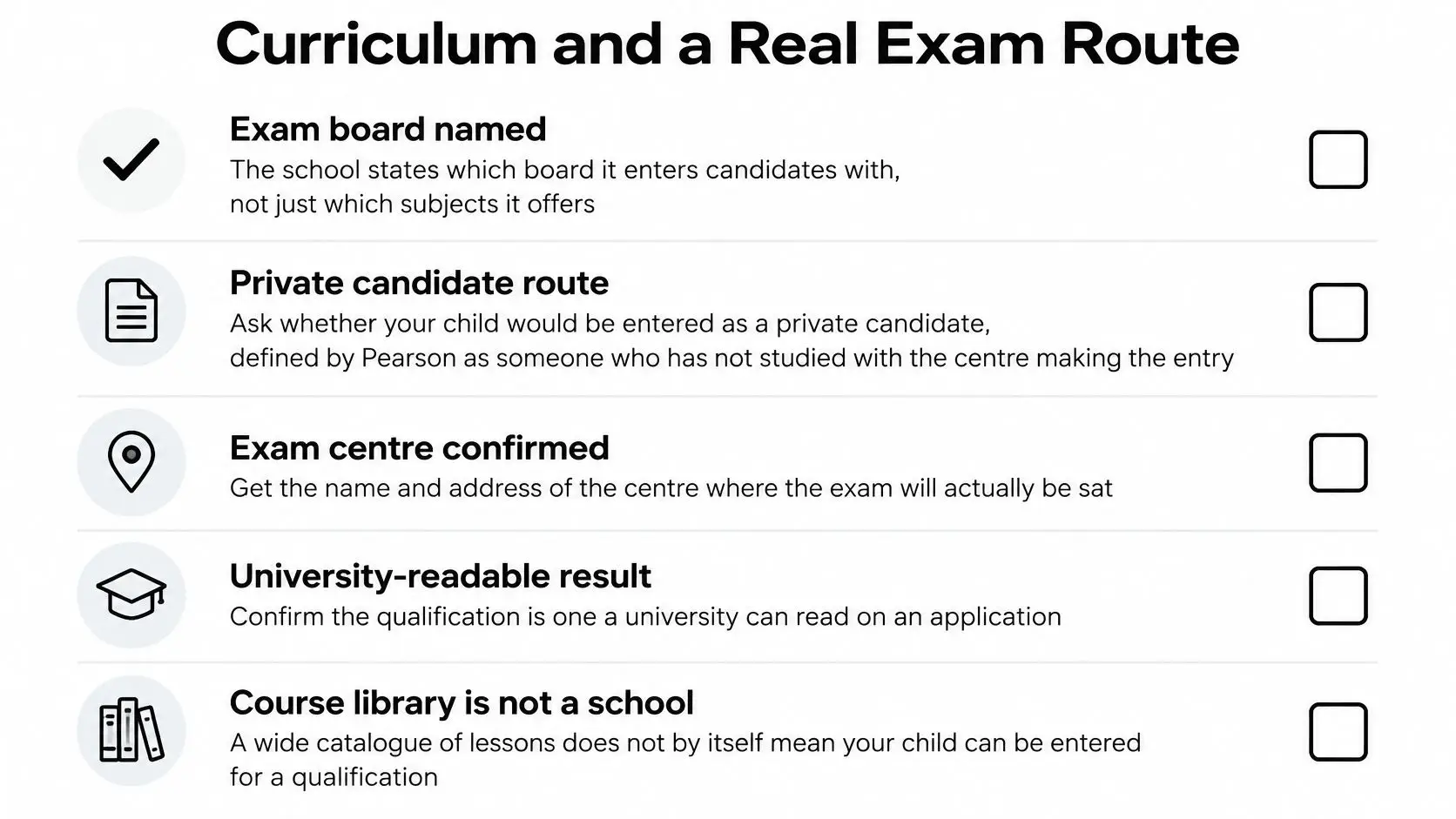
- Name the qualification. Ask for the exact specification and awarding organisation, not just a subject list. Check that the proposed subjects support your child's intended next stage.
- Identify who makes the entry. Establish whether the learner would be on the school roll and whether the school or another centre enters them. Get the centre's name and address.
- Confirm the examination setting. Ask where papers are sat, how identity and supervision are handled, and whom you contact if illness prevents attendance.
- Account for non-written assessment. Map science practical requirements, coursework and speaking tests against the actual specification. Ask who teaches, supervises and documents each component.
- Record adjustments and costs. Obtain written examination and administration charges, entry deadlines and the process for requesting access arrangements.
Pearson's private-candidate guidance defines a private candidate as someone who hasn't studied with the centre making their entry, says access arrangements or reasonable adjustments must be discussed with that centre, and explains that centres may charge examination and administration fees that Pearson doesn't control.
For a pupil with dyslexia, that conversation might concern a reader or modified materials. Another learner may need extra time or supervised rest breaks. Don't assume a classroom adjustment automatically transfers to an examination; ask the centre what evidence and approval it needs.
Connect the route to the next destination
Say an international family is choosing a British route for a teenager. They need to establish whether International GCSEs or A Levels match the learner's stage, then check the intended university's subject and entry requirements. An internationally recognised label isn't a substitute for that check.
Our guide to online-school accreditation helps frame the distinction between provider credentials and qualification arrangements. At Queen's Online School, we're a Pearson Edexcel Approved Centre and a registered UCAS centre.
Our subject-specialist teachers are dedicated to helping students achieve top examination results and gain admission to the world's leading universities. Students completing A Levels or International GCSEs can apply to universities in the UK and internationally, with our Guidance Team supporting the UCAS application process. That support should inform a realistic plan, not be mistaken for guaranteed admission.
Teachers Who Notice When a Child Slips
Consider a child with autism who understands the subject but finds unpredictable questioning exhausting. During a taster, they listen carefully and submit accurate answers privately. A teacher who judges engagement only by spoken contributions could misunderstand what's happening.
The parent's task isn't to secure a general promise of kindness. It's to find out whether staff can recognise this child's way of participating and respond when that pattern changes.
Turn a need into an observable action
Begin with the child's primary need, current support plan, attendance barriers and qualification goal. Describe what happens during a difficult lesson, not only the diagnosis: perhaps instructions arrive too quickly, public correction causes distress, or unfinished tasks become impossible to restart.
The Department for Education's SEN statistics for England recorded more than 1.7 million pupils with SEN in 2024–25, about one in five, with 14.2% receiving SEN Support and 5.3% having an education, health and care plan. A school should be able to discuss support concretely rather than treating additional needs as an unusual exception.
Make a short support map:
- Barrier: Your child loses track of spoken instructions. Response: Written task steps available during the lesson.
- Barrier: Speaking in front of classmates causes distress. Response: An agreed quieter way to answer.
- Barrier: A missed assignment triggers avoidance. Response: A named adult helps divide the task into manageable parts.
- Barrier: Sensory fatigue builds during the day. Response: Planned breaks and an agreed workload adjustment.
For each response, ask who organises it, where it's recorded and when it's reviewed. Include assistive technology where appropriate, and establish how adaptations work with both live teaching and recordings.
Ask what happens after a change
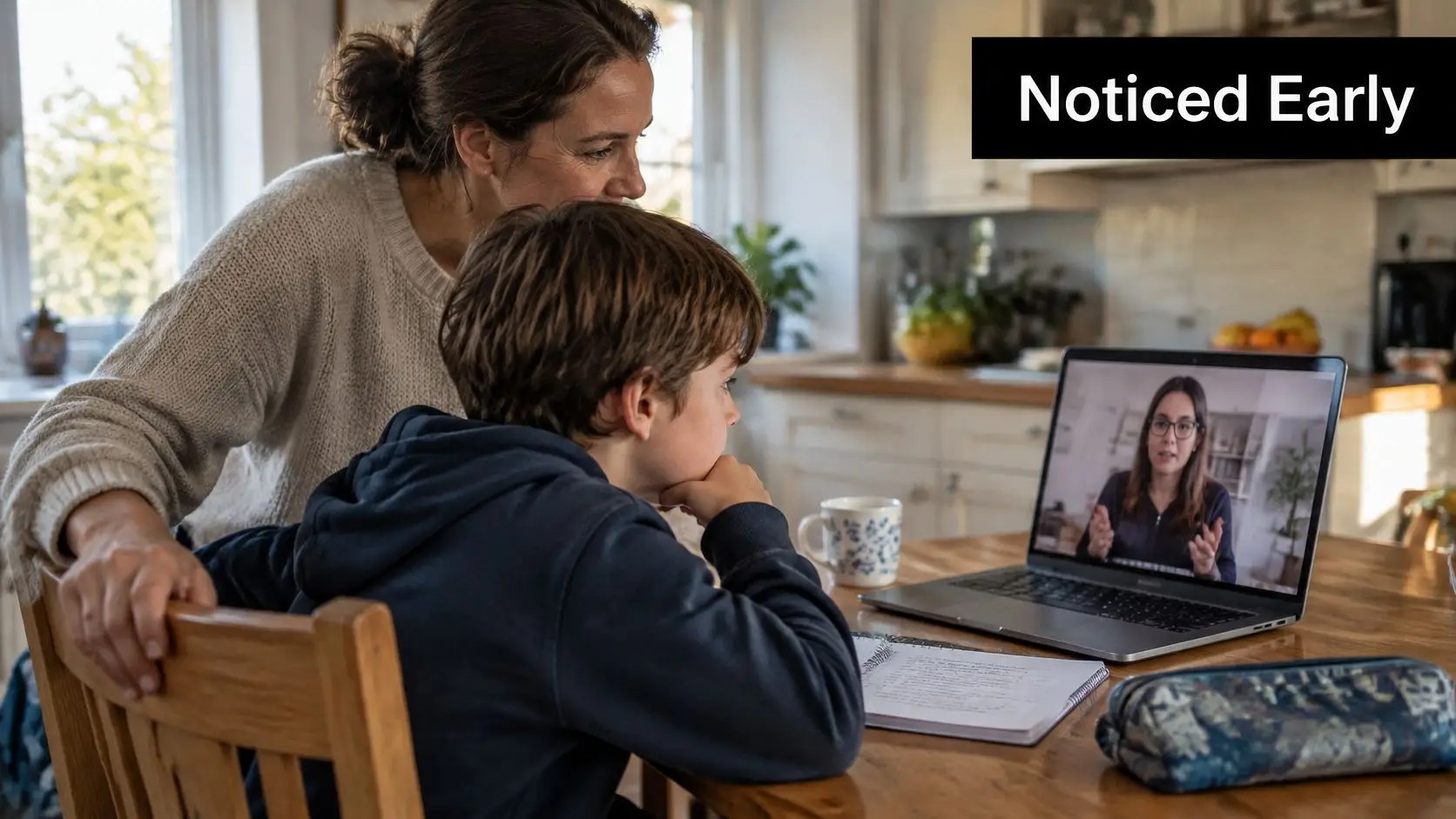
Now suppose the same child stops submitting answers. Their name still appears in the lesson, but they've become harder to reach. Ask the school to describe the next action: who checks in privately, when a parent is contacted and how concerns move to the support coordinator.
Request anonymised examples of how staff track attendance, engagement, assessment progress and wellbeing together. Attendance alone won't explain whether the child understands the work or feels secure enough to ask for help.
At Queen's, our lessons, assessments and support adapt to each learner's pace, preferences and goals. A useful admissions conversation turns that approach into a proposed arrangement for your child, including a responsible person and a review point.
Practical rule: If nobody can explain the next step when your child struggles, the support arrangement isn't clear enough yet.
After a taster, ask your child whether they felt spoken to rather than spoken about. Their answer isn't the whole decision, but it may reveal something a polished presentation cannot.
A Week the Child Can Actually Live
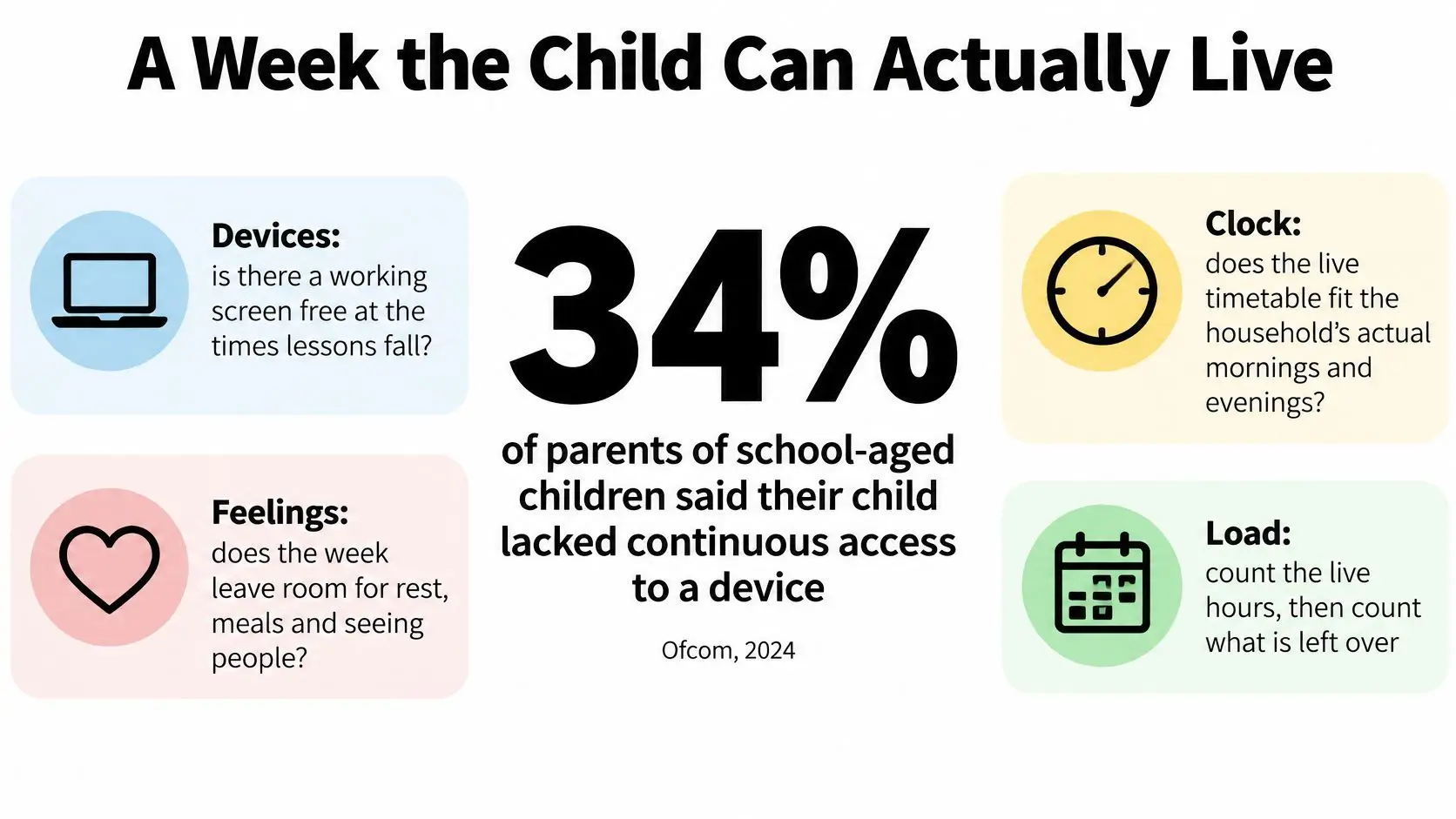
Put the household's actual week on paper before judging a flexible timetable. Include meals, appointments, siblings' lessons, work calls, training, rest and time with friends. Then place the proposed school day inside it.
A child shouldn't have to overcome a preventable access problem every morning before learning can begin. Nor should a parent discover after enrolment that being at home means remaining beside the laptop throughout every lesson.
Test devices before promises
Ofcom's 2024 Children's Media Literacy Report found that 34% of parents of school-aged children said their child didn't have continuous access to an appropriate device for online schoolwork, compared with 28% in 2021. A recording doesn't solve that problem if siblings still need the same screen at the same time.
Test the school's platform on the device your child would use. Open a lesson, an assignment and a recording, rather than checking that the login page loads.
- Equipment: Confirm minimum specifications and whether a tablet supports all required tasks.
- Connection: Ask what the child should do when broadband drops and how technical help is reached.
- Recovery: Establish how long recordings remain available and how missed work is explained.
- Alternatives: Find out whether offline resources or a loan-device arrangement are available, without assuming either is included.
Match the clock and the workload
Our online-school lessons include live and recorded teaching accessible from anywhere in the world. Our rolling admissions also allow students to join at various points through the year rather than only at fixed intake dates.
Those arrangements still need a personal timetable. An international family should convert live lesson times into its own time zone and account for seasonal clock changes. A late evening lesson may be technically accessible but unsuitable for a tired child.
For young performers and students on our Student Athlete Pathway, we combine recorded lessons with structured academic support and flexible scheduling around rehearsals, competitions and travel. The useful question is where the academic work will happen afterwards, with enough energy left to understand it.
Ask what parents are expected to do, too. At Queen's, we ask parents to help establish a daily routine, monitor assignments and stay in touch with teachers as needed, while giving older students room to work independently.
Count emotional energy as well as lesson hours
Ofcom's passive online measurement study recorded children aged 8–14 spending an average of 2 hours 59 minutes online daily across smartphones, tablets and computers. Ask which parts of a school day involve explanation, discussion and feedback, and where children can work away from a screen.
Online activity isn't separate from wellbeing: Ofcom's 2025 Online Nation report found that 69% of UK teenagers aged 13–17 go online to support their wellbeing, while 78% said the internet helps with schoolwork. Preserve space for friendships and relaxation rather than treating every non-school online activity as wasted time.
Safety needs equally practical attention. Internet Matters' additional-needs report found that 79% of children with additional needs had experienced online harm, compared with 63% of other children.
Ask who moderates peer interaction, whether cameras are compulsory and how a child reports something privately. Establish how an out-of-hours disclosure reaches a person and how the safeguarding lead coordinates with parents and the SENCO.
Choose a manageable week, not the fullest timetable your child could theoretically attend.
Seven Steps Before You Enrol
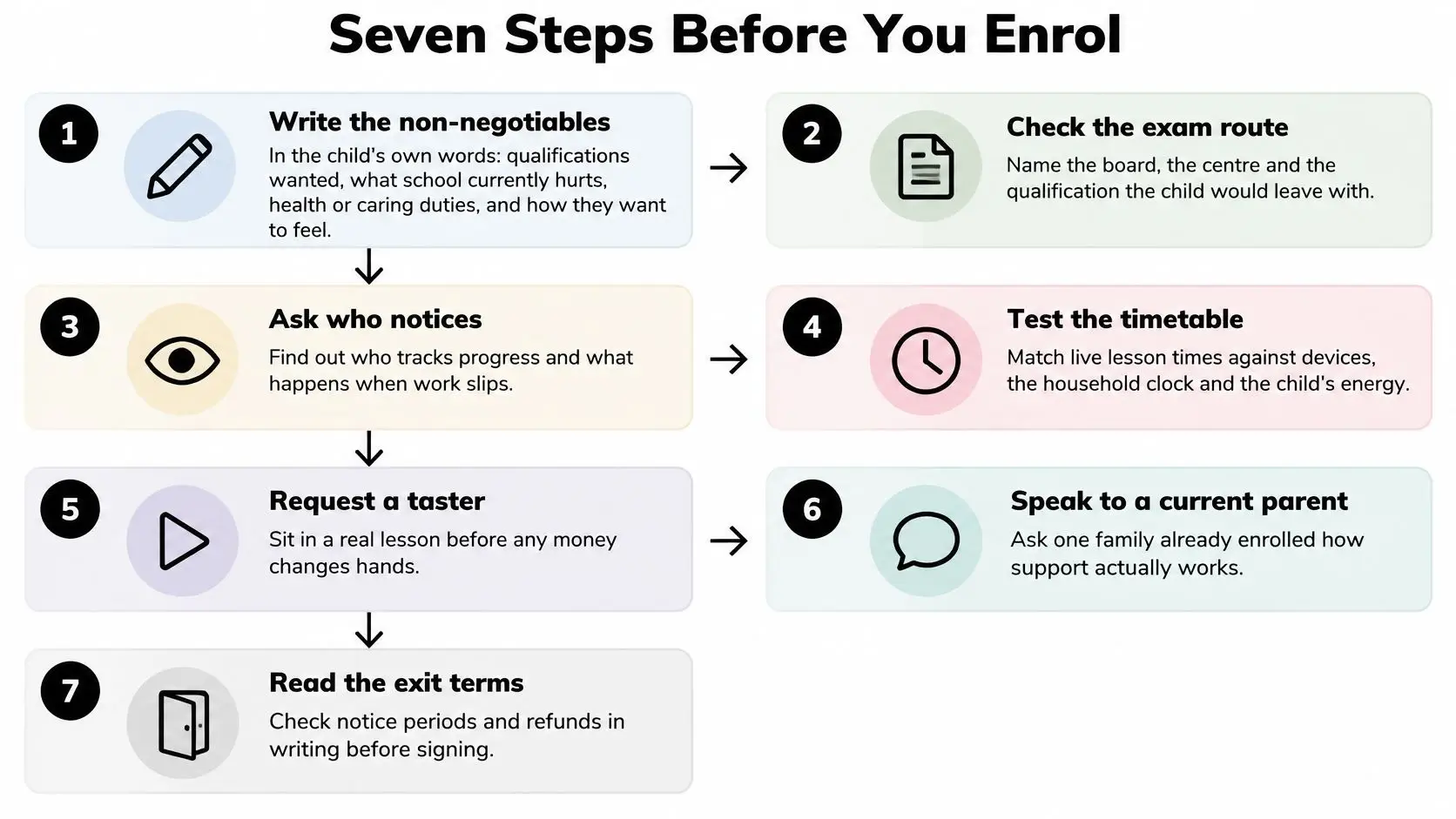
Give yourself a short decision period rather than continuing to browse indefinitely. You could spread these checks across a fortnight, leaving time between conversations to hear what your child thinks without an admissions team present.
Keep written answers together. You're looking for a coherent arrangement, not a collection of reassuring messages from people who may understand your child's needs differently.
Gather evidence before committing
Write down what matters most in your child's words. Include the qualifications they want, what currently hurts about school, health or caring responsibilities, and how they hope to feel by half-term. A child's wish to stop feeling frightened deserves attention alongside academic ambition.
Verify the provider and examination route. Confirm legal status, registration or inspection position, whether your child would be on a roll, the awarding organisation and the availability of planned subjects. Keep copies of the relevant documents so you can distinguish company details, school credentials and examination approval.
Attend a real live lesson. Watch whether the teacher asks questions, checks understanding and responds to confusion, rather than presenting slides. If possible, speak to a current parent about what happens when their child needs help, while recognising that another family's experience won't exactly match yours.
Get the attendance and missed-lesson rules in writing. Ask how participation is recorded, when parents receive alerts and who re-engages a child who stops appearing. Request a sample sequence showing responsible roles, contact points and escalation, including how a pupil reports bullying privately.
Agree the support responsibilities. Match SEND or SEMH needs to a named coordinator, specific adjustments and a review rhythm. Ask how staff share necessary information without making your child repeatedly explain something distressing, and what happens when the usual support person is absent.
Run the household platform test. Use your own laptop or tablet, briefly disconnect the internet, recover the lesson and locate a recording. Check accessibility settings, identity controls, who can see your child and how recordings and personal information are handled.
Examine outcomes and arrange the child-present call. Request results split by subject, cohort, age and SEND status where disclosure can protect privacy, rather than relying on a headline pass rate. Read notice periods and refund terms, then book a second conversation with your child present to discuss the proposed opening fortnight.
Make daily contact part of the decision
During the pandemic, Ofsted warned that children outside conventional settings could become “out of sight”, citing a local-authority survey reporting more than 75,000 home-schooled children in 2020, a 38% year-on-year increase. That warning explains why attendance checks must concern daily participation and welfare, not merely whether a place has been purchased.
On the final call, invite your child to ask a question themselves, or send it in advance if speaking feels difficult. Ask the school to describe an ordinary opening day, including where help comes from when something goes wrong.
A warm tour is not the same as a workable week.
Choose the School and Book a Conversation
Keep a school on your shortlist only if it meets the confidence and qualification priorities you starred, survives the household device test and names the people responsible for absence and safeguarding. If an essential condition remains unresolved, declining is an act of care, not a failure to embrace something new.
Your child doesn't need the school with the most appealing description of flexibility. They need an arrangement you can explain clearly: what they'll learn, who'll help and how they'll take their next step.
Apply the same standard to Queen's
Queen's Online School is an independent British international online school offering full-time Primary, Secondary and Sixth Form education for students aged 7 to 18. We offer a Student Wellbeing & Care pathway, an International Students pathway, a Neurodiverse Support pathway, a Young Performers Programme and a Student Athlete Pathway.
Queen's was featured in Absolutely Education's Guide to Online Schools 2026. Treat that recognition as a reason to investigate, not a substitute for checking the fit with your child.
Our Price Promise is straightforward: if a family finds a comparable online school offering the same number of live lessons for a lower fee, we refund the difference. Compare the educational fit first, then make the financial comparison on that basis.
Before deciding, arrange a conversation with your child in the room and request a taster on your own device. Leave with written confirmation of examination entry, recording access and who calls if your child goes quiet. The reassurance you're seeking is specific: a school where this child is expected, not just enrolled.
Queens Online School offers a British education with live and recorded teaching and support adapted to each learner's pace, preferences and goals. Visit Queens Online School to discuss your child's priorities and request a taster, bringing your timetable, support questions and qualification goals to the conversation.