

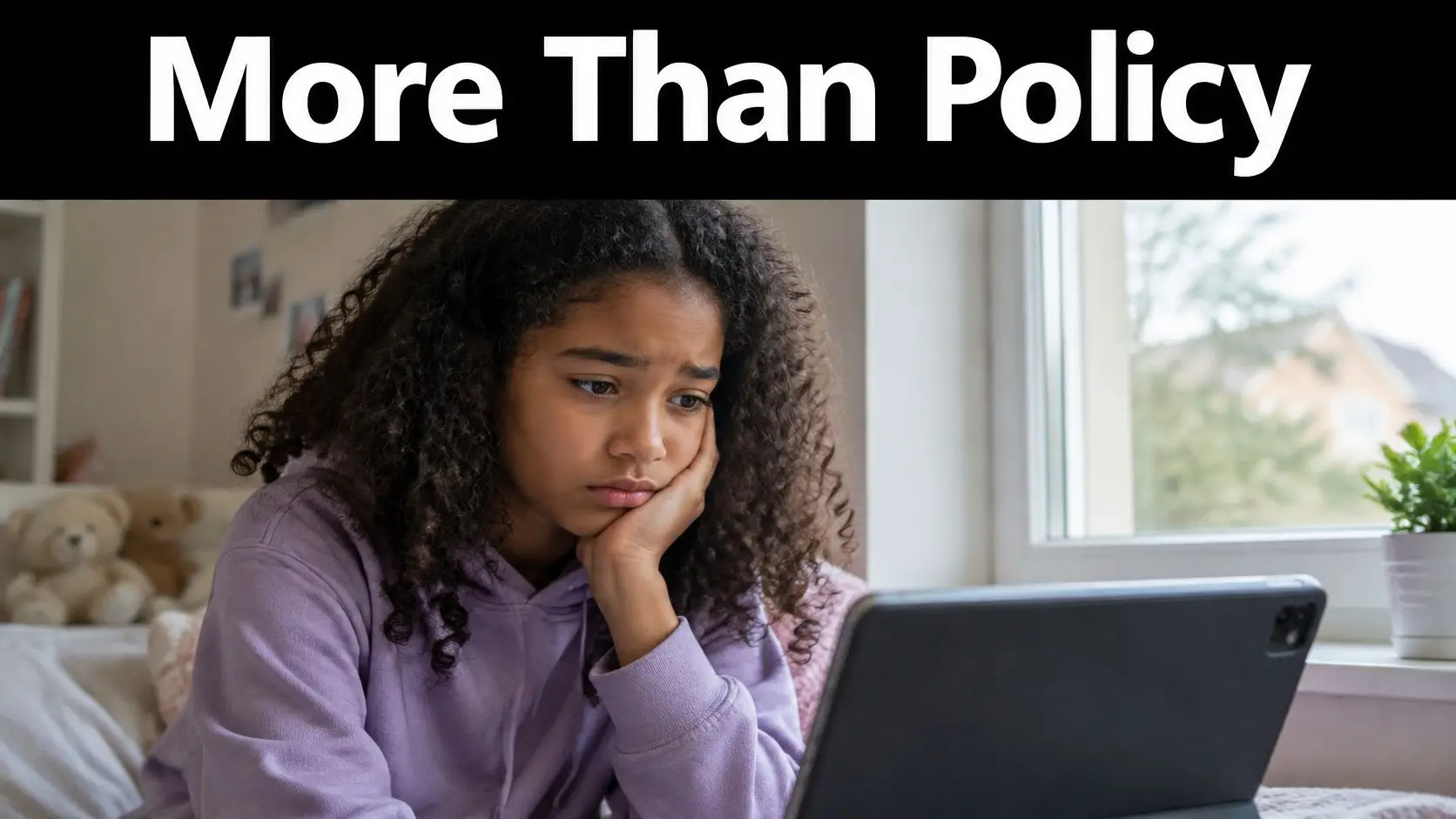
Your child is ready for the lesson, but won't turn the camera on. Say she's eleven, and yesterday a classmate mocked her curly hair in a group chat. Today she's watching the notifications instead of listening to her teacher. You want to help without making things worse, and she wants reassurance that telling an adult won't mean more humiliation.
Why a Frightened Child Needs More Than a Policy
That private dread is where bullying prevention in schools has to begin. A child shouldn't have to choose between taking part in learning and protecting herself from classmates. Nor should she have to build a perfect case before an adult takes her fear seriously.
The scale matters. In England, the Department for Education's National Behaviour Survey for 2023–24 found that 24% of pupils had been victims of bullying for any reason in the previous twelve months; 23% of all pupils reported bullying by another pupil at their school, while 3% reported bullying by someone else. Among pupils who had experienced bullying, 90% said at least some incidents occurred in person and 29% said at least some occurred online. Appearance was a perceived reason for 46% of pupils bullied in person and 39% of those bullied online.
Start with the child's next lesson
The pupil in this example needs practical protection, not a request to read the behaviour policy. Her teacher needs to know what happened, who can contact her, and how she can participate without becoming the centre of a public discussion.
A useful first conversation identifies the immediate worry. Is she afraid of another comment, a screenshot, exclusion from shared work, or retaliation for telling? Each answer calls for a different adult action.
The starting point: A policy sets expectations. An adult must turn those expectations into protection the child can actually feel.
That means recognising different forms of harm, making reporting accessible, supervising peer contact and checking the outcome. The child should know who will help before the next uncomfortable moment, not discover the reporting process while already frightened.
How to Name Bullying Including Cyberbullying
Bullying is behaviour meant to hurt, repeated or likely to be repeated, where a power imbalance makes it difficult for the child to defend themselves or escape. Power might come from physical strength, popularity, control of a friendship group or possession of an embarrassing image.
A disagreement between equals still needs attention, but it isn't automatically bullying. Think of a door: conflict can involve two people pushing against it; bullying is closer to one person controlling the handle while the other cannot leave.
Look at the pattern, not just the incident
Adults can miss bullying when they examine each event separately. A comment about a pupil's voice, exclusion from shared work and a mocking message may look minor in isolation. Together, they may show a group repeatedly making that pupil feel unwelcome.
Types of bullying, what the child feels and the first response
| Type | What it looks like | What the child may feel | First adult response |
|---|---|---|---|
| Verbal | Names, threats, mockery of looks, voice or work | Shame, dread of speaking | Stop it in the moment and record the words |
| Physical | Hitting, shoving, damaging or taking belongings | Fear, flinching, avoiding spaces | Separate the pupils and check for injury |
| Relational | Exclusion, rumours, friendship used as leverage | Loneliness, sudden loss of friends | Map the peer pattern and restore safe contact |
| Cyberbullying | Repeated hurt via chat, images, accounts or group messages | No safe offline escape, anxiety at notifications | Keep the messages and remove the child from the harmful chat |
| Prejudice-related | Targeting disability, appearance, race, faith, sex or identity | Feeling that who they are is under attack | Treat as a safeguarding concern and name the prejudice explicitly |
Read the table through the child's experience. A pupil who stops answering questions may be avoiding verbal humiliation, not losing interest in learning. Another who refuses group work may be trying to avoid classmates who repeatedly shut them out.
Physical harm needs an immediate safety check. Relational harm needs careful attention to who controls access to friends and activities. Don't arrange a public reconciliation before understanding whether the child feels able to disagree safely.
Digital harm needs its own questions
Ask where the behaviour happens and who can see it. A single uploaded image can be repeatedly shared or used to threaten a child, so counting the original posts alone won't explain the harm.
Our guidance on cyberbullying prevention can help families think through digital boundaries alongside school action. The immediate aim isn't to remove a child from every online friendship, but to stop harmful access while preserving safe relationships.
If the child cannot safely make it stop, treat it as a bullying concern even when the other pupil calls it a joke.
That's a protective starting point, not a substitute for investigation. Adults should establish what happened without making support depend on proving another pupil's intention.
Which Children Standard Systems Miss
Pupils with special educational needs and disabilities, or SEND, need more than a reporting system designed for confident verbal disclosure. UK Parliament's written answer citing the Department for Education's National Behaviour Survey records that, in 2022–23, 34% of pupils with SEND reported being bullied, compared with 20% of pupils without SEND.
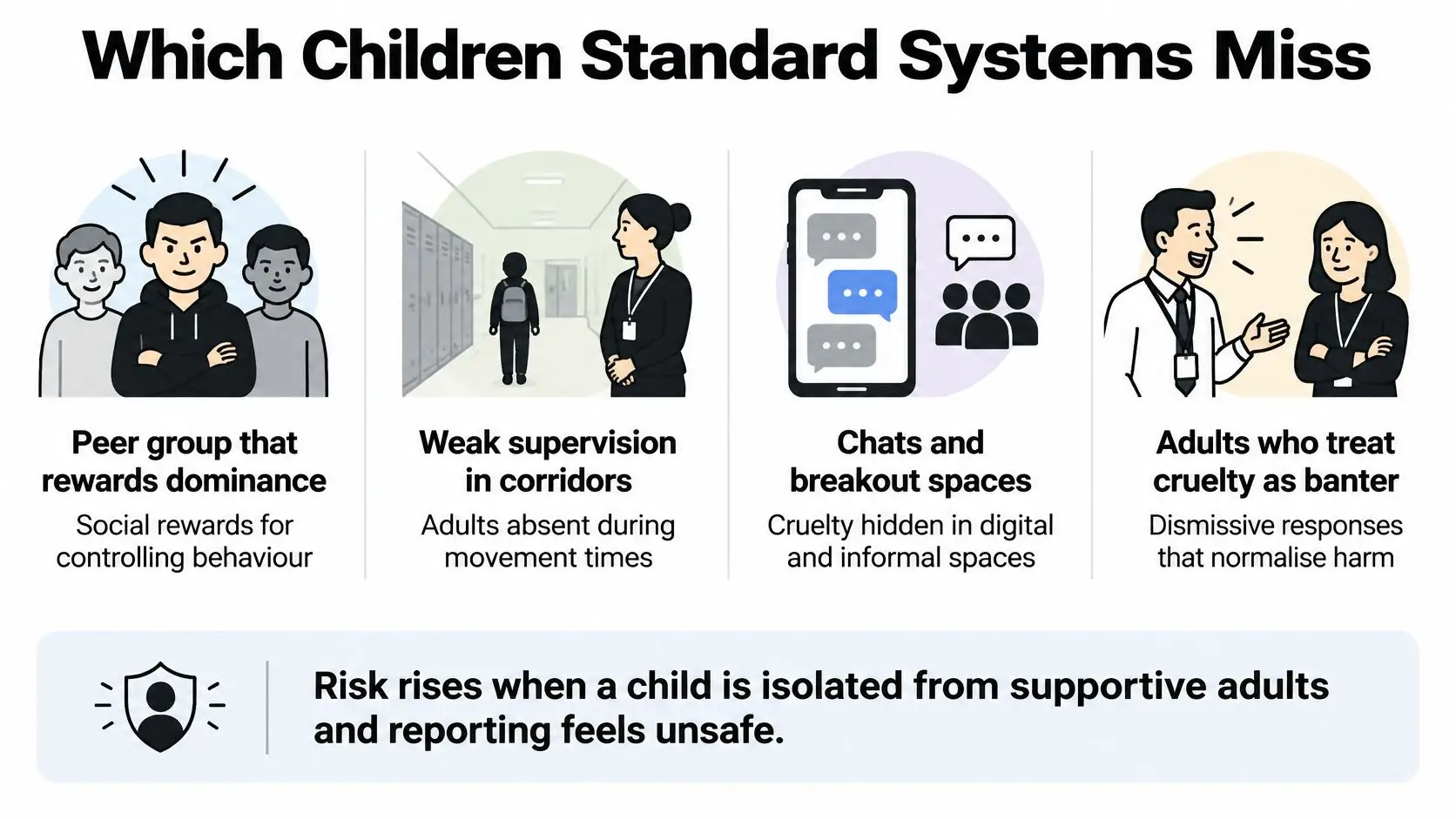
That difference doesn't mean a child's needs cause bullying. Adults need to examine the conditions that allow peers to hurt them: social rewards for dominance, poorly supervised spaces and dismissive responses to cruelty.
These are places to look, rather than reasons to blame the child.
When distress doesn't look like a report
A standard form assumes a pupil can identify bullying, organise events into a sequence and explain what they want an adult to do. Communication differences, anxiety, masking or an earlier dismissal can make that difficult.
A pupil with social, emotional and mental health needs, or SEMH needs, might withdraw, become angry or stop attending a club instead. None of those changes proves bullying, but each gives adults a reason to ask privately rather than punish first.
For example, a learner who repeatedly leaves a breakout room may be avoiding ridicule. Before treating the exit as refusal to collaborate, ask what happened immediately before they left and whether the same classmates were involved.
Adjust the route, not the expectation of safety
Offer a visual choice, a short spoken check-in or help completing a report. Let the child identify the adult they find easiest to approach, and allow them to describe events without using the word bullying.
- Communication: Accept a drawing, selected symbols or a parent-supported account.
- Predictability: Explain who will hear the concern and what will happen next.
- Observation: Compare changes in attendance, participation and friendships without assuming a cause.
- Privacy: Avoid questioning the pupil in front of those involved.
Our information on special educational needs support offers context for families considering adjustments to learning and participation.
Use the accompanying video as a starting point for discussion with staff, keeping the child's own account central.
The essential question is whether a pupil can access protection in practice. A reporting route isn't accessible just because every family receives the same form.
Whole-School Strategies the Evidence Supports
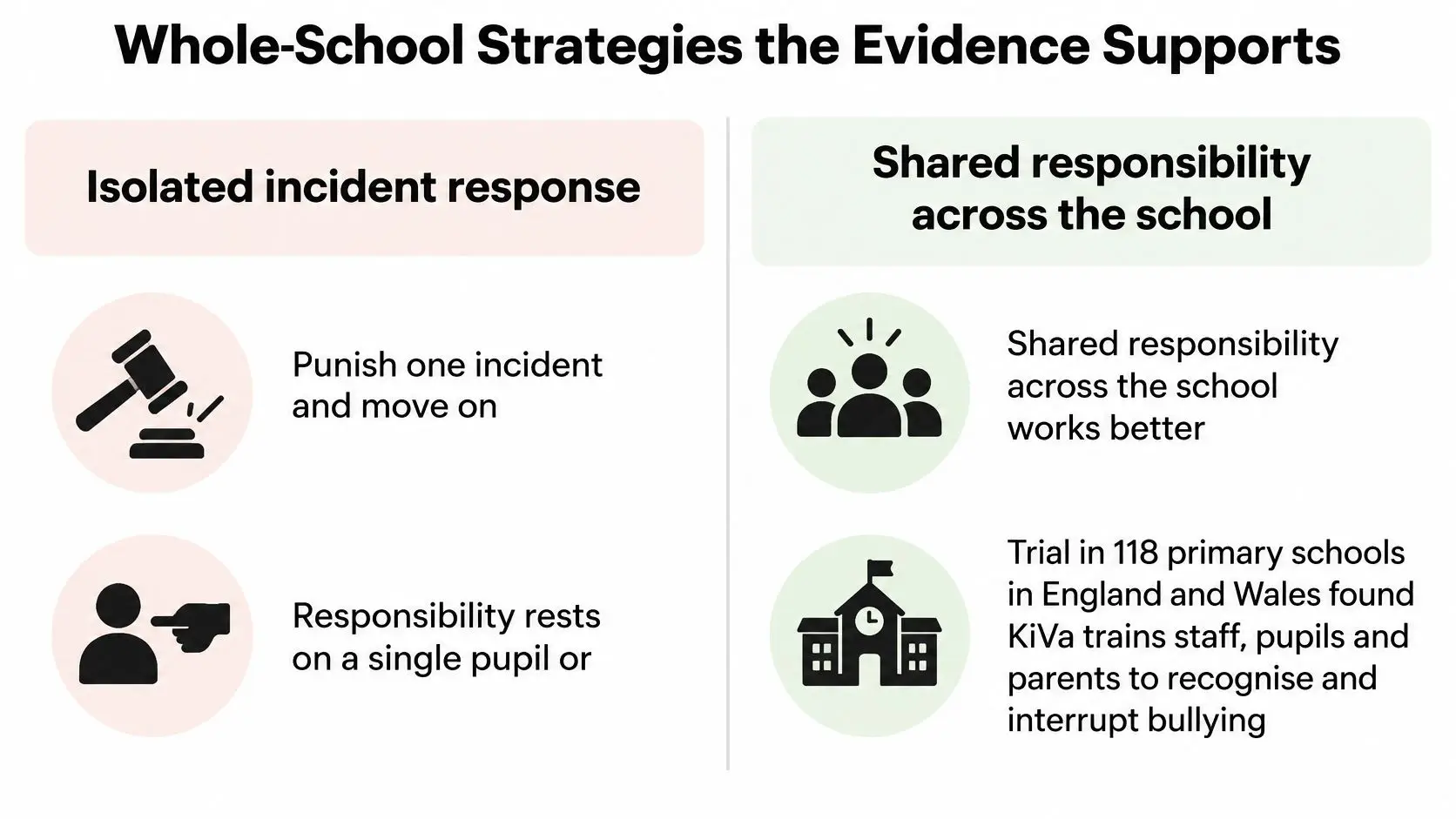
A school policy can draw a firm line. Protection comes from what adults and pupils do every day around that line. A KiVa trial published in Psychological Medicine across 118 primary schools in England and Wales found 13% less reported bullying victimisation compared with standard practice. That result points to a plain lesson: staff responses, bystander behaviour and peer-group dynamics all need attention. Changing the pupil causing harm is only one part of the work.
Think of prevention as a school-wide safety net, with several hands holding each knot. If one hand lets go, another still needs to be there. A pupil who is laughed at in a group chat may also be left out of a breakout room, teased in a club or silent in class. Each setting needs adults who notice, pupils who know how to respond and a route that leads to action.
In an online school, that net has to include digital spaces as carefully as lessons. Queen's Online School has a zero-tolerance policy on bullying and takes immediate action against any form of harassment or discrimination. Staff actively monitor for bullying and cyberbullying issues, and students are encouraged to report incidents. That matters because a harmed pupil needs to know which adult will respond, not only what the policy says.
Compare what each approach actually changes
A classmate who forwards a humiliating image, laughs at a cruel comment or controls group membership can help sustain bullying. Prevention should teach pupils safe alternatives, such as not sharing harmful content, including someone in an activity and reporting privately.
The contrast below shows why responsibility cannot sit with a single incident handler.
Prevention approaches and when they fall short
| Approach | What it changes | UK evidence picture | Do not rely on it when |
|---|---|---|---|
| Bystander and peer programmes such as KiVa | Peer dynamics and staff skill | A UK primary-school trial supports reduced reported victimisation | The school imports the brand without training or leadership |
| PSHE, assemblies and social-emotional teaching | Shared language for respect | Commonly used; their value as a standalone response needs checking | They are the only action across the school year |
| Restorative meetings | Repair after harm, if safe | Supporting evidence is uneven | There is fear, a power imbalance or pressure on the victim |
| Clear sanctions and safeguarding thresholds | Boundaries and protective action | Required within relevant legal and safeguarding arrangements | Pupils fear punishment or retaliation for reporting |
| Individual support and adjusted reporting | Access to protection for SEND, SEMH and isolated pupils | Elevated risk makes accessibility essential | Nobody checks whether the plan works for the child |
The table is a decision aid, not a ranking. A school needs a coordinated combination, with leaders checking delivery and staff applying consistent expectations across lessons, clubs and informal contact. That includes online clubs, peer forums and structured social opportunities with moderators, so pupils have safe ways to belong beyond a single lesson.
A zero-tolerance line helps set the boundary, but it is not the whole prevention plan. A frightened child may want to know who will sit with them at lunchtime, whether the cruel message will keep circulating and if adults will act without exposing them. Those questions need practical answers. Discipline issues are addressed promptly through open communication involving the student, parents and teachers, with the aim of resolving conflict while keeping the learning environment positive and safe.
Restorative meetings require trained facilitation, voluntary participation and safeguards. They should not be automatic when a child is still afraid or unable to disagree freely. Supporting the pupil who caused harm to change must never depend on the targeted child offering forgiveness.
A child should never have to perform reconciliation to earn protection.
Maintained schools in England have a duty under section 89 of the Education and Inspections Act 2006 to establish measures that prevent bullying, as explained in the Department for Education's prevention guidance. For families, the useful test is simpler: can the child name a trusted adult, make a report in a way they can manage and see that adults respond?
Queen's Online School also gives every student access to a wellbeing mentor as part of its pastoral care. Teachers regularly set up virtual breakout rooms and group projects so students can collaborate with classmates on shared work, discussions and presentations. These structures work best when staff watch how pupils are included, not only whether the task was completed.
Choose a consistent bundle of teaching, supervision, reporting, intervention and review. Explain it in pupil-friendly language and rehearse what children can do when they witness harm. An awareness day can support that work, but it cannot replace everyday practice.
What to Do the Day a Child Tells You
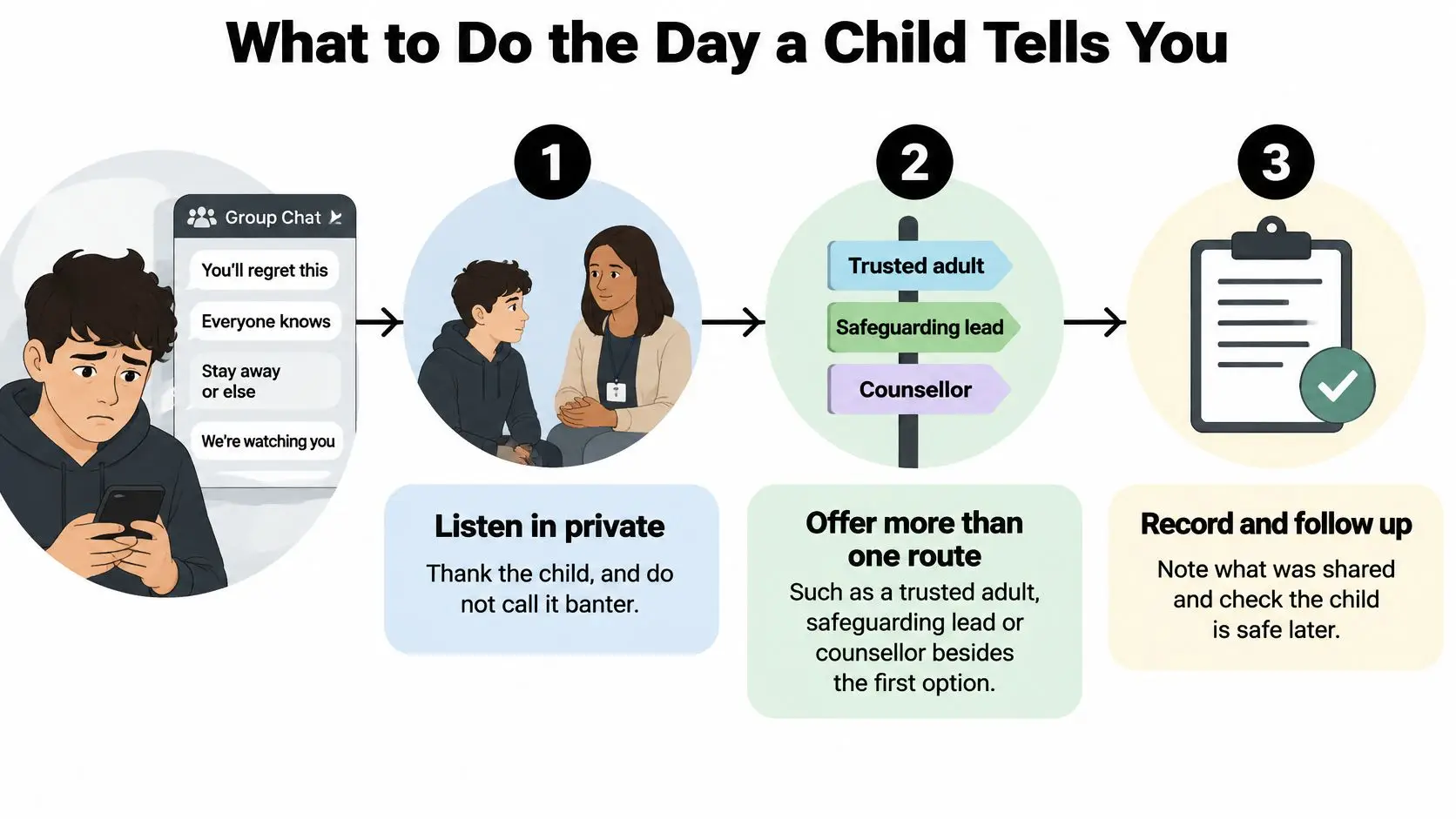
A teenager hands you their phone. Threatening messages have appeared in a class group chat, and their first worry is that everyone will know they reported it. Respond to that fear before discussing sanctions.
Use a named route such as trusted teacher → pastoral lead → designated safeguarding lead. This is a practical model to agree with the school, not a claim that every school uses identical arrangements.
Protect first, then establish the detail
Listen privately. Thank the child for telling you. Say that you'll help and explain that you may need to share information with adults responsible for keeping them safe. Don't promise absolute secrecy or dismiss the messages as banter.
Offer a choice of trusted adult, pastoral contact or confidential reporting form. For a child who struggles to explain, use a visual choice or help them describe the immediate worry. Arrange a same-day check-in as a protective step rather than waiting for a polished account.
Preserve the evidence. GOV.UK's reporting advice tells families to keep dated records of calls, emails or texts and not delete messages. Save screenshots showing account names, timestamps and surrounding context, then make a short incident log.
Reduce immediate pressure after saving evidence. Blocking, muting or leaving the harmful chat may help; the child shouldn't have to remain exposed so adults can investigate. Don't ask them to confront the sender.
The first response should feel calm and manageable.
Make the handover explicit
Contact the school's safeguarding lead. Agree who will explain the next action to the child, who will record the concern and when the child will hear back. Ask how staff will prevent retaliation while investigating. The family shouldn't have to repeat the entire account to every member of staff.
If there's immediate danger, contact emergency services. Where there's reasonable cause to suspect significant harm, treat the matter as child protection and involve the designated safeguarding lead and local-authority children's social care. Don't wait for a routine meeting when the child's safety is at risk.
At our school, staff actively monitor for bullying and cyberbullying, and pupils are encouraged to report incidents. Teachers regularly organise virtual breakout rooms and group projects, so supervision must include collaboration rather than only whole-class teaching.
We may record lessons, meetings, activities and communications for safeguarding, quality assurance, staff training, educational purposes, disciplinary investigations and dispute resolution. Where an appropriate recording exists, authorised staff can consider it during an investigation rather than relying entirely on repeated retelling.
Parents retain responsibility for physical safety, supervision, welfare and the home environment. Before the next login, agree where the child will sit, who will be nearby and how they can ask for help without announcing it to classmates.
How to Tell Whether the Harm Has Stopped
A completed incident form doesn't establish that a child is safe. Evaluate the response, including whether the behaviour returns, moves to another channel or leaves the pupil too frightened to participate.
A Department for Education evaluation, covering 1,378 school questionnaires, 527 follow-up questionnaires, 47 local-authority questionnaires and 36 case-study visits, found that schools commonly used PSHEE, assemblies and Social and Emotional Aspects of Learning, describing them as effective, economical and easy to deliver; only about one-fifth of local authorities had evidence supporting restorative approaches.
Establish a baseline and a review point
Start with recorded concerns and an anonymous pupil survey. Agree what improvement should look like for the affected child and set a review point rather than closing the case after an apology.
For a reporting benchmark, Enquire's Scottish guidance recommends that incidents should ideally be logged within three working days. That's a Scottish guidance benchmark, not permission to delay urgent protection.
Measures to track whether the harm has stopped
| Measure | How to collect it | Signal of success |
|---|---|---|
| Repeat victimisation | Incident log and anonymous pupil survey at baseline and term review | Fewer repeat reports for each named child |
| Time from report to adult response | Date stamps on the incident log | Prompt protective response, recorded concern and named check-in date |
| Child says the behaviour has stopped | Private check-in at a fixed point | Child reports no further harm during follow-up |
| Results by SEND, SEMH and age | The same measures segmented by group | No group remains overlooked or persistently above the school average |
| Results by online channel | Log live lesson, chat, club and pastoral contact separately | Harm falls across channels, not only in the overall total |
Check SEN and disability separately where records allow, without exposing identifiable pupil information. A falling total can hide persistent harm affecting a smaller group, while an initial rise in reports may reflect improved trust.
Read changes alongside the child's account
Say a pupil reports feeling safer after a seating change and tighter chat moderation. Check that classmates haven't moved the comments elsewhere. For a learner with SEMH needs, improved attendance after scheduled check-ins is encouraging, but it doesn't replace asking what feels different.
Persistent low mood or withdrawal also deserves support beyond the incident process. Refresh Psychiatry & Therapy's resource on signs of depression in teens can help parents prepare questions for a qualified professional, without treating a checklist as a diagnosis.
Ask who owns the next review and what will change if harm continues. Success includes the child entering an ordinary lesson without first searching the room or chat for danger.
Choose a School That Keeps Your Child Safe
Judge a school by the child's next ordinary day, not by the confidence of its policy wording. Ask staff to describe what would happen if your child reported repeated exclusion during group work.
A useful answer names an adult, a protective action and a review process. It also explains what happens when the initial response doesn't work.
A school safety checklist
- Private contact: Who can my child tell without classmates knowing, and when will an adult respond?
- Digital supervision: How are chat, group work and clubs supervised during live provision?
- Quiet distress: How do staff check pupils with SEN or SEMH needs who don't report directly?
- Recording: Which routes exist, who keeps the log and how is a check-in date agreed?
- Outcomes: How does the school establish that behaviour has stopped, including for different pupil groups?
- Escalation: Who reviews continuing harm when the first intervention fails?
Write down the answers. If they're vague, request a written reporting route before enrolment or transfer, including the relevant staff contact details.
Put belonging into ordinary lessons
At Queen's Online School, we have a zero-tolerance policy on bullying and take immediate action against harassment or discrimination. Every student has access to a wellbeing mentor, and we provide SEN and SEMH support through specialised staff and individualised plans.
Those commitments matter most when a pupil can use them during an ordinary school week. Support shouldn't require a child to reach crisis point or repeatedly explain why they're frightened.
A useful question: What will my child notice is different tomorrow?
This week, agree with your child which adult they would approach. Then establish the next check-in date with the school, keeping your child involved in how that conversation happens.
Where to Find Trusted Guidance
Choose guidance according to the decision you need to make. Reporting advice helps with immediate action; legal guidance clarifies responsibilities; evaluations help you question claims about a particular programme.
National figures provide context, not a verdict on an individual school. Keep questions focused on the child's experience and the school's own response.
Match the resource to the question
Trusted sources and what to use them for
| Resource | Use it for | Publisher |
|---|---|---|
| GOV.UK cyberbullying advice | Reporting online harm and keeping dated records | UK government |
| Education and Inspections Act 2006, section 89 | The school duty to prevent bullying in maintained schools in England | UK legislation |
| National Behaviour Survey 2023–24 | National baseline figures for bullying | Department for Education |
| Anti-Bullying Alliance programme evidence | Understanding risks affecting SEND and free-school-meal pupils | Anti-Bullying Alliance |
| Enquire guidance | Prompt logging and investigation of wellbeing impacts in Scotland | Enquire |
| School anti-bullying evaluation | Assessing evidence for restorative and universal approaches | Department for Education |
The government documents and evaluation are linked alongside the relevant findings above. For accessible context on legal responsibilities, our guide to UK anti-bullying law can help families prepare questions without assuming that identical arrangements apply across every school type or UK nation.
Keep local contacts ready
- School safeguarding: Obtain the designated safeguarding lead's details directly from your child's school.
- Continuing concerns: Ask for the school's escalation and complaints process in writing.
- Serious harm: Contact safeguarding professionals or local-authority children's social care; use emergency services for immediate danger.
Keep those details with the incident record so you don't have to search while distressed. Guidance is useful when it helps an adult take the next protective action, with the child informed and supported.
We offer live online learning alongside pastoral care, wellbeing mentors and specialist SEN and SEMH support, with staff monitoring for bullying and cyberbullying. Visit Queens Online School to discuss your child's needs and how reporting, support and follow-up could fit their school day.