


You're at the kitchen table with a revision timetable open, a mock result beside it, and a child who looks more tired than motivated. One course promises expert teachers, another advertises exam technique, and a third has been recommended by a parent whose child seems to revise effortlessly. The difficult question isn't which course looks most impressive. It's which one your child can use without becoming more anxious, exhausted or confused.
The right GCSE revision course must fit three things at once: the exact qualification, the way your child learns, and the reality of family life. A course that ignores any one of those can waste money and damage confidence. The strongest option diagnoses specific gaps, uses active recall and spaced practice, gives useful feedback, and adapts for anxiety, SEN or SEMH needs.
The Real Decision Behind Choosing GCSE Revision Courses
Most parents start with price, reputation or a recommendation. Those matter, but they're poor first filters. A polished course can still teach the wrong specification, move too quickly for a child with limited working memory, or schedule demanding sessions when your teenager is already depleted by school.
Start with the qualification. GCSE preparation is specification-specific, not a general intellectual exercise. Ofqual's official statistics cover GCSE qualifications, examination entries submitted in each series and entries submitted late by schools and colleges. That framework reflects a system involving multiple subjects, awarding organisations, specifications and examination series, so a provider should be able to name the relevant exam board and specification before you pay. Check the course against the child's actual subjects, not just the word “GCSE” in its advert. Ofqual's statistics framework is the right starting point for understanding that regulated structure.
Then look at the child sitting in front of you. One student may need a brisk, social classroom to rebuild confidence after poor mock results. Another may know the content but freeze under timed conditions. A dyslexic learner may need practice using approved extra time, while a student with SEMH needs may need shorter sessions, predictable routines and a named adult who notices when they stop attending.
The grade target also changes the decision. Among 16-year-olds in England who took seven or more GCSEs in summer 2025, 45.8% achieved grade 4 or above in every subject, while 5.5% achieved grade 7 or above in every subject. Those are different goals, requiring different support. Ofqual's summer 2025 qualification results show why a course should establish whether your child needs broad pass security, higher-grade precision, or both.
Finally, be honest about the family budget. The cheapest option becomes expensive if your child doesn't attend, can't follow the lessons or receives no feedback. The most expensive option is wasteful if it supplies hours of teaching where a targeted diagnosis and regular re-testing would have been enough.
The useful question is not “Which course is best?” It's “Which course matches this child, this specification, this timetable and this stage of the year?”
Seven Checks Every Parent Should Run Before Paying
Take these questions into a sales call, open evening or trial lesson. Ask for specific answers. If the provider responds with slogans instead of evidence, walk away.
1. Does the course match the exact exam board and specification?
Ask the provider to name the awarding organisation, specification code and examination series it supports. A green light is a published syllabus outline mapped to assessable topics. A fail signal is “we cover all GCSE content” without identifying the board or showing how lessons reflect its requirements.
2. Does it make the child retrieve knowledge?
Rereading, highlighting and copying notes can feel productive without proving that a learner can recall or apply anything. A UK-focused survey of nearly 40,000 students found that 37% of revision time was spent rereading, highlighting or making notes, while 76% of students in Years 10 to 13 did not space revision consistently. The figures are reported in CENTURY's evidence summary on the revision gap.
Look for closed-book quizzes, low-stakes testing, delayed revisits and exam questions followed by feedback. If every lesson consists of slides, explanations and worksheets completed with notes open, it isn't enough.
3. What happens when your child loses marks?
A ticked quiz score isn't a diagnosis. Ask whether the course records errors by topic and question type, then schedules a re-test. A strong provider can show how it distinguishes a knowledge gap from a calculation error, misread command word, weak application or poor timing.
For example, after a biology question, the error log might record the missing process, the mark-scheme wording, the corrected answer and the date for another attempt. “Your child completed the worksheet” is not progress evidence.
4. How will progress be reported?
Ask for a baseline assessment before teaching begins and a clear method for comparing later performance. A green light is a report showing topic mastery, corrected errors, attendance and performance under timed conditions. Be cautious if the provider promises a grade increase without showing how it measures starting points.
5. Who actually teaches the sessions?
A brand name doesn't teach your child. Ask for the teacher's subject expertise, experience with the relevant exam board and approach to feedback. You should also know who answers questions between lessons and who contacts you if attendance drops.
6. What does attendance support look like?
Find out whether missed sessions can be watched later, whether the teacher follows up incomplete work and how the course handles repeated absence. Recorded content helps, but it doesn't replace accountability for a student who already struggles to start work.
7. How does the course protect wellbeing?
Ask whether sessions can be shortened, whether the provider offers a calm point of contact and how it responds when anxiety affects concentration or sleep. A course that adds more worksheets to an overwhelmed child is not rigorous. It's poorly designed.
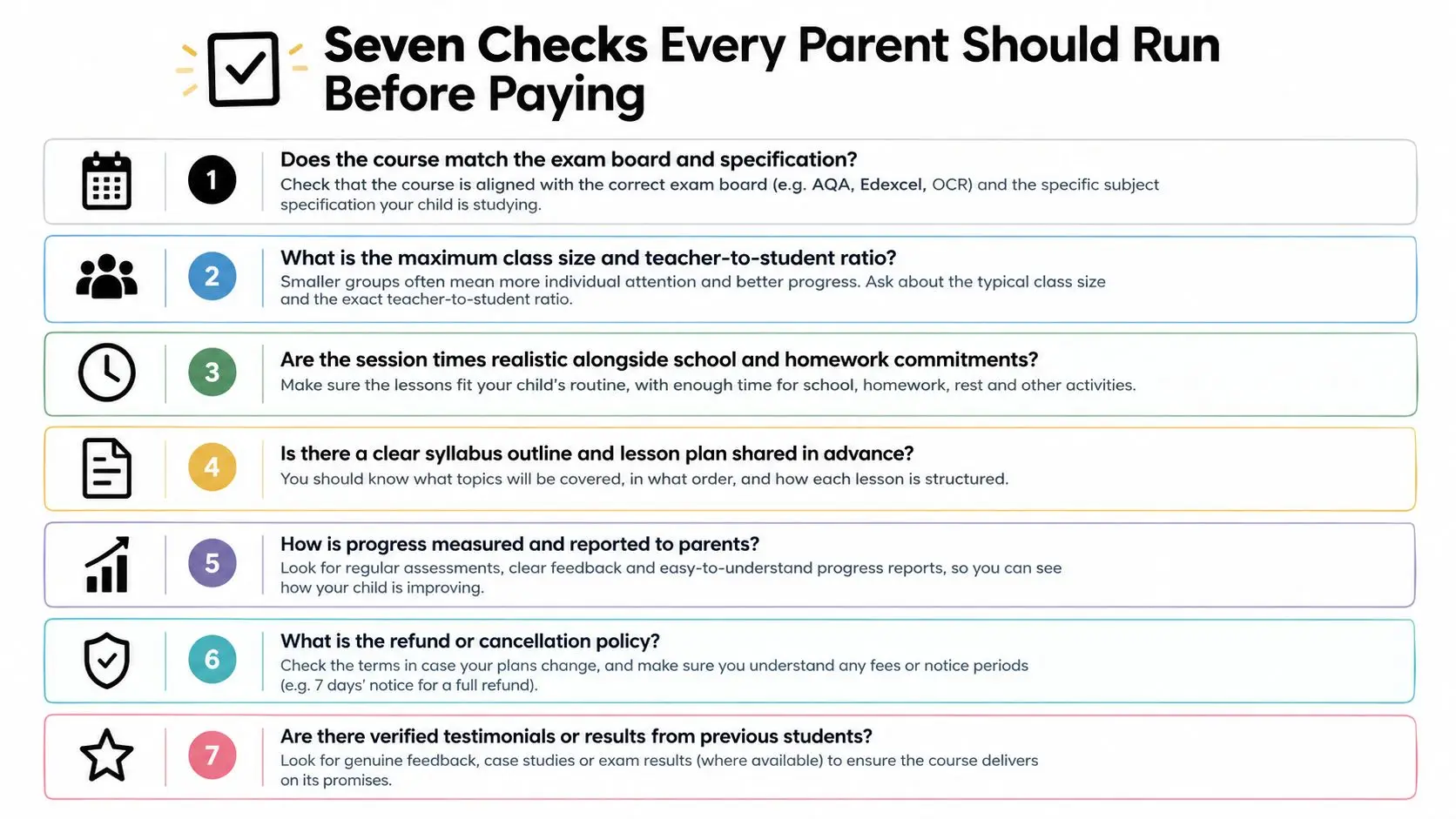
Write these seven questions down before speaking to a provider. You're more likely to notice evasive answers when you're comparing notes than when you're responding to a confident sales pitch.
A short explanation of delivery choices can also help you assess whether the format matches your child's habits. LearnStream's practical course delivery guide provides useful context on live, recorded and blended teaching models.
Live vs Online GCSE Revision Courses Compared
A live intensive week and an online spread programme solve different problems. Treating them as interchangeable is how families end up buying the wrong kind of support.
A live course works well when a student already has reasonable study habits, benefits from immediate teacher interaction and needs a concentrated confidence boost. An online programme spread across weeks or months suits a learner who needs repetition, predictable routines and time to process between sessions.
| Dimension | Live intensive week | Online spread programme |
|---|---|---|
| Flexibility | Fixed sessions during a holiday or set week | Lessons can be distributed around school and family commitments |
| Accountability | Immediate teacher oversight and group momentum | Depends on reminders, tutor follow-up and the child's routine |
| Anxiety | Social energy can reassure some learners, but a busy timetable may overwhelm others | Familiar surroundings and replayable lessons can reduce pressure |
| SEN fit | Easier to ask questions in real time, but pace may be demanding | Pausing, replaying and shorter study blocks can support processing |
| Feedback | Often immediate during lessons and mocks | Quality varies, from automated marking to detailed teacher review |
| Best use | Consolidating known content or rebuilding exam confidence | Developing retention through repeated practice over time |
A student who has been revising steadily but lacks confidence before mocks may thrive in a focused live week. A student who forgets content quickly, avoids crowded classrooms or needs frequent pauses will usually gain more from a spread online programme.
Don't confuse convenience with personalisation. Recorded videos offer flexibility, but they may leave a child alone with a misconception. Live online lessons can provide interaction, yet a large virtual class may still give little individual feedback. Ask exactly how teachers identify and correct errors.
For families exploring an online school model, online GCSE courses in the UK show how live lessons, recorded material and formal examination preparation can sit within a broader education plan. That may suit a child who needs continuity rather than a short revision intervention.
Use this decision rule:
- Choose live intensive revision when the child can sustain the pace, attends reliably and needs focused consolidation.
- Choose online spread revision when the child needs flexible timing, repeated exposure, quieter conditions or gradual confidence-building.
- Choose a blended format when the child needs live explanation but benefits from recordings for retrieval and review.
The child's behaviour is the evidence. If they leave live sessions energised and ask questions, the format may fit. If they become tearful, silent or unable to complete follow-up work, the course needs changing, not defending.
Pricing Models and What They Really Cost
Price tells you very little until you know what the child receives. A low-cost subscription may provide excellent practice material but no human diagnosis. A costly package may include many taught hours while spending too little time analysing why marks are lost.
Five pricing structures appear regularly:
Hourly one-to-one tuition
This offers the closest match to an individual gap. A child who repeatedly loses method marks in mathematics can work directly on that issue rather than revisiting every chapter. The trade-off is simple: the total cost rises with every additional subject and session, so ask whether the tutor provides a written plan and records progress.
Small-group packages
Small groups reduce the cost per learner while preserving live explanation and opportunities for questions. They're suitable for a student who enjoys learning with peers but still needs teacher correction. Ask about the maximum group size, how often each child receives individual feedback and what happens when abilities differ sharply.
Subscription access
A subscription can work for a self-directed learner who starts tasks without repeated parental prompting. It's a poor purchase for a child who needs an adult to interpret errors, organise the next step or maintain attendance. Check whether the fee includes live teaching, marking or only digital resources.
Intensive course packages
A holiday package can concentrate teaching and create momentum before a mock or examination period. It won't repair weak habits by itself. Ask how the course revisits content after the intensive block and whether the child receives marked work rather than completing lessons.
Per-subject courses
Subject-specific provision is sensible when one qualification is causing the difficulty. A child may need targeted chemistry support while managing English independently. Don't buy a full bundle just because the package price looks attractive.
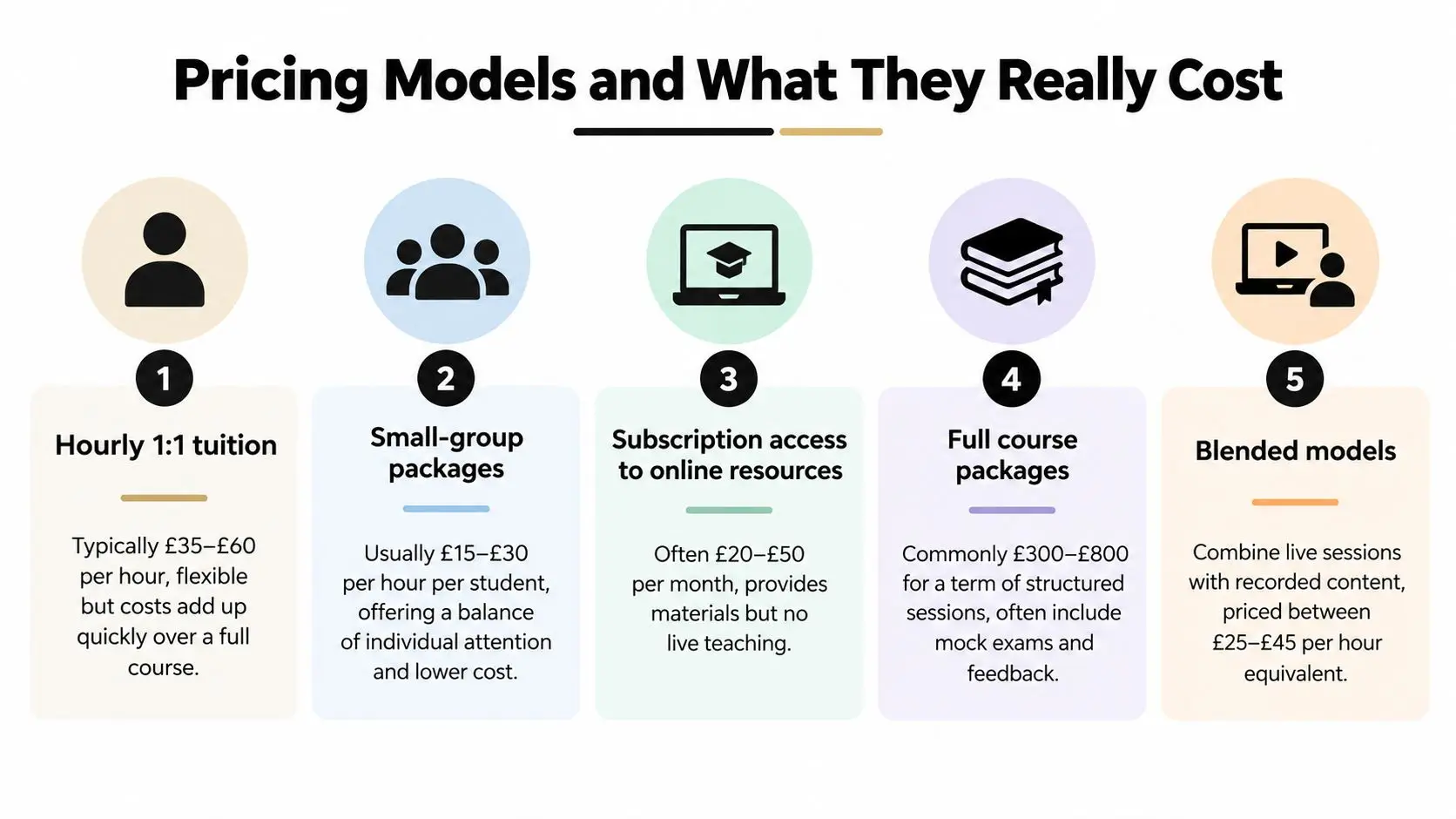
To compare quotes, calculate the effective hourly cost. Divide the total fee by the hours of live teaching or supervised work, then ask what evidence arrives with each hour. A package that includes a mock paper, detailed marking, an error log and a re-test may offer more practical value than a cheaper package made up of unmarked worksheets.
Do not let a spring discount make the decision for you. A deadline-based offer is not evidence of sound teaching. Providers should explain the baseline, the intended practice cycle and the progress measures. Be especially wary of guaranteed grades. National results describe population-level attainment, not the causal effect of an individual course.
Fitting a Course Around School, Mocks and Family Life
A revision course fails when it becomes one more demand your child cannot carry. Start with the existing diary, not the provider's timetable.
Map school, homework, travel, meals, sleep, family commitments and mock examinations. Then identify the weakest realistic slot, not every empty space. If your child already has a demanding school day, placing a long revision lesson immediately afterwards may produce attendance without learning.
A sensible Year 11 plan might replace one evening of passive rereading with a structured online lesson, followed by a short closed-book quiz and a later re-test. The rest of the evening stays free. During a holiday, a live intensive course can consolidate mock topics, but it should not consume every available day.
Use spaced practice rather than a single burst
A pilot randomised controlled trial across 12 UK secondary schools involving 408 pupils compared spacing models during science revision. The strongest model used 10-minute study intervals with learning repeated after 24 hours, producing a statistically significant improvement over control groups. Engagement with the programme also predicted increased attainment, as reported in the Frontiers in Education trial.
The practical lesson is straightforward. After a lesson, your child should retrieve the key ideas without notes, revisit them the next day and meet them again later in a different question. A course that schedules one giant content dump but no follow-up is asking memory to do work it can't reliably do.

Set a contingency rule before problems arise. If a mock result disappoints, diagnose the lost marks before adding hours. If attendance falls, speak to the provider and child together. If the child is visibly stressed, pause, reduce the workload or switch format. Continuing only because the fee has been paid is the sunk-cost trap, and your child pays the emotional price.
Supporting SEN, SEMH and Anxious Learners Through a Course
A course should adjust to the child. The child shouldn't have to hide their needs to fit the course.
Access arrangements are particularly important. Government statistics for England show that 18.0% to 27.7% of students assessed in at least one GCSE, AS or A-level qualification during 2024–25 had at least one valid access arrangement, while 25% extra time was granted to between 16.6% and 25.5% of assessed students. These figures are published in the government access arrangements statistics.
Extra time isn't a reward and a revision provider can't grant it independently. The examination centre must approve arrangements using evidence of need, the student's normal way of working and relevant assessment information. If a student with dyslexia normally works with approved extra time or a computer, timed revision papers should reflect that arrangement. Otherwise, the course may mistake slow processing for missing knowledge.
Ask the provider three direct questions:
- Can the course mirror normal working conditions? Find out whether practice papers can include approved extra time, a reader, a computer or rest breaks where appropriate.
- What happens when anxiety blocks recall? Look for shorter tasks, gradual exposure to timed work and a named adult who can respond when the child becomes distressed.
- How are concentration limits handled? A learner may need visual resources, one instruction at a time, replayable explanations or a shorter live session rather than a longer lecture.
The emotional signs matter. A child who repeatedly avoids the platform, develops headaches before lessons, cries over small mistakes or works late into the night isn't showing a commitment problem. They're telling you that the current demand is too high or the support is poorly matched.
Families can use Pretty Progress exam stress advice alongside a provider's wellbeing plan, but practical support must remain individual. A calm-down strategy is useful only if the child can use it during a lesson or mock.
For questions about formal adjustments, families may also need guidance on GCSE exam access arrangements. Keep dated mock scripts, teacher observations and records showing the child's normal way of working. The examination centre, not a commercial revision course, makes the formal decision.
A strong course reduces avoidable distress while maintaining high expectations. It might teach the same chemistry content through shorter retrieval blocks, visual prompts and carefully increased timed practice. That isn't lowering the standard. It's removing barriers that obscure what the child knows.
Your Action Plan and Questions Worth Asking Before You Buy
Use this four-step plan before committing money:
- Diagnose first. Review a recent mock, homework and the child's own account of what feels difficult. Separate forgotten knowledge from timing, concentration, interpretation and anxiety.
- Demand a method. Ask for active recall, spaced revisits, exam questions, feedback and re-testing. Passive rereading shouldn't be the main activity.
- Calculate the cost. Divide the fee by taught or supervised hours, then check what feedback and progress evidence comes with them.
- Confirm personalisation. Discuss SEN, SEMH, anxiety, normal working conditions and access arrangements before the first lesson.
The Education Endowment Foundation identifies metacognitive and self-regulated learning as a priority, with UK case studies showing how prediction, quizzing, error classification and choosing a next action can turn “I'm bad at science” into a specific revision diagnosis. The EEF's revision case studies provide a useful model for the conversations you should expect from a good provider.
How soon should progress show? Look first for better recall, fewer repeated errors, stronger attendance and improved confidence under realistic conditions. A final grade is too blunt to be the only early measure.
What if mocks go backwards? Stop adding hours. Analyse the paper by topic and question type, then change the plan.
Can online schooling replace traditional schooling? It can suit learners who need flexible scheduling, recorded lessons and specialist online support, but it must provide teaching, feedback, assessment and pastoral care rather than a library of videos. Use these GCSE revision tips to judge whether the routine is sustainable.
Queens Online School offers live, interactive GCSE teaching, recorded lessons for review, practice tests and timed mock exams, with support designed around individual learners, including those with SEN or SEMH needs. If your child needs a structured online education rather than a short revision purchase, visit Queens Online School to explore the available GCSE options.