

You're sitting at the kitchen table with your teenager, trying to make sense of an A-level chemistry specification. The pages seem to run from atomic structure to organic synthesis, practical skills and calculations, while your child is asking the more important question: "What will I have to do every week?"
That question deserves a clearer answer than a list of topic names. A strong A-level syllabus in Chemistry is a two-year working roadmap. It combines physical, inorganic and organic chemistry with mathematics, laboratory judgement, written reasoning and the confidence to apply knowledge in unfamiliar situations. For an online or flexible learner, the quality of that roadmap matters even more because practical experience, feedback and revision habits must be planned deliberately.
What the A Level Chemistry Syllabus Looks Like
A Year 12 student may first meet A-level Chemistry as a dense list of unfamiliar terms. Atomic structure appears beside bonding, energetics, rates, periodicity and organic reactions. For a parent, the specification can raise a practical concern: must a student remember every detail? For a teenager, the worry may be different: will one missed lesson leave a gap that becomes impossible to repair?
The course has a clearer shape than the topic list suggests. A-level Chemistry is usually taught over two years, across Year 12 and Year 13, with final assessments at the end of the course. Physical, inorganic and organic chemistry develop together, so ideas introduced early continue to support later work.
This linear design affects weekly study. A student cannot finish a small module, sit an examination and permanently set the material aside. Early knowledge returns in more demanding settings. A mole calculation may become part of an equilibrium problem. Bonding can explain boiling points. Practical observations can provide evidence for an evaluation question.
A roadmap rather than a checklist
A useful way to read the specification is to ask four questions about each topic:
- What chemical idea must the student understand?
- What calculation or representation must the student use?
- What practical situation could provide evidence?
- How could the idea connect with another part of the course?
Rates of reaction shows how these questions work together. A learner may need to explain collision theory, interpret a graph, calculate a rate, identify variables in an investigation and judge the reliability of measurements. One topic therefore develops several skills that reappear elsewhere.
Organic chemistry follows the same pattern. Learning the reaction of an alcohol involves more than remembering a reagent. The student may need to identify a functional group, predict a product, explain a mechanism, suggest a purification method and interpret analytical evidence.
A practical rule: A revision resource made only of facts does not represent the whole course. The learner also needs practice with calculations, evidence, diagrams, explanations and unfamiliar contexts.
What the next two years feel like
At the beginning, students build a reliable chemical vocabulary. They learn to distinguish atoms, ions and molecules, use formulae accurately and connect microscopic explanations with observable changes. Progress can feel slow for a learner who has previously depended mainly on memorisation.
The course then becomes more interconnected. A question about an industrial process might combine equilibrium, temperature, enthalpy, catalysts and economic reasoning. An organic question may include a preparation, a yield calculation, purification and a spectrum. A practical question may ask the student to decide whether a conclusion is justified, rather than just name an apparatus.
A familiar topic can therefore appear in a form that feels new. Students who describe themselves as “bad at chemistry” may be reacting to this change in demand. A-level Chemistry asks learners to transfer a method to unfamiliar situations rather than repeat a rehearsed answer.
For an online or flexible learner, families should ask how the provider turns the specification into a working routine:
- A visible sequence: Does each lesson show its connection with earlier work?
- Regular retrieval: Does the student revisit foundations before they fade?
- Written feedback: Does a teacher explain why a calculation or evaluation lost marks?
- Practical planning: Is laboratory work scheduled throughout the course?
- Emotional support: Can the student ask for help without feeling they are falling behind?
These questions matter because the specification is also a timetable for developing habits. Online study requires time for explanations, problem solving, practical preparation, feedback and revision, not just time spent watching lessons.
The demand is clear. Your child is learning to think like a chemist, using models, measurements, mathematical relationships and evidence to explain what happens and why.
How the Two-Year Course Is Structured
The first step is to stop thinking of the course as two completely separate qualifications. Many schools use AS-style foundations in the first year and A2 content in the second, but the final A-level is a linear qualification. Earlier knowledge remains active throughout the course, and final examinations assess the full specification.
The first year builds the language
Year 12 usually establishes the ideas that make later chemistry possible. Depending on the exam board and school sequence, students commonly meet:
- Atomic structure and the arrangement of electrons
- Amount of substance and quantitative chemistry
- Bonding, structure and intermolecular forces
- Energetics and reaction profiles
- Rates of reaction
- Equilibrium foundations
- Periodicity and inorganic reactions
- Introductory organic chemistry and reactions
The order can vary, but the dependency between topics matters. A student who is uncertain about formulae may struggle with moles. A student who has not understood bonding may find structure and physical properties difficult. A student who avoids algebra may lose confidence when equilibrium or energetics becomes more demanding.
The most useful Year 12 habit is to repair confusion quickly. If your child writes an incorrect formula, uses the wrong units or confuses oxidation with reduction, the teacher should address the underlying idea rather than just mark the answer wrong.
The second year increases transfer
Year 13 typically extends those foundations into more demanding chemistry. Learners may study deeper equilibria, acids and bases, electrode potentials, transition metals, analytical techniques and more complex organic synthesis. The questions also tend to demand more connections.
A learner may need to interpret a reaction pathway, calculate a quantity, select a suitable reagent and explain how a practical method could be improved. The challenge isn't just that the content is harder. It's that several kinds of thinking can appear in one question.
The linear structure also changes revision. Under a modular approach, a student might revise a unit shortly before an examination and then move on. For a linear A-level, that strategy is risky. The student needs short, repeated returns to older content while learning new material.
A sustainable weekly routine
A manageable routine often has four parts:
| Study activity | What it develops |
|---|---|
| Retrieval of older material | Long-term recall and accurate terminology |
| Current lesson practice | Understanding of new ideas |
| Calculation work | Fluency with methods, units and significant figures |
| Exam-style application | Transfer, evaluation and command-word control |
A student might spend one session revisiting moles and bonding, another working through current lessons on organic chemistry, and another answering a practical-data question. The exact timetable should fit the learner, but the principle is consistent: revision can't wait until the final examination period.
Exam boards organise their specifications differently, but the core chemistry content is broadly similar across AQA, OCR and Edexcel because the qualifications follow the required UK subject content. What changes most visibly is the order, paper design, wording and emphasis placed on particular assessment features.
Parents should therefore ask a prospective school which specification it teaches and how it sequences content. A good answer will connect the board's structure to lessons, practical work, revision and examination practice. “We cover the specification” isn't enough. You need to know how the school helps a teenager retain and use it.
The pressure points are usually predictable. Quantitative chemistry can expose gaps in mathematics early. Organic chemistry can feel like a memory burden if mechanisms and functional groups aren't organised clearly. Practical questions can surprise students who have performed experiments but never discussed uncertainty or method limitations.
A calm response is to treat each difficulty as a skill to diagnose. Ask whether the problem is knowledge, calculation, reading, working memory, timing or confidence. That makes support more precise and stops your child from turning one difficult topic into a judgement about their ability.
The Three Pillars of Chemistry Content
Students often ask whether physical, inorganic and organic chemistry are separate subjects. They're better understood as three connected ways of studying chemical behaviour.
Physical chemistry explains change
Physical chemistry uses models and mathematics to explain energy, rates, equilibrium and quantities. Consider an investigation into how temperature affects reaction rate. Your child might control concentrations, measure the time taken for a visible change, calculate a rate and compare results.
The scientific reasoning matters as much as the practical action. If a reaction becomes faster when temperature rises, the student should connect that observation with particle collisions and the proportion of particles able to overcome the activation energy. A graph may then provide evidence for a conclusion, but only if the learner considers scale, scatter, anomalous results and uncertainty.
Energetics offers another example. A student may use an enthalpy cycle to calculate an energy change that can't be measured directly. The calculation is important, but the learner must also understand why Hess's law allows the route to be rearranged.
Inorganic chemistry reveals patterns
Inorganic chemistry often begins with elements, ions and periodic trends. Your child may compare the reactions of substances in a group, explain changes in reactivity or use observations from a test to identify an ion.
Acid and base chemistry combines conceptual and quantitative work. In a titration, a learner adds one solution carefully to another until an indicator changes colour, records readings and uses the results to calculate an unknown concentration. The student must understand the reaction equation, select suitable measurements and judge the quality of the endpoint.
That example also shows why the three pillars overlap. Titration involves inorganic or analytical chemistry, but it relies on amount-of-substance calculations, accurate measurement and practical judgement.
Organic chemistry follows transformations
Organic chemistry becomes less mysterious when students organise it around functional groups and transformations. Instead of memorising unrelated reactions, your child can ask what group is present, what change is required and which conditions make that change possible.
For example, an alcohol may be converted into another organic product. The student may need to select a reagent, describe the conditions, identify the product and explain how the product could be separated from the reaction mixture. If the product is a liquid, distillation may be part of the practical method.
A preparation can therefore test much more than reaction memory. It can involve yield, purity, boiling point, apparatus, hazards, observation and analysis. The learner needs a route through the problem.
Where the pillars meet
A strong student eventually stops filing chemistry into isolated folders. A question may combine:
- An organic reaction pathway
- A physical calculation
- An inorganic test or observation
- Practical data
- An evaluation of the method
That's why a learner who can interpret a graph or explain an enthalpy cycle is developing a transferable chemistry habit. They're learning to identify variables, select evidence, use a model and justify a conclusion.
Families can make this connection visible at home. After a lesson, ask your child to explain not only “what reaction did you learn?” but also:
- What particles or bonds changed?
- What was measured?
- Which calculation was needed?
- What could make the result unreliable?
- How would the idea appear in another topic?
Those questions move revision away from passive copying. They also reassure a nervous teenager that chemistry is a connected system, not an endless pile of facts.
Understanding the Assessment Structure
A student can know the syllabus topics and still feel surprised by the papers. AQA Chemistry 7405 shows why: the qualification uses three written papers totalling 300 marks, with the final examinations taken at the end of the course. The AQA assessment information for Chemistry 7405 sets out this structure.
| Paper | Duration | Marks | Contribution | Main emphasis |
|---|---|---|---|---|
| Paper 1 | 2 hours | 105 | 35% | Selected physical chemistry and all inorganic chemistry |
| Paper 2 | 2 hours | 105 | 35% | Selected physical chemistry and organic chemistry |
| Paper 3 | 2 hours | 90 | 30% | The entire specification, practical and synoptic assessment |
Paper 3 combines the full specification with practical techniques, data analysis, synoptic questions and 30 multiple-choice questions. Students must switch between recall, calculation, interpretation and evaluation within one timed paper. For an online learner, that means regular mixed practice matters more than studying each topic in isolation.
What the marks are really rewarding
The assessment objectives divide marks between knowledge and understanding, application in theoretical or practical contexts, and analysis, interpretation and evaluation. The proportions are approximately 30%, 45% and 25%, respectively, according to the AQA scheme of assessment.
A definition remains useful, but the paper may require a student to apply it to unfamiliar information, interpret evidence or support a judgement. Copied notes can create confidence without showing whether the learner can use the chemistry.
A productive revision session might ask:
- Why would changing this condition alter the result?
- What does the gradient represent?
- Which observation supports the proposed ion?
- Why is this experimental conclusion limited?
- How can every step of the calculation be shown?
The important shift: A-level Chemistry rewards students who can use knowledge, not just recognise it.
Small habits affect marks. A student who rushes calculations may lose accuracy through units, signs or incomplete working. Someone who knows an equation but cannot interpret a table may struggle with application. Someone who understands an experiment but writes a vague evaluation may lose analysis marks.
Revision that matches the papers
Each revision cycle should include three layers:
- Recall: equations, definitions, reactions, conditions and terminology.
- Application: calculations, unfamiliar examples, practical scenarios and linked topics.
- Evaluation: data interpretation, limitations, improvements and evidence-based conclusions.
Students also need practice changing modes. Multiple-choice questions require quick discrimination between plausible answers. Longer calculations need organised working. Practical evaluations require precise scientific language and clear links to evidence.
Families can use this guide to revising for A-level Chemistry alongside teacher feedback. Ask which assessment skill each revision session strengthened, rather than counting hours. A prospective online school should be able to explain how lessons, homework and feedback prepare students for all three papers, including the synoptic demands of Paper 3.
Practical Work and the Practical Endorsement
A flexible learner may study theory at a desk, but A-level Chemistry still requires supervised laboratory experience. The final grade comes from written examinations, while practical work supports a separate endorsement and prepares students for practical questions. Under the Ofqual science conditions, each learner must complete at least 12 practical activities covering apparatus, techniques, investigation, measurement, risk management, observation, data handling and scientific reporting, as set out in the GCE science subject-level conditions.
These activities should form a planned record across the two-year course. They are opportunities to practise technique and develop the practical understanding that written papers can test, rather than optional enrichment added around the syllabus.
What the endorsement records
The Practical Endorsement is reported separately from the A-level grade as Pass or Not Classified. It is assessed through five Common Practical Assessment Criteria:
- Following procedures: carrying out written instructions accurately
- Investigative approaches: planning and applying suitable methods
- Safe working: using equipment and materials responsibly
- Observations and records: making, recording and presenting observations
- Research and reporting: referencing information and communicating findings
Each area must be demonstrated consistently during the course. A learner cannot make up for an unobserved competency by completing extra work elsewhere. An online or flexible provider should therefore maintain an individual practical record showing what the student did, what was observed and which criteria were met.
Why practicals affect written papers
At least 15% of the overall A-level Chemistry assessment covers practical knowledge, skills or understanding, according to the AQA practical assessment requirements. Written questions can ask students to apply a procedure, interpret qualitative or quantitative data, assess a method or explain an experimental conclusion.
For example, a learner may receive results from a rate experiment and need to identify variables, interpret a graph, discuss uncertainty and suggest an improvement. The exact experiment may be unfamiliar. The reasoning should not be. Students need to connect observations, measurements and evidence to a defensible conclusion.
Paper 3 brings these demands together. It allocates 40 of its 90 marks to practical techniques and data analysis, alongside specification-wide questions and multiple-choice questions. This means practical preparation belongs in ordinary study routines, not only in laboratory sessions.
What families should ask
Before choosing a provider, ask:
- Where will the practical activities take place?
- Who will observe the learner directly?
- How will the school record each competency?
- Which work can be supervised safely at home?
- Which experiments require an approved laboratory?
- How will missed sessions be replaced?
- Will students practise uncertainty, risk assessment and evaluation?
Safety arrangements should be explained clearly. A properly equipped laboratory needs suitable controls, including SEFA compliant fume hoods where hazardous vapours may be produced. Home-based activities should be limited to tasks that can be supervised safely with appropriate materials and instructions.
A useful practical programme teaches judgement as well as procedure. Your child should learn why a method is selected, what could go wrong, how risk is reduced and whether the evidence supports the conclusion.
Maths, Synoptic Demands and Recurring Skills
A learner can memorise organic reactions and still find A-level Chemistry difficult when calculations and unfamiliar combinations appear. Mathematical fluency and transfer between topics create a substantial part of the workload, so they need regular practice across the two-year course.
The AQA Chemistry specification requires at least 20% of the overall assessment to involve mathematical skills at Level 2 or above. This includes quantitative calculations and the interpretation of numerical data. Students can review the required skills in the AQA mathematical requirements.
The same methods appear in different clothing
Your child may use closely related mathematical processes in several chemical settings:
- Rearranging equations in rates, gases or electrochemistry
- Using logarithms in pH calculations
- Applying significant figures to measured results
- Calculating percentage yield
- Finding and interpreting gradients
- Converting units
- Using equilibrium expressions
- Handling uncertainty and percentage error
Learning each calculation as an isolated recipe makes revision harder. A more reliable routine is to identify the method underneath the context: rearrange the equation, substitute values, check units and round appropriately. That sequence remains useful when the question moves from gases to rates or from a classroom example to practical data.
A graph from an investigation may require the learner to identify independent and dependent variables, calculate a gradient, interpret the relationship and comment on scatter. The arithmetic may be manageable, yet the question also examines reading, scientific vocabulary and judgement. Online learners need opportunities to practise all of these steps, not just complete calculation worksheets.
Synoptic questions change the revision target
Synoptic assessment asks students to connect ideas across the specification. A question may combine practical data with a physical calculation and an organic or inorganic explanation. The learner must move from evidence to equation to chemical interpretation without being told which topic provides each step.
Separate topic folders can therefore hide important links. Connection maps make those links visible:
- Equilibrium: reversible reactions, temperature, concentration, yield and industrial decisions
- Organic analysis: functional groups, reactions, purification and spectra
- Electrochemistry: redox, electrons, cell potentials, measurements and feasibility
- Rates: collision theory, graphs, variables, activation energy and method evaluation
The goal is to train the brain to ask which chemical model and mathematical method apply, not to decorate the wall. A provider should show families how this kind of retrieval and mixed practice appears in weekly online study, rather than leaving synoptic revision until the final months.
Support for learners who process information differently
Dense tables, apparatus diagrams and multi-step calculations can tire students with dyslexia, ADHD, anxiety or SEMH needs. A learner may understand the chemistry but lose their place, omit a step or become overwhelmed when several pieces of information arrive together.
A clear routine keeps the reasoning visible:
- Underline the data and units.
- Identify what the question asks for.
- Write the relevant equation.
- Substitute values with working shown.
- Check the magnitude and units.
- Explain what the result means chemically.
For practical questions, teachers can first label the stages method, data, pattern, error and improvement, then reduce those prompts as confidence grows. One precise target, such as using units consistently, usually gives more useful feedback than a page of general criticism. Families should ask how an online school teaches these recurring habits between live lessons, marked work and independent study.
How Online Schools Deliver Practical Chemistry
A family considering online A-level Chemistry often asks a reasonable question: how can a learner demonstrate authentic practical competence without attending a traditional school every day?
The answer depends on evidence, supervision and planning. A credible online or blended provider should treat practical delivery as a compliance system, not as a collection of videos.
What a reliable evidence trail contains
An individual learner should have a practical log that records:
- The activity completed and its date
- The relevant specification skill
- Equipment and techniques used
- Safety considerations
- The learner's observations
- Calculations and data analysis
- Evaluation and proposed improvements
- The supervisor's direct observation
The provider should map activities to the required skills and retain contemporaneous student work. Video demonstrations can explain a technique, but they can't replace direct evidence of the learner performing it where direct observation is required.
A teenager studying flexibly may complete a supervised titration at a partner laboratory, then upload calculations and observations for teacher feedback. The teacher can discuss the endpoint, uncertainty and method quality during a live lesson. That creates a fuller record than a worksheet marked without seeing the practical work.
Home activities and laboratory sessions
Some activities may be suitable for carefully supervised home work, depending on the provider's risk assessment, equipment and local requirements. A simple rates investigation or a basic titration may be possible in an appropriate setting with approved materials and adult supervision.
Other activities need an approved laboratory or examination-centre setting. Distillation of organic liquids, work involving hazardous substances and electrochemical investigations may require specialist equipment, controlled conditions and trained supervision. Families shouldn't be asked to improvise laboratory safety in a kitchen.
Ask for the boundary in writing: A provider should be able to explain which work happens at home, which work happens in a laboratory and how every practical activity contributes to the learner's record.
A day in the life of a flexible learner
Imagine a student who has missed laboratory time because of illness. The provider first reviews the practical log and identifies the missing competencies. A teacher then schedules a supervised session, observes the student following the procedure and records the relevant evidence.
After the session, the learner analyses results, explains an anomalous reading and suggests a change to the method. The teacher provides feedback on both the technique and the written reasoning. The student isn't merely “catching up on an experiment”. They're rebuilding the complete chain from method to evidence to conclusion.
Families should also ask how practical work fits around accessibility needs. A learner with anxiety may need the room, instructions and assessment expectations explained beforehand. A student with ADHD may benefit from a short written sequence and explicit equipment checks. A student who works remotely may need travel planning and advance notice of laboratory sessions.
A strong programme makes these arrangements ordinary. The student should feel that practical chemistry is part of their education, not a test they've been left to organise alone.
Support for SEND, SEMH and Access Arrangements
A child can understand chemistry and still struggle to show that understanding under examination conditions. Long questions, dense data, timed calculations and unfamiliar practical diagrams can create barriers unrelated to chemical knowledge.
Access arrangements should therefore be treated as part of normal learning planning, not an emergency request made shortly before examinations. JCQ guidance says decisions should reflect classroom observations, teacher feedback and the candidate's own views, with applications for relevant adjustments processed through Access Arrangements Online, as explained in the JCQ access arrangements guidance.
Match the adjustment to the barrier
For an eligible candidate, a common arrangement is 25% extra time. That may help a dyslexic student decode a long chemistry question, organise a calculation and check units without being forced to rush. It doesn't make the chemistry easier or change the knowledge being assessed.
A student with ADHD may benefit from supervised rest breaks if sustained sessions lead to concentration loss or fatigue. A learner with anxiety or another impairment may need a carefully planned adjustment that reduces panic while leaving the academic demand intact.
The key issue is normal way of working. A student who receives extra processing time, rest breaks or structured prompts in lessons may need that pattern documented consistently. A diagnosis alone doesn't automatically determine an arrangement.
Evidence grows through everyday teaching
A supportive school records how the learner works in ordinary lessons. Useful evidence might include:
- How long the learner needs to read and process questions
- Whether timed work produces a consistent decline in accuracy
- Whether rest breaks are used in class
- How the student manages multi-step calculations
- Which formats help the learner organise practical evaluation
- What the learner says about their own barriers
Parents should raise concerns early with the SENCo and keep relevant professional information available. The conversation should focus on function rather than labels. “My child has a diagnosis” matters, but “my child regularly loses the final steps of a calculation when time pressure increases” gives the school something concrete to investigate.
Chemistry support should be specific
General reassurance isn't enough. A learner with dyslexia may need key command words, diagrams and calculations formatted consistently. A student with ADHD may need a visible sequence for practical tasks, short checkpoints and clear deadlines. A learner experiencing anxiety may need advance information about laboratory sessions and a predictable route for asking questions.
Families may also find it helpful to review clear, accessible information such as Children Psych explains ADHD terminology, while remembering that educational decisions must be based on the individual learner's observed needs.
Support should preserve dignity: The purpose of an access arrangement is to remove an avoidable barrier, not to lower the standard or make the learner feel singled out.
When support is built into daily teaching, examination arrangements feel familiar rather than alarming. That matters emotionally. A teenager is more likely to use an adjustment confidently when it has already helped them learn, practise and receive feedback.
How A Level Chemistry Compares With Other Sciences
Choosing Chemistry often involves comparing it with subjects that sound similar but demand different habits. The right question isn't which subject is universally harder. It's whether the subject's thinking style fits your child and their intended route.
| Subject | Typical emphasis | A student may enjoy it if they like |
|---|---|---|
| Chemistry | Models, reactions, calculations, practical evidence and explanation | Linking invisible particles to measurable change |
| Biology | Systems, processes, terminology and extended explanations | Learning how living systems work |
| Physics | Mathematical modelling, relationships and applied problem-solving | Using equations to describe physical behaviour |
| Mathematics | Abstract structure, reasoning and formal problem-solving | Working with patterns and symbols without a laboratory context |
Chemistry sits between biology and physics in an interesting way. It uses mathematical relationships and models, but it also depends heavily on substances, reactions, observations and laboratory methods. A student who enjoys both calculation and practical investigation may find that combination motivating.
Chemistry and university choices
Chemistry is essential or strongly preferred for several degrees and professional routes, including medicine, dentistry, veterinary science, chemistry, biochemistry, chemical engineering, materials science and many pharmacology courses. Entry requirements vary by institution and can change, so families should check each university directly rather than relying on a general subject list.
Chemistry pairs naturally with biology for medicine, dentistry and life sciences. Chemistry with mathematics and physics can support engineering and physical science routes. Chemistry alongside geography or economics may suit a student interested in environmental, energy, policy or business applications, depending on the university requirements.
The combination should follow the child's ambition, not the subjects that appear most impressive. A teenager aiming for medicine needs to check whether the proposed combination meets the relevant science requirements. A student considering chemical engineering should investigate the mathematics and physics expectations as well as chemistry.
Look for fit rather than prestige
A student may choose Chemistry because family members believe it keeps options open, then struggle because they dislike quantitative work and practical evaluation. Another learner may initially fear chemistry but thrive when lessons connect calculations with real substances and clear visual models.
Ask your child:
- Do you enjoy explaining why a change happens?
- Are you willing to practise calculations repeatedly?
- Does practical work interest or worry you?
- Can you tolerate an answer that requires several linked steps?
- Which university or career routes are you considering?
Chemistry can support a wide range of ambitions, but an unsuitable subject combination can narrow choices. The most responsible decision combines current strengths, genuine interest, support needs and verified entry requirements.
Comparing AQA, OCR and Edexcel Specifications
AQA, OCR and Edexcel all offer recognised UK A-level Chemistry specifications, and all must cover the required core content. They aren't identical learning experiences, though. Each board organises content, papers, practical expectations and question styles in its own way.
The differences families should investigate
AQA Chemistry 7405 uses papers that combine selected areas of physical chemistry with inorganic or organic chemistry, followed by a paper covering the entire specification and practical assessment. OCR presents content through named modules and a content-led structure. Edexcel uses its own concept-led organisation and paper pattern.
The important point isn't to label one board as easier. A board may suit a student because its specification is clearly sequenced, its practical arrangements fit the provider or its past-paper style matches the teaching approach.
| Question to ask | Why it matters |
|---|---|
| How is content divided across papers? | It shapes revision and examination practice |
| How prominently is synoptic assessment used? | It affects how students connect topics |
| What practical evidence must be recorded? | It determines laboratory planning |
| Are multiple-choice questions included? | It changes speed and recognition practice |
| Where are examinations available? | It matters greatly for international learners |
| How does the school teach the specification? | Delivery often matters more than the board name |
A flexible learner may need a provider experienced with approved examination centres abroad or with students who cannot attend a standard school timetable. Ask whether the school has arranged practical evidence and examinations for similar learners.
Compare the provider, not only the board
Two schools can teach the same board very differently. One may rely heavily on recorded explanations and independent worksheets. Another may use live lessons, small-group feedback, practical sessions and regular timed questions.
If your family is considering Edexcel, review the school's actual course outline rather than assuming every Edexcel programme follows the same sequence. For example, this Edexcel Chemistry AS resource may help families see how a provider presents the early course, but you should still ask how the full A-level, practical work and final examinations are handled.
A useful comparison meeting should include a sample lesson, a practical plan, an assessment calendar and an explanation of SEND support. The board is the framework. The school determines how clearly your child can work within it.
Choosing an Online A Level Chemistry Provider
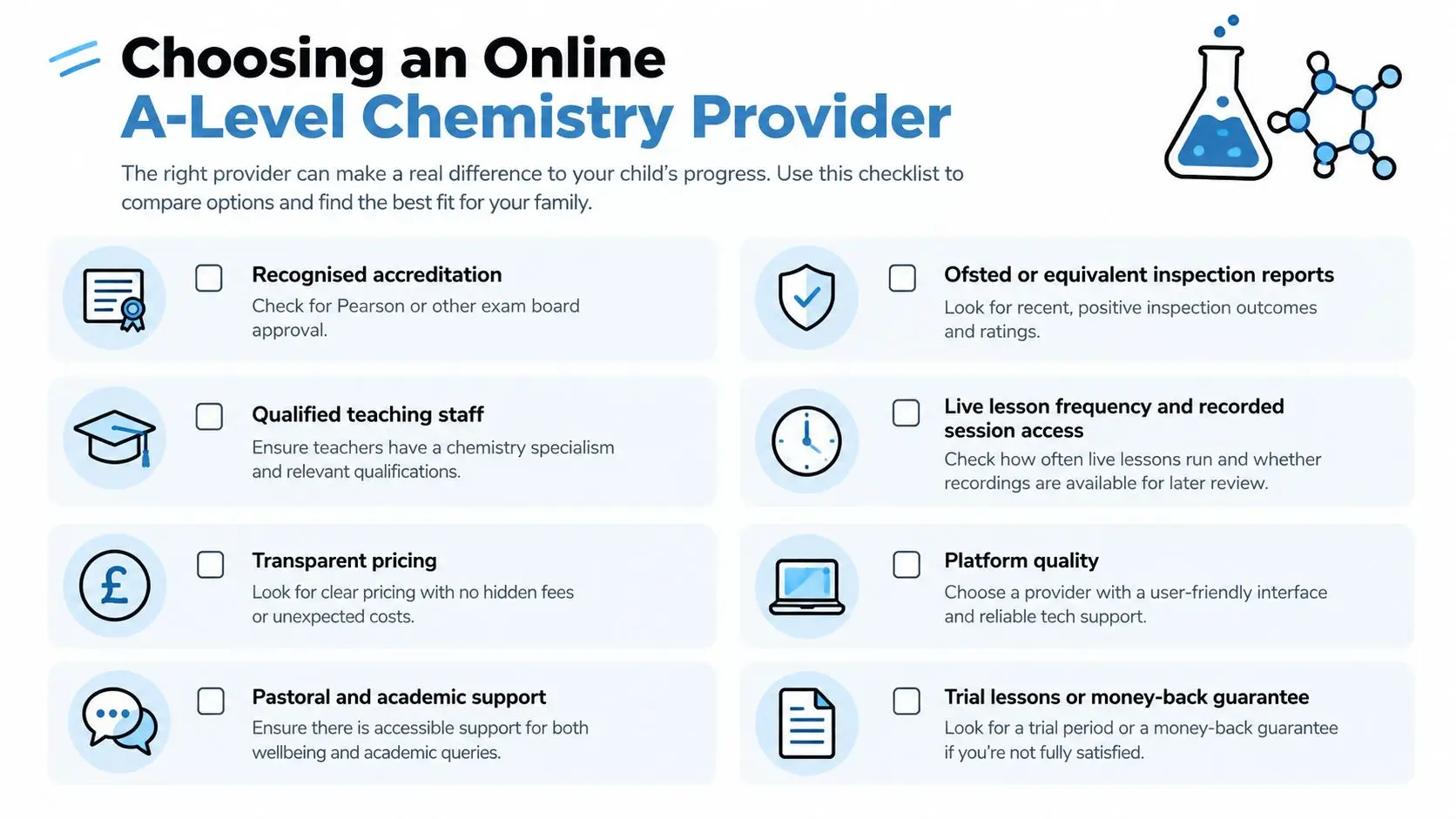
A provider should earn trust through evidence, not polished claims. Start with the practical question: Can this school deliver every part of the qualification your child will be assessed on?
Check recognition and examination access
Ask whether the provider is a recognised examination centre or works with one. Pearson approval is relevant for schools using Pearson qualifications, but families should also ask which exam board the Chemistry course follows and where the child will sit written examinations.
A provider should explain how practical endorsement evidence is collected and who is authorised to observe it. If the answer is vague, ask for a written schedule showing laboratory sessions, supervision and missed-work arrangements.
Check the chemistry teaching
Subject-specialist teaching matters because A-level Chemistry involves more than delivering slides. The teacher should be able to diagnose whether a student's difficulty comes from chemical knowledge, algebra, reading, practical interpretation or exam technique.
Ask to see how the school teaches:
- Quantitative chemistry and calculator methods
- Mechanisms and reaction pathways
- Practical uncertainty and evaluation
- Synoptic questions
- Multiple-choice strategy
- Feedback on extended answers
Live interaction is particularly valuable when a learner needs to explain a calculation aloud or discuss why a method is unreliable. Recorded sessions help with illness, time zones and catch-up, but recordings shouldn't replace opportunities to ask questions.
Check support around the child
A teenager choosing online education needs more than subject content. Ask about pastoral support, wellbeing policies, class size, response times, recorded lessons and the process for requesting help.
For a student with SEND or SEMH needs, ask how the school identifies barriers and documents normal classroom working. If the child has anxiety, find out whether they can meet teachers privately before joining a practical session or timed assessment.
A practical provider checklist
Use these questions during admissions conversations:
- Accreditation: Which qualification and examination-centre arrangements apply?
- Teachers: Who teaches Chemistry, and what subject expertise do they bring?
- Practicals: Where are the activities completed and directly observed?
- Evidence: How can families see the practical log and progress record?
- Mathematics: What additional support is available for calculations?
- Classroom access: How often are live lessons held, and are recordings available?
- SEND support: How are adjustments identified and reviewed?
- Progression: What information can the school provide about university pathways?
- Wellbeing: Who supports a student who becomes overwhelmed?
- Costs: Are practical sessions, examinations and required materials included?
A family may also consider online A-level Chemistry tuition as part of a broader programme, provided the course is aligned with the learner's examination specification and practical obligations.
Here is the promised video resource for families who want another explanation of the subject:
Don't choose solely because a timetable looks convenient. Ask your child how they learn best, then test whether the provider can support that way of working consistently.
Quick Reference Map of the Course
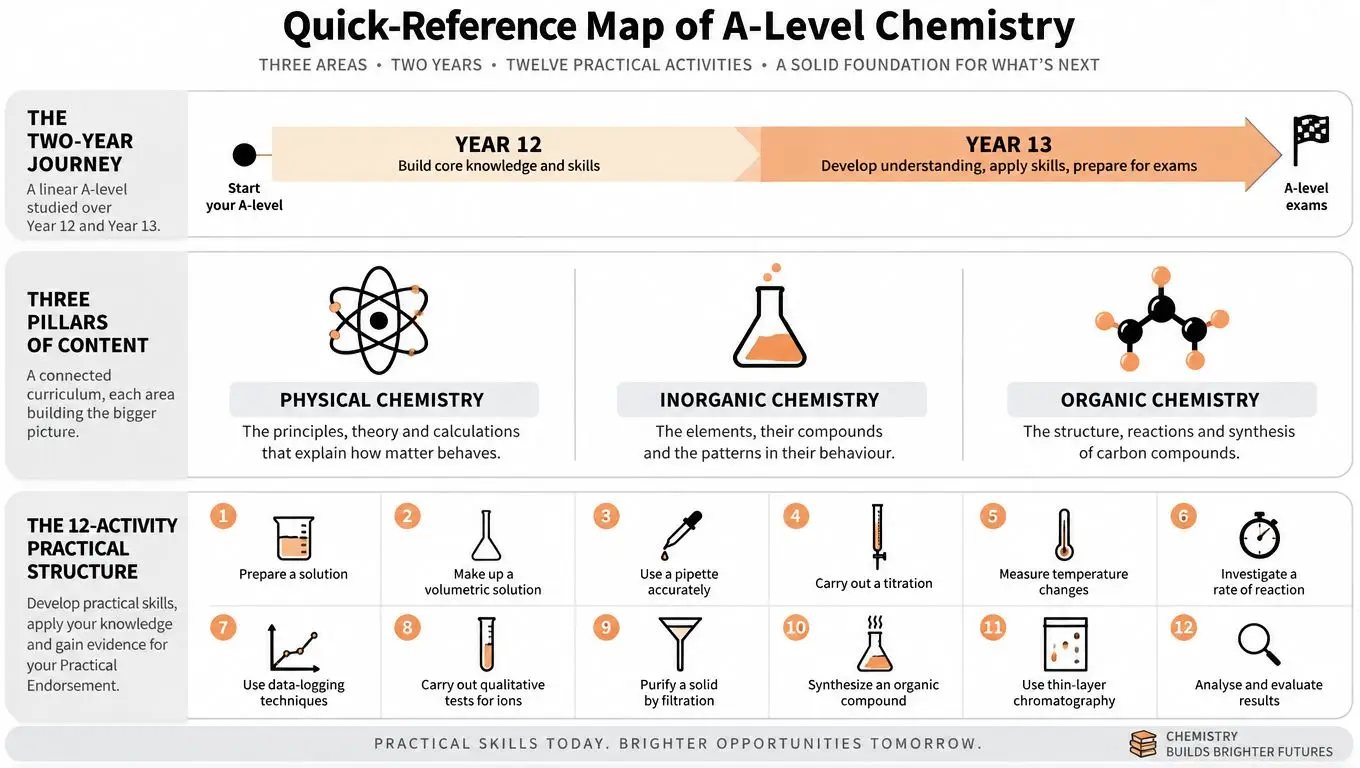
A-level Chemistry becomes less frightening when the moving parts are placed on one page. The course is linear, so early knowledge continues to matter. The content rests on three connected pillars, and success depends on using them through calculations, practical evidence and synoptic reasoning.
The course in one view
| Part of the course | What your child needs to build |
|---|---|
| Two-year linear structure | Secure foundations, repeated retrieval and cumulative revision |
| Physical chemistry | Calculations, models, graphs, energy, rates and equilibrium |
| Inorganic chemistry | Periodic patterns, reactions, observations and explanations |
| Organic chemistry | Functional groups, mechanisms, synthesis, purification and analysis |
| Practical work | Safe technique, measurement, data handling and evaluation |
| Mathematical work | Equations, units, logarithms, gradients, yields and uncertainty |
| Written assessment | Knowledge, application, analysis and interpretation |
| Practical endorsement | Directly observed competence reported separately as Pass or Not Classified |
The practical requirement is at least 12 activities, and the course also requires meaningful mathematical preparation. The assessment structure includes knowledge and understanding, application and analysis, so revision must include more than notes and flashcards.
For adult learners, parents returning to study and students rebuilding confidence after interrupted education, practical guidance about flexible routes can be useful. Resources such as adult education programs explained can help families think about timetable design, independent learning and support around study.
The question to carry into every decision
Ask whether the provider can answer three simple questions:
- What will my child learn?
- How will my child practise it?
- How will the school know my child can use it independently?
The first question covers content. The second includes calculations, practical work and examination practice. The third requires feedback, observation, assessment records and attention to the learner's emotional wellbeing.
A teenager doesn't need to feel fearless before starting Chemistry. They need a route through the difficult parts. With clear sequencing, regular support, authentic practical opportunities and revision that reflects the assessment, the course becomes demanding but manageable.
Queens Online School offers live online A-level Chemistry teaching aligned with examination specifications, including physical, organic and inorganic chemistry, practical endorsement skills, titrations, uncertainty calculations and past-paper practice. If your child needs a flexible British curriculum with subject-specialist teaching and support for different learning needs, visit Queens Online School to discuss the course and practical pathway.
No additional section remains. The supplied article already continues through the final section and includes the required closing call to action.