


A student stares at a chemistry worksheet full of curly arrows, bond enthalpy questions, and a practical write-up that still doesn't make sense. A parent is trying to help, but the next school deadline is close, homework is piling up, and nobody wants another evening of tears over organic mechanisms. That's where A Level Chemistry online tuition often enters the conversation, not as a generic extra lesson, but as a calmer, more structured way to help a young person feel back in control.
For many families, the hardest part isn't finding “more revision”. It's finding the right kind of help, at the right pace, from someone who can explain hard topics without making the student feel small. Good online tuition can do that well, especially when it's planned around the child's workload, confidence, and exam board expectations.
Introduction to A Level Chemistry Online Tuition
A Level Chemistry can feel like three subjects packed into one. A student might understand one lesson on rates, then lose confidence when the topic changes to organic synthesis, then worry again when a practical question appears in a mock paper. Parents often see the same pattern, strong effort at home, but frustration when the marks still don't match the work.
Why families start looking for online support
Online tuition tends to appeal when life is already busy. It can remove the travel stress, make it easier to fit lessons around school and clubs, and give students a chance to learn in a familiar space. For a teenager who's already anxious about chemistry, that comfort matters because the lesson starts from a lower emotional barrier.
It also helps when a student needs more than generic revision. Chemistry rewards precise thinking, so a tutor can slow the pace, revisit the basics of ionic equations, and then build back up to harder exam questions without rushing. That kind of steady support is often what turns confusion into repeatable method.
A useful rule for parents is simple, if your child keeps saying “I sort of get it” but can't finish the question independently, they need structured teaching, not just more worksheets.
Families also underestimate how much chemistry depends on confidence. One missed topic can make later lessons feel impossible, even when the student is capable. Online tuition works best when it treats the child's anxiety, workload, and understanding as one connected problem, not separate issues.
Understanding Syllabus Alignment in A Level Chemistry Online Tuition
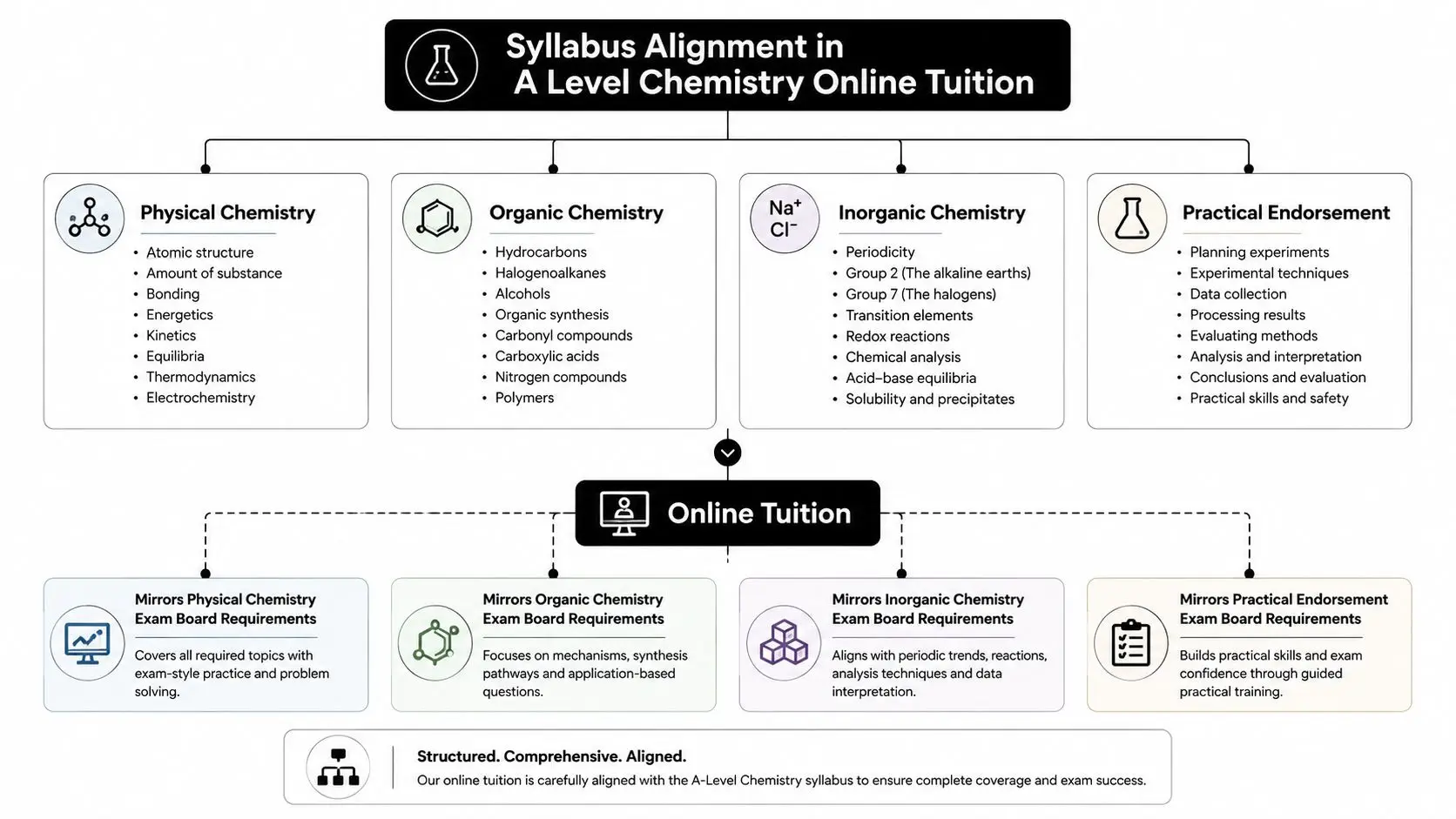
A chemistry tutor should not teach isolated topic packs. A Level Chemistry builds step by step, so one weak layer can make the next one harder to understand. It is a bit like stacking blocks, if the lower layers are uneven, the whole structure starts to wobble.
A lesson plan should follow the exam board specification closely, so the student is learning the same material that will appear in assessments. That is especially helpful for children whose confidence dips when topics seem to change without warning, because they can see how each lesson fits the wider course. Parents looking at Edexcel Chemistry AS guidance can use that kind of structure as a reference point when comparing providers.
What the syllabus needs to cover
The main content is usually split across physical chemistry, organic chemistry, and inorganic chemistry, and each area supports the others. Physical chemistry asks students to handle calculations and models carefully. Organic chemistry relies on spotting patterns, following mechanisms, and using the right terminology. Inorganic chemistry often checks recall, trends, and clear explanations.
The practical endorsement needs separate attention too. In England, it is assessed separately from written exams and reported on certificates as Pass or Not Classified, and students need hands-on skills such as titrations and uncertainty calculations Frobel Education's practical endorsement guide. Online tuition cannot replace the school lab, but it can prepare the student for practical work by making the method familiar, the vocabulary clear, and the common mistakes easier to spot before they happen.
A well-matched course should connect each lesson to assessment. That means the tutor is not just covering notes, they are showing how one idea leads into the next question and where marks are usually lost. If a provider does not say which exam board or specification they follow, that is a warning sign.
Families can also use a structured provider route such as Queens Online School's Edexcel Chemistry AS page to check whether the tuition follows the right course order and exam focus. The point is not the brand name itself, it is making sure the lessons match the course the student is sitting.
Students who need SEN or SEMH support may need this alignment even more clearly. A predictable lesson order, clear language, and shorter chunks of information can lower anxiety and make the work easier to process. For some learners, a tutor who repeats instructions in the same format each week can be as important as the chemistry content itself.
A small adjustment can also help with practical confidence. A student who finds live demonstrations stressful may do better with a written checklist, a labelled diagram, or a calm talk-through before moving into questions. That kind of support does not lower standards. It helps the student access them.
How to tell if alignment is real
When a tutor is properly aligned, they speak in the language of the course, not in vague promises. They refer to practical videos, past-paper patterns, and the exact topic order in the specification. Chemistry revision often depends on past-paper practice and mark-scheme familiarity, and revision guidance recommends building work around the correct exam board and course code, then using past papers and practical videos to target weak spots such as organic synthesis or chromatography revision guidance video.
A quick check can help. Ask how the tutor adapts teaching for a student who needs extra processing time, written instructions, or a calmer pace after a difficult school day. In online chemistry tuition, that might mean screen-sharing a worked example, pausing between steps, or using a visual prompt so the learner can follow the logic without feeling rushed. Some families also ask tutors whether they can support the student with devices or annotation tools, including a stylus such as this Best iPad pen, because handwriting and labelling diagrams can be easier for some learners than typing every answer.
If a lesson never shows how today's concept appears in a real question, the student may feel busy without getting more exam-ready.
That is why syllabus alignment is not a small detail. It separates general support from tuition that helps the student answer the questions in front of them.
Benefits of Live Online Tuition for A Level Chemistry
Live tuition gives chemistry students something static resources can't, another person reacting in real time to their confusion. That matters because a student who gets stuck on one step in a mechanism usually stays stuck until someone notices the exact moment the logic broke. A live tutor can interrupt that spiral before it turns into defeat.
Why real-time teaching changes the pace
The best live sessions feel like a sports team huddle. Everyone knows the goal, the tutor calls the plays, and the student gets immediate correction when an answer goes off track. In chemistry, that instant feedback is powerful because a tiny mistake in notation, units, or wording can cost marks even when the underlying idea is close.
UK evidence also supports the value of tightly focused small-group teaching. Targeted, frequent, consistent small-group tuition can add around 4 months' additional progress over an academic year, and the effect weakens when group size rises above 6–7 pupils independent tutoring review. For chemistry families, that points towards small groups or one-to-one rather than broad webinar-style teaching.
Live lessons also make exam technique less abstract. A tutor can watch a student answer a question, stop them when they miss the command word, and show how to reshape the response into marks the examiner can reward. That's harder to do with recorded videos or passive revision sheets.
A good writing setup can help too. Students who annotate diagrams or sketch mechanisms on screen often stay more engaged, especially when they can see the tutor working alongside them. A tablet stylus can make that process feel much more natural, and parents looking for equipment guidance can find a practical roundup of the Best iPad pen useful when choosing a device for online study.
What parents usually notice first
The first change is often emotional rather than academic. The student stops dreading chemistry night as much, because the lesson feels guided instead of exposing. That matters, because confidence is part of persistence, and persistence is part of progress.
For students who already know the basics but need sharper exam execution, live teaching gives constant adjustment. For those who're behind, it provides a place to rebuild without embarrassment.
How to revise for Chemistry A Level is a helpful companion if your child needs a revision structure alongside live support.
Evaluating A Level Chemistry Online Tuition Providers
A family choosing A Level Chemistry online tuition often needs more than a polished sales page. The real question is how the lessons will work for the student sitting at the screen, especially if they need slower pacing, clearer routines, or a tutor who can notice confusion before it turns into frustration. Good providers make those details visible from the start.
What to check before you enrol
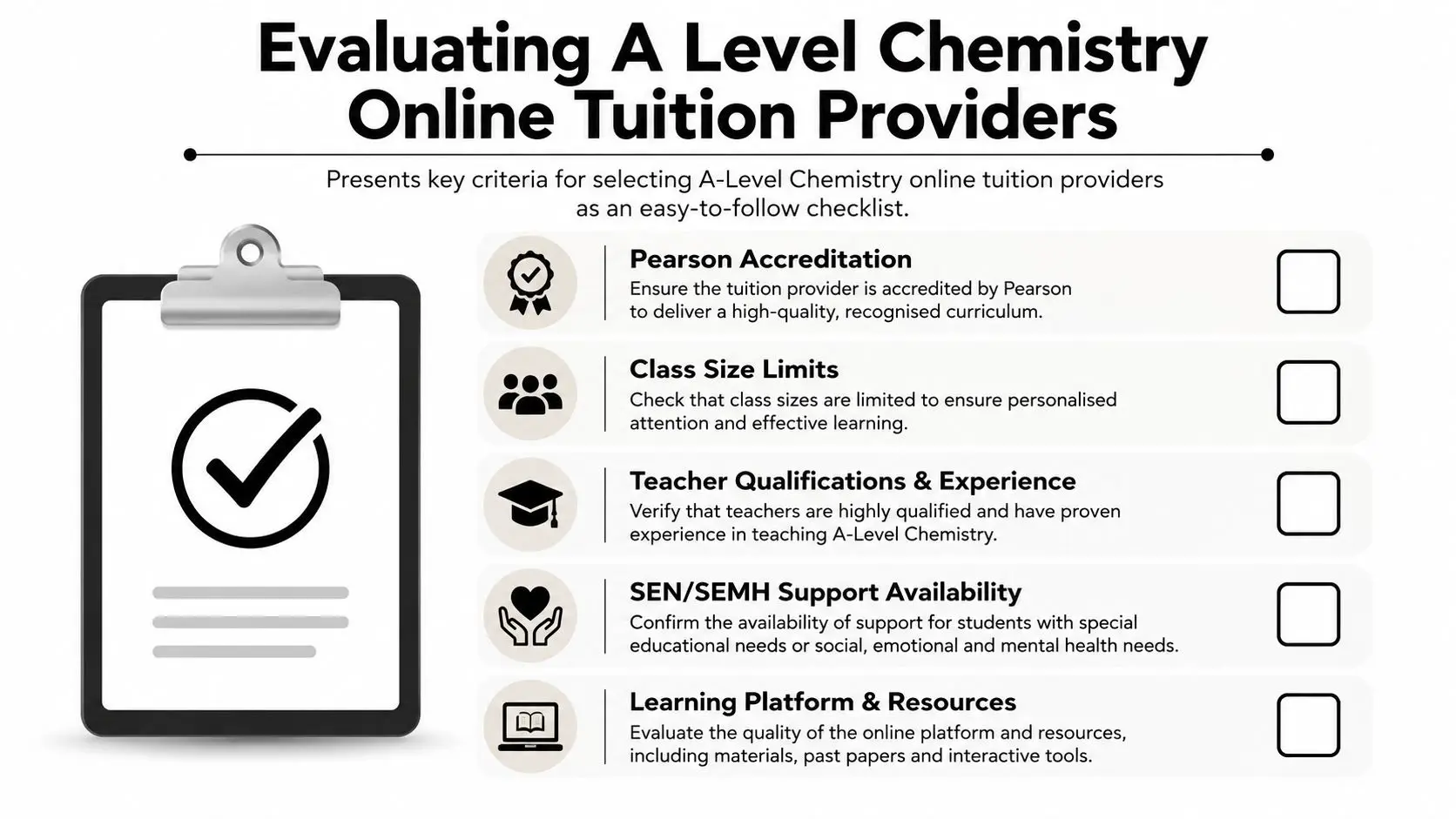
Start with the teaching basics. A provider should be able to explain teacher qualifications and experience, class size limits, and how lessons match the correct exam board. If they cannot show how they prepare students for the practical endorsement, paper-specific question styles, and steady past-paper practice, the tuition may look organised on the surface while missing parts of the course that students still have to master.
Parents should also ask how the provider supports learners who need a different pace or a calmer approach. Online tuition is often described as convenient, but the more useful question is whether it can also hold attention, reduce pressure, and adapt to SEN or SEMH needs. A student who feels overwhelmed in a fast class may do better in a setting that uses predictable routines, short checkpoints, and clear explanations, because those features help the lesson feel more like a guided lab walk-through than a rushed race through content chemistry tutoring support gap.
For families comparing options, Queen's Online School is one provider that offers live, interactive classes with subject specialists, small class sizes, and support for learners with SEN and SEMH needs. If you are comparing science subjects as well as chemistry, the broader approach is outlined in online tutoring for science. That makes it easier to judge one provider against another without assuming any single route is right for every child.
A simple parent checklist
- Exam-board fit: Confirm the tuition follows the exact chemistry specification your child is studying.
- Live teaching: Check that the lessons are interactive, not just recorded content with occasional messages.
- Group size: Ask how many students are usually in a session, because smaller groups usually allow more correction and more speaking time.
- Practical support: Find out how the tutor prepares students for practical endorsement tasks, including method recall and handling uncertainty in experiments.
- Pastoral approach: Ask how the provider supports confidence, attendance issues, or anxiety around tests.
If a provider cannot explain how a child will be supported on a bad week, they have probably not thought carefully enough about real student needs.
Families often want certainty before they commit, and that is understandable. A good provider should make the learning model easy to inspect, especially if your child needs extra support rather than just extra content.
Pricing and Scheduling for A Level Chemistry Online Tuition
A family choosing A Level Chemistry online tuition often starts with price, but the better question is what the lesson helps a student do. In the UK private-tuition market, the FindTutors price report places the national median at £24 per hour for online tuition versus £20 per hour in person, a 20% premium. For parents, that points to a simple reality, specialist online academic support is often priced above standard in-person help, so value depends on fit, subject knowledge, and the way the tutor teaches.
Why specialist online lessons can cost more
Chemistry tuition often sits in the higher-demand bracket because the subject is technical, exam-heavy, and difficult to teach well without subject expertise. The same price report notes that high-demand subjects like A-Level Chemistry often command a £5 premium. Parents should read that as a sign to compare what is included, not just the hourly rate. A lesson that helps a teenager explain mechanisms clearly, corrects exam wording, and spots misconceptions early can be worth more than a cheaper session that feels busy but leaves gaps behind.
Scheduling matters just as much as price. TutorChase's chemistry guide recommends 4–5 hours per week of independent study alongside classroom teaching TutorChase guide. That means tuition works best as one part of a wider weekly plan, like a support beam holding up the rest of the study routine rather than replacing it.
Here is the practical balance.
- One live lesson gives direction and feedback.
- Independent study helps recall stick.
- School teaching gives breadth and continuity.
Families sometimes respond to a weak mock result by adding too many sessions too quickly. That can leave a student tired and less able to take in explanations, especially in a subject where each idea builds on the last one. A steadier plan, with regular tutoring and realistic self-study, usually works better for teenagers who are already balancing other subjects, homework, and revision.
How to avoid burnout
Choose a timetable your child can keep. A tired student will struggle to absorb complex chemistry explanations, even from a strong tutor. If lessons are stacked too closely together, the child may attend without processing the material, which makes the session far less useful.
The weekly plan should leave space for school homework, rest, and at least one clear block of self-study. Families also need to think about practical endorsement requirements, because chemistry is not only about remembering facts, it also includes handling experimental methods and showing confidence with practical work. For children with SEN or SEMH needs, the schedule may need extra predictability, shorter tasks, or a calmer pace so the tuition supports learning instead of adding pressure. If tuition is meant to reduce stress, the routine has to feel manageable for the child, not just efficient on paper.
Student Success Examples in A Level Chemistry Online Tuition
A top-grade student, a struggling student, and an anxious student do not need the same kind of support, even when they are studying the same subject. Good tuition notices that early. The grade is important, but the route to reach it should fit the child's starting point, confidence, and exam needs.
Three different journeys
One student may be aiming for an A* and already understand the content well, but still lose marks in the final stretch of the A2 units. For that learner, tuition becomes a precise piece of support, polishing wording, tightening calculations, and practising exam timing. That matters because an A* requires an A grade overall plus 90% or more of the maximum uniform mark on the A2 units TutorChase guide.
Another student may be close to a grade boundary. They understand some topics, but not well enough to answer mixed questions under pressure every time. In that case, the tutor usually slows the pace, breaks topics into smaller parts, and returns to weak areas until the student can explain them clearly in their own words.
A third student may be capable with the content but feel emotionally overwhelmed. They freeze when they see long questions, worry about making mistakes, and hesitate to ask for help in class. Online tuition can give them a steadier setting, where predictable routines and a gentler pace help rebuild confidence without making the work feel watered down.
What progress often looks like in practice
Progress is often visible in small moments before it shows in the final grade. A student starts writing fuller answers. They recognise question patterns more quickly. They stop panicking when a calculation looks unfamiliar.
The clearest sign of success is when a student can handle a question independently, rather than only repeating a model answer while the tutor is still talking.
That shift is why chemistry tuition can feel such a relief for families. The young person feels less trapped by the subject, and the parent sees effort turning into usable skill. When tuition matches the child properly, chemistry stops feeling like a wall and starts feeling like a puzzle they can solve.
FAQs and How to Enrol at Queen's Online School
A parent may be looking at a worried teenager, a pile of mock papers, and a chemistry course that now feels harder than it should. At that point, the first questions are usually practical ones. Can online tuition really support both the theory and the laboratory side of the course, and will it suit a learner who needs a calmer, more individual approach?
Parents often ask whether online chemistry tuition can handle practical work, not just theory. The answer is yes, provided the tutor takes the practical endorsement seriously and prepares the student for the method, the language, and the calculations behind it. Since the endorsement is reported separately as Pass or Not Classified in England, it should be treated as part of the course, not as an afterthought.
Common questions families ask
Can online tuition help if my child is already behind?
Yes, if the provider is willing to slow the pace, identify gaps, and keep lessons steady. A student who needs catch-up support usually benefits more from a clear plan than from adding more topics alone.
What about SEN or SEMH needs?
Online delivery can support these learners well when it is designed with care. Adjusted pacing, predictable routines, and delivery that respects sensory needs can help students who have had disrupted attendance or who feel anxious in live lessons, especially when confidence has been affected.
How should we prepare before starting?
Have the current exam board, recent mock feedback, and any topic list ready. That gives the tutor a clearer starting point and helps the first lesson feel useful rather than generic. It also helps if the parent can explain what the student finds hardest, because sometimes the actual problem is not the topic itself, but the way the student meets it under pressure.
A simple enrolment path
- Review your child's needs. Decide whether the main issue is content gaps, confidence, practical preparation, or all three.
- Check the provider's fit. Look at exam-board alignment, live lesson format, and support for SEN or SEMH needs.
- Ask about class size and pace. Smaller groups usually mean more individual correction and stronger engagement.
- Book the first assessment conversation. Share the student's targets, pressures, and weak topics.
- Prepare the learning setup. Make sure the device, internet connection, and note-taking method are ready before the first session.
- Agree a review point. After a few lessons, check whether the child feels clearer, calmer, and more able to work alone.
If you are ready to find a structured route that keeps your child's confidence in view as well as their grade target, take the next step with Queens Online School.