

You might be staring at a matrix question right now with that familiar sinking feeling. Brackets. Rows. Columns. Tiny subscripts that seem to blur together. When that happens, it doesn't mean you're bad at maths. It usually means the idea hasn't been made visible yet.
A matrix is only an organised grid of values. Once that clicks, the element of a matrix stops looking like a scary algebra phrase and starts feeling more like finding one square in a spreadsheet or one seat in a theatre. That feeling matters, especially if numbers on a page can make your mind freeze.
Feeling Lost in a Grid of Numbers
A lot of students first meet matrices as a block of numbers inside brackets, such as
[
begin{bmatrix}
2 & 5
7 & 1
end{bmatrix}
]
and think, “I have no idea where to begin.”
That reaction is normal. A matrix can look dense before you know what you're meant to notice. But the first thing to notice is simple. A matrix is just a neatly organised arrangement of values in rows and columns.
A kinder way to see a matrix
Think of a school timetable. Each box has a place. Or think of a score chart. Each number sits in one position. A matrix works the same way. It's an organised box of information.
If a child finds abstract notation stressful, it often helps to move off the textbook page and onto something physical. Squared layouts can make the structure feel calmer and more predictable, which is why tools like grid paper for workbooks and journals can help students mark rows and columns clearly with less visual clutter.
A matrix isn't a test of speed. It's a system for keeping information in order.
That's why this topic matters in school. The concept of an element of a matrix is a foundational part of the UK maths curriculum for Key Stage 4 students preparing for GCSEs under OxfordAQA and Pearson, as outlined in Study Rocket's matrix notation revision page.
Why this small idea matters
One element is just one value in the grid. But once a student can find one value confidently, much bigger topics start to feel manageable.
- Reading notation becomes easier because the symbols point to a place, not a mystery.
- Exam questions feel less overwhelming because you can break a big problem into one small location at a time.
- Confidence grows because the page starts to look organised instead of chaotic.
If you want extra guided practice before moving further into GCSE topics, this set of free GCSE maths online materials can support steady, low-pressure revision.
Pinpointing a Single Matrix Element
A single element is one value inside the matrix. That's all. If the whole matrix is the theatre, the element is one seat.
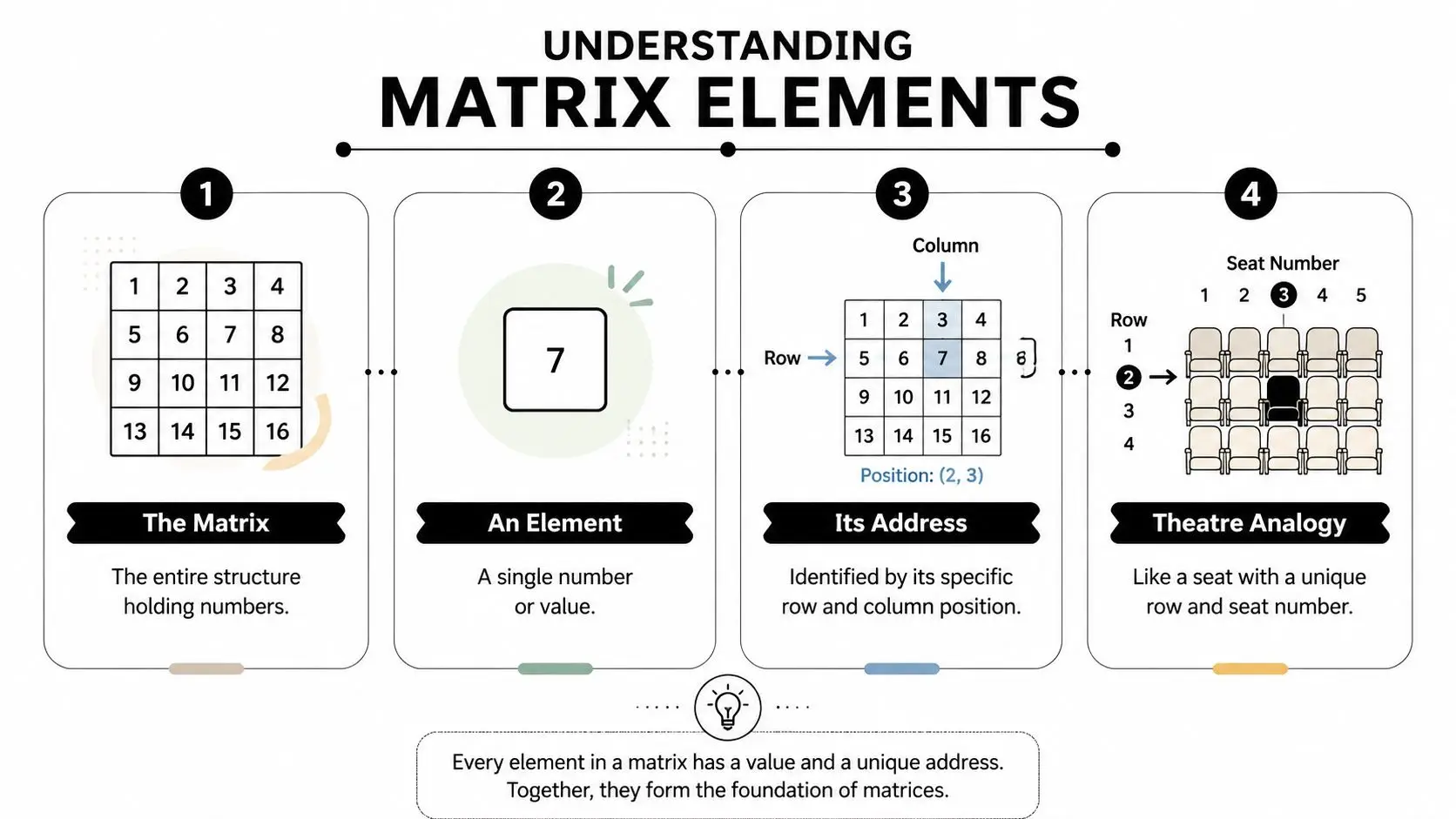
The seat number idea
Suppose we have this matrix:
[
A=
begin{bmatrix}
4 & 9 & 2
7 & 5 & 8
end{bmatrix}
]
Each number has an address. We name an element using subscripts, like (a_{ij}).
- (i) tells you the row
- (j) tells you the column
So (a_{23}) means the element in row 2, column 3.
In the matrix above, row 2 is:
[
7 quad 5 quad 8
]
Then move to column 3. The value there is 8.
So:
[
a_{23}=8
]
The rule students mix up most often
The order matters. A lot.
In UK maths education, the notation (A_{ij}) means the first subscript is the row counted top to bottom, and the second is the column counted left to right. Reversing them causes errors, as explained in this guide to elements of a matrix on GeeksforGeeks.
Practical rule: Read the subscripts as “row first, column second.”
If that helps, say it aloud each time at the start:
row first, column second.
A quick worked example
Use this matrix:
[
B=
begin{bmatrix}
3 & 1 & 6
0 & 4 & 2
9 & 7 & 5
end{bmatrix}
]
Find (b_{31}).
- Go to row 3
- Then go to column 1
- The value is 9
So (b_{31}=9).
Find (b_{12}).
- Go to row 1
- Then column 2
- The value is 1
So (b_{12}=1).
A short video can help if you prefer seeing this movement rather than only reading it.
One way to check yourself
If you're not sure whether you've found the right element, pause and ask:
| Check | Question |
|---|---|
| First | Did I choose the correct row first? |
| Second | Did I move across to the correct column? |
| Last | Does the number I found sit exactly there? |
That little pause can stop a lot of avoidable mistakes.
Visualising Elements in Different Matrices
Some students are fine with one example, then get unsettled when the matrix changes shape. That's understandable. A tall matrix can feel different from a wide one, even though the addressing rule stays the same.
UK students with SEN or SEMH needs often find matrix positions ((i,j)) difficult because many standard resources don't show row and column indexing clearly enough for learners with spatial processing difficulties, as discussed in Cuemath's explanation of matrix elements.
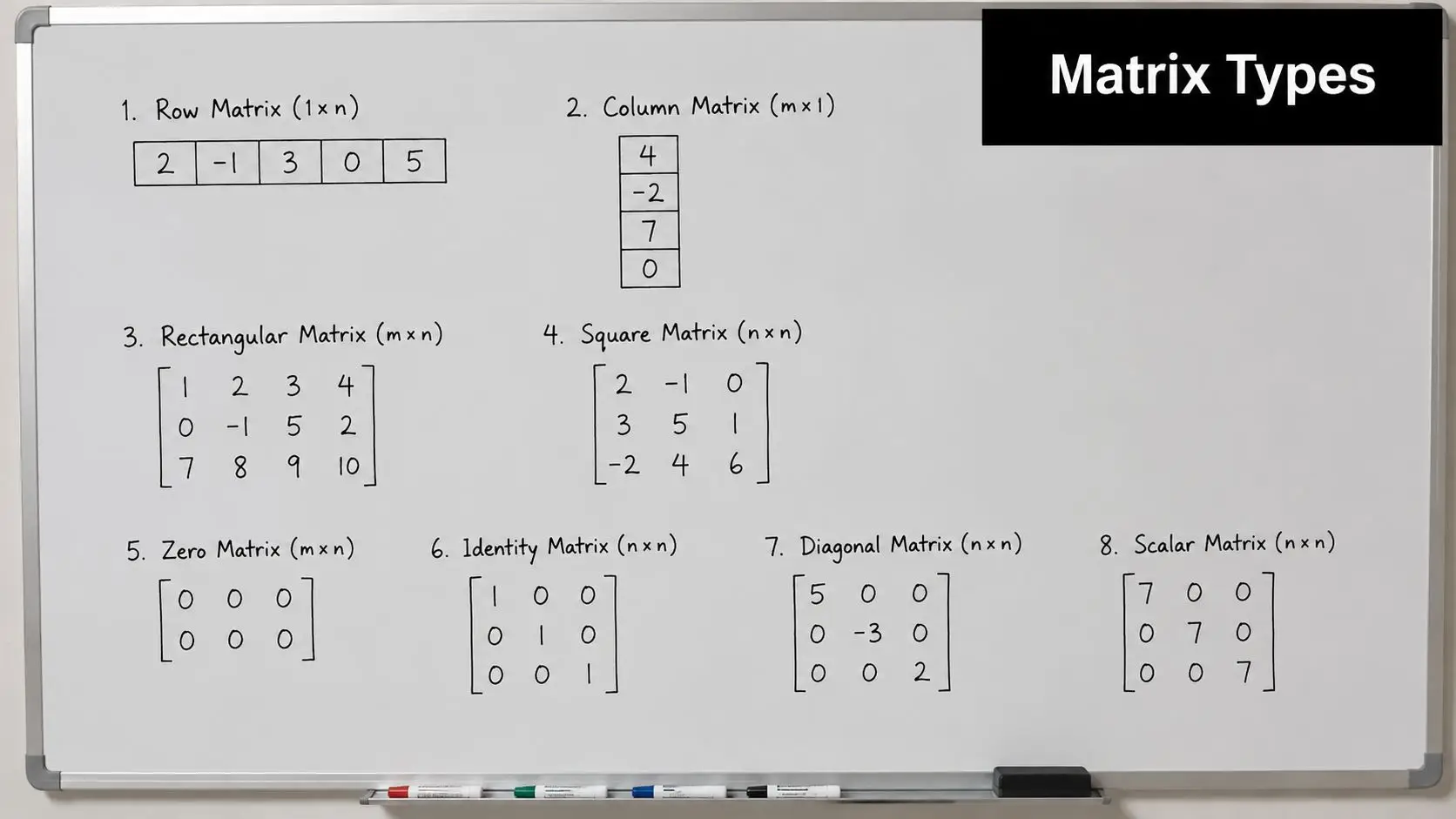
When the matrix is tall, wide, or square
Look at these examples:
[
begin{bmatrix}
2
6
9
end{bmatrix}
]
This is a column matrix. It has one column, but each element still has a row and column address. The number 6 is in row 2, column 1.
Now look at this one:
[
begin{bmatrix}
4 & 7 & 1 & 3
end{bmatrix}
]
This is a row matrix. It has one row. The number 1 is in row 1, column 3.
Then there's a square matrix:
[
begin{bmatrix}
5 & 2 & 0
1 & 6 & 4
8 & 3 & 9
end{bmatrix}
]
Square matrices often appear in exam work because patterns inside them matter.
Spotting the main diagonal
The main diagonal runs from top left to bottom right.
In the square matrix above, the diagonal elements are:
- 5 at row 1, column 1
- 6 at row 2, column 2
- 9 at row 3, column 3
Students often find this easier when they trace it visually with a finger or coloured pencil.
If coordinates feel slippery, don't force them to stay in your head. Mark the row lightly, mark the column lightly, then find where they meet.
A gentle visual habit
Try this whenever you're locating an element:
- Track down first by finding the row
- Slide across next to the correct column
- Circle the intersection so your eyes settle on one square
- Say the address aloud if it helps your memory
That small routine can reduce the panic that comes from scanning the whole matrix at once.
How Individual Elements Behave in Operations
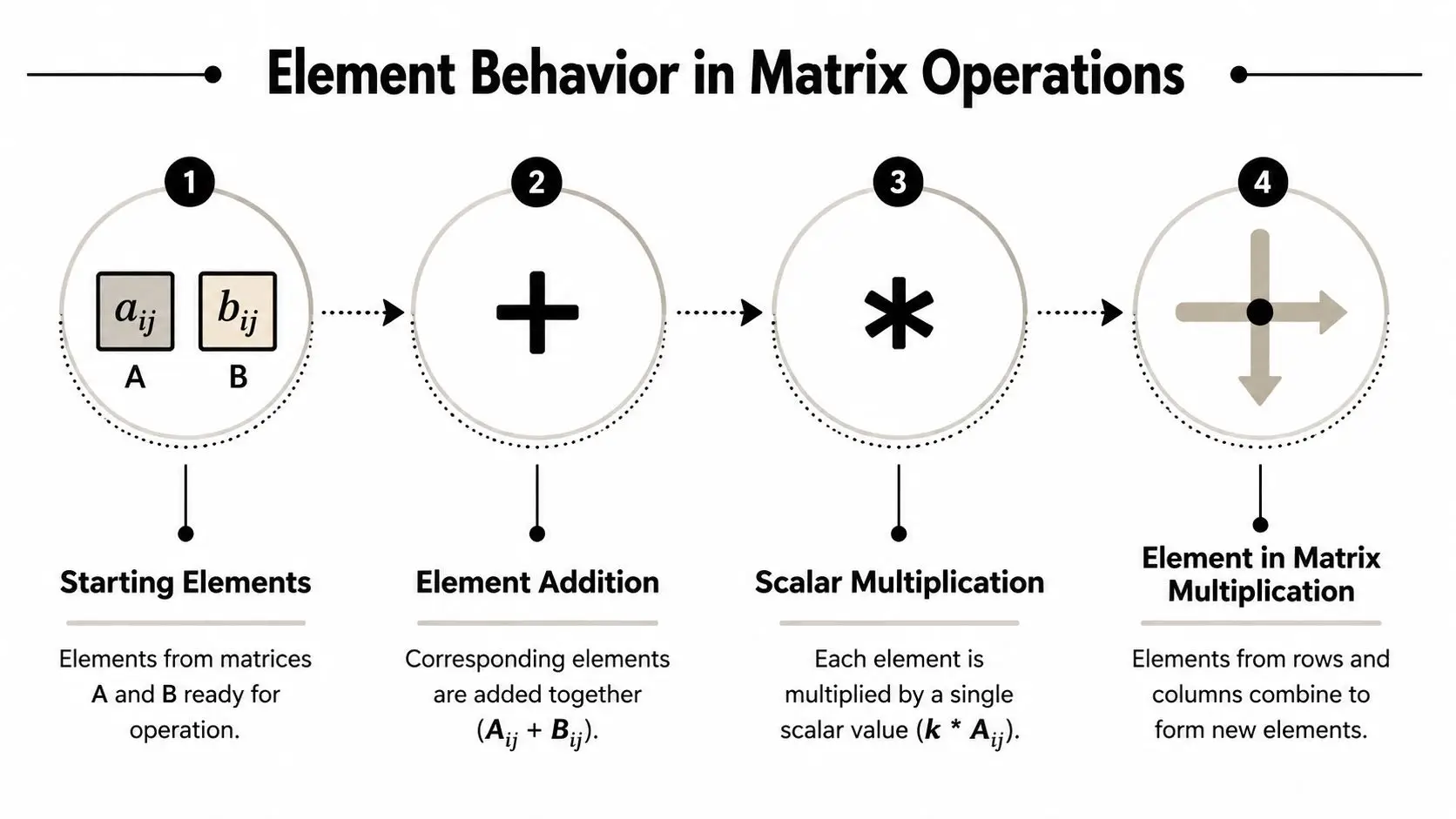
Once you can locate an element, matrix operations stop feeling random. Each operation tells you what happens to each value.
Addition and scalar multiplication
Start with the easiest cases.
If
[
A=
begin{bmatrix}
1 & 2
3 & 4
end{bmatrix}
quad
B=
begin{bmatrix}
5 & 6
7 & 8
end{bmatrix}
]
then to add them, match each element with the one in the same position:
[
A+B=
begin{bmatrix}
1+5 & 2+6
3+7 & 4+8
end{bmatrix}
begin{bmatrix}
6 & 8
10 & 12
end{bmatrix}
]
The element in row 2, column 1 of the answer comes from row 2, column 1 in both original matrices.
Scalar multiplication is also direct. If you multiply matrix (A) by 3, every element gets multiplied by 3:
[
3A=
begin{bmatrix}
3 & 6
9 & 12
end{bmatrix}
]
That's often reassuring for anxious learners because the element stays in the same place. Only its value changes.
Matrix multiplication feels harder because the element is built
With multiplication, an element in the answer doesn't come from just one matching square. It's created from a row and a column.
Take
[
A=
begin{bmatrix}
2 & 1
4 & 3
end{bmatrix}
quad
B=
begin{bmatrix}
5 & 7
6 & 8
end{bmatrix}
]
To find the element in row 1, column 2 of the result, use row 1 of (A) and column 2 of (B):
- row 1 of (A) is ([2 quad 1])
- column 2 of (B) is (begin{bmatrix}7 8end{bmatrix})
Then calculate:
[
(2times 7) + (1times 8) = 14 + 8 = 22
]
So the element in row 1, column 2 of the product is 22.
A UK engineering resource gives the formal rule clearly. The product matrix element at ((i,j)) is found from the dot product of row (i) of the first matrix and column (j) of the second, and even specific values such as (a_{43}=110) and (a_{32}=-50) matter because each individual entry affects the final result. That explanation appears in this engineering matrices resource from GCU.
Multiplication asks, “Which row am I using, and which column am I meeting?”
Transpose changes the address
A transpose flips rows into columns.
If
[
A=
begin{bmatrix}
2 & 5 & 7
1 & 4 & 9
end{bmatrix}
]
then
[
A^T=
begin{bmatrix}
2 & 1
5 & 4
7 & 9
end{bmatrix}
]
The element that was in row 1, column 3 moves to row 3, column 1. Same value. New address.
That's a useful pattern to notice if you like structure.
Using Matrix Elements to Solve Exam Questions
Exam questions often look bigger than they are. Underneath the algebra, they usually begin with one quiet skill. Find the right element. Use its position correctly. Build from there.
A common gap appears when students only practise with plain numbers. Yet Study Rocket's Edexcel Further Maths revision page notes that 68% of Edexcel Further Maths exam questions involve solving for missing elements using algebraic equations, while many revision sites focus mostly on numeric examples.
A variable-based example
Suppose
[
A=
begin{bmatrix}
x & 3
5 & 7
end{bmatrix}
]
and you're told that the element in row 1, column 1 is 4.
That means:
[
a_{11}=x=4
]
So (x=4).
Simple, but this is exactly the kind of step that students rush past when nerves kick in.
Now try something a little richer:
[
A=
begin{bmatrix}
x & 2
3 & y
end{bmatrix}
,quad
B=
begin{bmatrix}
1 & 2
3 & 4
end{bmatrix}
]
If you're told that (A=B), then corresponding elements must be equal.
So:
- row 1, column 1 gives (x=1)
- row 2, column 2 gives (y=4)
This is why element positions matter so much. Equality of matrices depends on matching the exact address.
Where students often lose marks
The mistake usually isn't the algebra. It's the indexing.
Here are some common slip-ups:
- Mixing up row and column so (a_{21}) gets read as row 1, column 2
- Comparing the wrong entries when two matrices are set equal
- Missing the position entirely because the student sees letters and freezes
- Rushing through substitutions without checking where each value came from
Slow is often faster in matrix questions. One correct address can unlock the whole method.
A short exam-style routine
When you meet a matrix question in revision or in a paper, try this order:
Read the address first
If the question mentions (a_{ij}), translate it into words before doing any algebra.Mark the location
Put a tiny dot or light pencil mark at the correct row and column.Write the matching value separately
Don't keep it only in your head.Then do the algebra
Once the position is clear, the rest is usually ordinary solving.
If you need a steadier revision method for these sorts of questions, this guide on how to revise for maths GCSE can help students build routine and reduce panic.
Mastering Matrix Concepts with Confidence
Confidence in maths rarely arrives all at once. It grows when a student realises, “I can find this. I know what that symbol means. I'm not lost anymore.”
That's the power of the element of a matrix. It gives one value a clear address. Once a child can trust that address system, the whole grid becomes more manageable.
Support matters as much as explanation
For many children, the struggle isn't only mathematical. It's emotional. Noise, pressure, embarrassment, and fear of getting it wrong can block understanding before the working even begins.
Government data reported by the BBC confirms that nearly 20% of students in England now receive SEN support within the classroom, the highest proportion recorded since statistics began. The same report describes this as 1 in 5 pupils needing extra assistance, which shows how many children need teaching that feels calmer and more responsive. That reporting appears in this BBC article on record levels of SEN support in England.

Looking beyond one topic
Matrix skills don't only belong to school exams. They sit underneath later work in maths, computing, engineering, and data-focused study. For older students who like seeing where mathematical thinking can lead, routes such as MTech Data Science programs in India show how structured numerical reasoning keeps showing up in advanced study.
Students who continue into sixth form maths often benefit from seeing these links early, especially when they're deciding whether to keep going with the subject. An A-Level Maths course can build on that foundation with more guided support and consistent practice.
You don't need to love every symbol straight away. You need a method that helps the symbols make sense.
If your child has been feeling anxious, stuck, or overlooked in maths, patient support can change the experience completely. The goal isn't just correct answers. It's helping a young person feel safe enough to keep trying.
If your child needs a more supportive and flexible way to learn maths, Queens Online School offers a full British curriculum online with live teaching, personalised support, and an environment designed to help students grow in confidence as well as achievement.