

You found the exam board's published fee on a Tuesday evening, multiplied it by five, and felt briefly better about the whole plan. Then the centre's email arrived with a figure at the bottom that had nothing to do with the number on that page.
Nobody is trying to trick you. The published fee and the centre's bill are two different things, and the distance between them is the most useful thing to understand before you transfer any money. Once you can see where each line comes from, the total stops being frightening and becomes something you can check, question and budget for.
What a Private GCSE Really Costs in 2026
A family budgeting for five written GCSEs might find board fees that add up to about £280. The centre's quote could be much higher because the board fee covers the qualification entry, not the full cost of sitting the exams.
The Joint Council for Qualifications (JCQ) lists an average GCSE price of £55.80 at the start of 2026, a 3.4% increase compared with the same point in 2025, in its guidance for private candidates. At that average, five entries come to roughly £279 before centre charges.
There is no national price for sitting a GCSE privately
Each exam centre sets its own private-candidate fees and deadlines. As a result, prices can differ between centres, even for the same subjects. The centre's quote may include charges for the venue, invigilation and administration, as well as the exam-board fee. Subjects with practical or spoken components may require additional arrangements.
| Scenario | Estimated total | Basis |
|---|---|---|
| Five written GCSEs, exam-board fees only | about £279 | five times the £55.80 average GCSE price |
| Five written GCSEs, through a centre | £1,050–£1,625 | centre subject charges of £210–£325 each |
| Combined science plus four written GCSEs | £1,190–£1,755 | combined science £350–£455 plus four subjects at £210–£325 |
The most useful figure is the centre's written total for your child's exact subjects. A published board fee is a starting point, not a full budget.
For example, a quote might list £245 for maths, £250 for history, £260 for geography, £310 for English Literature and £290 for English Language. Together, those entries total £1,355. Check that the quote covers every subject and identifies what each charge pays for. An AurenWell pool service estimate template illustrates the value of listing costs separately before comparing totals. Apply the same principle to exam fees: add each subject charge, then ask the centre to explain any amount that differs markedly from the typical ranges above.
What Each Charge on the Bill Covers
A private candidate can't usually walk into an exam board's office and buy an entry. An approved centre submits the entry, collects the payment, runs the assessment and handles the paperwork, so the bill arrives as several lines rather than one fee.
The board's portion is smaller than most families expect. Pearson's 2026–27 UK centre tariff lists typical GCSE subject fees at approximately £48.45 to £58.10 per entry, and Pearson states plainly that centres may add their own administration fees, which Pearson doesn't control. The board sets a wholesale price; the centre sets what you pay.
| Charge | Who sets it | What it covers | When it applies |
|---|---|---|---|
| Awarding-body entry fee | Exam board | qualification assessment | every subject entered |
| Centre administration fee | Approved centre | processing the entry and payment | may be added to every entry |
| Invigilation and venue | Approved centre | supervising written papers | written examinations |
| Practical or spoken assessment | Approved centre | supervision, facilities and assessors | subjects with practical or speaking components |
| Access arrangements | Centre and exam board | support for a child with SEN needs | only where the child qualifies and it is approved |
| Late or very-late entry fee | Approved centre | surcharge on the standard fee | after the normal or centre deadline |
How to read a one-line quote
A quote that shows a single "exam fee" line is the one to question. Ask which parts of that table it covers. A £290 quote that includes invigilation, the spoken endorsement and certificates isn't the same product as a £270 quote that later adds £40 for administration and £25 for certificate postage. The cheaper headline is often the dearer entry.
Ask before paying: which of these six charges are already inside this figure, and which will be invoiced separately?
The registration work sits with you. As the parent, you're responsible for selecting the examination centre, registering your child, paying the exam fees and meeting the entry deadlines. No one at the board will chase you if a form goes missing.
Studying online doesn't shift any of this. A remote course removes the classroom, not the exam hall, and venue and invigilation charges still apply in full.
If you're the one producing quotes rather than reading them, how to invoice tutoring clients covers the same discipline from the other side: itemise first, total second, and put the refund terms in writing.
How Subject Choice Changes the Price
A child's subject list can change the exam bill before any centre-specific charges are added. A written paper usually needs a room and an invigilator; practical, oral or separately assessed components may require extra facilities, supervision or sessions.
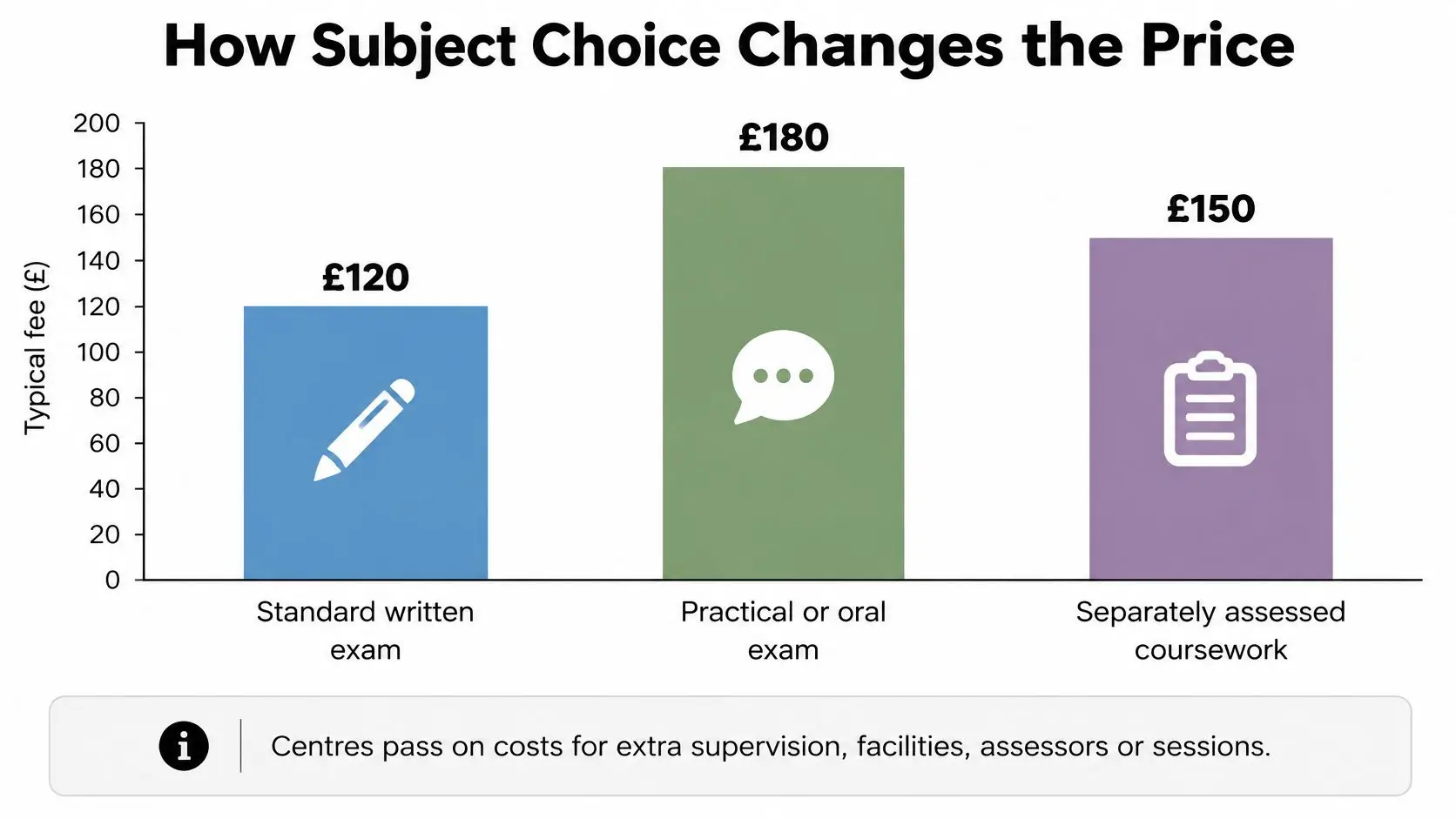
Published private-candidate schedules summarised in this guide to how much GCSEs cost put standard subject charges at roughly £210–£325 per GCSE at examined centres. Combined science is listed at approximately £350–£455, depending on the centre and whether practical requirements are included. A comparison of named UK centres reported standard GCSE prices from £215 to £290, combined-science prices from £390 to £430, and English Language entries with spoken components at around £380 at one London centre.
| Subject | Exam-board fee (Pearson 2026–27) | Typical centre charge |
|---|---|---|
| English Language | £58.10 | Around £380 for entries with spoken components at one London centre |
| Geography | £56.65 | Within the £210–£325 standard range |
| Individual sciences | £56.45 | Within the £210–£325 standard range |
| Standard GCSE subject | £48.45–£58.10 | £210–£325 |
| Combined science | Not listed here | £350–£455 |
Where the premium shows up on a real quote
For a child taking combined science and four written subjects, science may account for the largest part of the centre charges. Check whether the combined-science price includes the practical sessions required by the specification. If it does not, those costs may appear as a separate charge.
English Language can also cost more when a spoken component is included. The endorsement does not change the grade, but it requires supervision and authentication. That added work can explain why a centre's price differs from another's.
Price is not the same as fit
Some subjects are harder to arrange for private candidates. Art, drama, music, PE and design technology involve substantial non-exam assessment, so a centre may not accept an entry. Geography with fieldwork also depends on whether the centre runs the required days.
A low-cost shortlist is of little use if it rules out a subject your child wants to take. Begin with the subjects, then check which centres can accommodate them. If choices are still open, this overview of GCSE subjects to choose can help structure the discussion at home.
Write down each intended subject and mark any practical, oral or coursework components. Then ask centres to price that exact combination. The board tariff is a starting figure; the centre's quote shows what your child's entries will cost in practice.
How to Get a Written Quote You Can Trust
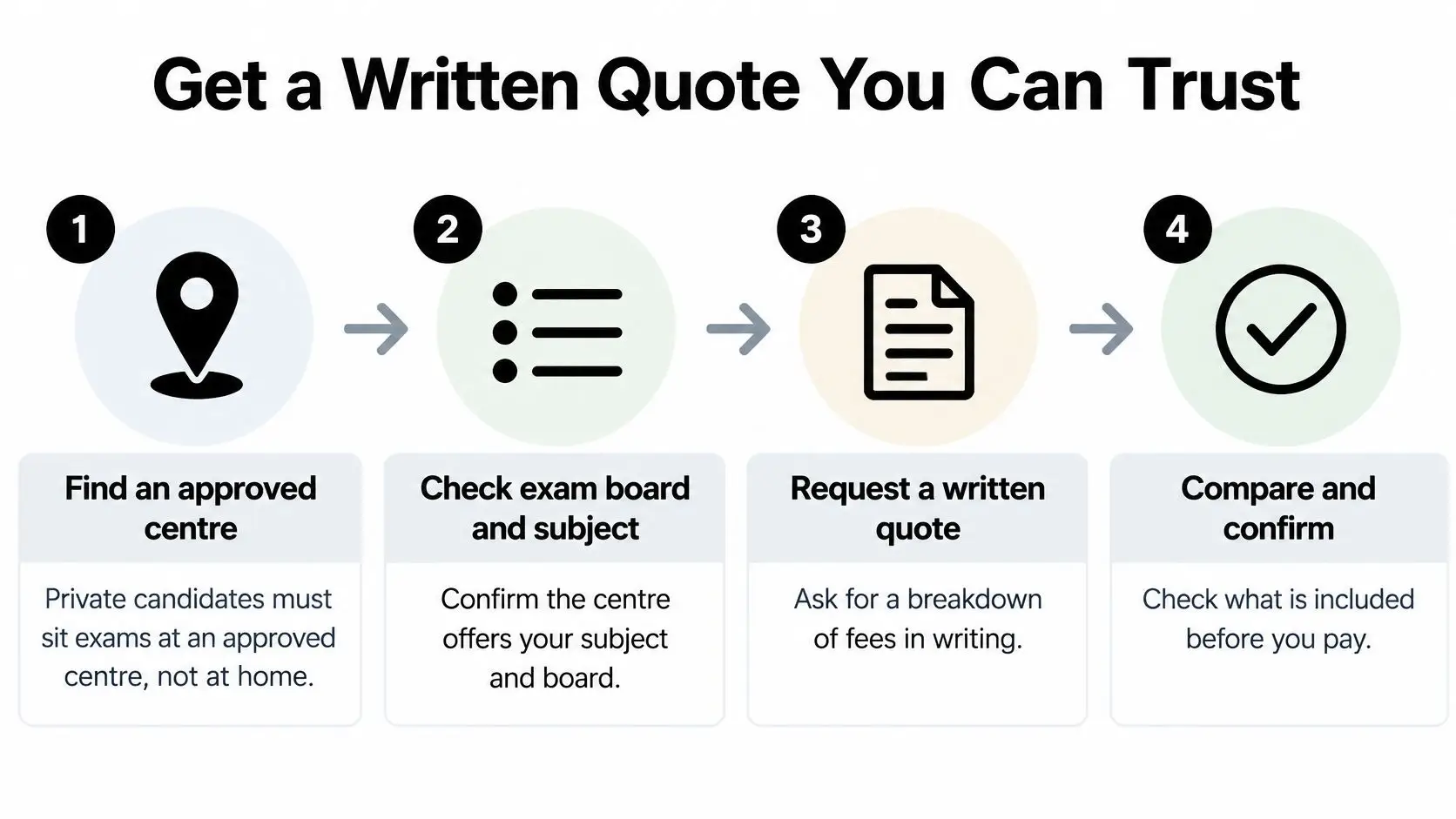
Start with the centre, not the board. GCSE, International GCSE and A Level exams are sat at approved exam centres rather than at home, in line with UK examination board requirements, so the centre list is where the search begins.
The largest cost risk usually isn't the standard tariff. It's centre-specific charges and late-entry exposure. AQA states that schools and colleges may impose additional administration or accommodation fees, payable to the centre rather than the awarding body, and warns that candidates entering after the normal closing date may incur late or very-late entry fees in addition to the standard fee, as its guidance on exam entries and fees for private candidates explains.
Here's the order that works.
- Shortlist centres using the JCQ private-candidate centre search. Search by postcode, qualification and board, then treat the list as a starting point rather than a guarantee. Listed centres apply their own processes and prices.
- Confirm the centre is approved for the exact specification. "Edexcel GCSE English" isn't precise enough if the centre only runs a different code. Ask for the specification code in writing before you go further.
- Request an itemised quote in writing. Ask for the awarding-body fee, administration, invigilation, venue and access arrangements to appear as separate lines. Verbal quotes change; emails don't.
- Get the centre's internal deadline and its late-fee schedule. This is the step families skip. A centre's internal deadline can fall weeks before the board's official closing date, and the candidate remains responsible for paying every charge through the centre.
- Check whether practical or spoken components sit inside the price. A subject with a speaking test priced without one is an incomplete quote, not a bargain.
- Confirm identification and access arrangements. Ask what photo ID your child brings, and whether any access arrangement is assessed or priced separately. Arrangements need evidence and advance approval, so this can't wait until exam week.
Use this line in your first email: please send an itemised written quote for these exact subjects for this series, showing every charge that is not the awarding body's entry fee.
Two centres can quote almost the same subject price and still be £100 apart once one of them itemises. That's the whole reason for asking in writing. And if your child is preparing through an online provider, it's worth knowing where GCSE exams are actually sat before you build the shortlist, because the venue determines everything else.
Late Entries and Costs That Appear Later
A family could book their child's exams by the exam board's published closing date, then learn that the centre's own deadline passed two weeks earlier. The standard fee may still be due, with a late-entry charge added. For a student who has already begun revising, uncertainty about whether an entry will go through can add pressure.
Exam boards set published entry deadlines, but exam centres may set earlier cut-offs to allow time to process registrations. The board's deadline is therefore not necessarily the date a family must meet. Missing the centre's deadline can raise the bill even while the board is still accepting entries; later entries may bring further charges.
Other costs can emerge after an initial quote:
- Late or very-late entry fees: Ask whether these are charged per subject and request the centre's schedule.
- Access arrangements: Assessment or administration may carry a separate charge if arrangements are raised late.
- Travel: Include the cost of getting to the centre for each exam sitting, as well as parking or an overnight stay if needed.
- Time away from work: A parent or carer may need to take time off on exam days.
- Preparation: Materials, tutoring or extra support sessions may add to the overall cost.
These costs vary, so a general estimate cannot replace the centre's own written terms. Set a calendar reminder ahead of the centre's internal deadline, rather than relying only on the board's published date. That gives you time to resolve entry questions before a late charge becomes part of the bill.
Weighing Private Entry Against Your Child's Needs
Exam fees are the part of this decision you can count. The part you can't count is whether your child can walk into that hall and do themselves justice.
Take a 15-year-old who has been out of a classroom for a year because the noise and pace of school made every day unbearable. They need a quiet room, a familiar adult nearby, and a timetable that doesn't leave them finished by Tuesday. Once that's the picture, the fee becomes one line in a much larger sum.
So compare like with like. Put the centre bill beside the cost of the school alternatives, and beside the support your child will receive for that money. A cheaper entry that leaves your child unsupported in an unfamiliar hall isn't cheaper.
Work through these before deciding:
- Can your child's current school enter them? If a place exists, that route is usually simplest and may cost less.
- Does your child have SEN or SEMH needs that require access arrangements? Extra time, a reader, a scribe or a separate room must be applied for in advance, with evidence, and some centres charge for the assessment.
- How is your child's learning progressing right now? A child who is behind in two subjects may need tutoring alongside the entry fee.
- Do the planned subjects include practical or speaking components? Those lines change both the price and the shortlist.
- What travel and time can your family realistically carry? Six exam days two hours away is a different proposition from six down the road.
A child with recognised needs deserves that access conversation at the very start, not in April. Ask what evidence the centre requires, who assesses it, and what happens if the application fails.
Budgeting helps too, because spreading a bill across a year feels very different from finding it in one month. The Money Maniac's comparison of budgeting methods is useful if you need a structure for setting the money aside. And if your child is learning outside a school already, these online GCSE courses for homeschooling show how the study side and the exam-centre side fit together.
Pay Only After the Written Price Is Complete
Picture the moment before payment. Two centre quotes are open on the laptop, one spreadsheet has the subjects listed down the side, and a 15-year-old is waiting to hear which exams they'll be sitting in June.
Pay nothing until at least two approved centres have sent itemised written quotes for your child's exact subjects. Then read those quotes for three things only: a complete price, the centre's own internal deadline, and confirmation that your child can sit every paper, with any approved access arrangements in place.
A lower headline fee stops being a saving the moment a spoken test, a practical session or a late surcharge appears after your child has already started revising. If your child studies online, ask the provider whether it can point you towards an approved centre. Queen's Online School is a Pearson Edexcel Approved Centre, so families can ask us about the entry route, then confirm that centre's own charges in writing.
The goal is simple. Your child walks into a booked exam hall knowing the bill is settled, the date is fixed and the support is agreed.
Queen's Online School teaches the British curriculum live and online from Key Stage 2 through A Level, with small classes and subject specialists who understand how anxious exam years can feel. If you're building a GCSE or International GCSE plan and want to know how the exam entry side fits with the study side, our team can talk you through the route and what to confirm with your chosen centre. Visit Queens Online School to see the courses and start the conversation.