

Key Stage 3 covers Years 7, 8 and 9 in England, for pupils aged 11 to 14, the three years between primary school and GCSE courses. A child starting Year 7 in September will usually turn 12 during that first secondary year and finish Year 9 at 13 or 14, ready for GCSE study.
The secondary transfer letter arrives in the spring term of Year 6, and with it a uniform list, a bus timetable and a set of subject names your child has never mentioned. You read it twice. Underneath the admin, the central question isn't about blazers at all: how will I know my child is doing well?
One feature of the English system catches families out. Key Stage 3 has no national test at the end. There's no SATs equivalent at 14 and no certificate waiting in Year 9.
The thing to hold on to: fewer tests doesn't mean less information. It means the information is held inside the school, in teacher judgement, tracking data and marked work, and a parent who knows what to request gets a clearer picture than one who waits for a grade that never arrives.
Where Key Stage 3 Fits Across Years and Ages
Key Stage 3 is the middle block of England's national curriculum. It covers Years 7, 8 and 9 for pupils aged 11 to 14, and it sits between primary education and the examination-focused Key Stage 4, which begins at 14 and runs through Years 10 and 11, as the Department for Education's national curriculum overview sets out. The table below places every key stage side by side, so you can find your child's year group and read across.
| Key Stage | Years | Typical ages | What it leads to |
|---|---|---|---|
| Key Stage 1 | Years 1-2 | Ages 5 to 7 | Foundations of reading and number |
| Key Stage 2 | Years 3-6 | Ages 7 to 11 | Year 6 SATs and the move to secondary school |
| Key Stage 3 | Years 7-9 | Ages 11 to 14 | Preparation for GCSE courses |
| Key Stage 4 | Years 10-11 | Ages 14 to 16 | GCSE exams |
| Key Stage 5 | Years 12-13 | Ages 16 to 18 | A Levels and vocational courses |
Two details matter more than they look. The ages are typical rather than fixed: pupils generally enter Year 7 at 11 or 12, progress through Year 8 at 12 or 13, and complete Year 9 at 13 or 14. That's why a child with an August birthday can be almost a year younger than a classmate born the previous September while sitting at the same desk.
The whole framework is also English. UK education is devolved, and curriculum arrangements differ across England, Scotland, Wales and Northern Ireland, so a family moving between nations meets different structures and different names. These year groups and ages describe England, and they're the version most British-curriculum schools internationally follow.
A quick check you can do tonight: find the year group your child is in or joining, match it to the key stage in the table, and you'll know which framework governs the timetable and the expected ages. If the year group and your child's age don't seem to line up, ask the school. It usually points to a different start date or an accelerated year, and it's better to know in October than in July.
The Subjects Pupils Study in Years 7 to 9
Every Year 7 to 9 pupil studies three core subjects: English, mathematics and science. These carry the most weight in assessment and shape which GCSEs stay open later, so a wobble in one of them is worth catching in Year 7 rather than Year 9.
Around them sit the foundation subjects: history, geography, computing, art and design, design and technology, music, a modern foreign language and physical education. Many families are surprised that the list doesn't stop there. The national curriculum framework for key stages 1 to 4 confirms that schools must also provide relationships and health education, sex education and religious education, with citizenship part of the same broad entitlement.
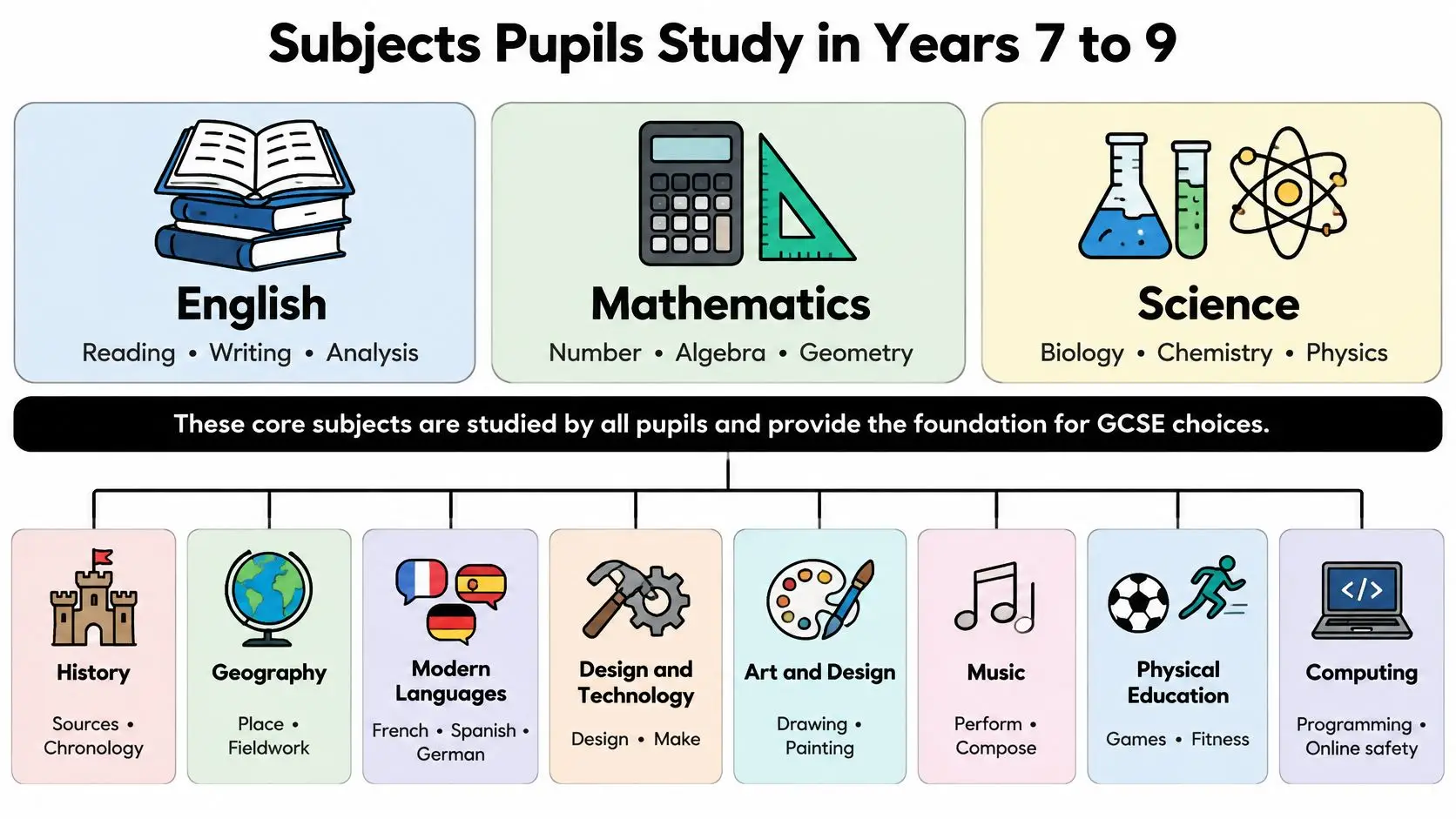
Here's how the three groups differ in the room, rather than on a list.
| Subject group | Subjects | Typical example |
|---|---|---|
| Core | English, mathematics, science | A Year 8 novel study with weekly written analysis |
| Foundation | History, geography, computing, art and design, design and technology, music, languages, physical education | A Year 9 geography unit on migration with a research task |
| Citizenship and health | Citizenship, relationships and health education, religious education | A Year 7 debate on rights and responsibilities |
Why the breadth is worth defending
A timetable reduced to exam subjects alone disadvantages the child whose strengths don't show up in a written test. A pupil who feels unsuccessful in English lessons may find belonging through music, design or sport, and that belonging is what keeps them turning up long enough to build the reading and number skills that matter later.
Science is the obvious test case, because it splits into biology, chemistry and physics while still resting on the same reading and reasoning skills. The Key Stage 3 science curriculum shows how those threads build across the three years, which is useful when you're trying to work out whether a struggling Year 8 is finding the content hard or the language hard.
When you look at your child's timetable this term, check two things: that every group appears, and that progress is being tracked across all of it, not only in the three core subjects.
How Progress Is Checked Without National Tests
If your child reaches the end of Year 9 without sitting a national exam, it is natural to wonder how you can tell whether they are keeping up. The answer depends on the evidence the school gathers and how clearly it shares that evidence with families.
Statutory National Curriculum tests for 14-year-olds were phased out in the late 2000s, and the national statistics collection for Key Stage 3 records the end of formal KS3 testing. Older reports may use National Curriculum levels. In that system, Level 5 or above was the former benchmark for reaching the expected standard. Schools now use their own assessments and progress measures, so a single national result is no longer available to show how pupils are doing.
Fewer tests do not necessarily mean less information, but families may need to ask for it. The Curriculum and Assessment Review found that assessment and progress-monitoring systems are less developed at Key Stage 3 than at Key Stage 4. It also noted that, without national KS3 assessment data, attainment can be difficult to track, and that progress may slow between Key Stage 2 and Key Stage 3, particularly in English and mathematics. The practical question for parents is what evidence the school uses, and whether it can explain what that evidence means.
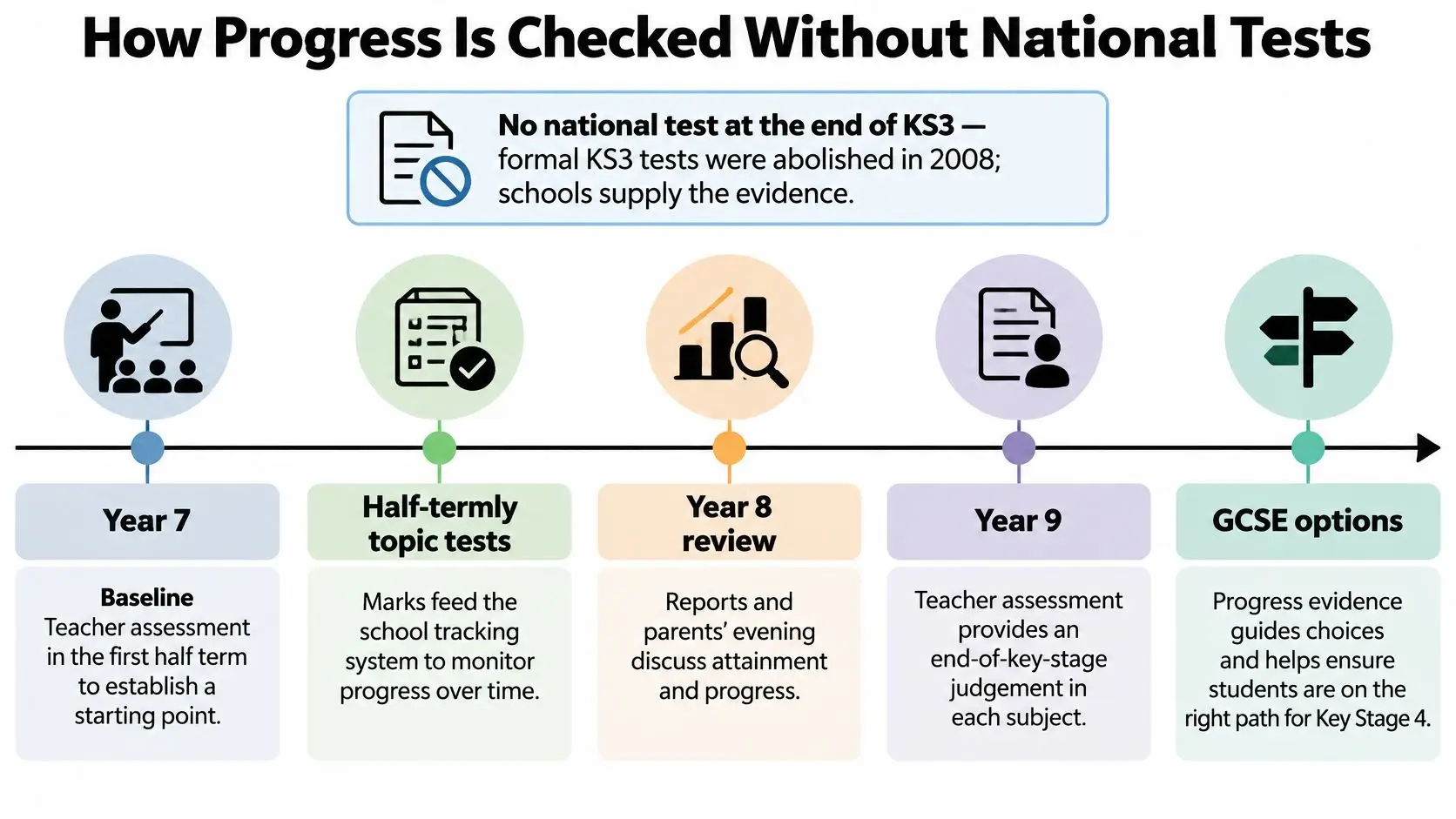
What to ask for, and when
| Evidence | What it shows |
|---|---|
| Baseline assessment | Starting point, informed by Year 6 information |
| Termly progress measures | Whether progress is steady or slowing |
| Scrutiny of written work | The quality of extended writing and reasoning |
| Intervention records | Which gaps are being retaught and whether they have closed |
| Curriculum mastery indicators | Which units the child has secured |
A specific example can make the information easier to interpret. If a Year 7 pupil is unsure about fractions, ask what practice and feedback will address that gap, and how the school will check for improvement. Fractions support later work with algebra and proportional reasoning, so a useful progress discussion connects today's difficulty with what the pupil is learning next.
Assessment can take several forms. In Key Stage 3 History, continuous assessment includes source analysis tasks, essay writing assignments, project-based learning and end-of-unit tests. These different tasks give teachers evidence of how pupils interpret information, build arguments and apply what they have learned, rather than relying on one test alone.
Formal tests can also cause anxiety. A child who finds timed exams difficult may feel relief when there is no national exam at the end of Year 9. That reassurance matters, but regular feedback still helps identify whether low confidence is masking a learning gap. Ask for examples of the work, the teacher's feedback and the next steps, not only a broad label such as “on track.”
At parents' evening, these questions can help turn general updates into a clear picture:
- How does the school measure progress from my child's Year 6 starting point, and is that measure shared with parents in writing?
- Which subjects show slowing progress, and what is the plan to address them?
- What evidence will show that a gap has closed?
How Key Stage 3 Prepares Pupils for GCSEs
A Year 9 pupil may be reading graphs in science, weighing evidence in English and using ratios in mathematics. These skills are not separate pieces of preparation: GCSE subjects often ask pupils to combine them. Key Stage 4 begins at 14, in Years 10 and 11, so the habits and knowledge built across Years 7 to 9 help pupils approach that change with confidence.
Numeracy deserves particular attention. An Ofsted review of Key Stage 3, drawing on inspection evidence from September 2014 to March 2015, reported that improvements in literacy were observed nearly three times as often as improvements in numeracy. One in five senior leaders interviewed judged numeracy development to be much weaker than literacy, and only a quarter could describe comparable actions to improve it. Pupils may become more confident readers and writers while still needing help with the calculations and data used across science, geography, computing and mathematics.
Reading also changes as pupils progress. The English programme of study expects pupils to develop a love of reading and tackle increasingly challenging material independently. That goes beyond answering questions about a short passage. Children need practice staying with longer texts, understanding unfamiliar vocabulary and explaining how evidence supports an interpretation.

One task that shows both skills working together
In a Year 9 science lesson, a pupil might read a temperature graph, estimate a value between two points and describe the trend in a complete sentence. The task brings together measurement, estimation and interpretation with clear written explanation. It also gives the teacher a useful view of whether the pupil can apply skills, rather than recall them.
These foundations grow through regular practice: checking units, estimating, using ratios, reading graphs, applying proportional reasoning and interpreting data. When pupils meet these ideas in different subjects, they learn to recognise when and how to use them, not just how to complete a worksheet.
Before GCSE options are finalised, ask what evidence the school can share. Key Stage 3 has no national test at the end, so families need clear examples of progress: subject-specific reports, feedback on extended answers and records showing what support was given for a gap and whether it helped. A gap spotted in Year 8 leaves time to address it before GCSE study begins.
Study routines matter too. Pupils who check what they remember are better prepared for a heavier workload than those who spend longer revisiting material. If your child replays recorded lessons without testing their understanding, show them how to stop rewatching recorded lectures and practise recalling key ideas instead. To understand what lies ahead, the Key Stage 4 curriculum outlines the subjects and pathways available during the GCSE years.
Supporting Children With SEND or Anxiety at Key Stage 3
A child who felt settled in a small primary school may find Year 7 overwhelming: new corridors, bells, routines and unfamiliar faces arrive all at once. For a pupil with autism, SEND or anxiety, that change can affect how safe school feels. Agreeing support before difficulties build can help make the transition more manageable.
The SEND Code of Practice guidance for schools describes how schools should consider a pupil's skills and attainment, information from previous settings, reasonable adjustments related to disability, and cooperation with local authorities on needs assessments and Education, Health and Care Plans. Practical adaptations may include writing frames, chunked instructions, adjusted resources and carefully planned questions.
What those adjustments look like in a classroom
- Predictable structure: Keep a familiar lesson pattern where possible, break instructions into steps and give advance notice of timetable changes.
- A quieter route into discussion: Let pupils write a contribution, talk with a partner before sharing with the class, or use a card instead of raising a hand.
- Memory support: A visual checklist and writing frame can help a pupil with working-memory difficulties keep track of instructions.
- Accessible reading: Pre-teach vocabulary, offer audio versions and allow extra time for a child with dyslexia, so unfamiliar text does not become a test of decoding.
These adjustments do not lower expectations. They remove barriers so pupils can show what they know.
Spotting distress before it hardens into absence
Refusing school, stomach aches on school mornings, falling attendance or withdrawing from group work can signal distress rather than defiance. The SEND identification report recommends considering unidentified SEND when attendance problems emerge. It reports that pupils with more authorised absence in Key Stage 2 were more likely to be identified with SEND later, and that 14% of children identified with SEND had also used CAMHS by Year 11. The same report describes a Southampton transition project recommending assessment that considers observation and learner information as well as attainment scores.
At home, calm conversations and predictable routines can sit alongside school support. Practical ideas for helping kids cope with anxiety may help families respond without treating anxiety as a reason to avoid discussing school altogether.
Not lower expectations: a writing frame does not make the work easier. It removes the barrier that was hiding what the child already knows.
Ask how support from primary school will carry into Year 7, who will be the named contact and how wellbeing will be reviewed. Families considering an online setting should ask how individualised SEN provision is planned and reviewed across the school year. A SEN support plan can help families understand the kinds of arrangements to discuss, but ask the school directly how support will fit their child's needs.
Confirm Your Child's Key Stage 3 Plan Before Year 7
You don't need to become an expert in curriculum frameworks. You need three things in place before September, and one rule for judging how it's going.
- Request the evidence. Start with the Year 6 baseline and the termly progress measures, and ask to see a marked piece of extended writing.
- Check the timetable's breadth. Confirm every subject group appears, from English, mathematics and science through to citizenship, relationships and health education and religious education, and that any support plan from primary school has transferred to a named contact in Year 7.
- Agree how wellbeing is reviewed. Ask who leads the termly review of wellbeing and any SEND needs, and what written record you'll receive.
Then apply one decision rule. If your child is settling well and progressing in the core subjects, keep the current plan and review it at each parents' evening. If attendance, anxiety or progress is slipping, request a meeting with the school within two weeks, before a small problem becomes the story of the year.
Families considering a different setting can compare provision using the same three questions. Queen's Online School runs a Lower Secondary pathway covering Key Stage 3, Years 7 to 9, for ages 11 to 14 in English, Maths, Citizenship and Wellbeing, and Science (with UK-qualified, DBS-checked teachers), and the process begins with a discovery call after which we design a customised learning pathway covering subjects, pace and schedule.
The right Key Stage 3 UK plan isn't the most demanding one on paper. It's the one that keeps a child curious enough to keep trying.
If you're weighing up Key Stage 3 options and want a setting where progress is discussed termly rather than discovered at GCSE, Queens Online School teaches Years 7 to 9 live and online with subject-specialist teachers who know each learner by name. We cover English, Maths, Science, and Citizenship and Wellbeing through a British curriculum, with support built around each child's pace. Book a discovery call and visit Queens Online School to talk through what Key Stage 3 could look like for your child this September.