

If one pupil takes more GCSEs than another, does that automatically mean they'll have more choices after Year 11? Not necessarily. The more useful question is how many GCSEs do you need for the next step your child wants, and which subjects and grades does that route require?
There's no single UK-wide GCSE total that every pupil must reach. A number can look reassuring, but a course may care more about a particular English, maths or science grade. Start with the next step, check its entry requirements, then shape a subject plan around your child's strengths, support needs and realistic workload.
Typical GCSE Requirements for Each Next Step
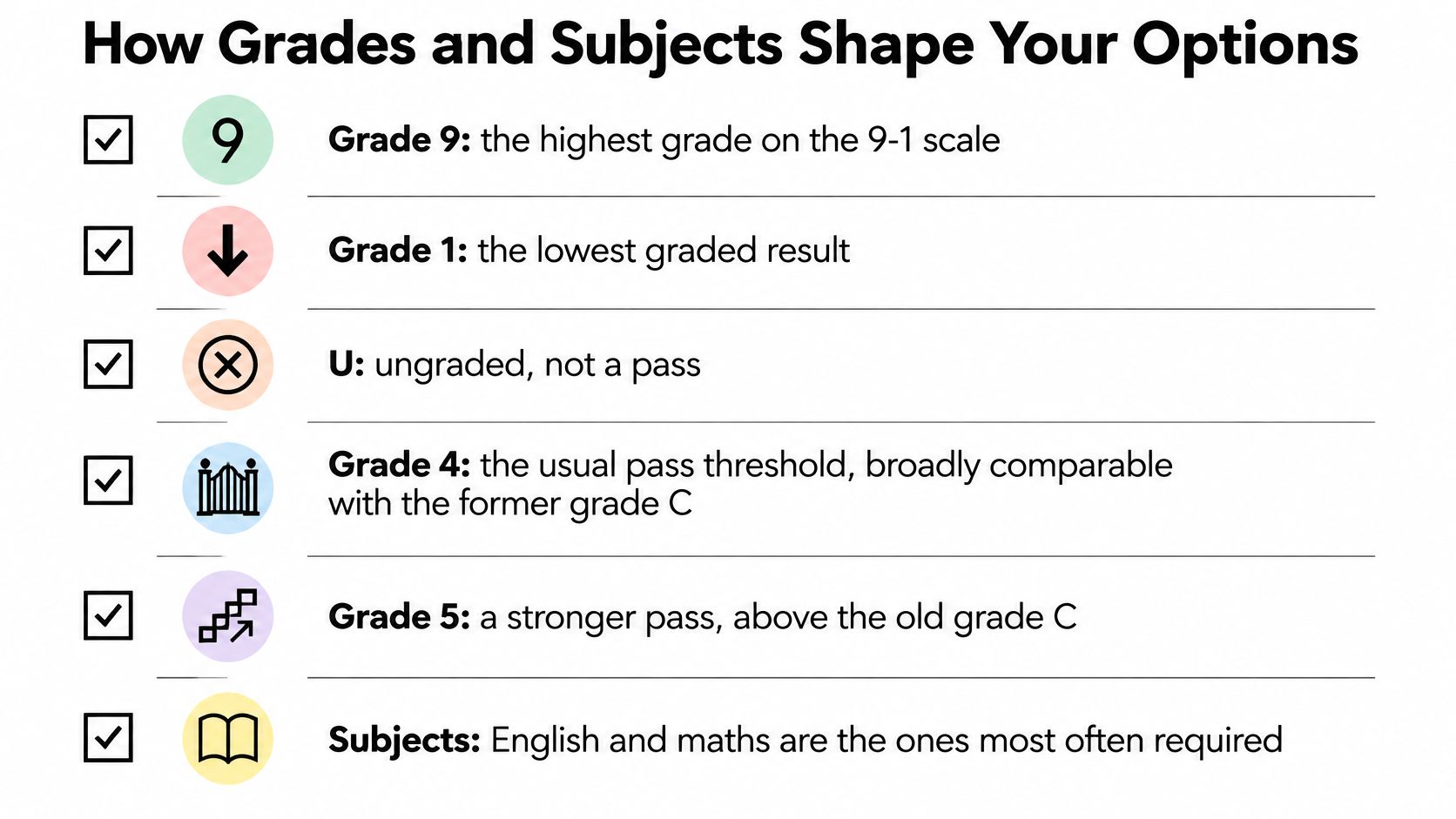
There's no single GCSE total for every pathway. The number and grades required depend on the course, employer or provider, so a familiar figure such as five GCSEs shouldn't be treated as a national rule. GCSEs are graded from 9 to 1: 9 is the highest, 4 is the standard pass, and U means ungraded.
| Next step | Typical GCSE expectation | Usually also checked | Where to confirm |
|---|---|---|---|
| Sixth form or college (A levels) | Often 5 or more at grades 9–4; varies by institution | English and maths at grade 4, plus grades in subjects the course names | Published sixth-form or college entry policy |
| College Level 3 course | Varies by course; often includes English and maths | English and maths at grade 4 for many courses | Course entry requirements on the college site |
| Level 2 apprenticeship | Often no specific qualifications required | English and maths frequently checked | Individual apprenticeship vacancy |
| Level 3 apprenticeship | Some GCSEs, often including English and maths | English and maths usually | Individual apprenticeship vacancy |
| Higher apprenticeship (Level 4 and above) | Commonly 4–5 GCSEs at grades 9–4, plus A levels or equivalent | English and maths | Individual apprenticeship vacancy |
| University (via A levels or equivalent) | Set by each course, not a fixed GCSE total | English and maths often at grade 4 | Course entry requirements on the university site |
| Employment without an apprenticeship | No fixed number; varies by role | English and maths at grade 4 for many roles | Individual employer |
These are typical expectations, not guarantees. The apprenticeship guidance from Skills for Careers explains that requirements differ by apprenticeship level and vacancy. Sixth forms, colleges, universities and employers also set their own criteria. A selective course may ask for a particular subject grade as well as a total number of GCSEs.
For example, a Year 11 pupil interested in an electrical apprenticeship should look at actual vacancies. One employer may focus on English and maths and the applicant's readiness for practical training, while another may specify additional GCSEs. A pupil aiming for sixth-form biology, by contrast, should check the sixth form's biology entry rules and the required science and maths grades. The title “biology” doesn't tell you the exact threshold.
Start with the destination, not the total. Find the relevant row, note the number and subjects to check, then confirm the details with the provider.
If A levels are the goal, compare the published requirements for the actual subjects your child hopes to study. Our guide to A-level entry requirements can help families know what to look for, but the sixth form's own policy is the final reference.
How Grades and Subjects Shape Your Options
What matters for the next step your child has in mind: the number of GCSEs, or the grades in particular subjects? In England, GCSEs use a 9–1 scale, with 9 the highest grade and 1 the lowest. Grade 4 is generally considered a standard pass, while grade 5 is a stronger pass. The GOV.UK guide to GCSE subject content and requirements explains the curriculum areas schools must provide, but it does not set one universal number of GCSEs every pupil must achieve.
Start with the row that matches your child's next step. Then check which subjects it names and what grades it requires, especially in English and maths. A provider may ask for a higher grade in a specific subject, so the total GCSE count alone won't show whether a pupil meets its entry rules.
For example, a pupil interested in A-level sciences should check the sixth form's requirements for science and maths, including which GCSE science route it accepts. A humanities course may specify English and a subject such as history or geography. Some courses name a modern foreign language, too, so check before GCSE options are finalised.
A 14-year-old considering law might focus on developing strong English skills and choosing a humanities subject that interests them. There is no need to settle on a whole career now. A considered subject combination can keep options open while making room for a pupil's interests and wellbeing.
Families comparing science options can read about STEM subject combinations explained. Use these questions to check a possible route:
- Named subjects: Which GCSE subjects does the intended course specify?
- Required grades: What grade does it ask for in each subject?
- Prerequisites: Does the pupil need a particular subject before starting?
- Available specification: Can the school or exam centre provide and assess that GCSE?
The Threshold and Your Fallback Routes
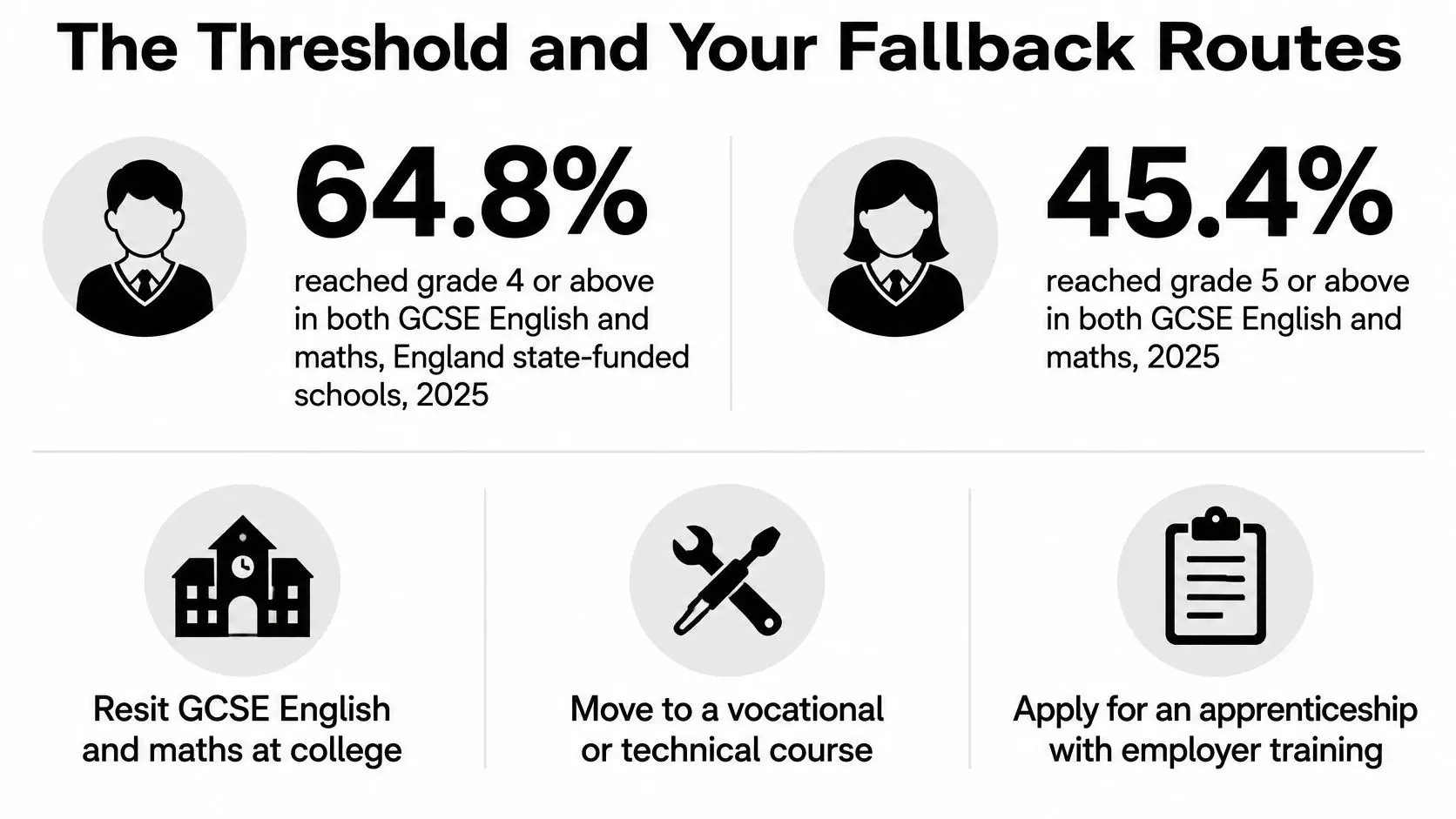
A shortfall in English or maths does not automatically close off the next step. Most pupils leave school with at least grade 4 in both subjects, but individual results and course requirements vary. The practical question is what the learner needs to do next.
In England, students who have not achieved grade 4 in English or maths generally continue studying the subject alongside post-16 education or training until they reach the required standard, subject to the conditions of their programme. Continuing to study does not always mean sitting an exam immediately.
For example, a 16-year-old with grade 5 in English and grade 3 in maths might begin a college course while continuing maths study. The grade shows the learner's current result, not a limit on their ability or future progress.
Resits are one route, not the only route
GCSE English Language and Maths can generally be retaken in the November series, although eligibility and timing rules apply. Resits in most other GCSE subjects take place the following summer. For many 16–19-year-olds in England without a suitable prior pass, continuing English and maths study is a funding condition. Providers should consider readiness, attendance, engagement and progress before entering a learner for a November resit, particularly after a grade 3 or below. See the National Careers Service guidance on exam resits for further information.
| Situation | Route to discuss |
|---|---|
| A learner needs more time to strengthen English or maths | Continue teaching, then consider a resit when they are ready |
| A learner is ready to try the exam again | Ask the provider which resit series is available |
| A learner needs a different course structure | Discuss whether an approved equivalent or vocational route fits |
| A learner wants work-based training | Explore apprenticeship vacancies and check their entry requirements |
A career route outside traditional study may also be worth exploring. Information about typical pay for bootcamp graduates can help with career research, but it does not replace checking the entry criteria for a particular course or job. If your child may sit an exam as a private candidate, review the GCSE exam fees and arrangements for private candidates and confirm details with the exam centre.
Providers and universities can set conditions beyond these general routes. Ask the school when a resit could take place, which study or training route fits your child, and what evidence will help the provider decide whether they are ready.
The clip below offers another way to consider GCSE results and the options that may remain open.
How Many GCSEs a Typical Child Takes
How many GCSEs should a child take? There is no single number that fits every pupil. Entry counts vary, so a typical total is a guide to common patterns, not a legal minimum or a target every child must meet.
A number that suits one child can overwhelm another.
A pupil with dyslexia, anxiety or other special educational needs may benefit from a manageable set of subjects, leaving enough energy for learning and recovery. Another pupil aiming for a particular sixth form might choose more, provided they can sustain the workload and meet its entry requirements. The right subject load depends on the learner and the next step.
A school's curriculum is not the same as a required number of GCSEs. In England, English, maths and science are core subject areas at Key Stage 4. Schools must also provide access to computing, physical education and citizenship, as well as at least one subject from arts, design and technology, humanities or modern foreign languages. These rules describe what schools provide, not how many qualifications each pupil must pass.
GCSE exams are not limited to Year 11. The provisional summer 2024 GCSE entries statistics record entries from pupils in Year 11, Year 12 and above, and Year 10 and below. A young person whose health or special educational needs have interrupted their schooling may take fewer subjects in one exam series and complete more later. Planning around readiness can be kinder and more effective than rushing to match classmates.
Before settling on a subject load, write down three things:
- The next step: What does the target course or provider require?
- The support needed: What help or adjustments would make study manageable?
- The workload: How many subjects can your child sustain this year?
Common Mistakes and Your Four-Step Subject Plan
Families often focus on a GCSE total because it's easy to compare. But a useful plan accounts for the specific entry rules and the child's experience of learning. These questions can help correct common missteps:
- Counting subjects instead of checking grades: Would eight or ten GCSEs still leave a required English or maths grade missing?
- Treating five as a national minimum: Is that number written in the policy for this particular course, or is it only a common expectation?
- Treating English and maths as optional extras: What support could help your child work towards the grades their next step asks for?
- Ignoring provider rules: Have you checked the actual sixth-form, college or apprenticeship criteria?
- Comparing your child with classmates: Does that comparison help your child's goals, wellbeing and learning needs?
- Choosing subjects for prestige: Does each subject fit the route, the child's interests or their strengths?
Turn the answers into a plan
1. Confirm the next step and its entry rule. Decide whether your child is aiming for A levels, a college course, an apprenticeship or work. Check the current entry policy for the exact course or vacancy.
2. Check English and maths. Note the grade required, and ask what happens if your child reaches post-16 study without it. A clear plan can take some of the fear out of a difficult result.
3. Choose the remaining subjects around the pathway and the child. Consider subject prerequisites, areas of interest, support needs and the workload your child can manage. A useful GCSE subject-choice guide can help families compare options. For families looking at a different international curriculum, this practical guide to IGCSE planning for HK parents offers another perspective on planning subject choices.
4. Confirm the details in writing. Ask the provider to confirm the required grades and any named subjects, so your family can refer to the same information when making decisions.
If you're considering online or flexible provision, confirm how each chosen GCSE is taught and assessed, and where exams will take place. For example, Queen's Online School's GCSE curriculum covers Key Stage 4, Years 10–11, for ages 14–16, including English Language, Mathematics, Science and Art & Design Fine Art. GCSE, International GCSE and A Level exams are sat at approved exam centres, not at home, in line with examination-board requirements.
Put the plan on one page and share it with your child's school or college. Review it at the start of each year, or sooner if your child's goals or support needs change.
Three Children, Three Plans
Three pupils can have different GCSE totals and still be making sensible progress. What matters is whether each plan matches the child's next step and gives them a realistic way to work towards it.
| Pupil | Next step | Target to check | Core focus |
|---|---|---|---|
| Year 11 pupil interested in electrical work | Electrical apprenticeship | The individual vacancy's GCSE and training requirements | English and maths, alongside practical strengths |
| Pupil aiming for sixth-form biology | A-level biology | Sixth-form entry policy and required grades | Science and maths |
| Pupil with dyslexia and grade 3 in maths at 16 | College course with continued maths study | Course entry rules and the plan for ongoing maths | A manageable workload and support |
The pupil interested in electrical work should read the vacancy carefully rather than assuming every apprenticeship has identical requirements. If English and maths are included, the family can plan around those grades while keeping the young person's practical interests in view.
The future biology student should confirm both the number of GCSEs the sixth form asks for and its science and maths grades. A timetable that protects the relevant subjects may be more useful than adding an extra option that competes for study time.
For the pupil with dyslexia, a college course with continued maths study can be a route forward, not a lost year. The family and provider can discuss a workload that leaves room for learning support and steady progress.
Each child is a person with a route, not a score. Write your child's row with four details: their profile, their next step, the target to check and the subjects to focus on.
If your child needs a flexible route through GCSEs and beyond, Queen's Online School offers live online learning across the British curriculum, with subject-specialist teaching and personalised support for different learning needs. Explore how we can help your family plan a subject pathway at Queens Online School.