

A teenager who used to tell you everything now sits in silence at dinner, shrugs off questions and says “it doesn't matter”. At school, they've stopped putting their hand up. It's tempting to encourage them to speak more or try something new, but confidence doesn't grow just because an adult asks for more bravery.
Confidence building for teenagers starts with finding out what's making a situation feel difficult. A young person may need protection from bullying, a different way to receive instructions, help with anxiety, or a chance to feel included before they're ready to take a bigger social or academic step. The right support begins by listening, then choosing a manageable action together.
Find the Barrier Behind Your Teen's Low Confidence
A teenager who goes quiet may be anxious about being judged, dealing with bullying, overwhelmed by a communication demand, discouraged by academic setbacks, or feeling excluded. The behaviour can look similar, but the cause matters. A bigger challenge may help one teen, while the same challenge makes another feel more exposed.
Belonging is part of the picture. In May 2025, 69% of secondary pupils in England said they felt they belonged at school most or every day. The proportion was lower among Key Stage 4 pupils, pupils eligible for free school meals, and pupils identified with SEND, according to the Department for Education's pupil experiences report. Telling a young person who feels excluded to “be more confident” can make a problem with their environment sound like a personal failure.
For one week, note what happens before, during and after a hard moment. Keep the notes brief and factual: the lesson, activity or conversation; what your teen did; what seemed to make things easier or harder. Don't turn the notes into a case against them. The aim is to spot a pattern you can discuss together.
| Barrier | Typical sign | First move |
|---|---|---|
| Anxiety about judgement | Avoids speaking, rehearses excuses, or gets a stomach-ache before lessons | Agree on one low-stakes contribution, such as a written answer |
| Bullying or unsafe peers | Suddenly avoids going out, changes phone habits, or withdraws from group chats | Raise the concern with the school safeguarding lead before trying a confidence exercise |
| SEND communication demands | Freezes on open questions but responds better to written or visual instructions | Change the format of the demand, not the child |
| Academic setbacks | Says “I'm stupid”, gives up quickly, or avoids certain subjects | Ask a teacher to help rebuild one small success in that subject |
| Appearance comparison | Checks mirrors or photos repeatedly, makes negative remarks about their body, or becomes preoccupied with social media | Talk about what they see online and distinguish supportive connection from comparison |
| Social exclusion | Has no one to sit with, eats alone, or says they have no friends | Look for a small, structured peer group before trying a large one |
If you're unsure whether a concern is primarily social, emotional or mental-health related, this overview of social, mental and emotional health can help you think about what support to explore. The best first move depends on the barrier. Take time to identify it before asking your teenager to practise being braver.
A Six-Week Plan to Build Confidence Step by Step
It can be reassuring to know that low confidence isn't unusual. A UK survey of more than 1,400 young people aged 11 to 18 found that around 31% reported low or no confidence. It also found that 71% felt confident when starting secondary school at age 11, compared with 65% at age 16, when exams and decisions about leaving school can add pressure, according to this report on teenage confidence.
That's a reason to use small, achievable steps, not to demand instant self-belief. Agree on one manageable practice task each week, then ask how it felt. Recognise the preparation and effort even if your teen doesn't feel proud of the result. For ideas on recognising progress without turning every attempt into a performance, see these examples of positive reinforcement.
| Week | Focus | Practice task | Check at week's end |
|---|---|---|---|
| 1 | Notice and name | Agree on one goal and note one moment that felt hard | Can your teen name the barrier in their own words? |
| 2 | Small contribution | Answer one question in class or add a comment in a group chat | Describe how it felt, without needing praise |
| 3 | Asking for help | Draft an email together asking a teacher for one clarification | Did a reply arrive, or did you agree on the next step? |
| 4 | Trying a group | Attend a club or activity for 20 minutes | Does your teen choose whether to stay longer? |
| 5 | Sharing a strength | Teach a friend or sibling one skill or interest | Can your teen notice one moment of competence? |
| 6 | Review and set the next goal | Review the five weeks and pick the next challenge | Rate confidence from 1 to 10 for the next six weeks |
A socially anxious teenager might find a large club too much at first. Sending a teacher an email in week three can be a more suitable step: it gives them a chance to ask for help in a controlled way, with time to choose their words. If they want to build towards a social situation, this guide to graded exposure for socially anxious teenagers offers context for taking gradual steps rather than jumping straight into the hardest one.
Ask, “What kind of support would make this feel manageable?” Don't assume that pushing a teen into a large group will build confidence; it may intensify embarrassment. A good week doesn't have to end in a proud declaration. It's enough for your teen to experience capability without treating confidence as another test.
How to Challenge Negative Thoughts Together
Negative thoughts can feel like facts, especially when a teenager is already worried about how others see them. A useful response isn't to dismiss the fear or insist that everything will go well. Instead, help them slow down, look at the thought and choose a small, manageable way to test it.
Action for Children's account of The Blues Programme, a UK school-based intervention with a one-hour group session each week and home tasks, reports that 77% of participating students said it improved their confidence and 73% said it improved their self-esteem. The programme teaches young people to challenge negative thoughts and consider coping strategies. You can read more about the Blues Programme and its approach.
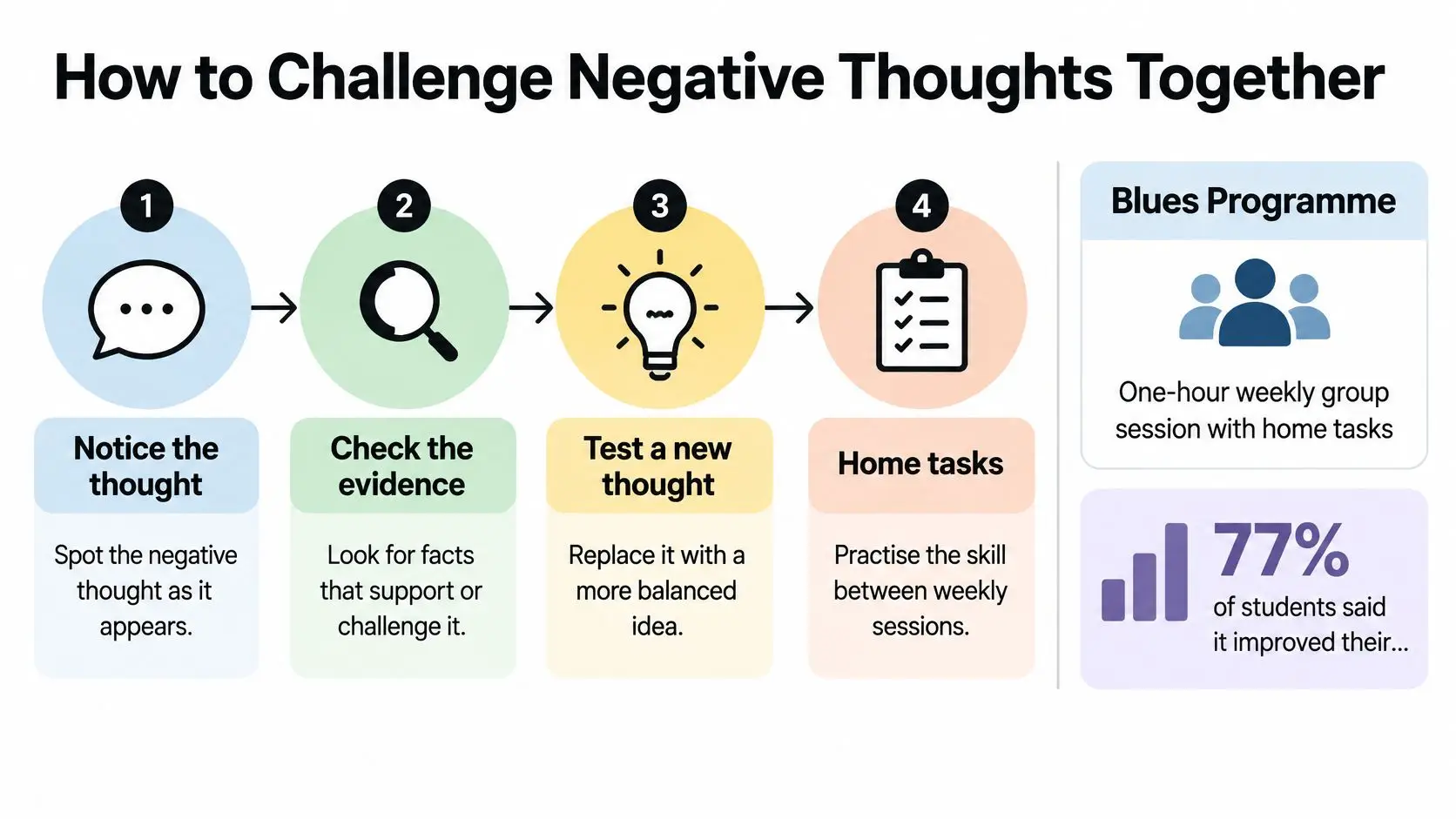
Try the steps below with a real situation. If you want another practical explanation to use alongside them, this guide to five steps to challenge negative self-talk offers a related way to examine an inner critic.
Name the situation and thought. A Year 9 student is thinking about answering a question in class and tells their parent, “Everyone will laugh if I get it wrong.” Write down the exact thought rather than replacing it with a more comfortable version.
Rate the feeling. Ask how strong the worry feels from 0 to 10. This gives the teenager a way to describe what's happening without having to explain everything at once.
Separate facts from predictions. What has happened when they've answered before? What are they guessing might happen next? Don't argue with the prediction; help them distinguish it from something they know.
Write a balanced alternative. Try, “I might make a mistake, but mistakes happen and I can ask for help.” The aim isn't to make the teen feel cheerful. It's to create a thought that makes room for more than one possible outcome.
Choose one small experiment. The student could prepare one sentence to contribute in the next lesson. Let them decide whether that feels doable, and agree on a smaller step if it doesn't.
Review what happened. Afterwards, ask what they noticed and rate the feeling again. A difficult attempt still provides useful information about what support might help next time.
Two common mistakes are telling a teenager to “just be confident” and rushing straight to the experiment before acknowledging their fear. If group work feels unsafe, start privately with a trusted adult and adapt the steps to the young person's communication needs. The teen can keep a notebook page with the situation, thought, feeling rating, facts, balanced alternative, chosen experiment and what they learned.
Scripts for the Conversations That Shape Confidence
When a teenager is upset, an adult's first words can either make space for a conversation or make the teen feel they need to defend themselves. These scripts are starting points, not lines to deliver perfectly. Use language that sounds natural in your family or classroom.
Before a difficult day: “What's one thing you're dreading, and one thing you're looking forward to?” Let your teen choose which to discuss first; giving them that choice can make a difficult conversation feel less like an interrogation.
After a setback: “That sounds frustrating. What part felt hardest?” Hold back from fixing the problem until they've finished. Listening first helps you understand whether they want advice, reassurance or someone to hear them.
After an online comparison: “You don't have to decide that's true right now.” Offer to look at what they saw together later, rather than debating their appearance or telling them to stop caring.
When they refuse to talk: “I'm not going to push. I'll be here at seven if you want to talk, or we can take a walk.” This respects their boundary while making clear that support remains available.
A weekly check-in can help you notice what's changing without turning every evening into a serious conversation. Ask: “What felt difficult?”, “What helped, even a little?” and “What would make tomorrow easier?” Your teen can talk, write their answers or give a rating from 1 to 10.
Praise honest communication and attempts to cope, not forced positivity. If your teen shrugs, you could say, “You don't have to know yet. We can leave it there for now.” A shrug may mean they're not ready, not that your care doesn't matter.
“You don't have to solve this alone. We can work out the next step together.”
Handling Appearance Comparison and Social Media
Your teen scrolls through polished photos at lunch and walks into afternoon lessons feeling smaller. That sinking feeling is familiar to many families. Appearance worries are a common drain on teenagers confidence, and they often grow stronger after time spent comparing.
Social media sits in the middle of this. It can offer group chats, humour and real support from friends. It can also leave a young person feeling worse about how they look or less able to focus on school, hobbies and sleep.
Start with safety and belonging before you talk about bravery online. Ask, “How did you feel after ten minutes of scrolling?” Invite a rating from 1 to 10, then look together at what helped and what stung. Keep the chat that offers encouragement. Suggest muting an account that triggers comparison for a week, rather than quitting everything at once.
A Year 9 pupil might notice she rechecks photos straight after lunch and then dreads the next lesson. Moving that check until after school gives her a buffer, and it makes the link between habit and mood easier to spot.
According to the 2025 Young Persons Behaviour and Attitudes Survey finding that 97% of 11-to-16-year-olds used at least one social media site, with heavy daily use reported by 65% of girls and 54% of boys, use is near universal. The useful question is which habits leave your child depleted.
If acne or scarring is part of the worry, keep the tone calm and separate online claims from steady information. This guide to understanding scars left by breakouts can support that talk. If your teen feels worthless or unsafe online, pause the feed changes and bring in adult support promptly.
Adapting School and SEN/SEMH Support for Confidence
Confidence advice can't replace an adjustment that makes school accessible. A teen who freezes when a teacher asks an open question may need more processing time or written prompts, not encouragement to answer faster.
| Need | Common school barrier | Adjustment to try |
|---|---|---|
| Anxiety or school phobia | Avoids lessons, arrives late or asks to leave | Agree a gradual return plan, safe exit route and one trusted adult |
| SEND communication needs | Struggles with open questions and spoken instructions | Provide written or visual instructions and extra processing time |
| Sensory needs | Feels overwhelmed by noise, crowds or bright rooms | Offer a quieter space for presentations and sensory-friendly peer groups |
| Executive function difficulties | Misses deadlines, loses work or isn't sure what to do | Use checklists, shorter tasks and a weekly mentor check-in |
| Low belonging | Stays silent in class, eats alone or avoids group work | Identify a named adult and offer small, structured group work |
Belonging can help pupils feel able to ask teachers for help when they're stuck, while pupils who feel intimidated may stay silent. In its case-study research across 16 mainstream primary and secondary schools, the Department for Education describes pupil-voice approaches such as councils, form representatives, suggestion boxes, QR-code feedback, worry boxes and class charters. When pupils could see a change after giving feedback, they described stronger belonging and confidence that carried into classroom work, according to the Department for Education's school belonging case studies.
Choose one barrier and one adjustment to raise with the school. For instance, a student who struggles to follow spoken instructions could ask for the task in writing. Their parent or teacher should report back on what happened, including an honest explanation if the request can't be met. Being listened to means giving the young person a clear response, not only collecting their opinion.
For a teen who needs a structured record of what support has been agreed, a SEND support plan can help families and school staff keep the plan clear. Online and flexible learners may also benefit from smaller classes, breakout rooms and sensory-friendly peer groups, where taking part doesn't require speaking in front of a large class. At Queen's Online School, each student with special educational needs is paired with a dedicated mentor who meets regularly, and small-group breakout sessions focus on areas including executive function, literacy support and sensory-friendly peer groups.

Ask the school who the named adult is and how you and your teen will know whether the adjustment is working.
Track Progress and Know When to Get Help
Grades alone can't show whether a teenager feels more able to ask for help, join in or connect with others. Record a simple starting point in the first week, then repeat the same measures at six weeks and at the end of term. Keep the check-in brief enough that you can repeat it consistently.
| Indicator | How to record it | Sign of progress |
|---|---|---|
| Help-seeking | Count requests for help at school or home each week | More requests, even small ones |
| Classroom participation | Ask the teacher for a short note, or let the teen rate one contribution per lesson | Contributions rise across the six weeks |
| Attendance | Keep a weekly log of attended and missed sessions | Fewer missed sessions and less lateness |
| Emotional difficulties | Ask the teen to rate worry or low mood from 1 to 10 each Friday | Ratings stay stable or fall |
| Connection | Ask the teen to name peers they spoke to or sat with | They can name at least one reliable friendship |
Don't treat one good day as proof that the problem has gone away. A harder week can sit within a longer improving pattern; look at the overall direction and ask your teenager what feels different. A school can add assessment information, mentor check-ins and the student's own reflections alongside wellbeing measures, rather than judging progress by grades alone.
The Education for Wellbeing programme covered 32,655 pupils in 513 English schools and tested several school-based approaches. The government's report on school mental-health awareness interventions also notes that the AWARE trial found no statistically significant short-term reduction in emotional difficulties from Youth Aware of Mental Health. That's a reminder to define success carefully, monitor how support is delivered and keep referral routes clear.
Bring in more help if your teen says they feel worthless, hopeless or unsafe, or if low mood persists for weeks despite the plan. Contact a GP, the school safeguarding lead or a qualified mental-health professional. Keep your teenager informed about who you're contacting and what you'll share, so they don't have to tell their story over and over.
Choose Your First Step This Week
You don't need to solve every confidence concern at once. Choose one barrier from the diagnostic table, one week-one task from the six-week plan and one question from the conversation scripts. A useful first aim is for your teen to describe what feels hard, not to promise that it no longer bothers them.
- Name the barrier in your teenager's own words.
- Agree on the week-one task together.
- Book the first check-in and use the three questions: What felt difficult? What helped, even a little? What would make tomorrow easier?
- Decide who will notice changes at home and at school.
By week six, a helpful outcome might be that your teen can name a barrier, describe one moment when they felt capable and say what would make the next challenge easier. If school-based support is limited, an online school may be one option to explore alongside local services. Queen's Online School includes regular wellness workshops on topics such as managing transitions, building confidence and reflecting on how a student learns best.
The aim is a teenager who feels capable and heard, not one who has been pushed into being louder.
At Queen's Online School, students have access to a wellbeing mentor, while regular wellness workshops give them space to build confidence and reflect on what helps them learn. If a flexible learning environment might suit your teenager's needs, visit Queens Online School to explore the school's offer.