


An online school place can often start mid-year, but only once the place is confirmed and withdrawal from the current school is handled in the right order. You don't necessarily have to wait until September.
Perhaps your child is upstairs, dreading another school morning, while you're searching for a way forward. Or a house move has suddenly made their current placement impossible. You need something more reassuring than an application button: you need to know when teaching will begin, who will support your child and how to avoid leaving them without a suitable education.
Starting anytime should mean a coordinated transition, not just a quick admission. The right start date brings together your child's wellbeing, their learning needs and the practical responsibilities that adults must arrange around them.
Can You Start Online School Anytime?
Many online schools accept applications outside the usual September intake. Whether your child can begin teaching straight away rests on available places, their learning stage and the route they're taking out of their current arrangement.
Start situations and what decides each one
| Situation | Can they start? | What decides it | First check |
|---|---|---|---|
| Rolling-intake online school with a free place | Usually yes | Provider's rolling admissions and available places | Confirm the next intake or start date in writing |
| Child moving from a state school | Yes, once withdrawal is notified and the applicable requirements are met | Written notice to the headteacher and no gap in full-time education | Plan the new start to follow withdrawal directly |
| Deferred entry after age five | Yes, before the compulsory school age deadline | The applicable deadline following the child's birthday | Find the deadline that applies to the child |
| Child with an EHCP at a special school | Only with local-authority consent | EHCP and any School Attendance Order | Ask the local authority before any withdrawal |
| GCSE or A-level student mid-course | Yes, to study; exams need a registered centre | Centre acceptance and exam-board entry deadlines | Find an exam centre and entry deadline before starting |
| Family moving from abroad | Usually yes | Admissions evidence and previous school records | Request transfer records as early as possible |
For younger children in England, the government's school-starting-age guidance allows a part-year start or deferral to the following September, provided full-time education begins by compulsory school age: 31 December, 31 March or 31 August following the fifth birthday, whichever comes first. Deferral doesn't remove the normal application process for a state-funded place, and it isn't permission to postpone suitable education indefinitely.
Rolling admissions still needs a boarding point
Think of rolling admissions like a bus service that runs throughout the year. The service keeps operating, but seats can fill and the timetable determines when you can board. Anytime to apply isn't necessarily anytime to be taught.
At Queen's Online School, we run rolling admissions, so students can join at various points through the year rather than only at fixed intake dates. A family should still obtain a confirmed teaching start, rather than treating an enquiry or submitted application as an allocated place.
Take these hypothetical situations. Amara, aged thirteen, became anxious after a bullying incident in October, and her family hopes she can start online in January. Her parents need to establish whether she's transferring between registered schools or leaving school for elective home education. That distinction matters more than the month on the calendar.
For a child leaving a mainstream state school, the family must coordinate the withdrawal with the next arrangement. For a child at a special school under an education, health and care plan, the family needs to involve the local authority before treating the move as agreed. A teenager changing during GCSE or A-level study needs an exam pathway as well as somewhere to learn.
An international move raises a different problem. A child may have studied topics in another order, even when both schools describe their teaching as British curriculum. Previous reports and examples of recent work help teachers place that child sensibly instead of assuming their year-group label tells the whole story.
What a real start looks like
Suppose a Leeds family must move in March with their ten-year-old. An account login won't, by itself, reassure a child who's losing familiar teachers and friends. A meaningful start means a baseline assessment, a timetable slot, an appropriate live class group and access to the recordings needed for catch-up.
Ask what your child will do on their opening morning. Will someone explain how to join the lesson? Does the teacher know which topics they've already studied? Who should they contact if they feel lost?
A confirmed place should give your child a clear next step, not leave the family guessing what happens after payment or application.
Before giving notice, make these checks today:
- The date: Get the next available teaching start in writing.
- The legal route: Establish whether this is school enrolment or elective home education.
- The records: Confirm what the receiving provider needs to organise placement and support.
Legal Duties Before You Withdraw
Getting the order wrong can leave a frightened child with no clear educational arrangement while the adults sort out paperwork. Don't stop attendance because an online application is underway.
In England, distinguish formal admission to a registered school from elective home education, where parents arrange education themselves, potentially using an online provider. Parents taking the latter route carry the duty under section 7 of the Education Act 1996 to secure suitable full-time education for their child's age, ability, aptitude and special educational needs, as explained in Peterborough City Council's elective home education policy, which also addresses written withdrawal and the risk of non-attendance action under section 444.
Establish who holds responsibility
For a mainstream-school withdrawal into home education, notify the headteacher in writing. Where a child attends a special school under an EHCP, local-authority consent is generally required; any School Attendance Order must also be addressed.
Company registration isn't the same as school registration. Queens Online School is a trading name of Cambridge Online Education Limited, a company registered in England and Wales under company number 06594953. Separately establish who will hold your child's admission record and how their education and attendance will be recorded.
Our guide to UK home-schooling laws can help you prepare those questions.
Close the transition gap
Suppose Tom, aged fourteen, is leaving a school in Kent. His parents agree the new place and teaching arrangements first, send written notice with the intended withdrawal date, then receive the formal start letter confirming the following Monday. They retain the correspondence and arrange suitable learning through the handover.
The letter documents the plan; it doesn't replace any consent that's legally needed.
For an England transition, check:
- Written withdrawal date: Keep a copy and obtain confirmation of the administrative position.
- Continuity of education: Know what suitable teaching will happen throughout the transition.
- Transfer of records: Arrange learning, attendance, safeguarding and support information.
- Local-authority notification: Clarify who will notify the authority if the child risks missing education, consistent with children missing education statutory guidance.
Wales, Scotland and Northern Ireland each set their own rules for home education, attendance and school registration. Families there must check their own government and local-authority guidance before withdrawing, including whether a provider is registered in that nation, how attendance is recorded and which authority must be notified.
How to Enrol Mid-Year, Step by Step
A child who's been unhappy at school may hear “new school” and worry about failing again. Begin with what they want to feel different: quieter lessons, a trusted adult or knowing what tomorrow looks like.
Use this process overview to keep the move manageable.
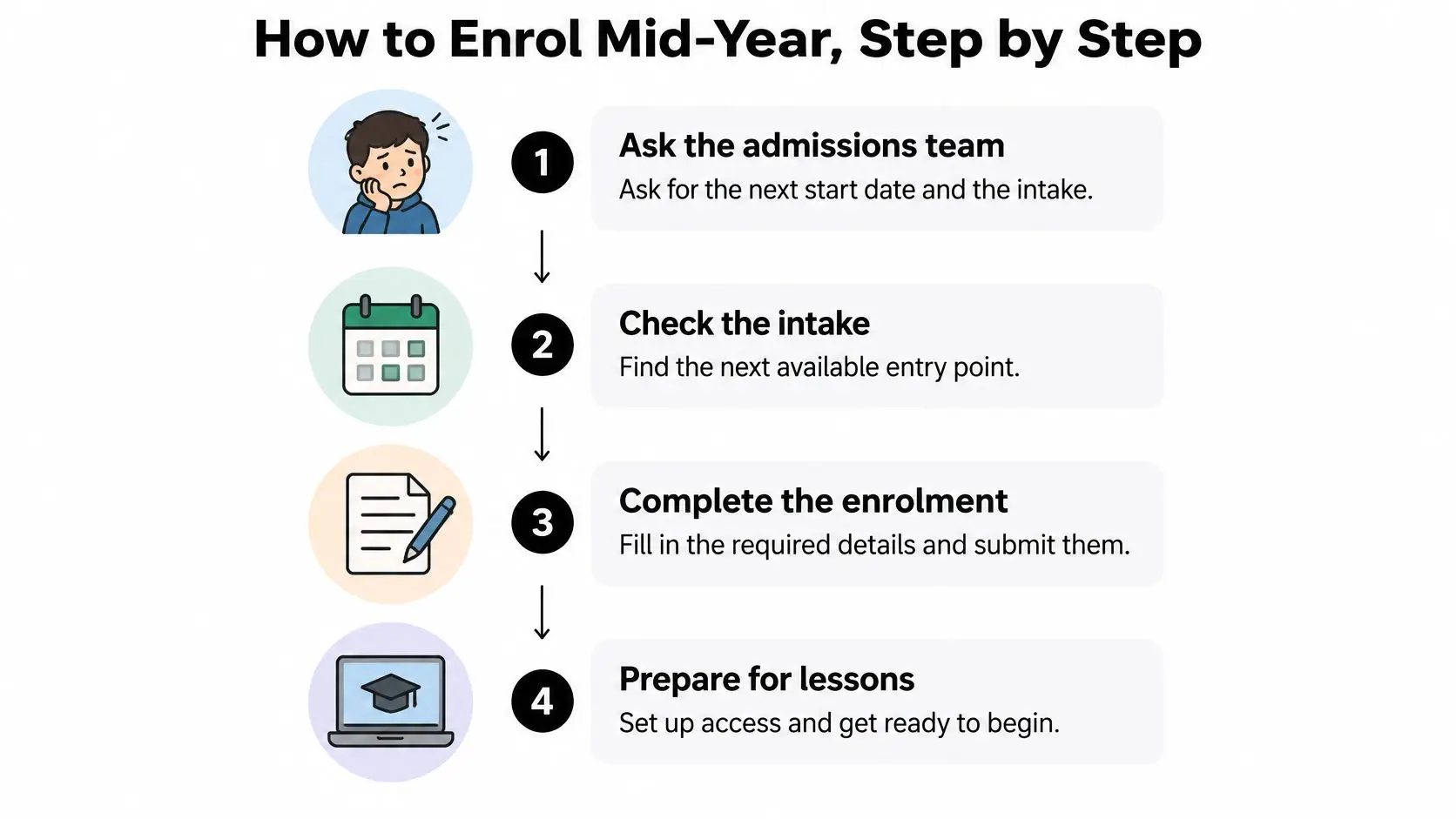
Arrange the place and prepare the information
Get the next start date in writing. Ask our admissions team for the available entry point and intake arrangements. Don't promise your child a particular morning until their place is confirmed.
Request a baseline assessment. Establish how teachers will check learning against the English National Curriculum or relevant GCSE specification. Its purpose is to find the right starting point, not make your child prove they deserve help.
Prepare a document pack. Gather a birth certificate or passport, proof of address, recent school reports and the attendance record. Include any EHCP, SEN support plan, or relevant medical or counselling letters, and confirm which documents are required and how to share them securely.
Confirm the legal route before sending notice. Establish whether the arrangement is school enrolment or elective home education, then coordinate withdrawal where applicable. Don't assume acceptance of an application automatically changes the current school's register.
Make the first lessons predictable
Complete the application and safeguarding forms. Our online school registration information provides a starting point for the application. We don't require a formal entrance exam; that's distinct from assessing a learner's current knowledge to plan suitable teaching.
Test access before the first live class. Check the learning system, microphone, timetable and lesson links together. We may provide access to learning systems, resources, recordings and lessons immediately upon enrolment, but confirm the live teaching arrangements separately.
Agree a settling-in plan. For example, plan the first fortnight around a trial lesson, a named contact and manageable tasks, with a review around the fourth week. Ask your child what would help them join the opening lesson without feeling exposed.
The video below offers another way to approach the enrolment conversation.
Practical rule: Don't let an enthusiastic start outrun the confirmed withdrawal and education arrangements.
A common transition slip is assuming that beginning online lessons completes the administrative move. The greater risk is withdrawing before the next arrangement is ready, leaving an avoidable gap. A good opening week feels simpler: your child knows their timetable, can log in and has someone to ask when they're stuck.
How Live and Recorded Lessons Handle a Mid-Year Start
A child joining an established class may understand the current topic but lack something taught earlier. Another may already know much of the material and need challenge rather than repetition. Assessment should identify the difference before catch-up work is assigned.
The Education Endowment Foundation's digital technology evidence review connects effective technology use with better practice, precise feedback and teacher assessment, rather than treating technology as a substitute for teaching. For a mid-year joiner, a folder of recordings isn't enough without someone checking what they understand.
Match the format to the child
Some children regain confidence through a predictable live routine. Others need the option to pause, replay or work around fluctuating health. Compare the format with your child's needs, not just the convenience of the timetable.
Lesson formats and how they handle a mid-year start
| Lesson format | Mid-year catch-up | Best fit | Watch for |
|---|---|---|---|
| Live small-group classes | Baseline assessment, then teacher-led catch-up | Children who need interaction and a fixed routine | Timetable fit with family life |
| Recorded lessons only | Replay at own pace, available 24/7 where offered | Children with anxiety about live lessons or changeable health | Isolation and missed feedback from teachers |
| Blended live and recorded | Live core lessons plus recordings for missed sessions | Students with rehearsals, competitions or travel | Clear review points and an accurate attendance record |
Our online school lessons combine a structured approach with resources learners can revisit. Students can access our lesson recordings 24/7, and if they miss a lesson, they can use its resources and recording to catch up.
Access doesn't demonstrate understanding, though. Ask who will look at completed work and what happens when a child remains confused.
Turn missed knowledge into a manageable plan
Consider Priya, aged eleven, joining in February after a move from Dubai. In this hypothetical plan, her baseline assessment reveals uncertainty with fractions, which makes her current mathematics lessons harder to follow.
Her teacher might assign three weeks of short recorded modules alongside a weekly live session, then review her understanding at weeks four and eight. The modules target a specific prerequisite instead of asking her to replay every lesson she missed.
A useful catch-up plan names:
- The knowledge gap: The exact skill or concept needing attention.
- The activity: A selected recording, practice task or teacher explanation.
- The evidence of progress: Work the teacher will check and a scheduled review.
Priya should also know which work takes priority, so she isn't trying to complete an entire previous term alongside current lessons. Flexibility helps when a teacher checks progress and adjusts the workload, not when the child is left to manage an expanding list alone.
Starting Well With SEN, SEMH and Exam Pressure
A child who has cried before school may greet online learning with relief and suspicion at the same time. They want a fresh start, but they may worry that another teacher won't understand why lessons feel difficult. Make space for that uncertainty rather than promising that a different screen will solve everything.
England's official 2025–26 special educational needs statistics report 1,319,780 pupils receiving SEN support without an EHC plan, representing 14.8% of pupils, and show that 19.4% of primary pupils and 17.6% of secondary pupils have an EHC plan or receive SEN support. Those figures don't prove online learning is better; they underline why a generic promise of flexibility isn't enough.
Describe what helps this particular child
Share the existing support plan before teaching begins. Explain communication preferences, sensory sensitivities, literacy difficulties, attention needs and emotional triggers in practical language.
For example, a child with dyslexia may need accessible digital materials and extra processing time, rather than instructions delivered only through dense text. A child with social, emotional and mental health needs may need a named adult, predictable routines and a discreet way to request a break.
Ask your child to help identify workable adjustments:
- Try the environment: Use a short trial lesson to notice what feels comfortable or overwhelming.
- Discuss participation: Explore camera expectations, chat functions and ways to ask questions.
- Reduce uncertainty: Agree how recorded access and breaks could support learning.
- Name the coordinator: Establish who will communicate adjustments to teachers and review whether they're working.
The useful question isn't whether your child can cope with online school in general. It's whether the proposed teaching and support fit this child.
Keep examination access separate from teaching access
A teenager can be ready to study while their examination arrangements remain unresolved. Under government guidance for exams and assessments, private candidates must register with an examination centre, centres decide whether to accept them, and access arrangements should be discussed as early as possible.
Suppose a student with ADHD needs extra time. Their family should contact the proposed centre early, explain the need and establish what evidence and assessment arrangements the centre requires. Don't assume a previous adjustment transfers automatically.
Confirm the exam board, specification, entry deadline, coursework supervision and any practical or non-exam assessment requirements. A written exam pathway helps a teenager understand both how they'll learn and where they'll demonstrate that learning.
Decide Whether a Mid-Year Start Suits Your Child
A mid-year start can be the right decision even when it needs careful handling. After bullying, illness or relocation, joining at another point in the year may protect continuity, while learning from home removes the daily journey to a physical school.
Queen's Online School enables families to access British schooling online without living close to a school building. For some children, that creates steadiness during a difficult period. For others, home learning works only when friendship, movement and time away from the screen are planned deliberately.
Treat the possible benefits as discussion points with your child, then test them against the week you could run.
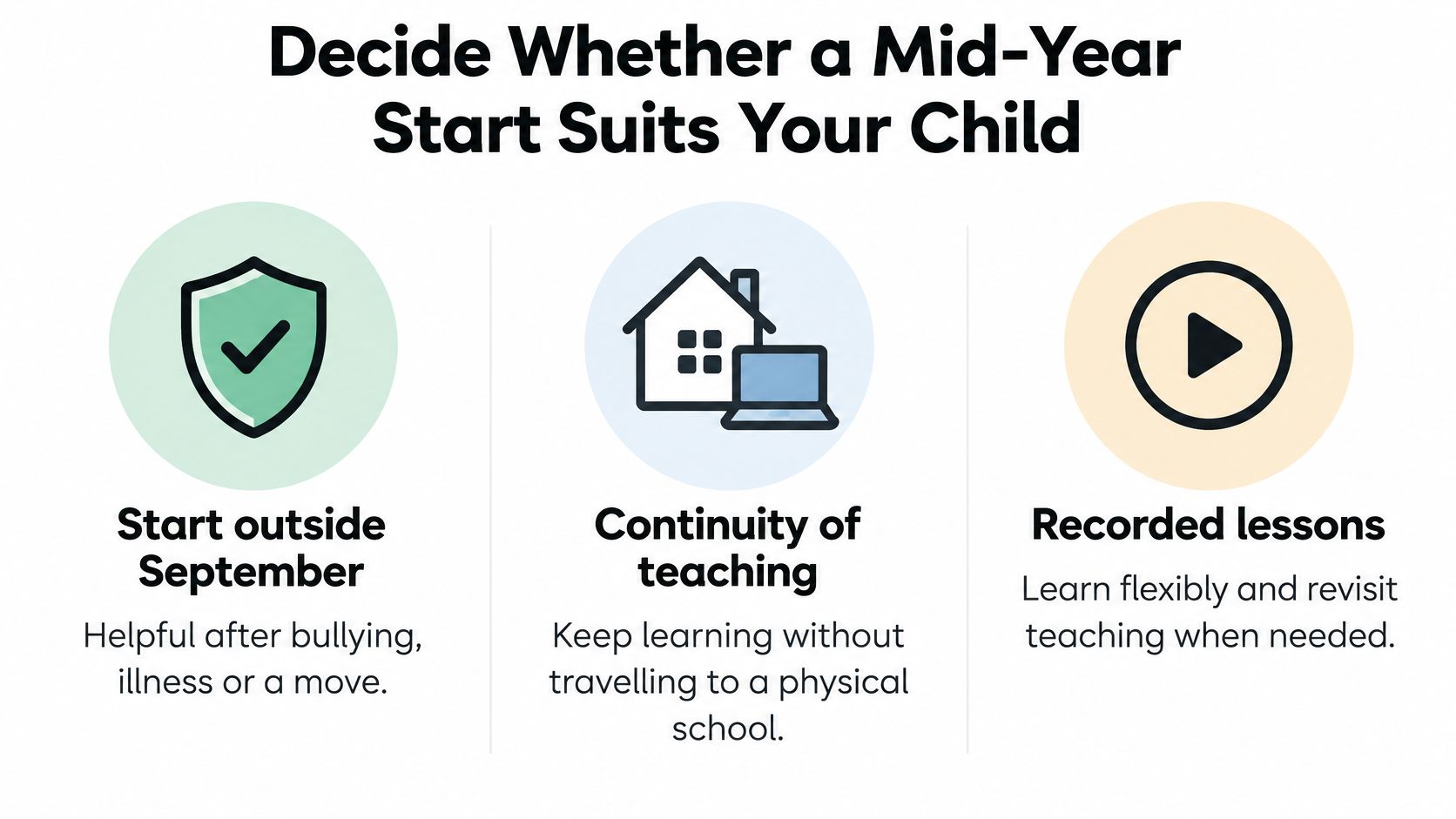
Balance relief with the everyday reality
Recorded teaching can give an anxious child room to revisit an explanation without asking in front of classmates. Live contact still matters, because isolation can build when the whole school day happens at home. A flexible timetable also needs a dependable daily routine, with clear start times, breaks and a place where work is expected to happen.
Under elective home education, the family retains responsibility for suitable education. Think about who will be at home, who will notice unfinished work, and how you would spot growing distress before it becomes refusal. Queen's Online School operates entirely online, so staff are not physically present with the student.
Invite an older learner to explain what they want from the move. Their answers can shape a workable routine, such as regular teacher contact with fewer unpredictable social demands. Quiet compliance can look like coping, so ask directly what feels easier and what still feels hard.
Treat attendance difficulties as a request for support
The government's pupil absence statistics for England classify missing 10% or more of possible sessions as persistent absence and 50% or more as severe absence.
Attendance thresholds and what they signal
| Threshold | Classification | What it signals |
|---|---|---|
| 10% or more of possible sessions missed | Persistently absent | Ask for an attendance review and help early |
| 50% or more of possible sessions missed | Severely absent | Full review of support, timetable and wellbeing |
These school-attendance markers are not universal measures of participation in every home-education arrangement. Obtain the applicable attendance policy in writing and clarify how sickness, adjusted timetables and missed live classes are recorded.
If a child repeatedly misses live sessions because they trigger anxiety, request an attendance review straight away. Explore sensory overload, bullying fears or fatigue, then agree adjustments before absence hardens into a pattern.
Before committing, confirm the intake date, legal route, transferred records, baseline assessment, support plan and written attendance policy. Email the admissions team with anything unresolved, arrange a trial lesson and set an early review so your child knows adults will check how the move feels.
Queens Online School offers rolling admissions with live teaching and recorded lessons, helping families plan a start outside the traditional September intake. Visit Queens Online School to discuss your child's circumstances, confirm the next available start and arrange the practical steps before withdrawing from their current school.