


The laptop is open, the homework is waiting, and your child is doing anything except starting. You've reminded them gently, then less gently. Now they look upset, you feel frustrated, and an ordinary study session has become a disagreement about effort.
If you're wondering how to be self disciplined as a student, or how to help your child learn it, start with what makes the task difficult. They may feel anxious, confused, tired or reluctant to leave something enjoyable. Self-discipline is a supported skill, not a verdict on their character: children learn to start, plan and manage feelings through routines they can use.
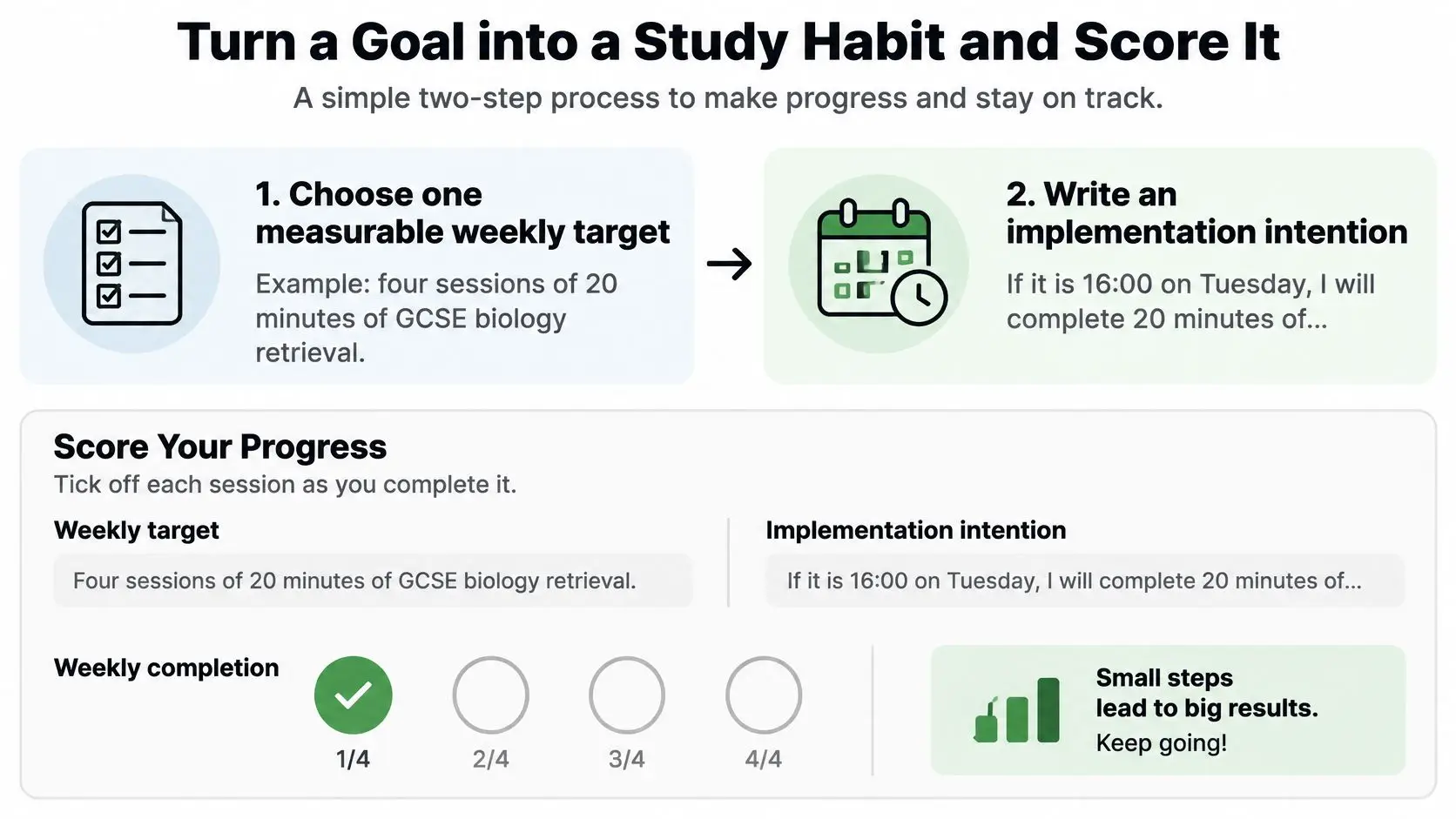
Turn a Goal into a Study Habit and Score It
Make the first action clear
A study target becomes easier to follow when your child knows what to do, when to begin and how to tell when the task is complete. For example, set four weekly sessions of 20 minutes of GCSE biology retrieval practice. Completion means answering from memory, checking the answers and marking what needs another attempt, rather than sitting beside an open textbook.
Attach the task to a cue. An implementation intention links a situation with an action. The University of Stirling goal-setting document gives this example: “If it is 16:00 on Tuesday, I will complete 20 minutes of GCSE biology retrieval practice at my desk.” Write the cue somewhere your child can see it.
Name the feeling and likely obstacle. A minute spent identifying the wanted result, what might get in the way and what to do next can make the plan more manageable. If your child feels lost, have the correct page ready. If messages are worrying them, agree where the phone will go.
Plan, work, then review. Try a 25-minute cycle: state one objective, predict the difficult part, work without switching tasks, note distractions and compare the result with the plan. If starting feels impossible, agree on a five-minute opening task. It gives your child a manageable way in without assuming they will continue for longer.
Use scores to adjust support
A session score should help you decide what support to offer, not judge your child's character. The Session dashboard scored from 0 to 2 uses 0 for not yet manageable, 1 for partly manageable and 2 for secure. When a score falls below 2, change one thing at a time.
| Dimension | Score 2 means | Action if below 2 |
|---|---|---|
| Task clarity | Next step is written on the card | Break the task into a worked example |
| Focus held | Block finished with few drifts | Plan a break or try a 10-minute block |
| Next-step confidence | Child can name the next action | Adult checks in during the first two minutes |
Priya, a Year 11 pupil, understands her maths homework but feels dread before beginning. Her parent names the worry, sits beside her for the first two minutes and leaves once she is underway. The support addresses the difficult starting point without requiring an adult to watch every answer.
The Education Endowment Foundation's synthesis of metacognition and self-regulation approaches draws on 355 studies and reports an average impact equivalent to seven months of additional progress over a year. The EEF cautions that these approaches need modelling, feedback and guided practice. The metacognitive strategies guide can help children explain what worked, rather than only report whether they finished.
On Sunday, compare planned sessions with sessions started and completed. Treat completion as the main measure, and note what support helped make it possible. For example, your household might treat 90% of planned sessions as holding steady and use two missed blocks in a fortnight as a cue to change the prompt or make the task smaller. These are family planning choices, not school attendance thresholds.
A Week of Study Blocks and Tomorrow's First Card
A home learner can feel unsettled by an afternoon with no obvious beginning. The kitchen has no bell, and a parent's reminder can sound like an interruption rather than a predictable cue. A visible timetable removes some of that uncertainty.
Start with existing lessons, meals and rest, then add short independent blocks. The sample below is a worked example, not a minimum workload: a younger child, an exhausted teenager or a learner managing additional needs may need less.
A timetable you can put on the fridge
Sample week of short study blocks for an online learner
| Day | Block | Task | If it slips |
|---|---|---|---|
| Monday | 16:00-16:25 | English retrieval with notes already open | Write the first sentence for five minutes |
| Tuesday | 16:00-16:20 | GCSE biology retrieval at the desk | Phone in another room, timer already running |
| Wednesday | Live lesson plus 10 minutes | Three things remembered after class | Join the first ten minutes, or use the recording after a genuine miss |
| Thursday | 16:00-16:25 | One maths worked example, then one question | Adult checks only the first line |
| Friday | 15 minutes | Write next week's if-then cards | Stop; no catch-up marathon |
| Weekend | One 25-minute block | Weakest subject only | Rest the rest of the day |
On Monday, keep the English notes open for checking after your child has tried recalling the material. On Tuesday, make biology resources easy to find before the scheduled start. Preparation belongs outside the block wherever possible, so a difficult login doesn't consume the child's available attention.
Treat Wednesday's live lesson as protected attendance, with support agreed beforehand if joining feels daunting. Starting with part of a lesson can be a supported re-entry step, not a routine substitute for attending it. Use a recording after a genuine miss through illness or anxiety, and agree with the teacher how the learner will reconnect.
Practical rule: A missed independent block needs a manageable restart, not a doubled evening.
A fixed live timetable, such as the small-group lessons at Queens Online School, is one option alongside school timetables, tutor appointments and family calendar reminders. It supplies an external start time when a child finds it difficult to create one independently.
Prepare tomorrow without filling tonight
Parents balancing work and home learning may find SyncThemCalendars' guide to protect focus time across client calendars useful for keeping their own commitments from overlapping with agreed support time. The relevant habit is reserving the appointment before other demands fill it, not treating your child like a work project.
For the learner's schedule, time management for students can help translate assignments into visible commitments. Keep the child's calendar simpler than yours, with room to recover between demands.
Tonight, copy one suitable row onto a card and add tomorrow's if-then line. Agree who will ask how the block felt, rather than whether it was perfect. Then put the card where the child will begin.
Handling Distractions and Motivation Dips
Restlessness and reluctance are predictable, especially when work feels difficult or unrewarding. Prepare a response while everyone is calm, rather than negotiating after your child has already wandered away.
Before starting, put the phone in another room, close unused tabs and set a visible timer. If a notification or unrelated thought interrupts, your child can jot it on a distraction note, point to the next written action and return. Review recurring distractions at the Sunday check rather than answering every interruption immediately.
Use a short dip routine
Shrink the task to a five-minute starter. If the whole essay feels unbearable, the starter might be opening the document and writing a rough opening sentence. Make the reduced commitment explicit so your child trusts the stopping point.
If that doesn't work, take a planned five-minute movement break. Stretch, walk to get water or step outside together, then return to the prepared resource. Avoid a screen break if stopping it will create another difficult transition.
Reduce the load if the dip persists. For example, after two difficult days, remove one independent session from that week rather than adding hours later. Check whether the child needs teaching, recovery or help with worry before restoring it.
A dip gives you information about the task and the child's capacity. It doesn't prove laziness, and it doesn't mean the timetable must be abandoned.
Keep the expectation kind and clear
For an anxious learner, begin by noticing their raised shoulders or worried expression and acknowledging that the task feels daunting. Then offer the shortened block as the next manageable step. If distress escalates, pause and help them settle rather than insisting that visible suffering counts as persistence.
For ADHD-related impulsivity, use the visible card, prepared resource and timer as external reminders. Voice Control Pro's practical strategies for ADHD procrastination offer further ideas to consider, selecting only those appropriate to your child's age and needs.
The guidance on how to concentrate when studying can also help you identify changes to the workspace. Choose a change together and test it without turning the room into a collection of competing reminders.
Don't extend the block to repay lost time. Let the next scheduled slot be a fresh start.
Match the Skill Gap Before You Push Harder
Which part is difficult: starting, planning, switching, managing emotion or staying with the task? That question is more useful than asking why your child won't try harder. The same unfinished worksheet can reflect very different needs.
A UK cohort study available through Oxford's research archive, involving 8,072 pupils aged 11–15 across 84 secondary schools, found that stronger executive function was associated over time with better wellbeing and fewer social-emotional-behavioural difficulties, identifying emotional control and planning as potential intervention targets. An association doesn't diagnose an individual child, but it supports looking beyond effort alone.
Notice the feeling before choosing support
Say a child closes a game and immediately pushes the maths book away, fists tight. They may be angry about stopping, worried about maths or overwhelmed by the transition. Begin with what you can observe, acknowledge the disappointment and keep a calm boundary around safe behaviour.
Offer a coping choice that suits the child: squeezing a cushion, moving briefly or sitting somewhere quiet. Once they're settled, identify the next action. Co-regulation means helping them regain enough calm to act, not removing every expectation or demanding instant composure.
Which skill is failing and what to try first
| Skill gap | What you notice | Try first | Seek more help when |
|---|---|---|---|
| Starting | Stares at a blank page or delays logging on | Five-minute action with the resource already open | The freeze happens most school days |
| Planning | Everything is left until the night before | One card with three tiny steps | They still cannot sequence after a model |
| Switching | Shutdown or anger when a game, screen or break ends | Countdown, then one named next step | Transitions trigger distress daily |
| Emotion | Tight fists, tears, or expressions of being unable to cope | Name the feeling, validate it, keep the boundary, offer one coping choice | Anxiety stops sleep or attendance |
| Attention | Starts, then drifts within a few minutes | 10-minute block, movement break, visible timer | Focus support is already part of an SEN plan |
Treat the table as a conversation
Ask your child which description feels closest, without presenting the answer as a label. Someone who delays logging on may be avoiding confusing instructions, a noisy lesson or a subject where they feel exposed. The visible behaviour alone won't tell you which.
For an autistic learner, a consistent desk and visual order of tasks may make the afternoon more predictable. Another child may need reduced sensory distraction or advance notice of a timetable change. Ask what helps rather than assuming every learner with the same diagnosis needs identical arrangements.
The useful question is not whether your child can tolerate more pressure, but what would make the next action accessible.
Bring in a teacher, pastoral lead or SEN contact when freezing, distress, sleep loss or attendance difficulties become frequent. Share observations, including what happened before the difficulty and which adjustments helped. Persistent changes in mood or functioning also warrant a conversation with an appropriate health professional.
Protect Sleep Before Adding Revision
Your teenager is exhausted but wants to add another hour because stopping feels frightening. Acknowledge that fear first: they're worried they haven't done enough. Then help them protect tomorrow's ability to think, rather than treating bedtime as something they must earn.
This is the moment to close the books, not judge their commitment.

In a 2025 Healthwatch survey of 9,717 children and young people, only 46% regularly achieved the recommended 8–10 hours of sleep, and those who did reported significantly higher wellbeing. Sleep isn't a reward for good discipline; it belongs in the conditions that make learning manageable.
Swap the late session for an earlier appointment
For a hypothetical GCSE revision plan, move difficult retrieval practice to the afternoon rather than after 21:30. If a particular paper is causing worry, schedule a focused 25-minute session for the next afternoon instead of attempting an hour at midnight.
Work backwards from the morning lesson to protect an age-appropriate sleep opportunity. Allow time to settle as well as time asleep, and don't treat the lower end of a sleep range as a target every child should manage on.
- Make worry concrete. On paper, write the fear and the next small action, then close the book.
- Reduce bedtime friction. Charge the phone outside the bedroom if that's workable, and prepare tomorrow's materials before winding down.
- Separate habit from distress. A predictable bedtime can help with routine; persistent anxiety needs a parent, tutor, pastoral or health conversation.
Use video content earlier in the evening if it forms part of your family's discussion, rather than adding more screen time after settling for bed.
End the day without another test
Younger children need the same principle in a simpler form: a predictable finish, a manageable reading goal and an adult who helps them stop. A tearful child doesn't need to complete another page to prove determination.
If worry repeatedly prevents sleep, don't keep tightening the timetable. Ask what feels unsafe, uncertain or unmanageable and arrange support. The useful outcome is a child ready to learn tomorrow, not an extra page tonight.
Accountability Without Shame
A named adult should notice difficulty before your child starts believing they're disappointing everyone. Accountability works best when children know who will help, what that person will ask and what happens after a missed commitment. It shouldn't depend on being caught.
Choose responsibilities that fit your family: a parent can support the start, a teacher can notice live-lesson participation, and a tutor or pastoral lead can help review the workload. Your child shouldn't have to explain the same difficulty repeatedly to adults who haven't spoken to one another.
Ask about experience as well as completion
Use a brief check-in built around these prompts:
- What did you start? Notice the action taken, including returning after an interruption.
- What felt heavy? Listen for confusion, embarrassment, worry or exhaustion before proposing a solution.
- What will we shrink? Agree a manageable adjustment and who will help put it in place.
For a child who freezes, the adult can provide a calm presence at the start, then withdraw once they're settled. For a child avoiding an oversized assignment, ask for the agreed opening action rather than demanding the whole piece immediately.
Keep this conversation private. Public tallies and rewards tied to a perfect week can make a missed session feel like losing everything, when the child most needs a route back.
Useful praise: Notice waiting, returning attention and finishing an agreed task, not just high marks or easy compliance.
Make the weekly review safe enough to be honest
For example, hold a ten-minute Sunday conversation comparing completed sessions with the previous week. Celebrate a specific improvement and agree one change. An extra completion matters, but don't require improvement every week before acknowledging effort or asking whether the workload is fair.
Tell the teacher when a live lesson is missed, including any barrier the child is comfortable sharing. Caring follow-up is easier when adults know whether the problem was illness, anxiety, access or misunderstanding.
If the same check-in fails for two weeks, treat that as a cue to involve a pastoral or SEN contact, not to increase pressure. Parents also need permission to pause when frustration rises. Calm support, clear limits and a workable next action teach more than another argument about willpower.
Queens Online School offers live, interactive British curriculum lessons, small classes and subject-specialist teaching, with support for learners including those with SEN and SEMH needs. Visit Queens Online School to explore how a regular lesson timetable and personalised learning support could help your child build study habits without relying on willpower alone.